Search This Blog

Saturday, February 11, 2023

NM ethics commission alleges elections official deleted, mishandled midterm ballots

 A New Mexico ethics commission accused a local elections official of deleting and mishandling midterm ballots, along with other misconduct, in a complaint filed on Tuesday.

According to the state ethics commission, Torrance County Clerk Yvonne Otero “dramatically failed” to comply with government conduct laws, using her elected office for “her own personal benefit and to pursue personal interests.” 

Otero allegedly deleted a significant number of unopened and unread emails in October 2022, including two ballots that were cast electronically via the Uniformed and Overseas Citizens Absentee Voters Act. 

The emails also included information from the New Mexico secretary of state about procedures and timelines for the then-upcoming 2022 midterm election.

Otero also reportedly presigned certifications for 22 ballot tabulators without any inspection because she was going to be on vacation in Las Vegas during the inspections.

She appeared to threaten an employee who questioned a timesheet prepared by her mother, who was working as a presiding judge for absentee ballots in late spring 2022, with Otero reminding the employee that she signed off on their timesheets.

Otero also allegedly solicited narcotic drugs from a subordinate employee and made several references to using drugs, held intimate engagements in her office during work hours, discharged a Taser beside the head of an employee as a “joke” and gave her brother a Torrance County laptop for personal use. 

https://thehill.com/homenews/state-watch/3853900-new-mexico-ethics-commission-alleges-elections-official-deleted-mishandled-midterm-ballots/

‘Mystery’ Alaska object entered US airspace without being detected

 The mysterious “object” shot down over Alaska managed to penetrate American airspace without being detected, a senior US official said Saturday — while President Biden’s administration continued its silence regarding the intruder’s appearance, capabilities, and even its ownership.

The unnamed official told Fox News the object was spotted by the US military while it was “over Alaska not far from the northern coast” on Thursday night, but had previously gone unnoticed.

“We have no further updates at this time,” a Department of Defense spokesperson told The Post when asked for more information about the car-sized object that breached US airspace and was shot down over frozen Alaskan waters on Friday.

The incident came nearly a week after the US military shot down a massive Chinese spy balloon that had made an embarrassing high-altitude journey over the entire North American continent, from Alaska to South Carolina, before it was finally shot down on Feb. 4.

On Friday, the second object — this one “the size of a small car” — was destroyed by the US military at an altitude of 40,000 feet, according to National Security Council spokesman John Kirby

Former acting Secretary of Defense Chris Miller

Former acting Secretary of Defense Chris Miller ridiculed the Biden administration’s confusion over repeated breaches of US airspace.
Getty Images

But officials have refused to describe the latest intruder, saying only that it was “not similar in size or shape” to the much larger spy balloon.

“We don’t know who owns it – whether it’s state-owned or corporate-owned or privately-owned, we just don’t know,” Kirby told reporters Friday.

The administration’s ignorance drew ridicule Saturday from former President Trump’s acting Secretary of Defense Chris Miller.

A picture of Chinese Foreign Ministry spokesperson Mao Ning.
Chinese Foreign Ministry spokesperson Mao Ning said the Chinese balloon was part of an extensive surveillance program.
AP
The remnants of the large balloon drift above the Atlantic Ocean, just off the coast of South Carolina.
AP

“We don’t know if it’s a Chinese balloon or just some kid,” an incredulous Miller told Fox News. “If you’re a writer for Saturday Night Live, you’ve got all the material you need for the next three weeks.”

“We have to send up a $100 million aircraft to shoot down a balloon with a $400,000 missile?” Miller asked. “The cost curve’s all off on that one … holy cow.”

Republicans have hammered Biden for his foot-dragging response to the Chinese spy balloon’s week-long journey — saying that his “vastly changed” response to Friday’s airspace intrusion was evidence that it had been mishandled.

Meanwhile, the Biden administration slapped sanctions on six Chinese companies to retaliate for the spy balloon’s intrusion late Friday.

The Commerce Department blacklisted five aerospace corporations and one research institute, accusing them of supporting Beijing’s “military modernization efforts, specifically those related to aerospace programs, including airships and balloons” used for “intelligence and reconnaissance.”

The move will block the targeted entities from buying American technical materials.

“The Commerce Department will not hesitate to continue to use … regulatory and enforcement tools to protect U.S. national security and sovereignty,” Deputy Secretary Don Graves tweeted.

https://nypost.com/2023/02/11/us-blacklists-chinese-companies-over-spy-balloon-program/

US shoots down ‘unidentified object’ that violated airspace over Canada

 Canadian prime minister Justin Trudeau said that a US fighter jet shot down an unidentified airborne object over Yukon Saturday.

“I ordered the take down of an unidentified object that violated Canadian airspace,” Trudeau tweeted. ”Canadian and U.S. aircraft were scrambled, and a U.S. F-22 successfully fired at the object.”

Previously, security sources had told Canada’s Global News Saturday that one or two new airborne objects that could be additional spy balloons were being monitored by NORAD, the joint US-Canada military response team that oversees the continent’s air defenses.

Canada closed its airspace over parts of Yukon Saturday afternoon due to an “active air defense operation.”

Recovery operations continued Saturday near Deadhorse, Alaska to retrieve the remnants of a still-unidentified object that penetrated American airspace before being shot down Friday, the US Northern Command said.

The search, which was being conducted on sea ice, was hampered by “arctic weather conditions, including wind chill, snow, and limited daylight,” the command said. “We have no further details at this time about the object, including its capabilities, purpose, or origin.”

The mysterious object managed to penetrate American airspace unobserved, Fox News reported.

https://nypost.com/2023/02/11/norad-monitoring-possible-spy-balloons-nearing-us-airspace/

Cocaine use disorder alters gene networks of neuroinflammation and neurotransmission

 Individuals with cocaine use disorder exhibit gene expression changes in two brain regions: the nucleus accumbens, a region associated with reward, and the caudate nucleus, a region mediating habit formation, according to research conducted at the Icahn School of Medicine at Mount Sinai and published February 10 in Science Advances.

These changes, which contribute to the persistent behavioral abnormalities seen in addiction to drugs, occur because  sets off a series of chemical reactions that lead to increases in the amount of messenger RNA being produced from some of the affected genes in these two brain regions, whereas the activity of other genes decreases.

Changes in the amount of messenger RNA produced—a process also known as "expression" of the underlying genes—lead to changes in the amount of proteins that are produced and that subsequently carry out  in the brain. The research team found a significant overlap between the RNAs expressed in these two , suggesting that these molecular changes may be key to the development and maintenance of  use disorder.

Cocaine use disorder is a chronic, relapsing brain disorder for which there are currently no FDA-approved medication treatments. While it is hypothesized that regulation of gene expression in the brain's reward and motivational centers plays a critical role in the persistent behavioral changes that define addiction, knowledge remains limited of the maladaptive gene activity that chronic cocaine use causes in these circuits in humans and that underlies cocaine use disorder.

To address the knowledge gap, the research team performed RNA sequencing in both the  and caudate nucleus from the postmortem brain tissue of persons with cocaine use disorder and matched controls. Using the largest and most diverse cohort examined to date, they found that neuroinflammatory processes are suppressed and that synaptic transmembrane transporters and ionotropic receptors—proteins that control how  communicate with one another in the brain—are enriched in the striatum of people with cocaine use disorder.

Cocaine increases the amount of the neurotransmitter dopamine at synapses, or junctions between two brain cells where electrical signals are converted into chemical signals. By doing so, the research team found, cocaine sets off a cascade of events that activate a chemical messenger in the brain called cyclic AMP, which then triggers changes in gene expression.

"In addition to the new insights into the molecular changes that cocaine use confers, we found that people with cocaine use disorder have dysregulated  associated with schizophrenia and , which indicates that these disorders may share some underlying gene regulatory and neural circuit systems," said Philipp Mews, Ph.D., Instructor of Neuroscience at Icahn Mount Sinai and first author of the paper together with Ashley M. Cunningham, a neuroscience Ph.D. student.

"Importantly, the transcriptional abnormalities—in particular, the neuroinflammatory responses that are suppressed in the nucleus accumbens of people with cocaine use disorder—are directionally opposite of the proinflammatory cascade responses conferred by opioid use disorder. The observation that there are distinct molecular changes conferred by each of the two  could be valuable for the development of targeted, effective treatments specific to cocaine use disorder."

Because it is difficult to directly study how drugs like cocaine affect the , researchers often use animal models to study their effects. However, a key question is whether what they learn from these animal models is similar to what happens in the brains of humans who use cocaine.

"Our research team looked at studies performed in mice that were given the opportunity to self-administer cocaine and compared the resulting  to those seen in postmortem brain tissue of people with cocaine use disorder. Our analysis revealed strikingly similar changes in the brain's gene expression profiles in both the mice and humans, validating the use of mouse models to study the pathophysiological basis of cocaine use disorder," said Eric J. Nestler, MD, Ph.D., Nash Family Professor of Neuroscience, Director of The Friedman Brain Institute, Dean for Academic Affairs at Icahn Mount Sinai, Chief Scientific Officer of the Mount Sinai Health System, and senior author of the paper.

"It is also important to emphasize that our human  cohort includes a significant number of Black individuals, who have not been well represented in prior transcriptional studies of cocaine use disorder, despite longstanding evidence that the highest rate of overdose deaths involving cocaine is among Black individuals. Together, these findings represent a considerable advance in our understanding of the molecular abnormalities in cocaine use disorder and provide a highly valuable resource for future investigations."

More information: Convergent abnormalities in striatal gene networks in human cocaine use disorder and mouse cocaine administration models, Science Advances (2023).


https://medicalxpress.com/news/2023-02-cocaine-disorder-gene-networks-neuroinflammation.html

Study finds mushrooms magnify memory by boosting nerve growth

 Researchers from The University of Queensland have discovered the active compound from an edible mushroom that boosts nerve growth and enhances memory.

Professor Frederic Meunier from the Queensland Brain Institute said the team had identified new active compounds from the mushroom, Hericium erinaceus.

"Extracts from these so-called 'lion's mane' mushrooms have been used in  in Asian countries for centuries, but we wanted to scientifically determine their  on ," Professor Meunier said.

"Pre-clinical testing found the lion's mane mushroom had a significant impact on the growth of brain cells and improving memory.

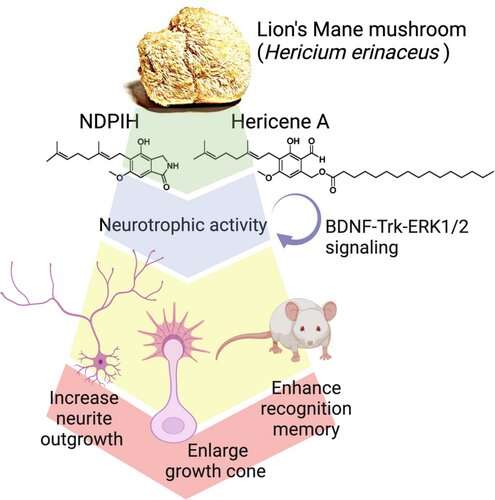
"Laboratory tests measured the neurotrophic effects of compounds isolated from Hericium erinaceus on cultured brain cells, and surprisingly we found that the active compounds promote neuron projections, extending and connecting to other neurons.

"Using , we found the mushroom extract and its active components largely increase the size of growth cones, which are particularly important for brain cells to sense their environment and establish new connections with other neurons in the brain."

Mushrooms magnify memory by boosting nerve growth
Graphical abstract. Credit: Journal of Neurochemistry (2023). DOI: 10.1111/jnc.15767

Co-author, UQ's Dr. Ramon Martinez-Marmol said the discovery had applications that could treat and protect against neurodegenerative cognitive disorders such as Alzheimer's disease.

"Our idea was to identify bioactive compounds from natural sources that could reach the brain and regulate the growth of neurons, resulting in improved memory formation," Dr. Martinez-Marmol said.

Dr. Dae Hee Lee from CNGBio Co, which has supported and collaborated on the research project, said the properties of lion's mane mushrooms had been used to treat ailments and maintain health in traditional Chinese medicine since antiquity.

"This important research is unraveling the molecular mechanism of lion's mane mushroom compounds and their effects on brain function, particularly memory," Dr. Lee said.

The study was published in the Journal of Neurochemistry.

More information: Ramón Martínez‐Mármol et al, Hericerin derivatives activates a pan‐neurotrophic pathway in central hippocampal neurons converging to ERK1 /2 signaling enhancing spatial memory, Journal of Neurochemistry (2023). DOI: 10.1111/jnc.15767


https://medicalxpress.com/news/2023-02-mushrooms-magnify-memory-boosting-nerve.html

Florida doctors' board tightens ban on gender-affirming care

 A prohibition against puberty blocking hormones and gender-affirming surgeries for minors in Florida was tightened further after a board overseeing doctors eliminated an exception for clinical trials Friday at the request of Florida Gov. Ron DeSantis' administration.

Some members of the public attending the meeting in Tallahassee shouted expletives, and law enforcement officers positioned themselves in the front of the room after the vote by the Florida Board of Osteopathic Medicine.

The decision came after one member of the public after another testified at the packed meeting of the osteopathic medicine board and the Florida Board of Medicine that gender-affirming treatment had been "magical" and like "opening a prison door" for them or their children. One transgender adult man during his testimony gave himself an injection of hormones in front of the doctors' boards. Others said treatment had stopped them from "fighting with themselves" and contemplating suicide.

"I'm a teenager. Without getting this medicine at this crucial age I would have been waiting for my life to start," said L.J. Valenzuela, a trans man in high school who said he was getting hormone replacement treatment.

Judy Schmidt told board members that she worried that her trans son, who was 6 when he told her he was a boy, will have been transitioning socially for four to five years before he reaches puberty and won't be able to get the gender-affirming care he needs.

"You as doctors are supposed to do no harm," Schmidt to the boards made up primarily by doctors. "If you make this blanket rule, you are doing harm."

The Florida Board of Medicine and the Florida Board of Osteopathic Medicine approved rules last fall that prohibited gender-affirming surgery and puberty blocking hormones for minors, though minors receiving puberty blockers prior to the rules taking effect could continue to take them. The osteopathic medicine board made an exception for clinical research trials that examined the long-term impact of the treatments.

During Friday's meeting, the Florida Department of Health asked the boards to tweak the rules to eliminate the osteopathic medicine board's exception for research. The DeSantis administration's health department got the ball rolling on curbing gender-affirming treatment for minors in Florida last year by petitioning the boards to pass the prohibition. In 2021, DeSantis, who is widely considered to be weighing a run for the Republican presidential nomination, signed a bill barring transgender girls and women from playing on public school teams intended for student athletes assigned female at birth.

John Wilson,  for the Department of Health, told the boards that the exception would create confusion since one board allowed it, but the other didn't.

"The department is concerned the exception undermines the purpose of this rule," Wilson said.

State Rep. Anna Eskamani, a Democrat from Orlando, called the prohibition against gender-affirming care "politically motivated."

"We should not be making policy based on who can make a fundraising letter off it," Eskamani said.

Florida Board of Medicine member Hector Vila disputed that interpretation of the boards' actions.

"This isn't about trans- or homophobia," said Vila, a doctor in Tampa. "This isn't about politics."

https://medicalxpress.com/news/2023-02-florida-doctors-board-tightens-gender-affirming.html

Extracts from two wild plants inhibit COVID-19 virus: study

 Two common wild plants contain extracts that inhibit the ability of the virus that causes COVID-19 to infect living cells, an Emory University study finds. Scientific Reports published the results—the first major screening of botanical extracts to search for potency against the SARS-CoV-2 virus.

In laboratory dish tests, extracts from the flowers of tall goldenrod (Solidago altissima) and the rhizomes of the eagle fern (Pteridium aquilinum) each blocked SARS-CoV-2 from entering .

The  are only present in miniscule quantities in the plants. It would be ineffective, and potentially dangerous, for people to attempt to treat themselves with them, the researchers stress. In fact, the eagle fern is known to be toxic, they warn.

"It's very early in the process, but we're working to identify, isolate and scale up the molecules from the extracts that showed activity against the virus," says Cassandra Quave, senior author of the study and associate professor in Emory School of Medicine's Department of Dermatology and the Center for the Study of Human Health. "Once we have isolated the active ingredients, we plan to further test for their safety and for their long-range potential as medicines against COVID-19."

Quave is an ethnobotanist, studying how traditional people have used plants for medicine to identify promising new candidates for modern-day drugs. Her lab curates the Quave Natural Product Library, which contains thousands of botanical and fungal natural products extracted from plants collected at sites around the world.

Caitlin Risener, a Ph.D. candidate in Emory's Molecular and Systems Pharmacology graduate program and the Center for the Study of Human Health, is first author of the current paper.

In previous research to identify potential molecules for the treatment of drug-resistant bacterial infections, the Quave lab focused on plants that traditional people had used to treat skin inflammation.

Given that COVID-19 is a newly emerged disease, the researchers took a broader approach. They devised a method to rapidly test more than 1,800 extracts and 18 compounds from the Quave Natural Product Library for activity against SARS-CoV-2.

"We've shown that our natural products library is a powerful tool to help search for potential therapeutics for an emerging disease," Risener says. "Other researchers can adapt our screening method to search for other novel compounds within plants and fungi that may lead to new drugs to treat a range of pathogens."

SARS-CoV-2 is an RNA virus with a spike protein that can bind to a protein called ACE2 on host cells. "The viral spike protein uses the ACE2 protein almost like a key going into a lock, enabling the virus to break into a cell and infect it," Quave explains.

The researchers devised experiments with virus-like particles, or VLPs, of SARS-CoV-2, and cells programmed to overexpress ACE2 on their surface. The VLPs were stripped of the genetic information needed to cause a COVID-19 infection. Instead, if a VLP managed to bind to an ACE2 protein and enter a cell, it was programmed to hijack the cell's machinery to activate a fluorescent green protein.

A plant extract was added to the cells in a petri dish before introducing the viral particles. By shining a fluorescent light on the dish, they could quickly determine whether the viral particles had managed to enter the cells and activate the green protein.

The researchers identified a handful of hits for extracts that protected against viral entry and then homed in on the ones showing the strongest activity: Tall goldenrod and eagle fern. Both  are native to North America and are known for traditional medicinal uses by Native Americans.

Additional experiments showed that the protective power of the plant extracts worked across four variants of SARS-CoV-2: alpha, theta, delta and gamma.

To further test these results, the Quave lab collaborated with co-author Raymond Schinazi, Emory professor of pediatrics, director of Emory's Division of Laboratory of Biochemical Pharmacology and co-director of the HIV Cure Scientific Working Group within the NIH-sponsored Emory University Center for AIDS Research. A world leader in antiviral development, Schinazi is best known for his pioneering work on breakthrough HIV drugs.

The higher biosecurity rating of the Schinazi lab enabled the researchers to test the two plant extracts in experiments using infectious SARS-CoV-2 virus instead of VLPs. The results confirmed the ability of the tall goldenrod and eagle fern extracts to inhibit the ability of SARS-CoV-2 to bind to a living cell and infect it.

"Our results set the stage for the future use of natural product libraries to find new tools or therapies against infectious diseases," Quave says.

As a next step, the researchers are working to determine the exact mechanism that enables the two plant extracts to block binding to ACE2 proteins.

For Risener, one of the best parts about the project is that she collected samples of tall goldenrod and eagle fern herself. In addition to gathering medicinal plants from around the globe, the Quave lab also makes field trips to the forests of the Joseph W. Jones Research Center in South Georgia. The Woodruff Foundation established the center to help conserve one of the last remnants of the unique longleaf pine ecosystem that once dominated the southeastern United States.

"It's awesome to go into nature to identify and dig up plants," Risener says. "That's something that few graduate students in pharmacology get to do. I'll be covered in dirt from head to toe, kneeling on the ground and beaming with excitement and happiness."

She also assists in preparing the plant extracts and mounting the specimens for the Emory Herbarium.

"When you collect a specimen yourself, and dry and preserve the samples, you get a personal connection," she says. "It's different from someone just handing you a vial of plant material in a lab and saying, 'Analyze this.'"

After graduating, Risener hopes for a career in outreach and education for science policy surrounding research into natural compounds. A few of the more famous medicines derived from botanicals include aspirin (from the willow tree), penicillin (from fungi) and the cancer therapy Taxol (from the yew tree).

"Plants have such chemical complexity that humans probably couldn't dream up all the botanical compounds that are waiting to be discovered," Risener says. "The vast medicinal potential of plants highlights the importance of preserving ecosystems."

More information: Caitlin J. Risener et al, Botanical inhibitors of SARS-CoV-2 viral entry: a phylogenetic perspective, Scientific Reports (2023). DOI: 10.1038/s41598-023-28303-x


https://medicalxpress.com/news/2023-02-wild-inhibit-covid-virus.html