Each year with the release of the January CPI, seasonal adjustment factors are recalculated to reflect price movements from the just-completed calendar year. This routine annual recalculation may result in revisions to seasonally adjusted indexes for the previous 5 years. [And it did in spades] Recalculated seasonally adjusted indexes as well as recalculated seasonal adjustment factors for the period January 2018 through December 2022 were made available on Friday, February 10, 2023.
All Items as Reported and Revised
December as Reported -0.1, As Revised +0.1
November as Reported +0.1, As Revised +0.2
October as Reported +0.4, As Revised +0.5
September as Reported +0.4, As Revised +0.4
August as Reported +0.1, As Revised +0.2
Hmm. It seems the bit of celebratory deflation in December didn't happen. Let's look further.
Food and Beverage Revisions
Food and Beverage Items as Reported and Revised
December as Reported +0.3, As Revised +0.5
November as Reported +0.5, As Revised +0.6
October as Reported +0.6, As Revised +0.7
Hmm. It seems the Thanksgiving Turkey you bought cost more than they said.
Core CPI Month-Over-Month
Core CPI as Reported and Revised
December as Reported +0.3, As Revised +0.4
November as Reported +0.2, As Revised +0.3
Core CPI is all items minus food and energy. Even that was up in the final two months of the year.
Smelly Revisions
Looking back to 2021, I also see a pattern of upward revisions late in the year.
Perhaps this all balances out. But even if so, revisions of this size are more than a bit smelly.
Expect Negative Job Revisions
Speaking of revisions, I have been expecting negative revisions on jobs given the massive discrepancy between employment and nonfarm payrolls.
Jobs and employment rose more than expected in January. But because of massive revisions, the BLS cautions all of its household data is full of errors.
Hmm. The BLS household data is full of errors too. Who coudda thunk?
And please note that of the alleged job increase of 894,000 in January, 810,000 was a population control revision.
Payrolls vs Employment Since May 2022
Nonfarm Payrolls: +3,031,000
Employment Level: +1,893,000
Full Time Employment: -166,000
Employment and payroll revisions are a given. And they probably won't be pretty.
While we are at it, does anyone have a lot of faith in that fourth-quarter 2022 GDP report?
Microsoft-backed OpenAI has kept its hit ChatGPT app off-limits to users in China, but the app is attracting huge interest in the country, with firms rushing to integrate the technology into their products and launch rival solutions.
While residents in the country are unable to create OpenAI accounts to access the artificial intelligence-powered (AI) chatbot, virtual private networks and foreign phone numbers are helping some bypass those restrictions.
At the same time, the OpenAI models behind the ChatGPT programme, which can write essays, recipes and complex computer code, are relatively accessible in China and increasingly being incorporated into Chinese consumer technology applications from social networks to online shopping.
The tool's surging popularity is rapidly raising awareness in China about how advanced U.S. AI is and, according to analysts, just how far behind tech firms in the world's second-largest economy are as they scramble to catch up.
"There is huge excitement around ChatGPT. Unlike the metaverse which faces huge difficulty in finding real-life application, ChatGPT has suddenly helped us achieve human-computer interaction," said Ding Daoshi, director of Beijing-based internet consultancy Sootoo. "The changes it will bring about are more immediate, more direct and way quicker."
OpenAI or ChatGPT itself is not blocked by Chinese authorities but OpenAI does not allow users in mainland China, Hong Kong, Iran, Russia and parts of Africa to sign up.
OpenAI told Reuters it is working to make its services more widely available.
“While we would like to make our technology available everywhere, conditions in certain countries make it difficult or impossible for us to do so in a way that is consistent with our mission," the San Francisco-based firm said in an emailed statement. "We are currently working to increase the number of locations where we can provide safe and beneficial access to our tools."
In December, Tencent Holdings' WeChat, China's biggest messaging app, shut several ChatGPT-related programmes that had appeared on the network, according to local media reports, but they have continued to spring up.
Dozens of bots rigged to ChatGPT technology have emerged on WeChat, with hobbyists using it to make programmes or automated accounts that can interact with users. At least one account charges users a fee of 9.99 yuan to ask 20 questions.
Tencent did not respond to Reuters' request for comments.
ChatGPT supports Chinese language interaction and is highly capable of conversing in Chinese, which has helped drive its unofficial adoption in the country.
Chinese firms also use proxy tools or existing partnerships with Microsoft, which is investing billions of dollars in its OpenAI, to access tools that allow them to embed AI technology into their products.
Shenzhen-based Proximai in December introduced a virtual character into its 3D game-like social app who used ChatGPT's underlying tech to converse. Beijing-based entertainment software company Kunlun Tech plans to incorporate ChatGPT in its web browser Opera.
SleekFlow, a Tiger Global-backed startup in Hong Kong, said it was integrating the AI into its customer relations messaging tools. "We have clients all over the world," Henson Tsai, SleekFlow's founder said. "Among other things, ChatGPT does excellent translations, sometimes better than other solutions available on the market."
CENSORSHIP
Reuters' tests of ChatGPT indicate that the chatbot is not averse to questions that would be sensitive in mainland China. Asked for its thoughts on Chinese President Xi Jinping, for instance, it responded it does not have personal opinions and presented a range of views.
But some of its proxy bots on WeChat have blacklisted such terms, according to other Reuters checks, complying with China's heavy censorship of its cyberspace. When asked the same question about Xi on one ChatGPT proxy bot, it responded by saying that the conversation violated rules.
To comply with Chinese rules, Proximai's founder Will Duan said his platform would filter information presented to users during their interaction with ChatGPT.
Chinese regulators, which last year introduced rules to strengthen governance of "deepfake" technology, have not commented on ChatGPT, however, state media this week warned about stock market risks amid a frenzy over local ChatGPT-concept stocks.
The Cyberspace Administration of China, the internet regulator, did not respond to Reuters' request for comment.
"With the regulations released last year, the Chinese government is saying: we already see this technology coming and we want to be ahead of the curve," said Rogier Creemers, an assistant professor at Leiden University.
"I fully expect the great majority of the AI-generated content to be non-political."
CHINESE RIVALS
Joining the buzz have been some of the country's largest tech giants such as Baidu and Alibaba who gave updates this week on AI models they have been working on, prompting their shares to zoom.
Baidu said this week it would complete internal testing of its "Ernie Bot" in March, a big AI model the search firm has been working on since 2019.
On Wednesday, Alibaba said that its research institute Damo Academy was also testing a ChatGPT-style tool.
Duan, whose company has been using a Baidu AI chatbot named Plato for natural language processing, said ChatGPT was at least a generation more powerful than China's current NLP solutions, though it was weaker in some areas, such as understanding conversation context.
Baidu did not reply to Reuters' request for comments.
Access to OpenAI's GPT-3, or Generative Pre-trained Transformer, was first launched in 2020, an update of which is the backbone of ChatGPT.
Duan said potential long-term compliance risks mean Chinese companies would most likely replace ChatGPT with a local alternative, if they could match the U.S.-developed product's functionality.
"So we actually hope that there can be alternative solutions in China which we can directly use... it may handle Chinese even better, and it can also better comply with regulations," he said.
The recalled products can contain Pseudomonas species bacteria, including Pseudomonas aeruginosa and Pseudomonas fluorescens, which are environmental organisms found widely in soil and water. People with weakened immune systems, external medical devices, or underlying lung conditions who are exposed to the bacteria face a risk of serious infection that may require medical treatment. The bacteria can enter the body if inhaled, through the eyes, or through a break in the skin. People with healthy immune systems are usually not affected by the bacteria.
Remedy:
Refund
Replace
Recall Date:
February 08, 2023
Units:
About 4.9 million (In addition, about 56,000 in Canada)
Colgate-Palmolive Company toll-free at 855-703-0166 from 9 a.m. to 5:30 p.m. ET Monday through Friday, or online at www.Fabulosorecall.com or at www.Fabuloso.com and click on the banner at the top of the landing page for more information.
Federal scientists are gearing up to test the first vaccines in poultry againstbird fluin years, as Biden administration officials say they have now begun weighing an unprecedented shift in the U.S. strategy to counter the growing outbreak.
The move comes amid mounting concern over the threat posed by the ongoing spread of highly pathogenic avian influenza over the past few years, which has devastated flocks of wild and commercial birds around the continent.
A record 58 million birds — mostly commercially-raised poultry — have died in the outbreak so far, according to figures tallied by the USDA's Animal and Plant Health Inspection Service — either killed by the virus itself or put down in efforts to quash its transmission. Every state has detected the virus spreading among wild birds and 47 have spotted them in poultry.
"The decision to proceed with vaccination is complex, and many factors must be considered before implementing a vaccination strategy," USDA spokesperson Mike Stepien said in a statement, adding that the inspection service is discussing the options and "soliciting input from many different industry stakeholders that would be impacted."
While the Biden administration has so far not greenlighted the use of vaccines for highly pathogenic avian influenza, several shots had been licensed for potential use in previous outbreaks. Poultry are already regularly vaccinated for other diseases, like infectious bronchitis.
While animal vaccines can take years to be licensed, Stepien said some parts of the process can be accelerated for emergencies.
It is not yet clear whether vaccines are available that will work against clade 2.3.4.4b, the strain behind the current outbreak in the U.S.
"There are a lot of moving parts to this kind of testing. And some of it is just pure logistics of getting everything in place to do the testing, getting the vaccines that are updated, getting things from parties that are involved, different manufacturers," said Erin Spackman, a virologist who studies avian influenza vaccines at the USDA.
While it is not always a requirement for animal shots to be licensed by the department, the trials will offer an early independent evaluation of how well a vaccine works in this case. Antibody studies suggest earlier vaccines might not be as well-matched against the strain now driving the current outbreak, prompting the need for tests.
"On the test, it's a twofold reduction, but that makes it sound a lot closer related than it is. In vaccine-speak, it means it's starting to drift away," said Spackman.
Spackman said evaluating the vaccines can take three months, from when birds get their shot — often in the back of the neck or thigh — to studying their response to the virus after immunity develops.
Vaccine makers say they are also closely tracking deliberations by the U.S. and other countries over the possibility of poultry vaccination, as well as assessing their own shots.
A spokesperson for Merck Animal Health said the company has an "extensive, ongoing research program" developing vaccines that can work with so-called Differentiating Infected from Vaccinated or DIVA strategies — an approach that involves systematically hunting for the virus among vaccinated flocks, in hopes of preventing undetected spread among immunized birds.
When to vaccinate poultry?
Officials have so far been wary of deploying vaccines against the outbreak, citing concerns that the use of the shots could make it harder to export American poultry products.
"What is the trigger point of when you might use vaccination? And that's what they're looking at. Is it so many birds in a poultry farms in an area getting infected? Or is it a certain amount of economic loss? Or is it because a neighboring state has the virus in poultry, and you're concerned? So there's those are really the tough, tough questions," said poultry veterinarian David Swayne.
Before retiring to become a consultant, Swayne served for nearly three decades in the USDA's infectious disease arm and was the director of the department's top research facility for dangerous pathogens.
Swayne noted there are several high-income countries in Europe that are "further along" in exploring DIVA strategies that would work with poultry exports, after wrestling for years with their outbreak. Others, including Indonesia and China, have already rolled out poultry vaccinations for bird flu.
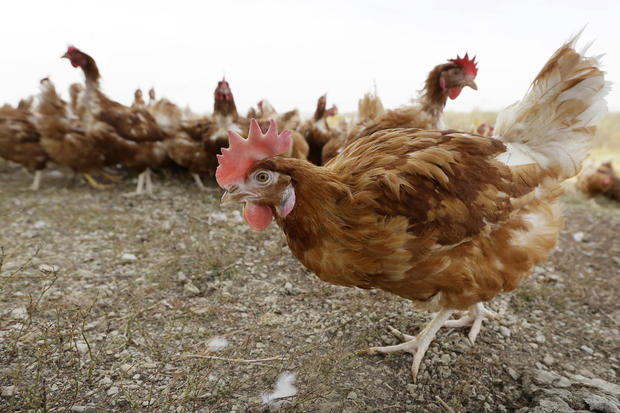
FILE: Chickens walk in a fenced pasture at an organic farm in Iowa on Oct. 21, 2015.CHARLIE NEIBERGALL / AP
Under one approach,birds who die of any cause in a vaccinated flock could be aggressively tested for the virus, Swayne said, or live birds might be systematically sampled for antibodies in their blood through a more complex process. Surveillance may also be possible through swabbing the environment, like checking the containers birds drink water from.
"We want to make sure our partners understand that, if we use them, we're going to use them in the right the right manner so that they can feel secure and safe that the products they buy are not products that might contain, say, a highly pathogenic avian influenza virus," said Swayne.
Authorities would also need a way to coordinate tracking viruses for updates to the vaccines, potentially similar to how the World Health Organization issues recommendations for manufacturers of human flu shots to keep pace with the latest strains.
However, Swayne cautioned that poultry producers will still need to take steps to shield their flocks from contact with wild birds and other ways the virus could spread.
Like their counterparts abroad, American wildlife officials have spotted the virus decimating groups of birds across a range of species. Officials believe the virus is largely being transmitted to commercial poultry flocks by wild birds migrating across the Americas.
"Biosecurity really is the first line of defense, and any vaccination that might be done is only sort of another layer of protection, sort of an insurance policy," he said.
Is it a threat to humans?
Authorities say the risk the virus poses to humans seems to be low for now, despite a 56% fatality rate among the handful of people who have tested positive after direct contact with infected birds.
Out of more than 6,000 poultry workers that American health authorities have tracked after exposure to infected birds, only one has tested positive for the virus.
Regardless, officials have urged Americans to avoid handling dead or sick birds to reduce their risk. The virus has spilled over from birds to other species, often from coming into contact with the carcasses of infected birds.
"Somewhat concerning is that there's been transmission to mammals in a variety of terrestrial mammals, which are basically the most of them are predatory mammals," the Centers for Disease Control and Prevention's Tim Uyeki told a webinar hosted by Emory University last month.
The federal Administration for Strategic Preparedness and Response also already maintains a program with vaccinemakers to "make and test small quantities" of shots for humans that can be ramped up to large-scale production if needed.
"High on my radar. We've already been in touch with our teams as to where we are with both surveillance and detection, as well as our USDA colleagues on the detection in the avian population as well," CDC Director Dr. Rochelle Walensky told a panel of the agency's advisers this week.
When Demi Washington, a basketball player at Vanderbilt University came down with COVID-19 in late 2020, her symptoms were mild, just a runny nose. But to ensure her safe return to the court, the school required her to undergo an MRI.
The results brought Washington to tears.
Following the infection, the now college senior had developed myocarditis — when the heart muscle becomes inflamed, which can decrease the heart's ability to pump blood. The condition can lead to stroke or heart attack, according to Mayo Clinic. Washington was not vaccinated against COVID-19 at the time.
"I was scared because any internal organ, you’re like, 'Oh, my gosh, I need that to live,'" she recalled to TODAY. "I didn’t really know what was going to come of it, how long was it going to take for it to resolve."
Demi Washington has recovered from her myocarditis and has returned to playing basketball. Many other young people who developed heart problems after a COVID-19 infection aren't so lucky.Courtesy Demi Washington
Washington had to skip the rest of the 2020 to 2021 season, but ultimately she was grateful. "I think about the fact that Vanderbilt does do the MRI and a lot of other schools didn’t," she told TODAY in a segment aired Feb. 9. "The fact that I could have played if we didn’t is hard and scary to think about."
Washington's doctor never told her that she was at risk of dying, but he did stress the importance of rest and keeping her heart rate under a certain pace. She had to wear a watch to track her activity. Even though COVID was especially new at the time, Washington said her doctor felt confident her condition was due to the coronavirus, as he'd seen something similar other college athletes.
Washington said she felt no symptoms or signs that her heart had become inflamed, nor did she have a genetic predisposition. "It (just) happened to be me," she said. "I still don't really know why."
Washington has since recovered and is back to playing ball. But her experience sheds light on the thousands of young adults infected with COVID-19 whose health hasn't rebounded as successfully.
COVID-19, heart attacks and young people
Since the COVID-19 pandemic began, heart attack deaths across all age groups have become more common in the U.S., according to a September 2022 study by Cedars Sinai hospital in Los Angeles.
The age group hit the hardest? People between 25 and 44, who saw a 29.9% relative increase in heart attack deaths over the first two years of the pandemic (which means the actual number of heart attack deaths were almost 30% higher than the predicted number).
“Young people are obviously not really supposed to die of heart attack. They’re not really supposed to have heart attacks at all,” Dr. Susan Cheng, a cardiologist at Cedars Sinai and co-author of the study, told TODAY in a segment aired Feb. 9.
Adults between 45 and 64 saw a 19.6% relative increase in heart attack deaths, and those 65 and older saw a 13.7% relative increase, according to a press release from Cedars Sinai. The increase in U.S. heart attack deaths continued through the omicron surge, even though the variant is thought to cause milder illness, and spikes of heart attack deaths have aligned with the timing of COVID-19 surges in the U.S.
Los Angeles County paramedic Romeo Robles told TODAY in the Feb. 9 segment that upticks in COVID-19 would often lead to more 911 calls related to heart issues in his community.
"Surprisingly, people my age ... we would find them in cardiac arrest, and it was all predicted by these waves," he said.
"It appears to be able to increase the stickiness of the blood and increase ... the likelihood of blood clot formation," Cheng said. "It seems to stir up inflammation in the blood vessels. It seems to also cause in some people an overwhelming stress — whether it’s related directly to the infection or situations around the infection — that can also cause a spike in blood pressure."
The reason for the relative rise in young people in particular is unclear, but one theory, Cheng said, is that the virus's impact on the cardiovascular system in some people may be due to an excessive immune system response and that young people are more likely to have stronger immune systems.
COVID-19 and heart disease
For COVID-19 survivors, the risk of developing a heart condition even a year after the infection, regardless of how severe the initial symptoms were, is "substantial," according to a February 2022 study of more than 150,000 individuals with COVID-19. The risk increases even for people who don't have any other risk factors for heart disease.
Dr. Ziyad Al-Aly, a physician-scientist at Washington University School of Medicine in St. Louis and co-author of the study, estimated that about 4% of people who have COVID-19 will develop a heart problem, such as irregular heartbeat, heart failure, inflammation or heart attacks.
"It’s a small number, but really, it’s not (if) you multiply that number by the huge number of people in the United States and throughout the world who had COVID-19," he told TODAY.
What's more, the risk of developing long COVID, including heart problems, increases with each COVID-19 infection an individual has, Al-Aly pointed out. As a result, Latino and Black communities, which have higher rates of reinfection, are especially high risk for heart problems post-COVID, Cheng said.
As doctors and other researchers continue to wade through the data on COVID-19 and heart disease, the best course of action is to avoid infection as best you can, Cheng and Al-Aly said. To do so:
Wear a mask in crowded settings, and consider socializing outdoors with people outside your household.
Stay up to date on your vaccinations. Research shows that you're 11 times more likely to develop myocarditis from COVID itself versus the vaccine, NBC News senior medical correspondent Dr. John Torres said during a TODAY segment on Feb. 9.
Take a COVID-19 test as soon as you start to develop any symptoms and stay home when you're sick.
If you've been infected with COVID-19, especially multiple times, Cheng also encouraged staying on top of your risk factors for heart disease, such as your blood pressure, cholesterol and blood sugar. Typical signs of heart attack, per the U.S. Centers for Disease Control and Prevention, include:
Chest pain or discomfort, such as pressure, squeezing or fullness.
Weakness, light-headedness or fainting.
A cold sweat.
Pain or discomfort in the jaw, neck or back.
Shortness of breath, either at the same time as or before chest discomfort.
Prior to the COVID-19 pandemic, heart attack deaths were trending downward in the United States, but the pandemic appears to have reversed the progress, according to the Cedars Sinai research.
"I'd love to say we're ... coming out on the other side and we can think of COVID more so like the common cold. Unfortunately, that is not the case. ... That is eminently clear from all of the data," Cheng said. "This is not even just like the flu. ... This virus is still very different from any other virus we have seen in our lifetime."
In the past decade, the need for anesthesia services outside of the operating room (OR) has increased dramatically. While this can be partially attributed to the expansion of gastrointestinal endoscopy services due to lowering of the recommended age for colonoscopy screening, there has been exponential innovation in the arena of minimally invasive interventions, from complete heart valve replacements to cancer treatment in the interventional radiology suite.
While these innovations have expanded the ability to care for patients who otherwise might not have been surgical candidates, anesthetic care in these non-OR areas do pose a significant challenge for patient safety. In fact, non-OR anesthesia (NORA) cases are projected to account formore than 50%
opens in a new tab or window of all anesthesia cases in the next decade. If we don't find a way to tackle the myriad issues with NORA procedures, the quality of care received by patients will suffer.
NORA is defined as any anesthesia care provided in a setting that is not an OR. This can include interventional cardiology suites or cardiac catheterization labs, interventional radiology suites, or gastroenterology suites where endoscopies and colonoscopies are performed. NORA can also refer to cases done outside of the OR in ambulatory surgery centers, or even in dental or medical offices.
Here's what we know: NORA cases are characterized by many tough issuesopens in a new tab or window, including problematic schedules, long internal commutes between the main OR and procedure suites, and the lack of access to tools typically available in the OR. These are all things that contribute to a less than ideal scenario for doctor and patient.
Even though the use of procedural suites outside of the OR has become more commonplace, the logistics do not get easier. NORA remains an urgent concern for patient safety, and a stress-inducer for anesthesiologists.
These problems are compounded by a rapidly aging population with increasingly complex comorbidities, the introduction of new technology, and the economics of a healthcare environment looking to improve value by cutting costs.
Regardless of the reason, people should be concerned about the overall quality of care patients receive outside of a well-resourced OR.
Among anesthesiologists, it is well recognized that non-OR locations pose risks. The mental work is tougher. More preparation is required up front to feel comfortable in a different setting. And problems can arise because doctors are working outside of the OR with not-the-usual standards of equipment and monitoring and teamwork they're used to.
Additionally, a lack of space for anesthesia equipment, as well as poor positioning for the anesthesia provider in relation to the patient are also commonly cited grievances from those operating in a NORA setting.
Patient safety concerns came to the forefront after a series of studies showed higher rates of complications and death with NORA cases versus regular OR cases. One such study
opens in a new tab or window using malpractice claims data also found that respiratory issues such as inadequate oxygenation and ventilation were more common in NORA cases.
Patient safety has since become a common phrase that accompanies most mentions of NORA among anesthesia providers. The good news is several anesthesia groups have worked to create education on how to improve patient safety in NORA cases. The Anesthesia Patient Safety Foundation has a specific task force dedicated to NORA safety and held a consensus conference last year to put forward recommendations for best practices in NORA.
Additionally, the journal Current Opinion in Anesthesiology dedicated an entire issueopens in a new tab or window last year to the many concerns anesthesiologists have about working on NORA cases. Some items discussed include the need for more strategic planning, checklists, and consistent staffing models specifically to help reduce pulmonary complications.
Anesthesiologists and patient safety advocates want to see more collaboration and communication between anesthesiologists and the various procedural specialties to help identify and address areas of concern with NORA cases.
We need to focus on developing guidelines together to better address these concerns about NORA and patient safety. We know the risks NORA poses, and I believe we're making progress in a way that we haven't in quite some time, but we need all of us working together to make a real difference.