Search This Blog

Wednesday, February 15, 2023

Federal workers not entitled to COVID hazard pay -U.S. appeals court

 A divided U.S. appeals court on Tuesday said federal workers are generally not entitled to extra pay for being exposed to COVID-19 through their jobs.

In a 10-2 decision with potentially "far-reaching" ramifications, the U.S. Federal Circuit Court of Appeals ruled against 188 current and former correctional employees at a federal prison in Danbury, Connecticut.

The employees said they deserved hazardous duty and environmental differential pay because they worked with or in close proximity to people, objects and surfaces infected with COVID-19, and were not wearing sufficient protective gear.

But the appeals court said the government's Office of Personnel Management, the human resources agency for more than 2.1 million federal workers, had no regulations affording extra pay for exposure in most settings to contagious diseases.

It said exceptions covered some laboratories and tropical jungles, and that it was up to Congress or the agency to add categories.

"COVID-19 is a serious national and international health concern, and the potential ramifications of this case are far-reaching and cut across the entire federal workforce," Circuit Judge Raymond Chen wrote.

"We conclude that OPM simply has not addressed contagious-disease transmission (e.g., human-to-human, or through human-contaminated intermediary objects or surfaces)" in most settings, he added. "That is not to say that such differential pay may not be warranted."

Circuit Judge Jimmie Reyna dissented, saying the prison employees plausibly alleged they deserved extra pay for exposure to "unusually" hazardous conditions.

"The COVID-19 pandemic adversely affected our workplaces, schools, airlines, hotels, meat-packing houses, and hospitals," Reyna wrote. "Even courthouses were momentarily shuttered on the premise that COVID-19 was in the streets roaring like a lion. We cannot shake off those experiences like dust from a rug."


China says U.S. balloons flew over Xinjiang, Tibet, warns of countermeasures

 China said on Wednesday that U.S. high altitude balloons flew over its Xinjiang and Tibet regions, and that it will take measures against U.S. entities that undermine Chinese sovereignty as a diplomatic dispute festered.

Washington and Beijing are locked in a tussle over flying objects after the U.S. military this month shot down what it called a Chinese spy balloon over the coast of South Carolina. Beijing says its balloon was a civilian research vessel mistakenly blown off course, and that Washington overreacted.

This week, China countered that U.S. balloons had flown over its airspace without permission more than 10 times on round-the-world flights since May 2022.

"Without the approval of relevant Chinese authorities, it has illegally flown at least 10 times over China's territorial airspace, including over Xinjiang, Tibet and other provinces," Wang told a regular daily briefing on Wednesday.

The White House has disputed China's allegations.

Washington has added six Chinese entities connected to Beijing's suspected surveillance balloon program to an export blacklist.

"The U.S. has abused force, overreacted, escalated the situation, and used this as a pretext to illegally sanction Chinese companies and institutions," Wang said.

"China is firmly opposed to this and will take countermeasures against relevant U.S. entities that undermine China's sovereignty and security in accordance with the law," Wang said, without specifying the measures.

The balloon dispute has delayed efforts by both sides to mend relations, although U.S. President Joe Biden has also said that he does not believe ties between the two countries were weakened by the incident.

U.S. Secretary of State Antony Blinken, who postponed a planned trip to Beijing over the balloon, is considering meeting China's top diplomat Wang Yi in Munich this week, sources have said.

https://news.yahoo.com/china-says-u-balloons-flew-084904415.html

Philippines, U.S. to hold biggest war games in years

 The Philippines and the United States will this year carry out their biggest joint military drills since 2015, Manila's army chief said on Wednesday, against a backdrop of growing tensions with China in the South China Sea.

The exercises underscore improved ties with the United States under President Ferdinand Marcos Jr., and come as the Philippines condemns China's "aggressive" actions in the disputed waterway, including its use of a "military-grade laser" against one of Manila's vessels earlier this month.

The annual 'Balikatan' exercises will be conducted in the second quarter and involve more than the previous year's 8,900 troops, army chief Romeo Brawner told reporters.

"All of these exercises that we are doing are in response to all types of threats that we may be facing in the future, both man-made and natural," Brawner said.

President Marcos on Tuesday summoned China's ambassador to express "serious concern" over the intensity and frequency of China's activities in the South China Sea, most of which China claims as its territory.

China's use of a laser against a Philippine vessel on Feb. 6, which its foreign ministry insists was legal, has sparked expressions of concerns and support from Australia, Japan, and the United States.

Washington "will redouble its efforts with our Philippine ally" to bolster the Philippine military and coast guard's defence capabilities "as we work shoulder-to-shoulder to uphold the rules-based international order," Pentagon spokesperson Brigadier General Patrick Ryder said on Twitter.

The Philippines has granted Washington greater access to its military bases as part of the latter's efforts to deter China's increasing assertiveness in the South China Sea and tension over self-ruled Taiwan.

In 2015, more than 11,000 troops from both countries participated in the joint military exercises.

"The exercises will involve a myriad of activities, not just focused on developing the war fighting capability of both armed forces, but also of the other non-traditional roles such as humanitarian assistance and disaster response," Brawner said.

https://www.yahoo.com/news/philippines-u-hold-biggest-war-095245248.html

Emergent BioSolutions Sekks Travel Health Business to Bavarian Nordic for Up To $380 M

 Emergent BioSolutions (NYSE: EBS) today announced that it has entered into an agreement to sell its travel health business to Bavarian Nordic (BVNRY) for a total value of up to $380 million, including potential future milestone payments. Under the terms of the definitive agreement, Bavarian Nordic will acquire the rights to VIVOTIF®, indicated for the active immunization to prevent typhoid fever, and VAXCHORA®, indicated for the active immunization to prevent cholera, as well as the development-stage chikungunya vaccine candidate CHIKV VLP. Bavarian Nordic will also acquire Emergent’s manufacturing site in Bern, Switzerland, and development facilities in San Diego, California. Approximately 280 current Emergent employees are expected to join Bavarian Nordic as part of the transaction.

“This agreement enables these important vaccines to continue to get to patients and customers who need them while allowing us to further sharpen our focus on protecting and enhancing life through our core products and contract manufacturing services businesses,” said Robert G. Kramer, Emergent president and chief executive officer. “I want to thank our Emergent teammates who will be joining Bavarian Nordic for their dedication to developing and delivering these products that address global health needs.”

The sale of its travel health business builds on Emergent’s previously announced strategic prioritization of its medical countermeasure products, such as ACAM2000® (Smallpox (Vaccinia) Vaccine, Live), TEMBEXA® (brincidofovir), RSDL® (Reactive Skin Decontamination Lotion Kit), several anthrax products, and opioid overdose reversal medicine NARCAN® (naloxone HCl) Nasal Spray, and contract development and manufacturing services businesses. Together, these actions will improve profitability and position Emergent for steady, sustainable growth over the long term.

https://finance.yahoo.com/news/emergent-biosolutions-announces-sale-travel-070000994.html

French Pension War

 by GabriĆ«l Moens via The Epoch Times,

When a million people protest on the streets of Paris and most major French cities, you know there is a serious problem in French society...

The protests, which had been going on for four days, culminated on Feb. 11 in Paris, where reportedly half a million people participated. The vitriol directed at the president during these protests was uncivilised and contemptuous of government reform proposals.

Reminiscent of the Yellow Vest Revolution in 2018, which was initially directed at a hike in the price of fuel, it soon morphed into a demand to raise the minimum net wage in France, which is now around €1,679 (US$1,800) per month.

The recent proposal, which earned the wrath of the protestors, concerns President Emmanuel Macron’s plan to raise the pension age from 62 to 64. It is a response to the dire situation of the French pension system.

In France, retirees might be paid 50 per cent of their income, with a maximum of €41,136 annually. The state scheme is financed by “social security contributions”—a payroll tax that burdens French businesses.

It could be argued that the French president’s proposal constitutes a justifiable attempt at containing the burgeoning cost of the pension scheme, which otherwise would become unsustainable.

That the pension scheme is economically untenable is an unavoidable consequence of changes in French demographics.

A protester holds a placard reading “Macron pensions, it’s no!” during a demonstration on the fourth day of nationwide rallies organised since the start of the year against a deeply unpopular pensions overhaul, in Paris, on Feb. 11, 2023. (Christophe Archambault/AFP via Getty Images)

In 1910, when the first pension law came into effect, life expectancy was 51.3 years, whereas now it is 82.4 years. Also, the population has increased exponentially since 1910 and now stands at around 65 million, compared to around 39 million in 1910.

The present situation means that the younger generation, who make up a much smaller percentage of the population, has to support an ever-increasing number of older people. From an economic point of view, the present retirement age is unsustainable.

People Hold Onto Their Privileges

The French protests disclose that once a privilege has been extended to people, it is exceedingly difficult to remove it, and it becomes nearly impossible to attempt reform. In Western democracies, it appears that people have lost the ability to distinguish between a “privilege” and a “right.”

A “right” exists independently of any societal consideration unless it conflicts with the right of others, but a “privilege” is merely a temporary benefit extended to people, and the legislature could repeal it.

An example of people’s inability to distinguish between the two can be seen in the blockade of French highways in 2015. French farmers used to the “privilege” of receiving high prices for their agricultural products, blockaded roads from Germany and Spain to stop the importation of foreign meat, vegetables, and dairy products to protest the falling prices for their own products due to cheap imports.

Angelique Chrisafis, writing in The Guardian, described these protests in the summer of 2015 as “a summer of agricultural discontent.”

In 2005, Elise Feller argued an article: “French wage earners today are so strongly attached to their retirement system that they react viscerally whenever it is called into question. Many commentators accuse them of being incapable of reform, willing to go to any length to preserve their retirement privileges.”

The current protests certainly confirm the validity of Feller’s opinion. Indeed, television stations broadcast interviews with enraged protestors who asked rebelliously, “why should I work beyond 62?”

Protesters attend a demonstration on the fourth day of nationwide rallies organised since the start of the year against a deeply unpopular pensions overhaul in Paris on Feb. 11, 2023. (Christophe Archambault/AFP via Getty Images)

Big Government, Small People

Many younger people joined the protests in the name of “solidarity,” even though they disproportionally carry the burden of financing France’s pension scheme.

But the protests also disclose another and ultimately more dangerous societal development. The expectation that people will be able to benefit from the government’s largesse has facilitated a climate of dependency and diminished the people’s will to contribute to the nation’s economic well-being.

Apart from the fact that meaningful work gives people a sense of purpose and fulfils an aspiration to realise their potential, it could also extend life expectancy and healthy living.

Indeed, boredom and loneliness are often unintended consequences of retirement that may well lead to premature death and poverty.

Onlookers gather around a car in a fire on the sidelines of a demonstration on the fourth day of nationwide rallies organised since the start of the year against a deeply unpopular pensions overhaul, in Paris, on Feb. 11, 2023. (Bertrand Guay/AFP via Getty Images)

As people still want to achieve their life’s objectives, reliance on government welfare may well create an army of discontented retirees dependent on government handouts.

It is a social welfare system that elevates the all-powerful state at the expense of people, who will gladly grasp any benefit that comes their way instead of taking their life’s destiny into their own hands. Such a mentality enables governments to treat people like children in a nursery.

Hence, if these ruminations on the welfare state have any validity, an extension of the pensionable age to 64 (or later) appears to be the only way to reduce the incidence of government dependency and to sanitise the pension scheme that otherwise would become unsustainable.

Pension Issues in Other Countries

Of course, the French pension problem is not unique in Europe. For example, neighbouring Belgium has tried to reform its pension system for the last 30 years.

Each incoming government pledges to reform the pension system, but they abandon these lofty proposals when they discover the complexity of the system and the unpalatable electoral consequences of any reform.

However, at present, the pensionable retirement age in Belgium is 65, gradually increasing to 67 for those retiring on or after Feb. 1, 2030.

In Australia, there is also a debate, especially at the time of the delivery of the Budget, about the sustainability of its pension scheme. But the problem is not nearly as cantankerous as in Europe.

The absence of nastiness may well be a consequence of the valuable reform of former Prime Minister Paul Keating, who introduced a superannuation scheme. While the super scheme comes with its own set of problems, it at least enables people to look after themselves when they retire. Only the very needy have to rely on a government pension.

Perhaps it is time for France to consider supporting its workers who want to boost their retirement savings by working longer?

https://www.zerohedge.com/personal-finance/french-pension-war

Tesla App To Remotely Control Cars Crashes Across Europe With "503" Error

 European Tesla drivers tweeted Tuesday that their mobile smartphone app to control their vehicles has crashed. Some complained remote functions ceased to work as the app read "503 Server Maintenance." 

The Tesla App allows drivers to remotely view the status of their vehicles, lock or unlock doors, manage climate control, and control charging. The inability to access the app could create headaches for drivers. 

One of the first tweets about the Tesla App being down was from a person in Germany on Tuesday morning. 


The outage appears to be across multiple EU countries. 

Someone noted:

Tesla has historically not utilized the HTTP Code 503 for proper maintenance and instead occurs during unexpected downtimes. We also see 500, 504, and 502 errors, which speaks more to the current status.

The good news is Tesla owners can still unlock or lock their vehicles via Bluetooth and the keycard. 

People say this issue has been shared on forums "everywhere" today, while Tesla has yet to announce an issue. 

https://www.zerohedge.com/technology/tesla-app-remotely-control-cars-crash-across-europe-503-error

Tuesday, February 14, 2023

Joint Effort: CBD Not Just Innocent Bystander in Weed

 Welcome to Impact Factor, your weekly dose of commentary on a new medical study. I'm Dr F. Perry Wilson of the Yale School of Medicine.

I visited a legal cannabis dispensary in Massachusetts a few years ago, mostly to see what the hype was about. There I was, knowing basically nothing about pot, as the gentle stoner behind the counter explained to me the differences between the various strains. Acapulco Gold is buoyant and energizing; Purple Kush is sleepy, relaxed, dissociative. Here's a strain that makes you feel nostalgic; here's one that helps you focus. It was as complicated and as oddly specific as a fancy wine tasting — and, I had a feeling, about as reliable.


And while a strain that evokes memories of your first kiss is beyond the reach of modern cultivation practices, it is true that not all marijuana is created equal. It's a plant, after all, and though delta-9-tetrahydrocannabinol (THC) is the chemical responsible for its euphoric effects, it is far from the only substance in there.

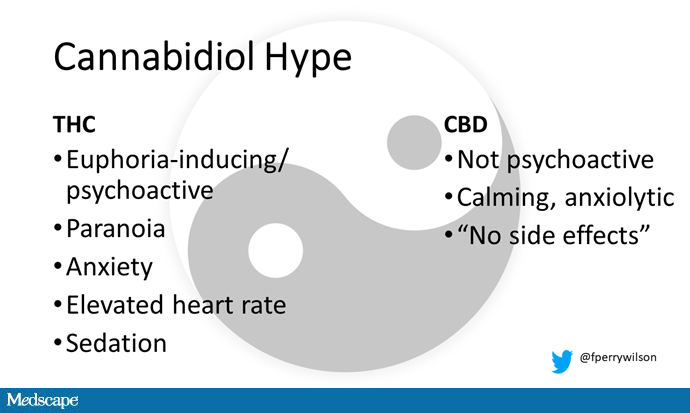
The second most important compound in cannabis is cannabidiol (CBD), and most people will tell you that CBD is the gentle yin to THC's paranoiac yang. Hence your local ganja barista reminding you that, if you don't want all those anxiety-inducing side effects of THC, grab a strain with a nice CBD balance.


But is it true? A new study appearing in JAMA Network Open suggests, in fact, that it's quite the opposite. This study is from Dr Austin Zamarripa and colleagues, who clearly sit at the researcher cool kids table.

Eighteen adults who had abstained from marijuana use for at least a month participated in this trial (which is way more fun than anything we do in my lab at Yale). In random order, separated by at least a week, they ate some special brownies.


Condition one was a control brownie, condition two was a brownie containing 20 mg of THC, and condition three was a brownie containing 20 mg of THC and 640 mg of CBD. Participants were assigned each condition in random order, separated by at least a week.

A side note on doses for those of you who, like me, are not totally weed literate. A dose of 20 mg of THC is about a third of what you might find in a typical joint these days (though it's about double the THC content of a joint in the '70s — I believe the technical term is "doobie"). And 640 mg of CBD is a decent dose, as 5 mg per kilogram is what some folks start with to achieve therapeutic effects.

Both THC and CBD interact with the cytochrome p450 system in the liver. This matters when you're ingesting them instead of smoking them because you have first-pass metabolism to contend with. And, because of that p450 inhibition, it's possible that CBD might actually increase the amount of THC that gets into your bloodstream from the brownie, or gummy, or pizza sauce or whatever.

Let's get to the results, starting with blood THC concentration. It's not subtle. With CBD on board the THC concentration rises higher faster, with roughly double the area under the curve.


And, unsurprisingly, the subjective experience correlated with those higher levels. Individuals rated the "drug effect" higher with the combo. But, interestingly, the "pleasant" drug effect didn't change much, while the unpleasant effects were substantially higher. No mitigation of THC anxiety here — quite the opposite. CBD made the anxiety worse.


Cognitive effects were equally profound. Scores on a digit symbol substitution test and a paced serial addition task were all substantially worse when CBD was mixed with THC.


And for those of you who want some more objective measures, check out the heart rate. Despite the purported "calming" nature of CBD, heart rates were way higher when individuals were exposed to both chemicals.


The picture here is quite clear, though the mechanism is not. At least when talking edibles, CBD enhances the effects of THC, and not necessarily for the better. It may be that CBD is competing with some of the proteins that metabolize THC, thus prolonging its effects. CBD may also directly inhibit those enzymes. But whatever the case, I think we can safely say the myth that CBD makes the effects of THC more mild or more tolerable is busted.

F. Perry Wilson, MD, MSCE, is an associate professor of medicine and director of Yale's Clinical and Translational Research Accelerator. His science communication work can be found in the Huffington Post, on NPR, and here on Medscape. He tweets @fperrywilson and his new bookHow Medicine Works and When It Doesn'tis available now.

https://www.medscape.com/viewarticle/988181