Search This Blog

Wednesday, February 15, 2023

ABPI president, a Novo Nordisk exec, steps down after company's code breaches

 After Novo Nordisk breached not one, not two, but seven clauses of the code that regulates U.K. drugmakers, its U.K. general manager is stepping down as president of the industry's national organization.

The Association of the British Pharmaceutical Industry (ABPI) regulates its 120-plus members through the Prescription Medicines Code of Practice Authority (PMCPA). Novo Nordisk was recently found (PDF) to be in violation of the U.K. national pharma code, and ABPI has an ongoing investigation into the company's conduct.

Now, Novo's U.K. general manager Pinder Sahota is resigning as ABPI president to avoid “becoming a distraction from the vital work of the ABPI,” the organization said in a statement.

The shuffling won’t impact the Novo Nordisk case, Richard Torbett, chief executive at ABPI, said in the statement. For now, ABPI Vice President Susan Rienow, who is the country president for Pfizer, will fill in until the board decides on a new president.

Novo's Sahota was instated as the vice president of the ABPI in May 2021 and was bumped up to president in August of last year. He’s served as Novo’s U.K. general manager since May 2018.

Late last year, PMCPA reprimanded Novo Nordisk for multiple breaches of the national pharmaceutical code. 

The crux of Novo’s wrongdoing centered on a LinkedIn post about an obesity webinar, which was sponsored by the company. However, the sponsorship was not clear on the post, according to the complainant who brought the case to the PMCPA. Since Novo’s Saxenda is a weight loss drug, the post “appeared to be promotional,” the complainant said.

PMCPA agreed, saying that it was “very concerned that Novo Nordisk did not recognize that this was a large-scale Saxenda promotional campaign, which Novo Nordisk knowingly paid for and which was disguised.”

Novo wasn’t alone in breaking the rules. AstraZeneca, Biogen, Daiichi Sankyo, Lundbeck and UCB all committed similar acts, according to the PMCPA. However, only Novo got the scathing reprimands.

https://www.fiercepharma.com/pharma/conflict-interest-novo-nordisk-exec-steps-down-abpi-president-amidst-novos-serious-code

Pfizer CEO's texts with European Commission chief trigger new NYT lawsuit

 Twenty-two months after European Commission President Ursula von der Leyen admitted to The New York Times that she negotiated a COVID-19 vaccine deal with Pfizer CEO Albert Bourla, Ph.D., through text messages, the newspaper is suing the commission over its refusal to make the texts public.

While the lawsuit was filed on Jan. 25 and listed on the European Court of Justice’s public website Monday, Feb. 13, none of the documents related to the case are available to the public. Two people familiar with the suit confirmed it to Politico.

The NYT argues that the EC is required legally to turn over the messages. Last year—in response to a public information request—the commission wrote that text messages do not need to be stored because they are treated as “short-lived ephemeral documents.”

In addition, last June, von der Leyen said she no longer had the messages in her possession. Shortly afterward, Europe’s ombudsman Emily O’Reilly opened a probe.

Between September and December 2022, Bourla twice declined to testify before European Parliament. In October, Pfizer’s president of international development markets Janine Small appeared at a Parliament hearing, saying that talks are too detailed and involve too many parties to be executed through text messages.

The round of negotiations in question came two years ago, as Europe was facing a COVID vaccine crisis. Its primary supplier, AstraZeneca, was having difficulty manufacturing shots and convincing the public they were safe.

The EC turned to Pfizer and struck a deal to purchase 900 million vaccines, with an option to buy another 900 million. It was the largest contract the EU signed during the pandemic, coming to 35 billion euros ($37.6 billion) if fully realized.

https://www.fiercepharma.com/pharma/new-york-times-sues-ec-over-failure-reveal-text-messages-pfizer-ceo-bourla

U.S. Industrial Production Unexpectedly Unchanged In January

 With a nosedive by utilities output offsetting notable increases in mining and manufacturing output, the Federal Reserve released a report on Wednesday showing U.S. industrial production was unexpectedly unchanged in month of January.

The report said industrial production was unchanged in January after slumping by a revised 1.0 percent in December.

Economists had expected industrial production to climb by 0.5 percent compared to the 0.7 percent decrease originally reported for the previous month.

The Fed said utilities output plummeted by 9.9 percent in January after spiking by 5.1 percent in December, as a swing from unseasonably cool weather in December to unseasonably warm weather in January depressed the demand for heating.


Meanwhile, the report said mining output shot up by 2.0 percent in January after slumping by 1.2 percent in December, while manufacturing output jumped by 1.0 percent after tumbling by 1.8 percent in the previous month.

"The solid 1.0% m/m rebound in manufacturing output in January provides further evidence that the economy began the year on a strong footing," said Andrew Hunter, Senior U.S. Economist at Capital Economics.

He added, "That said, while the survey evidence also appears to be turning a corner, for now it is only consistent with a stabilization in output at a weak level rather than a sustained upturn."

The Fed also said capacity utilization in the industrial sector edge down to 78.3 percent in January from a downwardly revised 78.4 percent in December.

Economists had expected capacity utilization to inch up to 79.0 percent from the 78.8 percent originally reported for the previous month.

Capacity utilization in the utilities sector plunged to 68.6 percent, while capacity utilization in the mining and manufacturing sectors increased to 89.0 percent and 77.7 percent, respectively.


https://www.nasdaq.com/articles/u.s.-industrial-production-unexpectedly-unchanged-in-january

Goldman Axes Credit Card Bet On Subprime Americans

 Goldman Sachs' credit card business, anchored by the Apple Card since 2019, has arguably been the company's biggest success by lending to America's sub-660 FICO population. Goldman has since wanted to develop its own credit card for retail customers, but as CNBC just learned, the idea has been scrapped.

After the COVID money drop and various moratoria on payments/bankruptcies/delinquencies, Goldman thought it was well suited to be the next big subprime lender to people with credit scores below 660 on the commonly used FICO scale.

But as we explained last year, there was a major canary in the unsecured lending coal mine. Goldman reportedly "planned to stop originating unsecured consumer loans." 

The move was a noticeable pivot from the bank's previous plans of trying to get closer to retail banking, which they were doing through their Marcus offering, which provided services like personal loans and high-yield savings, similar to combining the features of lenders like Sofi and Upstart with the savings products from companies like Capital One.

Months later, CNBC reported that the bet on subprime America has unraveled as the Goldman-branded credit card for retail customers is no more. 

One person familiar with the situation said the plan to kill the Goldman credit card occurred last year following the shuttering of its Marcus personal loans business and shelved plans for checking accounts. 

Last month, CEO David Solomon said the bank's move into consumer finance slowed due to its inability to execute. It also didn't help that the Consumer Financial Protection Bureau was looking into existing card products the bank offered. 

"The idea of a consumer-facing proprietary Goldman Sachs credit card was discussed but never became a meaningful part of our strategy," a Goldman spokesperson said. 

Why would Goldman abruptly pivot from offering a suite of banking products to subprime borrowers? The timing comes as the economy experiences a downturn that could expose the bank to higher losses. 

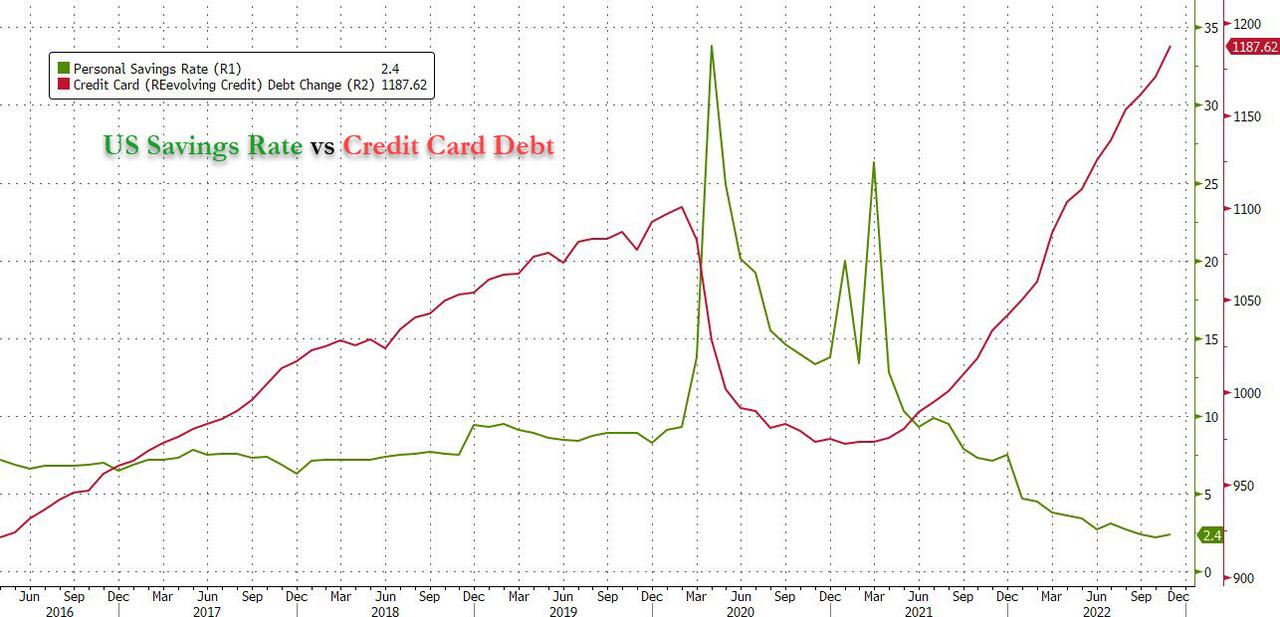
US consumers, especially low-tier ones, are in dire straits. The savings rates have collapsed... While many are using credit cards to survive the inflation storm. 

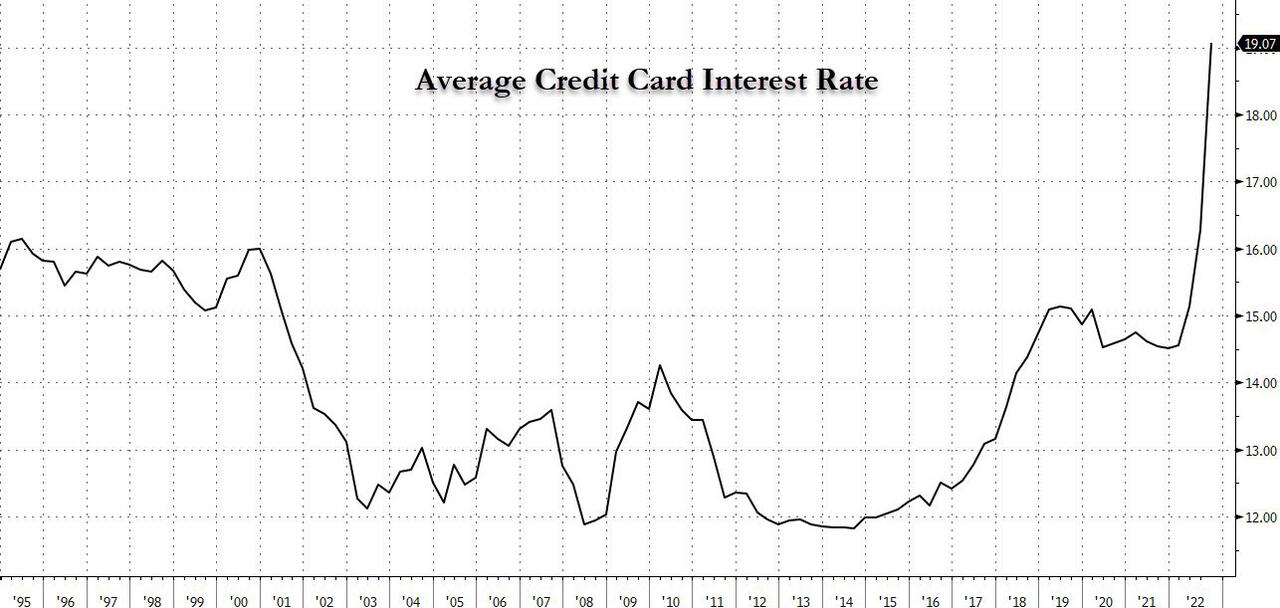
The average rate across US credit cards just rose to an all time high 19%+. 

Twenty-one months of negative real wage growth has crushed many low-income households. 

... and here's the big issue. Credit loss provisions at top US banks are rising. 

More or less, Goldman got cold feet to launch its own credit card because the economy was in a downturn, and betting on subprime at this point of the cycle would've turned out very messy. So much for the strong consumer narrative... 

https://www.zerohedge.com/markets/goldman-axes-credit-card-bet-subprime-americans

Asco-GU – Bicycle tries to put distance between itself and Seagen

 Since Bicycle’s BT8009 is one of only four nectin-4-targeting industry projects apart from Seagen’s Padcev, its maker is positioning it as a key pipeline asset. Yesterday brought more data suggesting that BT8009 might have a future in Padcev’s approved use of urothelial bladder cancer.

Bicycle’s job now is to put distance between BT8009 and Padcev, and it worked hard to play up its project’s safety, especially in terms of rash and neuropathy. But doubts about BT8009’s regulatory pathway are likely to continue to vex investors, as is the fact that the project appears to have negligible efficacy beyond bladder cancer.

This is not a new problem. Scant evidence of activity in other tumours combined with an unclear safety advantage contributed to Bicycle stock falling during last year’s AACR meeting.

Though BT8009 has been escalated up to 10mg/m2 every two weeks, Bicycle yesterday focused on 5mg/m2 once a week, which it has designated the recommended phase 2 dose, and on which it has the most data. An abstract to be presented at this week’s Asco-GU cited the same 50% remission rate among eight bladder cancer patients that had been disclosed at AACR.

Longer lasting?

What was new was duration of response, which Bicycle said hit a median of about 14 months for this cohort. This looks impressive against Padcev’s 7.6 months in cohort 1 of the EV-201 study, though with just four responses to go on the Bicycle data must be treated with extreme caution, and a 50% ORR looks comparable to Padcev’s 44% on a cross-trial basis.

As for other tumour types, the Asco-GU data include six lung cancer and seven breast cancer patients across all doses, but efficacy amounts to just one partial response in each. Bicycle stock slipped 4% yesterday.

So what does safety look like? Padcev’s label cites 45% rates of any-grade rash and peripheral neuropathy, and on this basis BT8009 might have an edge, with respective figures of 12% and 27%. However, the small patient numbers in Bicycle’s trial, and the fact severe adverse event rates look similar – 70% for Padcev and 67% for BT8009 – blunts the advantage.

Approvability is a further problem. Padcev already has full approval in third-line urothelial cancer after PD-(L)1 blockade and platinum chemo, and second line in cisplatin-ineligible patients, so without controlled – and perhaps head-to-head – data BT8009 would likely have to contend with an even later-line use initially.

First line is the big prize. Here a Padcev plus Keytruda combo has scored in an uncontrolled cohort, and Seagen’s phase 3 EV-302 trial reads out this year. As such, with the Seagen/Merck combo likely to be approved in 2024, and a front-line BT8009/Keytruda study not even under way, it is hard to see an accelerated pathway for Bicycle here.

The only other anti-nectin-4 assets are Mabwell Bioscience’s 9MW2821, Nectin Therapeutics’ NTX1105 and Shanghai Junshi’s JS114, according to Evaluate Pharma. In a damming note to clients B Riley wrote yesterday that it had “yet to witness a specific target or indication where [Bicycle’s] new modality would showcase a clear and meaningful therapeutic edge against conventional antibody-drug conjugates”.

Some datasets being presented at Asco-GU 2023
ProjectCompanyMechanismTrialData
BT8009Bicycle TherapeuticsAnti-nectin-4 bicycle conjugateNCT0456136250% ORR in 8 bladder cancer pts at RP2D
LAVA-1207Lava TherapeuticsAnti-PSMA gamma-delta T-cell engagerNCT05369000Late-line mCRPC; no severe TRAEs, no responses (n=8) 
TalabostatBioxcelDPP inhibitorNCT03910660SCNC phenotype mCRPC; 25% ORR in 28 pts (Keytruda combo) 
LorigerlimabMacrogenicsAnti-PD-1xCTLA-4 MAbNCT03761017mCRPC cohort; 26% ORR in 42 pts
TalzennaPfizerParp inhibitorTalapro-21L mCRPC; late-breaker embargoed until 16 Feb
Notes: mCRPC=metastatic castration-resistant prostate cancer; SNEC=small cell neuroendocrine carcinoma. Source: Asco-GU.

Other biotech assets being discussed at Asco-GU include Lava Therapeutics’ LAVA-1207 and Bioxcel’s talabostat (BXCL701), both in prostate cancer.

The former company is notable for having attracted Seagen as a deal partner, though LAVA-1207, which targets PSMA, sits outside this tie-up, and has yet to show any efficacy. Bioxcel is better known for CNS assets, and in cancer its talabostat/Keytruda combo now appears to be focusing on patients with the SCNC phenotype.

And also in prostate cancer, Macrogenics fell 17% yesterday after an Asco-GU abstract on its anti-PD-1xCTLA-4 bispecific lorigerlimab showed a 35% rate of severe treatment-related adverse events, leading to a 24% discontinuation rate. This was despite a 26% response rate in a prostate cancer cohort broadly similar to Bristol Myers Squibb’s Checkmate-650 trial, in which Opdivo plus Yervoy managed an ORR of just 10%.

Still, the big Asco-GU focus for many will be the Talapro-2 study of Pfizer’s Talzenna, under wraps until tomorrow. The trial, toplined positive but with no further detail disclosed so far, could help this fourth-to-market Parp inhibitor challenge Astrazeneca/Merck’s Lynparza and GSK’s Zejula in front-line prostate cancer.

https://www.evaluate.com/vantage/articles/events/conferences-trial-results/asco-gu-bicycle-tries-put-distance-between-itself

Biogen Expects Modest Leqembi Revenue as Aduhelm Takes Another Hit

 Biogen anticipates middling market performance for its newly-approved Alzheimer’s therapy Leqembi (lecanemab), company leadership announced Wednesday in its 2022 fourth-quarter and full-year results.

The financial report comes after an additional warning on Biogen’s first anti-amyloid Alzheimer’s therapy, Aduhelm (aducanumab), came to light. The updated label alerts doctors to the risk of intracerebral hemorrhage in treated patients.

In an investor call Wednesday morning, Michael McDonnell, chief financial officer, Biogen, said the company expects commercialization expenses for Leqembi to exceed its revenue.

Still, the Massachusetts-based biotech is pinning its hopes on Leqembi, along with upcoming depression candidate zuranolone, as it grapples with declining revenues and growing biosimilar pressure.

Zuranolone, developed with Sage Therapeutics, has an FDA action date of Aug. 5, 2023.

Christopher Viehbacher, president and CEO, said during the call that both have the potential to be “quite transformative in their respective therapeutic areas.”

Biogen is also looking to grow its existing products, including multiple sclerosis drug Vumerity (diroximel fumarate) and Spinraza (nusinersen) in spinal muscular atrophy (SMA), Viehbacher said.

In total, Biogen made more than $10 billion in 2022, down from nearly $11 billion in 2021. Almost all of the company’s businesses demonstrated downward trends, including its multiple sclerosis, SMA and biosimilar products.

Biogen also revealed it had discontinued its neuropathic pain candidate vixotrigine due to “regulatory, development and commercialization challenges.” The oral sodium channel blocker showed early promise in the Phase II CONVEY trial, where a 200-mg twice-a-day dose significantly eased daily pain after 12 weeks.

The company has also terminated its licensing agreement with InnoCare Pharma and is returning oral Bruton's tyrosine kinase inhibitor, orelabrutinib, to the Chinese company. In July 2021, Biogen paid $125 million to gain access to orelabrutinib and study it in multiple sclerosis.

Aduhelm Takes another Hit

Aduhelm, the first-ever therapeutic approved to treat an underlying cause of Alzheimer’s disease, is a human monoclonal antibody that targets amyloid beta plaques in the brain. The product launched in April 2021 and almost immediately attracted controversy.

In November 2021, Biogen reported that a 75-year-old woman treated with the drug died of amyloid-related imaging abnormalities (ARIA). Three other ARIA cases were reported from July to September 2021, all of which occurred outside the U.S. but required hospitalization.

In the new label adjustment, the FDA advised prescribers to inform their patients that though infrequent, cases of intracerebral hemorrhage exceeding 1 cm in diameter have been documented in patients taking Aduhelm.

The risk of brain bleeding might also be higher in patients who are also on antithrombotic or thrombolytic medications, the regulator noted.

The additional safety warning is unlikely to strongly impact Aduhelm sales, as few patients are on it to begin with after the U.S. Center for Medicare and Medicaid Services severely limited coverage of Aduhelm. Over the course of 2022, Aduhelm managed just $4.8 million in sales.

https://www.biospace.com/article/biogen-expects-modest-leqembi-revenue-as-aduhelm-takes-another-hit-/

Pension reform strikes tell story of French work malaise


French lawyer Isabelle Dumond said she had never taken part in a demonstration against pension reforms before, as she joined compatriots who appear ready to fight for a better work-life balance after years of being pushed to work harder.

"I work in an office. I don't have to carry bricks all day. But I'm mentally exhausted by the pace, the productivity that's demanded of us," she told Reuters.

"For me, the reform would mean working an extra year and a half, but I can't take it anymore," the 56-year-old continued as she stood in front of the Paris opera house last Tuesday.

French President Emmanuel Macron wants to raise the retirement age from 64 to 62, in a move he warns is vital to avoid the collapse of the creaking state pension system and ensure younger generations will not carry the burden of financing the old-age of the "baby boomer" generation.

The reform could yield an extra 17.7 billion euros ($19.18 billion) in annual pension contributions to plug the government's funding gap, according to Labour Ministry estimates. The left-wing opposition says the gap could be filled by taxing the rich and companies more.

For Macron there's a lot at stake. Failure to reform pensions would tarnish the rest of his second and final term and stop his reformist zeal dead in its tracks, government sources say.

However, after more than two decades of a 35-hour working week, which has pushed productivity rates in France above most of its European peers, the French are showing signs of burn-out and a change in attitude towards the workplace.

"The pandemic has forced the most privileged classes, those from the private sector, small managers, to re-think their relationship to work, something the working class had done a long time ago," Jeremie Peltier of the Jean Jaures Foundation think tank said.

THE 35-HOUR CURSE

Jean-Jaures foundation researchers found that although 60% of the French rated their job as "really important" in their lives in 1990, only 21% did so in October 2022.

Moreover, 61% of the French say they'd rather earn less and have more free time. But in 2008, the reverse was true: 62% of the French said they'd rather earn more and have less free time.

The 35-hour work week, introduced in 2000, is exacerbating the current malaise, labour experts say. Reducing working time forced French companies to squeeze more out of their employees to keep up with their international competitors, by cutting break times for instance.

As a result, productivity in France rose 18% to $67.42 per hour worked in 2019 from 2000. This compares with a 16.8% increase in Britain over the same period to $59.52. French productivity was also ahead of Germany's $67.06 and Italy's $53.66, according to OECD figures.

But the productivity drive left France with one of the highest rates of burn-out in Europe, according to the Eurofound European Working Conditions Survey. France and Luxembourg were the only countries in Western Europe with a "high" rate of burn-out at above 3.25 on a scale of one to five in the 2018 study.

"France is one of the countries with the highest productivity and also one where we work the least," said Laurent Pietraszewski, who oversaw Macron's previous attempt at reforming pensions in 2019/2020.

"This intensity is one of the reasons why people feel burnt out," said Pietraszewski, who used to work in human resources at Auchan supermarkets and is now a consultant outside government.

This unease towards the workplace helps to explain why the French demonstrations against pension reforms are attracting bigger and more diverse crowds and morphing into a broader movement questioning the place of work in society, making it harder for Macron to get the genie back in the bottle.

As the government's bill continues to make its way through parliament, a fifth nationwide strike is scheduled for Thursday.

The government has been surprised by the huge turnout, with a protest on Jan. 31 attracting 1.27 million protesters across the country. The number of protesters swelled to over a million much faster than during the 2010 reforms that pushed the pension age to 62 from 60, for instance.

But this frustration with the workplace clashes with a president who pitched himself as the candidate of "work". He once said he didn't like the word "strenuous" when applied to work because "it implied that work is painful."

Macron's government hopes lower unemployment and looser labour laws will increase labour mobility and reduce the number of people who stay in jobs they don't like because they fear being jobless.

After years of chronically high unemployment, much above the rates in Germany and Britain, France is starting to make progress. At 7.2 percent at the end of 2022, unemployment hit a 15-year low. But it may not have dropped low enough and for long enough for French attitudes to change.

https://www.marketscreener.com/news/latest/Analysis-Pension-reform-strikes-tell-story-of-French-work-malaise--42996528/