Search This Blog

Tuesday, February 28, 2023

Reata gets FDA OK for Friedreich’s Ataxia treatment

FRIEDREICH’S ATAXIA IS AN ULTRA-RARE, PROGRESSIVE, NEUROMUSCULAR DISEASE THAT AFFECTS APPROXIMATELY 5,000 DIAGNOSED PATIENTS IN THE UNITED STATES

SKYCLARYS IS INDICATED FOR THE TREATMENT OF FRIEDREICH’S ATAXIA IN ADULTS AND ADOLESCENTS AGED 16 YEARS AND OLDER

RARE PEDIATRIC DISEASE PRIORITY REVIEW VOUCHER GRANTED

MANAGEMENT TO HOST CONFERENCE CALL TODAY, FEBRUARY 28, 2023, AT 6:00 PM ET

Reata Pharmaceuticals, Inc. (Nasdaq: RETA) ("Reata," the "Company," "our," "us," or "we"), a biopharmaceutical company focused on developing and commercializing novel therapies for patients with severe diseases, announced that the U.S. Food and Drug Administration ("FDA") has approved SKYCLARYS™ (omaveloxolone) for the treatment of Friedreich’s ataxia in adults and adolescents aged 16 years and older. With this approval, the FDA granted a rare pediatric disease priority review voucher.

Reata’s management will host a conference call on February 28, 2023, at 6:00 pm ET. The conference call will be accessible by dialing (844) 200-6205 (toll-free domestic) or (929) 526-1599 (international) using access code 827526. The webcast link is https://events.q4inc.com/attendee/939887927.

https://finance.yahoo.com/news/reata-pharmaceuticals-announces-fda-approval-222500644.html

Drone crashes in failed attack southeast of Moscow, regional governor says

 A drone crashed near a natural gas distribution station southeast of Moscow on Tuesday in an apparent failed attack 110 km (68 miles) from the centre of the Russian capital, the regional governor said.

Andrei Vorobyov reported the incident near the town of Kolomna shortly after the Defence Ministry accused Ukraine of attempting two drone strikes in southern Russia overnight.

Ukraine does not publicly claim responsibility for attacks inside Russia. If it was behind the Kolomna incident, it would be its closest attempted drone strike to the Russian capital since Russia invaded Ukraine just over a year ago.

Postings on Russian social media showed the grey metal wreckage of a drone lying in a snowdrift by the edge of a wood said to be near Kolomna. Reuters could not immediately verify the images.

Vorobyov said the drone appeared to have been intended to strike a "civil infrastructure facility" but there was no damage. He said the FSB security agency was dealing with the situation and there was no danger to residents.

Earlier, the Defence Ministry accused Ukraine of launching attack drones towards civil infrastructure targets in the southern regions of Krasnodar and Adygea.

It said its anti-drone defence systems had caused the drones to veer off course and miss their targets.

"Both drones lost control and deviated from their flight paths. One fell into a field, the other, deviating from its trajectory, did not harm the intended target," it said.

There was no immediate comment from Ukrainian authorities.

Russian state news agencies had earlier reported a fire at an oil depot in the Krasnodar region, around 240 km (150 miles) southeast of the Crimean peninsula, after a drone was spotted flying overhead.

The main civilian airport of Russia's second city, St Petersburg, suspended all flights for an hour on Tuesday morning for what the Defence Ministry said were exercises involving fighter jets in Russia's western air space.

FDA panel votes for Pfizer's RSV vaccine

 A panel of outside advisers to the U.S. Food and Drug Administration (FDA) on Tuesday recommended Pfizer Inc's respiratory syncytial virus (RSV) vaccine, paving the way for one of the first approved RSV shots in the United States for older adults.

The FDA advisory committee voted 7 to 4 in favor of the drug, saying data from the clinical study conducted by the company established that the treatment was effective and safe in preventing the lower respiratory tract disease caused by RSV in 60 years and older

https://finance.yahoo.com/news/u-fda-panel-votes-pfizers-210636909.html

Novavax raises doubts about its ability to remain in business

 COVID-19 vaccine maker Novavax Inc on Tuesday raised doubts about its ability to remain in business and announced plans to slash spending as it works to prepare for a fall vaccination campaign.

The company said there is significant uncertainty around its 2023 revenue, funding from the U.S. government, and pending arbitration with global vaccine alliance GAVI. But its cash flow forecast indicates it has sufficient capital to fund operations over the next year.

The company lost $182 million, or $2.28 per share, in the fourth quarter on weaker-than-expected sales of $357 million. Analysts had expected sales of $383 million, according to Refinitiv data.

Novavax shares fell over 20% in after-the bell trading.

"If we execute on our operating plan, we'll be in a very strong position not only at the end of this year, but going into next year," Novavax's new Chief Executive John Jacobs, who joined the company in late January, said in an interview. Novavax had $1.33 billion of cash on hand at the end of 2022.

However, Jacobs cautioned that there are risks in the near term to that operating plan, including the fact that protein-based vaccines like Novavax's take longer to produce than their messenger RNA-based competitors.

Companies will need to change their vaccine each year to match circulating strains as required by regulatory agencies, including the U.S. Food and Drug Administration.

"We don't know what the strain selection is yet from FDA. We don't know what global health authorities may want from a regulatory standpoint on how the new vaccine needs to look," Jacobs said. "The sooner we know that the more clarity we have on our path forward."

The CEO said the company has been spending at a "hot rate," and plans to cut back, likely including job cuts.

"We're in the process of assessing the global footprint of Novavax, rationalizing our supply chain, rationalizing the portfolio and rationalizing the company structure and our infrastructure," he said.

Air Force Relieves Six Leaders At Nuclear Base Over "Loss Of Confidence"

 Six leaders, including two commanders and four of their subordinates, at Minot Air Force Base, North Dakota, were abruptly relieved of their duties "due to a loss of confidence," the US Air Force wrote in a press release Monday.  

Maj. Gen. Andrew J. Gebara, commander of the 8th Air Force, relieved Col. Gregory Mayer of the 5th Mission Support Group and Maj. Jonathan Welch of the 5th Logistics Readiness Squadron from their leadership positions at Minot AFB "due to a loss of confidence in their ability to complete their assigned duties." 

"These personnel actions were necessary to maintain the very high standards we demand of those units entrusted with supporting our Nation's nuclear mission," said Gebara.

Also, four subordinate leaders assigned to Minot AFB were relieved of their duties. 

"Eighth Force continues to safeguard global combat power and conduct around-the-clock strategic deterrence operations in a safe, secure and effective manner.

"Our mission is foundational to our Nation's defense, and we remain committed to the success of that no-fail mission," Gebara said.

Minot AFB is home to the 5th Bomb Wing, which falls under the 8th Air Force. The wing flies nuclear-capable Boeing B-52 Stratofortress bombers. The air base also has a missile wing that operates intercontinental ballistic missiles. 

Gebara did not explain what caused the loss in confidence among Minot AFB commanders entrusted with the nation's nuclear bombers and ICBMs. 

https://www.zerohedge.com/military/air-force-relieves-six-leaders-nuclear-base-over-loss-confidence 

Back Pain: Red Flags and When to Image

 Matthew F. Watto, MD: Welcome back to The Curbsiders. On tonight's episode, we are going to be talking about back pain. This is based on an interview, Back Pain Update with Dr Austin Baraki. He gave us some great pearls about how to manage back pain, which we see so much of in primary care. I'll use one of my famous teaching techniques: If the patient has any kind of back pain, they should just not move. Right?

Paul N. Williams, MD: That's right, Matt-we should recommend bedrest until they get better for anyone who has any back pain? No. For back pain, early activity and exercise are great. Patients are often concerned that physical therapy will make their pain worse, so they don't exercise. This misunderstanding is not surprising. They believe that if they are experiencing pain, it's facilitating more damage, which is not necessarily the case. It will get better, and a little bit of anticipatory guidance goes a long way in terms of managing patient expectations related to early mobilization, early exercise, and physical therapy.

Watto: Absolutely. One of the goals of treatment is symptom relief to the extent that we're able to achieve. We're not expecting the pain to go to zero. That just doesn't happen, especially if someone's on a medication long term. Another goal is return to function. We want them sleeping. We want them to be able to tolerate movement.

We have medications — NSAIDs and muscle relaxants, which are actually tranquilizers. But most therapy for back pain doesn't involve medications. It involves active movement, so we have to find movement that the patient enjoys doing. Passive treatments, things being done to patients, just don't work as well.

Williams: We should be clear — we're talking primarily about chronic back pain here. For acute back pain, we actually have some decent medications, but acute back pain tends to improve no matter what you do. We don't have much to offer pharmacologically for chronic low back pain. The best modalities usually involve physical activity of some kind.

Watto: Let's discuss the evaluation of back pain. Something that always comes up: Should we order imaging, and is there a right time to get it? Dr Baraki was very clear about when to do imaging. Two big buckets of patients might need imaging.

First, a patient who has a serious underlying condition and you're using imaging to try to diagnose it; or in a chronic setting, a patient who needs surgery, and imaging is part of the presurgical evaluation. We talked about red flags.
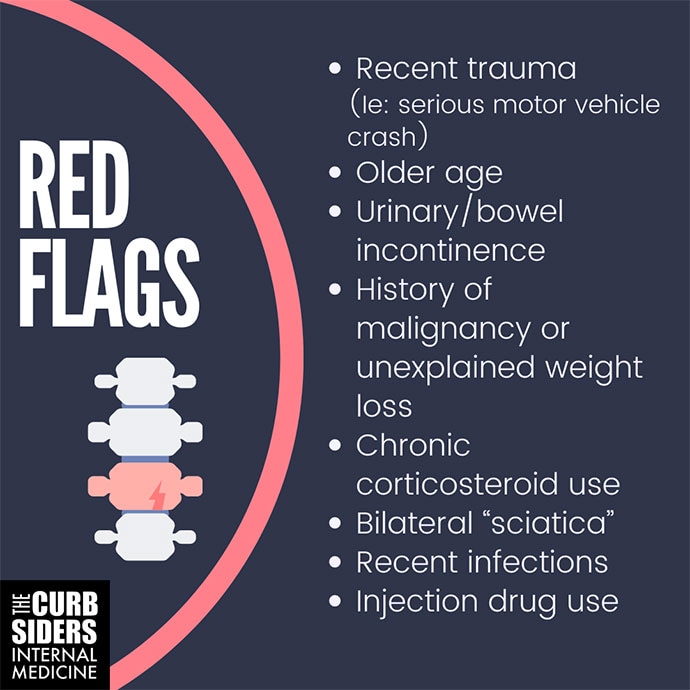
The red flags are major trauma, where we have reason to believe there might be something going on — if we strongly suspect infection, or the patient is injecting drugs. If the patient has a history of cancer, we would be worried that they might have a recurrence. Those are some of the main red flags. With a patient who has osteoporosis or is on chronic steroids, you might even be able to get by with plain films instead of an MRI to look for fracture.

The other thing I wanted to ask you about is, when should we get imaging? Are there any pitfalls we need to worry about?

Williams: I always like podcasts I'm not on because I enjoy listening to them much more. Dr Baraki talked about the very specific language that is used in radiology reports, such as spondylitis, spondylolysis, and multilevel degenerative disease. They sound bad, but if they are just reframed as age-related degenerative changes, that sounds so much more benign. When discussing with patients, we should avoid medical jargon and say that we saw some changes that we would expect for someone of your age. That sounds so much better than saying we saw multilevel degenerative disease, which sounds like an alarming pathology if you're not a physician. Without being inaccurate, we should frame the discussion such that we aren't providing a very specific diagnosis, because that is rarely the case with chronic low back pain. Typically, many things are going on and you may never identify a single unifying diagnosis, which doesn't tend to help anyway.

Watto: There's evidence showing that if the radiology report uses clinical terminology that both clinician and patient think of as less serious, they are less likely to proceed to more invasive treatments. Calling an episode of back pain a "lumbar strain" helps the patient understand that this is a pretty common thing. Almost everyone is going to have an episode of back pain at some point in their life, and almost all of them will get better. Most of the time there's no serious underlying condition.

This was a great discussion with Dr Baraki. Click on Back Pain Update with Dr Austin Baraki to hear the full discussion. Until next time, I've been Dr Matthew Frank Watto.

Williams: And I'm Dr Paul Nelson Williams.

Matthew F. Watto, MD

Clinical Assistant Professor, Department of Medicine, Perelman School of Medicine at University of Pennsylvania; Internist, Department of Medicine, Hospital Medicine Section, Pennsylvania Hospital, Philadelphia, Pennsylvania

Disclosure: Matthew F. Watto, MD, has disclosed no relevant financial relationships.

Paul N. Williams, MD

Associate Professor of Clinical Medicine, Department of General Internal Medicine, Lewis Katz School of Medicine; Staff Physician, Department of General Internal Medicine, Temple Internal Medicine Associates, Philadelphia, Pennsylvania

Disclosure: Paul N. Williams, MD, has disclosed the following relevant financial relationships:
Serve(d) as a director, officer, partner, employee, advisor, consultant, or trustee for: The Curbsiders Received income in an amount equal to or greater than $250 from: The Curbsiders

https://www.medscape.com/viewarticle/987071

Can Amazon Deliver With 24/7 Primary Care?

 Last night, I saw an announcement on Amazon's homepage that they are now offering a subscription service that provides 24/7 primary care. According to a letter from the CEO, this is in response to a broken healthcare system, and the service that Amazon will be providing is, in their words, "how primary care should work."

Amazon has usually been pretty good at spotting trends and opportunities. This causes me to reflect about what it is we offer with traditional in-person primary care that might be different from what Amazon will offer with 24/7 access.

Fundamentally, excellent primary care is distinguished from other types of care, particularly online care, by three things: trust, shared decision-making, and judgment, all of which are facilitated by deep relationships that develop over time.

Notice that I did not mention medical knowledge. Medical knowledge is a necessary component of any healthcare delivery system.

I want to contrast that with purely algorithm-based care. In purely algorithm-based care, a patient with no comorbidities other than hypertension, on hydrochlorothiazide, with a blood pressure of 141/91 should have their antihypertensive therapy increased so that they can reach the goal of 140/90. In fact, what usually happens is that we look back in the chart to see how many times the patient's blood pressure exceeded goal. We ask whether they've been adequately carrying out lifestyle interventions that we've talked with them about, and also whether or not they particularly want to continue with those lifestyle changes.

Then we present a choice to them, based on the risks and benefits in the context of their personal values and preferences about whether adding another medicine at this point in time makes sense for them. This all happens very quickly, and while we don't think a lot about it, what is happening is the integration of medical knowledge with shared decision-making, in a discussion with someone who trusts us, and then a judgment call about what the patient should do.

Ultimately, the way that medical care is provided will be decided in the marketplace. That marketplace is the same one that has already begun to erode some of the core features of primary care, such as the time it takes to develop trust, engage in shared decision-making, and exercise judgement. All of this takes time. But talk to any primary care physician and you'll find that time is the one thing that is in short supply.

Patients will vote with their feet. Some patients will like quick access to any provider. I don't think that any one type of care will dominate, because medicine never has been, and shouldn't be, one-size-fits-all. Some people are attracted to one doctor's personality more than to another. Some people like the way one clinician listens to them, another person likes the way a clinician explains things to them. For some, trust is built over time and facilitated by relationship. For others, trust comes from a trust in the system.

The other thing that will determine how this all plays out will be metrics of care that will be looked at by everyone from clinicians to patients to payers. Hard outcomes will be an important metric; patient satisfaction will be another. As we pay attention to metrics, though, it will be important to remember a statement that has been attributed to a number of people and which I'll twist a little bit: "Not everything that can be measured counts, and not everything that counts can be measured."

In the end, what matters is that patients receive high-quality care, in a manner that is comfortable to them, from a system and people who have their interests in mind.

Innovation presents challenges and it also presents the opportunity to reflect and refine what we have to offer. And what we have to offer always has been, and remains, profound and important.

Neil Skolnik, MD, is Professor, Department of Family Medicine, Sidney Kimmel Medical College of Thomas Jefferson University, Philadelphia, Pennsylvania; Associate Director, Department of Family Medicine, Abington Jefferson Health, Abington, Pennsylvania

Disclosure: Neil Skolnik, MD, has disclosed the following relevant financial relationships:
Serve(d) on the advisory board for: AstraZeneca; Teva; Eli Lilly and Company; Boehringer Ingelheim; Sanofi; Sanofi Pasteur; GlaxoSmithKline; Merck; Bayer
Serve(d) as a speaker or a member of a speakers bureau for: AstraZeneca; Boehringer Ingelheim; Eli Lilly and Company; GlaxoSmithKline Received research grant from: Sanofi; AstraZeneca; Boehringer Ingelheim; GlaxoSmithKline; Bayer
Received income in an amount equal to or greater than $250 from: AstraZeneca; Teva; Eli Lilly and Company; Boehringer Ingelheim; Sanofi; Sanofi Pasteur; GlaxoSmithKline; Merck; Bayer

https://www.medscape.com/viewarticle/988810