Search This Blog

Sunday, April 16, 2023

Half of migrants piling into NYC not vaxxed for polio, health commish warns

 A startling 50% of migrants streaming into the Big Apple are not vaccinated against the contagious and potentially deadly poliovirus, city Health Commissioner Ashwin Vasan recently revealed — as he urged doctors to help prevent a public health emergency, The Post has learned.

Vasan also said the new migrants come from, or pass through, countries with high rates of infectious tuberculosis — and noted there’ve been outbreaks of chickenpox in shelters housing the newcomers.

“More than 50,000 people have come to New York City (NYC) in the past year shortly after crossing the U.S.-Mexico border. As more people arrive and many make NYC their home, the scale and scope of need continues to grow,” Vasan said in an eight-page letter, dated April 11, sent to physicians and other health care providers. A copy was obtained by The Post.  

“I am writing now to underscore how critical it is that health care providers take a wide range of considerations into account when working with people who are seeking asylum … The scope of this letter represents the scale of the need. It is incumbent upon us as a welcoming city to comprehensively evaluate and meet these needs.”

Vasan said screening and vaccinating migrants for diseases and viruses that’ve been kept in check in the city is a top priority.

“Vaccination rates for certain diseases are low in some of the most common countries of origin, with rates hovering around 50% for polio as an example,” the commissioner said.

A crowd of migrants wait in line to see immigration officials in Manhattan on March 13, 2023.
Robert Mecea

The polio virus spreads through person-to-person contact, lives in an infected person’s throat and intestines — and can contaminate food and water in unsanitary conditions.

Paralysis is the most severe symptom of poliovirus because it can lead to permanent disability and death.

Between two and 10 out of 100 people who have paralysis from polio die because the virus damages the muscles that help them breathe, according to the US Centers for Disease Control and Prevention.

Jay Varma, who served as the senior health advisor to former Mayor Bill de Blasio, said the number of migrants not immune from polio is a cause for concern, but manageable.

“There is always a risk to public health when people are not vaccinated against important infectious diseases, such as measles and polio,” Varma said told The Post on Sunday.

“That said, the risk is not immediate, since there are high levels of vaccination among children and adults among current New Yorkers. As the Commissioner says, it is critical that the City work to provide newly arrived persons with medical care, and ensure that healthcare providers catch up newly arrived persons on their vaccinations, just as happens routinely for anyone accepted into the US through the regular immigrant or refugee resettlement programs.”

The potential for public health outbreaks is one of many concerns for officials concerned about absorving the migrant influx.

Mayor Eric Adams said the estimated city tab could hit $4.3 billion to cover shelter, food and other services for asylum seekers.

In his letter, the health commissioner said doctors should ask newcomers for their immunization records “but anticipate they may not be available,” adding any patient vaccine records should be entered into the Citywide Immunization Registry.

“Children should be screened and vaccinated urgently with all needed recommended immunizations, including those required for school attendance. Both influenza and COVID-19 vaccination should be offered to everyone age 6 months and older,” Vasan wrote.

He also said it was important to test for tuberculosis, an infectious bacterial disease characterized by the growth of nodules in the tissues, especially the lungs.

TB in the lungs or throat is often contagious, though it’s not infectious in other parts of the body, like the kidney or spine.

Migrants arriving in Manhattan on a bus from El Paso, Texas on September 6, 2022.
Robert Miller

People with TB are most likely to spread it to people they spend time with every day, like family members.

“Many people who recently arrived in NYC have lived in or traveled through countries with high rates of TB,” Vasan said.

He said people with symptoms of active TB should be promptly evaluated and tested, including chest X-rays.

He said the city Health Department’s clinics provide treatment at no cost to patients, regardless of their immigration status.

Migrants should be asked if they have TB symptoms, such as extended coughing and coughing with blood, fever or night sweats, and unexplained weight loss.

“Health care providers should also assess all immigrants who recently arrived in the U.S. for latent TB infection,” said the commissioner.

Migrants entering a shelter at the Brooklyn Cruise Terminal on February 2, 2023.
Photo by Michael M. Santiago/Getty Images

The letter said migrants have been infected with chicken pox.

“An outbreak of varicella is occurring among families who recently arrived and are residing in shelters and other facilities in NYC. Most cases have been among unvaccinated children, but cases have also occurred among young adults,” the letter said.

Chickenpox is a highly contagious and causes an itchy, blister-like rash on the skin; it is not considered life-threatening.

“Vaccinate children and adults with no or an unknown history of varicella or vaccination urgently,” Vasan said.

Typically, individual cases of varicella don’t need to be reported to the Health Department.

But the commissioner said because of the recent outbreak with migrants, chickenpox cases in shelters need to be reported to the Health Department Provider Access Line.

He also urged doctors to get migrants up to speed with COVID-19 shots.

“COVID-19 continues to circulate in NYC,” the commissioner said. “Some people may have received initial COVID-19 vaccinations at the U.S.-Mexico border but may not have received additional immunizations in the U.S,” he wrote.

Elsewhere, the migrants need to be screened for trauma, given the often grueling and risky journey endured just to get across the Mexico-US border border and end up in New York, as well as check for sexually transmitted diseases and maternal health, he urged.

“For many people who are seeking asylum, finding refuge entails traveling long distances and enduring numerous experiences before getting help. Despite being resilient, many people seeking asylum are at elevated risk for experiencing poor mental health due to traumatic pre- and post-migration experiences and preexisting social and mental health conditions that can impair their ability to cope,” the letter said.

Equally important is helping migrants apply for public health insurance since they’re mostly eligible despite their undocumented or uncertain immigration status, pending asylum applications.

Children under age 18 are eligible for the Child Health Plus public health insurance program, regardless of immigration status. 

Pregnant women are eligible for Medicaid, regardless of immigration status and paroled immigrants — those allowed to temporarily love or work in the US — may be eligible for public health insurance.

Others will at least qualify for Emergency Medicaid, which pays medical costs like hospital admission and treatment.

https://nypost.com/2023/04/16/half-of-migrants-piling-into-nyc-not-vaxxed-for-polio-top-doc-warns/

Key mechanism identified for reducing chronic inflammation in cardiovascular diseases

 A breakthrough discovery in understanding how white blood cells move in the body could pave the way for new treatments for chronic inflammation-related diseases including cardiovascular diseases, according to a recent study from the Centenary Institute.

Published in the journal Circulation Research, the study investigated the movement of neutrophils, a type of white blood cell that is an essential part of the immune system.

Neutrophils, the first responders when there's an injury or infection, move from  to the site of injury and initiate inflammation and healing. However, prolonged retention of neutrophils, such as at the site of vascular injury, can result in chronic inflammation and a build-up of atherosclerotic plaques that can lead to strokes and heart attacks.

Dr. Joyce Chiu, lead author of the study, from the ACRF Centenary Cancer Research Center, said that the team had uncovered the method by which neutrophils unstick from blood vessels as they move towards the site of injury. This mechanism, she said, could be potentially harnessed to reduce chronic inflammation by preventing the movement of neutrophils to certain areas of the body.

"Molecules known as integrins help neutrophils stick to the walls of blood vessels, to prevent the cells from being carried away by . To move to the site of injury, neutrophils must stick and unstick from blood vessel walls. While we knew how integrins helped neutrophils stick, we did not know how they unstick," said Dr. Chiu.

According to Dr. Chiu, the study discovered that a molecule called protein disulfide isomerase (PDI), secreted by neutrophils, plays a crucial role in helping the cells unstick from blood vessels as they move towards the site of injury.

Dr. Chiu believes that this finding suggests that PDI could be a target for  to treat chronic inflammation in diseases including cardiovascular diseases.

"New drugs can be designed to inhibit PDI, to keep neutrophils from 'unsticking' and migrating from blood vessel walls. Preventing  from moving around can help prevent  by reducing their ability to accumulate at sites of  or infection," Dr. Chiu said.

"Our research could pave the way for new treatments and management strategies that are able to limit the extent of inflammation, and potentially improve outcomes for individuals with chronic inflammatory and cardiovascular conditions."

More information: Alexander Dupuy et al, Mechano-Redox Control of Macrophage-1 Antigen De-Adhesion From ICAM-1 (Intercellular Adhesion Molecule 1) by Protein Disulfide Isomerase Promotes Directional Movement Under Flow, Circulation Research (2023). DOI: 10.1161/CIRCRESAHA.122.321926


https://medicalxpress.com/news/2023-04-key-mechanism-chronic-inflammation-cardiovascular.html

Discrepancies at the dispensaries: Study finds THC potency much lower than labeled

 Researchers at the University of Northern Colorado teamed up with folks at Mile High Labs in Colorado to interrogate the THC potency claims of cannabis retailers. In the study "Uncomfortably high: Testing reveals inflated THC potency on retail Cannabis labels" published in PLOS ONE, researchers found that labeling did not match the verification tests.

All cannabis test samples were purchased from licensed Colorado dispensaries. Testing was performed by Mile High Labs, which, as the name implies, is located near Denver, Colorado, a city nicknamed Mile High City because it sits one mile above sea level and also because the lab refines cannabis products.

Using High-Performance Liquid Chromatography, Mile High Lab techs tested 23 samples (1–2 grams per sample) representing 12 strains purchased from 10 Colorado dispensaries. Strains were chosen to represent a diversity of reported THC % by dry weight from 12.8% to 33.0%.

Label information was recorded as it was printed on the packaging. Some labels reported a range of THC, and some reported a single number though it was unclear to researchers if the single values reported were an average of multiple tests or the result of a single test.

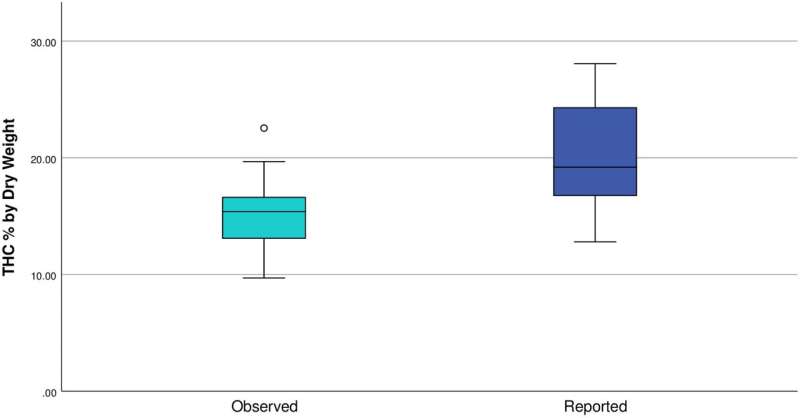
The average observed THC potency was 23.1% lower than the lowest label reported values and 35.6% lower than the highest label reported values. Overall, ~70% of the samples were more than 15% lower than the THC potency numbers reported on the label, with three samples having only half of the reported maximum THC potency. 13 of 23 tested samples had observed values that were more than 30% lower than the lowest reported value.

Discrepancies at the dispensaries: Study finds THC potency much lower than labeled
Mean THC % by dry weight for observed (light blue) and reported values (dark blue). Credit: PLOS ONE (2023). DOI: 10.1371/journal.pone.0282396

While the research was not set up to explain the THC potency discrepancies, only to detect them, they did rule out a few possibilities. The sample testing used by the dispensaries could be different.

The testing instrumentation used by Mile High Labs is the most common method used in Colorado, with all ten current testing labs advertising High-Performance Liquid Chromatography as the method used. So all of the samples, if tested by a different methodology, would need to be sent out of the area, a practice that could be seen as "lab shopping" to obtain higher THC potency results.

Researchers considered the possibility of THC degradation. According to previous research, when stored at , THC potency decreases by ~17% after one year and up to~ 41% after four years. When THC degrades this way, it is converted to cannabinol (CBN) which was not observed in sizeable enough quantities in the study, indicating the lower potency values were not due to age or poor storage conditions.

The authors also mention the possibility of an economic incentive related to THC labeling, as consumers are willing to pay a premium for higher-potency cannabis. This suggests a motive at least for intentionally inflated THC potency by only sending the highest potency samples for testing, lab shopping for more favorable analysis, or directly presenting erroneous data.

The researchers conclude that it is urgent steps are taken to increase the accuracy of cannabis labeling as a lack of accurate potency reporting could have impacts on medical patients controlling dosage. Additionally, recreational consumers should be getting what they pay for. As the legal cannabis market continues to grow, it is essential that the industry moves toward selling products with more accurate labeling or risk losing trust in the industry as a whole.

More information: Anna L. Schwabe et al, Uncomfortably high: Testing reveals inflated THC potency on retail Cannabis labels, PLOS ONE (2023). DOI: 10.1371/journal.pone.0282396


https://medicalxpress.com/news/2023-04-discrepancies-dispensaries-thc-potency.html

Biden’s approach to crisis: make too-big-to-fail banks even bigger

 Six weeks into President Joe Biden’s first major financial crisis, the White House’s approach is clear: make America’s biggest banks — “too big to fail” banks from 2008 — even bigger.

The result is bad for small businesses.

Three of America’s four biggest banks — JPMorgan Chase, Citigroup and Wells Fargo — reported last week what The Wall Street Journal called “blowout” earnings.

Collectively, profits, at $22 billion, were a third higher than last year.

But aren’t we in a banking crisis?

In March, the country experienced the second-largest bank failure ever, when the feds seized Silicon Valley Bank, the 20th-biggest bank, and its $175.4 billion in deposits.

A week later, regulators seized smaller Signature Bank and its $89 billion.

You’d think a banking crisis would not be great for banks.

True: Consumers have pulled a half-trillion dollars from the country’s bank-deposit base this year, shrinking deposits by nearly 3%.

Yet the biggest banks have benefited.

Even as people and businesses have withdrawn their money from banks overall, they’ve increased the money they keep at the biggest banks.

JPMorgan Chase and Citigroup saw deposits rise by $80 billion, and Wells Fargo saw an increase, too.

Why? Federal bank-deposit insurance only guarantees your first $250,000 in an account if your bank fails.

California-based Silicon Valley Bank collapsed in March.
REUTERS/Brittany Hosea-Small/File Photo

So businesses and people with money in the bank exceeding this limit are nervous about keeping those funds anywhere but at the biggest banks.

But why would they be? The Federal Deposit Insurance Corp. limit isn’t higher at JPMorgan Chase than at your corner bank.

If JPMorgan fails tomorrow and you’ve got several million dollars in savings there, you’re just as out of luck.

ut wealthy individuals and execs don’t see it that way. They think it’s inconceivable the government would let JPMorgan (or Citi or Wells or Bank of America) fail.

That’s because the government bailed these banks out in the 2008 financial crisis. Back then, both Citi and BofA needed tailored bailouts.

Dodd-Frank, the 13-year-old law that was supposed to “put a stop to taxpayer bailouts once and for all,” as then-President Barack Obama put it, never did any such thing.

All Dodd-Frank did was put big banks under constant supervision — so they won’t fail.

But the government can never know every aspect of a bank’s operations.

The Federal Reserve was scrutinizing Silicon Valley Bank and identified serious problems with its risk management nearly two years ago.

But the regulators did . . . nothing.

New York City's Signature Bank collapsed shortly after SVB.
New York City’s Signature Bank collapsed shortly after SVB.
Kevin C. Downs for NY Post

It took the free market — bank depositors sniffing out information and acting on that information, yanking their money — to reveal SVB’s deficiencies to the world.

After SVB and Signature failed, regulators experienced panic of their own, quickly suspending their rules and offering all depositors at the two banks insurance, above $250,000, after the fact.

This was supposed to stem the outflow from other medium-sized banks to the biggest banks. But it didn’t work.

Absent adherence to a rule, customers at other banks have no idea how big their bank must be for them to receive full deposit insurance.

And what if regulators change their minds and refrain from making good on all deposits should another midsized bank fail?

Safer to stick with the biggest.

That’s how the nation’s four biggest banks nearly quadrupled their deposits since 2007, before the financial crisis, from a collective $1.6 trillion to more than $6.1 trillion now — a third of all deposits in the country, up from fewer than a quarter.

These two medium-sized-bank failures represent the first test of Dodd-Frank, and what have they proven? The government is scared to use its own post-crisis laws; it immediately resorts to bailouts.

Big banks’ too-big-to-fail advantage builds on itself. Right now, small banks have to offer much higher interest rates to attract deposits, to compensate for higher risk.

This means smaller banks have less money to loan to small businesses, and they’ll have to charge higher interest rates.

A monolith of big banks is bad for small businesses in other ways. Big banks make decisions based on algorithms.

Big banks have their place, but small businesses need the option of going to a local institution, one whose lending officers have a feel for whether to offer somebody with a limited credit record money to open a restaurant or a store, based on their understanding of whether a specific plan might work in a particular location.

Then there’s the long-term risk: Someday, a big bank will start to fail. What will Biden do?

Nicole Gelinas is a contributing editor to the Manhattan Institute’s City Journal.

https://nypost.com/2023/04/16/bidens-approach-to-crisis-make-too-big-to-fail-banks-even-bigger/