Search This Blog

Wednesday, April 26, 2023

Bud Light Suffers "Staggering" Sales Decline As Boycott Intensifies

 New Bud Light sales data shows a "staggering" decline after the brewer attempted to position itself as the king queen of "woke" beers with the help of a transgender TikTok influencer partnership. 

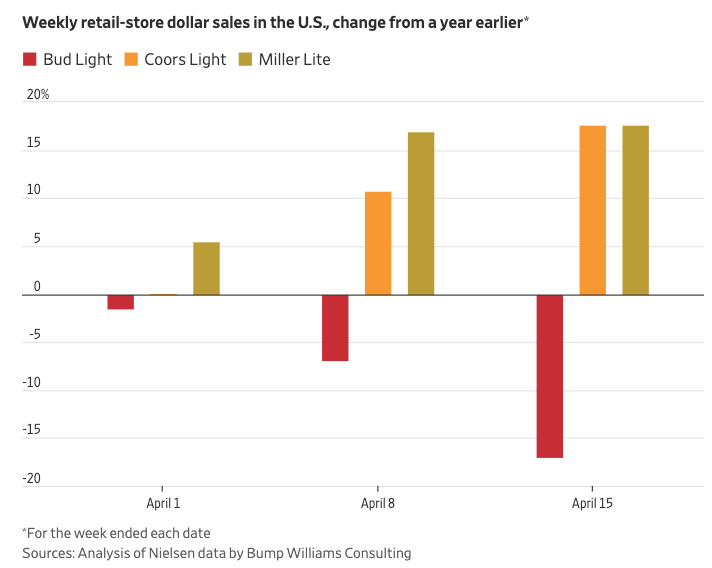
According to the New York Post, data from NielsenIQ and Bump Williams Consulting reveals a significant decline in Bud Light sales for the week ending on April 15, with a 17% plunge in revenue and a 21% slide in volume.

For the week ending April 8, the seven days following trans-TikTok influencer Dylan Mulvaney promoting Bud Light on April 1, sales fell 6%, and volume sank 11%. 

"These numbers are staggering ... and right now this is an extremely difficult scenario for Anheuser Busch, the Bud Light brand, and for AB distributors," according to an Insights Express report published on April 23, which focuses on the beer industry. 

Meanwhile, the boycott of Bud Light has sent Coors Light and Miller Lite's sales surging, suggesting consumers' deep opposition to Bud Light's marketing mishap. 

Source: The Wall Street Journal 

Recall on April 2. We were the first to report "Did Bud Light Go 'Woke' With Trans-TikTok Star? Boycott Calls Intensify." 

Additional data from BeerBoard, a tech company that monitors 3,000 locations, such as Buffalo Wild Wings, TGI Fridays, and Hooters, found Bud Light pours were 6% lower than other light lagers from April 2 to April 15. 

Bud Light made a series of moves late last week following the backlash and increasing boycott calls for its products. Alissa Heinerscheid, the vice president of marketing for Bud Light, was forced to take a leave of absence. Another top exec, Daniel Blake, is also stepping aside.

Fox News said Anheuser Busch hired consultants with experience in Washington, DC's conservative circles in an attempt to stop the hemorrhaging of sales.

Former Anheuser-Busch exec Anson Frericks told co-host Will Cain on "Fox & Friends Weekend" on Sunday that the brewer is seeking to restore its conservative base might be a "wrong bet" because many diehard drinkers won't forget the Mulvaney TikTok marketing blunder. 

"That's the bet they're making. I think that's the wrong bet to make. And I think now is the time to go back and, for companies like Anheuser-Busch, to say that, 'Hey, moving forward for brands like Bud Light, we're not going to be political. We're not going to get involved in the environmental social governance movement because that's not what the customer wants,'" Frericks said. 

Coors Light and Miller Lite are the biggest beneficiaries of Bud Light going super woke. Companies should avoid involving themselves in political matters. 

https://www.zerohedge.com/markets/bud-light-suffers-staggering-sales-decline-boycott-Intensifies

New SOBRsafe Distributor with 5,000+ Customers Seeks to Replace Breathalyzers with SOBRcheck

  SOBR Safe, Inc. (Nasdaq:SOBR) (SOBRsafe™), providers of next-generation transdermal alcohol detection solutions, today announced that it has partnered with Think Twice (www.DUIprevention.org) to advocate SOBRsafe's technology to enterprise employers across key commercial markets. Founded in 2016, Think Twice is a leading provider of public safety products and programs throughout the United States and Canada. It serves over 5,000 customers across numerous industries, including occupational safety, medical, military, higher education, grocery, manufacturing, transportation and logistics. Think Twice will encourage customers to replace breathalyzers with SOBRsafe's faster, more hygienic technology for frontline, preventative applications.

https://finance.yahoo.com/news/sobrsafe-distributor-5-000-customers-061500442.html

War Threatens Ukraine Auto Empire of Biden Megadonor Urging Greater U.S. Role

 Ukrainian President Volodymyr Zelensky isn’t the only one demanding more military assistance from President Biden to protect Kiev from Russian forces. So too is a close Delaware friend and financial backer of Biden, who owns several luxury car dealerships around the Ukrainian capital. 

Winner
John Hynansky: The President’s close relationship with him illustrates larger ethical questions that have long surrounded Biden and his family.

By sending billions of dollars in weapons and other military aid to help defend Ukraine, Biden also is securing the investments of millionaire car magnate John Hynansky, a Ukrainian American and longtime supporter of the president. 

Over the course of Biden’s political career, Hynansky and his family have contributed more than $100,000 to his campaigns, including $8,000 in 2020, Federal Election Commission records show. Hynansky family members have been guests at the White House, and Hynansky has floated hundreds of thousands of dollars in loans to Biden family members, property records show. Hynansky’s son, Michael, who helps run his car empire, lent the use of his Lear jet to Biden when he was a senator.

Since Russia started shelling the area around Kiev in February 2022, the U.S. government has spent $77 billion to help Ukraine rebuild and repel future attacks. 

Government ethics watchdogs say the president’s friendship poses a potential conflict of interest that demands a full accounting of how the massive foreign aid, which includes open-ended humanitarian and economic assistance, has been used and who has benefited from it. On the military side, moreover, billions of dollars have gone to unspecified areas, such as “security," “intelligence," and “training." In the past, Hynansky has supplied the police cars and ambulances in several regions of Ukraine. 
 
The Biden administration helped Hynansky’s team in Ukraine prepare for the invasion, including placing calls to his top executive in Kiev 13 days in advance of Russian tanks crossing the border. It has sent billions of dollars to help rebuild war-torn cities where Hynansky operates the largest share of the country’s car showrooms and service centers specializing in Porsches, Jaguars, Land Rovers, and Bentleys, among other non-American brands he imports.  

Although supporting Ukraine is a policy with widespread – though not universal – bipartisan support in Washington, the president’s close relationship with Hynansky illustrates larger ethical questions that have long surrounded Biden and his family members, who often have financial interests directly affected by policies he endorses. While serving as President Obama’s point man in Ukraine in 2015,  Biden famously demanded the firing of a prosecutor who was investigating a natural gas company, Burisma, that was paying his son Hunter $80,000 per month to serve on its board. Recent revelations of lucrative dealings with concerns tied to China’s Communist government while Joe Biden was both in and out of office have also raised questions about his current policy toward Beijing. 

At a time Supreme Court Justice Clarence Thomas’s relationship with a generous billionaire is fueling complaints among Democrats about money and politics, Biden’s friendship with Hynansky also raises red flags.  

Helping 'My Very Good Friend' 
 

The connection between Joe Biden and Hynansky’s business ventures dates back to 2009, when the then-vice president made his first visit to Ukraine. In a speech in Kiev to government officials, Biden singled out Hynansky for praise, noting that he had just had breakfast with “my very good friend, John Hynansky.” (The previous year, Hynansky had individually contributed more than $33,000 to the Obama-Biden ticket primarily through the Obama Victory Fund, according to FEC records.) 

Within months of his hobnobbing with the vice president and local officials in the Ukrainian capital, Hynansky scored his first international development loan from the U.S. Overseas Private Investment Corporation, or OPIC, a federal body whose board was appointed by President Obama. Hynansky used the $2.5 million to break ground on a new headquarters and massive distribution center outside Kiev that prepares 8,000 cars for sale every year. In 2012, Hynansky landed another $20 million in OPIC funding to expand his dealership facilities, federal records show, helping him corner roughly 25% of the luxury car market in Ukraine. 

"The proceeds of the loan will be used to construct and operate two new, state-of-the-art dealership facilities for Porsche and Land Rover/Jaguar automobiles, and repay any outstanding balance of an existing OPIC loan,” according to a 2012 OPIC financing document. 
 
The terms of the OPIC loans state that all cars sold at his dealerships would be imported from Europe, not the United States, which meant that American-based automakers would not benefit from the taxpayer-backed venture. Under "U.S. economic impact,” the loan summary states that the jobs created from the deal would be created in "the host country, Ukraine,” not America. The terms of the loan also deferred Hynansky’s paying the principal on the loans for almost three years during construction, according to the OPIC document, which called the deferment a “grace period." 
 
The next year, acting as Obama’s point man in Ukraine, Biden pushed for the ouster of what he called the country's Russia-friendly president and helped set up a coalition government in 2014 while promising millions in aid for the Ukraine energy industry. That same year, Hunter Biden, who is a close childhood friend of Hynansky’s daughter, Alexandra (who was listed as a sponsor on the OPIC loans), was appointed to the board of Burisma. 
 

Redfin/Google Street View
"The Biden Bungalow": When James and Sara became overextended financially, Hynansky came to the rescue.
In 2015, Joe Biden’s younger brother, James, and his sister-in-law, Sara Biden, became overextended financially after purchasing a six-bedroom, four-bathroom beach house plus guest house on Keewaydin Island, Fla., which was dubbed “The Biden Bungalow" after the vice president spent time there as well. Owing almost $700,000 in tax liens and contractor debts, the Bidens turned to Hynansky for help in lieu of a traditional lender. The car dealer came to the rescue with loans totaling $900,000. 
 
AP
Sara and James Biden: Off the beach and at the White House.
The bailout occurred as Hynansky’s powerful American pal oversaw U.S. policy in Ukraine, and as OPIC authorized new loans allowing his company to build a new 7,300-square-foot Porsche dealership along the highway that connects downtown Kiev to the Boryspil International Airport. 
 
Mortgage records initially reported the Bidens' lender as "1018 PL, LLC," obscuring Hynansky as the source of the loans. But the corporate entity is controlled by Hynansky, a 2018 document would later reveal. 
 
The Bidens sold the waterfront house in 2018, and Hynansky released his lien on the property. However, Hynansky did not acknowledge full payment and satisfaction of the loans, according to the details laid out in documents recorded in Collier County, Fla. 
  
Attempts to reach James Biden for comment were unsuccessful. 
Circuit Court, Collier County, Fla.
Years later, this filing showed that Hynansky controlled a generous Biden mortgage lender, 1018 PL LLC.
Hynansky is politically connected in Kiev as well as Washington. President Zelensky also calls Hynansky a good friend and in recent years has bestowed state awards on him. Kiev Mayor Vitaliy Klitschko also is close to the prominent Wilmington businessman. 

In August 2021, Hynansky secured a $24 million loan from the European Bank for Reconstruction and Development (EBRD) to expand its Ukraine operations into electric vehicles, including building new Renault and Volvo dealerships in Lviv. The U.S. is a founding member of EBRD and provides 10% of its capital. The Biden administration has been pushing such “green” deals. 
 
“In the near future, we intend to increase our presence on the Ukrainian market,” Hynansky’s top official in Ukraine, Petro Rondiak, said at the time.  
 
The White House did not respond to queries about the president’s relationship with Hynansky. 

Ukrainian Presidential Press Office
The area around Kiev airport, where numerous Hynansky auto dealerships are located, was considered safe enough that Biden could visit Ukraine's President in February.

Though Biden is silent about his actions in Ukraine as they concern Hynansky and his businesses there, he has repeatedly denied that his son’s Burisma dealings influenced his official actions in Ukraine -- which included handing over more than $50 million in U.S. support to assist the Ukrainian energy industry, an aid package Biden personally announced in Kiev the month before Burisma hired his son in 2014. 
 
Republicans are investigating whether those funds were intended to help his son’s business interests in Ukraine. Less explored is whether U.S. tax money has also been used to protect or boost Hynansky’s Ukrainian investments. 
 
Paul Kamenar, counsel to the National Legal and Policy Center, a Washington watchdog group. said that in dealing with Ukraine, Biden increasingly is drawing suspicion he may be putting his own political fortunes ahead of the national interest.  

Many of Hynansky’s dealerships ‒ organized under the Winner Group Ukraine ‒ are located around the Kiev airport. Though the American head of Winner Group Ukraine fled the country after Russia’s invasion, the dealerships are still “operational,” according to a spokesperson at Hynansky's headquarters in Delaware. All told, his Ukrainian subsidiary controls some 55 dealerships and service centers employing more than 800 workers. 

Thanks to the shipment of U.S. weaponry ‒ including Stinger missiles, howitzers, and Abrams tanks ‒ properties around Kiev airport are now secure enough that Biden was able to use the train station just 19 miles away to visit Zelensky during February's anniversary of the invasion. And though Boryspil International Airport is still closed, Ukrainian forces have retaken strategically important suburbs of Kiev near the airport. 

Winner
Petro Rondiak, Hynansky’s top executive in Ukraine: "Dear western ally politicians, when will the gloves come off?"

Since taking control of the House, Republicans have threatened to curb aid to Ukraine and audit the massive funds the Biden administration and the Democratic-controlled Congress have funneled there.  
 
Winner executives have been clamoring for more U.S. military aid and direct intervention by Biden and other Western leaders. Before the invasion, the company had reported its best year in Ukraine. 
 
Rondiak, Hynansky’s top executive in Ukraine, has called for greater military intervention from America and the West, including setting up a "no-fly zone" over Ukrainian airspace. "Dear western ally politicians,” he tweeted in December, “when will the gloves come off?" 
 
Added Rondiak, “The flow of weapons must increase quickly.” He's also called for a military counteroffensive "to punish Putin.” 
 
Although car sales are down, he said virtually all of Hynansky's "dealers are operating” in Ukraine thanks to Biden administration support. He also praised the State Department for calling him to warn him to leave Kiev for his own safety two weeks ahead of the invasion.  

U.S. Aid 'as Long as It Takes'  

Biden has pledged to keep sending U.S. funds to Ukraine "as long as it takes,” continuing indefinitely an already unprecedented spending stream. Support to Ukraine from other countries lags far behind the United States. Britain is providing less than 10% of what America is sending there, despite ranking second in total aid, according to Council on Foreign Relations data. 
 
Kamenar suggested that a special inspector general may be needed to audit U.S. spending in Ukraine, similar to the one Congress created to monitor U.S. aid and reconstruction contracts in Afghanistan.  

House Oversight Committee Chairman James Comer said he suspects the kind of fraudulent and wasteful spending the Pentagon IG uncovered in Afghanistan "could be happening in Ukraine, where we are spending a significant amount of tax dollars.” 

 
"I know some of the tax dollars are going for ammunition. I know some of it's going for humanitarian aid,” Rep. Comer told CNN last week. "But we hear that not all of it is."  

Some administration critics say that Biden has done a poor job of explaining why supporting Ukraine is in America’s interests. Irrespective of that complaint,  the Biden’s financial entanglements with Hynansky muddy the waters – and have gone unreported in the news coverage about his intense focus on the embattled country. 
 
Long before Hunter Biden landed a lucrative oil and gas deal in Ukraine, despite having no prior experience inUkraine or the energy industry, Biden benefactor Hynansky began investing heavily in Ukraine -- with Joe Biden’s help. 

https://www.realclearinvestigations.com/articles/2023/04/26/war_threatens_ukraine_auto_empire_of_biden_megadonor_urging_greater_us_role_895319.html

COVID lockdown scolds killed people — but they still have no shame

 “You horrible scolds killed people. You should be forever ashamed.”

That was the reaction of a friend on Facebook to a new University of Virginia Health study showing suicide attempts by overdose among children rose sharply during the pandemic. And, of course, he’s right.

It was about three years ago that we were told we should lock things down for “two weeks to slow the spread.”

The initial argument seemed plausible — shutter for a bit to slow transmission of the Chinese coronavirus now known as COVID-19 just enough that hospitals and other health-care facilities could handle the surge.

Would a two-week lockdown have helped? We don’t know because we got something closer to two years.

Or longer: Though evidence that mandatory masking worked was somewhere between skimpy and nonexistent, we only this year saw experts finally calling for an end to mask requirements in health-care facilities, among other measures.

Meanwhile, studies keep coming out indicating all sorts of harm from these so-called “non-pharmaceutical interventions” during COVID.

The damage ranges from the “shocking” increase in LGBTQ intimate partner violence that a Rutgers study found, to a rise in sex attacks on teen girls, to a major decline in cancer screenings, to an “unprecedented” drop in teen mental health, to a dramatic loss in kids’ school learning, which remedial attempts have been unsuccessful in reversing. Even bar exam scores suffered.

Though these interventions didn’t do much to reduce COVID death rates — Sweden, which avoided lockdowns, did better than the nations that pursued them — there’s considerable evidence they caused increased numbers of deaths from heart attacks, obesity, mental-health problems, drug overdoses and the like.

People who because of their age were at very low risk from COVID died at much higher-than-normal rates from these other causes as a result of the disruption of normal life, the cutoff of normal social-support networks and, of course, the endless miasma of fear government and media spread.

And children were hurt the most, suffering developmental delays and other losses.

For a 6-year-old, two years of masking and lockdowns is nearly half a lifetime, and you can’t get those years back.

Even the Centers for Disease Control and Prevention admitted lockdowns fueled strep, flu and respiratory-syncytial-virus outbreaks.

Many lockdown measures were nonsensical or downright discriminatory.

As lefty blogger Nate Silver observed, “It’s kind of crazy (and tells you a lot about who was writing the restrictions) that churches in some jurisdictions were subject to more restrictions than museums! Not even attempting to follow any sort of epidemiological principles.”

We saw outdoor skate parks filled with sand, ocean kayakers cited for not wearing masks while paddling alone on the ocean and, as the post Silver retweeted noted, a Santa Clara church and its congregation made the “targets of an unprecedented surveillance operation” over defiance of lockdown rules.

It was a golden age for scolds, busybodies and petty tyrants, and they made the most of it.

The result was a drastic loss of trust in the honesty and competence of public authorities, scientists and the media at every level, a loss of trust that was 100% justified.

I myself wasn’t skeptical enough, which is rare. I knew the history of the 1918 flu, where there were short-term mask rules and business closures, and foolishly assumed the coronavirus rules would be something like that. Short term and comparatively modest.

Boy, was I wrong. In my defense, we live in a different — and in many respects worse — America than 1918’s.

Our authorities are more venal and less competent (no small feat, as they were no great shakes back then, really), our press more one-sided and, lamentably, our public less willing to resist the abuse of power.

Though in the event of some new pandemic, I expect much less cooperation. People may have been too trusting before, but now they know better.

The scolds were happy. Once America made fun of them, mocking characters like nosy neighbor Gladys Kravitz from “Bewitched” as they stared between the curtains at the goings-on next door.

During the pandemic era, though, we empowered them. They got to mind other people’s business while pretending to serve the public interest.

But those horrible scolds killed people, by enabling — and demanding and continuing to demand — intrusive government policies that demonstrably didn’t work and in fact made things worse.

Will they be forever ashamed? Nope. But they should be.

Glenn Harlan Reynolds is a professor of law at the University of Tennessee and founder of the InstaPundit.com blog.

https://nypost.com/2023/04/24/the-covid-lockdown-scolds-killed-people-but-they-still-have-no-shame/

Biden To ‘Lean Into’ Abortion for Reelection

 Within the first five seconds of officially announcing his run for reelection, President Biden made clear that abortion would be a cornerstone of his campaign.

The second still image from his launch video showed a protestor standing outside the Supreme Court. An encapsulation of Democratic orthodoxy, her sign read, “abortion is healthcare.” The Biden campaign believes that by uniting around that message, and attacking the GOP as extremists on abortion, they can keep a Republican out of the White House in 2024 just like they held off a predicted “red wave” in 2022.

A campaign spokesman told RealClearPolitics that abortion access will be “a huge tenet” of the reelection strategy and that, on this question, Vice President Kamala Harris will serve as “the leading voice.”

And while Biden spoke first to a friendly union crowd earlier in the day, touting his efforts to revive domestic manufacturing and promising to “finish the job,” it was Harris who delivered the pro-abortion message at the campaign’s first official rally.

“I stand here, proud to run for reelection with President Joe Biden, as vice president of the United States of America, so we can finish the job,” she told a crowded auditorium at Howard University before blasting Republicans as “so-called leaders who want you to bow down to them, to elect them, to praise them, to say they are strong when they’re in the process of tearing down rights and freedoms.”

Reporters spotted Julie Chavez Rodriguez, the newly announced campaign manager, watching from the crowd. Her number two: Quentin Fulks, an alum of Sen. Raphael Warnock’s 2022 successful reelection and also the pro-abortion group Emily’s List.

Biden and his team are confident they have the right personnel and policy in place to win the abortion argument in a general election, regardless of who Republicans nominate, according to a senior Democratic aide familiar with the campaign’s plans but who spoke on condition of anonymity because they were not authorized to discuss details on the record.

“They all have this political anvil tied around their waist, and we can talk credibly about the issue and how extreme Republicans are no matter who their nominee is, even if that’s not Trump,” the aide told RCP in reference to the GOP field led by the former president.

Abortion access was always going to be a central pillar of the campaign, the aide added, but Biden and Harris are “leaning in because Republicans are giving us that opportunity,” before saying that for the GOP, “abortion in this primary for them will be what ‘Medicare for All’ was for us in 2019.”

“And when they stand on a debate stage in August, one of the first questions will be, ‘would you sign a national abortion ban – yes or no? Raise your hand,’” the aide predicted. The resulting image, they said, will be “seared into the minds of voters.”

Democrats have rallied around abortion rights since the Supreme Court overturned Roe v. Wade last summer, and Biden had promised before the midterms that he would codify Roe into federal law if voters delivered him a super majority in the Senate, a hope that did not develop. Though buoyed politically by the controversy as more and more states pass legislation limiting abortion, the White House has not said if the president favors any national restrictions at all. That debate now consumes Republicans.

Trump earned a strong rebuke from the anti-abortion lobby earlier this month when he said that the “issue should be decided at the state level.”

Marjorie Dannenfelser, president of SBA Pro-Life America, promised her group would oppose any candidate “who refuses to embrace at a minimum a 15-week national standard to stop painful late-term abortions while allowing states to enact further protections.”

Some Republicans, like Mike Pence, who is mulling his own White House bid, have already expressed a willingness to meet that standard. The former vice president told RCP in an interview last September that he supports a 15-week ban. Others, like former U.N. ambassador Nikki Haley, told RCP earlier this month that debating what week to ban abortion is “a no win.”

Haley was the first declared candidate to address the topic at length, laying out her vision for finding a “national consensus” on abortion at SBA Pro-Life America. At the group’s headquarters in Arlington, the former South Carolina governor, who signed a 20-week ban into state law, insisted that there was a “federal role” for regulating abortion but gave no specifics.

What was possible in red states, she added, would not be enacted at the federal level, noting that “no Republican president will have the ability to ban abortion nationwide. Just as no Democratic president can override the laws of all 50 states.”

In a statement afterwards, the influential pro-life group praised Haley for her commitment “to acting on the American consensus against late-term abortion by protecting unborn children by at least 15 weeks when they can feel excruciating pain.”

The Haley campaign disputed the characterization by SBA, telling RCP that her speech “was clear” and that she wants to find consensus to ban “late-term abortion” but did not put forward any specific restrictions.

A spokesperson for the organization that promised to oppose any candidate not backing a 15-week ban assured RCP that they listened to every word that Haley just delivered at their headquarters. “We stand by what she assured us,” the official told RCP, without offering additional specifics on the record.

https://www.realclearpolitics.com/articles/2023/04/26/an_anvil_tied_around_their_waist_biden_to_lean_into_abortion_149153.html
GSK says more deals to come as oncology takes another blow

 After coughing up $2bn for Bellus and paying $90m to license Scynexis’s antifungal, more deals are on the way from GSK, with chief executive Emma Walmsley telling journalists this morning to “expect more targeted business development” this year. Any moves are likely to be made in infectious diseases – including vaccines and HIV – and immunology/respiratory, where the group is increasingly focusing. GSK has all but admitted missing the boat in oncology, and revealed a further blow to those efforts in today's financial results. The group lost a case against Astrazeneca over Zejula that could see GSK pay out low single-digit royalties on sales of the cancer drug in the coming years, Evaluate Vantage understands. The spat centres on patent licence agreements that Zejula’s original developer, Tesaro, struck with Astra in 2012, and fighting its case dented GSK’s operating profits in the first quarter. A phase 3 trial testing Zejula in early-stage breast cancer was also terminated this month; coming after recent label restrictions for the Parp inhibitor class Zejula is increasingly looking like an expensive asset to support. True, it is not one of GSK's big growth drivers, but positive readouts from its development programme are needed.

Zejula: pending late-stage readouts 
TrialSetting Readout
Ruby (ph3)Recurrent or primary advanced (stage III/IV) endometrial cancer; Zejula +/- Jemperli + chemoPart 1 toplined as positive, progressing to part 2 readout
First (ph3)1L stage III/IV nonmucinous epithelial ovarian cancer; SOC +/- Zejula +/- JemperliPCD Jul 2023
Zeal (ph3)1L NSCLC maintenance; Zejula + Keytruda vs placebo + KeytrudaPCD Dec 2024
Zest (ph3)Her2-ve BRCAm or triple-negative breast cancer, with ctDNA after definitive therapy; Zejula vs placeboTerminated after enrolment problems
PCD=primary completion date. Source: clinicaltrials.gov & company statements.

https://www.evaluate.com/vantage/articles/news/corporate-strategy-snippets/gsk-says-more-deals-come-oncology-takes-another

Tecentriq runs out of luck in triple-negative breast cancer

 Roche’s historic strength in breast cancer once looked likely to extend to triple-negative disease courtesy of Tecentriq, but now the PD-L1 MAb is drinking in the last-chance saloon.

Today’s quiet discontinuation of Impassion-030 in adjuvant TNBC, a major study as Roche tries to push into perioperative settings, marks the latest in a list of failures and disappointments. It comes as new management tries desperately to improve the Swiss group’s oncology fortunes, which had recently been brightened by Tecentriq’s surprising success in adjuvant liver cancer.

In TNBC (triple-negative breast cancer), however, the latest setback comes after the perioperative NeoTRIPaPDL1 trial failed in December 2019. Tecentriq plus chemo did once have accelerated approval for first-line TNBC, thanks to Impassion-130, but that was rescinded when the confirmatory Impassion-131 study drew a blank; that was followed by the failure of a first-line ipatasertib combo in Ipatunity-170.

Futile

On its first-quarter investor call today Roche said Impassion-030 had been discontinued after a data-monitoring committee conducted a futility analysis and ruled that the chemo combo trial was unlikely to meet its primary endpoint of invasive disease-free survival versus chemo alone.

In perioperative TNBC Roche had already lost ground to Merck & Co, which succeeded in getting Keytruda plus chemo fully approved on the basis of the controversially designed Keynote-522 trial. The trial had also supported the Merck MAb’s full first-line approval in ≥10% PD-L1 expressers.

Roche did appear to score in the neoadjuvant Impassion-031 trial, but that was on the basis of pathological complete response, which is not generally an approvable endpoint. This fact was confirmed when Roche pulled an EU filing for this use and Impassion-031 failed to show a benefit on event-free survival.

Tecentriq in triple-negative breast cancer
StudyDesignPrimary endpoint(s)Result
Neoadjuvant
Impassion-031Abraxane combo, vs AbraxanepCR in PD-L1+ and all-comersPositive for pCR, negative for EFS (secondary endpoint); EU filing withdrawn
Neoadjuvant + adjuvant
NeoTRIPaPDL1*Abraxane combo, vs AbraxaneEFSFailed in Dec 2019
MO39875*Chemo combo, vs chemopCR & EFSEnds in Dec 2023
Adjuvant
Impassion-030Chemo combo, vs chemoiDFSFailed in Q1 2023
First-line
Impassion-130Abraxane combo, vs AbraxaneOS & PFS in PD-L1+ and all-comersApproved in ≥1% PD-L1, but withdrawn in Aug 2021 after Impassion-131 failed
Impassion-131Paclitaxel combo, vs paclitaxelPFS in PD-L1+ and all-comersUpsized by 11%, failed in Oct 2020
Impassion-132Chemo combo, vs chemoOS in PD-L1+ and all-comersUpsized by 63%, completion delayed from Jul 2019 to Jun 2023
Ipatunity-170Ipatasertib + paclitaxel +/- Tecentriq vs paclitaxel +/- TecentriqPFS & OS in PD-L1+ & PD-L1-Failed in Feb 2021
Note: *academia-sponsored study. pCR=pathological complete response; EFS=event-free survival; iDFS=invasive disease-free survival. Source: clinicaltrials.gov & company presentation.

Other pipeline changes revealed by Roche today included discontinuation of the geographic atrophy project RG6312, though the group has a couple of other irons in the fire here.

In oncology Roche played up its Kras G12C inhibitor RG6330, which now carries the INN divarasib and is in phase 3. And it confirmed that the hotly awaited Skyscraper-01 trial of Tecentriq plus the Tigit MAb tiragolumab had not hit for overall survival at an interim analysis, and was thus continuing to final readout in the third quarter.

Despite this Roche’s recently appointed head of pharma, Teresa Graham, said the group continued to be interested in the Tigit pathway, and was considering starting new phase 3 trials. The Tigit story is “far from fully written”, she told analysts.

And she defended Tecentriq, insisting that Impassion-030’s failure did not affect any other ongoing TNBC trials; these include MO39875 in perioperative disease and the upsized first-line Impassion-132 chemo combo study, both due to end this year. True, Tecentriq cannot be entirely written off in TNBC, but given the numerous setbacks this looks like an optimistic take.

Roche stock slipped slightly on today’s first-quarter figures, and the latest pipeline setbacks mean that Graham and the group’s new chief executive, Thomas Schinecker, have it all to do.

https://www.evaluate.com/vantage/articles/news/trial-results/tecentriq-runs-out-luck-triple-negative-breast-cancer