Search This Blog

Saturday, August 26, 2023

Oximeters often overestimate COVID patients' oxygen levels, delaying care

 A study led by Johns Hopkins University researchers suggests that the use of pulse oximeters in hospitalized COVID-19 patients often overestimated true arterial oxygen saturation (SaO2), especially in those of minority race, and led to delayed therapy in a high proportion of patients of all races.

For the study, published today in JAMA Network Open, the researchers used linear mixed-effects models to evaluate the relationship between the overestimation of  in COVID-19 patients using  and time to receipt of the drugs remdesivir or dexamethasone, hospital length of stay, risk of hospital readmission, and in-hospital death among 24,504 patients at 186 U.S. hospitals with concurrently measured  oximetry oxygen levels (SpO2) and SaO2 from March 2020 to October 2021.

Average patient age was 63.9 years, 41.9% were female, 41.4% were white, 32.2% were Hispanic, 16.0% were Black, and 10.4% were Asian, Native American or Alaskan Native, Hawaiian or Pacific Islander, or another race.

The investigators also assessed a subset of 8,635 patients admitted after July 1, 2020, who didn't need immediate COVID-19 therapy based on an SpO2 reading of 94% or higher without .

"Observational data and laboratory studies suggest that pulse oximeters systematically overestimate arterial oxygen saturation among patients from minority racial and , leading to a greater risk of occult hypoxemia, generally defined as a true arterial oxygen saturation (SaO2) below 88% with an oxygen saturation by pulse oximetry (SpO2) in a normal range above 92%," the study authors wrote.

Minorities had more hidden low oxygen

Pulse oximetry overestimated SaO2 for Black (adjusted mean difference, 0.93 percentage points), Hispanic (0.49 percentage points), and other race (0.53 percentage points) patients compared with white patients. In the patient subset, compared with white patients, Black patients were at significantly higher risk of having pulse oximetry measurements that masked the need for COVID-19 medication (adjusted odds ratio [aOR], 1.65).

Occult hypoxemia (hidden low oxygen) was noted in 18.3% of Black patients, 20.9% of Hispanic patients, and 19.7% of patients from other racial and ethnic minority groups (19.7%), compared with 13.0% of white patients. At the individual level, occult hypoxemia was seen in 4.9% of SpO2−SaO2 pairs (4.9%) among Black patients, 5.1% among Hispanic patients, and 4.5% among other racial minority patients, compared with 3.5% among white patients.

Of note, Black patients had the lowest rate of in-hospital death and the shortest length of hospital stay.

Patients with an unrecognized need for COVID-19 medication were 10% less likely to receive it (adjusted hazard ratio, 0.90) and had higher chances of readmission (aOR, 2.41), regardless of race. There was no link between the unrecognized need for COVID-19 therapy and in-hospital death (aOR, 0.84) or length of stay (mean difference, −1.4 days).

Pulse oximeter inaccuracy was highest among patients of minority race, suggesting that these groups would be disproportionately affected on a , but about 13% of patients who had occult hypoxemia and over 43% of patients with an unrecognized need for COVID-19 medication by pulse oximetry were white.

"These results suggest that although racial and ethnic disparities exist in measurement of oxygen saturation by pulse oximetry, overestimation may increase the risk of hospital readmission regardless of patient race," the researchers wrote. "The relationship between overestimation of oxygen saturation with timing of COVID-19 medication delivery and clinical outcomes remains unknown."

Improved pulse oximeter accuracy is critical to the delivery of timely and equitable care to COVID-19 patients. "The implications of pulse oximeter errors likely extend to other acute respiratory illnesses and oxygen supplementation in chronic respiratory disease, which necessitate ongoing investigation," they concluded.

More information: Ashraf Fawzy et al, Clinical Outcomes Associated With Overestimation of Oxygen Saturation by Pulse Oximetry in Patients Hospitalized With COVID-19, JAMA Network Open (2023). DOI: 10.1001/jamanetworkopen.2023.30856


https://medicalxpress.com/news/2023-08-oximeters-overestimate-covid-patients-oxygen.html

Activating astrocytes in the basal forebrain keeps mice awake without any signs of sleepiness

 Sleep is known to support the proper functioning of body, including the brain, allowing it to rest, recover, and recharge. While countless neuroscientists and medical researchers have been trying to better understand this vital biological process, much of its neural underpinnings are still unknown.

Researchers at Washington State University (WSU) have been conducting studies investigating the role of astrocytes, a subtype of glial cells known to regulate different brain and bodily functions, in sleep and wakefulness. Their most recent paper, published in the Journal of Neuroscience, shows that the activation of astrocytes in the basal forebrain (i.e., a brain region that supports the regulation of sleep, waking-up and body temperature) caused mice to remain awake indefinitely, without showing any signs of sleepiness.

"Our study was part of a larger investigation into the  and circuits that make us sleepy," Marcos Frank, one of the researchers who carried out the study, told Medical Xpress. "Scientists refer to this as 'sleep drive,' and we really don't have a complete explanation of sleep drive. Back in 2009, we published the first evidence that a class of non-neuronal cells called glial astrocytes influenced sleep drive in vivo. Since then, we have been trying to understand the precise role of astrocytes in sleep and wakefulness."

The key objective of the recent work by Frank and his colleagues was to better understand how astrocytes in the basal forebrain influence sleep, wakefulness, and overall sleep drive. To do this the researchers used a series of advanced genetic and chemical techniques to reversibly alter the activation of astrocytes in the mouse basal forebrain.

"We used a 'chemo-genetic' technique to express a receptor to a small molecule not normally expressed in the mammalian brain," Frank explained. "When activated by a special drug, this receptor activates astrocytes. We combined this with standard measures of brain activity and motor activity, which together tell us if the animal is awake or asleep."

To ensure that the effects they observed were specifically linked with the chemo-genetic activation of astrocytes, the team also carried out several control experiments, where the same mice were observed in similar circumstances but without their astrocytes being activated. Ultimately, the researchers observed that the activation of basal forebrain astrocytes resulted in the mice being awake for hours on end, without exhibiting any typical signs of sleepiness.

"It seemed that the mice were awake without any 'cost,' or in other words no increased sleep drive," Frank said. "This was unexpected to us and has several important implications. First, our results challenge the notion that our need for sleep is generated by wakefulness per se. Instead, it may require a specific set of interactions between subtypes of brain cells."

Overall, the recent findings gathered by this team of researchers highlight the key role of some neuronal-glial circuits in modulating sleep drive and wakefulness. In the future, they could pave the way to exciting new discoveries about the neural underpinnings of sleep, potentially also enabling the creation of drugs that allow people to remain awake and lucid for prolonged periods of time.

"Imagine a world where (if this is translated to humans) shift-workers don't get sleepy, and for extended periods, astronauts, pilots, soldiers, health-care providers, first-responders can dispense with ," Frank added.

"We are very early in this process, but if this were to happen, it would forever change the limits of human performance. Our next works will focus on understanding what happens next in the chain of events when we activate basal forebrain astrocytes. Does this lead to changes in surrounding neurons and how does that explain our results? What normally controls this process in the healthy , and is this -activated waking the same as normal waking? These are all questions we hope to answer in our future studies."

More information: Ashley M. Ingiosi et al, Activation of Basal Forebrain Astrocytes Induces Wakefulness without Compensatory Changes in Sleep Drive, The Journal of Neuroscience (2023). DOI: 10.1523/JNEUROSCI.0163-23.2023.


https://medicalxpress.com/news/2023-08-astrocytes-basal-forebrain-mice-sleepiness.html

Why The House Has No Alternative To An Impeachment Inquiry Into President Biden

 by Jonathan Turley,

Below is my column in The Messenger on the expanding evidence in the Biden corruption scandal and the need for Congress to take commensurate action to investigate the matter. After this column ran, Fox’s Brian Kilmeade conducted an interview with Ukrainian prosecutor general Viktor Shokin. What was striking about the interview is not just the contradiction with other accounts (like insisting that he was investigating Burisma and the investigation was expanding when he was fired), but that he claimed that Kilmeade was the first to seek to interview him. This is just Shokin’s account and many question his veracity. However, it is astonishing that this is the first interview that I have seen of one of the key figures in this scandal. It highlights the need to still fully investigate a scandal that the media has largely avoided in prior years.  However, the greatest case for an impeachment inquiry was made by Attorney General Merrick Garland himself.

Here is the column:

When Congress returns next month, it has little alternative but to launch a long-discussed impeachment inquiry into President Joe Biden. For House Speaker Kevin McCarthy (R-Calif.), the case for an inquiry came from a most unlikely source: Attorney General Merrick Garland.

The debacle in the Hunter Biden investigation has left most objective legal analysts in disbelief, with one CNN analyst calling it an “unholy mess.”

Even before the collapse of a widely condemned “sweetheart deal” with Hunter, the investigation headed by U.S. Attorney David Weiss was a growing concern for many observers. In prior years, I wrote about Garland’s refusal to appoint a special counsel despite the obvious conflicts posed by the potential involvement of President Biden in his son’s alleged influence-peddling scandal. I also raised the problem of an investigation that remained ongoing for years as the statute of limitations expired on major potential crimes.

It turns out that the same concerns were being raised within the Weiss team. Two IRS whistleblowers recently confirmed that the expiration of potential tax felony crimes was raised with Weiss and the Department of Justice (DOJ). There reportedly was an agreement to extend that period, including on the violations tied to the most controversial alleged payments from sources in Ukraine and other countries. The two witnesses testified that the Justice Department instead allowed the statute of limitations to expire.

These two whistleblowers — and, more recently, a former FBI agent — said that the DOJ tipped off the Biden team on attempts to interview Hunter and to conduct searches. They describe an investigation that was anything but the “routine” matter described by congressional Democrats in seeking to block House investigations.

What followed has bordered on the burlesque. Weiss cut a deal with Hunter’s legal team that was widely derided. After years of investigation, he and the DOJ agreed to a couple of tax misdemeanors, a papered-over gun charge, and no risk of jail time for the president’s son. The deal disassembled in court after a few questions from the presiding judge about sweeping immunity language and other curious elements. When District Judge Maryellen Noreika asked the prosecutor if he had ever seen any agreement like this one, he replied “no.”

House Republicans had previously demanded that Weiss and his team answer questions about the investigation and the plea bargain. And an appearance before a House committee was planned when Garland suddenly preempted that by doing what many of us have demanded for years: He appointed a special counsel. To the amazement of many, though, he appointed the one prosecutor who should have been categorically excluded — David Weiss.

Section 600.3 of the DOJ’s code on special counsels requires an appointment from outside the Justice Department, for obvious reasons. While another prior special counsel, John Durham, also came from within the Justice Department, Durham was retiring from the department at the time of his appointment. Not only did Garland have to ignore his own regulations to appoint Weiss but he also had to ignore the main qualification: The appointed outside counsel should be someone with “a reputation for integrity and impartial decision-making.”

Weiss could well have a legitimate defense to Republican complaints that he ran a fixed investigation into Hunter or accusations that he made false statements to his own team. However, he clearly remains under suspicion by many people. That is reflected in an ABC News/Ipsos poll in which almost half of Americans lack trust that the DOJ will conduct the Hunter Biden investigation in a “fair and nonpartisan manner.”

In addition to this controversial appointment, Garland again refused to expressly extend the special counsel’s mandate to include influence-peddling allegations involving President Biden.

Even some liberal pundits are mystified by these moves and why Garland would not simply appoint someone in compliance with the regulations who could guarantee a new and full investigation.

So Weiss is now investigating crimes that continue to dwindle in number due to the long delays in prosecution. It is like waiting for winter to go goose hunting in Canada, long after the geese have flown South. Everyone just gets dressed up and fires aimlessly into an empty sky.

While Hunter still can be charged on the same meager grounds (and possibly the addition of a Foreign Agents Registration Act charge), the alleged fix remains in the Biden investigation.

Now, however, Congress will have a more difficult time getting answers out of Weiss because he can claim he is engaged in an ongoing special counsel investigation, and he can use the eventual special counsel report as much to defend his own actions as to detail any potential crimes.

At the same time, the Biden administration still is resisting the sharing of information with the House, including records held by the National Archives.

For months, I have discussed a potential impeachment of the president with Republican House members and have encouraged them not to repeat the abuses of House Democrats in the use of “snap impeachments” and the discarding of fact hearings in the House Judiciary Committee.

Garland, however, has effectively forced their hands.

While Garland seems incapable of imagining any crime involving the president, he has made a conclusive — if unintended — case for an impeachment inquiry.

With the investigative impediments created by the Weiss appointment and by Garland’s refusal to expressly extend the special counsel’s mandate to the allegations of Biden family influence-peddling, there is little choice but to commence an impeachment inquiry. The authority of the House is at its apex when carrying out its duties under the impeachment clause.

Whatever interest — or ability — remains to prosecute Hunter Biden, Congress has a separate duty to confirm any high crimes and misdemeanors committed by President Biden. Indeed, the Democrats themselves established precedent for carrying out retroactive impeachments for prior offices, including any which may have occurred when Biden was vice president.

With the current state of the Hunter Biden investigation and the baffling conduct of Attorney General Garland, there is no alternative for the House but to launch the impeachment inquiry.

https://www.zerohedge.com/political/why-house-has-no-alternative-impeachment-inquiry-president-biden

White House says assistance to New York for migrant influx depends on Congress

 The White House told New York Gov. Kathy Hochul that it cannot send more assistance to the state to help with the influx of migrants, placing the blame on a lack of Congressional action.

Hochul announced Thursday that she wrote a letter to President Biden requesting executive action to help the state. She estimated that about 100,000 asylum seekers have come to the state in the last year, mostly to New York City.

“The reality is that we’ve managed thus far without substantive support from Washington, and despite the fact that this is a national, and indeed an inherently federal issue,” Hochul said. “But New York has shouldered this burden for far too long.”

The Biden administration responded by defending its actions so far, while explaining the Congressional hurdle.

“Without Congressional action, this Administration has been working to build a safe, orderly, and humane immigration system and has worked to identify ways to improve efficiencies and maximize the resources the federal government can provide to communities across the country to support the flow of migrants,” a White House spokesperson said in a statement.

“We will continue to partner with communities across the country to ensure they can receive the support they need,” the spokesperson wrote. “Only Congress can provide additional funding for these efforts, which this Administration has already requested, and only Congress can fix the broken immigration system.”

The state has earmarked over $1.5 billion to assist migrants this year. The governor said she expects that cost to rise to $4.5 billion next year and has asked for federal assistance in footing the bill.

New York City shelters have been at near capacity for months and officials have scrambled to set up temporary housing in hotels, recreation centers and school gyms. 

Mayor Eric Adams (D) has also demanded more assistance from Hochul and the federal government for months. The city has already received $140 million in federal funds to assist migrants, the largest amount for any city not on the U.S.-Mexico border.

Hochul and Adams want the federal government to speed up processing for asylum-seekers so they can work in the U.S. legally. 

The migrants have created a rift between Adams and the Biden administration which resulted in him being stripped of surrogate status for the president’s reelection team over comments deemed too critical to the president.

“While many Republicans in Congress may be holding up critical reform, the White House can help us now,” Adams said earlier this month. “The federal government must take action.”

https://thehill.com/homenews/administration/4172655-white-house-denies-request-executive-action-migrant-influx/

A decade after a landmark ruling, gene patents still threaten America’s health

 Ten years ago, an unlikely group promoted innovation in the field of genomic medicine. They did not have medical degrees or toil endlessly in research laboratories — they sat as judges on the Supreme Court. In the Association for Molecular Pathology v. Myriad Genetics case, the court ruled 9-0 that human genes were products of nature, not intellectual property, and that exclusive patent rights over genes should never be granted to anyone.

Since that ruling, authored by Justice Clarence Thomas, much has changed in the world of medicine and biotechnology because of the groundbreaking case. All of humanity is better for it.

The case revolved around patent rights granted to a company, Myriad Genetics, over the BRCA1 and BRCA2 genes. Mutations in these genes are associated with hereditary breast and ovarian cancer, a condition linked to an 80 percent increased risk of breast cancer and 50 percent higher risk of ovarian cancer (as well as a lesser risk of other cancers, such as prostate cancer, pancreatic cancer, and melanoma). These patents granted the company exclusive rights to clinical testing of the BRCA1 and BRCA2 genes and thus essentially corporate ownership of the associated diseases.

Myriad shut down genetic testing performed by other laboratories, even when the testing methods were significantly different than the tests the company offered. Patients had no access to “second opinion” confirmatory testing, and this led to harm. A 2006 study found that approximately 12 percent of people with breast cancer who had severe family histories of cancer but tested negative for BRCA1 and BRCA2 alterations using Myriad’s testing strategy were found by other testing methodologies to carry a large genomic deletion or duplication in one of these genes.

The monopolization of fundamental scientific information and tools prior to the 2013 Myriad decision stymied innovation growth in the health diagnostics space. In 2001, a survey of 122 clinical laboratory professionals performing genetic testing demonstrated that most felt the patent environment was negatively affecting the cost, access and development of genetic tests. A 2010 study by the Department of Health and Human Services recognized the burden associated with negotiating numerous licenses, calling out how the cost of these endeavors could render a clinically valuable test unworthy of financial investment.

Pathologists, clinical laboratory scientists and patients objected to this state of affairs. The lawsuit brought against Myriad by pathologists and laboratory organizations was taken the full distance and won at the Supreme Court. “A naturally occurring DNA segment is a product of nature and not patent eligible merely because it has been isolated,” the opinion said. The results have reverberated ever since.

In our post-Myriad world, we are fortunate that clinical laboratories are no longer restricted by the existence of gene patents when developing and employing diagnostic tests. This has directly led to ongoing development and increasing availability of comprehensive genomic tests for carrier screening and cancer profiling. Whole exome and genome sequencing, which evaluates a large number of genes or the full genome, is an important option for pediatric genetic testing for rare diseases. This approach is crucial as the gene or genes involved in an individual disease process are often not obvious or known. In cancer treatment, multi-gene analysis has quickly become the standard of care. The percentage of clinical trials incorporating biomarkers has risen from 18 percent in 2000 to 61 percent in 2019. This important work has led to the availability of 286 targeted therapies for patients in 2020, more than three times as many as were available in 2012.

These advances were only made possible because information about thousands of genes, and the role of various segments of genetic sequences in human health and disease, can be incorporated into a single test. Prior to the Supreme Court’s Myriad decision (and other cases like it), these advances would be inconceivable, as laboratories would have been required to obtain licenses for every gene patent that existed or exclude potentially clinically relevant genes from the analysis.

Imagine if the genetic sequence for SARS-CoV-2 had been patented, and if laboratories were forced to pay fees to develop these critical tests. Although the nation’s response to the pandemic was not perfect, the broad availability of effective diagnostic was thanks to freedom of information. In January 2020, scientists made the full sequence of the virus’s genome available to the public, allowing clinical laboratories to develop innovative tests for Covid-19. Under the current patent framework — where natural phenomena, rules of nature and abstract concepts are judicially exempted from patent eligibility — pathologists and laboratories were able to directly develop and deploy tests to meet the capacity needs in communities across America. At the height of the pandemic, millions received tests as laboratories ran several different platforms testing for the disease every day.

While we are thankful for the decisions of the past, we cannot be complacent. Interest groups in Washington have renewed efforts to legislatively overturn judicial precedent and resume issuing patents over natural phenomena like the data encoded in genes. A strong coalition of pathologists, scientists and organizations like the ACLU continue to repel efforts to regress patent law to a pre-Myriad state by so-called “pro-patent-reform” groups.

Allowing commercial entities to patent genes or other natural phenomena through simple isolation or minimal alteration is dangerous to the public welfare. We know there would be a sudden deceleration in health-science advances, as this was the state of affairs before. Genomic testing costs would rise, and access to lifesaving tests would be diminished. We do not need more roadblocks to the development of effective tests when the next public health emergency arises.

We celebrate a decade of innovation since the 2013 Myriad decision. Leaps in knowledge have been made, but our enthusiasm is tempered by the large gaps in knowledge that remain unfilled, and the ongoing need to remain vigilant against the so-called pro-patent reform groups — lest our hard-gained freedoms and protections are taken away.

Dr. Emily Volk is President of the College of American Pathologists.

https://thehill.com/opinion/healthcare/4172860-a-decade-after-a-landmark-ruling-gene-patents-still-threaten-americas-health/

Maui mayor appoints new interim director of emergency management

 The Mayor of Maui County announced the hiring of a new head of the Maui Emergency Management Agency on Friday.

Darryl Oliveira will become interim administrator for MEMA on Monday, according to a release from Maui County. The new hiring of Oliveira, a former administrator of the HawaiÊ»i County Civil Defense Agency, comes in the wake of the resignation of the former MEMA administrator amid criticism of the emergency response to the recent destructive fires on Maui that have resulted in a death toll so far of over 110 people. 

“We are honored to have Darryl Oliveira step forward to serve Maui County’s community in this unprecedented disaster,” Maui Mayor Richard Bissen said in a statement on the hiring. “His locally-led response amid storms, fires, flooding and lava events, along with his pulse on the Neighbor Island community, demonstrate invaluable experience and skill during challenging times.”

On the heels of the catastrophic fires, wildfire experts called for the state and its people to take steps to be more prepared for comparable situations.

“Over the last few years, the wildfire risk there has increased more quickly than then our ability to raise awareness throughout the population,” wildland fire consultant Pat Durland, who is also a board member at the HawaiÊ»i Wildfire Management Organization, told The Hill.

https://thehill.com/homenews/state-watch/4172863-maui-mayor-appoints-new-interim-director-emergency-management/

The Shocking Truth About Biden’s Proposed Energy Fuel Standards

 The National Highway Traffic Safety Administration NHTSA did an impact assessment of 4 fuel standard proposals and compared them to the cost of doing nothing. Guess what.

The Wall Street Journal reports: Buried deep on Page 56,342 of volume 88 of the Federal Register, the agency makes this concession about its latest proposed rules: “Net benefits for passenger cars remain negative across alternatives.” In plain English, this means that mandating ever-more-stringent fuel economy for passenger cars will harm society.

No-Action and Action Alternatives

  • Alt. PC1LT310: 1 percent increase per year, year over year for Model Year (MY) 2027–2032 passenger cars, and 3 percent per year, year over year for MY 2027–2032 light trucks
  • Alt. PC2LT4: 2 percent increase per year, year over year for MY 2027–2032 passenger cars, and 4 percent per year, year over year for MY 2027–2032 light trucks (Alternative PC2LT4 is NHTSA’s Preferred Alternative)
  • Alt. PC3LT5: 3 percent increase per year, year over year for MY 2027–2032 passenger cars, and 5 percent per year, year over year for MY 2027–2032 light trucks
  • Alt. PC6LT8: 6 percent increase per year, year over year for MY 2027–2032 passenger cars, and 8 percent per year, year over year for MY 2027–2032 light trucks

Draft Environmental Impact Statement

The 362 page Draft Environmental Impact Statement is a bit more readable.

Draft Environmental Impact Statement

NHTSA is proposing these new Corporate Average Fuel Economy (CAFE) and heavy-duty pickup trucks and vans (HDPUV) FE standards under the Energy Policy and Conservation Act of 1975, as amended by the Energy Independence and Security Act of 2007. Environmental impacts analyzed in this Draft EIS include those related to fuel and energy use, air quality, and climate change.

This EIS compares the potential environmental impacts of the No-Action Alternative and four action alternatives for setting fuel economy standards for MY 2027–2032 passenger cars and light trucks and the No-Action Alternative and three action alternatives for setting FE standards for MYs 2030–2035 for HDPUVs.

NHTSA has consistently interpreted “the need of the United States to conserve energy” to mean “the consumer cost, national balance of payments, environmental, and foreign policy implications of our need for large quantities of petroleum, especially imported petroleum.”

Following roughly 150 pages of fearmongering discussion of things like gasoline spills, 27 references to cancer, and the hypothetical benefits of proposed actions, we arrive at this amusing table.

Doing Nothing vs Four Alternatives Year 2035

Passenger car emission image from NSTA Draft Environmental Impact Statement

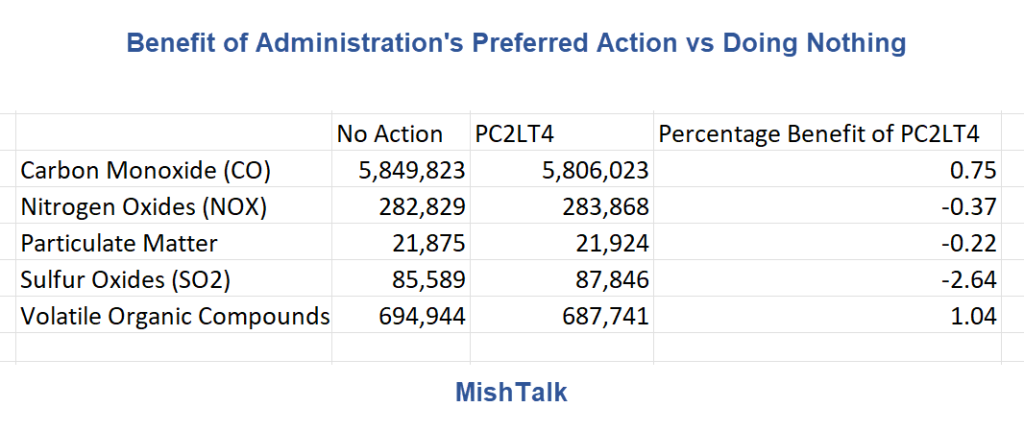
Doing Nothing vs NHTSA Preferred Alternative PC2LT4

Mish calculation based on NSTA Draft Environmental Impact Statement Data

There is a slight negative benefit on NOX, Particulate Matter, and SO2. There is a slight positive benefit on CO and Organic Compounds.

Stricter standards makes things much worse for sulphur dioxide SO2 (think acid rain).

The report comments “Under each CAFE standard action alternative compared to the CAFE No-Action Alternative, the largest relative increases in emissions among the criteria pollutants would occur for SO2, for which emissions would increase by as much as 16.8 percent under Alternative PC6LT8 in 2035 compared to the NoAction Alternative.

Health Impacts of No Action vs Alternatives, Trucks

Health impact Image from NSTA Draft Environmental Impact Statement

In 2050 there will be one fewer case of lower respiratory symptoms under the administration’s preferred action. Hooray?!

Greenhouse Gasses

Surely, there is a huge greenhouse gas improvement. Right?

Let’s check out page 238 (Section 5-16) of the report for the answer.

Greenhouse Gas Emissions, Doing Nothing vs 4 Alternatives

Greenhouse gas emissions from NSTA Draft Environmental Impact Statement, plus Mish Calculation

Through 2040, the total reduction of greenhouse gas emissions from passenger cars and light trucks would be a mere 2.01 percent less vs doing nothing at all with emission standards!

Through 2060 the benefit is even less, barely above zero.

Q: How can that be?
A: Improvements are expected anyway.

Bottom Line Assessment of Biden’s Preferred Energy Fuel Standards

Recall the NHTSA considers more than just greenhouse gasses.

It also considers impacts on the economy including “consumer cost, national balance of payments, environmental, and foreign policy implications.”

Here is the NHTSA’s bottom line: “Net benefits for passenger cars remain negative across alternatives” vs doing nothing at all.

China Abandons Clean Energy Goals Making U.S. Efforts Painful and Pointless

Q: What about China?
A: China Abandons Clean Energy Goals Making U.S. Efforts Painful and Pointless

Bidenomics and the EPA have America on a path of inflationary and environmental madness that’s all pain and no gain.

Clean Energy Exploitations and the Death Spiral of an Auto Industry

It’s not often I agree with Michael Moore on anything, but his video ought to be an eye opener for those who mistakenly believe EV will do anything for the environment.

The video start at the 36:44 mark, a good spot for the exploitation that goes into producing the minerals needed for EVs and how solar energy is destroying the desert.

For discussion of the video please see Clean Energy Exploitations and the Death Spiral of an Auto Industry

What to Expect When Politicians Try to Pick Technology Winners

On May 25, with a spotlight on the EU, I commented on What to Expect When Politicians Try to Pick Technology Winners Part 1

Biden’s Solar Push Is Destroying the Desert and Releasing Stored Carbon

The Left ignores environment destruction, even in the US.

On May 28, 2023, I noted Biden’s Solar Push Is Destroying the Desert and Releasing Stored Carbon

Biden is so clearly wrong, even the extremely liberal Guardian sees it. But it’s full speed ahead with massive subsidies for something counterproductive for the goal.

Beware of Government Cost Estimates

Beware of government cost assessments. Costs are always much greater than expected, and in this case we are already starting from a negative benefit.

We have no assessment of battery, environmental costs, and inflation under Biden’s goals.

Electric Vehicles for Everyone?

On July 19, I asked Electric Vehicles for Everyone? If the Dream Was Met, Would it Help the Environment?

My follow-up post was What Do MishTalk Readers Think About “Electric Vehicles for Everyone?”

Math Does Not Add Up

None of Biden’s mandates scale and that is on top of already expected negative benefits.

The cost of minerals to produce a battery now is one thing. The cost of a battery after Green advocates force more EVs down everyone’s throat is another. Infrastructure requirements are another huge problem.

Expect an economic disaster if we stay on the current path.

https://mishtalk.com/economics/the-shocking-truth-about-bidens-proposed-energy-fuel-standards/