Search This Blog

Thursday, August 31, 2023

Top US Senate Republican McConnell 'medically clear' -physician

 U.S. Senate Republican leader Mitch McConnell has been medically cleared to continue with his schedule, the attending physician to Congress said on Thursday, one day after the 81-year-old froze up at an event in his home state of Kentucky.

The incident had raised fresh questions about the health of the Senate's top Republican, who had similarly frozen up a month earlier during a press conference at the U.S. Capitol.

McConnell had also been sidelined from Congress earlier this year, after he tripped in March and was hospitalized for a concussion and a minor rib fracture. He returned to the Senate in April.

Lawmakers are due to return to Washington from summer recess next week and will have urgent work ahead -- the federal government will begin a partial shutdown on Oct. 1 if Congress doesn't authorize additional spending by then.

The physician said in a statement that he had consulted with McConnell and McConnell's neurology team and had evaluated the incident.

"I have informed Leader McConnell that he is medically clear to continue with his schedule as planned. Occasional lightheadedness is not uncommon in concussion recovery and can also be expected as a result of dehydration," Congress's attending physician, Brian Monahan, wrote.

McConnell's health issues come amid public concern about the United States' aging leaders. The Senate has one of the oldest memberships of parliamentary bodies in the world, with the average age of its lawmakers hovering above 64.

Democratic President Joe Biden, who is seeking reelection in 2024 at age 80, is the oldest U.S. president ever, while former President Donald Trump, the front-runner among candidates for the Republican nomination, is 77.

https://news.yahoo.com/top-us-senate-republican-mitch-184200736.html

Skin Disease Focused MoonLake Poised To Outshine Rivals: Needham

 Needham initiated coverage on MoonLake Immunotherapeutics 

 with a Buy rating and a price target of $76

The analysts Serge Belanger and Rohit Bhasin note the company's lead product developing sonelokimab (SLK), a dual IL-17A/-17F inhibitor nanobody for chronic dermatological ailments like hidradenitis suppurativa (HS) and psoriasis (PsO), outshining established biologics in terms of efficacy.

The analysts expound that SLK has positioned itself as a potential best-in-class treatment, boasting remarkable efficacy that surpasses that of well-known biologics. 

The differentiation comes through its innovative approach of concurrently inhibiting both IL-17A and IL-17F, promising a robust and holistic mode of action.

What further adds to SLK's allure is its applicability to various indications, offering a collective market opportunity estimated at a substantial $30 billion. 

Anticipated growth projections propel this figure even higher, with the market value expected to swell to a noteworthy $40 billion-$50 billion by the mid-2030s.

The analysts emphasize that the upcoming six months hold significant promise for MoonLake Immunotherapeutics. They anticipate a flurry of catalysts and news releases that could drive additional value. 

Furthermore, this could amplify the company's desirability as an acquisition target for major pharmaceutical players deeply invested in these chronic indications, armed with a biologics portfolio.

Needham sees UCB SA's 

 
UCBJF
 bimekizumab and izokibep by Acelyrin Inc  as the main competitors to SLK.

In late June, SLK demonstrated efficacy results in HS that appear superior to those of bimekizumab, and izokibep has yet to demonstrate placebo-controlled efficacy results that rival those of SLK or bimekizumab.

https://www.benzinga.com/analyst-ratings/analyst-color/23/08/34150742/skin-disease-focused-moonlake-immunotherapeutics-poised-to-outshine-rivals-analyst-

Crinetics Positioned For Success In Chronic Endocrine Disorder Treatment: OppCo

 Oppenheimer initiated coverage on Crinetics Pharmaceuticals Inc 

 with an Outperform rating and a price target of $40.

The analysts Leland Gershell and Rohan Mathur note significant room for improvement in drugs targeting various chronic endocrine disorders. Current options either have suboptimal benefit/risk profiles, problematic administration routes, or inadequate frequency.

The well-understood biology of peptide hormone signaling through G protein-coupled receptors makes them the therapeutic targets of choice, and Crinetics Pharmaceuticals is distinguished by its ability to create oral, once-daily non-peptide drug candidates to endocrine GPCRs

Oppenheimer writes that Crinetics Pharmaceuticals is well-positioned to meaningfully improve the treatment condition for a growing number of chronic endocrine disorders through its non-peptide drug discovery capability against well-understood targets. 

Phase 3 development success in acromegaly could pave the way for oral paltusotine to generate ~$250 million in peak sales, and next quarter's Phase 2 look in neuroendocrine tumors could bring ~2x that initial opportunity into focus. 

The analysts hold a positive outlook for the forthcoming Phase 2 outcomes of the daily oral ACTH antagonist CRN04894, anticipating it will establish proof-of-concept for both Cushing's syndrome and Congenital adrenal hyperplasia. Additionally, CRNX is progressing towards addressing more common medical conditions, as its early-stage initiatives for Graves' disease/Thyroid eye disease and diabetes/obesity are advancing toward clinical trials.

https://www.benzinga.com/general/biotech/23/08/34152684/biotech-stock-crinetics-pharmaceuticals-positioned-for-success-in-chronic-endocrine-disorder-trea

RadNet started at Buy by Truist

 Target $40

https://finviz.com/quote.ashx?t=RDNT&p=d

Wegovy Is Least Cost-Effective Weight Loss Drug for Teens in Study


  • Wegovy is less cost-effective than other drugs, study finds
  • Novo Nordisk’s weight loss drug costs $1,349 a month in the US

Novo Nordisk A/S’s blockbuster weight loss drug Wegovy is not remotely cost effective when compared to other weight-loss drugs for teens, a new study suggests.

Researchers from Columbia University modeled 100,000 adolescent patients with obesity to determine the cost-effectiveness of different weight-loss drugs. While Wegovy helped teenage patients lose the most weight, its $1,349 monthly cost made it a less appealing option than older, cheaper drugs, according to findings published Thursday in JAMA Network Open.

https://www.bloomberg.com/news/articles/2023-08-31/wegovy-is-least-cost-effective-teen-weight-loss-drug-in-study

"Who's The Next Incremental Buyer?" - Options Market Signals Doubts Rising Over AI Bubble

 With Melius Research (who?) writing a note this week asking (and answering) "Dare We Say Nvidia Is Now Cheap?", we couldn't help but get that feeling that investors may have jumped the shark on the AI bubble (now that NVDA's Q2 earnings are behind us).

Of course, there are plenty of superlatives surrounding the AI new world order:

"OpenAI is currently on pace to generate more than $1 billion in revenue over the next 12 months from the sale of artificial intelligence software and the computing capacity that powers it. That’s far ahead of revenue projections the company previously shared with its shareholders, according to a person with direct knowledge of the situation," according to The Information.

That's quite a jump from the $28 million in revenue that OpenAI generated last year (before it started charging for its groundbreaking chatbot, ChatGPT), and the billion-dollar revenue figure means that the recent $27 billion valuation does not look that crazy anymore.

However, a quick glance at publicly-traded companies benefiting from this trend shows - at a minimum - the fervor of future spend is being pulled forward.
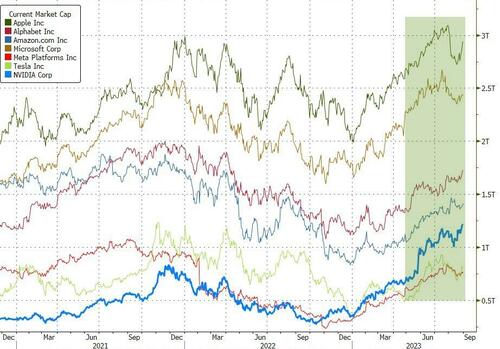
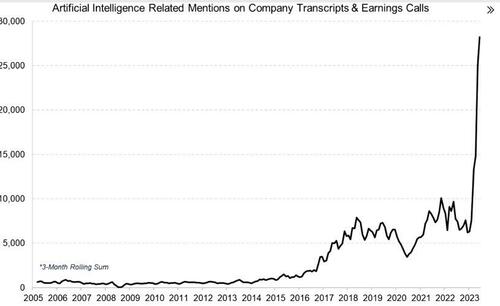
As every CEO and his pet rabbit drops the two most important letters - A and I - in talks with investors and media.

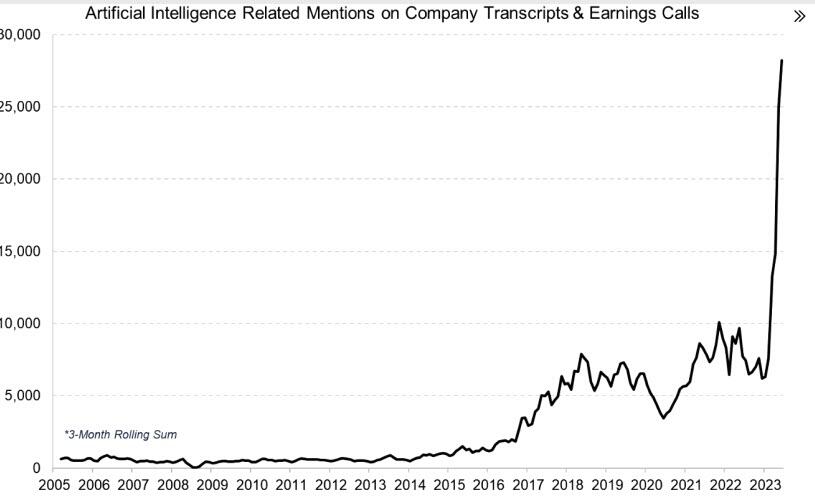
We went from ~500 mentions of AI on earnings calls in 2015 to ~30,000 this year and we still have 4 months left.
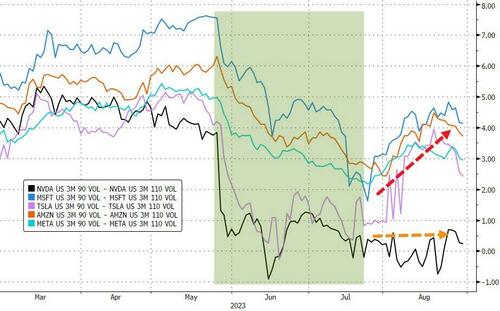
But, dare we say it, the froth may be coming off that soy, non-fat, skinny vanilla cappuccino as Bloomberg reports the heavy call-buying of high-flying technology stocks has tapered off, ushering in a more normal options-market dynamic for the biggest names in artificial intelligence.

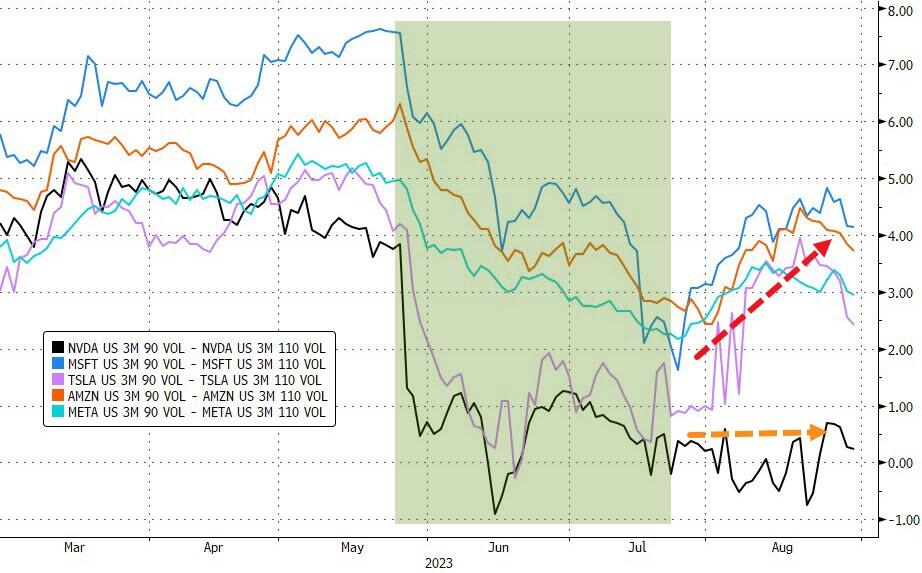
The regime-change is most clearly seen in the so-called options-skew (difference between the cost of upside and downside bets) for a number of the highest profile AI-beneficiaries.

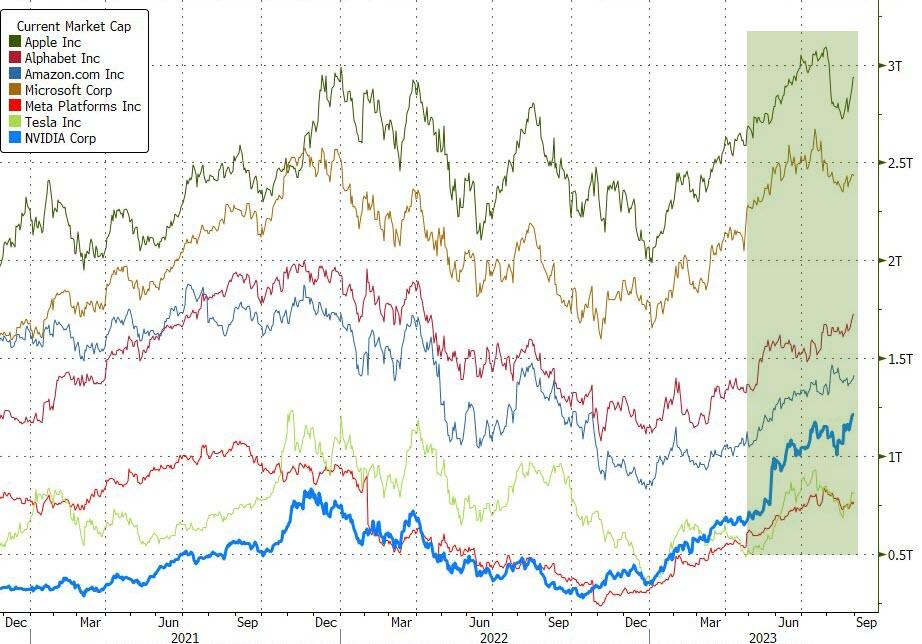
As excitement mounted in June and July, AI-mania flipped the norm (of puts costing more than calls) on its head with the cost of calls on MSFT, AMZN, NVDA,TSLA, and META generally rising more than put options (gren shaded box), according to data from Nations Indexes.

However, in recent week, things are looking a bit more normal, and calls are back to a discount for most of those companies.
“Tech was in a mini bubble, and AI was in a legitimate full-on bubble in June and July,” said Scott Nations, president of Nations Indexes.

“Now, people realize that we’ve seen bubbles before.”

There is an exception - Nvidia. Calls still cost more than puts, but the gap is narrowing, signaling that the mania over the S&P’s top gainer of 2023 is subsiding, at least a little.

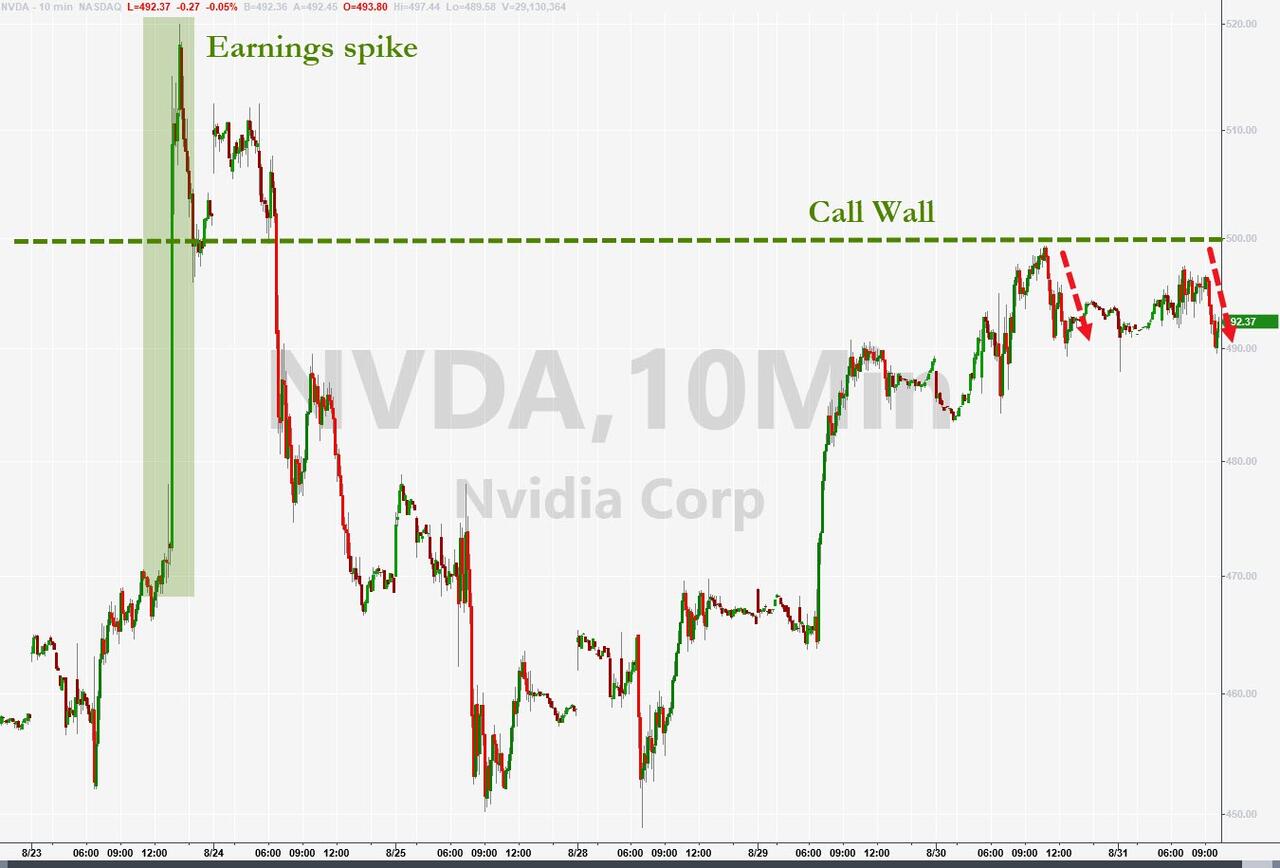
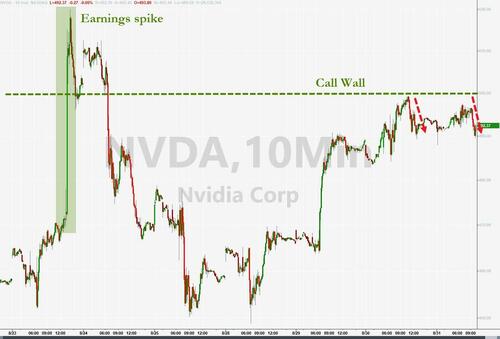
In fact, since the chip giant's blowout earnings spike, it has been unable to extend gains (most notably stalling at its call-wall around $500)...
Indeed, tech might be running out of buyers.

As Amy Wu Silverman, head of derivatives strategy at RBC Capital Markets, warns, chatter of clever chatbots may not fuel stock rallies forever.  Eventually, investors will look for signs of progress.

“Unless some other incremental AI news happens, I’m curious who the next incremental buyer is,” Silverman said.

“Retail was actually on this relatively early and had always been on this and then got the institutions - who had started this year fairly bearish and worried - essentially capitulate and have to go in. The bar is higher because who else has to go in now?”

In other words, the retail bagholder is not there for the pros to dump it to - because everyone's already filled their boots... which explains why puts are suddenly more bid than calls.
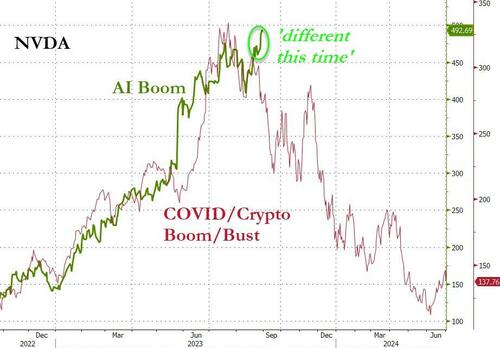
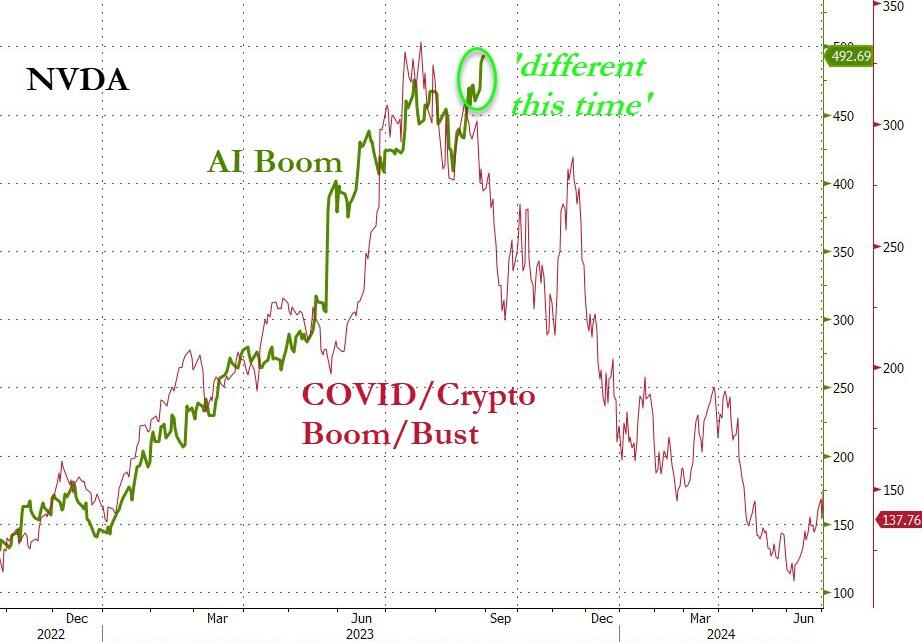
Is it really different this time?

https://www.zerohedge.com/markets/whos-next-incremental-buyer-options-market-signals-doubts-rising-over-ai-bubble

Biden administration offers $12B to convert auto factories into EV plants

 The Biden administration will put up to $12 billion into converting auto manufacturing facilities into plants for hybrid and electric vehicles, it announced Thursday.

Automakers will be able to receive loans or grants to convert their factories into those that make plug-in electric, hybrid, or hydrogen fuel cell vehicles, Energy Secretary Jennifer Granholm told reporters Thursday. 

A total of $10 billion will come from the Energy Department’s Loan Program Office and an additional $2 billion coming from Inflation Reduction Act grants. The loan program was also bolstered by the Democrats’ climate, tax and health care bill. 

The Department will also make an additional $3.5 billion available for domestic battery manufacturing that was made possible by the Bipartisan Infrastructure Law. 

“For a hundred years, America has been home to the best automakers in the world. We have got to be using their will and their skill to dominate the global EV market,” Granholm said. 

Broadly, the Biden administration has sought to advance more fuel efficient vehicles and a shift toward electric vehicles as part of an effort to combat climate change through funding opportunities, tax credits and regulations.

A proposed rule from the Environmental Protection Agency projects that, if it is implemented, two-thirds of new vehicle sales could be electric by 2032.

The Energy Department said that both sets of funding announced Thursday will prioritize good working conditions, including facilities that pay high wages and commit to retaining or expanding collective bargaining agreements. However, there will be no specific requirements needed to get the funding, Betony Jones, the director of the office of energy jobs confirmed.

That announcement comes as labor concerns bubble up in the transition to clean energy — with the United Auto Workers union accusing industry of using the transition to cut wages and pushing the Biden administration to do more about it.

https://thehill.com/policy/energy-environment/4181119-biden-administration-offers-12b-to-convert-auto-factories-into-ev-plants/