Search This Blog

Thursday, September 7, 2023

Ramaswamy's Anti-ESG ETFs Cross $1 Billion

 We have been writing about the ESG scam on this site since it caught fire years ago, taking with it trillions of dollars of investment capital. And just as though there was big money in ESG for a couple of years, it now looks like there's big money in "anti-ESG". 

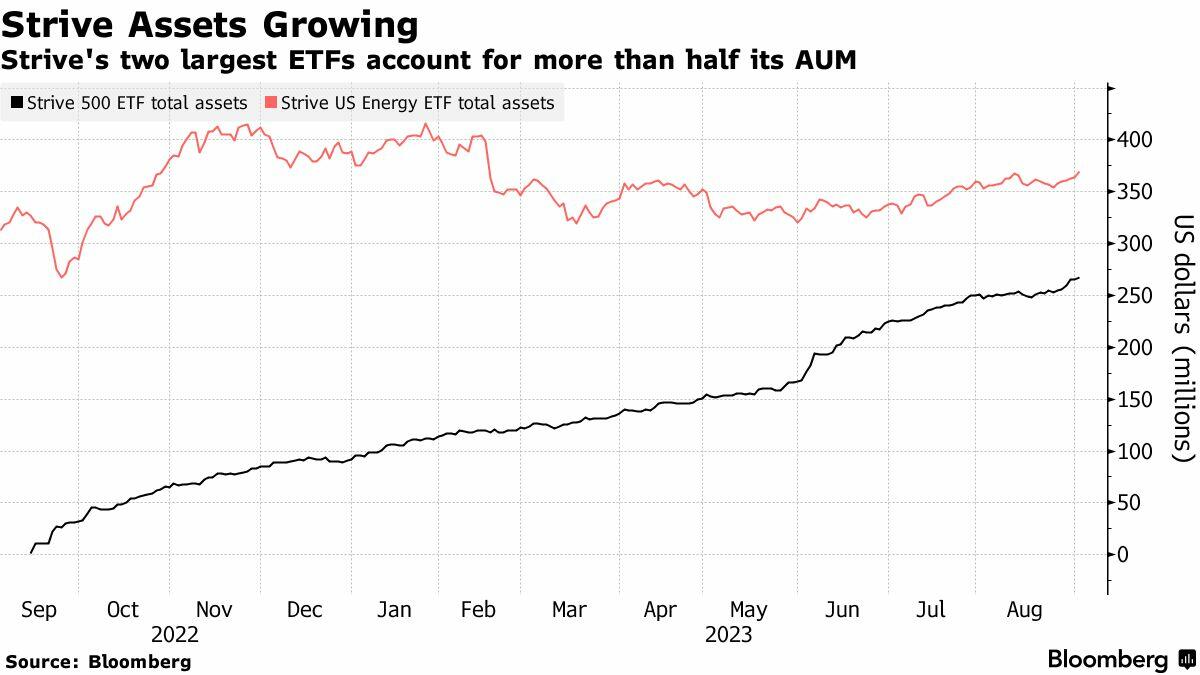
Republican presidential hopeful Vivek Ramaswamy is co-founder of Strive Asset Management, an anti-activism fund company. They have recently seen their assets under management crossing $1 billion. The firm has 11 exchange-traded funds and launched in 2022. 

The firm says it wants companies to “focus on excellence” rather than ESG mandates, Bloomberg reported. It is likely being helped along by Ramaswamy's run for president shining a public eye on him and his firm. 

Bloomberg Intelligence senior ETF analyst Eric Balchunas commented: “It is a rare feat for any indie issuer to hit $1 billion in first year, let alone one that is largely a pushback to ESG as many of those ETFs have flopped.”

“Ramaswamy’s wealthy backers helped a lot and running for president probably can’t hurt either. That is some unchartered territory when it comes to ETF marketing,” he continued. 

Some of the firm's ETFs, according to Bloomberg, include:

  • $369 million Strive US Energy ETF (ticker DRLL) which encourages companies to “drill more and frack more”
  • $267 million Strive 500 ETF (STRV), the largest and oldest ETF
  • $153 million Strive Emerging Markets Ex-China ETF (STXE)

“Big, passive companies like BlackRock and Vanguard are beginning to democratize the voting and letting the end investor decide, which defuses some of the argument that they are voting everyone’s shares in an ESG way,” Balchunas added. 

There has also been the addition of the GWGB ETF this week, with Tuttle (who runs SARK) filing for the "Get Woke Go Broke" ETF. 

We also wrote about the latest chapter in the ESG ruse this summer, where tobacco companies - yes tobacco companies - were blowing away EV-maker Tesla in their ESG ratings. 

We wrote earlier this summer that S&P Global assigned Tesla "a lower environmental, social, and governance score than Philip Morris International, the maker of Marlboro cigarettes."

Tesla earned just 37 points on their ESG scorecard while Philip Morris posted a score of 84. Similarly, the report notes, the London Stock Exchange has given British American Tobacco a score of 94. 

Jonathan Berry, who sued NASDAQ last year over its diversity requirements for corporate boards, told the Free Beacon: "ESG company ratings often measure abstract woke goals that have no rational connection to companies' actual businesses. Companies score 'points' mainly by demonstrating their compliance with the latest dogmas issued by the DEI complex."

Nowadays, trillions of dollars of capital moves according to how companies fare with their ESG scores. Despite Tesla's crowning acheivement of nearly singlehandedly ushering in the era of electric vehicles, this still puts them at a disadvantage.

Perhaps this is why the anti-ESG movement is gaining such steam...

https://www.zerohedge.com/markets/vivek-ramaswamys-anti-esg-etfs-cross-1-billion

Britain's Superdrug says Wegovy received is "very small fraction" of waiting list

 British health and beauty chain Superdrug said on Thursday that the amount of weight-loss drug Wegovy it has so far received is "a very small fraction" of what would be needed to fulfil its swelling waiting list.

More than 20,000 people had registered an interest in buying Wegovy from Superdrug even before Novo Nordisk launched the drug in Britain on Monday, and the waiting list has increased since then, a spokesperson told Reuters.

The very small volume of the drug, which is delivered by monthly injection, received by the company may stoke concerns expressed by doctors and medical experts this week that UK demand will immediately outstrip supply.

Novo said when announcing the launch in Britain that Wegovy will be available through the National Health Service's weight management scheme and on the private market.

Superdrug and other large pharmacy chains, such as Walgreens Boots Alliance, have online weight-loss management clinics that have begun dispensing Wegovy.

But the websites of Superdrug and Boots say limited stocks mean the companies' doctors can only provide the treatment to those who are among their existing weight-loss patients.

Saxenda, a daily injection which is Novo's older weight-loss treatment and which is less effective than Wegovy, is already in shortage, according to the UK's health regulator.

Ozempic, which contains the same active ingredient as Wegovy but is approved in the UK for treatment for type 2 diabetes, is also officially in shortage.

Advocacy group Diabetes UK told Reuters this week that Ozempic's increasing "off-label" use for weight-loss has hurt people with type 2 diabetes who have been prescribed the drug but have struggled to fill their prescriptions.

Novo said on Monday its launch in Britain would be "limited and controlled" due to supply constraints that have also affected the other four markets in which Wegovy is available, including the United States.

When asked for comment on Superdrug's statement on Thursday, the Danish drugmaker reiterated its statement on Monday that a proportion of available supply has been allocated for use only within the NHS, and said it could not comment on supply figures.

Superdrug did not immediately respond to a request for comment on how many prescriptions it had so far dispensed.

Boots did not immediately respond to a request for comment on how much stock it had so far received.

https://news.yahoo.com/britains-superdrug-says-wegovy-received-123140641.html

'Australia's Indigenous Voice referendum faces misinformation linked to COVID influencers'

 At a beachfront park in Brisbane's north, suspended Australian doctor William Bay told a gathering that an upcoming referendum to recognise the country's first inhabitants and enshrine an Indigenous advisory body in the constitution would "open a gateway to unending tyranny and lawlessness".

The proposal was "equivalent to Germany's Enabling Act of 1933, which turned Hitler into the Fuhrer", Bay said in the speech in August, which he posted on Facebook for his 14,000 followers. The advisory body could "control the parliament and the government, thus replacing our system of representative democracy", added Bay, who lost his medical licence in 2022 after protesting against COVID-19 vaccines.

Dozens of campaigners who built substantial audiences during the COVID era by opposing Australia's pandemic response have turned their focus to undermining the Oct. 14 referendum, analysis of social media posts by independent fact-checkers shows.

Many of their claims bear little resemblance to the proposal Australians will vote on: to establish a body called the Voice to Parliament to provide non-binding advice to lawmakers on matters concerning Indigenous Australians.

These influencers are playing an outsized role in the debate, spreading falsehoods that threaten to put the landmark vote at risk of failing, eight political analysts and anti-misinformation experts told Reuters. The direct link between COVID agitators and misinformation about the Voice has not been previously reported in detail.

Polls show support for the Voice has slumped from about two-thirds in April to less than 40% this month. While factors cited by political commentators include lack of bipartisan support, uncertainty about the Voice's scope and a lackluster "Yes" campaign, the experts who spoke to Reuters said some of the decline can be attributed to misinformation.

Facebook owner Meta increased funding for third-party fact-checkers in July, but a month later 40% of posts from accounts flagged for sharing "misinformation or toxic narratives related to the referendum" went viral, according to previously unpublished research by Reset.Tech Australia reported by Reuters for the first time. The internet advocacy group defines "viral" as receiving more than 100 engagements within 24 hours.

Just 4% of posts on Facebook containing independently assessed misinformation about the electoral process were marked or taken down after three weeks, said Reset.Tech, which monitored 99 misleading posts with a combined reach of 486,000 people across Facebook, X (formerly known as Twitter) and TikTok.

Not one X post containing electoral misinformation was marked or taken down in the monitoring period, before or after being reported, Reset.Tech said.

X, which laid off many staff after billionaire Elon Musk bought the platform in 2022, did not respond to a request for comment. The company's civic integrity policy says the use of its services to manipulate or mislead people about elections is a violation of its user agreement.

TikTok labelled or removed one-third of misleading posts, Reset.Tech said, the most proactive in the study.

"Many of the accounts pushing electoral misinformation narratives turned to a style of anti-lockdown politics during the pandemic," said Reset.Tech Australia executive director Alice Dawkins. "Some of these accounts have since attained new levels of virality in the lead up to the referendum, particularly on X."

A Meta spokesperson said the company wanted healthy debate on its platforms but it was "challenging to always strike the right balance" when some users "want to abuse our services during election periods and referendums".

TikTok's Australian public policy director Ella Woods-Joyce said the company was focused on protecting "the integrity of the process and our platform while maintaining a neutral position".

In relation to the referendum, Australia's Electoral Commission has seen "more false commentary about electoral processes spread in the information ecosystem than we've observed for previous electoral events", its media and digital director Evan Ekin-Smyth told Reuters.

Under a giant fig tree, Bay urged his mostly middle-aged audience - and Facebook following - to "scrutineer" polling booths to "make sure it is counted correct", in remarks reminiscent of unsubstantiated vote-rigging claims by former U.S. president Donald Trump over his 2020 loss.

Speaking to Reuters, Bay denied spreading misinformation, saying he considered his claims accurate. He acknowledged his statements "may carry some weight" given his public profile related to the pandemic.

At the same event, local member of parliament Luke Howarth spoke against the Voice, sticking to the conservative opposition's argument that the proposal would be ineffective and divisive because it would extend additional rights to some people based on race.

'POLLUTE YOUR OPINION'

Australia's tough pandemic lockdown and vaccine measures triggered numerous protests, often inspired by social media influencers and anti-vaccine campaigners.

"Covid seemed to awaken in people a complete distrust of authority and lack of confidence in the state," said David Heilpern, dean of the Southern Cross University law school, who studies anti-government movements. "It certainly will have an effect on the vote."

Bay is far from alone in the anti-Voice online ecosystem that has emerged from the pandemic.

A Qantas pilot who quit over the airline's COVID vaccine mandate, Graham Hood, now hosts a webcast that he shares with 142,000 Facebook followers.

His guest on July 10, far-right senator Pauline Hanson, told viewers the Voice would turn Australia's Northern Territory into a breakaway "Aboriginal black state" and add extra seats in parliament "which they can make purely for Aboriginal, Indigenous people".

Tristan Van Rye, an electrician with 22,000 Facebook followers after protesting against COVID vaccines, wrote in a July 10 post that the Indigenous body would "take control of certain beaches, nature reserves, national forests and either totally restrict access to all Australians, or charge them fees to access the land". Hood, Hanson and Van Rye did not respond to Reuters' questions about the spread of misinformation.

The Voice was proposed by Aboriginal leaders in 2017 as a step toward healing a national wound dating back to colonisation. Unlike Canada, the U.S. and New Zealand, Australia has no treaty with its Indigenous people, who make up about 3.2% of its population and lag national averages on socioeconomic measures.

Ed Coper, director of communications agency Populares, said that for voters facing a new issue like the Voice, "it is a lot easier to see misinformation on social media and have that pollute your opinion while you're (still) forming that opinion".

One X account labelled by misinformation researchers as possibly fake due to its high volume of anti-Voice content was ultimately linked to a real person, a retired cleaning-business owner from Melbourne.

"I've only got political within the last two years," the account operator, Rosita Diaz, 75, told Reuters by phone. "99.9% of what I post is 100% correct. I would say 100% but some people would turn around and call me a liar. Sometimes I might get something wrong."

Diaz said she had been suspended by Facebook "seven or eight" times over posts deemed false. She now mostly posts on X, where she has 20,600 followers and pays for a subscription, meaning her posts appear more frequently on users' feeds.

MISINFORMATION BILL

Australia's left-leaning Labor government, which supports the Voice, introduced draft legislation this year that would allow the media regulator to determine what constitutes misinformation and fine social media companies that fail to curb it.

The bill, which is still in public consultation, has been criticised by Voice opponents as government censorship. But it may not become law until after the referendum.

A spokesperson for Communications Minister Michelle Rowland said the government wants the bill passed this year but social media platforms are expected to comply with a voluntary code of conduct when it comes to the Voice.

The Yes campaign, meanwhile, has accused the No camp of deliberately spreading misinformation as part of its strategy. A spokesperson for Advance Australia, which is coordinating the No campaign, told Reuters there were "tens of thousands of (No campaign) hats and t-shirts out there and we're not responsible for what people say while they're wearing them".

Elise Thomas, an analyst with the Institute for Strategic Dialogue, said a lack of evidence-based research meant Australians may never gain a full picture of how disinformation and misinformation influence the referendum outcome.

"That's a shame, both for us here in the present and for future generations of Australians trying to understand this moment in history," she said.

https://www.yahoo.com/news/australias-covid-agitators-inject-misinformation-010408179.html
'UN chief heat officer says warming cities pose potential to be major killers '

 The United Nations' first global chief heat officer called on Wednesday for political leaders to make firm commitments at November's COP28 climate meeting to stem rapidly rising temperatures in cities, particularly in poorer countries.

Eleni Myrivili, tasked with trying to ease the impact of hotter summers that threaten the health and livelihoods of billions of urban residents around the world, said finding the finance for nature-based solutions and adaptation plans for cities was a major roadblock to progress.

"This was a really bad summer for heat, for people and for ecosystems and for agriculture and for economies," Myrivili said in an interview at the Reuters IMPACT conference in London. "In July, we had these crazy heat domes in almost all of the Northern Hemisphere."

"It really felt like something was different, it felt like a turning point," Myrivili, the former chief heat officer for Athens, said.

"I'm really hoping this COP is going to be more of a decisive COP in turning away from generalities ... and really moving fast forward with stopping greenhouse gas emissions and stopping deforestation and figuring out how to create a much sustainable agriculture and sustainable animal husbandry."

Myrivili and national chief heat officers around the world are focused on measures like bringing nature into cities and employing mitigation techniques such as the white reflecting asphalt introduced in Phoenix, Arizona.

She is, however, most concerned about cities in poorer countries that do not have the capacity, the architectural expertise or the funds to make significant changes.

"That's the really scary thing," she said. "That's the thing I'm really worried about. There are a lot of countries that have a lot of informal housing, a lot of informal labour and a lot of poverty, and that's where heat becomes the real killer."

https://news.yahoo.com/un-chief-heat-officer-says-151404037.html

Paqui removes 2023 'One Chip Challenge' from store shelves, citing teen use

 Snack company Paqui is choosing to remove it's signature spicy chips from store shelves around the country this week, after a Massachusetts teenager died while trying to complete the company's advertised "One Chip Challenge."

Harris Wolobah, 14, was found unresponsive and not breathing earlier this month in Worcester, Massachusetts, and was pronounced dead at a local hospital, according to police. His death is being investigated by a state medical examiner, whose office did not immediately respond Thursday to a request for comment.

The teen's family said on a GoFundMe page they "suspect" Wolobah's death to be related to complications from the "One Chip Challenge."

The extremely hot corn chips that Paqui LLC, marketed as part of its "One Chip Challenge" are made with Carolina Reaper and Naga Viper peppers and are meant only for adult consumption, according to packaging labels.

Harris Wolobah

"We care about all of our consumers and have made the decision to remove the product from shelves," Paqui spokesperson Kim Metcalfe told USA TODAY.

The decision to pull the "One Chip Challenge" chips from store shelves this week comes after the company saw an "increase in teen usage" of the product, Metcalfe said. The move by the Austin, Texas-based company is voluntarily, and is not a recall, she said. The company's website also says it made the decision out of "an abundance of caution," noting the individually wrapped "One Chip Challenge" product adhered to food safety standards.

"We are actively working with our retailers and are offering refunds for any purchases of our single-serve one chip challenge product," Metcalfe said in the statement.

Paqui chips have been available at gas stations, drug stores and some food retailers, according to the company website's store locator. The company makes other flavored tortilla chips, including Zesty Salsa Verde and Mucho Nacho Cheese varieties.

Are extremely spicy foods dangerous?

The heat or pain we feel after eating a hot pepper is not an indication of physical harm, according to federal researchers. Rather, it's a neurological signal our body sends to our brain telling us not to take another bite.

"People have a misconception about heat from peppers. There is not actual heat, it's a brain trick," said Ed Currie, the creator of the Carolina Reaper pepper.

There have been instances of people complaining of headaches after eating the Carolina Reaper, however.

In 2018, a 34-year-old man went to the emergency room complaining of severe headaches just days after eating the pepper. Newsweek reported that brain scans revealed constricted arteries that eventually returned to their normal state five weeks later. In 2020, the National Center for Biotechnological Information reported an incident of a 15-year-old boy who ate a Carolina Reaper and had an acute cerebellar stroke two days later after being hospitalized because of headaches.

What is the Scoville Scale?

The Carolina Reaper is one of the hottest peppers in the world on the Scoville Scale.

The scale reflects the level of heat of a pepper based on the level capsaicin it contains.

The scale was invented in 1912 by a pharmacologist named Wilbur Scoville, according to the commerce department's National Institute of Standards and Safety. To measure the heat of a pepper, its capsaicinoids are diluted until the heat can no longer be tasted by a panel taste testers, the NIST's website says.

The longer a pepper takes to dilute, the higher it rates on the Scoville Scale.

What is the One Chip Challenge?

In recent years, the brand Paqui has sold individually wrapped corn chips made with hot peppers and advertised the #OneChipChallenge on their website, encouraging consumers to tag the company on social media after they try to eat the chip and see how long they can keep from eating or drinking anything else afterwards.

Videos posted to TikTok show young people and adults unwrapping the single triangle-shaped corn chip, which is covered in a layer of pepper, and challenging themselves to eat it. Some videos have upwards of 200,000 likes.

Extracts vs. organic heat

People interested in exploring spicy foods should consider that manufactured foods can contain exaggerated versions of the spiciness that occurs naturally in hot peppers, Currie said.

Hot peppers can be turned up a notch and become intolerably hot for everyday consumers when their oils are condensed into an extract, said hot pepper competition winner Kelly Myers, of Leighton, Pennsylvania.

"Unfortunately, there are things with extract in it where the pepper is not at its organic level anymore," he said.

Beyond that, it's also possible to use chemicals to create spicy substances that rate higher on the Scoville Scale than organic peppers eaten on their own, according to Currie.

https://www.usatoday.com/story/news/nation/2023/09/07/paqui-removes-one-chip-challenge-after-death/70784180007/

AI-Generated Drake Song Up For Grammy Nomination

 by Savannah Fortis via CoinTelegraph.com,

A hit track made from an AI-generated vocal track of the rapper Drake has been submitted to the Recording Academy for Grammy nomination in two categories...

A viral track from the anonymous producer “Ghostwriter” using an artificial intelligence (AI)-generated vocal track of the rapper Drake has been submitted for consideration for a Grammy award, according to a Sept. 5 report in The New York Times.

The track “Heart on My Sleeve” has been submitted by the Ghostwriter team to the Recording Academy - the organization behind the Grammys - for nomination in the Best Rap Song and Song of the Year categories, a representative told the NYT.

In both of those categories, the award is attributed to the songwriter, who the Ghostwriter representative also confirmed to be a human.

Earlier in 2023, the Grammys updated its policy for awards in the upcoming award season, saying that music with AI-generated components is eligible for an award. The catch is that the category for which the track is nominated must be for a human-created portion of the song.

The CEO of the Grammys, Harvey Mason Jr., confirmed the policy and said music with AI elements is “absolutely eligible” for a Grammy nomination. He reiterated this to the NYT regarding the Ghostwriter AI-Drake track, saying:

“As far as the creative side, it’s absolutely eligible because it was written by a human.”

He also pointed out that the Academy also looks at whether or not the song was commercially available, which is a component of Grammy rules. It says a track must have “general distribution” to be eligible, including availability on streaming platforms.

However, “Heart on My Sleeve” was removed from all major streaming services, despite industry experts saying that its use of AI fell into a “legal gray area.”

Cointelegraph reached out to the Recording Academy for further comment. 

In April, Universal Music Group - one of the industry’s most prominent record labels - sent a mass email to major streaming services, including Spotify and Apple Music, requesting they block AI services from harvesting melodies and lyrics from copyrighted songs and remove songs violating copyright. 

Shortly after, Spotify was reported to have ramped up policing of tracks violating copyright infringement on its platform, as well as blocking artificial streaming of songs to increase listen count.

https://www.zerohedge.com/technology/ai-generated-drake-song-grammy-nomination

China suspected of using AI on social media to sway US voters, Microsoft says

 Microsoft researchers said on Thursday they found what they believe is a network of fake, Chinese-controlled social media accounts seeking to influence U.S. voters by using artificial intelligence.

A Chinese embassy spokesperson in Washington said that accusations of China using AI to create fake social media accounts were "full of prejudice and malicious speculation" and that China advocates for the safe use of AI.

In a new research report, Microsoft said the social media accounts were part of a suspected Chinese information operation. The campaign bore similarities to activity which the U.S. Department of Justice has attributed to "an elite group within (China's) Ministry of Public Security," Microsoft said.

The researchers did not specify which social media platforms were affected, but screenshots in their report showed posts from what appeared to be Facebook and Twitter, now known as X.

The report highlights a fraught social media environment as Americans prepare for the 2024 presidential election.

The U.S. government has accused Russia of meddling in the 2016 election with a covert social media campaign and has warned of subsequent efforts by China, Russia and Iran to influence voters.

The report provided limited examples of the recent activity and did not explain in detail how researchers attributed the posts to China.

A Microsoft spokesperson told Reuters that the company's researcher used a "multifaceted attribution model," which relies on "technical evidence, behavioral evidence and contextual evidence."

The campaign began using generative artificial intelligence technology in about March 2023 to create politically charged content in English and "mimic U.S. voters," Microsoft said.

Generative AI can create images, text and other media from scratch.

The new content is much more "eye-catching than the awkward visuals used in previous campaigns by Chinese nation-state actors, which relied on digital drawings, stock photo collages, and other manual graphic designs," the researchers wrote.

The paper cited an example of one AI-generated image, which Microsoft said came from a Chinese account, that depicts the Statue of Liberty holding an assault rifle with the caption: "Everything is being thrown away. THE GODDESS OF VIOLENCE."

The Microsoft spokesperson said the identified accounts had attempted to appear American by listing their public location as within the United States, posting American political slogans, and sharing hashtags relating to domestic political issues.

https://finance.yahoo.com/news/china-may-behind-social-media-130917740.html