My mother lived to be 91 years old, an age her mother did not see.
She smoked and was a worrier who lived a simple life. She walked great distances to the store most days, even in the cold of winter and summer’s heat.
My father let most things roll off his back. He enjoyed the holidays and loved company, cigars and good food. He died suddenly the year of his 80th birthday.
I have often wondered what made the difference in their longevity.
In a documentary interview with The New York Times when he was 93, renowned TV producer Norman Lear reflected on longevity:
"Often, when I'm getting dressed, I look at myself nude, dissatisfied but amused. I'll sing and dance alone in front of a full-length mirror, and I have wondered for a great many years: How do we know that's not the secret to longevity?"
In the last decade of his life, he tried to convince TV executives they should have a show on the air about older people because that population is underrepresented.
But even Lear, whose immense talent turned the sitcom into a public square by creating shows that tackled racism, poverty, classism and feminism, could not break through the industry's entrenched ageism. While singing his praises, broadcast television executives rejected what could have been Lear's final contribution, a sitcom about a retirement community.
“Guess Who Died” reached the pilot stage but was passed over in 2018.
"The right people read it, the right people thought it's funny, but the right people said it's not our demographic," Lear lamented.
Seems like a missed opportunity.
According to Statista.com, adults 65 and older spend the most time watching television, at more than four hours a day, while 15- to 19-year-olds spend less than two hours daily.
And while there is no evidence that four hours of television a day is toxic for older adults, the parade of pharmaceutical commercials promising cures for everything from hair loss to toe fungus is enough to make TV a turnoff for any age group.
Though I'm no longer shocked when I run into centenarians, I still think God has kissed them.
Dr. Nir Barzilai, director of the Institute for Aging Research at the Albert Einstein College of Medicine in New York, is leading a SuperAgers family study in an effort to uncover the group's secrets.
"Centenarians not only live longer, but they live healthier,” Barzilai told me. “Many of them don't get diseases until 30 years after people their children's age. They also have a compression of morbidity, meaning they are sick for very little time at the end of their life.
"Though they may have genetics for diseases for aging, they don't get those diseases. This is because they have ‘longevity genes’ — changes in their DNA that have functional consequences — that slow the biology and rate of aging.”
Barzilai’s study is recruiting 10,000 SuperAgers and their adult children to try to determine the genetics and lifestyles that might explain their longer lives.
"Some of these discoveries have turned into drugs that have passed clinical studies,” he said of such efforts. “The American Federation for Aging Research's SuperAgers family study will help identify the mechanisms that protect against human aging and related diseases in order to develop drugs that can slow aging, prevent diseases, and allow us all to live healthily most of our lives.”
Lear is an excellent example of a centenarian who lived fully all the way until his death.
And I hope that, at some point, Lear’s “Guess Who Died” finally makes it to the screen, and we can enjoy the creativity of his SuperAger mind.
Patients with lung cancer treated with epidermal growth factor receptor (EGFR) inhibitors may have an increased risk of new-onset keratitis, a U.S. population-based cohort study showed.
Over a 20-year period, 1.12% of patients who were treated with EGFR inhibitors developed new-onset keratitis compared with 0.74% of those who did not take these drugs (HR 1.520, 95% CI 1.339-1.725), reported Kevin Sheng-Kai Ma, DDS, of Harvard T.H. Chan School of Public Health in Boston, and colleagues in JAMA Ophthalmologyopens in a new tab or window.
Specifically, patients treated with EGFR inhibitors -- including gefitinib (Iressa), erlotinib (Tarceva), afatinib (Gilotrif), and osimertinib (Tagrisso) -- had higher risks of keratoconjunctivitis (HR 1.367, 95% CI 1.158-1.615), superficial keratitis (HR 1.635, 95% CI 1.306-2.047), and corneal ulcer (HR 2.132, 95% CI 1.515-3.002).
Notably, patients taking the second-generation EGFR inhibitor afatinib had the highest risk of keratitis (HR 2.229, 95% CI 1.480-3.356), though the risk was still observed with osimertinib, the standard first-line option in the metastatic setting (HR 1.591, 95% CI 1.130-2.239).
Ma told MedPage Today that clinicians should keep in mind that the drugs can significantly improve the overall survival of lung cancer patients. The findings "don't tell us to stop EGFR inhibitors," he said, "but would guide our clinical decisions in terms of whether or not we should follow the patients more frequently if the patients have shown early signs of severe forms of keratitis."
According to the Cleveland Clinicopens in a new tab or window, contact lenses are a major risk factor for keratitis, and other risk factors include weakened immunity and long-term use of corticosteroids. Eye drops are initially prescribed, and corneal transplants may be needed in the most severe cases.
Jeanine Baqai, MD, of Northwestern University Feinberg School of Medicine in Chicago, told MedPage Today that eye doctors see keratitis often.
"It is important to decipher if the cause of this inflammation is infectious or non-infectious," she said. "If there is concern for infection, we will typically culture the patient and start them on antimicrobial treatment. The infection may be bacterial, viral, fungal, or parasitic. If the inflammation is not felt to be infectious and there is no ulceration, we may treat with steroids. We are fortunate to be able to resolve most keratitis with topical treatment."
EGFR inhibitors are used to treat several kinds of cancers including lung, breast, colorectal, and pancreatic cancer. Case reports and series have reported ocular adverse effects in patients taking the drugs for lung cancer, Ma noted, but no comprehensive studies have looked at the overall risk or stratified the results by type of drug and type of keratitis.
There are three generations of the drugs available, Ma said, and a fourth is under development. The risk remained steady over the 20-year period of the study, suggesting that the evolution of the drugs over time has not changed the risk level.
The drugs may boost the risk of keratitis by inhibiting healing within the cornea, Ma explained. "All patients taking all those drugs should be instructed by their ophthalmologist, medical oncologist, or primary care physicians about the potential complications from EGFR-targeted therapies."
Baqai said the link between the drugs and keratitis "is certainly known amongst cornea subspecialists, but it is not a complication we typically see on a regular basis like other conditions." However, "as more drugs surface, the prevalence with which we see these patients increases."
"Cancer patients and patients receiving these medications should be examined and evaluated with a very discerning eye," she added. "Sometimes we can see side effects from medications and other times we can see manifestations related to the cancer itself. It is important to be very thoughtful about the cause and the treatment of any keratitis, since the condition can lead to loss of vision. Expedited referral to the appropriate subspecialist is always recommended."
For this study, Ma and team examined data from the TriNetX database on 1,388,108 adult patients who were treated for lung cancer from May 2003 through October 2023. The index dates were the date of first prescription for the patients who took the EGFR inhibitors or the date of diagnosis with lung cancer for the patients who did not take these drugs.
Of the total patients, 22,225 received EGFR inhibitors. Mean age was 69.7, and 62.8% were women. About half of patients in both groups had hypertensive diseases; those taking EGFR inhibitors were more likely to have secondary malignant neoplasms.
What's next? Ma said his team is working on follow-up studies to examine the risk of keratitis by ethnicity, since research has linked ethnic background to EGFR mutation status.
Disclosures
The study authors reported no conflicts of interest.
Baqai reported no conflicts of interest.
Primary Source
JAMA Ophthalmology
Source Reference: opens in a new tab or windowHuang P-C, et al "Epidermal growth factor receptor inhibitors for lung cancer and the risk of keratitis" JAMA Ophthalmol 2024; DOI: 10.1001/jamaophthalmol.2023.6089.
Put yourself into your patients' shoes for a moment. Imagine you are visiting your primary care provider (PCP) today to follow up on your diabetes and blood pressure control. After a quick finger-stick test, you find out that your average blood sugar over the past 3 months has been much too high. Your doctor gives you some advice on how you can modify your diet, and then suggests that you take a new medication called dulaglutide (Trulicity).
The insurance you get through your employer isn't very generous, and recently, you've been struggling to pay all of your copays. You worry that this additional medicine may not be affordable and that you'll either have to do without it or cut back on other expenses in your life, like eating healthier food.
Despite having insurance, many people in the U.S. run into predicaments like this. In fact, half of peopleopens in a new tab or window report struggling to afford their medical care and 31% of patientsopens in a new tab or window who have a prescription drug have skipped or cut back on at least one of their medications because of the cost.
Reluctantly, you ask your doctor, "So, how much will the medicine cost?" Until recently, this question could only be answered for patients without insurance. Doctors could look up medication prices on GoodRxopens in a new tab or window or on the websites of direct-to-consumer pharmacies, but for those who had insurance, there was no straightforward way to find the exact copays.
Since 2021, clinicians practicing at many large health systems have the option to estimate the prices of the medications they prescribe for patients with private insurance or Medicare. That year, CMS began requiringopens in a new tab or window that Medicare drug plans provide price estimates to prescribing clinicians. These price estimates, which are generated via applications called Real-Time Benefit Tools (RTBTs), account for each patient's specific pharmacy coverage, deductible, copays, and preferred pharmacy. They are integrated into electronic health records (EHRs), so clinicians can access them when they're in the room with a patient.
These tools can also alert clinicians at the point of prescribing about any lower-cost alternatives that may exist. The alternatives might be different medications in the same drug class, the same medication at a different pharmacy, the same medication for a different number of days (e.g., 30-day supply vs 90-day supply), or the same medication but a different formulation (e.g., tablet vs capsule).
We recently sought to understand whether these tools were leading clinicians to change their medication orders for patients. Previous researchopens in a new tab or window has shown that when clinicians become aware of their patients' financial constraints, they often feel a moral and professional obligation to help patients identify solutions for lowering costs, either through financial assistance (e.g., coupons, charity care) or by finding medications that cost less. RTBTs have the potential to help clinicians find out more about how much their patients are paying for their medications and come up with practical solutions that may lower patient costs.
Our group examinedopens in a new tab or window how often PCPs at one large academic health system changed their medication orders when the RTBT alerted them to the existence of a lower-cost alternative. Over the course of 3 years, the RTBT alerted 889 PCPs with price estimates for 181,887 medication orders. We found that overall, PCPs changed their orders only 12% of the time. On closer examination, we saw that PCPs were more likely to change their orders when patients' cost savings were greater. As an example, for diabetes medications, PCPs changed their orders 11% of the time when cost savings were $5 or less; when cost savings were over $20, they changed their orders 16% of the time.
We were surprised to find that PCPs changed their medication orders so infrequently, even when the potential cost savings were quite high. This may have happened for a number of reasons.
First, RTBT price estimate alerts typically popped up when a clinician was attempting to sign a medication order. At that point in the visit, a clinician has likely already discussed the benefits and risks of their selected medication. Given how short and compressed primary care visits are, they may be reluctantopens in a new tab or window to start discussing an entirely new option and risk getting behind schedule.
In fact, we found that when clinicians independently looked up an RTBT price estimate earlier in the visit, they were almost three times more likely to change their order. Second, a busy clinician may simply not pay attention to price estimates. Prioropens in a new tab or windowstudiesopens in a new tab or window have shown that when clinicians get too many alerts, they do not fully acknowledge them, or even ignore them altogether. Third, 71% of RTBT alerts would have saved patients $5 or less.
Although in aggregate these alerts represent considerable savings, some patients may not be concerned with saving a few dollars per prescription, or alternatively, their PCPs may assume that is the case and dismiss the price alert without mentioning it. The latter scenario represents a major missed opportunity for improving patient access to care. Finally, some clinicians may not believe that the price estimates they are seeing are accurateopens in a new tab or window or appropriate with respect to the patient's current condition or stage of disease, causing them to dismiss the suggestions.
The fact that clinicians can now more easily find medication price estimates for patients with insurance represents an advance in efforts to increase price transparency in healthcare. This is information that both patients and clinicians say they wantopens in a new tab or window, and it can help clinicians answer questions about the affordability of new medications like dulaglutide.
Understanding the factors that contribute to clinicians sticking with versus changing their medication orders after price estimate alerts should be a priority for RTBT and EHR developers. Such information can inform efforts to focus RTBT design and logic for medicines where patient price information is most relevant, and allow for the greatest benefit while minimizing disruptions to clinical workflows.
Sen.Mike Lee (R-Utah) “wholeheartedly” endorsed former President Trump, the current GOP primary frontrunner, during a Friday night appearance on Laura Ingraham’s Fox News show.
Lee said that voters can choose between “order” over “chaos” and that it is time to get behind the former president.
“Look, whether you like Donald Trump or not, whether you agree with everything he says or not, he is our one opportunity to choose order over chaos and putting America first over America last,” Lee said while on The Ingraham Angle. “It’s time to get behind him.”
Lee added that Trump kept the “promises” he campaigned on and that we know what kind of a president he will be.
“In presidential campaigns, there are always a lot of promises made,” Lee said. “My favorite kinds of political promises are promises kept. Donald Trump has kept promises that he’s made as he’s campaigned in the past. We know what kind of president he will be.”
He added, “And so, whether you agree with him on every point or not, if you are not content with the status quo — the status quo of lawlessness, of putting America last — it’s time to get behind Donald Trump, and I wholeheartedly endorse Donald J. Trump in his bid for the presidency in 2024.”
Including the newly announced boost from the Utah senator, Trump has racked up 21 endorsements from GOP Senators so far, outpacing his 2024 GOP opponents by a large margin. His rivals, Florida Gov. Ron DeSantis and former U.N. Ambassador Nikki Haley, have yet to accumulate one endorsement from a sitting U.S. Senator.
Lee’s endorsement is a full-circle gesture for the Utah senator whom Trump endorsed in April 2022, when he was running for reelection, a contest Lee won to keep his seat.
The Supreme Court said Friday it would consider whether local laws prohibiting homeless people from sleeping on public property is cruel and unusual punishment barred by the Constitution.
The Oregon city of Grants Pass asked the high court to review a lower court’s decision to block it from enforcing its public camping ordinance, writing that the decision “cemented a conflict” with California courts that have upheld similar ordinances.
The city cited a slew of potential consequences for allowing the 9th Circuit Court of Appeals decision to stand, including crime, fires, environmental harm, “the reemergence of medieval diseases,” drug overdoses and deaths.
“(The 9th Circuit Court of Appeals’) decisions are legally wrong and have tied the hands of local governments as they work to address the urgent homelessness crisis,” Theane Evangelis, a lawyer for Grants Pass, said in a statement.
“The tragedy is that these decisions are actually harming the very people they purport to protect,” she continued. “We look forward to presenting our arguments to the Supreme Court this spring.”
Grant Pass’s request for the Supreme Court to take up the case was backed by officials in San Francisco and Phoenix, California Gov. Gavin Newsom (D) and 20 Republican state attorneys general.
The Eighth Amendment is at the heart of the case. It prevents “cruel and unusual punishments” from being imposed, in addition to excessive fines or bail.
“For years, political leaders have chosen to tolerate encampments as an alternative to meaningfully addressing the western region’s severe housing shortage,” attorneys representing the city’s homeless population wrote to the justices, urging them to let stand the lower court’s ruling favoring them.
“As the homelessness crisis has escalated, these amici have faced intense public backlash for their failed policies, and it is easier to blame the courts than to take responsibility for finding a solution,” they added.
The Supreme Court previously declined to consider a similar appeal of the lower court’s 2019 ruling, which found that sleeping outdoors on public property — when there is no option to sleep indoors — can’t be criminalized “on the false premise they had a choice in the matter.”
“The fact is the Ninth Circuit’s narrow ruling is consistent with decades of Supreme Court precedent. The U.S. Constitution does not allow cities to punish people for having an involuntary status, including the status of being involuntarily homeless. We look forward to presenting our case to the Court,” Ed Johnson, director of litigation at the Oregon Law Center and lead counsel for the respondents, said in a statement.
Friday’s announcement came one day after the 9th Circuit upheld a lower decision prohibiting San Francisco from removing homeless people from the streets without first offering them shelter.
The court’s brief, unsigned order — as is typical — likely places it in the final set of cases to be argued this term. Such a timeline would result in a decision by the end of June.
The justices on Friday also agreed to step into the Starbucks union fight as well as cases related to visas, arbitration and a remedy-exhaustion requirement.
Billionaire investor drawing up plans to ‘fix’ colleges, media
‘Certain thrill’ from posting on hot-button topics, he says
Bill Ackman wants you to know this: He’s just getting started, and he doesn’t care that he’s making adversaries in the media or on the political left.
His months of haranguing Harvard University presidentClaudine Gayended in her resignation. Now the billionaire hedge-fund manager said he intends to use his money and influence wherever he chooses.
In the 2000 movie “Gladiator,” the soldier Maximus understands the strategic advantage of sticking with allies and refusing to back down during an iconic fight scene in the Roman Colosseum.
With the odds stacked against them, Maximus—played by Russell Crowe—and fellow gladiators hold their ground against opponents to win their battle despite long odds.
It’s a lesson not lost on at least one Republican lawmaker in Wisconsin, who wielded legislation to slash Diversity, Equity, and Inclusion (DEI) programs in the University of Wisconsin (UW) system. He finally claimed victory in December after a seven-month battle.
Wisconsin is considered a “purple” state politically—a mix of blue, with its Democratic governor, and red, with the Republican-controlled state assembly and senate.
That’s why some are saying Assembly Speaker Robin Vos pulled off such a major victory for conservatives despite a challenging political climate. His prize: getting the state’s university system to remove many DEI positions and practices.
In response to Mr. Vos’s maneuvers in negotiating the passage of the state budget in May, UW leaders agreed to remove a third of the system’s 188 DEI positions.
Additionally, UW officials also said they‘d freeze DEI hiring for three years. They said they’d eliminate DEI loyalty statements for new hires. The pledges require new employees to promise to support DEI ideology and give preference to minority or identity groups said to have been oppressed.
UW trustees also voted to phase out minority-focused recruitment and replace it with recruitment based on accomplishment. They promised to incorporate merit in student admissions, automatically accepting the top 10 percent of students in high schools based on grades and class rank. And they agreed to add an endowed chair to focus on conservative political thought.
In exchange, UW got money for salary raises and new buildings.
“The one thing that I have learned, the more I’ve done this, is that I have total respect for people who fight for the conservative cause,” Mr. Vos told The Epoch Times, after persuading UW trustees to make the changes, an effort that took months of negotiations and was initially voted down.
“But I have a lot more respect for people who win.”
Decimating Campus DEI
Critics contend DEI is a form of Marxism that divides people into identity groups of oppressors and their victims.
Supporters of DEI policies say they’re needed to right the wrongs of what they believe to be systemic racism in America by giving preferential treatment to minority groups.
Mr. Vos, who has been the speaker for about 12 years, said some people scoffed when he told them DEI was the top issue for his state. He’s felt that DEI policies in the university system led to students being “indoctrinated,” rather than educated.
“People also don’t fully appreciate how this is like a cancer,” Mr. Vos said of DEI, which has spread to universities around the country. “It’s the worst possible thing for our democracy.”
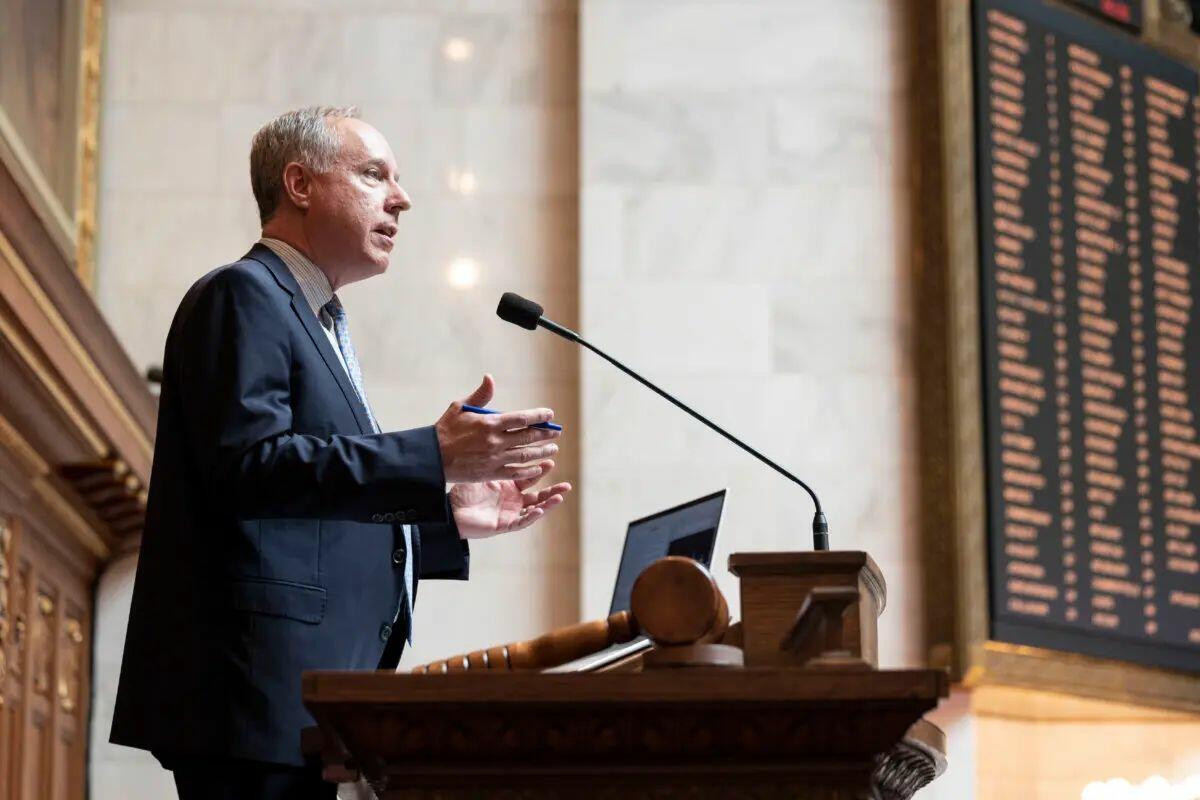
Speaker of the Wisconsin State Assembly Robin Vos (Courtesy of Robin Vos)
Mr. Vos and fellow GOP lawmakers in Wisconsin used a carrot-and-stick approach to getting the two-year state budget passed, including measures that would mean doom for DEI on university campuses in the state.
During budget negotiations, Republicans slashed $32 million from the university system’s budget, about what they calculated was the funding needed to support DEI programs.
Gov. Tony Evers threatened to veto the entire state budget because of the cuts to DEI. But that would mean no raises for any state employees.
He called Republicans’ efforts “really obnoxious” and “B.S.” He signed the budget in July.
But a Republican-controlled committee still needed to approve the raises before going into effect. Mr. Vos warned that the committee would not approve pay raises for UW employees until receiving assurance that DEI would be cut from the university system.
That left the decision up to UW officials. If they wanted to secure the pay raises, they'd have to agree to eliminate DEI.
Mr. Vos recalled telling the UW leadership, “I am dead serious. We are not giving you one nickel until we negotiate and make changes to DEI.”
After months of wrangling, university system leaders were forced to choose—pay raises for their employees or the preservation of DEI on campuses.
They chose to boost salaries for employees in exchange for axing much of DEI.
Lawmakers of the Black Caucus issued a statement saying they were “appalled and ashamed” at the diversity changes and questioned whether racial minorities were involved in the negotiations.
Wisconsin Gov. Tony Evers, a Democrat, speaks to supporters during an election night event at The Orpheum Theater in Madison, Wis., on Nov. 8, 2022. (Jim Vondruska/Getty Images)
Conservatives point to Mr. Vos’s tactics as a blueprint for how Republicans should unite and use the so-called “power of the purse” to eliminate what they see as divisive policies from public institutions.
The process showed Mr. Vos is a “master” legislator, said GianCarlo Canaparo, a senior legal fellow in the Edwin Meese III Center for Legal and Judicial Studies at The Heritage Foundation.
“He just played the levels of power in that state like a fiddle,” Mr. Canaparo told The Epoch Times.
“I think what happened in Wisconsin shows why Republican legislators need to use the powers they have more than they are [using them currently], even if they don’t completely control state government,” said William Jacobson, a Cornell law school professor.
Mr. Jacobson formed EqualProtect.org in response to DEI-fueled discrimination in education against whites and others. DEI is a form of “racial discrimination,” supported by a small group of activists, he said.
It’s not a popular idea with most people, Mr. Jacobson said. And in his view, cutting off funding for campus DEI programs is the best way to dismantle them.
“Because when push comes to shove, college administrators and college professors and university systems care more about the money than they care about DEI,” Mr. Jacobson said.
‘Stand for What You Believe’
The Wisconsin speaker’s plan to take down DEI in his state’s university system began forming when he heard troubling stories about how hallmarks of the ideology were affecting constituents, he said.
One told him that students had to write essays on politically left-wing topics to get into the state’s colleges. Another informed him that the universities no longer required scores from entrance exams for admission.
Mr. Vos bristled when he learned that some high schools in his state were removing acknowledgments of merit by doing away with grades or class rankings for students.
Concerns about DEI at the state’s universities had been growing, he said.
And a recent survey showed a worrisome lack of free speech on one of the campuses.
Yet, when he raised concerns about those issues with university system leadership, they ignored him, he said.
“And frankly,” he said, “they kind of were arrogant and thought they could just go around me.”
Meanwhile, he said, university leaders began making their wish list known to his colleagues. Namely, they wanted raises and new buildings, especially a new engineering building at the system’s flagship campus in Madison, he said.
New College of Florida students and supporters protest against the removal of DEI policies ahead of a meeting by the college's board of trustees in Sarasota on Feb. 28, 2023. (Rebecca Blackwell/AP Photo)
But Mr. Vos rallied Republicans, urging them to stand firm, as they hatched a plan.
Mr. Vos wanted to negotiate for legislative control over the creation of positions within the state universities. And he wanted to require universities to base student admissions on scores from standardized entrance exams again.
It was then that university leaders “realized that things were going to have to be different if they were going to have any chance to get the money that they wanted” for pay raises and new buildings, Mr. Vos said.
That made conditions right for negotiating.
In December, UW officials agreed to cut DEI policies, and Republicans agreed to fund the wanted pay raises and release the money needed for building projects within the UW system. That included money for the new engineering building initially rejected by the GOP.
Republicans also agreed to authorize $32 million for workforce development within the UW system.
They didn’t get standardized test scores returned to the admissions process.
But they did maneuver to get merit back into education.
School systems in Wisconsin and across the country have attempted to eliminate the awarding of letter grades to students and have, in many cases, eliminated testing.
Those traditions that elevate individuals based on their achievements don’t fit the DEI concepts. Acknowledging merit is seen by proponents of DEI as part of an oppressive system that hurts minorities.
As part of the deal-making in Wisconsin, the university system agreed to automatically admit the top 5 percent of graduating high school seniors to the University of Wisconsin, Madison. Students in the top 10 percent of their graduating class would be admitted automatically to any of the other 12 college campuses in the system.
“We want the smartest, best people on the front lines of everything from science to technology,” Mr. Vos said. It should not, he said, be “based on your race.”
Proponents of affirmative action hold signs during a protest at Harvard University in Cambridge, Mass., on July 1, 2023. (Joseph Prezioso/AFP via Getty Images)
As a result of those victories, parents of high school students will be empowered to demand a return to the awarding of grades and the assigning of class rankings, Mr. Vos said.
The outcomes illustrate that “you just have to be tenacious,” he said. “You have to stand for what you believe in and accept the fact that you’re not going to get everything.
“But if you play it right, you have the ability to get more than they want to give.”
For Republicans, the “more” was the promise to create an endowed chair at the flagship university in Madison. The position will focus on conservative political thought, classical economic theory, or classical liberalism.
Additionally, university system leaders agreed to develop and implement on all campuses a module to teach entering undergraduate students about freedom of expression.
Mr. Vos—who views himself as being on the “hard right” politically—said Republicans need to understand that in successful negotiations, getting much of what you want is better than getting nothing.
Florida and Texas have passed legislation banning DEI positions at universities.
But DEI is entrenched on most college campuses, Mr. Jacobson said.
So there’s still the possibility that DEI positions and programs that were supposed to be eliminated actually will be preserved, just with new names that sound different but represent the same purpose, he said.
But those who feel DEI is wrong for America must stand strong.
“It is the start of the fight against DEI,” Mr. Jacobson said. “It is not the end of the fight against it.”