Search This Blog

Saturday, January 13, 2024

Study finds hundreds of overlooked cancer drug targets

 Researchers from the Wellcome Sanger Institute and partners have carried out a comprehensive analysis of cancer cells, identifying 370 ‘priority’ targets that could be used to develop new drug therapies.

The findings – published in the journal Cancer Cell – came from a systematic look at ‘multi-omic’ information on 930 cell lines taken from 27 different tumour types, including breast, lung, and ovarian cancers, backed up by machine learning technology.

They represent one step closer to the creation of a complete ‘cancer dependency map’ of every vulnerability in every type of cancer, according to the team, which included scientists from public-private target validation initiative Open Targets and partners from other groups, including the Broad Institute in the US.

The new paper covers the second iteration of the dependency map, which was first published in 2019 and provides a “panoramic view of what enables cancer cells to grow and survive,” according to the scientists.

The project uses CRISPR-Cas9 screening to knock out all the genes expressed in the cancer cells, one at a time, to see how they affect their ability to function, hoping to identify those that can be exploited to kill the cells.
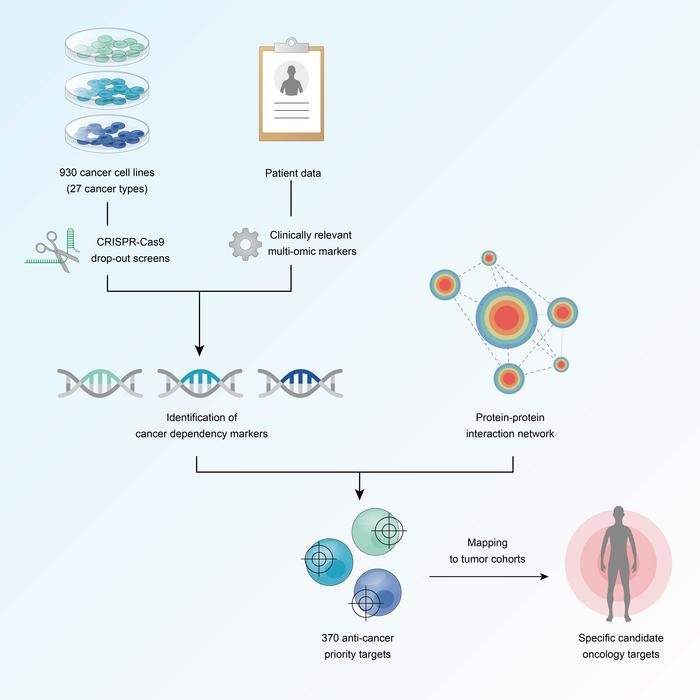
Graphical abtract

A key objective of the project is to find ‘genetic dependencies’ – the genes, proteins, or cellular processes that cancer cells rely on to survive – that could be harnessed to make new therapies.

Those dependencies are then linked to clinical markers to identify patients for whom those therapies would be most effective, and the dependency-marker pairs are examined to see how they fit in with what is known about molecular interactions in cancer cells.

That can throw out new targets for drug discovery, but also suggest ways in which existing drugs might be re-deployed to treat other forms of cancer – and hopefully help to improve on the current 90% failure rate in new drug development.

Dr Francesco Iorio, co-lead author of the study from the Computational Biology Research Centre of Human Technopole, said the work had created the most comprehensive map of the ‘Achilles heel’ of human cancers.

“We identify a new list of top-priority targets for potential treatments, along with clues about which patients might benefit the most – all made possible through the design and use of innovative computational and machine intelligence methodologies,” he added.

With over 20,000 potential anti-cancer targets in the genome, determining which are suitable to target for specific types of cancers and patients is a significant challenge, and Dr Mathew Garnett, co-lead author at the Wellcome Sanger Institute and Open Targets, said the map “will help drug developers focus their efforts on the highest value targets to bring new medicines to patients more quickly.”

The research was also hailed by Cancer Research UK, which supports the dependency map project.

“Two people might have the same type of cancer, but their diseases can behave differently. That is why we need precision medicine,” commented Dr Marianne Baker, science engagement manager at the charity.

“Giving people treatments for their unique cancer can improve the odds of success and help more people affected by cancer live longer, better lives.”

https://pharmaphorum.com/news/study-finds-hundreds-overlooked-cancer-drug-targets

Fani Spanked: Jordan Launches Investigation Into DA's Alleged Lover As Trump-Ga. Case Goes Off Rails

 Update (1523ET): House Judiciary Chairman Jim Jordan (R-OH) has launched an investigation into Nathan Wade, the special prosecutor in the Trump-Georgia case who has been accused of making more than $650,000 off the case - during which he and Willis took lavish vacations together.

"According to a recent court filing, you have been paid more than $650,000—at the rate of $250 per hour—to serve as an 'Attorney Consultant' and later a 'Special Assistant District Attorney' in the unprecedented investigation and prosecution of the former President and other former federal officials," wrote Jordan in a Friday letter reported by Just the News.

"This filing also alleges that while receiving a substantial amount of money from Fulton County, you spent extravagantly on lavish vacations with your boss, Ms. Willis."

"The Committee has information that the FCDAO [Fulton County District Attorney's Office] received approximately $14.6 million in grant funds from the Department of Justice between 2020 and 2023 and, given the enormous legal fees you have billed to the FCDAO, there are open questions about whether federal funds were used by the FCDAO to finance your prosecution," the letter continues.

Wade has until January 26th to reply with documents related to the case.

*  *  *

Fulton County District Attorney Fani Willis - who has charged Donald Trump and 18 co-defendants with trying to change the outcome of the 2020 US election in Georgia - has become the main attraction in a major prong of the left's 2024 election lawfare operation.

On Tuesday we noted that Willis had hired Nathan Wade (without proper approval), a private attorney in the midst of a divorce who "has little to no experience trying felony cases, much less complex RICO actions," according to the 127-page filing.

Wade ended up pocketing nearly $700,000 from Fulton county taxpayers - with which he allegedly took Willis on lavish vacations.

Now, Wade's wife has alleged in divorce documents that he failed to disclose over $700,000 in earnings from the county, and has continued to draw from her bank account, leaving it "routinely overdrawn" despite "the clear inequity in financial circumstances," the Daily Caller reports.

Wade filed to divorce his stay-at-home wife of 20 years on November 2nd, 2021, the day after Fani hired him as a Special Prosecutor in the Trump caseHe had his divorce sealed on February 10th, 2022, according to the 127-page filing by Trump co-defendant Michael Roman.

Republican Georgia Rep. Marjorie Taylor Greene sent a criminal referral Wednesday to Republican Georgia Gov. Brian Kemp and Attorney General Chris Carr asking for an investigation into Willis and expressing “serious concerns” about the allegations. Greene suggested Willis could have violated a number of Georgia statutes, including violations of public oath, bribery, improper influence of a government official and more.

The Monday motion did not cite hard evidence that Willis and Wade were romantically involved but referenced “sources close to both the special prosecutor and the district attorney” who confirmed their ongoing relationship. -Daily Caller

Oh, and let's not forget - Wade billed taxpayers $2,000 to talk to the Biden White House about prosecuting Biden's political opponent.

Looks like someone didn't run their schemes past Marc Elias... 

https://www.zerohedge.com/political/fanigate-goes-full-jerry-springer-das-alleged-lover-left-wife-dire-need-after-failing

Is eye color surgery the new fad? Interest soars as doctors warn of permanent risks

 These days, there are many ways to get what you want but don’t have. Dimples? Wear cheek clamps. Freckles? Get them tattooed on your face. Different eye color? Just ask an ophthalmologist to laser a chemical dye into your cornea or have a silicone iris surgically implanted instead.

If that sounds dangerous to you, that’s because it is — and eye doctors are desperate to get the message across to the many blue- and green-eyed hopefuls who are being bamboozled by purported success stories online.

Eye color change procedures, none of which are FDA-approved, carry with them risks that include severe light sensitivity, glaucoma, cataracts, corneal disease, vision loss and blindness. Side effects may manifest shortly after a procedure or take years to develop. In many cases, people become depressed as they navigate these consequences, eye doctors told USA TODAY. 

One clinic in New York City is driving much of the social media chatter on permanent eye color change, garnering millions of views per TikTok. Run by ophthalmologist Dr. Alexander Movshovich, KERATO is the first keratopigmentation practice in the U.S. that uses special lasers to insert pigments inside a healthy cornea to cover the eye’s natural color, which lies in the iris. The procedure costs $12,000 and is not covered by insurance. 

Yet the risks and cost doesn't deter some people.

Just before the new year, actor and model Jessica White revealed on Instagram that she permanently changed her eye color with KERATO from dark brown to hazel. In 2014, reality TV star Tameka “Tiny” Harris said she went to Africa to change her eye color with iris implants: the riskiest procedure of them all, ophthalmologists say.

What is an iris implant and is it safe?

During iris implant surgery, a doctor cuts a slit in the cornea and slides a folded, artificial iris made of silicone into it, according to the American Academy of Ophthalmology. The fake iris is then unfolded to cover the natural one. This surgery is illegal in the U.S., so many people get it in other countries. Some experts consider the surgery “malpractice.” 

Dr. Guillermo Amescua, a cornea specialist at the Bascom Palmer Eye Institute within the University of Miami Health System, said he has treated several patients who have experienced serious complications from iris implants and have had to get them removed: an additional surgery that could further damage the eye.

One patient of his is now partially blind; another developed glaucoma — nerve damage that causes vision loss and blindness — so severe they had to get a cornea transplant.  

The resulting mental health effects can be brutal. "When people get their implants, they're super happy and experience a boost in self-esteem," Amescua said. "When they start getting complications, however, they go into denial and then get really bad depression when their implants are removed."

More on eye health:Does driving or grocery shopping make you anxious? Your eyes may be the problem.

Iris implant surgery was originally developed to help people born with missing, undeveloped or damaged irises with symptoms like glare and light sensitivity. (In 2018 the FDA approved the first prosthetic iris in the U.S. for this purpose.) However, the surgery gained popularity as a cosmetic treatment, and despite evidence documenting its risks, people still seek it out, sometimes landing back in doctor’s offices when things go haywire.

“Coming from someone who spends their life trying to restore vision and give people their sight back, it seems cavalier and somewhat silly to me to take on the risk where you could permanently damage your vision,” said Dr. Melissa Daluvoy, an associate professor of ophthalmology at the Duke University School of Medicine. “I would advise any of my patients to really think long and hard if the risks are worth the benefits.” 

Daluvoy agrees that iris implant surgery is the most dangerous way to change your eye color. Once you need a new cornea, which comes from a cadaver, Daluvoy said that you run the risk of rejection like other organ replacements. “And if you’re young, which most people who change their eye color are, then you’ll eventually need another transplant because you will outlive that organ that was donated to you,” Daluvoy said. 

Is keratopigmentation safe? 

Based on available evidence, Daluvoy said that keratopigmentation is “probably the safest of these procedures," but she'd still strongly advise against it. One of her patients required a cornea transplant after they had it done. At the very least, she said, this procedure could limit your peripheral vision because the dye reaches the outer rim of the eye. That said, many people who get keratopigmentation don't experience side effects.

Keratopigmentation may also affect a doctor’s ability to care for other eye problems as a person ages, such as glaucoma and cataracts. “The pigment in the cornea can obstruct the view and make those [conditions] more difficult to diagnose and treat,” Daluvoy said. 

The long-term effects are still unknown. Because the cornea receives its nutrients through fluid in the eye, Daluvoy wonders if dyes, some of which contain metal, could damage the cornea over time.

“I just don't think we have the long term data to know for sure,” she said. 

There’s another eye color change procedure called laser depigmentation of the iris. A doctor uses a laser to diminish the density of the iris’ natural pigment, turning brown eyes blue. But there’s limited research on this method and most doctors don’t recommend it because it can damage the iris, Amescua said, which is critical for controlling how much light enters the eye. 

If you’re interested in changing your eye color, experts recommend talking to an ophthalmologist before undergoing any procedure or considering colored contacts, which require a prescription from an eye doctor.

https://www.usatoday.com/story/life/health-wellness/2024/01/11/how-to-change-your-eye-color-doctor-advice-trend/72177039007/

'How Covid-19's symptoms have changed with each new variant'

 With a new variant of the Sars-CoV-2 virus causing a spike in cases, it is demonstrating just how much the disease has changed since the pandemic began – and what happened to "Covid toe".

"For almost four years, I've managed to dodge Covid-19," TV broadcaster Mehdi Hasan tweeted a fortnight ago. "But it finally got me. At the end of 2023."

Hasan added that his symptoms were thankfully mild, but he is just one of many people reporting their first ever positive test for the virus responsible for the pandemic, Sars-CoV-2, four years on from when it first began spreading around the world.

What are the symptoms of JN.1

The version of the Covid-19 virus behind the latest spike in infections shares many of the same symptoms as earlier variants of Sars-CoV-2 : a sore throat, fatigue, headache and a cough.

Differences in the symptoms often depend on a person's underlying health and their immune system. But some clinicians are reporting some of the most common first signs of an infection by JN.1 are diarrhoea or a headache. Fewer patients are losing their sense of smell with variants closely-related to Omicron, of which JN.1 is a subvariant. 

Covid-19 cases are starting to rise again as a result of the JN.1 Covid variant, which appeared last September in France. The variant accounts for around 60% of new infections in early January, according to a data tracker from the US Centers for Disease Control and Prevention (CDC).

At the same time, data from both the CDC and the UK Health Security Agency shows that hospitalisations and deaths from Covid-19 are markedly lower compared to January 2023. Primary care physicians say they are finding it virtually impossible to distinguish Covid-19 symptoms from influenza without the help of a PCR test.

"When Covid first came, it was characterised by these very odd, vague symptoms – from brain fog, feeling exhausted, and losing taste and smell," says Ziad Tukmachi, a GP at Chartfield Surgery in south-west London, UK. "Now I feel it's mutated to more similar symptoms to the flu, where it's very difficult clinically to distinguish between the two."

While this might all suggest that the virus is evolving to become progressively less pathogenic, epidemiologists believe that the reality of the situation is more nuanced.

"The virus isn't necessarily less pathogenic," says Greg Towers, professor of molecular virology at University College London, UK. "Rather, it's infecting a population that are less inclined to become sick, because they've seen Sars-CoV-2 before, and they're better at regulating [their] immune response against it."

Towers says the major lesson over the course of the pandemic is that the symptoms which appear in patients are highly dependent on prior immune status. In the first two years of Covid-19, the responses of an individual patient to the virus were primarily dictated by their state of immune health, along with prior exposure to other coronaviruses.

Now, in 2024, this is determined by a much more complex cocktail of factors, including how many times that person has already been infected by the virus, their vaccination status, and whether their vaccination-induced immunity might be on the wane.

As a result, Denis Nash, an epidemiologist at the City University of New York, US, says that people now experiencing Covid-19 for the very first time are at greater risk, especially if it has been a while since their last booster vaccine.

"There are still people who have somehow managed to remain completely Covid-näive," says Nash. "If they are unvaccinated or under vaccinated, they stand to have the highest risk of severe and protracted symptoms."

Still, Sars-CoV-2 is also constantly mutating, something which is also subtly shifting how it attempts to invade the human body. The JN.1 variant has an elevated ability to evade the immune system, for example, compared to other Omicron sub-variants. But this is also altering the way it affects the human body.

In 2023, researchers at Virginia Commonwealth University's School of Medicine reported that people now being infected with Omicron-related subvariants are just 6-7% as likely to lose their sense of smell or taste, compared to infections by the virus in the early stages of the Covid-19 pandemic.

Instead, some clinicians such as David Strain, associate professor of cardiometabolic health at the University of Exeter, UK, told the BBC that his patients are more likely to present either with diarrhoea or a headache having been infected with JN.1 or the EG.5 variants.

"There has been a huge shift in viral tropism, meaning which cells get infected," says Towers. "And that's governed by the sequence of the spike protein. Almost everybody in the world has been infected or vaccinated, so the virus is under huge pressure to escape those immune responses to continue to transmit, so the spike protein has evolved a lot. This leads to it infecting different cells to gain entry, which is why people aren't losing their smell or taste anymore."

Researchers are still trying to figure out whether some more subtle, internal consequences of Sars-CoV-2 infection varies between variants of the virus or whether any differences are more driven by the waning of previous vaccine-induced protection. One of the ongoing concerns remains the virus' ability to cause damage to blood vessels and internal organs through the creation of micro clots, with the kidney – an organ which is constructed of approximately one million tiny blood vessels called capillaries – seemingly particularly vulnerable based on the patients Strain has seen.

"These are just observations but we're seeing more microvascular complications and a step change in the kidney function with the new JN.1 variant that does appear to be worse than the past couple of variants," says Strain. "But it's difficult to say whether it's the variant, or the fact it's 18 months to two years now since a lot of people last received a vaccine."

Getty Images The only way to know that you have Covid-19 for sure is to have a PCR test (Credit: Getty Images)Getty Images
The only way to know that you have Covid-19 for sure is to have a PCR test (Credit: Getty Images)

With some emerging evidence hinting that micro clots might be a cause of Long Covid – a study in August 2023 even suggested that they could contribute to the cognitive problems experienced by many Long Covid patients – researchers are now concerned that we might go on to see a further spike in chronic cases. However, it would be hard to distinguish whether this is a consequence of the new variant or declining population immunity.

"Studies from the March-summer 2020 period show that the risk of Long Covid from any case, was about 10%," says Danny Altmann, professor of immunology at Imperial College London. "Now we have far more infections, and the risk of Long Covid looks to have fallen, not because of a milder variant but because of a degree of protection from vaccine doses. A paper in the BMJ on a national cohort in Sweden shows protection goes up with each additional dose."

This all indicates the ongoing importance for all age groups of remaining up to date with vaccine boosters, but while politicians have long been keen to move on from Covid, Strain says it is vital to keep monitoring how different variants continue to infect us.

"Symptoms do seem to change from one variant to another," he says. "We've had periods where the earliest symptom is headache, and others where it's more gastrointestinal. We all to go back to life as normal, but the reality is, Covid isn't going anywhere."

--

Whatever happened to "Covid toe"?

In the early months of the Covid-19 pandemic, reports of an unusual and baffling symptom of the disease began to emerge – patients were developing painful or intolerably itchy lesions on their feet and hands. These chilblain-like swelling and reddening of the skin became commonly known as "Covid toe".

Doctors and scientists were puzzled – how did a respiratory virus cause such a strange symptom in the body's extremities?

Tests on samples taken from people with Covid toe have failed to find the presence of the virus responsible for Covid-19, Sars-CoV-2, in the chilblains, suggesting the virus itself is not directly responsible. Instead, a number of hypotheses have been put forward, including that it could be the result of an excessive response by part of the immune system that produces a protein called interferon IFN-1, which helps the immune system target cells infected by viruses.

Others have suggested that it may not be something specific to Covid-19 at all, and rather just a response that occurs in people who are prone to chilblains anyway.

Another theory was that lockdown rules meant more people were just not wearing adequate footwear around their homes and too much time sitting still.

Curiously, as the virus has evolved and lockdowns have lifted, so too has the apparent occurrence of these cutaneous problems. Research by scientists at King College London, UK, who studied the reported symptoms of more than 348,000 people who logged their Covid symptoms via a mobile app, has revealed that Covid toe and related skin complaints have decreased in more recent waves of the Sars-CoV-2 virus.

They were reported by 11% of people during the wave caused by the Omicron variant, compared to 17% in the Delta variant wave, where symptoms also tended to last longer.

https://www.bbc.com/future/article/20240111-covid-19-how-does-its-symptoms-differ-from-flu

FDA approves Medtronic Percept™ RC neurostimulator for movement disorder, epilepsy

 Medtronic plc (NYSE:MDT), a global leader in healthcare technology, today announced the U.S. Food and Drug Administration (FDA) approval of its Percept™ RC Deep Brain Stimulation (DBS) system. The rechargeable neurostimulator is the latest innovation in the Medtronic Percept™ family, which includes the Percept™ PC neurostimulator, BrainSense™ technology†, and SenSight™ directional leads. The Percept™ family is the only sensing-enabled DBS system on the market, allowing the physician to personalize treatment for patients with movement disorders such as Parkinson's disease, essential tremor, and dystonia* as well as epilepsy. Over 11 million people in the U.S. are living with movement disorders1-2 and approximately 3.4 million with epilepsy3.

https://news.medtronic.com/2024-01-08-FDA-approves-Medtronic-Percept-TM-RC-neurostimulator-with-exclusive-BrainSense-TM-technology#assets_all

Tinnitus prevalence, associated characteristics, and related healthcare use


Summary

Background

Tinnitus is a potentially disabling condition with few treatments. We examined the prevalence and characteristics of tinnitus among demographic groups in the United States (US) and assessed associated factors and tinnitus-related healthcare.

Methods

We included adults with and without bothersome tinnitus from the nationally representative 2014 National Health Interview Survey (NHIS; raw n = 36,697), the latest year with tinnitus data. We evaluated tinnitus prevalence and characteristics (frequency, severity, duration) overall and among groups defined by sex and race/ethnicity. Logistic regression with adjusted Wald tests were used for comparisons in NHIS-weighted populations by sex and race/ethnicity, and to evaluate associations between demographic/medical characteristics and noise exposure on tinnitus risk.

Findings

The US prevalence of tinnitus was 11.2% (95% CI: 10.8%, 11.7%; ∼27 million people) in 2014. Of those with tinnitus, 41.2% always had symptoms and 28.3% had ≥15 years symptom duration; the rates were significantly higher among men vs. women and non-Hispanic (nHW) vs. Hispanic Whites (HW), Blacks, or other ethnicity. Significantly more women vs. men and HW vs. nHW reported severe tinnitus. Sex and race/ethnicity, except Asian, were not significantly associated with tinnitus when age, otologic/medical disorders, and noise exposure were included in the model. Significantly lower rates of all minority groups discussed tinnitus with a doctor compared to nHW, and among those who did, Blacks were significantly less likely to receive tinnitus evaluation than nHWs.

Interpretation

Tinnitus prevalence varies across US demographic groups and racial differences were identified in the delivery of tinnitus-related healthcare.

Funding

Rich Robbins, Bertarelli Foundation Endowed Professorship.