Search This Blog

Tuesday, January 16, 2024

Teen brain especially susceptible to harms of THC

 Ask thousands of teens whether frequent use of certain substances brings a high risk of harm, and they mostly nail it: a majority say yes for cigarettes, alcohol, cocaine and heroin. But there’s one substance that many skip over — cannabis.

Only 35 percent of 12- to 17-year-olds perceive a “great risk of harm” from smoking marijuana once or twice a week, according to the National Survey on Drug Use and Health.

It’s a sentiment that some of their parents may share. Parents often don’t understand that the products used today “are not what they knew when they were in high school,” says Kelly Young-Wolff, a licensed clinical psychologist and research scientist at Kaiser Permanente Northern California Division of Research in Oakland. If their children are using cannabis, parents may think, “‘it’s not that bad, at least they’re not using this other drug that’s worse.’”

But the cannabis products available now are leaps and bounds more potent — which may increase the risks for addiction and psychosis — than in the past. Marijuana plants have been bred to contain more delta-9-tetrahydrocannabinol, or THC, the main psychoactive chemical. In 1995, the total percent of THC by weight of marijuana plant material was around 4 percent; now marijuana with a THC potency of 20 percent or more is available. Trouncing that are concentrated cannabis products, including wax, budder and shatter, which can have a THC potency as high as 95 percent.

Cannabis is legal for adults to use recreationally in 24 states and Washington, D.C., and is allowed for medical use in 38 states and D.C. The widespread availability of cannabis “promotes the idea that it’s safe,” says pediatrician Beth Ebel of the University of Washington School of Medicine and Seattle Children’s Hospital. But that “is an incorrect assumption.” THC can impact brain chemistry “in a way that wasn’t intended,” Ebel says. “Some of the worst effects can have lifelong health consequences, especially for a young person.”

Concentrated cannabis products can be so extremely potent, and so different from what’s been known as cannabis, that “we need to start calling them something else,” says neuroscientist Yasmin Hurd of the Icahn School of Medicine at Mount Sinai in New York City. “These are new drugs.”

How does THC affect the adolescent brain?

As is true for other drugs, adolescence is an especially risky time to use cannabis. “The adolescent brain is still developing into early adulthood,” Hurd says. During this period, connections within adolescents’ brains are forming, getting reinforced or being pruned. “Your brain is trying to figure out, ‘what is important that I need to learn, and what is important that I need to retain,’” Ebel says, and this process is “negatively affected by THC.”

THC binds to one of the main receptors, called CB1, of the endocannabinoid system. This complex system influences many functions in the body. In the brain, the endocannabinoid system plays a crucial role in the organ’s development and helps to regulate anxiety, pain, memory, the motivation of behaviors and more.

The endocannabinoid system also contributes to structural changes that occur as developing teen brains mature. But THC can interfere with the system’s signaling during this key time and leave an imprint on the brain’s structure.

Studies in animals have found that exposure to THC in adolescence can reduce CB1 receptors in the brain and lead to long-lasting problems with memory and learning. One of the areas the psychoactive chemical alters is the prefrontal cortex, which matures during adolescence and is integral to problem-solving and emotional regulation. In adolescent rats injected with THC, nerve cell protrusions that connect with other nerve cells were prematurely cut back, disrupting the circuitry of the prefrontal cortex, Hurd and colleagues reported in Molecular Psychiatry in 2019.

There’s also evidence in people that THC changes teens’ brains. Researchers analyzed close to 1,600 magnetic resonance images of the brains of nearly 800 adolescents, taken at 14 and 19 years of age, on average. There was an association between cannabis use over the five years and an accelerated thinning of the prefrontal cortex, the researchers reported in JAMA Psychiatry in 2021. Cortical thinning is expected in adolescence and is likely tied to the pruning of underused connections. But accelerated thinning means that process isn’t following the normal developmental plan. The researchers hypothesize that the accelerated thinning might be connected to the premature loss of nerve cell protrusions that was described in the rat study.

Marijuana use is linked to mental health harms

Using cannabis puts teens’ mental health at risk. That’s true even for someone using cannabis recreationally. Adolescents ages 12 to 17 whose cannabis use did not meet the threshold for a substance use disorder were about twice as likely to develop depression or have suicidal ideation as those who didn’t use cannabis, according to a study of more than 68,000 adolescents published in May in JAMA Network Open.

The risks increase for those with cannabis use disorder, which is diagnosed when someone’s use interferes with daily life, but they aren’t able to stop using, among other symptoms. The JAMA Network Open study reported that adolescents with cannabis use disorder were 2.5 and 3 times as likely to have depression or suicidal ideation, respectively, as those who didn’t use cannabis.

Beginning cannabis use as a teen is more likely to lead to dependence than starting as an adult, just like alcohol, cocaine and nicotine. Compared with young adults, adolescents are more susceptible to dependence within a year of taking up marijuana. Eleven percent of those ages 12 to 17 progressed to cannabis use disorder by 12 months, but only 6 percent of those ages 18 to 25 did, researchers reported in 2021 in JAMA Pediatrics. After three years, the prevalence was 20 percent of adolescents versus 11 percent of young adults.

Yet many teens are turning to marijuana as a coping mechanism. A study of what motivated high school seniors to use cannabis found that reasons related to coping — such as to escape problems, relieve tension or deal with anger — approximately doubled in prevalence during the last four decades, researchers reported in 2019 the Journal of Studies on Alcohol and Drugs. For a project on how cannabis legalization for adults in California has impacted adolescent health, Young-Wolff has talked to clinicians who care for adolescents. They’ve told her that many of their patients who use cannabis are doing so to self-medicate, to try to relieve symptoms of depression or anxiety.

Ebel has seen this too. But as the drug wears off, users are more anxious than they were before, she says. “It drives a cycle that drives increased use.”

When marijuana is a part of a teen’s everyday life, it can change their future trajectory. A study of young people in Australia and New Zealand compared the frequency of cannabis use before the age of 17 with how participants had fared by age 30. Those who used cannabis daily were more likely to become dependent on cannabis, use other drugs and attempt suicide, and less likely to finish high school, compared with teens who had never used, researchers reported in 2014 in the Lancet Psychiatry.

Cannabis addiction is also tied to the development of the psychiatric disorder schizophrenia. A study of nearly 7 million Danish people ages 16 to 49 found an association between cannabis use disorder and schizophrenia, researchers reported in May in Psychological Medicine. The association was stronger for males overall and especially at the ages of 16 to 25 years old. The researchers estimate that in 2021, without cannabis use disorder, around 15 percent of cases of schizophrenia in males and 4 percent in females would not have occurred.

The risks of using concentrated cannabis products

Although smoking the marijuana plant is still the most common way teens use cannabis, vaping cannabis concentrates is on the rise. A study of high school seniors reported that from 2015 to 2018, among past-year cannabis users, smoking decreased from 95 percent to 90 percent, while vaping increased from 26 percent to 34 percent. Daily use was also more common among those who vaped, at 29 percent, verses those who smoked, at 18 percent, researchers reported in JAMA Pediatrics in 2020.

There is early evidence that high-potency products are associated with an increased risk of psychosis, a symptom of schizophrenia. In a study of adults, daily use of high-potency cannabis products led to nearly five times the risk of psychosis compared with people who didn’t use cannabis, researchers reported in 2019 in Lancet Psychiatry. For the purposes of the study, high potency was defined as having 10 percent THC or higher.

There are also reports of a rise in cannabis hyperemesis syndrome, a complication of high potency cannabis use that leads to abdominal pain, nausea and repeated vomiting. A Canadian study found that emergency department visits for the syndrome increased 13-fold from 2014 to 2021.

Ebel says concentrated cannabis products are largely unstudied and “pose new and alarming health risks.” Hurd says that because we don’t know the full impact on health from high potency products, users are essentially the test subjects.

So as with other substances, public health officials recommend that parents talk with their kids about the risks of cannabis use. Especially with indications that teens are turning to cannabis to self-medicate, “if you notice a change in your child’s behavior, try to find out what’s going on,” Young-Wolff says. It’s also important for parents to consider the messages they send about marijuana, she says. The clinicians Young-Wolff has talked to have noticed that parents are using cannabis more and that they’ve become more permissive about teen cannabis use. “That can really make it hard to get this message to the kids to not use,” she says.

So, for adults who are taking part in the new legality of marijuana: “If you are going to use cannabis,” Young-Wolff says, “don’t use in front of your children.”


CITATIONS

Recession Signal: Private-Sector Job Growth Is Being Replaced By Gov't-Sector Job Growth

 by Ryan McMaken via The Mises Institute,

Over the past two years, the Biden administration has repeatedly insisted that job growth is amazing, and that the administration has "created" millions of jobs.

In reality, of course, much of the job growth that did exist was the predictable job growth that came with the end of forced business closures and lockdowns. Job growth was also fueled by rising aggregate demand fueled by runaway growth in government spending. After all, during 2020 and 2021, the regime's easy money policies meant that the central bank and private banks created approximately seven trillion dollars during that period. 

Since early 2021, however, the job growth we're seeing has been increasingly fueled by growth in government-sector jobs. In other words, the job growth we do see in the government sector does not represent the result of private investment, saving, or demand. It's not organic economic growth. Rather, these government positions are positions that only exist as the result of wealth transferred from the private sector to the government sector.  

Government-funded jobs are not drivers of growth. They are obstacles to growth, as stated by Ludwig von Mises: 

...there is need to emphasize the truism that a government can spend or invest only what it takes away from its citizens and that its additional spending and investment curtails the citizens' spending and investment to the full extent of its quantity.

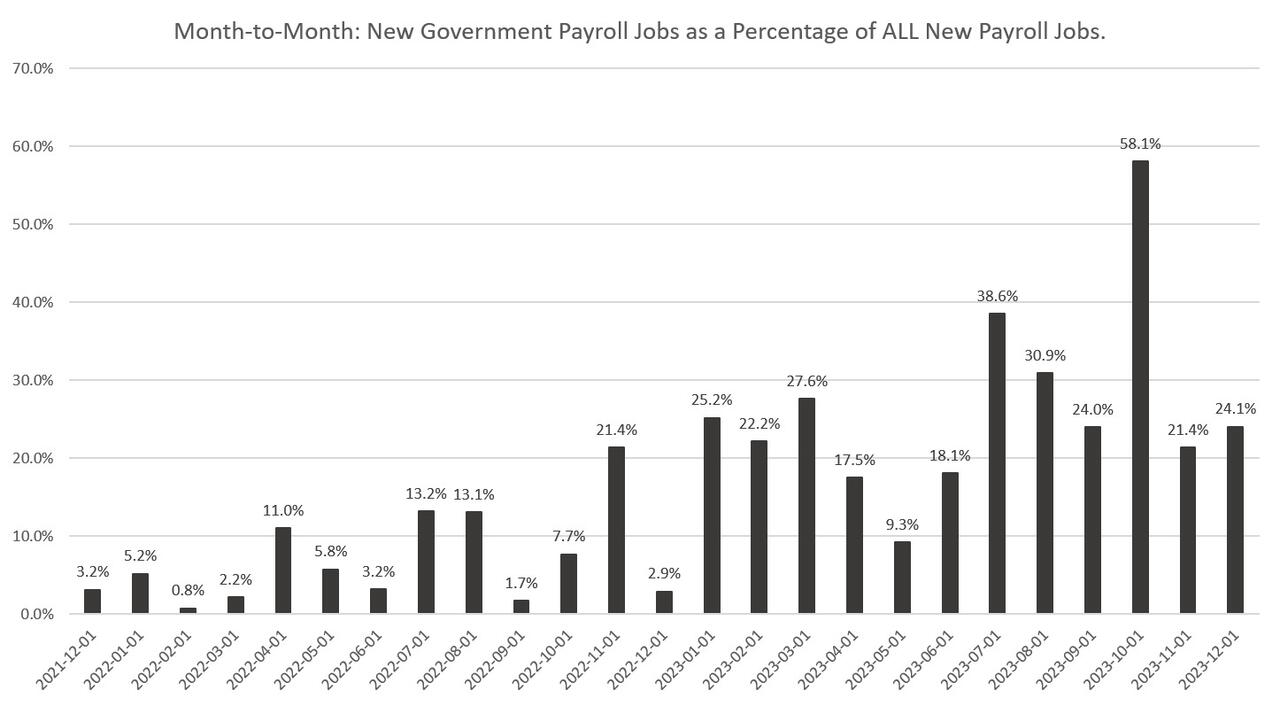
Looking at month-to-month job growth since 2021, the graph shows government jobs as a percentage of all new job growth (according to the establishment survey.) This has accelerated over the past six months as government job growth has comprised from 21 percent to 58 percent over that period. Indeed, over the past year, from December 2022 to December 2023, private sector jobs grew at half the pace of government jobs, with private sector payrolls rising 1.5%. During that time, government payrolls increased 3 percent. 

The relationship between government jobs and private sector jobs also can also indicate approaching recessions in many cases.

Here is a graph that shows year-over-year growth in private sector jobs (gray) and government jobs (red), each as a proportion of all job growth. We can see how in numerous cases, the portion of all jobs that is private tends to deteriorate as recessions approach. For example, as the 1991-1992 recession, approached, we see that new government jobs became a larger and larger share of all new jobs during 1990 and 1991.

Government jobs made up about 20 percent of all new job growth in early 1990, but by December of that year, government jobs has provided about half of all new job growth. We can clearly see a similar trend with the lead up to the great recession: private-sector jobs began to collapse as early as late 2006 even though government job creation continued to buoy overall job growth in that period.  

During times of strong economic growth, we find that government jobs rarely comprise more than twenty percent of all new jobs.

Since September of this year, however, government jobs has taken up more than twenty percent of all new jobs in each month. In December, government jobs reached 24.9 percent of all new jobs.

That's the largest proportion since the covid panic in March 2020. 

Daniel Lacalle has said that the United States is in the midst of a "private sector recession." What he means is aggregate numbers can still show good economic trends—such as job growth—while the private sector is stagnating or shrinking. That is, if government spending and government job creation is robust enough, it will mask private sector weakness in the aggregate statistics. 

That may be the trend we are facing right now. The job growth we do see is increasingly being driven by government spending, and not by private investment. Even worse, the government spending we see is largely deficit spending, meaning the economic "good news" is reliant on massive amounts of new government debt. 

https://www.zerohedge.com/personal-finance/recession-signal-private-sector-job-growth-being-replaced-govt-sector-job-growth

Key to clearing precancerous cells a potential treatment mechanism?

 Researchers have chipped away a little more at the mystery of cancer resistance, this time in the form of new findings that explain how the immune system senses DNA damage in precancerous cells. 

In a study published Jan. 10 in Nature, researchers from the University of North Carolina School of Medicine reported that they had learned how an immune pathway called cGAS-STING detects DNA damage in cells and leads to necroptosis, or programmed cell death. Results from experiments involving mice with breast cancer suggest that stimulating this pathway can suppress tumor growth, lending to the idea that it may be a good target for both therapy and even prevention. 

“How cancers become resistant to radiotherapy and chemotherapy is poorly understood,” study lead Gaorav Gupta, M.D., Ph.D., told Fierce Biotech Research in an email. “Our work suggests that disrupting the cell’s ability to activate innate immune responses to DNA damage may be an important cancer resistance mechanism. Strategies to reactivate these pathways should be explored and may help to overcome treatment resistance.”

The researchers’ work centers on interactions between an immune system enzyme called cyclic GMP-AMP synthase, or cGAS, and a molecule called MRE11. cGAS is known for sensing damage in DNA that’s found in the cytosol of cells, to which it reacts by stimulating the immune response. But to prevent excessive inflammation, cGAS is caged in histone molecules—the proteins around which DNA is wrapped—until it detects a threat, as another team of UNC researchers showed in 2020. 

Building off those findings, Gupta and his team wondered if MRE11, best known for detecting broken bits of DNA, might be involved in the process of unlocking cGAS from the histones so it can activate the immune response. That was indeed the case, their analysis showed—when MRE11 spies broken DNA, it releases cGAS, allowing it to “fully activate in the presence of broken DNA fragments,” Gupta explained.

“This is a very elegant solution for DNA sensing that both protects against spurious inflammatory activation, but also triggers activation in the presence of DNA damage,” he said.

In mouse models of breast cancer, stimulating the interaction between MRE11 and cGAS suppressed tumor growth, specifically by activating the cGAS-STING pathway and resulting necroptosis, Gupta’s team showed. This suggests two things: First, that cancer cells develop resistance to DNA-damaging treatments, like radiation, by somehow turning this pathway off; and second, that reinstating it might be enough to prompt the immune system to remove cancerous cells. 

The latter point will be assessed in a forthcoming clinical trial involving HER2-negative breast cancer patients who will take Merck & Co.'s PD1 inhibitor Keytruda, either with or without radiation. As part of the trial, Gupta’s team will look at whether the cGAS-STING necroptosis pathway is activated in response to these therapies. 

Intriguingly, the recent findings also hint at the possibility of actually preventing breast cancer altogether, though this wasn’t tested in the study. Theoretically, immune checkpoint blockers like PD1 inhibitors could stimulate necroptosis and suppress cancer development, Gupta noted. 

“We plan to explore these possibilities in our preclinical breast cancer models, but it’s too early to know whether this strategy may lead to future clinical trials in individuals known to be at high-risk for developing breast cancer,” he said.

Meanwhile, there are some challenges that stand in the way of translating these findings to new treatments. One includes better tools to measure necroptosis in cancer samples, while another is an issue that many labs know well: funding. 

“We are currently applying for new grants that will support our ability to investigate how DNA damage induced necroptosis can be augmented to promote breast cancer treatment and prevention,” Gupta said.

https://www.fiercebiotech.com/research/researchers-find-key-clearing-precancerous-cells-and-it-potential-treatment-mechanism

'FDA clears AI that predicts Alzheimer’s progression from an MRI scan'

 The FDA has granted a de novo clearance to an artificial intelligence program capable of reading a standard brain MRI scan and predicting a patient’s chances of progressing from mild cognitive impairment and early memory loss to Alzheimer’s disease and dementia within five years, according to the software’s developer Darmiyan.

Described as a virtual microscope, the BrainSee prognostic program could be implemented before a positron emission tomography (PET) scan, which requires injections of radioactive tracers, or instead of biopsies of cerebrospinal fluid, the company said.

“Our vision is to redefine brain health screening and monitoring standards and impact the lives of patients and their family members in a meaningful way,” Darmiyan founder and CEO Padideh Kamali-Zare said in a statement.

BrainSee, which previously received a breakthrough designation from the FDA in 2021, delivers a quantitative score from 0 to 100, allowing for patients to be categorized by risk when considering potential treatment options. 

The program only requires a common 3D MRI scan, with no contrast injections, as well as cognitive test scores that are typically collected during a diagnostic workup. 

The San Francisco-based Darmiyan launched in 2016 and received funding from Y Combinator the year after. In 2020, a $6 million seed financing round was led by the Alzheimer’s-focused drugmaker Eisai, with additional backing from IT-Farm and Y Combinator.

https://www.fiercebiotech.com/medtech/fda-clears-ai-predicts-alzheimers-progression-mri-scan

Apple may evade import ban by nixing pulse ox sensor from Apple Watch, Masimo says

 In an attempt to avoid another pause on sales of its smartwatches equipped with blood oxygen sensors—which are the subject of a patent infringement case brought by Masimo—Apple in late December submitted to U.S. Customs and Border Protection a redesign of those Apple Watches that could exempt them from an import ban imposed by the U.S. International Trade Commission

The plan has reportedly worked: Though CBP has yet to publicly release its Jan. 12 ruling on the matter because it contains information designated by Apple as confidential, a court filing from Masimo this week claims that the department has concluded that the redesigned Apple Watches fall “outside the scope” of the ITC’s order.

They do so by completely removing the devices’ pulse oximetry technology, according to the document, a letter from Masimo’s attorney that was filed in federal appeals court Monday.

In a statement sent to Fierce Medtech, a spokesperson for Masimo said, “Apple’s claim that its redesigned watch does not contain pulse oximetry is a positive step toward accountability. It is especially important that one of the world’s largest and most powerful companies respects the intellectual property rights of smaller companies and complies with ITC orders when it is caught infringing.”

The import ban affects only domestic sales of the Series 9 and Ultra 2 models of the Apple Watch, which Apple briefly stopped selling in the U.S. for a few days in December before the import ban took effect.

Though the company confirmed in a court filing of its own on Monday that CBP did approve a redesign, it has yet to confirm whether the submitted designs do indeed remove the blood oxygen sensors from the devices, nor has it announced any plans to sell pulse ox-less versions of the smartwatches.

For now, both models are still available for sale with the sensors still in place, an Apple spokesperson confirmed to Fierce Medtech.

The ITC levied the import ban in October, siding with Masimo in its claims that the Apple Watch’s built-in blood oxygen sensor infringes on Masimo’s own light-based pulse oximetry technology. The ban took effect in late December, following a 60-day presidential review period during which the Biden administration opted not to veto the ban.

The ban is currently on hold, however, as Apple was granted an emergency pause while it fights for a longer stay that would remain in place while it appeals the ITC decision. Apple has argued that being unable to sell the affected models of its smartwatch while the appeal plays out—a process that it says could take a year or more—would cause “irreparable harm” to its business.

Masimo has pushed back on that claim, suggesting that Apple can stay afloat on sales of its other Apple Watch models and wide array of other products, and adding in its letter this week that potential sales of the newly redesigned devices “would eliminate any irreparable harm alleged by Apple.” For its part, Apple argued in its Monday filing that the still-confidential changes made in the redesign “[mean] Apple will continue to suffer reputational harm from being unable to provide consumers with a fully-featured Apple Watch product.”

The federal appeals court could issue its ruling on the requested stay pending appeal as early as today, Jan. 16, per Apple.

https://www.fiercebiotech.com/medtech/apple-may-evade-import-ban-removing-pulse-ox-sensor-apple-watch-masimo

'NewAmsterdam Pharma's Obicetrapib Potential Blockbuster In Cardio'

 Piper Sandler initiated coverage on NewAmsterdam Pharma Co. NV 

+ Free Alerts
, a clinical-stage developing therapy for metabolic diseases, with lead asset obicetrapib, focused on the cardiovascular space going after a major market opportunity.

Obicetrapib is a novel, selective cholesteryl ester transfer protein (CETP) inhibitor that potently decreases low-density lipoprotein-cholesterol (LDL-C) as well as increases high-density lipoprotein-cholesterol (HDL-C) and the number of ApoA1-containing lipoproteins. 

Piper analyst writes that Obicetrapib is a next-generation CETP inhibitor designed to block the transfer of cholesteryl esters from HDL to LDL, directly reducing LDL-C levels in the body. 

Obicetrapib is differentiated and improved from existing CETP therapies through potent LDL-C lowering activity, tolerability, favorable oral administration, and pricing.

Piper has initiated with an Overweight rating and a price target of $37.

Analysts Yasmeen Rahimi and Emma Nesson write that Street observers may be unaware that approximately 26 million patients in the U.S. require lipid-lowering treatments, even with high-dose statins. 

The lipid-lowering therapy market shows a 7% compound annual growth rate (CAGR) over three years, while non-statin treatments exhibit an 18% 3-year CAGR, representing a significant blockbuster potential for obicetrapib.

In January, NewAmsterdam outlined its 2024 priorities, noting that it is positioned for three Phase 3 trial readouts over the next 18 months.

  • Topline data expected from Phase 3 BROOKLYN trial in heterozygous familial hypercholesterolemia (HeFH) in 3Q 2024 and BROADWAY trial in atherosclerotic cardiovascular disease (ASCVD) in 4Q 2024.
  •  Plan to initiate the TANDEM Phase 3 trial evaluating obicetrapib and ezetimibe fixed-dose combination in 1Q 2024; topline data is expected in 1Q 2025.
  •  On-track to complete enrollment in Phase 3 PREVAIL CVOT in 1Q 2024; topline data expected in 2026.