Search This Blog

Wednesday, January 17, 2024

ECB Rates Pricing Gets A Dose Of Reality Check All The Way From Davos

 By Ven Ram, Bloomberg Markets Live reporter and strategist

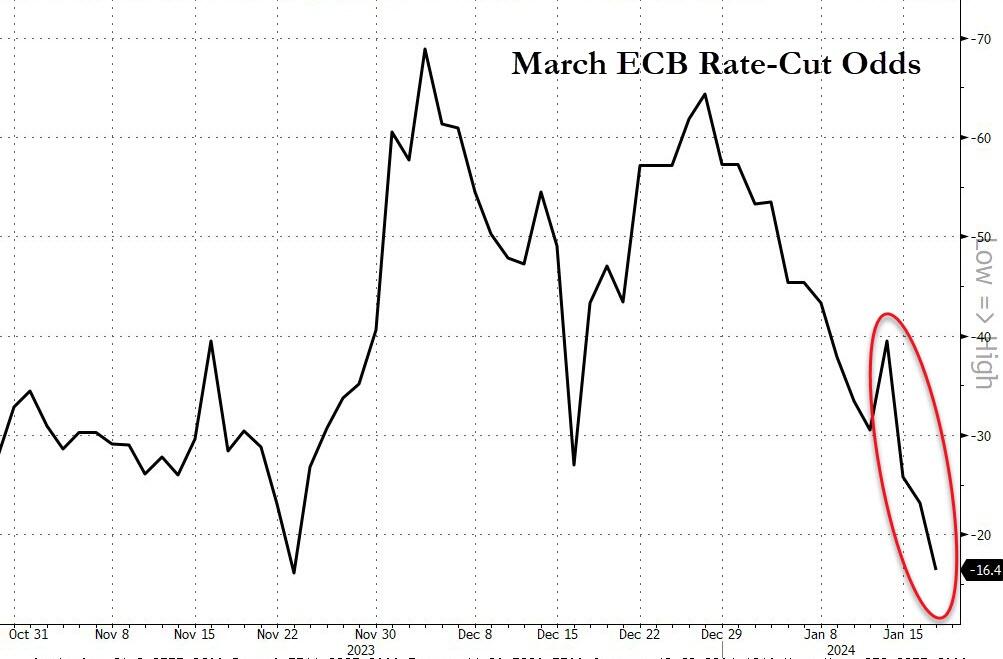
Market pricing of a rate cut from the European Central Bank as early as March has withered since the start of the new year. Now, officials seem to be questioning even the notion of a reduction in April — highlighting another pocket of possible mispricing. Also at peril may be traders’ estimate of how low the ECB’s benchmark rate could really go this year.

Every: "Markets Are Overlooking How Much Worse This Can Get, How Inflationary It Could Prove"

 By Michael Every of Rabobank

Waller Way to Behave

Points of order today. First, we need to underline the major disconnect between market pricing for aggressive 2024 Fed rate cuts -- including new hedges that the Fed cuts by 50bp in March-- and how the actual economy is still performing. Second, we have to ponder what drove the Fed to make the dovish statements in late 2023 that drove, and still drive, that kind of wild pricing. Third, we have to deal with the Fed, and others, walking it all back just weeks later.

That’s what Waller became the latest central banker to do yesterday. He started off saying, “For a macroeconomist, this is almost as good as it gets. But will it last?”, then argued only far more time than between now and the March meeting will tell. As a result, bonds, stocks, and just about everything except the US dollar sold off.

For the few who read Waller’s speech in full -- and people who price for six or seven Fed cuts, and 50bp cuts in March, when core inflation is well above target likely don’t read anything fully -- he added he’s more confident the economy can still move towards immaculate disinflation, that financial conditions remain restrictive (despite the Pavlovian response since Powell’s dovish turn), and that we can still get three rate cuts later in 2024 if inflation behaves, including next month’s revisions to CPI methodology. Indeed, what will be hedonically adjusted lower this time?

Yet all around us we see misbehaviour. Maybe the White House and Congress just found another $70bn down the back of the sofa to throw at voters; maybe President Biden will cancel student loans less than $12,000, so more money to buy a sofa. It’s an election year where, “democracy is on the ballot,” or ‘the future of the country’ is. You really think we are going to get tight fiscal policy? The key question is if the Fed will play ball or hardball.

Waller also mentioned the Red Sea, where the behavior is truly worrying – but so was his take that there would only be a one-time price effect if the Suez Canal remains closed. He hasn’t learned from the last shipping supply-shock crisis, it seems.

Meanwhile, more Houthi attacks on commercial shipping have occurred; Japan’s NYK is avoiding Suez too; so are Shell’s tankers, joining Qatari and Russian LNG carriers; and maritime insurance rates have soared from 0.1% to 1% of cargo, with some insurers reportedly avoiding coverage of US and UK (and Israeli) merchant ships against war risks – and that includes their “interest” in a ship, a far more blanket term than just the registration of beneficial ownership. Note that’s because the US and UK carried out recent airstrikes on the Houthis to try to stop these shipping attacks, which the EU disassociated themselves from (in order to keep their insurance rates down).

I published on this unfolding crisis yesterday (Same Deep Ship, Different Day). It stresses that markets are overlooking how much worse this can get, how inflationary it could prove, how hard it will be to resolve, and how it will soon be everyone for himself in trying to protect their maritime trade.

Making my points for me less than 24 hours later:

  1. As already shown, the crisis is getting worse.
  2. We see the warning that a ‘tipping point’ Houthi attack that reduces all willingness to sail through Suez is not far away.
  3. Inflation pressures already loom: (‘DP World sees Red Sea disruptions hurting European customers hardest: Cost of goods into Europe from Asia will be higher’).
  4. Chevron is warning of a very real risk to oil prices: that would certainly be the case if the Houthis turn their fire on Saudi Arabia again.
  5. Maersk says the crisis could last for months. That may actually be optimistic.
  6. The US is already winding back expectations that airstrikes will stop Houthi attacks, as it is about to officially redesignate them as terrorists. Indeed there is no realistic military solution to “The Houthis hijacking the world economy,” in the words of US National Security Advisor Jake Sullivan, without massive ground forces, which nobody will provide given how often Yemen has given invaders a bloody nose in the past.
  7. Moreover, there is no realistic political solution. Rather, there is agreement with our immediate post-10/7 analysis that this is not just about Israel/Hamas, problematic enough, but the geoeconomics/geopolitics of the proposed India-Middle-East Economic Corridor which bypasses Iran(“If you don’t work through us and our North South Corridor…we will make sure that no shipping is safe between India-South Asia to the Red Sea and Europe.”) Indeed, note that the UN Security Council resolution condemning the Houthi attacks was not supported by either China or Russia.
  8. EU Member States Back New Naval Mission in Red Sea to try and keep their own cargo flowing. Yet how will they succeed where the US Navy has failed, and do you know how much it will cost Europe to do that at scale, long term – and as Germany is insistent on balancing its budget? (On which, see our recent note on the hunt for EU strategic autonomy.)

In my best Cilla Black impression (for the few who will get that reference) “Waller way to behave!” And Deep Ship for most of us? You bet!

https://www.zerohedge.com/markets/markets-are-overlooking-how-much-worse-can-get-how-inflationary-it-could-prove

Blinken Stranded In Davos After His Boeing 737 Breaks Down

 It's just not Boeing's year

After the recent fiasco involving the Boeing 737 Max, aka the "mid-air convertible" model and subsequent grounding, the last thing the aerospace giant needed was more focus to its DEI-inspired airplane production practices. Alas, that's precisely what it got moments ago when Bloomberg reported that US Secretary of State Antony Blinken was unable to fly home from Davos as scheduled on Wednesday due to a critical error with his aircraft.... which, you may have guessed - is a Boeing 737.

After flying from Davos on helicopters (the gas-free variety, because we all know that the Davos set is very concerned about the environment and CO emissions) and boarding the modified Boeing 737, Blinken and his party were informed that the aircraft had been deemed unsafe to fly. An oxygen leak detected previously could not be remedied.

A smaller jet (supposedly "more private" and even more gas-guzzling, yet one that does not spontaneously become a convertible model mid-air) was being flown to Zurich from Brussels to ferry home the top US diplomat, while many of his aides and members of the press pool had to travel to Washington commercially. Those peasants.

Last September, Canadian Prime Minister Justin Trudeau got stuck in India after a Group of 20 summit in New Delhi after a mechanical fault with his plane. Back in 2018, then German Chancellor Angela Merkel’s plane also suffered from a malfunction.

https://www.zerohedge.com/markets/anthony-blinken-stranded-davos-after-his-boeing-737-breaks-down

In Davos, Iran FM & CNN's Zakaria Take Spotlight On Main Stage

 Speaking at the World Economic Forum (WEF) in Davos, Iranian Foreign Minister Hossein Amir-Abdollahian has warned that "we are witnessing an expansion of the conflict in the Middle East."

Many Western leaders and officials present are not happy that the Iranian top diplomat was given prominence on the main stage at Davos Wednesday, which included an interview with CNN's Fareed Zakaria. During that discussion Abdollahian boasted that Iran's ballistic missile attack on northern Iraq on Monday targeted "elements and agents of Mossad" in Erbil.

There are reports that a building used as a Mossad headquarters in the region was blown up by the short-range ballistic missile strike. The below image has circulated widely on social media, purporting to show the destroyed alleged Israeli intelligence center.

As for the Iranian Foreign Minister's presence on the Davos stage, it reportedly drew a huge media presence, and Politico captured some of the shock and anger among attendees in a blog entry called "Iran Comes to Town":

IRAN IN THE SPOTLIGHT: One of the international community’s best-known pariah states — Iran — will have pride of place at the WEF today, when Foreign Minister Hossein Amir-Abdollahian is interviewed by CNN’s Fareed Zakaria in the Congress Center.

Awks: The Iranian’s appearance is scheduled a few hours after U.S. Secretary of State Antony Blinken graces the stage. (Don’t expect any fist-bumps in the corridors.)

Courting controversy: Amir-Abdollahian was a relatively last-minute addition to the schedule — a move that’s being slammed by groups like United Against Nuclear Iran.

Interesting company: One of Amir-Abdollahian’s recent international visits was to Qatar, where he met with Ismail Haniyeh, the head of the political bureau of Hamas. And just a couple of days ago, Amir-Abdollahian spoke by phone with Russian Foreign Minister Sergey Lavrov.

Iran has also been accused by the US of arming the Houthis even as the Yemeni rebel group wages war on international shipping in the Red Sea. Sky News Arabia has also newly cited a US defense official who says the Houthis "have prepared plans to target US bases in the Arab region."

Prior to taking the stage with Fareed Zakaria, Abdollahian on Tuesday told CNBC that Washington's backing of Israel is "the root of insecurity" in the Middle East. "The US should not, Mr. [Joe] Biden should not, tie their destiny to the fate of Netanyahu," he had said. "The full-scale cooperation of Biden and the White House with thugs like Netanyahu in Israel is the root of insecurity in the region."

He had a similar theme Wednesday on the Davos main stage. Within 24 hours prior, Iran had also launched missiles on an area of Pakistan’s southwest Balochistan province, said to be targeting the Sunni militant group Jaish al-Adl, which is known in Iran as Jaish al-Dhulm. Tehran said this is in response to the Kerman city suicide bombing which killed over 100 people on January 3rd.

Watch Iran's foreign minister and CNN's Zakaria on stage at Davos...

Abdollahian was asked about this and the attack on Iraq, and responded to Zakaria, "We have good relations with both Pakistan and Iraq, and we have security pacts with both fighting terrorism & securing our common borders. We targeted the Mossad headquarters in Erbil with missiles, not Iraq."

However, he also stressed, "We don’t tolerate terrorist presence in Pakistan and the Zionist presence in Erbil. We consider the security of Iraq and Pakistan as part of Iran's security." He claimed that Iran didn't target Pakistani nationals, despite Pakistan reporting that two children were killed as a result of the missile strikes. Throughout the interview with Zakaria, the Iranian FM charged Israel with genocide, and also blamed the West - including the United States - for enabling the mass killing of Palestinians.

https://www.zerohedge.com/geopolitical/anger-davos-after-iran-fm-cnns-zakaria-take-spotlight-main-stage
Allakos cut to Hold from Buy by Jefferies

 Target to $1.50 from $6

https://finviz.com/quote.ashx?t=ALLK&p=d

Evolus Prelims, Guidance


  • Preliminary Unaudited Net Revenue of Approximately $61 Million for the Fourth Quarter 2023, Representing 40% Growth Over the Prior Year Quarter and a 22% Increase Over the Prior Sequential Quarter
  • Preliminary Unaudited Net Revenue of Approximately $202 Million for the Full-Year 2023, Representing 36% Growth Over the Prior Year
  • 2024 Net Revenue Guidance of $255 Million to $265 Million, Which Represents 26% to 31% Growth From Preliminary 2023 Results

'Bullfrog AI Collaboration Yields Potentially Groundbreaking Brain Expression Data'

  BullFrog AI Holdings, Inc. (NASDAQ: BFRG; BFRGW) (“BullFrog AI” or the “Company”), a technology-enabled drug development company using artificial intelligence (AI) and machine learning to enable the successful development of pharmaceuticals and biologics, today announced early results from its collaboration with the Lieber Institute for Brain Development (LIBD) that could revolutionize the understanding and treatment of psychiatric disorders. The early findings from this global strategic partnership have successfully stratified brain expression data, offering what may turn out to be unprecedented insights into psychiatric conditions.

The proprietary data from LIBD included gene expression data from over 2,800 brain samples encompassing schizophrenia, bipolar disorder, major depressive disorder, and non-psychiatric control brains. Utilizing graph analytics, BullFrog AI and LIBD have, for the first time, clustered subjects based solely on their biological data, independent of their behavioral diagnoses. This innovative approach has yielded promising insights, highlighting distinct differences and similarities in biological pathways across various brain disorders. Moreover, it has revealed biological subtypes within individual disorders, offering a nuanced understanding that could lead to personalized treatment strategies.

https://www.globenewswire.com/news-release/2024/01/17/2810580/0/en/BullFrog-AI-s-Collaboration-with-Lieber-Institute-for-Brain-Development-Yields-Potentially-Groundbreaking-Biological-Stratification-of-Brain-Expression-Data.html