Search This Blog

Wednesday, March 13, 2024

New insights into deadly acute respiratory distress syndrome (ARDS)

 Researchers at the University of Minnesota Twin Cities may have discovered a mechanical explanation for instability observed in the lungs in cases of acute respiratory distress syndrome (ARDS), particularly in the aftermath of respiratory illnesses such as COVID-19 or pneumonia.

The research was recently published in the Proceedings of the National Academy of Sciences (PNAS), a peer reviewed journal of the National Academy of Sciences.

Currently, there is no known cure for ARDS, a life-threatening lung injury that allows fluid to leak into the lungs.

The researchers in this study say that as many as two thirds of all patients that passed away from COVID-19 had ARDS.

There is not a clear reason on why specific people with a severe respiratory illness may develop ARDS, while others may not, but researchers in this study were looking to find that answer.

They identified the concentration of a lysolipid -- a byproduct of the immune response to viruses and bacteria -- that can have a major impact in adults suffering from ARDS.

Increased concentration of this chemical eliminates the surfactant, a complex composed of fats and proteins generated in the lungs.

The result is uneven lung inflation and, ultimately, respiratory distress in adults.

"This study looked into the correlation of the concentration of the lysolipid in the lungs. Once that fluid reached a certain level, it started to cause severe impacts," said University of Minnesota Department of Chemical Engineering and Materials Science Professor Joseph Zasadzinski and lead professor on the research.

"Your average everyday person usually won't need to think about this, but if a virus or infection is bothering your lung surfactant system and you end up in the hospital, then it could become top of mind very quickly," Zasadzinski added

There are a natural amount of these lysolipids that exist in the human body, and as long as those stay below a specific concentration, the average person can breathe normally.

When someone has a bad infection, those lysolipids increase, which can lead to respiratory distress.

Once a patient is headed in that direction, there are not many ways of reversing those symptoms.

"This research shows frequency dependence, or how quickly you open and close the lungs. This could help doctors try to tailor the treatment process for each specific patient," said Clara Ciutara, a 2023 Ph.D. chemical engineering and materials science graduate and first author of the study.

Previous research of neonatal respiratory distress syndrome (NRDS) in premature infants found that it could be treated by introducing replacement lung surfactant, but that was not the case in adults.

It is the amount of lysolipid that determines the outcome of the surfactant in the lungs, not the breakdown of the existing lung surfactant.

The next step in the research will be to translate these ideas into a clinical environment and test to see if they can manipulate specific molecules to make them less active or stick to a specific place.

This could help drop the concentration of the lysolipids to a threshold that may be able to reverse symptoms of ARDS and put people on the road to recovery.

In addition to Zasadzinski and Ciutara, the research team included University of Minnesota Department of Chemical Engineering and Materials Science NIH postdoctoral fellow Steven V. Iasella, undergraduate student Boxun Huang, and former postdoctoral associate Sourav Barman.

This work is supported by a grant from National Institutes of Health (NIH) Heart, Lung, and Blood Institute. All microscopy images were obtained at the University Imaging Center at the University of Minnesota.


Journal References:

  1. Clara O. Ciutara, Steven V. Iasella, Boxun Huang, Sourav Barman, Joseph A. Zasadzinski. Evolution of interfacial mechanics of lung surfactant mimics progression of acute respiratory distress syndromeProceedings of the National Academy of Sciences, 2023; 120 (51) DOI: 10.1073/pnas.2309900120
  2. Charles Maldarelli. Respiratory distress when a lung surfactant loses one of its two hydrophobic tailsProceedings of the National Academy of Sciences, 2024; 121 (10) DOI: 10.1073/pnas.2320426121

'Mathematicians use AI to identify emerging COVID-19 variants'

 Scientists at The Universities of Manchester and Oxford have developed an AI framework that can identify and track new and concerning COVID-19 variants and could help with other infections in the future.

The framework combines dimension reduction techniques and a new explainable clustering algorithm called CLASSIX, developed by mathematicians at The University of Manchester. This enables the quick identification of groups of viral genomes that might present a risk in the future from huge volumes of data.

The study, presented this week in the journal PNAS, could support traditional methods of tracking viral evolution, such as phylogenetic analysis, which currently require extensive manual curation.

Roberto Cahuantzi, a researcher at The University of Manchester and first and corresponding author of the paper, said: "Since the emergence of COVID-19, we have seen multiple waves of new variants, heightened transmissibility, evasion of immune responses, and increased severity of illness.

"Scientists are now intensifying efforts to pinpoint these worrying new variants, such as alpha, delta and omicron, at the earliest stages of their emergence. If we can find a way to do this quickly and efficiently, it will enable us to be more proactive in our response, such as tailored vaccine development and may even enable us to eliminate the variants before they become established."

Like many other RNA viruses, COVID-19 has a high mutation rate and short time between generations meaning it evolves extremely rapidly. This means identifying new strains that are likely to be problematic in the future requires considerable effort.

Currently, there are almost 16 million sequences available on the GISAID database (the Global Initiative on Sharing All Influenza Data), which provides access to genomic data of influenza viruses.

Mapping the evolution and history of all COVID-19 genomes from this data is currently done using extremely large amounts of computer and human time.

The described method allows automation of such tasks. The researchers processed 5.7 million high-coverage sequences in only one to two days on a standard modern laptop; this would not be possible for existing methods, putting identification of concerning pathogen strains in the hands of more researchers due to reduced resource needs.

Thomas House, Professor of Mathematical Sciences at The University of Manchester, said: "The unprecedented amount of genetic data generated during the pandemic demands improvements to our methods to analyse it thoroughly. The data is continuing to grow rapidly but without showing a benefit to curating this data, there is a risk that it will be removed or deleted.

"We know that human expert time is limited, so our approach should not replace the work of humans all together but work alongside them to enable the job to be done much quicker and free our experts for other vital developments."

The proposed method works by breaking down genetic sequences of the COVID-19 virus into smaller "words" (called 3-mers) represented as numbers by counting them. Then, it groups similar sequences together based on their word patterns using machine learning techniques.

Stefan Güttel, Professor of Applied Mathematics at the University of Manchester, said: "The clustering algorithm CLASSIX we developed is much less computationally demanding than traditional methods and is fully explainable, meaning that it provides textual and visual explanations of the computed clusters."

Roberto Cahuantzi added: "Our analysis serves as a proof of concept, demonstrating the potential use of machine learning methods as an alert tool for the early discovery of emerging major variants without relying on the need to generate phylogenies.

"Whilst phylogenetics remains the 'gold standard' for understanding the viral ancestry, these machine learning methods can accommodate several orders of magnitude more sequences than the current phylogenetic methods and at a low computational cost."

Journal Reference:

  1. Roberto Cahuantzi, Katrina A. Lythgoe, Ian Hall, Lorenzo Pellis, Thomas House. Unsupervised identification of significant lineages of SARS-CoV-2 through scalable machine learning methodsProceedings of the National Academy of Sciences, 2024; 121 (12) DOI: 10.1073/pnas.2317284121

Stepmother convinced father to sign over house 'so he could qualify for Medicaid,' cut me out of will

 'I am 62 and one of three children. My parents divorced when I was seven. The last home that we all resided in as a family had remained in my father's possession since the divorce. It was used by my cousin while attending law school and served as the first home my wife and I lived in after college, until we were able to purchase a home of our own. The home is in Washington, D.C., and my father lived there with his longtime girlfriend.

Three years ago, my father and stepmother purchased another home in Florida, eventually establishing legal residency there. Shortly thereafter, his health began to decline. During the process of admitting him to a care facility, my stepmother took action so my father "could qualify for Medicaid benefits." This involved, among other things, taking my father's name off the deed of our childhood home and replacing it with hers.

My stepmother sold the home he had purchased for them in Florida and purchased another home nearby. She also sold the condo she had owned, as well as my father's residential investment property. Upon our father's death, my stepmother chose to split the funds among other beneficiaries, including herself and her adoptive daughter, instead of dividing the proceeds from the sale of the childhood home as our father had indicated.

What can we do?

The Son'

Dear Son,

Your stepmother took action that was designed to transfer ownership of your father's primary home to her name. It had, I'm afraid, very little to do with helping him qualify for Medicaid, and unfortunately there's likely very little you can do about it. She had your father sign a quit-claim deed and, presumably with his cooperation; removing his name from the deed of his primary home was unnecessary under Florida law. She presumably sold separate property in an effort to reduce his assets to qualify for Medicaid.

"This is a sad but very common scenario that comes up in many families, particularly ones where there is a second marriage," says Elizabeth Forspan, an attorney with Forspan Klear LLP. "It underscores why people must plan early for the eventuality that they will need care." Had he planned in advance, "he could have created a trust for the ultimate benefit of his daughter or natural children, transferred the house therein and made sure that his family, not his new wife's, would inherit the family home."

Divesting his assets after he moved to a care facility is an 11th-hour move: There is typically a five-year Medicaid look-back to review whether the individual divested themselves of assets in order to qualify for benefits. There are exceptions to the five-year look-back rule: Those include paying off debts, buying medical devices and making home renovations to improve accessibility. A person's income and other assets may also disqualify them from Medicaid eligibility, with rules that vary by state.

Some states, including Florida, New York and California, have rules that exempt a primary residence from assets calculated by Medicaid under certain circumstances. In New York, you need to live in the home while receiving care or plan to return to the home afterwards. California eliminated its asset limit this year, making a person's home automatically safe from Medicaid while they are living. However, that does not mean it's safe from Medicaid's Estate Recovery Program.

In Florida, however, Medicaid can only recover debt from the deceased recipient's probate estate. "With a married couple and one spouse applying for Medicaid, Medicaid does not look at the value for the home," according to the law firm DeLoach, Hofstra + Cavonis PA, which has offices in Florida. "The at-home spouse (the "community spouse") can live in the home, no matter the value, and it will not affect the Medicaid applicant spouse."

Homestead protection in Florida

The law firm adds: "Further, the cost of the home may help the community spouse keep more income. We may be concerned if the spouse at home - the community spouse - were to predecease the Medicaid recipient, but that is another issue. Upon the applicant's death, the homestead is protected from creditors, including the state of Florida, if it descends to your heirs at law (that is, your family)." This makes your stepmother's decision to take his name of the deed of that house all the more curious.

If a person makes a will or signs their assets over to a trust, or signs over their home, you could possibly look into making a case for undue influence, duress, overpersuasion, coercion or establishing whether your father was of sound mind when he made these decisions. You would need to hire a lawyer and present a body of evidence that includes medical records and financial statements. If a will was signed under undue influence, it would be deemed invalid.

The same is true for a so-called deathbed marriage. "If successful in establishing that the marriage was procured by fraud, duress, or undue influence, Florida law specifically prohibits recovery of all rights and benefits under the Probate code, including non-probate exempt property and homestead," according to Zoecklein PA, a law firm with offices in Florida. "Further, this provision of Florida law can invalidate rights to a Trust and/or Life Insurance benefits."

To succeed, you would need to demonstrate, among other things, that your father had an established and longstanding estate plan that was contradicted by the ultimate outcome, Forspan adds. Undue influence also has an "incredibly high burden of proof when it comes to a spouse. Moreover, the fact that the wife (and perhaps also dad) was advised, presumably by an attorney, to make the transfer in order to qualify for Medicaid - a transfer that worked and achieved their goals - will make it even more difficult to prove that something nefarious and wrong happened here."

Ultimately, the burden of proof would lie with you. Each state also has a statute of limitations for such cases. When challenging a trust in Florida, for instance, there is typically a four-year statute of limitations. You have several challenges: the race against time, gathering enough evidence to make your case, the expense of hiring a lawyer and, yes, the stress that such a contest would bring. Even if your father was not of sound mind, this may not be easy case to prove.

https://www.morningstar.com/news/marketwatch/20240313950/my-stepmother-convinced-my-father-to-sign-over-his-house-and-sell-all-his-properties-so-he-could-qualify-for-medicaid-she-has-now-cut-me-out-of-her-will

Health Officials: Man Dies From Bubonic Plague In New Mexico

 by Jack Phillips via The Epoch Times (emphasis ours),

Officials in New Mexico confirmed that a resident died from the plague in the United States’ first fatal case in several years.

The New Mexico Department of Health, in a statement, said that a man in Lincoln County “succumbed to the plague.” The man, who was not identified, was hospitalized before his death, officials said.

They further noted that it is the first human case of plague in New Mexico since 2021 and also the first death since 2020, according to the statement. No other details were provided, including how the disease spread to the man.

The agency is now doing outreach in Lincoln County, while “an environmental assessment will also be conducted in the community to look for ongoing risk,” the statement continued.

This tragic incident serves as a clear reminder of the threat posed by this ancient disease and emphasizes the need for heightened community awareness and proactive measures to prevent its spread,” the agency said.

A bacterial disease that spreads via rodents, it is generally spread to people through the bites of infected fleas. The plague, known as the black death or the bubonic plague, can spread by contact with infected animals such as rodents, pets, or wildlife.

The New Mexico Health Department statement said that pets such as dogs and cats that roam and hunt can bring infected fleas back into homes and put residents at risk.

Officials warned people in the area to “avoid sick or dead rodents and rabbits, and their nests and burrows” and to “prevent pets from roaming and hunting.”

“Talk to your veterinarian about using an appropriate flea control product on your pets as not all products are safe for cats, dogs or your children” and “have sick pets examined promptly by a veterinarian,” it added.

“See your doctor about any unexplained illness involving a sudden and severe fever, the statement continued, adding that locals should clean areas around their home that could house rodents like wood piles, junk piles, old vehicles, and brush piles.

The plague, which is spread by the bacteria Yersinia pestis, famously caused the deaths of an estimated hundreds of millions of Europeans in the 14th and 15th centuries following the Mongol invasions. In that pandemic, the bacteria spread via fleas on black rats, which historians say was not known by the people at the time.

Other outbreaks of the plague, such as the Plague of Justinian in the 6th century, are also believed to have killed about one-fifth of the population of the Byzantine Empire, according to historical records and accounts. In 2013, researchers said the Justinian plague was also caused by the Yersinia pestis bacteria.

But in the United States, it is considered a rare disease and usually occurs only in several countries worldwide. Generally, according to the Mayo Clinic, the bacteria affects only a few people in U.S. rural areas in Western states.

Recent cases have occurred mainly in Africa, Asia, and Latin America. Countries with frequent plague cases include Madagascar, the Democratic Republic of Congo, and Peru, the clinic says. There were multiple cases of plague reported in Inner Mongolia, China, in recent years, too.

Symptoms

Symptoms of a bubonic plague infection include headache, chills, fever, and weakness. Health officials say it can usually cause a painful swelling of lymph nodes in the groin, armpit, or neck areas. The swelling usually occurs within about two to eight days.

The disease can generally be treated with antibiotics, but it is usually deadly when not treated, the Mayo Clinic website says.

“Plague is considered a potential bioweapon. The U.S. government has plans and treatments in place if the disease is used as a weapon,” the website also says.

According to data from the U.S. Centers for Disease Control and Prevention, the last time that plague deaths were reported in the United States was in 2020 when two people died.

https://www.zerohedge.com/medical/health-officials-man-dies-bubonic-plague-new-mexico

Movement of pilot's seat a focus of probe into LATAM Boeing flight

 The movement of a flight deck seat is a key focus of the probe into a sudden mid-air dive by a LATAM Airlines Boeing 787 plane that left more than 50 people injured, aviation industry publication the Air Current reported on Wednesday.

The plane, which was heading from Sydney to Auckland on Monday, dropped abruptly before stabilizing, causing those on board to be thrown about the cabin.

Based on the available information it was understood the seat movement was "pilot induced, not intentionally," the report said, citing a senior airline safety official.

"The seat movement caused the nose down" angle of the aircraft, the publication said, citing another anonymous source who added the possibility of an electrical short was also under review.

Boeing is expected to release a message to 787 operators regarding the incident, the Air Current reported, in a sign a fleet-wide issue could be involved though it said the specific topic was not known to the publication.

Boeing declined to comment on the report, instead referring Reuters to the investigating agencies.

Chile's aviation regulator, which is leading the probe given it involves a Chilean airline flying in international airspace, said the investigation "just got underway" and its investigators had arrived in New Zealand.

LATAM said it "continues to work in coordination with the authorities to support the investigation" and said it was not appropriate to comment on speculation that has circulated.

LATAM is based in Chile and the flight, which had 263 passengers and nine crew members, was due to continue on to Santiago after stopping in Auckland.

The cause of the flight's apparent sudden change in trajectory has not yet been explained. Safety experts say most airplane accidents are caused by a cocktail of factors that need to be thoroughly investigated.

New Zealand's Transport Accident Investigation Commission said on Tuesday it was seizing the cockpit voice recorder and flight data recorder of the flight, which would provide information about the conversations between the pilots and the plane's movement.

https://finance.yahoo.com/news/pilot-seat-movement-focus-probe-235431287.html

Mexican Military Incursions On US Soil Worry Border Agents

 by Brad Jones via The Epoch Times (emphasis ours),

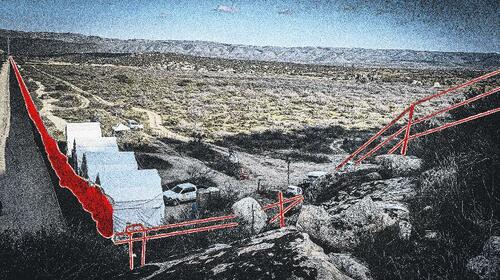
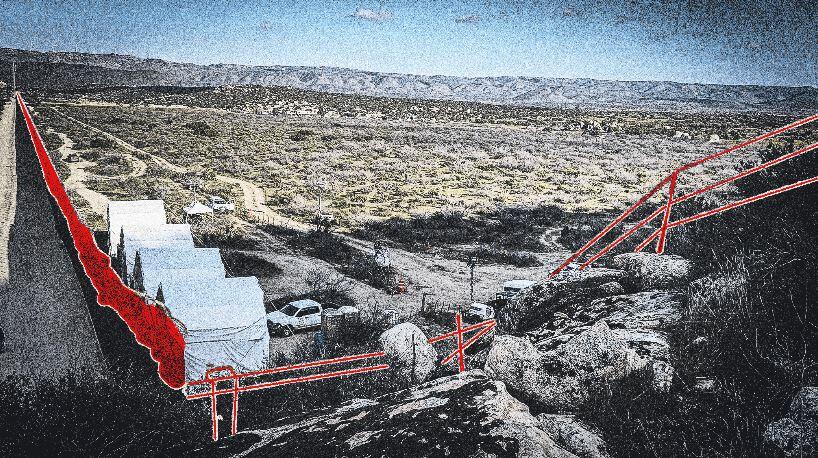
As daylight begins to fade at an abandoned illegal immigrant camp at the border wall near Jacumba, in California’s San Diego County, a couple of Mexican soldiers armed with assault rifles patrol the rocky terrain in the hills above.

Below them, white tents along the Mexican side of the border wall signal the army presence as Mexican national guard (Guardia Nacional) troops pull up in a truck. They set up camp here in early February.

On Feb. 29, a Mexican soldier hides behind a rock as he realizes reporters have seen him on the U.S. side of the border. Several moments later, he ducks back under the barbed wire fence into Mexico.

Manny Bayon, a National Border Patrol Council spokesman in San Diego, said usually any incursion by the Mexican military is directly reported to headquarters and the White House is notified.

After watching an Epoch Times video of the Mexican soldier in the hills above the San Judas break, Mr. Bayon said it’s obvious that the soldier was on U.S. soil.

They should know better,” he told The Epoch Times. “There’s a boundary marker on top of that hill. I’ve been up there. I’ve seen it.”

Any incursion presents a risk to the safety of Border Patrol agents, Mr. Bayon said.

When you have somebody with an automatic weapon coming into the U.S., it’s concerning. I mean, they’re not coming here with flowers or to make things better,” he said. “It’s concerning because they do counter surveillance on us.”

And, just because someone wearing a uniform appears to be Mexican military, doesn’t necessarily mean they are, Mr. Bayon said.

“The cartels have also used military uniforms to make it look like they are military—but they’re actually cartel,” he said.

Illegal immigrants walk through a gap in the U.S. border wall to await processing by Border Patrol agents in Jacumba, Calif., on Dec. 7, 2023.

A Border Patrol agent in Arizona, who asked not to be named for fear of retaliation, told The Epoch Times that no incursions go unanswered.

Any time Mexican military comes on our side, we’re always notified. It’s a big deal,” he said. “We have guys that are liaisons with the south side, so they’re going to be notified, and there is definitely going to be phone calls made immediately.”

Sometimes, he said, it’s Mexican soldiers not knowing where the boundary is or they get lost, especially in remote areas where it’s not as cut and dry, he said.

“But then there are certain areas where it’s very clear,” he said. “We try to play nice with them, because for the most part they’re the same with us.”

“We don’t come in like guns blazing. Typically, we try to defuse the situation and their chain of command is notified. It’s not something that we just allow to happen. There’s definitely people notified immediately. It’s always a big deal if they come over onto the U.S. side and vice-versa.”

Less than three months ago, the gap at the end of this border wall where the military tents now sit, was a pedestrian highway for thousands of foreign nationals entering the U.S. illegally from Mexico.

Mexican smugglers routinely dropped off their human cargo at a footpath leading to the narrow gap, called the San Judas break, where the 30-foot border wall ends at the steep hillside.

In February, Kate Monroe, a U.S. Marine Corps veteran and Republican congressional candidate in District 49 who lost in the March 5 primary election, bought a 400-foot coil of razor wire off Amazon and blocked the gap. The razor wire is still there.

A few hundred yards away on the American side at a site known as Willow camp to the U.S. Border Patrol agents, little remains of the dozens of firepits and makeshift shelters where hundreds of illegal immigrants waited to be transported and processed after surrendering to agents in December 2023.

Two other sites—known as Moon and 177 camps—close to known illegal crossing sites near the small towns of Jacumba and Boulevard on the southeastern fringe of the county, are also now patrolled by the Mexican military, according to the Border Patrol.

For all the military presence, illegal crossings haven’t substantially dipped in the area. On March 6, 1,132 illegal immigrants were apprehended in the San Diego sector, which is within the average daily range over the last several weeks, according to Brandon Judd, president of the National Border Patrol Council.

“We have not seen a drop in total arrests,” he told The Epoch Times.

An illustration with red markings highlighting the border wall and fencing that separates the United States (L) and Mexico (R), near Jacoumba, Calif. , on Feb. 29, 2024.

A Deal with Mexico?

Todd Bensman, a senior national security fellow at the Washington-based Center for Immigration Studies and former counterterrorism intelligence officer, told The Epoch Times that according to Mexican soldiers he interviewed, they’re rounding up migrants near the U.S. border and moving them south.

“They said their orders are to hunt down all immigrants and give them to Mexican immigration for deportation to their southern provinces. They also told me their deployments are open ended,” Mr. Bensman said.

The increased Mexican military presence along the border coincides with a flurry of bilateral talks.

President Biden hosted bilateral meetings with his Mexican counterpart on Nov. 17, 2023, and spoke with him over the phone on Dec. 22, 2023, which led to a Dec.. 27, 2023, meeting between the Mexican president and a U.S. delegation, including Secretary of State Antony Blinken and Secretary of Homeland Security Alejandro Mayorkas, preceding President Biden’s trip to Mexico City on Jan. 9.

“Secretary Blinken will discuss unprecedented irregular migration in the Western Hemisphere and identify ways Mexico and the United States will address border security challenges,” said a State Department spokesman prior to the meeting.

The spokesman also said Mr. Blinken would reaffirm U.S. commitment to the Los Angeles Declaration for Migration and Protection, and “underscore the urgent need for lawful pathways and additional enforcement actions by partners throughout the region.”

After their return, Mexico “mounted one of the most epic domestic anti-illegal-immigration operations in recent memory,” Mr. Bensman wrote.

He surmised the Biden administration may have “cut a deal” with Mexican President Andrés Manuel López Obrador to crackdown on illegal immigrants headed northward. Both presidents have elections this year.

“The Mexican army is all over the northern border now doing different kinds of interdiction across from Texas, they’re hunting down immigrants aggressively. And when they find them, they force them onto buses and ship them south,” Mr. Bensman said.

“They are interdicting the traffic on top of the freight trains, blocking access to the rail yards, and pulling immigrants off the trains,” he said. “This is all part of a Biden-inspired and directed Mexican crackdown that is nationwide for Mexico.”

In January, Border Patrol agents apprehended 124,220 illegal immigrants along the southern border, CBP data show. It’s a 50-percent decrease from the record surge of 249,735 in December 2023.

American news outlets have essentially ignored Mexico’s actions while “the Mexican media has been all over this,” Mr. Bensman said.

One Mexican newspaper reported the Mexican government is “under U.S. pressure” to step up its military operations in Tijuana, Juarez, and Matamoros—cities across from San Diego, El Paso, and Brownsville, respectively. In Matamoros, the military recently bulldozed a massive migrant camp and dug anti-pedestrian trenches.

https://www.zerohedge.com/geopolitical/mexican-military-incursions-us-soil-worry-border-agents

'Hungry Looters Looking For Bread' To 'Million Dollar Organized Retail Crime' In Record Time

 My, my my...how quickly we go from a couple kids just looting to feed their families to "organized crime rings plaguing retailers". Seems like we made the transition in just a couple of years and no Soro-appointed DA even noticed!

But alas these crime rings were the topic of a new CNBC report which spent 8 months investigating organized retail crime rings. 

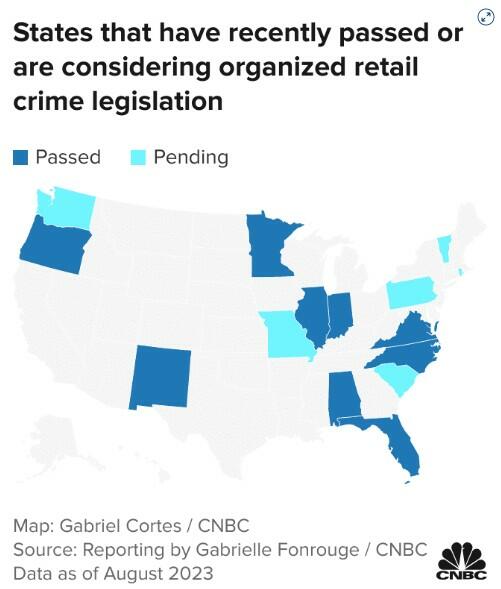
Organized retail theft has emerged as a significant concern for both large and small retailers, contributing to reduced profits, staffing challenges, and a diminished shopping experience. This issue has also garnered bipartisan public frustration over increased security measures, such as locking products behind glass, the report notes. 

The rise of such crime is debated, with retailers like Target, Foot Locker, Walgreens, and Ulta reporting escalating theft issues, though specifics on frequency and financial impact are often not disclosed. This has led to suspicions that retailers might be attributing operational shortcomings to crime, as we have alluded to numerous times here on Zero Hedge and on our X account. 

According to the National Retail Federation, $40.5 billion was lost to external theft in 2022, accounting for 36% of inventory losses, a slight decrease from the previous year. Despite debates on its direct impact on profits, the perceived threat to employee and customer safety is clear.

Adam Parks, an assistant special agent in charge at HSI, which is the main federal agency investigating retail crime, told CNBC: “We’re talking about operations that have fleets of trucks, 18-wheelers that have palletized loads of stolen goods, that have cleaning crews that actually clean the goods to make them look brand new.”

“Just like any business, they’ve invested their capital into business assets like shrink wrap machines, forklifts. That is what organized theft looks like, and it actually is indistinguishable from other e-commerce distribution centers,” he continued. 

In response, both local and federal law enforcement efforts against organized retail crime have intensified. Homeland Security Investigations (HSI) significantly increased its actions, with cases and arrests rising sharply between 2021 and 2023. The California Highway Patrol reported a 170% increase in arrests for organized theft in 2023 compared to 2022, though it remains uncertain if this reflects a genuine spike in theft or enhanced enforcement efforts driven by increased public and industry pressure.

Ulta CEO Dave Kimbell said: “The financial impact is real, but way more important is the human impact, the impact it has to our associates, the impact it has to our guests.”

“It also impacts the communities in which we live. If people don’t feel safe going in to shop in certain areas of a community, it really has an impact and can change neighborhoods and change communities over time,” he continued. 

In New Orleans, the investigation unearthed security video that captured a man walking into a Walgreens, going straight to the cosmetics section, and filling a plastic bag hidden in his pants with 17 nail polish jars, worth about $200. He then proceeded to the main branch of the New Orleans Public Library, about half a mile away, and sold the stolen items to a security guard, according to police.

In San Jose, the California Highway Patrol discovered a vast array of new merchandise, including detergents like Gain, Tide, and Downy, Gillette razors, Olay moisturizer, Allegra allergy pills, and sparkly silver boots with T.J. Maxx tags, in a home and storage unit linked to a suspected organized retail theft ring.

In total, nearly 20,000 items, worth over $550,000 and believed to be stolen from T.J. Maxx and various drugstores and grocery stores in the Bay Area, were found at five locations associated with the group.

In San Diego, police uncovered "a multimillion-dollar criminal scheme" involving shoplifting and then selling the items on Amazon. One scheme participant texted back in January 2023: “I’m not stealing regular I’m going to start filling up my bag quick. So I want to know stuff I can grab in bulks too.”

After that, the suspect committed at least 10 thefts at Ulta stores across California. But don't worry - AOC says these shoplifters are just 'hungry' people seeking bread to feed their family with. 

You can read CNBC's full investigation, including details of thefts in individual cities, here.

https://www.zerohedge.com/markets/weve-gone-hungry-looters-looking-bread-million-dollar-organized-retail-crime-record-time