Search This Blog

Thursday, March 14, 2024

'Can I cut income tax by paying my kids wages for jobs? Tik Tok influencers no-brainer'

 It's a lot harder than social media makes it look to legally justify a deduction from your small business income for a child's wages

One nugget of free tax advice that pops up a lot on social media during tax-prep season is a strategy for business owners to pay their kids wages and then deduct that as an expense. Your kids get earned income, which they can then contribute to a Roth IRA, and you save money on your taxes.

Sounds like a no-brainer. Except, it isn't.

It's actually very hard to make this deduction work, and there are plenty of tax court cases where business owners have lost their appeals and had to pay penalties and interest. "The wages have to be ordinary and necessary," says Brandon Hall, a CPA who runs an accounting firm based in Raleigh, N.C.

So, what's in: Raking leaves at rental properties for $15 an hour during the fall, bussing tables at a family-owned restaurant for 25 hours a week or data entry for 10 hours a week at a parent's law practice.

Out: Emptying the garbage in a parent's home office, getting paid $13,000 a year for watching the baby so a parent can work, dancing in the background of social-media videos promoting a parent's lumber business.

"The key question to ask is would you pay somebody else the same amount of money to do that job?" says Hall.

If the answer is no, then the wages cannot be deducted from your business income.

Other key questions to ask

Your accountant should ask you the questions you need to answer to justify the wages, and will have no trouble saying no to you if it doesn't seem legitimate. "It's usually the newer clients, and often the younger clients, who are watching these videos and then asking about it," says Mary McDonald, a CPA for Hansen House, based in Duluth, Minn.

McDonald has clients who successfully employ their own children and take a legitimate business income deduction for it. One such client has a construction business where they clear land and build houses. His 14-year-old works with him during summer, where the child is supervised, works reasonable hours and is paid less than somebody who would be more qualified. He makes about $6,000, so he gets experience and is able to make a full Roth IRA contribution, where the growth will be tax-free if he leaves it there until he's 59 1/2. As long as the child's earnings stay under the standard deduction, which is $13,850 for the 2023 tax year and $14,600 for the 2024 tax year, they will owe no income tax of their own. The parents get a deduction from this year's business income.

The thing is, that deduction will be for a limited amount, based on the reasonable amount of wages paid, and not a large sum that will erase all their business income or is just a convenient sum for the parent.

A lot of the social media pitch for this deduction strategy is actually less about saving money on taxes and more about them trying to sell their digital courses, Hall contends. "Marketers have figured out that If they can frame it in a way that makes people see this is super easy, they're going to buy my course and I'm going to make money," says Hall.

It's easy to see that paying $13,000 to an 8-year-old for what are basically household chores is out of bounds, but what about social-media influencers who put their kids in their videos and make money that way? Could you then justify a modeling fee for a baby?

"The first litmus test for hiring your kid is, would you hire a third party to do the same thing at the same hourly rate? if yes, then you can," says Hall. It is all the more legit, he adds, if you're actually selling a product that pertains to your child, like children's shoes. It's a bit harder if you run something like a lumber company, and post videos of your baby driving a truck.

"So modeling might be ordinary but it's probably not. And it's probably also not necessary for your business to function and make sales," says Hall.

You're also probably paying too much for the modeling involved. "People will do a photo shoot and they'll want to pay their kids like $5,000, but I'm pretty sure the Gerber baby doesn't even make that much money right now," Hall says.

What if you get caught?

If you claim wages for a child and get flagged by the IRS, you're first going to get a letter in the mail about an audit, which generally causes taxpayers to panic.

"They will likely disallow the expenses, so that will increase your profit, so you will need to amend the personal return. There's often a tax penalty and interest," says McDonald. She adds that the IRS often throws out a lot of other deductions when they start to poke around, so it's best to make sure everything on your return is justified.

Hall points to several tax cases where business owners lost on appeal and had wages for children disallowed. In one 2016 case, a marketing business owner paid his 10-year-old stepson $6,315 for wages that were labeled things like "taking out the trash, vacuuming, setting up chairs, and cleaning the pool." The taxpayer was dinged for a number of other disallowed deductions in the same case.

In a 2006 case, a family paid wages to five of their children, ranging in age from 8 to 21, for various tasks, but the IRS disallowed the deductions because the wages were not paid properly for necessary work. The oldest son, for one, was paid in advance for tasks he would do the following summer, more like an allowance than pay. The younger daughters were basically being paid for household tasks that weren't necessary for the business, and did not fill out proper W-2 paperwork.

"What happens is that everybody drastically overpays their kids and that exposes them to audit risk," says Hall. "When you tell people, yes, you probably could pay your kid $2,500 this year based on the scope of work that you've laid out, all of a sudden they lose interest because saving $1,000 in taxes is no longer that appealing, right? That's the piece that the TikTok and Instagram (META) gurus never really talk about."

https://www.morningstar.com/news/marketwatch/20240314342/can-i-really-reduce-my-income-tax-by-paying-my-kids-wages-for-doing-a-variety-of-jobs-tik-tok-influencers-say-its-a-no-brainer

Senate panel considers 32-hour work week

The Senate Committee on Health, Education, Labor, and Pensions is slated to hold a hearing Thursday morning regarding a standard 32-hour work week.

Sen. Bernie Sanders (I-Vt.) on Wednesday introduced a bill to establish a standard four-day workweek in the United States without any reduction in pay.

The bill, over a four-year period, would lower the threshold required for overtime pay from 40 hours to 32 hours. It would require overtime pay at a rate of 1.5 times a worker’s regular salary for work days longer than 8 hours, and it would require overtime pay at double a worker’s regular salary for work days longer than 12 hours.

The committee will hear from United Auto Workers President Shawn Fain, among other witnesses.

The hearing is scheduled for 10 a.m. EDT.

https://thehill.com/homenews/4531555-senate-panel-considers-32-hour-work-week-watch-live/

White House officials meeting with Arab, Muslim leaders in Chicago ahead of Illinois primary

 White House officials are set to meet Thursday with Arab, Muslim, and Palestinian American leaders in Chicago, a source familiar with the meeting confirmed to The Hill.

The meeting, which was first reported by CNN, comes as President Biden has faced increasing pushback from the pro-Palestinian community over his stance on the Israel-Hamas war.

The Illinois Democratic primary is next week, and there’s an effort there to get Democrats to cast protest votes against Biden.

The organization, Muslim Civic Coalition-Activate, launched a Protest Power Vote campaign that is encouraging voters in Illinois to write in “Gaza” on their primary ballots or to leave it blank. Additionally, the “Abandon Biden” organization has a presence in Illinois and has been advocating for protest votes.

The push for a protest vote in Illinois follows similar efforts in Michigan and Minnesota. In Michigan, 100,000 people voted “uncommitted,” while 45,000 people voted “uncommitted” in Minnesota. Biden officially clinched the Democratic presidential nomination Tuesday.

Biden is traveling to Michigan on Thursday and is not expected to meet with leaders in the Arab American community while he’s there. Biden has pushed for a temporary cease-fire in the Middle East to free hostages and get aid into Gaza while advocates have pushed for him to call a permeant cease-fire.

CNN reported that White House officials meeting with the leaders in Chicago include Tom Perez, director of intergovernmental affairs; Steve Benjamin, director of public engagement; and Mazen Basrawi, liaison to Muslim-American communities, among others.

https://thehill.com/homenews/administration/4531527-white-house-officials-meeting-with-arab-muslim-leaders-in-chicago-ahead-of-illinois-primary/

SEIU spending $200M to help Biden win reelection

 A top labor union announced Wednesday that it will be spending $200 million to help President Biden win reelection.

The Service Employees International Union (SEIU) announced a “massive drive” to mobilize working class voters of color in battleground states to back pro-labor candidates, including Biden. The SEIU represents about 2 million members across service industries, including the health care, property service, and public services sectors. 

“This election, workers are going to vote for candidates up and down the ballot who’ve got their back,” SEIU Executive Vice President Rocio Sáenz said in a statement. “They are ready to support candidates like President Biden, who walked the picket line, took on big corporations, and invested in good, union jobs.

“Workers don’t want leaders who blame immigrants for everything while giving tax breaks to billionaires and trying to take our healthcare away,” Sáenz added.

The announcement stated the union aims to reach 6 million voters of color in the swing states of Pennsylvania, Michigan, Wisconsin, Nevada, Arizona, Georgia, and North Carolina. It is hoping to engage with voters who are less likely to vote or who have never voted at all by using field programs and partnering with community groups, among other efforts.

The SEIU endorsed Biden last April, shortly after he formally launched his reelection bid. The union says it plans to launch messaging that “contrasts how the president has backed workers with how Donald Trump has sided with big corporations and tried to take healthcare coverage and reproductive rights away from millions.”

The organization noted that similar efforts in 2022 increased voter turnout by 27 percent among those that they reached. The union also said it will be reaching out to voters in seven different languages to get its message across.

“Our votes are our demand for a better future,” SEIU Secretary-Treasurer April Verrett said in a statement. “Workers walked the picket lines for better pay and better jobs, and we will vote for the same reasons.”

“Workers of all races know what’s at stake in this election, and will take our energy from the strike lines to the ballot box to support candidates who side with us instead of price-gouging, union-busting corporations,” she said.

https://thehill.com/homenews/campaign/4531832-labor-union-spending-200m-to-help-biden-win-reelection/

What is delta-8? Delta-9?

 A recent study indicated 11 percent of 12th graders have used delta-8-tetrahydrocannabinol, or delta-8, the first time teen usage of the drug has been documented nationally.

The study, posted Tuesday in the journal JAMA and funded by the National Institutes of Health (NIH), found that among the high school seniors who reported using delta-8, which is legal for all ages in some areas, 90 percent said they have also used marijuana.

The NIH pointed out its “Monitoring the Future” study was given to students in classrooms, meaning it could represent an undercount as drug use can cause teenagers to miss school.

What is delta-8 THC? 

Delta-8 comes from hemp, which is found in cannabis plants. Not much is known about its specific effects.  

“Delta-8 is chemically synthesized, and what has been happening recently is that companies have been synthesizing delta-8 THC and putting it in a number of different types of consumable products like gummies and in vapes,” said Adam Leventhal, author of the study and executive director of the USC Institute for Addiction Science.  

The NIH said delta-8 likely has similar effects to the primary THC component, delta-9, which makes people feel “high” from pot.  

The study is the first time usage among teens has been widely documented, as delta-8 has only recently become popular.  

“2023 was the first year that a question about this substance was included. We can’t really deduce whether prevalence is increasing, decreasing or staying the same, right? Because it’s only after you ask a question for the first time and then ask it for a few years can you determine whether there is like a broader trend over time,” said Sheila Vakharia, deputy director of research and academic engagement for Drug Policy Alliance.  

Why is it popular? 

Delta-8 has no federal minimum age requirement for purchase, making it very accessible, as it can be ordered online or in gas stations, the NIH said. The Food and Drug Administration put consumer warnings on the product in 2022. 

“Eleven percent is a lot of people — that’s at least one or two students in every average-sized high school class who may be using delta-8. We don’t know enough about these drugs, but we see that they are already extremely accessible to teens,” said Nora Volkow, director of the National Institute on Drug Abuse. 

The study found that popularity also corresponds with which region of the U.S. a student is in.

The South and Midwest had the most 12th graders using delta-8, at 14 percent and 15 percent, respectively. In the North, 10 percent were using the substance, compared to only 5 percent in the West.

Notably, 14 percent of 12th graders in states that have not legalized weed reported having used delta-8, compared to only 8 percent in states that have, with experts saying black markets could be having an effect on use.

How did it become legal for teens? 

It is possible that delta-8 has so far slipped under the radar because hemp is used in other manufacturing products, and lawmakers have mostly focused on regulating delta-9.

“There was a federal legislation, which is referred to as the Farm Bill, that legalized manufacturing of hemp forms of the cannabis plant,” Leventhal said. “One of the reasons for that is hemp can be used in textiles, but part of the policy didn’t necessarily call out other types of intoxicating chemicals as being prohibited.”

The legislation prohibited products from containing more than 0.3 percent of delta-9, which was the most commonly known THC at the time.

Delta-8 “was something that was left open and, since 2018, the development and synthesis of delta-8 THC and other types of psychoactive chemicals from the hemp plant is something that is increasing,” Leventhal said

What does the future look like?

“The national trends documented by the Monitoring the Future survey provide critical information for research and policy to keep pace with new developments in the market for cannabis products, which has seen considerable change in recent years,” said Richard Miech, co-author of the NIH study.

Vakharia said it is important that further studies are done — both on delta-8’s rate of use, as well as really diving into its effects.

“We also need studies where people under controlled conditions are consuming those substances, and then we can monitor their effects as well, because that’s the kind of research that happens in a lot of these types of drug studies,” Vakharia said.

https://thehill.com/homenews/education/4529396-delta-8-thc-marijuana-teenagers-use/

Amateurs Talk Strategy, Professionals Talk Logistics

 By Michael Every of Rabobank

I start today with a reference to yesterday's Seinfeld focused Global Daily: a reader reminded me of the most appropriate George Costanza quote for our present times, which I had missed: "It's not a lie if you believe it." There is a lot of that about.

Of course, shills aside, a strategist should try not to lie to themself about what's going on in order to best predict what may happen. And how does one best look at what's going on? As I stress, start with precepts (how does the world work?), then look at logistics (how is the world working?). After all, as a US general once said, "amateurs talk strategy, professionals talk logistics." What's true in war is true in peace, and more so as we dive deeper into an undeclared and, for markets, unrecognised economic war.

So let's look at some of the logistical dots that have just been plotted for us. (There a lot, so don't stop after just a few, or risk missing some of the best at the end!).

In the Middle East, the Red Sea crisis is getting worse: even if few are paying attention. Try to juice demand with large rate cuts into a supply squeeze and see what happens. The maritime aid flow from Cyprus to Gaza is now starting, but won't resolve distributional issues on the ground, and experts remain sceptical about the naval pier the United States has promised. President Biden just confirmed a $10bn sanctions waiver for Iran, who is backing the Houthis, weeks after making token military strikes on its regional forces (supposedly still ongoing) as payback for killing three US soldiers. In short, peace seems a long way off.

Russia reiterated it will use a nuclear weapon if threatened, even as Ukrainian drones destroy more Russian military factories deep into the latter's territory. Ukraine is also taking out Russian oil refineries: how many more of those before markets react? Yet the larger question is "where is Russia?" given various maps of it going round.

In Europe, the ECB launched an operational review which Bas van Geffen covers in detail here. There are lots of wonkish tweaks: one is the ECB will retain a strategic bond portfolio that includes SSA bonds issued by the European Investment Bank (EIB). At the same time, the EIB will soon consider investing in the EU defense sector.

As our SSA expert Matt Cairns notes, this comes post-Ukraine, pre-Trump, and mid German rejections of joint Eurobonds to fund arms spending. The use of the EIB may prove a path of ‘less resistance' given it already lends for dual use equipment like drones or helicopters. Agreement is likely to take time, and funding will only be raised gradually at first, but the EIB’s funding target is €60bn for 2024, with authorization of up to €65bn, allowing for upside flexibility. Going even higher would be a technical formality, although Matt considers this to be some way off politically. Yet the geopolitical backdrop is as urgent as Covid, which triggered past rapid action, given the long lag times to get defence goods flowing.

What one can also say is that such a development potentially looks like part of the radical European 'strategic autonomy' policy-shift framework we proposed back in December.

In the US, the BTFP bank support scheme has ended: and nothing bad has happened (yet). At the same time, the Fed overnight reverse repo balance has risen from $445bn back up to $522bn in two days. Meanwhile, Treasury Secretary Yellen stated she does not expect US rates to decline back to their pre-COVID lows. Indeed, as Bloomberg puts it: “The three-month rate, for example, will average 5.1% this year, up from the 3.8% projected last March, White House officials said. The 10-year yield projection rose to 4.4% from 3.6%. The latter projection might have been even higher but for the intervention of Lael Brainard, director of the National Economic Council, according to people familiar with the matter prior to the release.”

If so, how are real term cuts in Pentagon spending going to be reversed ahead? Where or what is the US version of the EIB? Or are others globally going to have to do far more to stay safe in a world in which the US deliberately does far less, as it looks more to itself first?

That’s as the TikTok divestment bill passed the US House of Representatives with a huge bipartisan majority and has key backing in the Senate from some quarters, even if the body as a whole is more conservative (read: has different lobbyists) than the House; and if it passes there, President Biden has said he will sign it.

So, China is livid. So are those who worry what happens next to social media. This all seemingly swelled up 'from nothing', but didn't, and where this impetus might be directed next introduces further uncertainty into some markets.

In which, Trump is reported as floating various hedge fund billionaires as potential future Treasury Secretary should he win in 2024; but also former USTR Lighthizer, who is now an avowed Hamiltonian mercantilist. Ever heard of bait and switch? Or Hamilton? Or mercantilism?

There is more than enough acronymic-financial logistics action here than I can cover in detail today. But the underlying direction of travel seems to be fairly clear, unless you are an amateur, have something to sell, or are George Costanza.

https://www.zerohedge.com/markets/amateurs-talk-strategy-professionals-talk-logistics

IEA, OPEC Divergence On Oil Demand Becomes Too Big To Ignore

 by Irina Slav via OilPrice.com,

  • Reuters this week reported that the divergence between IEA and OPEC demand numbers is the largest in 16 years.

  • The IEA predicted last year that oil demand would peak before 2030.

  • OPEC has a vested interest in stronger global demand, so there may well be an overestimation bias in its outlooks.

Ever since the International Energy Agency switched from a pure-play information provider to an advocate of the energy transition, its forecasts about oil demand have shifted to increasingly reflect this advocacy.

This has led to a growing divergence between the IEA's and OPEC's outlooks on the future of the commodity, increasing the risk of confusion among analysts and investors. The question "Who's right?" has become a legitimate one.

To begin with, it's worth noting that neither authority is completely impartial.

OPEC has a vested interest in stronger global demand, so there may well be an overestimation bias in its outlooks.

The IEA, on the other hand, acts like it has a vested interest in the energy transition, which has led it to regularly underestimate oil demand, with its most marked departure from reality to date contained in the original Net Zero Roadmap.

The document came out in May 2021. In that report, the IEA said there was no need for new oil and gas exploration as of that year because the energy transition was moving fast enough to make that redundant. But did not take long for the IEA to revise its view. In November of that same year, the agency called for more investment in new oil and gas exploration amid a risk of a supply shortage.

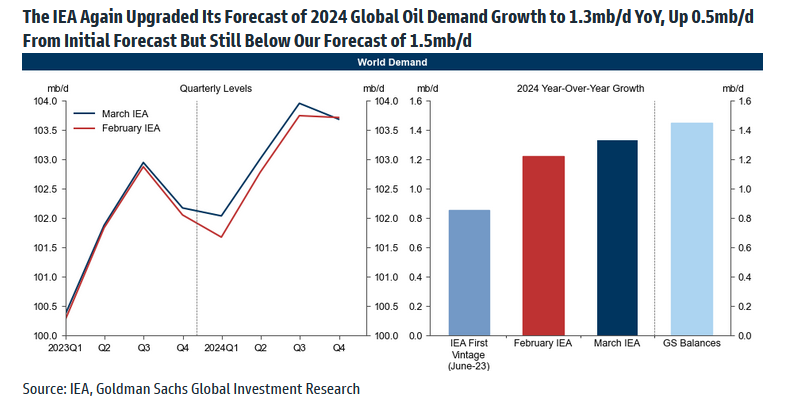
Last year, the IEA began the year by forecasting oil demand growth at 1.9 million barrels daily. Over the next 11 months, it kept revising this, to end the year at 2.3 million bpd in global demand growth—a view it held over January this year as well, and a figure very close to OPEC's forecasts during the year that all saw demand growing by over 2 million barrels daily.

Reuters this week reported that the divergence between IEA and OPEC demand numbers is the largest in 16 years, based on the analysis of data going back to 2008. This divergence concerns the February oil demand forecasts of the two organizations, and the gap is indeed considerable, at over 1 million bpd.

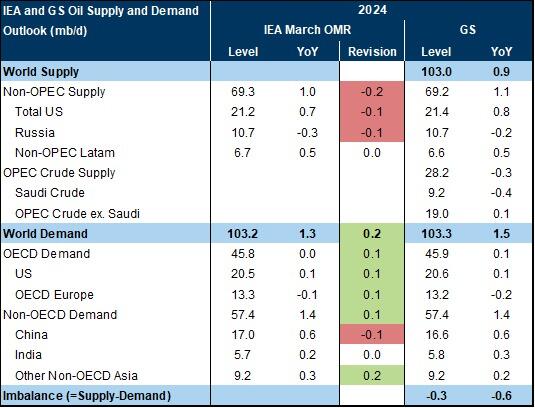
In its February Oil Market Report, the IEA forecast oil demand growth at a modest 1.2 million barrels daily this year, citing a deceleration in demand recovery after the pandemic lockdowns.

OPEC, for its part, kept its 2024 oil demand growth forecast unchanged from previous months at 2.2 million bpd.

There is also divergence over the longer-term prospects for oil demand, with the IEA last year predicting that it would peak before 2030, along with natural gas demand and coal demand. This prediction seems to have been the last drop for OPEC, which reacted with a sharp warning to the IEA to stop politicizing energy, accusing it of cheerleading for the energy transition and letting this affect the accuracy of its forecasts.

"The IEA has a very strong perception that the energy transition will move ahead at a much faster pace," a former official at the agency told Reuters.

"Both agencies have boxed themselves in with a position, which is why they have this enormous gulf in demand forecasts," Neil Atkinson, former head of the agency's oil markets division explained.

Some form of bias is almost unavoidable when it comes to predicting oil demand, and this is precisely because of the massive push for a transition that has seen a lot of money funneled into climate advocacy organizations that, among their advocacy activity, also deal in forecasting.

In itself, this bias is not a problem as long as the users of that information are aware of it.

It becomes a problem, however, when biased forecasts begin to be shared and amplified, painting a distorted picture of, in this case, oil demand growth prospects and affecting investment decisions.

https://www.zerohedge.com/energy/iea-opec-divergence-oil-demand-becomes-too-big-ignore