Search This Blog

Friday, March 15, 2024

Over-the-counter ‘diet weed’ is the new go-to for teens

 Teens are stooping to a new low to get high.

New medical research in the Journal of the American Medical Association has found that 11% of high school seniors admit to using a prevalent and easily accessible synthetic marijuana, known as delta-8 THC.

That number translates to “at least one or two students in every average-sized high school class,” according to Nora Volkow, director of the National Institute on Drug Abuse.

New medical research found that 11% of high school seniors admit to using the easily accessible drug.NYPost Photo Illustration
11% is just about one or two students in every average-sized high school class.The Washington Post via Getty Images
A lack of federal regulation means there’s no age restriction on the over-the-counter product, found readily in gas stations, online and in convenience stores in many states — leaving experts worried.

And it’s not just easy access that’s keeping them awake at night — there’s also the concern about the effects and ingredients of variations like delta-8, which is typically targeted and packaged to attract young people.

Teens are especially susceptible, as the human brain isn’t fully formed until age 25.

“With teens [these products] have an impact that is much more significant [compared to] what happens to the adult brain,” Heather Hugelmeyer, director of behavioral health at Northwell Health’s Garden City Patient Center, told The Post.

In other words, young users could be in for something way more serious than a bad case of the munchies.

“I can say there have been multiple, situations around the country that have been documented where people were using these synthetic derivatives that then had terrible reactions,” she said, adding that the realistic number of 12th-grade users is likely much higher than 11%.

“Whether it was psychotic symptoms, passing out or other different types of reactions that were potentially, medically dangerous to that individual — or they became agitated or behaved in a way that put others at risk.”

Two years, ago, the Food and Drug Administration (FDA) issued a warning of the serious health risks associated with use of delta-8.

Delta-8 is not permitted to be sold in New York state and is allowed only in parts of New Jersey, while Connecticut has cracked down on the sale of large doses.

However, Hugelmeyer warns that there’s no guarantee delta-8 is not being mixed into other products, due to the lack of transparency, regulation and deceptive packaging.

Delta-8, which comes in edible forms like gummies, is causing concern among substance experts.The Washington Post via Getty Images
“You really don’t know what is in any of these products when you may be using them,” she said, comparing delta-8 to how other substances may be laced with fentanyl, unbeknownst to a user.

“For me, that’s the big concern.”

The readily-accessible drug, which comes in many forms like vapes or edibles, is known commonly by users as “diet weed” for its reputation of being a weaker alternative than the similar delta-9.

Teens who use it can be blindsided by unexpectedly powerful effects, including depression, anxiety or a condition called cannabis hyperemesis, which induces cyclical vomiting.

Hugelmeyer said the latter has increased in patients over recent years, compared to being “something you read about, but you never saw,” two or three decades ago.

Delta-8 is rising in popularity with high school-age teens.TNS

Delta-8 and other synthetic marijuana can also cause learning defects regarding memory development, attention, and difficulty sleeping, Hugelmeyer explained.

She added that teens who explore substances before the age of 21 have a “significantly higher likelihood” of developing a substance disorder as adults — a difference of about one in four versus one in 20.

The new study found that 91% of the 12th-grade delta-8 users also used marijuana.

Frustratingly for parents, the behavioral health expert says that typical symptoms of usage — like stress and anxiety — are extremely difficult to distinguish from typical teen growth issues.

The only real physical sign is finding pieces of vape cartridges in their belongings.

Hugelmeyer warns that symptoms of use coincide with normal teen behavior.

Parents should also keep tabs on who their teens are or are not spending time with. If a high schooler is trading time with good influences for a bad crowd, that can be a warning sign.

“What I can say for parents is if you see a significant change in your adolescent, something is likely going on,” Hugelmeyer said. Even if their struggle is not drug-related, it’s important to take that moment to connect with teens to open a support system of trust, she added.

“You want to have a conversation that raises a red flag and really just express concern. ‘I noticed X, Y, and Z is happening — that seems different. Are you okay?’ Just opening that potential conversation.”

https://nypost.com/2024/03/15/lifestyle/delta-8-thc-use-rising-in-teens-as-experts-worry-over-lax-rules/

MedPAC's Report Recommends Pay Changes for Healthcare Services

 Hospital inpatient and outpatient services should get 1.5% more in 2025 Medicare payments, skilled nursing homes should receive 3% less, base payment rates for home health agencies should drop by 7%, and physicians should receive what current law allows plus 50% of the projected increase in the Medicare Economic Index, the Medicare Payment Advisory Commission (MedPAC) said in its annual March report

opens in a new tab or window to Congress.

In two of the report's 15 chapters, which took up 20% of the 561-page report, the commission addressed major problems with private Medicare Advantage (MA) plan quality and payments, which have been frequent topics of regular meetings. Commissioners reiterated that "a major overhaul of MA policies is urgently needed" to address lack of quality and overpayments compared with fee-for-service (FFS) plans.

Other issues include the need for Medicare to change policies that disadvantage FFS beneficiaries who don't want to use MA provider networks or undergo prior authorization. The commission advised Congress to push harder for information that is lacking about the value of MA plans' "extra benefits."

"The lack of information about the use and value of many MA supplemental benefits prevents meaningful oversight of the program such that we cannot ensure that enrollees are getting value from those benefits," the report noted.

The March report is one of two that MedPAC is required to send to Congress each year and is mandated to review payment policies, efficiency of services, and access and quality for beneficiaries. The June report analyzes Medicare issues more broadly and has more flexibility in discussing topics affecting the programs, MedPAC spokesperson Stephanie Cameron said in an email.

In a press briefing prior to the report's release Friday, MedPAC executive director Paul Masi noted the report's estimate that Medicare will pay MA plans $455 billion this year, not including sums paid for prescription drugs, but which include an estimated $2,142 per beneficiary of extra benefits. The amount to be paid to MA plans this year is 22%, or $83 billion more than what Medicare would spend if those beneficiaries were enrolled in FFS.

That's due, the report said, to the plans' practice of assigning 18% to 20% higher risk scores and coding more rigorously to diagnose more conditions among their enrollees, which results in higher monthly capitated payments to MA plans.

According to the report, those higher risk scores are projected to result in $50 billion more in payments to MA plans in 2024.

Masi noted that "the benefits from MA's higher payments relative to fee for service are subsidized by the taxpayers and beneficiaries who fund Medicare, [putting] an increased fiscal strain on the program. The commission estimates that Part B premiums will be about $13 billion higher in 2024 because of that higher MA spending."

Added to the problem is the fact that MA enrollees have lower spending, also called "favorable selection," which generally means they are healthier than their counterparts in FFS. Beneficiaries enroll in MA because of perception of lower costs when they are relatively healthy.

Those MA plan practices generate higher capitated monthly payments for those private companies. "The commission has long been concerned about the ability of the current MA quality bonus program to help beneficiaries meaningfully differentiate across plans and between MA and FFS," the report noted, adding that it "contends that the program does not effectively promote high-quality care and has several other flaws."

"Further, the commission is concerned that policies leading to higher MA payments also do not adequately address issues that distort the nature of plan competition," the report continued.

Mike Tuffin, president and CEO of AHIP (formerly America's Health Insurance Plans), which represents MA plans, was not pleased with the MedPAC's conclusions and estimates of overpayment.

"These estimates double down on speculative assumptions about Medicare Advantage and overlook basic facts about who Medicare Advantage serves and the value the program provides," he wrote in a press release. "At a time when more than 33 million Medicare Advantage beneficiaries are counting on stability in their costs and benefits, policymakers should seek to strengthen and build on the value of the program -- not undermine it."

The commission's four standing recommendations to Congress, dating as far back as March 2016, which have not been implemented, are:

  • Have HHS develop a risk-adjustment model that uses diagnostic data, excluding diagnoses from health risk assessments
  • Improve MA plans reporting of encounter data, withholding refunds to those that don't meet thresholds
  • Replace the quality bonus program with a score based on population-based measures that evaluates and rewards quality at a local market level
  • Replace the current MA benchmarking policy -- the way MA plans are paid base rates -- with a new policy that uses geographic markets as payment areas

Asked by MedPage Today why Congress has failed to implement those recommendations, Masi declined to say. But this year's report includes "additional information around the performance of the MA payment system, and underlying concerns we've had for many years now with how the payment system is performing," he said.

The report called the MA program "robust," and noted that the average beneficiary has a choice among 43 plans, and that the commission "strongly supports including private plans in the Medicare program" because they allow beneficiaries choice.

The report made special note of "tragic effects on beneficiaries and damaging impacts on the nation's healthcare workforce" due to burnout and risks to their own health and safety during the COVID-19 pandemic, factors that have affected funding and made it difficult to interpret some payment adequacy indicators.

As for other recommendations, the report noted that in the last 2 years, clinician payment remained positive or improved, but said "clinicians' input costs are estimated to have grown faster than the historical trend." Because physicians don't submit cost reports, the commission can't compute profit margins.

Under current policy, physician pay is expected to decline in 2025 due to the expiration of a 1.25% increase for 2024 alone. "Given recent high inflation, cost increases could be difficult for clinicians to continue to absorb," the report said, although from many indicators the commission looked at, it appears that payments are currently adequate.

The commission recommended that physicians in 2025 be paid currently allowed rates, plus 1.5% of the projected increase in the Medicare Economic Index.

American Medical Association President Jesse Ehrenfeld, MD, MPH, said in a press release that MedPAC's call for the increase is "desperately needed," and is an acknowledgement that current payment is inadequate. It "comes days after Congress allowed an approximate 2% cut in Medicare payments to become law," and as physicians suffer cyberattacks, years of Medicare cuts, COVID-19, and inflation that has "weakened physician practices' ability to absorb all these shocks."

Looking at ambulatory surgical center (ASC) services, the supply of mostly for-profit ASCs continued to grow, with some 6,100 centers treating 3.3 million FFS beneficiaries in 2022. Growth is attributed to an increasing number of services that can be moved safely from inpatient to outpatient, and lower costs compared with in-hospital surgeries. The report reiterated its recommendation that ASCs submit cost data.

The commission also recommended that Congress eliminate the update to hospice base payment rates for 2025 because of indicators that the number of facilities has increased and beneficiaries' access was good.

Finally, the commission determined that with 7,800 facilities providing dialysis to 290,000 beneficiaries in 2022 at a cost of $8.8 billion, payment is currently adequate because facilities have the capacity to meet demand.

Cheryl Clark has been a medical & science journalist for more than three decades.

https://www.medpagetoday.com/publichealthpolicy/medicare/109207

FDA Tries to Close the Lid on Poop Transplant Company

 The FDA has issued a warning letter

opens in a new tab or window to a company it says is selling fecal microbiota transplants (FMTs) in various forms -- including "capsules, enemas, and infusions" -- against agency regulations.

FDA sent the letter to Michael Harrop, founder of Human Microbes, saying that claims made on the company's website indicate that its products should be classified as drugs and biological products. Therefore, it would need an approved biologics license application (BLA) to market its treatments to patients, or would need an investigational new drug (IND) application to conduct research.

Particularly, FDA took issue with the fact that the site says that in addition to treatingopens in a new tab or window Clostridium difficileopens in a new tab or window, FMT "has shown promising results in clinical trials" for other conditions including irritable bowel syndrome, inflammatory bowel disease, Parkinson's, fibromyalgia, chronic fatigue syndrome, multiple sclerosis, autism, diabetes, and mental health disorders.

It goes on to say FMT "may also have potential applications ... in obesity, autoimmunity, cardiovascular disease, cancer, and more," and that it also can "attenuate adverse effects" of antibiotics, according to the FDA's warning letter.

FDA also cites a video on the company's YouTube channelopens in a new tab or window titled, "We want your poop," which promotes FMT as a potential treatment for a long list of conditions, and refers to a patient who "cured her bipolar disorder" after an FMT.

Human Microbes offers products directly to patients and gives instructions for self-administering treatments, the warning letter stated, adding that its products "raise potential significant safety concerns due to inadequate donor screening."

A "donor results spreadsheet" available on the site reports adverse events including increased intestinal pain, nausea, sweating, and loss of appetite, FDA stated.

But Harrop takes issue with allegations about product quality. "We are by far the highest quality source of stool donors, and I have a long history of pushing for better donor standards," he told MedPage Today in an email.

In two blogopens in a new tab or window postsopens in a new tab or window on the Human Microbes website, Harrop wrote that he has "been getting extremely burned out screening so many people who don't qualify. It makes this feel like an incredibly useless endeavor."

The blog states that he has been "writing to hundreds of research groups" about donor quality, and expressed concern that no companies are willing to invest in finding a "super-donor."

Human Microbes has received more than a million applicants and still hasn't found one ideal donor, he wrote.

"Out of all the hundreds of FMT clinical trials in recent years, I only recall one or two that went out of their way to try to find a highly effective donor," he added.

Harrop wrote that regulating FMT under an IND "seems poorly applicable to stool."

"Poop is not a drug and I am not developing a drug," he wrote. "I'm searching for people healthy enough to be stool donors. Researchers, doctors, clinical trials, etc., can then purchase stool from our donors."

He added in an email to MedPage Today that the company has "no limitations on who can purchase stool from our donors, nor for what purpose they can purchase for."

Harrop said he responded to FDA's warning letter, which was dated February 9, and that he hasn't yet heard back from the agency.

https://www.medpagetoday.com/special-reports/exclusives/109191

Reddit receives US FTC inquiry on AI-related deals

 Reddit said on Friday it received a letter from the U.S. Federal Trade Commission on March 14 about a inquiry focused on the company's sale, licensing and sharing of user-generated content with third parties to train artificial intelligence models.

https://www.marketscreener.com/news/latest/Reddit-receives-US-FTC-inquiry-on-AI-related-deals-46212335/

Taibbi: Why The TikTok Ban Is So Dangerous

by Matt Taibbi via Racket News,

Did they tell you the part about giving the president sweeping new powers?

It’s funny how things work.

Last year at this time, Americans overwhelmingly supported a ban on TikTok.

Polls showed a 50-22% overall margin in support of a ban and 70-14% among conservatives. But Congress couldn’t get the RESTRICT Act passed.

As the public learned more about provisions in the bill, and particularly since the outbreak of hostilities in Gaza, the legislative plan grew less popular. Polls dropped to 38-27% in favor by December, and they’re at 35-31% against now.

Yet the House just passed the “Protecting Americans from Foreign Adversary Controlled Applications Act” by a ridiculous 352-64 margin, with an even more absurd 50-0 unanimous push from the House Energy and Commerce Committee.

What gives?

As discussed on the new America This Week, passage of the TikTok ban represents a perfect storm of unpleasant political developments, putting congress back fully in line with the national security establishment on speech. After years of public championing of the First Amendment, congressional Republicans have suddenly and dramatically been brought back into the fold. Meanwhile Democrats, who stand to lose a lot from the bill politically — it’s opposed by 73% of TikTok users, precisely the young voters whose defections since October put Joe Biden’s campaign into a tailspin — are spinning passage of the legislation to its base by suggesting it’s not really happening.

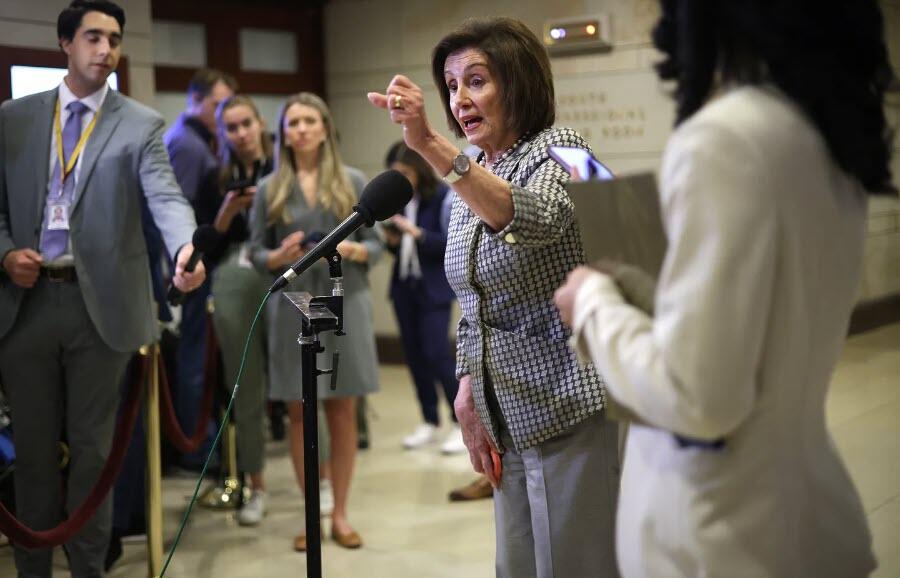
“This is not an attempt to ban TikTok, it’s an attempt to make TikTok better,” is how Nancy Pelosi put it. Congress, the theory goes, will force TikTok to divest, some kindly Wall Street consortium will gobble it up (“It’s a great business and I’m going to put together a group to buy TikTok,” Steve Mnuchin told CNBC), and life will go on. All good, right?

Not exactly. The bill passed in the House that’s likely to win the Senate and be swiftly signed into law by the White House’s dynamic Biden hologram is at best tangentially about TikTok.

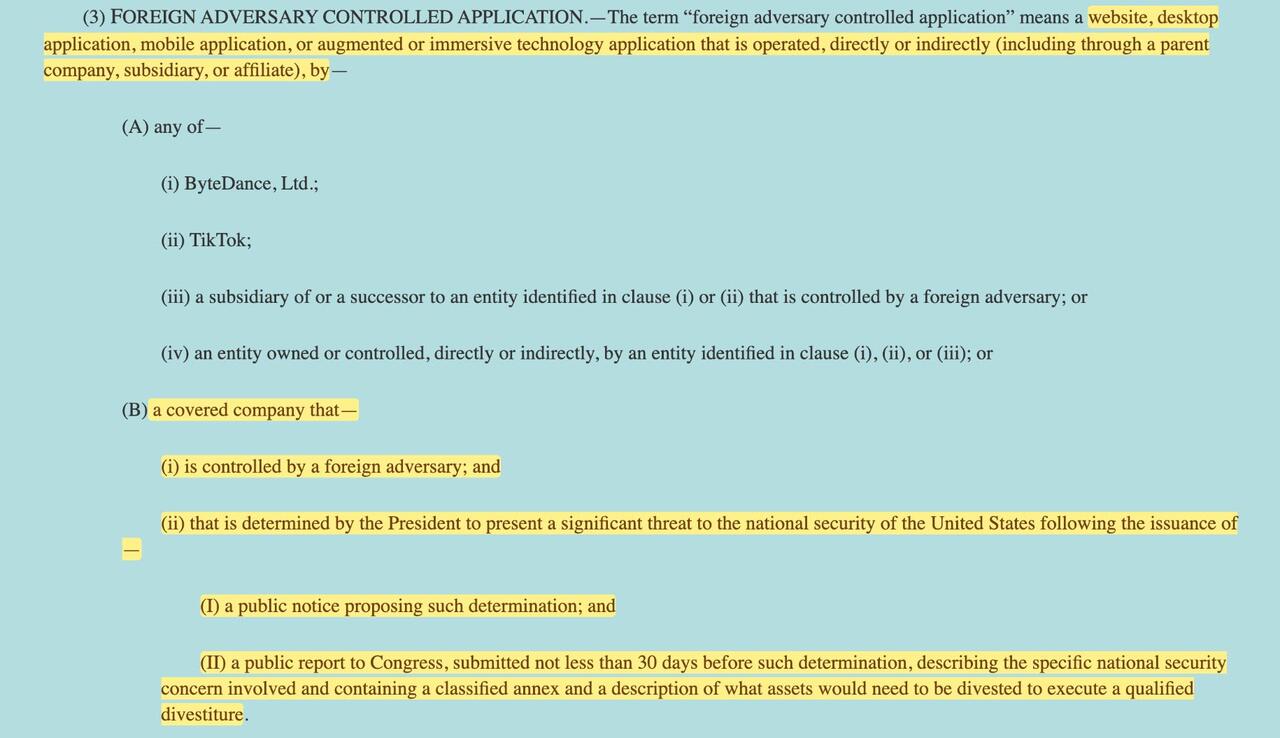
You’ll find the real issue in the fine print. There, the “technical assistance” the drafters of the bill reportedly received from the White House shines through, Look particularly at the first highlighted portion, and sections (i) and (ii) of (3)B:

As written, any “website, desktop application, mobile application, or augmented or immersive technology application” that is “determined by the President to present a significant threat to the National Security of the United States” is covered.

Currently, the definition of “foreign adversary” includes Russia, Iran, North Korea, and China.

The definition of “controlled,” meanwhile, turns out to be a word salad, applying to:

(A) a foreign person that is domiciled in, is headquartered in, has its principal place of business in, or is organized under the laws of a foreign adversary country;

(B) an entity with respect to which a foreign person or combination of foreign persons described in subparagraph (A) directly or indirectly own at least a 20 percent stake; or

(C) a person subject to the direction or control of a foreign person or entity described in subparagraph (A) or (B).

A “foreign adversary controlled application,” in other words, can be any company founded or run by someone living at the wrong foreign address, or containing a small minority ownership stake. Or it can be any company run by someone “subject to the direction” of either of those entities. Or, it’s anything the president says it is. Vague enough?

As Newsweek reported, the bill was fast-tracked after a secret “intelligence community briefing” of Congress led by the FBIDepartment of Justice, and the Office of the Director of National Intelligence (ODNI). The magazine noted that if everything goes as planned, the bill will give Biden the authority to shut down an app used by 150 million Americans just in time for the November elections.

Say you’re a Democrat, however, and that scenario doesn’t worry you. As America This Week co-host Walter Kirn notes, the bill would give a potential future President Donald Trump “unprecedented powers to censor and control the internet.” If that still doesn’t bother you, you’re either not worried about the election, or you’ve been overstating your fear of “dictatorial” Trump.

We have two decades of data showing how national security measures in the 9-11 era evolve. In 2004 the George W. Bush administration defined “enemy combatant” as “an individual who was part of or supporting Taliban or al Qaeda forces, or associated forces that are engaged in hostilities against the United States.” Yet in oral arguments of Rosul et al v Bush later that year, the government conceded an enemy combatant could be a “little old lady in Switzerland” who “wrote a check” to what she thought was an orphanage.

Eventually, every element of the requirement that an enemy combatant be connected to “hostilities against the United States” was dropped, including the United States part. Though Barack Obama eliminated the term “enemy combatant” in 2009, the government retained (and retains) a claim of authority to do basically whatever it wants, when it comes to capturing and detaining people deemed national security threats. You can expect a similar progression with speech controls.

Just ahead of Monday’s oral arguments in Murtha v. Missouri, formerly Missouri v. Biden — the case so many of us hoped would see the First Amendment reinvigorated by the Supreme Court — this TikTok bill has allowed the intelligence community to re-capture the legislative branch. Just a few principled speech defenders are left now. Fifty Democrats voted against the bill, which is heartening, although virtually none argued against it on First Amendment grounds, whis is infurating. Pramila Jayapal had a typical take, saying the ban would “harm users who rely on TikTok for their livelihoods, many of whom are people of color.”

Contrast that with Kentucky Senator Rand Paul, who went after members of his own party, singling out Republicans encouraging a governmental power grab after years of fighting big tech abuses not just at TikTok but other platforms. These people claim to be horrified, he said, but actions speak louder than words.

“Look at their legislative proposals,” he said, noting many want to “set up government agencies and panels” on speech, effectively saying “If you’re not putting enough conservatives on there, by golly we’re going to have a government commission that’s going to determine what kind of content gets on there.”

These, he said, are “scary ideas.”

He’s right, and shame on papers like the New York Post that are going after Paul for having donors connected to TikTok. Paul has been consistent in his defense of speech throughout his career, so the idea that his opinion on this matter is bought is ludicrous. It’s a relief to be able to expect at least some adherence to principle on this topic from him or fellow Kentuckian Thomas Massie, just as we once could expect it from Democrats like Paul Wellstone or Dennis Kucinich.

I don’t often do this, but as Walter pointed out in today’s podcast, this bill is so dangerous, the moment so suddenly and unexpectedly grave, that we both recommend anyone who can find the time to call or write their Senators to express opposition to any coming Senate vote. It might help. Yes, collection of personal information and content manipulation by the Chinese government (or Russia’s, or ours) are serious problems, but the wider view is the speech emergency. As the cliché goes, forget the furniture. The house is on fire. Let’s hope we’re not too late.

https://www.zerohedge.com/political/taibbi-why-tiktok-ban-so-dangerous

Ukraine bondholders poised to form creditor group for $20 billion debt talks

 Ukraine's overseas bondholders are in talks to form a creditor committee ahead of debt rework talks with the country, according to four people with direct knowledge of the discussions.

Time is of the essence for Ukraine to secure a restructuring before a two-year payment freeze agreed by holders of its $20 billion of outstanding international bonds ends in August.

A formal group could kick off talks ahead of the International Monetary Fund's spring meetings, two sources said, which are scheduled to start on April 17 in Washington.

Russia's full-scale invasion in February 2022 has shattered Ukraine's economy and finances, forcing it into a debt freeze to avoid a sovereign default. This would be the first effort to formalize debt talks between private bondholders and the country.

A formal group would be able to engage with the government to hold detailed discussions and exchange concrete proposal, involving privileged information.

The current push to get creditors together is coming from a number of sides, according to the sources.

Ukraine's debt management office has reached out to some investors in an effort to get them organised as a creditor group, the sources said.

Weil, the law firm that advised creditors on the nation's 2015 restructuring and on the payment pause, has also reached out to some of the country's largest creditors to prepare for debt talks, according to four sources, who asked not to be named because the talks are private.

The creditor committee is expected to include eight to 12 large asset managers, one of the sources said.

Weil did not immediately respond to a request for comment.

A spokesperson for Ukraine's DMO said authorities had never stopped exchanging opinions with the market on debt strategy and sustainability.

"We keep collecting the feedback from investors on the approaches towards the commercial debt treatment in line with the intention we publicly announced a year ago," the spokesperson said.

RUSSIA'S FROZEN ASSETS

The war-torn economy has been sounding out major investors since late 2023 over plans to restructure the country's international debt and the possibility of raising fresh financing, as previously reported by Reuters.

But so far discussions have only been held informally.

What a restructuring could look like is unclear as it involves an economy engulfed in a war whose outlook, fiscal position and ability to pay back its debt remain highly uncertain.

Some bondholders are hoping to emerge from a debt rework with new bonds that would deliver interest payments from the start, according to two of the sources. However, paying foreign bondholders might be unpalatable for Kyiv which is struggling to shore up its finances to keep the country afloat.

In addition to issuing bonds as part of the rework, Ukraine could raise fresh financing by selling collateralized and guaranteed bonds.

These could see Ukraine's international partners - either multilateral lenders or individual countries - provide collateral for the new bonds, akin to the so-called Brady bonds issued by Latin American countries in the late 1980s that were backed by U.S. Treasuries.

The debt talks will unfold as Western officials are weighing confiscating some of the $300 billion-$350 billion worth of frozen Russian assets to help support Ukraine, but how it will be done remains highly complex given it would set a contested precedent.

The reserves locked in the European Union - essentially bonds and other types of securities in which the Russian central bank had invested - are held in a Brussels-based depository called Euroclear.

S&P Global Ratings said last week it expected the country to complete a debt restructuring with private creditors by the middle of this year, as it cut the country's rating deeper into junk territory.

https://www.yahoo.com/news/ukraine-bondholders-poised-form-creditor-131758342.html