Search This Blog

Saturday, March 16, 2024

3 Killed In Bucks County, PA Shootings, Suspect Identified

 Update (12:45pm ET) Bucks County authorities have identified a suspect in a series of deadly shootings that prompted a shelter-in-place order early Saturday morning. As Fox29 reports, police say they are searching for 26-year-old Andre Gordon, who was last seen driving a stolen vehicle.

According to police, Gordon shot and killed two people at a home on the block and fled in a stolen vehicle. He then drove to Edgewood Lane around 9 a.m. and fatally shot a third person before fleeing the scene.

Then, around 9:15 a.m., police say he carjacked a vehicle at gunpoint in the parking lot of a Dollar General on Bristol Pike in Morrisville. The driver of that vehicle was not harmed.

According to police, it is believed that Gordon knew all of the victims who were fatally shot. He is also believed to currently be homeless and has ties to Trenton, New Jersey. He was last seen operating a 2016, dark grey Honda CRV with a Pennsylvania plate reading KFR-1534.

Police provided photos of the vehicle, and Gordon, who remains at large.

Shortly before noon Saturday, sources tell FOX 29's Steve Keeley the carjacked Honda was located in Trenton, New Jersey, and that SWAT teams were responding to the scene. Falls Township police have since confirmed that the vehicle was located unoccupied in Trenton.

Keeley also reported that local authorities had requested additional resources from neighboring departments, including Pennsylvania and New Jersey State Police.

A shelter-in-place order was sent to residents in Falls Township by phone and by mobile alert around 9:30 a.m. and was lifted by 12:30 p.m.

The Bucks County St. Patrick’s Day Parade was canceled as a result of the shelter-in-place, and several local businesses in the area also closed temporarily.

Governor Josh Shapiro noted he was informed of the shooting and said on X that he was directing Pennsylvania State Police to work with local law enforcement, and to provide whatever support they might need.

* * *

Police in the suburban Philadelphia township of Falls Township, Bucks County issued a shelter in place warning on around 9:30am on Saturday morning after reports that several people have been shot.

LevittownNow.com reports that according to law enforcement sources three people have been killed. There are shooting scenes in the area of Viewpoint Lane and Vine Lane, as well as on Edgewood Lane, both in Falls Township’s Levittown section.

Police said it wasn’t known yet if the shootings were “targeted or random.” The suspect fled the scene and may have carjacked a vehicle along Old Route 13 near Tyburn Road.

Police said Oxford Valley Mall and Sesame Place had been told to close until further notice. The area’s Target store and other businesses had chosen to close as well.

The county’s scheduled St. Patrick’s Day parade was canceled following the shelter-in-place order.as well.

As of 10:15 a.m., police continued to search for the shooter. A New Jersey State Police helicopter was assisting Falls Township police. Police departments from around Bucks County responded to assist.

State Rep. Steve Santarsiero (D-10th dist.) said the county's St. Patrick's Day parade, scheduled to be held Saturday morning, was cancelled due to the emergency situation.

According to State Rep. Brian Fitzpatrick (R-1st dist.) the incident involved a carjacking and shootings in two parts of Falls Township. He said he was “in touch with law enforcement officials as they pursue the suspect.”

On social media, at about 10 a.m., the Middletown Township Police Department confirmed that there had been a shooting and they are telling people not to travel to Falls Township on Saturday morning.

"This is a fluid situation and we are asking the community to take some precautions. Do NOT travel to Falls Township until further notice. If you live in areas that border Falls, you should shelter in place until further notice," police officials said online.

Also, police said a Target store in Langhorne has closed due to the shooting.

https://www.zerohedge.com/markets/shelter-place-issued-suburban-philadelphia-township-after-several-people-shot

Haitian Migrant Boat With Guns, Drugs & Night Vision Intercepted Off Florida

 Haiti's domestic security has rapidly deteriorated as widespread gang violence and civil unrest plague the failed state. A warning from the US Department of Defense on Tuesday explained that a "mass migration" wave from Haiti to South Florida is imminent. 

The 'Caribbean crisis' appears to be in the early stages of spreading to the US. Florida Governor Ron DeSantis announced Friday that a migrant boat with dozens of Haitians, firearms, and drugs, along with night vision, was recently intercepted by Florida Fish and Wildlife agents just off the Florida coast, according to Fox News

"Our Florida Fish and Wildlife offices interdicted a vessel that had 25 illegal immigrants, potential illegal immigrants from Haiti in their boat. In their vessel, they had firearms, they had drugs, they had night vision gear, and were boating very recklessly, which would potentially endanger other folks," DeSantis said at a press conference where he signed three pieces of legislation to deter illegal immigration. 

"That vessel was interdicted near the Sebastian Inlet and those illegal aliens were turned over to the Coast Guard for deportation," the governor said.


The announcement comes after the New York Post leaked an internal memo from Border Patrol that revealed agents in South Florida are preparing for an influx of Haitian migrants. 

"One landing will cripple the station and our ability to respond to other traffic," the memo said. 

Meanwhile, Biden administration officials warned last week in a House Armed Services Committee that they're preparing for a surge in Haitian migrants to enter the US. 

And the countdown to the next migration flood has already begun. 

Biden admin officials secretly cheer as these migrants will possibly be future Democrat voters.

https://www.zerohedge.com/geopolitical/haitian-migrant-boat-guns-drugs-night-vision-intercepted-florida-caribbean-crisis

My unmarried partner may need a nursing home. Who will pay for his care - and will I be able to stay

I am seeking information about a shared home that my partner and I co-own with rights of survivorship, and a subsequent beneficiary deed for four adult children from previous marriages.

We are in Arizona. If one of us needs to go into a nursing home, is the other safe in the home? Or would Medicaid come after the house?

I should note that my partner's assets outside of the home are around $100,000. The home is worth around $600,000.

My assets are about 15 times those of my partner. Am I required to financially support him should serious disability occur? (We were previously listed as domestic partners for insurance purposes prior to receiving Medicare two and a half years ago.)

Would Medicare assist in the costs for his care? Would it make sense to put most of my assets into a trust? Most assets are in a traditional IRA and a 401(k).'

Dear Reader,

Long-term-care planning can be tough - and scary. The short answer: It sounds like your home is safe, but that doesn't mean you shouldn't do more long-term care planning to be extra sure.

First, let's clarify: Medicare is the federal health insurance individuals are eligible for beginning at age 65, but they pay for their own healthcare through copays and deductibles upfront. The program does not assist very much in long-term care costs, except for a few very specific circumstances. Medicaid is a joint federal and state program for low-income individuals who can't afford healthcare, and in situations regarding long-term care, such as residence in a nursing home or memory care institutions, the agency picks up the tab.

In Arizona, the Medicaid beneficiary or the co-owner of the home (usually a spouse) must live in the home in order for the house to be exempt from the applicant's assets.

If no one was living in the house, the applicant must have an "intent to return," which is, as you could guess, the intention to move back into the house. This is not your case, but it might be for a fellow reader so it's worth mentioning.

Also, if no one is living in the house, the applicant can have a maximum home equity, which is the value of the house minus any debts against it, of no more than $713,000 in 2024, according to Medicaid Planning Assistance.

The estate recovery process is more of a pressing concern. In that case Medicaid would only try to get back the money it spent on your partner's medical bills. The federal government requires each state to try to recover some of the funds spent on a beneficiary's care, so they look at that person's assets (including the home) after death. Typically in cases for married couples, nothing is touched until after the second spouse dies. It is important to note, however, that your titling structure (rights of survivorship) was a good choice in this instance.

Rules in Arizona

"[The] AHCCCS' claim is filed only against the 'estate of the individual,'" according to the Arizona Health Care Cost Containment System, which is Arizona's Medicaid agency. "A home that is solely owned by the ALTCS member, is owned jointly without right of survivorship, or is owned jointly with right of survivorship but the joint owner is deceased, is subject to small estate affidavit or probate, and is therefore subject to payment of AHCCCS' claim against the estate." Estate recovery applies to anyone who received benefits under ALTCS or Home and Community Based Services (HCBS), was 55 or older when benefits started and is deceased, according to the AHCCCS.

The program may try to recover your partner's assets outside of the home.

Let's be clear - it is always good to run your specific case by a qualified, trustworthy estate planning or eldercare attorney in your state. The information in this letter is just the beginning of your planning, and a professional in your locality will be able to spot particular circumstances or know overlooked details based on your personal situation.

As for your own assets, it does make sense to get estate-planning documents in order, for your own protection should you need long-term care, and also for your beneficiaries if leaving behind a legacy is important. You can shop around for an attorney in your state, who will know what documents will keep your assets secure and your wishes met, in order to compare costs and processes these professionals may suggest. This includes a will and healthcare proxy, but it might also incorporate trusts, as you asked. In the meantime, check that all of your paperwork lists beneficiaries or are payable-on-death, so that they avoid probate.

It doesn't hurt to run your situation by an experienced Medicaid expert in your state, either. ALTCS offers a free consultation to clients for finding care or filling out the application for the service, and does offer more extended assistance (but you'd have to pay for that).

https://www.morningstar.com/news/marketwatch/20240316238/my-unmarried-partner-may-need-a-nursing-home-who-will-pay-for-his-care-and-will-i-be-able-to-stay-in-our-home

Dan Yergin Is Concerned About AI-Fueled Boom in Electricity Use

 Meeting demand and transitioning to clean energy amid geopolitical tensions will dominate conversations among industry heavyweights at CERAWeek in Houston next week.

More than 7,000 people are headed to Houston next week to attend CERAWeek by S&P Global with a key question in mind: How to meet increasing demand for power amid the transition to clean energy. Daniel Yergin, vice chairman of S&P Global, offers a window into that future.

Yergin, who wrote the Pulitzer Prize-winning book The Prize: The Epic Quest for Oil, Money & Power, will be the voice of the conference and lead more than two dozen panels featuring heavyweights from government, the oil and gas sectors and tech. Peak oil demand along with the geopolitics of oil and gas likely will be a key focus, as will mining, he said. Yergin also expects a lot of buzz on artificial intelligence and other new technologies.

https://www.bloomberg.com/news/articles/2024-03-16/ceraweek-s-yergin-on-what-to-expect-at-big-energy-conference

Four-Star Sellouts

 “The jungle is dark but full of diamonds, Willy. One must go in to fetch a diamond out.”

I’ve been thinking about that line from Arthur Miller’s masterpiece, Death of a Salesman, as I watch prominent men risk prison or disgrace to enrich themselves.

Look at the news.

Sen. Bob Menendez, former Chair of the U.S. Senate Foreign Relations Committee, is indicted for acting as a foreign agent to benefit Egypt.

Manuel Rocha, a former Ambassador to Cuba, will plead guilty to charges he conspired to act as an agent of Cuba.

Two years ago, former Marine Corps General John Allen resigned from his post as president of Brookings Institution amid a DOJ investigation into whether he illegally lobbied on behalf of the nation of Qatar.

DOJ dropped the charges but, in 2023, Congress released findings that 77 general officers and admirals had taken high-paying gigs with foreign countries. The list included former Defense Secretary James Mattis (UAE), former NSA chief Keith Alexander (Singapore, Saudi Arabia) and former National Security Advisor H.R. McMaster (Japan).

Go back to 2015 and you’ll be reminded that then-Deputy Secretary of Homeland Security Alejandro Mayorkas allegedly pressured DHS officials to approve visa requests on behalf of powerful friends in business, entertainment and politics.

I get it; there’s an edge in this game, too.

Mayorkas and the generals played close to the edge. Menendez played too close to the edge (at minimum). Rocha obviously went over the edge.

The bigger question is … why?

At an age when most Americans re-discover the soapy drama of daytime television, the politicians and generals venture deeper into the jungle.

Taking one more free trip.

Looking for one more big payday.

Something short of the law should restrain their greed. Call it shame, stigma, patriotism, or even self-discipline. Call it common morality.

The generals and military bigshots are most troubling. They made their names in an institution that demanded fidelity to the military ethos. Duck your duty to stand post, and you betray your comrades. Lie to your commanding officer, and you perhaps put an operation at risk. Sit back at the command post while your troops walk patrol, and be labeled a coward by yourself and others.

When Allen, Mattis, McMaster and the rest served as officers, much of what they could have done, they didn’t do. Their restraint enhanced their character. Their high moral standards made them leaders, and formed the basis for their credibility to ask young Americans to kill or be killed in combat.

But as generals transition to civilian life, apparently, they discover what can be gained by switching sides and corrupting into your opposite. The opportunity to become sandwich-board twirlers for foreign governments is turning once-virtuous leaders into human directionals for money, attention and other regime goodies.

Because the generals sold out, they’re not special anymore.

No more duty, honor, country.

No more honor, courage, commitment.

The generals are hunting diamonds now, and we should treat them accordingly. 

https://www.realcleardefense.com/articles/2024/03/11/four-star_sell-outs_1017175.html

'Who Really Released the Hur Report?'

 It’s the great unexplored theme in the Robert Hur imbroglio. The decision to release the Hur report, with its portrayal of a confused and forgetful president, wasn’t mandatory and neither did it rest with Mr. Hur, despite the congressional grilling he received this week.

The decision rested with Attorney General Merrick Garland.

He was under no legal obligation to do so. He could have buried Mr. Hur’s findings, redacted them or sent them back for edits. The inevitable sticks and stones from Republicans would have been eminently survivable, especially in light of the contortions the attorney general had already performed for President Biden.

To some neutral observers, he would even have been a hero for restoring the department’s honorable tradition of not disclosing investigative information about people it doesn’t intend to charge.

It’s worth recalling, until now, how much opprobrium Mr. Garland and his department have been willing to bear on Mr. Biden’s behalf.

He let himself be embroiled in a White House intrigue to paint parents as terrorists for doubting the woke agenda in schools. He remained mute while Mr. Biden derided him as a “ponderous judge” for not pushing criminal charges against Donald Trump. His department let the statute of limitations expire on Hunter Biden’s grossest tax behavior. When the spotlight got too hot, it dangled a plea deal that internal whistleblowers and a federal judge found riddled with irregularities.

Mr. Garland has made a specialty of pretzeling the department’s special-counsel rules. He appointed Jack Smith to supply the demanded Trump prosecutions even as he averted his gaze navelward and pretended he was doing anything but acceding to White House importuning.

He pretzeled the rules again in the Hunter Biden matter, instead of appointing the required outsider, choosing an insider who could be trusted to ignore whistleblower allegations of favoritism toward Hunter because he was the insider accused of providing the favoritism.

Mr. Garland’s decision to publish the Hur report came in the face of ad hominem White House leaks as well as back-channel lobbying.

If an unwritten part of the attorney general’s job is to protect the president who appointed him, another part is to recognize when the department has bent too far.

Could a new and unique form of lame-duckness be showing itself, the kind that comes to a president who isn’t expected to serve long if re-elected? Even more so, one who’s seen as ill-serving his party and country by clinging to a possible second term when a majority of his own voters think he’s too old?

Partisan Democrats this week shrieked certainty that Mr. Hur intended the controversy he was bringing into the presidential contest by alluding to Mr. Biden’s infirmity. Shouldn’t they go to the obvious place and ask if Mr. Garland intended it too?

Mr. Garland, as noted in a previous column, presents himself as almost immaculately absent from all controversial decisions, yet he picked Mr. Hur out of private practice and gave him his marching orders, despite Democratic body language trying to suggest to voters Mr. Hur was a Trump holdover or MAGA activist.

Disloyalty? Or loyalty to his country? Maybe in his memoirs Mr. Garland will let us know.

Mr. Garland has enough to repent of. For the third election in a row, the department he now heads will be central to the election fight, having possibly supplied, through its control of the FBI, the decisive factor in 2016 and 2020.

If Mr. Biden had felt more encouragement to step aside due to age, legal problems and lousy polls, a younger Democrat might be on his or her way to a ringing victory and mandate over Mr. Trump,

All of America might have regrets too if an exceptionally close election between two exceptionally unpopular candidates ends up chaotically in the House of Representatives.

After 2020, it was a tad disingenuous to ask ordinary Republicans to distinguish between Mr. Trump’s claims of massive vote fraud and the things that actually did happen, such as late rule changes, rampant media dishonesty, and U.S. intelligence veterans lying to the public about the Hunter Biden laptop.

Now, however you spin it, voters see President Biden trying to put his opponent in jail. For half of America, a Biden victory, fairly or not, will be seen as a tainted victory, a debacle that Mr. Garland’s fingerprints are all over, though not his alone.

He’s right to be embarrassed about the department’s role. He may have deeper reasons than he’d be likely to share for saying “enough.”

https://www.wsj.com/articles/who-really-released-the-hur-report-biden-attorney-general-chose-to-let-voters-see-9ceb7628

'Belt And Road' Western Hemisphere Investments Has China Firmly Rooted In America's Backyard

 by John Haughey via The Epoch Times,

The United States has been so focused on global security concerns that it has overlooked investing in its own backyard’s economic and military needs for decades.

But China hasn’t. With its Belt and Road Initiative (BRI, also known as “One Belt, One Road”), China has become South America’s largest source of infrastructure investment and second-largest trading partner, increasing trade from $18 billion in 2002 to $450 billion in 2022.

Twenty-five of 31 Central and South American countries have negotiated infrastructure investments from China, and 22 of those nations, most recently Honduras, have formally signed onto the BRI program.

Chinese companies, either owned or subsidized by the Chinese Communist Party (CCP), operate mines in Mexico, Argentina, Peru, and Venezuela, electrical grids in Peru and Chile, 5G wireless systems in Costa Rica, Bolivia, Brazil, and Mexico—80 percent of Mexico’s telecommunications equipment is provided by Chinese companies—space launch and satellite tracking facilities in Argentina, and the world’s largest embassy in the Bahamas.

The U.S. State Department estimates China’s trade with Latin American nations and investments in sea, space, telecommunication, critical minerals, and energy will match the United States by 2035 in the region. China’s military ties with Venezuela, Cuba, Peru, and Chile—which now include port visits by Chinese warships and technical advisers—will mature into base agreements within a decade.

China has, or plans to build or improve, 40 ports across 16 Latin American and Caribbean countries without restrictions on military use, including on both ends of the Panama Canal, where CCP-sponsored companies are bidding with Panama to work on the U.S.-built canal.

Next fall, Chinese leader Xi Jinping will be in Peru to commemorate the completion of “a $3.6 billion ‘mega port’ that was financed by China, built by Chinese workers, and it will be owned and operated by a CCP-backed company,” House Armed Services Committee Chair Rep. Mike Rogers (R-Ala.) said.

“It will be used to ship South American copper, lithium, and other critical materials to China to further their military modernization,” he said during a House Armed Services Committee March 12 hearing on Western Hemisphere national security challenges.

Mr. Rogers called it “the latest effort of China’s efforts to displace American influence and build a strategic footprint in our backyard.”

‘Debt Traps’ and CCP Espionage

However, U.S. Southern Command Commander Army Gen. Laura Richardson said China’s increasing presence is a double-edged sword for countries that accept financing and other assistance from the CCP.

“The world is at an inflection point,” she said at the committee hearing.

“Our partners in the Western Hemisphere, with whom we are bonded by trade, shared values, democratic traditions, and family ties, are increasingly impacted by interference and coercion from [China.]

“The People’s Republic of China [PRC] has exploited the trust of democracies in this hemisphere, using that trust to steal national secrets, intellectual property, and research related to academia, agriculture, and health care,” she continued.

“The scope and scale of this espionage is unprecedented. Through the Belt and Road initiative, the PRC aims to amass power and influence at the expense of the world’s democracies,” she added.

Ms. Richardson said that while it’s true that Central and South America have not received the economic and national security attention other areas have, that is changing.

“I’ve learned that our presence absolutely matters,” she said, noting after nearly 20 years of “receiving less than 50 percent” of its Western Hemisphere security cooperation needs, the U.S. Southern Command was fully funded and received additional supplemental funding in the fiscal year 2024 defense budget.

Ms. Richardson said while the boost “was very, very helpful, we can’t just get one year of additional funding to meet the requirement, and I would say that our presence absolutely matters” and needs to be fully funded again in the fiscal year 2025 defense budget.

With the additional funding, she said, the United States has stepped up joint military and emergency response exercises with Chile, Argentina, and Paraguay with “more engagement other than just a visit once a year.”

“This has really made a huge difference in terms of the partnering, but we have to be there. We have to have good security cooperation programs; we have to have flexible authorities that [respond to] opportunities [as they] open because they’re only open for a short period of time,” she added.

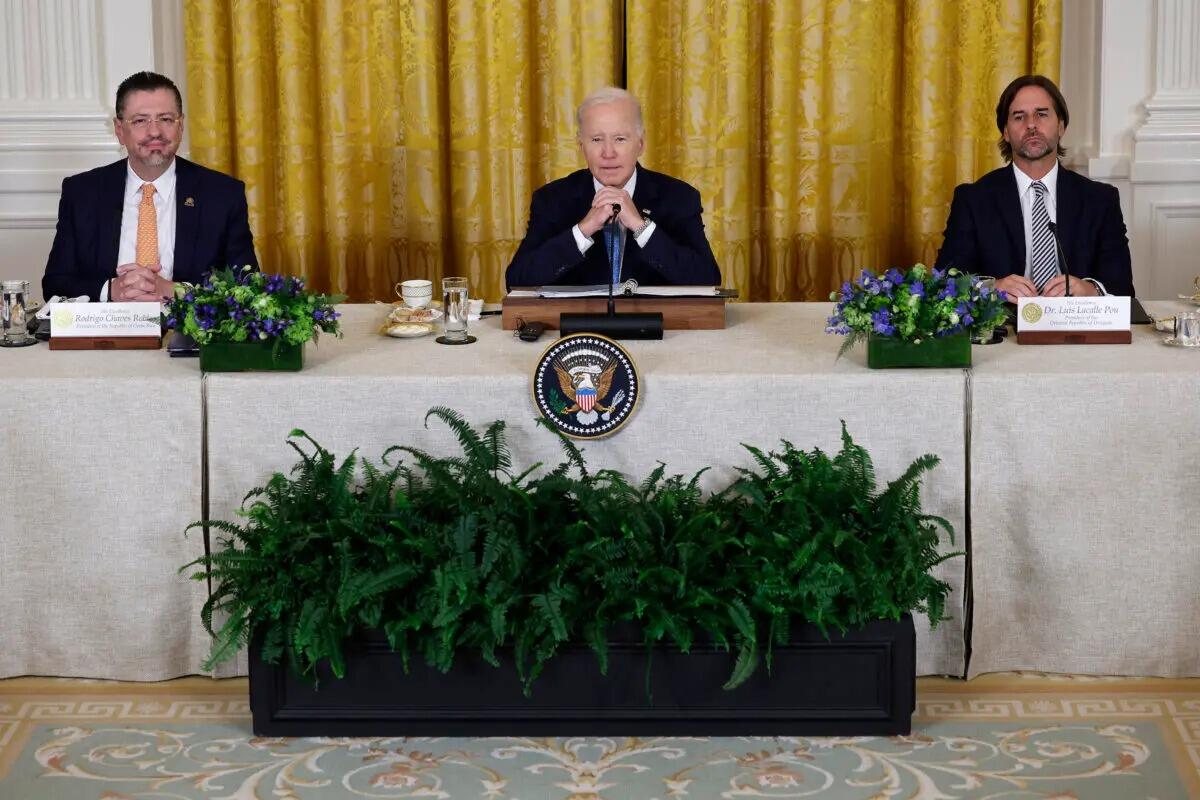
(L-R) Costa Rican President Rodrigo Chaves Robles, U.S. President Joe Biden, Uruguayan President Luis Lacalle Pou, and other leaders attend the plenary session of the inaugural Americas Partnership For Economic Prosperity Leaders' Summit in the East Room of the White House in Washington on Nov. 3, 2023. (Chip Somodevilla/Getty Images)

‘Put Our Money Where Our Mouth Is’

That money will be there, Assistant Secretary of Defense for Homeland Defense and Hemispheric Affairs Rebecca Zimmerman said at the committee hearing.

“We’re putting homeland defense and other interests across the hemisphere front and center,” she said.

“The department’s top priority is defense of the homeland [and countering] the growing multi-domain threat posed by the People’s Republic of China.”

Ms. Zimmerman said the United States is “deepening partnerships with Canada, Mexico, Brazil, Colombia, and Chile while reinforcing democratic institutions civilian control of the military and respect for human rights and the rule of law” across the hemisphere.

In February, Secretary of Defense Lloyd Austin participated in the North American Defense Ministerial with his counterparts from Mexico, Canada, and Latin American countries.

In November 2023, President Joe Biden welcomed leaders from the Western Hemisphere to the White House for the inaugural Americas Partnership for Economic Prosperity Leaders’ Summit to discuss migration, supply chains, and infrastructure investment.

Prime ministers, presidents, and foreign ministers from Canada, Barbados, Chile, Colombia, Costa Rica, the Dominican Republic, Ecuador, Peru, Uruguay, Mexico, and Panama attended.

The United States is developing a program with the Inter-American Development Bank to expand financing for infrastructure with the launch of an investment platform through the U.S. International Development Finance Corp. to invest billions in improving critical supply chains, modern ports, clean energy grids, and digital infrastructure.

The “Americas Partnership Accelerator” will assist entrepreneurs in developing and funding their business ideas and mobilize venture capital from around the world for startups in the region, the Biden administration maintains.

Rep. Jan Kiggins (R-Va.) said while “the defense budget is always inadequate” in addressing all needs, it is good “that we are again prioritizing that funding because it is so important that we can put our money where our mouth is.”

“The good news,” Ms. Richardson said, “is working with our very willing partners leads to the best defense.”

“We must use all available levers to strengthen our partnerships with the 28 like-minded democracies in this hemisphere who understand the power of working together to counter these shared threats,” she continued.

“The United States remains the preferred and most trusted security partner in the region.

“We build trust through investment and security cooperation programs that train and equip our partner militaries and security forces, a robust joint exercise program to build interoperability, and the development and employment of emerging technologies,” she added.