price target raised from GBX 9500 to GBX 10500.
https://www.marketscreener.com/quote/stock/ASTRAZENECA-PLC-4000930/
price target raised from GBX 9500 to GBX 10500.
https://www.marketscreener.com/quote/stock/ASTRAZENECA-PLC-4000930/
by Tom Ozimek via The Epoch Times (emphasis ours),
Two conservative Colorado counties—Douglas and El Paso—have sued the state of Colorado and its Democrat governor over laws that prevent local law enforcement from working with federal agents to arrest and deport illegal immigrants.
“The nation is facing an immigration crisis,” commissioners and sheriffs from Douglas and El Paso wrote in their complaint, which was filed on April 15 at the Denver County District Court.
The lawsuit targets two sanctuary state laws—House Bills 19-1124 and 23-1100—which prohibit local governments from joining with the federal government on immigration matters.
Specifically, the bills prohibit local law enforcement from arresting and detaining illegal immigrants. They also bar state judicial officials from sharing information with U.S. Immigration and Customs Enforcement (ICE) and prohibit local governments from entering into agreements with the federal government on matters of immigration enforcement.
“It is our intent to bring suit specifically to address the illegal immigration crisis now present in this country,” George Teal, chair of the Douglas County Board of Commissioners, said during a press conference announcing the lawsuit.
“Federal policies along the southern border ... [have] resulted in an unlimited string of illegal immigrants into our communities,” Mr. Teal continued. “And we see it as the duty of the county to push back against the state laws that prohibit us from working with federal authorities to keep Douglas County and our communities safe.”
The conservative counties allege in their complaint that the two laws that they’re challenging, which were signed into law by Colorado Gov. Jared Polis over the past several years, are illegal and unconstitutional. They allege that the laws violate various provisions of the Colorado State Constitution, including on intergovernmental relationships and distribution of powers.
“We do believe we will have victory,” Mr. Teal added.
Douglas County Commissioner Abe Laydon said during the press conference that he understands the hardship that illegal immigrants face but the lawsuit is about protecting local communities and prioritizing people who immigrate by legal means.
“This is about putting America first and putting Coloradans first,” Mr. Laydon said, adding that he’s the first Latino elected commissioner in Douglas County and he recognizes the plight of those who are legitimately seeking refuge and asylum in the United States.
Mr. Laydon described as “stark” the number of illegal immigrants that have been bussed into Denver—around 40,000 people from Venezuela. In order to provide assistance to this group, the mayor of Democrat-controlled Denver has asked the City Council to cut $45.9 million from its annual budget to pay for his $90 million illegal immigrant response program called the Denver Asylum Seekers Program.
Among the cuts will be layoffs or furloughs of city employees, reduced hiring for difficult-to-hire positions, fewer supplies purchases, and deferral of some technology and capital projects, the Denver Mayor’s office said.
Unlike Denver, Mr. Laydon’s county won’t be cutting services to residents in order to serve those that are coming here through improper channels.
“Douglas County is a great place to be. But Douglas County is a place where quality of life comes first. And we want to prioritize the rights of those who are legally here first,” he said.
The Colorado governor’s office did not respond to a request for comment on the lawsuit.
A number of states have laws that either limit or expand the ability of local law enforcement to cooperate with immigration enforcement, with “sanctuary cities” like Denver facing increased scrutiny and criticism amid the record influx of illegal immigrants into the United States.
Denver Mayor Mike Johnston recently announced a 2.5 percent budget cut to all city agencies—including the police, sheriff, and fire departments—in order to find around $45.9 million to help pay for the city’s new program to assist illegal immigrants.
The program, called the Denver Asylum Seekers Program, comes at a total price tag of nearly $90 million, with the other roughly half of the cost coming from a previously identified $44 million.
Earlier this year, Mr. Johnston asked all city departments to find creative ways to cut costs by up to 15 percent to pay for “newcomer operations,” though he said at a recent press conference and press release that the updated plan managed to avoid “the worst-case budget cut scenarios.”
The mayor’s office will take the brunt of the cuts, slashing 9.6 percent of its 2024 budget, followed by the Climate Action, Sustainability and Resiliency Department, which will cut 6.1 percent, according to a breakdown reported by KDVR-TV.
The Sheriff’s Department will face a 2.2 percent cut, the Police Department will see a 1.9 percent reduction, while the fire department budget will be reduced by 0.8 percent.
“After more than a year of facing this crisis together, Denver finally has a sustainable plan for treating our newcomers with dignity while avoiding the worst cuts to city services,” Mr. Johnston said in a statement. “So many times, we were told that we couldn’t be compassionate while still being fiscally responsible. Today is proof that our hardest challenges are still solvable and that together, we are the ones who will solve them.”
Denver and other Democratic-led cities had asked the Biden administration for aid to assist with the influx of migrants into their communities.
President Joe Biden asked Congress for $1.4 billion in funding for the effort as part of his budget. Congress refused and instead cut the Federal Emergency Management Agency’s (FEMA) Shelter and Services Program from $800 million to $650 million.
“Whether we'd like the federal government to do it or not, that was no longer a choice for us,” Mr. Johnston said.
Jana Pruet contributed to this report.
by Chase Smith via The Epoch Times (emphasis ours),
The Supreme Court of Idaho on Thursday, April 11, upheld recent legislative amendments to the state’s voter identification requirements, affirming a lower court’s ruling in favor of the Idaho Secretary of State, Phil McGrane, which eliminated the use of student IDs for voter registration and in-person voting.
The unanimous ruling came in light of the suit filed by two voter advocacy groups last year, claiming two pieces of legislation disproportionately affected young and out-of-state college voters, infringing upon their right to vote and violating equal protection under the Idaho Constitution.
The opinion of the court said, in part, “we conclude House Bills 124 and 340 are reasonable exercises of the legislature’s authority to enact conditions on the right of suffrage under Article VI, section 4 of the Idaho Constitution.”
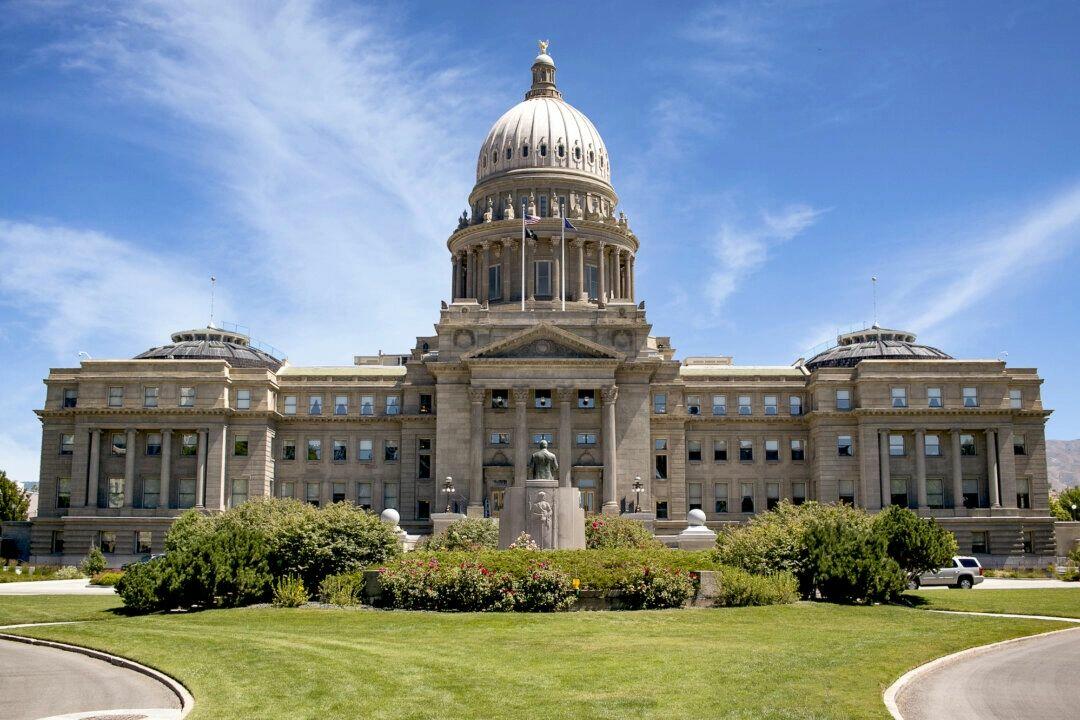
House Bill 124 removed student IDs as acceptable proof of identity at polling places, while House Bill 340 revised the identification needed for voter registration, eliminating the option to use the last four digits of a social security number.
Instead, voters must now present a current Idaho driver’s license, a U.S. passport, a tribal identification card, or a concealed weapon license.
In their lawsuit, BABE VOTE and the League of Women Voters, the two voter advocacy groups, claimed these changes would unduly burden young voters and out-of-state students in Idaho, constituting an unequal and heightened burden on their fundamental right to vote.
Justice Robyn Brody, writing for the court, detailed that while voting is a fundamental right protected by the Idaho Constitution, the legislature is granted authority to prescribe reasonable qualifications and conditions on voter registration and voting.
The court held that the changes enacted by House Bills 124 and 340 did not infringe upon the constitutional rights to vote and were appropriately within the legislature’s scope to ensure the integrity and efficiency of elections.
In part, the court also found the groups’ arguments for lack of standing as un-persuasive when reviewing it with a strict lens, but said with a lenient view the groups did have standing.
“While it may be an inconvenience for Plaintiffs, having to ’re-educate‘ voters and volunteers about changes in the law is not the ’concrete and demonstrable' injury,” Justice Brody wrote. “Indeed, the mission of these organizations is voter education. We agree with the Secretary that educating voters about the need to produce identification at the polls is not a new harm; it is part of the organizations’ mission; thus, it is not a sufficient basis to invoke organizational standing.”
The court, when applying a rational basis review, the most lenient standard of judicial scrutiny, concluded that the legislative amendments were “rationally related to legitimate government interests” such as maintaining election integrity and updating voter identification processes to reflect current standards.
The decision has been met with mixed reactions. Supporters of the bills argue that the updated laws strengthen the security and reliability of Idaho’s electoral process. Critics, however, maintain that the laws could suppress voter turnout among young and transient populations, particularly affecting students.
“We are pleased to see that the Idaho Supreme Court recognizes the importance of voting and that access to voting and the security of our elections are not competing objectives,” Mr. McGrane said in a post on X. “Voters can have confidence in Idaho’s elections.”
The plaintiffs argued that they did not get their day in court and that “justice has been denied” following the court’s ruling.
“Citizens’ right to vote is fundamental to our democratic republic,” the groups said in a statement posted to X. “This legislature has tried virtually everything in its power to prevent young, disabled, homebound, and working class Idahoans from exercising that right. Since these laws were enacted, BABE VOTE and the League of Women Voters of Idaho have been unable to help approximately 20% of legally eligible Idahoans from completing their voter registrations. Today’s ruling validates this voter suppression and undermines democracy in Idaho.”
The groups went on to say that they would do “everything in [their] power” to register as many voters as possible under “difficult” and “impossible” conditions of Idaho’s voter laws.
“While the state may have won in court today, they have not won this battle,” the groups added in their statement. “Today, we are mobilizing students on high school and college campuses across Idaho and the country to register, educate, and turn out young people in record numbers, starting with the primaries this May.”
https://www.zerohedge.com/political/idaho-supreme-court-upholds-ban-student-ids-voting
by Zachary Stieber via The Epoch Times (emphasis ours),
President Joe Biden will not be testifying to U.S. House of Representatives members who are engaged in an impeachment inquiry against him, the White House said on April 15.
Richard Sauber, special counsel to the president, told House Oversight Chairman James Comer (R-Ky.) that the president would not testify in the “partisan charade.”
“Your committee’s purported ‘impeachment inquiry’ has succeeded only in turning up abundant evidence that, in fact, the president has done nothing wrong,” Mr. Sauber said in a letter to Mr. Comer.
“Your insistence on peddling these false and unsupported allegations despite ample evidence to the contrary makes one thing about your investigation abundantly clear: The facts do not matter to you,” he added.
Republicans in their investigation have found that millions of dollars flowed from businesses and individuals, including foreigners, to members of the Biden family while President Biden was vice president.
They’ve also identified payments from Hunter Biden’s business to the president, and from the president’s brother to him, as well as emails between President Biden and an associate of Hunter Biden. Several witnesses, meanwhile, testified that President Biden would get on the phone with Hunter Biden’s associates and that he attended multiple meals with them.
President Biden and the White House have maintained that he was not involved with the business undertaken by his son and brother.
Mr. Comer wrote to the president in March, saying the evidence “wholly contradicts your position.”
“In light of the yawning gap between your public statements and the evidence assembled by the committee, as well as the White House’s obstruction, it is in the best interest of the American people for you to answer questions from members of Congress directly, and I hereby invite you to do so,” Mr. Comer wrote at the time.
“The apple doesn’t fall far from the tree in the Biden family. Like his son, Hunter Biden, President Biden is refusing to testify in public about the Bidens’ corrupt influence peddling,” Mr. Comer said Monday.
“This comes as no surprise since President Biden continues to lie about his relationships with his son’s business partners, even denying they exist when his son said under oath during a deposition that they did,” he said. “It is unfortunate President Biden is unwilling to answer questions before the American people and refuses to answer the very simple, straightforward questions we included in the invitation. Why is it so difficult for the White House to answer those questions? The American people deserve transparency from President Biden, not more lies.”
It’s not clear whether lawmakers are considering subpoenaing the president, and the White House did not respond when asked whether the president would comply with a subpoena.
Mr. Comer and other members have said they want answers to questions, including those about the source of the money for the payment from his brother.
They’re also wondering whether President Biden ever interacted with Hunter Biden’s associates, such as Chinese businessmen Jonathan Li, Ye Jianming, and Henry Zhao.
Lawmakers also want more details about the work done by Eric Schwerin, one of the associates, for President Biden. Mr. Schwerin told lawmakers that he often met with President Biden and provided him with free services, including tax preparation.
Lawmakers have yet to outline the next steps in the inquiry. The November election is looming and, if President Biden loses his re-election bid, he would exit the presidency regardless in January 2025.
Mr. Sauber, the special adviser to the president, is leaving the White House early next month. He was brought on in 2022 to oversee the White House’s response to congressional investigations as Democrats braced to lose their majorities on Capitol Hill that year.
The Associated Press contributed to this report.
https://www.zerohedge.com/political/biden-refuses-testify-gop-impeachment-inquiry
Nearly a half-million health workers who stand to benefit from California’s nation-leading $25 minimum wage law could be in for a rude awakening if hospitals and other health care providers follow through on potential cuts to hours and benefits.
A medical industry challenge to a new minimum wage ordinance in one Southern California city suggests layoffs and reductions in hours and benefits, including cuts to premium pay and vacation time, could be one result of a state law set to begin phasing in in June. However, some experts are skeptical of that possibility.
The California Hospital Association brought a partly successful legal challenge to Inglewood’s $25 minimum wage ordinance, which barred employers from taking those sorts of steps to offset their higher costs.
“Layoffs, reductions in premium pay rates, reductions in non-wage benefits, reductions in hours, and increased charges are consequences of an employer having less money to spend—which will necessarily be the case given the significant increase in spending on wages due to the minimum wage,” the association said in its lawsuit. Additional examples include reducing health coverage and charging for parking or work-related equipment.
Inglewood voters approved the ordinance in November 2022, nearly a year before California legislators enacted a $25 minimum wage for health workers. Those statewide higher wages are to be phased in starting in June under California’s first-in-the-nation law, but Gov. Gavin Newsom has since said they are too expensive as the state faces a deficit estimated between $38 billion and $73 billion. It’s unclear if lawmakers will agree to a delay or take other steps to reduce the cost.
U.S. District Judge Dale S. Fischer agreed with the hospital industry in a March 11 tentative ruling when he shot down the portion of Inglewood’s ordinance banning layoffs and clawbacks by employers, while allowing the rest of the ordinance to remain in effect. He gave the sides time to object to his preliminary decision, though none did.
The California Hospital Association represents more than 400 hospitals and was a key backer of the state’s carefully crafted compromise law, which notably contains none of the employee safeguards included in the Inglewood ordinance.
Spokesperson Jan Emerson-Shea said the association doesn’t know how providers will react once the state law takes effect. “We don’t have any insights,” she said.
“The challenge for any health care organization is figuring out how to pay for the higher wages,” said Joanne Spetz, director of the Philip R. Lee Institute for Health Policy Studies at the University of California-San Francisco. “Since labor costs are the largest part of any health care organization’s costs, it’s hard to figure out how to reduce spending without looking at labor costs.”
Providers can try to increase revenues by bargaining for higher reimbursements from commercial insurers, she said. Public hospitals, nursing homes, and community clinics get most of their money through Medi-Cal, the state’s Medicaid program.
Providers could reduce the services they offer, pare back charity care, and cut or delay capital investments, Spetz said. In the long term, she expects some combination of spending cuts and revenue increases.
Both the state law and local ordinance cover far more than doctors and nurses, with a definition of health worker that includes janitors, housekeepers, groundskeepers, security guards, food service workers, laundry workers, and clerical staff.
The most recent estimate by the Health Care Program at the University of California-Berkeley Labor Center is that as many as 426,000 health workers would make an average of $6,400 extra in the law’s first year, a 19% average pay bump mainly benefiting lower-income workers of color and women. State finance officials project that well over 500,000 workers will benefit.
Researchers didn’t include layoffs and other potential staffing and benefit reductions when they projected the state law’s costs and benefits, said Laurel Lucia, the program’s director. But she pointed to initial projections by hospitals, doctors, and business and taxpayer groups that the wage hike would cost $8 billion annually, thereby imperiling services and resulting in higher premiums and higher costs for state and local governments.
“It seems like a contradiction to say this law’s going to cost billions of dollars while at the same time saying it’s going to reduce workers’ total compensation,” said Lucia, who projects a far lower price tag.
She added that state finance officials had anticipated that Medi-Cal reimbursements would reflect the increased labor costs, while Medicare would eventually at least partially compensate for the higher labor costs.
Michael Reich, chair of the Center on Wage and Employment Dynamics at UC Berkeley’s Institute for Research on Labor and Employment, and affiliated economist Justin Wiltshire recently argued that California’s new $20 minimum wage law for fast-food workers won’t result in mass layoffs and price increases, as some have predicted.
Health care is much different than fast food, Reich acknowledged, but he argued for much the same positive result.
“A higher minimum wage will make it easier and cheaper for hospitals to recruit and retain these workers. The cost savings, and the productivity benefits of more experienced workers, could offset much of the labor cost increase,” Reich said.
The hospital association filed its lawsuit against Inglewood’s ordinance in July, while it was still opposing early versions of the statewide minimum wage legislation. Among many other provisions, the statewide law put on hold an initiative to cap hospital executives’ salaries in Los Angeles.
The hospital association’s legal challenge referenced in part layoffs and reduced working hours imposed by Centinela Hospital Medical Center after Inglewood’s ordinance took effect.
But Centinela said the reduction was entirely unrelated to the ordinance and that all staff were offered alternate positions, which many accepted.
“Centinela Hospital also has since added many more jobs in new clinical positions above minimum wage scale,” the hospital said in a statement.
Service Employees International Union-United Healthcare Workers West, the prime backer of both the local ordinance and the statewide law, sued the hospital in April 2023 alleging that it cut workers’ hours to offset the higher minimum wage. The case is still pending.
The union did not respond to repeated requests for comment.
In a court filing, however, the union and city of Inglewood said similar employer restrictions in previous minimum wage laws have survived.
The ordinance “merely sets the backdrop for collective bargaining negotiations,” and does not bar employers from locking out employees or hiring replacement workers during a strike. Employers can still lay off workers or reduce their hours, they said, so long as they don’t do so to fund the higher minimum wage.
But Fischer agreed with the hospital association that layoffs and reductions in employees’ total compensation packages are “obvious responses by an employer to rising compensation costs.”
Restricting employers’ options would violate federal labor relations rules, he said.
“The minimum wage an employer has to pay its employees will invariably affect the total amount of compensation it is able or willing to pay,” he wrote “This will then invariably affect the number of employees it can retain and the number of hours those employees will be scheduled to work.”
https://kffhealthnews.org/news/article/california-health-workers-25-dollar-wage-cuts/
The RansomHub hacking group is starting to share snippets of the data stolen from Change Healthcare's networks during a recent attack.
Why it matters: Initial screenshots published Monday and seen by Axios suggest that hackers have stolen a trove of sensitive information, including patients' hospital bills, financial documents and company contracts.
Catch up quick: RansomHub is the second ransomware gang to come into possession of data stolen from the Change Healthcare's networks.
Zoom in: In a post Monday evening, RansomHub said it possesses more than 4 terabytes of data stolen during the ChangeHealthcare attack.
Between the lines: It's common for ransomware gangs to post intimidating messages on their dark web sites to force a company to make a ransom payment.
What they're saying: "Our investigation remains active and ongoing," a Change Healthcare spokesperson told Wired on Friday. "There is no evidence of any new cyber incident at Change Healthcare."
What's next: RansomHub claims it won't leak the full trove of data if it receives a payment by Friday.
Reality check: Ransomware gangs are known to break their promises.
https://www.axios.com/2024/04/16/change-healthcare-data-leak-ransomware
The Biden administration will help 50 countries identify and respond to infectious diseases, with the goal of preventing pandemics like the COVID-19 outbreak
that suddenly halted normal life around the globe in 2020.
U.S. government officials will offer support in the countries, most of them located in Africa and Asia, to develop better testing, surveillance, communication, and preparedness for such outbreaks in those countries.
The strategy will help "prevent, detect, and effectively respond to biological threats wherever they emerge," Biden said in a statement Tuesday.
The Global Health Security Strategy, the president said, aims to protect people worldwide and "will make the United States stronger, safer, and healthier than ever before at this critical moment."
The announcement about the strategy comes as countries have struggled to meet a worldwide accord on responses to future pandemics. Four years after the COVID pandemic began, the prospects of a pandemic treaty signed by all 194 of the WHO's members are flailing.
Talks for the treaty are ongoing, with a final text expected to be agreed upon next month in Geneva. It's meant to be a legally binding treaty that obliges countries to monitor pandemic threats and share scientific findings. But major disputes have emerged over vaccine equity and transferring the technology used to make vaccines.
Even if a deal is hammered out, there would be few consequences for countries that choose not to abide by the treaty, as is the case with nearly all treaties brokered by the United Nations.
The U.S. will push on with its global health strategy to prevent future pandemics, regardless of a pandemic treaty or not, a senior administration official told reporters on Monday.
Several U.S. government agencies -- including the State Department, the CDC, HHS, and the Agency for International Development -- will help countries refine their infectious disease response.
Health systems around the globe have been overwhelmed with COVID-19 and other health emergencies such as Ebola, malaria, and mpox, the CDC said in a statement. The new strategy will help countries rebuild their agencies, the agency explained.
"Global health security is national security, and CDC is proud to contribute its expertise, investments, and rapid response to protect the health and safety of the American people and the world," Mandy Cohen, MD, MPH, the CDC's director, said in a statement.
Congo is one country where work has already begun, the official told reporters. The U.S. government is helping Congo with its response to an mpox virus outbreak, including with immunizations. The WHO declared mpox a global emergency, in 2022, with more than 91,000 cases spanning across 100 countries to date.
The White House on Tuesday released a website with the names of the countries that are participating in the program. Biden officials are seeking to get 100 countries signed onto the program by the end of the year.
The U.S. has devoted billions of dollars, including money raised from private donations, to the effort. Biden is asking for $1.2 billion for global health safety efforts in his yearly budget proposal to Congress.
https://www.medpagetoday.com/infectiousdisease/publichealth/109684