Search This Blog

Thursday, April 18, 2024

Why a deluge of Chinese-made drugs is hard to curb

When Sammy left her village in Sichuan province to attend university in northern China more than a decade ago, she was following a well-trodden rite of passage.

The English language graduate was the first person in her family to go to university. She had a passion for foreign languages and dreamed of becoming a teacher. She had never heard of synthetic opioids before.

After graduating, Sammy found work at a chemicals company in the Chinese city of Shijiazhuang, selling what she thought were chemicals to clients around the world. She would practice English every day speaking to her customers online, and earn a commission for each sale she made. Her dreams of becoming a teacher quickly faded.

"Maybe others are just like me… At the start we don't know what we are selling, but when we find out we have fallen in love with the work," she said. "This work can make money," she adds.

Sammy [not her real name] is an unlikely drug trafficker. She is one of what international law enforcement agencies estimate could be thousands of online sales representatives, working for illicit Chinese pharmaceutical and chemical companies producing and smuggling illegal laboratory made drugs.

The US government has long accused China of flooding the country with deadly drugs like fentanyl, a synthetic opioid up to 50 times stronger than heroin, claims the Chinese government denies. The US says Chinese-made opioids are fuelling the worst drug crisis in the country's history. In 2022 more than 70,000 Americans died from fentanyl overdoses.
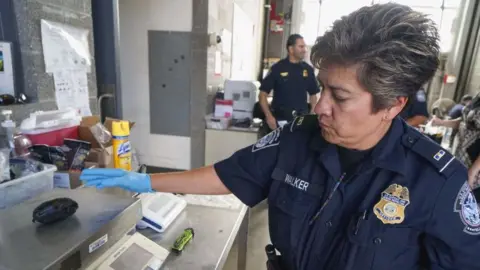
Getty Images A US Customs and Border Protection agent weighs a package of Fentanyl at the San Ysidro Port of Entry on October 2, 2019 in San Ysidro, California.Getty Images
The US has a problem with the smuggling and abuse of the powerful opioid fentanyl

According to a report published by the US select committee on the Chinese Communist Party, the Chinese government provides subsidies to companies openly trafficking illicit synthetic drugs. The report found tens of thousands of posts online advertising illegal drugs and pre-cursors.

The study claims that "wholly state owned" companies are involved in the trafficking of drugs. The Chinese government has consistently denied knowledge of the illegal drug trade.

Many like Sammy fall into the drug trade seemingly by accident, initially unaware of the products they are peddling online and their deadly consequences. But others are more aware of what they are selling.

Each morning Sara [not her real name] posts photos and videos across her social media platforms advertising drugs; synthetic cannabinoids, precursors for MDMA, and nitazenes, a synthetic opioid considered up to 50 times more potent than even fentanyl.

"We have many customers in Britain and have cooperated with them many times," boasts Sara, an international trade graduate, now working for an online platform.

When challenged, she is not drawn into a moral discussion about selling drugs. She claims she never asks customers how they use what she sells.

The UK National Crime and Agency (NCA) believes drug dealers are mixing the synthetic opioid with street drugs such as heroin.

According to the NCA, there have been more than 100 deaths linked to nitazenes over the past nine months, leading health professionals to warn the UK may be facing a drug-related crisis.

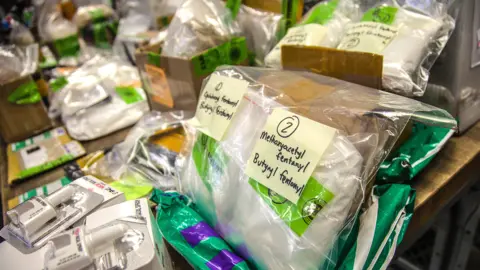
The BBC has found hundreds of adverts for nitazenes online. Suppliers contacted claim to send shipments through courier services, mislabelling deliveries and hiding drugs in fake packaging. The BBC has also seen courier tracking numbers provided by online sales representative in China claiming to have made successful deliveries across the UK.

Sara entered the business after university. She thought she was selling chemicals. She has worked in the industry for two and a half years. "I know most of the products," she says.

"My boss has been running this company for more than seven years, and he knows lots of customers and freight forwarders. If the product is detained, he will lose the most. So he will try his best to make the product reach you smoothly," she adds.

In March, the UK government classified 15 synthetic opioids as Class A drugs. Under the Misuse of Drugs act anyone caught supplying or producing the drugs could face up to life in prison. Those caught in possession face seven years.

According to the United Nations Office on Drugs and Crime (UNODC), China has between 40,000 and 100,000 pharmaceutical companies.

"China has long had one of the most significant pharmaceutical industries in Asia, as well as one of the largest chemical industries. And we've seen industry growth in other countries of the region," said Jeremy Douglas in late 2023, the then regional representative of the UNODC .

"While both industries are regulated, the challenge is significant given the sheer scale, and at the same time there are a number of ways to move products. Parcel post, air freight and shipping containers are all moving globally in high volumes," he said.

Mr Douglas says that synthetic drugs are disrupting the traditional drug trade. Outside of China, synthetic drugs offer opportunities for both traditional crime organisations and upstarts able to buy directly from producers half a world away.

"Synthetics like fentanyl have several advantages over traditional drugs - compact, easily shippable, pre-existing demand, replaceable. They're attractive to traffickers."
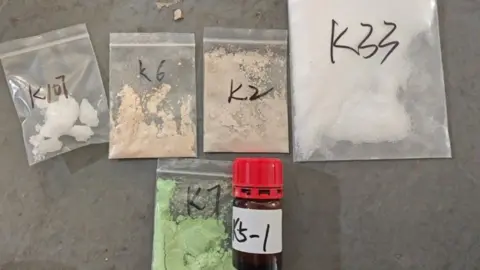
Selection of pharmaceuticals
Synthetic opioids are powerful so can be shipped in small quantities
That was confirmed in my conversations with sales people working for Chinese pharmaceutical firms.

"First of all, our packaging is completely secret, no one knows what it is until you open it, and second, we will change the name of the package and will not reveal any name about the product," says Sara.

"We will get the logistics order number when we send the package, we will track the situation of the package at any time, and any anomalies can be known and solved in time," she adds.

According to Europol, the European police agency, China is the world's biggest manufacturer and distributor of synthetic, lab-made drugs. Some mimic the effects of traditional drugs like cannabis or cocaine. Chemists synthesise new drugs in order to stay one step ahead of the law.

"It is criminal entrepreneurship, but in a legitimate framework which is really unique," says Dr Louise Shelly the director of the Terrorism, Transnational Crime and Corruption Center (TraCCC) at George Mason University, and author of Dark Commerce.

"I have not seen such a professionalism and a corporate element in this anywhere else in the world. Criminal activity was a type of social mobility."

In 2020, researchers from TraCCC studied over 350 English language websites advertising the synthetic opioid fentanyl. "From all the adverts that we found, nearly 40% of them were from corporate registries, and the largest hub of that was in Wuhan," says Dr Shelly.
Alamy US Customs and Border Protection officers locate fentanyl and other narcotics hidden in a package at the International Mail Facility November 28, 2017 in Chicago, Illinois.Alamy
US authorities intercept some synthetic opioids shipped from China

The sales people contacted by the BBC see the drug trade as simply another aspect of e-commerce. When challenged over selling drugs that damage lives, one described herself as a "middleman."

"Somebody needs it, somebody makes it, and I am just a middleman who lets customers know that I have it and what they do with it, I don't care," she says. "Then I figured out I just need to make money. I don't know and don't care. Everyone has their own needs."

The woman boasts of clients from Canada to Croatia. She provided photos of recent drugs shipments complete with labels showing a UK address.

"I didn't know at first until I went online and translated the product into Chinese," she says via a message punctuated with a teary emoji.

Another seller says: "This industry is easy, and you can get higher wages, which attracts a large number of young people". Natalie [not her real name], focuses on fentanyl.

"We buy from over 10 different labs and have a large selection. I have a professional shipping agent who packaged goods so has a very high delivery success rate to the UK."

Meanwhile, another supplier claimed to be able to smuggle drugs into the UK hidden in dog food packaging. "You don't need to worry about the packaging. We guarantee you safe delivery."

"We ship in large quantities all over the world every day. Please trust our professional team. We guarantee 100% safe transportation."

In 2019, the Chinese government banned all forms of fentanyl and its analogues. In January 2024, China and the US launched a joint operation to curb the production of the synthetic opioid fentanyl

"As long as market demand remains high in some parts of the world then that demand will be met in one way or another," said Mr Douglas from the UNODC.

https://www.bbc.com/news/business-68669244

The Great Freight Recession Has Now Lasted Longer Than The COVID Bull Market

 By Greg Fuller, CEO of FreightWaves

On March 31, 2022, FreightWaves declared that a freight recession was imminent. More than two years later, the freight market remains in one of its deepest and longest recessions in history.

Our original conclusion was derived from signals from FreightWaves SONAR. Its high-frequency datasets, which track freight supply and demand in real-time, indicated an imminent collapse. When FreightWaves first published the article, many were not only skeptical of the conclusion, they derided FreightWaves for the call. Even after the recession took hold, few would have guessed that the freight downturn would be as deep or as long as it has been.

As we enter the third year of the Great Freight Recession, the trucking industry asks, “How much longer is the market going to remain in a recession?”

We believe that we are now at the bottom of the market.

SONAR’s Outbound Tender Rejection Index, or OTRI, measures the percentage of truckload transactions rejected by carriers. OTRI indicates that conditions are better than they were a year ago, albeit not by much.

Tender rejections are a highly reliable indicator of the balance of supply and demand. The higher the rejection rate, the more load options a carrier has. The lower the rate, the fewer load options a carrier has. While some will look at the absolute value of tender rejections, we also look at them in the context of where they have been.

Tender rejections are currently at 3.95%, up from the 2024 low of 3.39 on March 26 and up substantially from 2.88% a year ago.

The Outbound Tender Rejection Index. To learn more about FreightWaves SONAR, click here

We believe that tender rejections bottomed out in late March and have steadily increased throughout April, which is historically a soft month in freight. This indicates that the 2024 low is in the rearview mirror.

Contracted load accepted volumes, another SONAR index measuring contracted load demand, tell us that the market has grown since January 2023.

As of April 15, 2024, year-over-year contracted volumes are up 9%.

Contract accepted volumes are currently down 6% compared to April 2021, the peak of the COVID bull run.

Contract Load Accepted Volume. To learn more about FreightWaves SONAR, click here

While a gap certainly exists between peak volumes and current volumes, the gap is narrowing. In the past year, contracted load accepted volumes have increased by 9%.

Contract Load Accepted Volume. To learn more about FreightWaves SONAR, click here.

The Atlanta Federal Reserve now forecasts that year-over-year GDP growth is up by 3%. In a normal growing economy, freight demand grows faster than economic growth. If the economy grows above 2% for the year, we expect that contracted load accepted volumes in 2025 will surpass the 2021 peaks.

Capacity will continue to decline

The growth in contracted load accepted volumes will occur at the same time that capacity continues to bleed out of the market.

Another of the many indices in the SONAR platform is the Carrier Details Net Revocation Data, which shows the increase or decline in the number of trucking companies in the market. In the chart below, anything above zero (green) shows an expansion in the number of trucking authorities, while anything below zero (red) shows a decline.

To learn more about FreightWaves SONAR, click here.

The index has been in negative territory since the fourth quarter of 2022. Capacity continues to leave the market, allowing the market to return to balance.

During the two years of the freight market’s COVID bull run, fleets built up substantial operating surpluses and were able to build strong balance sheets. This has enabled them to hang on for a long time.

For much of the Great Freight Recession, trucking fleets have been running many of their miles at losses. This has forced them to tap into the financial reserves they built up during the COVID bull run.

The Great Freight Recession has gone on longer than the COVID bull run, meaning that since the first days of the COVID lockdowns, truckers have operated primarily in recessionary territory. For those who remain in the market, their reserves are likely exhausted, as is their stamina.

However, for those who can continue, the tough times may be ending. The data suggests that a recovery in the balance of supply and demand will come as soon as fall 2024, but almost certainly by spring 2025.

https://www.zerohedge.com/markets/great-freight-recession-has-now-lasted-longer-covid-bull-market

Soros Nonprofit Gives 8-Figure Sum To Far-Left Super PAC

 by Eric Lundrum via American Greatness,

One of the many nonprofits run by far-left billionaire George Soros donated tens of millions of dollars to a major super PAC that funds multiple left-wing groups.

According to Fox News, Federal Elections Commission (FEC) records posted Monday reveal that the Fund for Policy Reform gave $60 million to the Democracy PAC in the first quarter of 2024; the Democracy PAC subsequently sent $21 million to Democratic committees in support of various congressional candidates in both the House and the Senate.

The $21 million was dispersed among a dozen left-wing groups, with $8 million being split two ways between top outside groups in support of House and Senate Democrats.

Additionally, $2.5 million was donated to Planned Parenthood, as well as another $2.5 million to BlackPAC, and $1.8 million to American Bridge, a Democratic opposition research firm.

Other donations included $1 million to the ColorOfChange PAC and $500,000 to Americans for Contraception Victory.

ColorOfChange is one of the most radical groups when it comes to the far-left “defund the police” agenda.

“We know that policing doesn’t keep us safe, communities do,” the group said in a petition demanding that supporters harass politicians to get them to support the defunding movement.

“Policing doesn’t lead to thriving communities, investment does.”

The massive $60 million dump was the second-largest donation in the 2024 election cycle thus far, only surpassed by the $82.6 million that was donated by a state super PAC to Never Back Down, the super PAC that backed the doomed presidential campaign of Governor Ron DeSantis (R-Fla.).

The 93-year-old George Soros recently handed full control of his political empire to his son, Alex, and Alex’s subsequent moves have been watched closely.

The younger Soros shows no signs of slowing down his family’s influence over left-wing politics both in America and globally, continuing to pour millions into far-left causes that undermine the security of the United States of America, including pro-amnesty and pro-open borders groups, as well as backing progressive district attorneys who refuse to enforce basic laws.

In response, Musk is gathering signatures...

Money-Market Fund Assets See Largest Outflows Since 'Lehman'

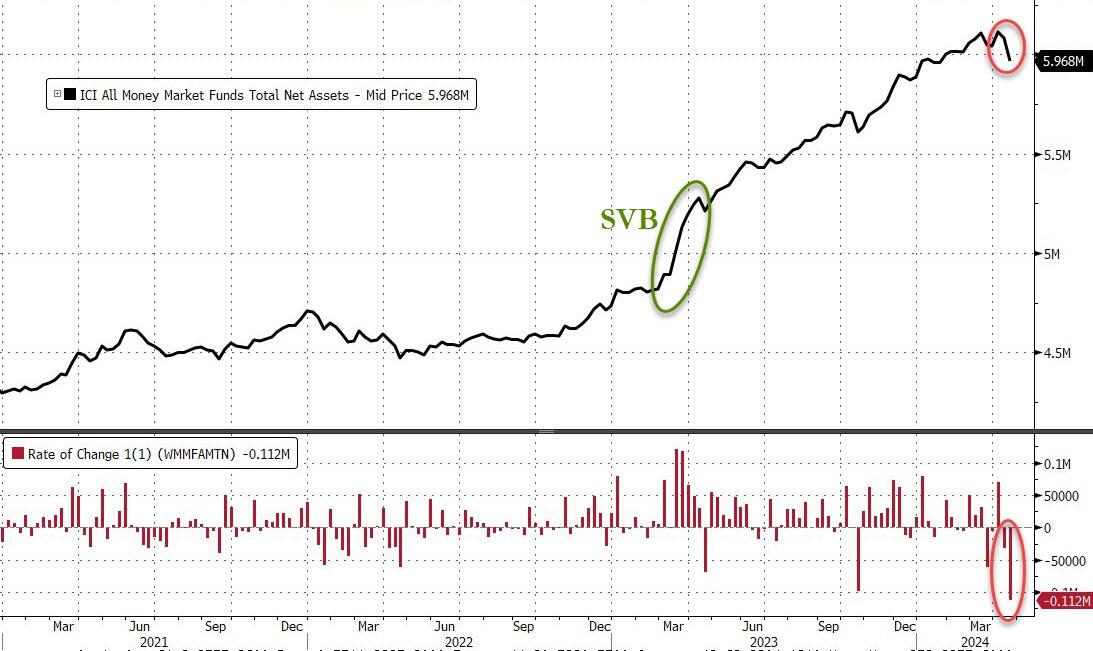
 Total money-market fund assets plunged by $112BN in the last week as Tax-Day demands took the total assets below $6 Trillion for the first time sine January (to $5.97 Trillion)...

Source: Bloomberg

Corporate taxes collected from April 11 through April 17 totaled $100.7 billion, Treasury data show.

While Tax-Day's impact matters obviously, we note that this is the largest weekly drop in money-market fund assets since Lehman (Sept 2008) and the biggest two-week drop (-$143BN) on record...

Source: Bloomberg

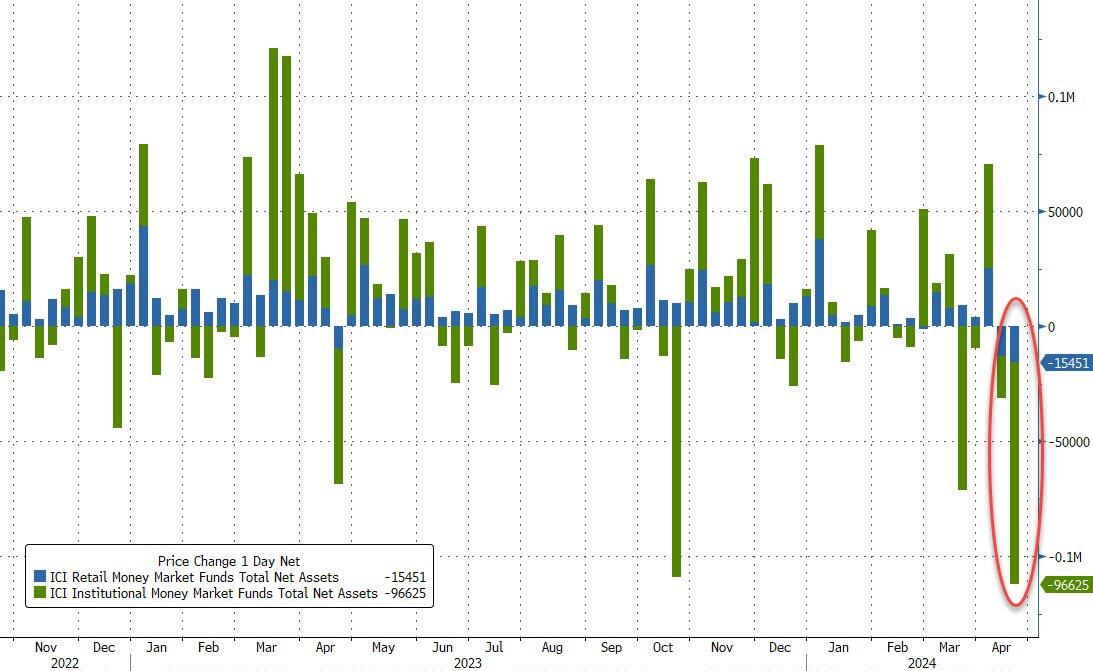
Much of the decline in money-market fund assets was led by institutional outflows that totaled $96.6BN in the week ended April 17 - the largest drawdown since an extended tax-filing deadline in mid-October. Retail investors pulled about $15.5 billion out of money-market funds../.

Source: Bloomberg

In a breakdown for the week to April 17, government funds - which invest primarily in securities like Treasury bills, repurchase agreements and agency debt - saw assets fall to $4.8 trillion, a $99 billion decline

Prime funds, which tend to invest in higher-risk assets such as commercial paper, meanwhile, saw assets fall to $1.01 trillion, a $12 billion decline.

Still, cash is expected to continue piling into money funds as long as the Federal Reserve keeps rates on hold - and this week has seen rate-cut expectations tumble further...

Source: Bloomberg

The Fed's balance sheet shrank to its smallest since February 2021...

Source: Bloomberg

As The Fed starts discussing tapering QT and usage of The Fed's bank bailout facility (now expired but these are 12 month term loans) fell by $4.1BN more to basically erase all the late-period arb-driven inflows, leaving a huge $126BN hole in bank balance sheets still being filled by this...

Source: Bloomberg

Finally, we note that bank reserve at The Fed slipped last week as it appears the reality for US equity market cap is starting to dawn...

Source: Bloomberg

While there may be no rate-cuts anytime soon... will The Fed taper QT in a big enough manner to avoid that recoupling?

https://www.zerohedge.com/markets/money-market-fund-assets-see-largest-outflows-lehman

Genentech Alecensa OKd as First Adjuvant Treatment for ALK-Positive Early-Stage Lung Cancer

 Approval based on Phase III ALINA study showing Alecensa reduced the risk of disease recurrence or death by an unprecedented 76% in people with ALK-positive early-stage resected non-small cell lung cancer (NSCLC) –

– This approval helps address an urgent unmet need, with about half of people living with early-stage NSCLC experiencing disease recurrence following surgery, despite adjuvant chemotherapy –

– The National Comprehensive Cancer Network® (NCCN®) Guidelines recommend routine testing for ALK, EGFR and PD-L1 biomarkers in people with early-stage NSCLC to inform adjuvant therapy selection –

https://www.businesswire.com/news/home/20240418088206/en/FDA-Approves-Genentechs-Alecensa-as-First-Adjuvant-Treatment-for-People-With-ALK-Positive-Early-Stage-Lung-Cancer