Search This Blog

Monday, May 13, 2024

That little lesson from Panama's election for lawfare-obsessed Democrats

 By Monica Showalter

Do any of the Democrats engaged in lawfare against President Trump read the news about leftists south of the border who do the same things they are doing?

Maybe Panama's election a week ago would be useful for them to know.

According to Foreign Policy, which has a good, if somewhat left-slanted overview of what went on there:

The winner, José Raúl Mulino, was a stand-in candidate for former President Ricardo Martinelli, who was disqualified due to a money laundering conviction. (Outgoing center-left President Laurentino Cortizo was barred from running due to a ban on immediate reelection.)

Martinelli governed Panama from 2009 to 2014, during an economic boom. Despite his legal woes, many Panamanians remain loyal to Martinelli. Mulino, who served as Martinelli’s security minister and referenced the economic abundance of Martinelli’s tenure on the campaign trail, earned around 34 percent of votes on Sunday—enough for victory in Panama’s one-round presidential race.

Sure, every country is different.

But the parallels here are quite striking. A former president who brought prosperity to his country through conservative and free market values from 2009 to 2014, Ricardo Martinelli, was running for a non-consecutive term as president. (Panama law doesn't permit consecutive terms).

The left, which took power after him, made a hash of the economy, and turned Panama into a illegal alien superhighway, leaving voters with only the memory of how good things were during Martinelli's administration.

The Associated Press seemed to think the voters remembered:

While he lacks Martinelli’s charisma, the economic boom seen under his ally pushed many voters to support Mulino at a time that Panama’s economy has lagged.

Foreign Policy put out its excusemaking for the left's miserable record in power this way:

Since the COVID-19 pandemic, however, Panama has entered more uncertain political and economic terrain. A drought has reduced activity in the Panama Canal. Increasing numbers of migrants traveling through the Darién Gap, Panama’s jungle border with Colombia, have strained humanitarian services. Last year, authorities shuttered the country’s most profitable copper mine, which accounted for an estimated 3.5 percent of Panama’s GDP in 2021.

Ah, COVID. It's always COVID-19, isn't it? I think the word the writer is looking for is 'lockdowns,' as this study by economist Steve Hanke and several others found.

The mining shutdown probably had more to do with it -- and the lingering memory of how good things were earlier. The Associated Press also noted that as a former security minister in the Martinelli administration, Mulino actually did shut down the Darien Gap passage to narcoguerrillas who were infesting the jungles at the time and vowed to do it again.

Foreign Policy added:

In the past three decades, Panama has generally outpaced its Latin American peers in economic growth. Its economy grew by an average of 5.9 percent annually between 1990 and 2019, driven in part by revenues from the Panama Canal. The country, a logistics hub, has also experienced booms in civil construction and mining.

Ahh, but the left had a solution to this: Lawfare, they'd pin a corruption charge on Martinelli, in this case, money-laundering, while ignoring the corruption in their own camp.

And sure enough, suddenly concerned about money-laundering, they succeeded.

Here's the New York Times headline from March 2024:

Panama Bars Ex-Leader Martinelli From Presidential Election

The electoral tribunal disqualified Ricardo Martinelli, saying he was ineligible to run because of his conviction for money laundering and sentencing to more than five years in prison.

So with two months to run and no political charisma to speak of, Martinelli's designated successor, Jose Raul Mulino, ran in his place.

Net result? A huge victory, with Mulino winning 35 percent of the vote in a three-way race, nine points ahead of his nearest challenger.

That had to be a surprise to the left, which thought it had solved its 'Martinelli problem' and the problem of its own execrable governing record through lawfare and by disqualifying Martinelli and sticking the man in jail. The guy has since taken refuge in the Nicaraguan embassy (no idea what the politics of that are) but the stunning bottom line is, Mulino won.

They thought they had him, they thought lawfare would fix things for them -- and all it did was get them thrown out of office harder.

Voters don't like this kind of crap, and they respond by supporting the wounded party with more intensity.

They did so in Panama, and it's out there for all to see. Now it's time for elections in the U.S. with a full menu of ginned-up lawfare directed at frontrunner President Trump. (Silvio Canto today has an excellent post on the scope of it). We've seen this movie before.

Too bad Democrats haven't.

https://www.americanthinker.com/blog/2024/05/that_little_lesson_from_panama_s_election_for_lawfare_obsessed_democrats.html

Pfizer Follows Eli Lilly's Footsteps To Sell Medicines Directly To Patients

 Pfizer Inc (NYSE:PFE) is looking to build on the success of its COVID-19 vaccine rollout by introducing a direct-to-consumer medicines platform under the brand “Pfizer for All.”

The move, reflected in a recent trademark application, aims to provide medical information, mail-order pharmacy, and telehealth services to US patients.

Recent reports indicate Pfizer’s intention to include various medications, including its COVID antiviral Paxlovid and diagnostic kits, on the platform later this year, expanding its offerings to cater to diverse healthcare needs.

The platform will offer a “downloadable mobile application for providing medical information” as well as “mail order pharmacy services” and “diagnostic test kits . . . for use in disease screening and detection”, according to the trademark application, the FT writes.

This initiative follows similar endeavors in the pharmaceutical industry to bypass traditional middlemen and directly reach consumers.

Earlier this year, Eli Lilly And Co (NYSE:LLY) launched its LillyDirect platform, marking an industry first.

The “Pfizer for All” platform is positioned as a healthcare equity endeavor, seeking to simplify the often convoluted process through which US patients obtain their medications, the Financial Times highlights.

Citing the sources familiar with the plans, the FT notes that Pfizer intends to leverage its brand equity gained from its pivotal role in combating the Covid-19 crisis.

Despite Pfizer’s favorable reception during the height of the vaccine rollout, its favorability score has experienced fluctuations. The company’s stock value has also declined from its pandemic peak, facing skepticism from investors regarding its growth trajectory.

However, Timothy Mackey, a professor of global health at the University of California San Diego, believes that Pfizer’s approach may resonate positively with consumers despite mixed sentiments surrounding pharmaceutical companies.

https://finance.yahoo.com/news/pfizer-follows-eli-lillys-footsteps-202254446.html

Masked And Super Masked

 by Roger L. Simon via The Epoch Times (emphasis ours),

We live in an era of masks, only not the fun kind you might find at Carnivale in Venice, Italy.

Something considerably more sinister is going on.

This era began, as almost all of us realize now, with COVID-19 when all of us were told to put on masks or our friends and relatives might die. We might expire ourselves.

How necessary this was has been the subject of much discussion. My “Spidey sense” says no. Others may differ.

Nevertheless, as with all pandemics—real, imagined, or something in between—the need eventually diminished. People were liberated. Sort of.

Only masks are still around us, startlingly so. In some cases they are more around us than ever.

I think it was on Clay Travis and Buck Sexton’s radio show I first heard the masks referred to, ironically, as a “fashion statement.” True enough—they do often tell us where the wearer stands on a whole raft of things—but that was a few months ago. It almost seems like ancient history.

Now masks are upon us with a vengeance—black ones, miscellaneous scarves, and, of course, keffiyehs. The wearers have various intents—to scare us; to hide their identities from the police, college administrators, or potential employers; or simply, pathetically, to be a faddist, part of what they think of as an “in crowd.”

We have seen this song before during Antifa and Black Lives Matter demonstrations. Exercise your right of free speech but don’t tell us who you are. We could call this cowardly, because it is, but it is also quite dangerous as it expands.

In some ways it reminds me of internet trolls, especially paid ones, who turn up virtually everywhere under assumed names, some obvious and some not. Does the First Amendment give you permission—legally, or more importantly, morally—to lie about who you are while exercising your right of free speech? Interesting question.

Many of the masked demonstrators on our campuses, we have been told—and considering the numbers who aren’t students, it is almost certainly true—are also paid for their “work,” not to mention transportation, tents, food, etc.

Who pays?

These are the people I termed in my title the Super Masked. They are the truly nefarious. The masked are their witting or unwitting foot soldiers.

It is the Super Masked who are behind the anti-Americanism, anti-Westernism, anti-free market capitalism, open borders, anti-religion, anti-Semitic, often pro-Chinese communist, gender fluid movements, and so forth.

Someone is paying for the campus chaos across our country. It doesn’t come free.

Who, then, are the Super Masked, and why are they doing this?

Park MacDougald has some answers in his Tablet article “The People Setting America on Fire.” Mr. MacDougald isolates, as have others, three groups as the principal organizers of the protests—Students for Justice in Palestine (SJP), Jewish Voice for Peace (JVP), and Within Our Lifetime (WOL).

Who is behind them? Mr. MacDougald has interesting details of the various cutouts, but it comes down to many of the “usual suspects”—the Rockefeller Foundation, George Soros in his various guises, and, to a great degree, the Tides Foundation. The author has this to say about Tides:

Tides, you might have noticed, is a name that keeps coming up again and again. The Tides Nexus, of which the Tides Foundation is a part, is one of largest progressive dark-money networks in the country, controlling upward of a billion in assets; its list of major donors is an all-star cast of left-wing billionaires and foundations, including Soros, Peter Buffett and his NoVo Foundation, eBay founder Pierre Omidyar, the Rockefeller Brothers Fund, the Ford Foundation, and the New Venture Fund, controlled by another Democratic dark-money powerhouse, Eric Kessler’s Arabella Advisors. A pioneer of what critics have called ‘charitable money-laundering’ through the use of fiscal sponsorships to obscure money trails through multiple layers of bureaucracy, Tides, through its donations and fiscal sponsorships, has emerged as a major backer of the anti-Israel protest movement across the country.”

This is, needless to say, not just about anti-Israel activities but about every progressive cause imaginable. Tides might be described as the king of the Super Masked.

One is tempted to channel the immortal words of President Ronald Reagan and say, “Mr. Tides, tear off that mask!”

My intention is to point out the level of often-deliberate obfuscation going on and the amount that people are being used, their ignorance exploited, consciously or unconsciously.

It’s easy to say that the infamous “globalists” are behind all this, and quite possibly it’s true, but I think there is a level at which people of all sorts have been swept up in causes they think are good without stopping to realize what they really are doing. It’s “my team,” and I will do what they say, even if it involves using “dark money.” And hiding my identity behind a mask.

The fight for transparency in our culture has been going on for some time with, unfortunately, little success. Meanwhile, we hear endless blather about preserving “democracy.” But without transparency, there is no democracy or constitutional republic, whichever you prefer.

So, tear off those masks!

End of sermon.

BUT NOT QUITE!

After I wrote the above, the most amazing report came out in the New York Post (May 9) that could break your brain. Black Lives Matter is suing the Tides Foundation? What is going on here?

“A progressive nonprofit that has been shelling out cash to anti-Israel protest groups is being sued by Black Lives Matter Global Network Foundation for fraud and withholding more than $33 million in donations, a bombshell lawsuit claims.

“Tides Foundation, which has managed hundreds of millions in donations for progressive groups since it was founded in 1976, has ‘refused to honor its promises and continues to commandeer BLMGNF’s donations,’ according to the 285-page lawsuit filed in California Superior Court, Los Angeles County, on Monday.

“Instead, Tides doled out an undisclosed amount of donations to a radical BLM breakaway group run by anti-police activist Melina Abdullah — who lost a ‘frivolous’ lawsuit against BLMGNF — according to court papers and an attorney for BLMGNF.”

What was it that Sir Walter Scott said? “What a tangled web we weave when first we practise to deceive!”

https://www.zerohedge.com/political/masked-and-super-masked

'WHO Makes Key Concessions Ahead Of Pandemic Treaty Vote'

 by Kevin Stocklin via The Epoch Times (emphasis ours),

The World Health Organization (WHO) has watered down some provisions of its pandemic agreements ahead of the upcoming World Health Assembly on May 27. Critics in the United States, however, say the changes don’t do enough to address the concerns over the policy.

Provisions in prior drafts of the WHO pandemic treaty and International Health Regulations (IHRs) together aimed to effectively centralize and increase the power of the WHO if it declares a “health emergency.”

The release of the latest draft of the amendments, dated April 17, are the first public update on the IHR draft, which was initially made public early 2023.

In most areas, and for all of those which most concerned us from a legal perspective, the interim draft reflects a major retreat by the WHO Working Group from the text of the original proposals,” write English solicitors Ben and Molly Kingsley in an April briefing paper regarding the new amendments.

Some WHO-watchers remain wary, however.

“Practically all the bad things are still there,” Dr. Meryl Nass, a U.S.-based physician and vocal critic of the WHO agreements, told The Epoch Times.

“The language is gentler, but since there is so much to be decided later it is not clear the gentler language is meaningful,” Dr. Nass said.

My best guess is that they are desperate to get something passed, so the options are likely to be either a vanilla version of the treaty … or a delay. But they fear delay because people are waking up.”

The WHO and its advocates—including celebrities, politicians, and religious groups—have launched a global campaign urging the 194 member states to sign the documents.

“Give the people of the world, the people of your countries, the people you represent, a safer future,” WHO Director-General Tedros Adhanom Ghebreyesus said at a May 3 Geneva meeting. “I have one simple request: please, get this done, for them.”

He urged any countries that don’t support the agreements to refrain from encouraging other states to oppose it.

WHO ambassador and former U.K. Prime Minister Gordon Brown on March 20 lauded “a high-powered intervention by 23 former national presidents, 22 former prime ministers, a former U.N. general secretary, and 3 Nobel Laureates … to press for an urgent agreement from international negotiators on a Pandemic Accord.”

Mr. Brown called for unified global action to “expose fake news disinformation campaigns by conspiracy theorists trying to torpedo international agreement for the Pandemic Accord.”

He refuted criticisms that the pandemic treaty and IHR amendments would cede any sovereignty from member nations to the WHO.

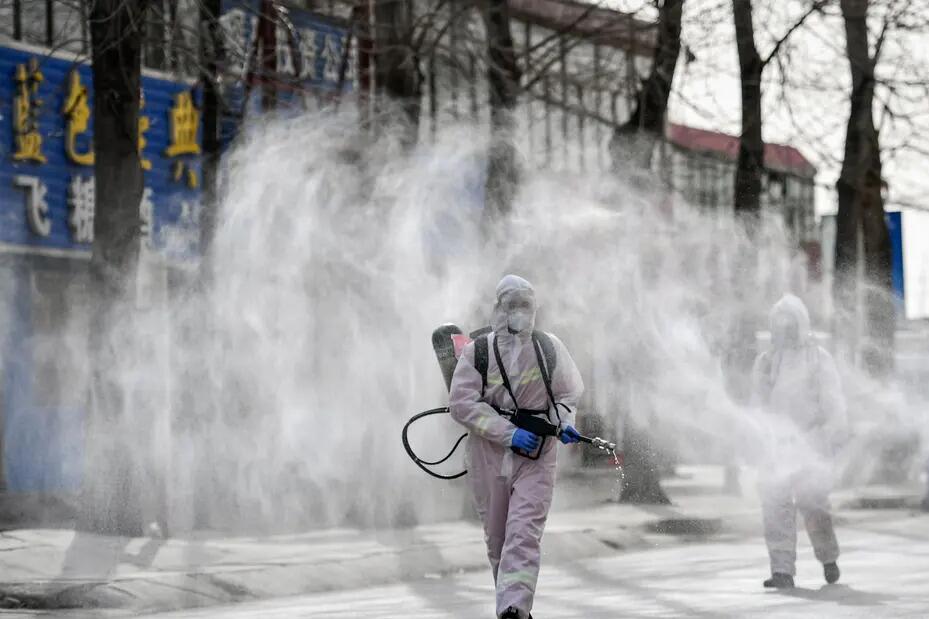
(Top) World Health Organization chief Tedros Adhanom Ghebreyesus speaks during a press conference in Geneva on April 6, 2023. (Bottom) People in protective suits spray disinfectant on a street in Shijiazhuang, which was declared a high-risk area for COVID-19 , in northern China's Hebei Province, on Jan. 15, 2021. (Fabrice Coffrini/AFP via Getty Images, STR/CNS/AFP via Getty Images)

Critics Remain Unconvinced

Despite these assurances, however, the efforts to vest more power within the WHO continue to face resistance.

In recent months, Louisiana and Florida passed laws stating that state officials will not obey WHO directives, and other states, such as Oklahoma, are considering similar legislation.

On May 8, attorneys general from 22 states signed a letter to President Joe Biden urging him not to sign the WHO agreements, and stating that they will resist any attempts by the WHO to set public health policy in their states.

“Although the latest iteration is far better than previous versions, it’s still highly problematic,” the attorneys general wrote. “The fluid and opaque nature of these proceedings, moreover, could allow the most egregious provisions from past versions to return.

“Ultimately, the goal of these instruments isn’t to protect public health. It’s to cede authority to the WHO—specifically its director-general—to restrict our citizens’ rights to freedom of speech, privacy, movement (especially travel across borders), and informed consent.”

Amid this recalcitrance, the WHO has stepped back from some of the more controversial measures. The Biden administration is involved in negotiating the WHO treaty and have expressed support for it, but haven’t stated a definite intention to sign.

The Latest Draft

Struck from the latest draft is a provision that member nations “recognize WHO as the guiding and coordinating authority of international public health response” and commit to follow the WHO’s directives during a health emergency. The latest draft also states that WHO recommendations are non-binding.

https://www.zerohedge.com/geopolitical/who-makes-key-concessions-ahead-pandemic-treaty-vote

US Kicks Chinese Crypto Miner Off Land Near Air Force Base


  • Treasury says Wyoming land buy was a national security threat
  • MineOne Partners Ltd. planned to use land for crypto mining

The US ordered a Chinese crypto mining company to vacate and sell a property it bought near a Wyoming Air Force base that houses intercontinental ballistic missiles, calling the firm a national security threat.

MineOne Partners Ltd. and its affiliated units and companies “might take action that threatens to impair the national security” of the US, the White House said in an order. The firm must divest the real estate it bought in 2022 near the F.E. Warren Air Force Base that houses US nuclear missiles.

https://www.bloomberg.com/news/articles/2024-05-13/us-kicks-chinese-crypto-mining-firm-off-land-near-air-force-base?srnd=homepage-asia

'New viruses that could cause epidemics'

 Suddenly they appear and -- like the SARS-CoV-2 coronavirus -- can trigger major epidemics: Viruses that nobody had on their radar. They are not really new, but they have changed genetically. In particular, the exchange of genetic material between different virus species can lead to the sudden emergence of threatening pathogens with significantly altered characteristics. This is suggested by current genetic analyses carried out by an international team of researchers. Virologists from the German Cancer Research Center (DKFZ) were in charge of the large-scale study.

"Using a new computer-assisted analysis method, we discovered 40 previously unknown nidoviruses in various vertebrates from fish to rodents, including 13 coronaviruses," reports DKFZ group leader Stefan Seitz. With the help of high-performance computers, the research team, which also includes Chris Lauber's working group from the Helmholtz Center for Infection Research in Hanover, has sifted through almost 300,000 data sets. According to virologist Seitz, the fact that we can now analyze such huge amounts of data in one go opens up completely new perspectives.

Virus research is still in its relative infancy. Only a fraction of all viruses occurring in nature are known, especially those that cause diseases in humans, domestic animals and crops. The new method therefore promises a quantum leap in knowledge with regard to the natural virus reservoir. Stefan Seitz and his colleagues sent genetic data from vertebrates stored in scientific databases through their high-performance computers with new questions. They searched for virus-infected animals in order to obtain and study viral genetic material on a large scale. The main focus was on so-called nidoviruses, which include the coronavirus family.

Nidoviruses, whose genetic material consists of RNA (ribonucleic acid), are widespread in vertebrates. This species-rich group of viruses has some common characteristics that distinguish them from all other RNA viruses and document their relationship. Otherwise, however, nidoviruses are very different from each other, i.e. in terms of the size of their genome.

One discovery is particularly interesting with regard to the emergence of new viruses: In host animals that are simultaneously infected with different viruses, a recombination of viral genes can occur during virus replication. "Apparently, the nidoviruses we discovered in fish frequently exchange genetic material between different virus species, even across family boundaries," says Stefan Seitz. And when distant relatives "crossbreed," this can lead to the emergence of viruses with completely new properties. According to Seitz, such evolutionary leaps can affect the aggressiveness and dangerousness of the viruses, but also their attachment to certain host animals.

"A genetic exchange, as we have found in fish viruses, will probably also occur in mammalian viruses," explains Stefan Seitz. Bats, which -- like shrews -- are often infected with a large number of different viruses, are considered a true melting pot. The SARS-CoV-2 coronavirus probably also developed in bats and jumped from there to humans.

After gene exchange between nidoviruses, the spike protein with which the viruses dock onto their host cells often changes. Chris Lauber, first author of the study, was able to show this by means of family tree analyses. Modifying this anchor molecule can significantly change the properties of the viruses to their advantage -- by increasing their infectiousness or enabling them to switch hosts. A change of host, especially from animals to humans, can greatly facilitate the spread of the virus, as the corona pandemic has emphatically demonstrated. Viral "game changers" can suddenly appear at any time, becoming a massive threat and -- if push comes to shove -- triggering a pandemic. The starting point can be a single double-infected host animal.

The new high-performance computer process could help to prevent the spread of new viruses. It enables a systematic search for virus variants that are potentially dangerous for humans, explains Stefan Seitz. And the DKFZ researcher sees another important possible application with regard to his special field of research, virus-associated carcinogenesis: "I could imagine that we could use the new High Performance Computing (HPC) to systematically examine cancer patients or immunocompromised people for viruses. We know that cancer can be triggered by viruses, the best-known example being human papillomaviruses. But we are probably only seeing the tip of the iceberg so far. The HPC method offers the opportunity to track down viruses that, previously undetected, nestle in the human organism and increase the risk of malignant tumors."

Chris Lauber, Xiaoyu Zhang, Josef Vaas, Franziska Klingler, Pascal Mutz, Arseny Dubin, Thomas Pietschmann, Olivia Roth, Benjamin W. Neuman, Alexander E. Gorbalenya, Ralf Bartenschlager, Stefan Seitz: Deep mining of the Sequence Read Archive reveals major genetic innovations in coronaviruses and other nidoviruses of aquatic vertebrates.

Journal Reference:

  1. Chris Lauber, Xiaoyu Zhang, Josef Vaas, Franziska Klingler, Pascal Mutz, Arseny Dubin, Thomas Pietschmann, Olivia Roth, Benjamin W. Neuman, Alexander E. Gorbalenya, Ralf Bartenschlager, Stefan Seitz. Deep mining of the Sequence Read Archive reveals major genetic innovations in coronaviruses and other nidoviruses of aquatic vertebratesPLOS Pathogens, 2024; 20 (4): e1012163 DOI: 10.1371/journal.ppat.1012163

Peptide-based hydrogel shows promise for wide range of tissue and organ repair

 Combining biomedical finesse and nature-inspired engineering, a uOttawa-led team of scientists has created a jelly-like material that shows great potential for on-the-spot repair to a remarkable range of damaged organs and tissues in the human body

Cutting-edge research co-led by uOttawa Faculty of Medicine Associate Professor Dr. Emilio I. Alarcón could eventually impact millions of lives with peptide-based hydrogels that will close skin wounds, deliver therapeutics to damaged , and reshape and heal injured corneas.

"We are using peptides to fabricate therapeutic solutions. The team is drawing inspiration from nature to develop simple solutions for wound closure and tissue repair," says Dr. Alarcón, a scientist and director at the BioEngineering and Therapeutic Solutions (BEaTS) group at the University of Ottawa Heart Institute, whose innovative research work is focused on developing new materials with capabilities for tissue regeneration.

Peptides are molecules in living organisms and hydrogels are a water-based material with a gelatinous texture that have proven useful in therapeutics.

The approach used in the study, published in Advanced Functional Materials and co-led by Dr. Erik Suuronen and Dr. Marc Ruel, is unique. Most hydrogels explored in  are animal-derived and protein-based materials, but the biomaterial created by the collaborative team is supercharged by engineered peptides. This makes it more clinically translatable.

Dr. Ruel, a full professor in the uOttawa Faculty of Medicine's Department of Cellular and Molecular Medicine and the endowed chair of research in the Division of Cardiac Surgery at the University of Ottawa Heart Institute, says the study's insights could be a game changer.

"Despite millennia of evolution, the human response to wound healing still remains imperfect," Dr. Ruel says. "We see maladapted scarring in everything from skin incisions to eye injuries, to heart repair after a myocardial infarction. Drs. Alarcón, Suuronen, and the rest of our team have focused on this problem for almost two decades. The publication by Dr. Alarcón in Advanced Functional Materials reveals a novel way to make , organ healing, and even basic scarring after surgery much more therapeutically modulatable, and therefore, optimizable for human health."

Indeed, the ability to modulate the peptide-based biomaterial is key. The uOttawa-led team's hydrogels are designed to be customizable, making the durable material adaptable for use in a surprising range of tissues. Essentially, the two-component recipe could be adjusted to ramp up adhesivity or dial down other components depending on the part of the body needing repair.

"We were in fact very surprised by the range of applications our materials can achieve," says Dr. Alarcón. "Our technology offers an integrated solution that is customizable depending on the targeted tissue."

Dr. Alarcón says that not only does the study's data suggest that the therapeutic action of the biomimetic hydrogels are highly effective, but its application is far simpler and cost-effective than other regenerative approaches.

The materials are engineered in a low-cost and scalable manner—hugely important qualities for any number of major biomedical applications. The team also devised a rapid-screening system that allowed them to significantly slash the design costs and testing timespans.

"This significant reduction in cost and time not only makes our material more economically viable but also accelerates its potential for clinical use," Dr. Alarcón says.

What are next steps for the research team? They will conduct large animal tests in preparation for tests in human subjects. So far, heart and skin tests have been conducted with rodents, and the cornea work has been done ex vivo.

More information: Alex Ross et al, Multipurpose On‐the‐Spot Peptide‐Based Hydrogels for Skin, Cornea, and Heart Repair, Advanced Functional Materials (2024). DOI: 10.1002/adfm.202402564


https://medicalxpress.com/news/2024-05-peptide-based-hydrogel-wide-range.html