Search This Blog

Friday, May 17, 2024

Chinese FX Outflows Soar To Highest Since 2015 Devaluation, Priming Next Bitcoin Surge

 Last October, when we pointed out that China's FX outflows had just hit a whopping $75BN - the single biggest monthly outflow since the 2015 currency devaluation - we concluded that the "unfavorable interest rate spread between China and the US will "likely imply persistent depreciation and outflow pressures in coming months", or in other words, September's biggest FX outflow in years is just the beginning, and very soon - in addition to geopolitics and central banks - the world will also be freaking out about the capital flight out of China... not to mention where all those billions in Chinese savings are going and which digital currency the Chinese are using to launder said outflows."

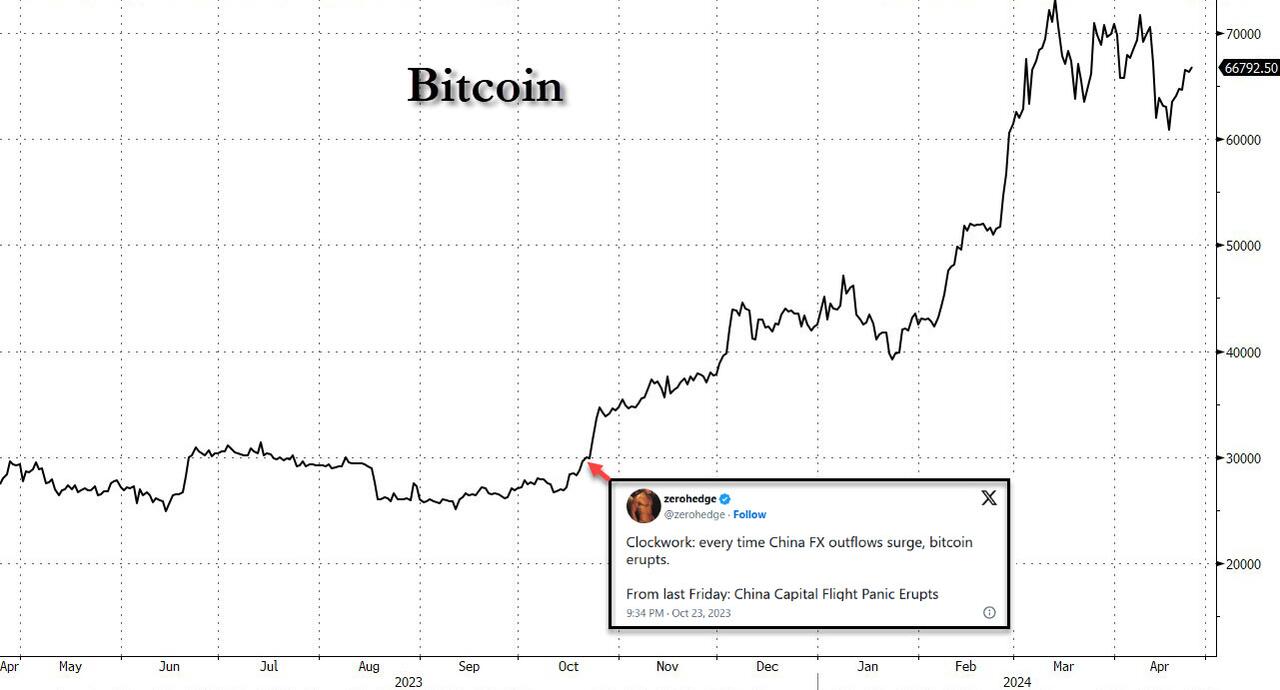
We wrote that on October 20 when Bitcoin was trading just under $30,000, a level it had been for much of 2023. And, just as we correctly predicted at the time...

... following this surge in Chinese FX outflows, bitcoin - traditionally China's preferred means to circumvent Beijing's great capital firewall since gold is, how should one put it, a bit more obvious when crossing borders - promptly exploded more than 100% higher in the next 4 months.
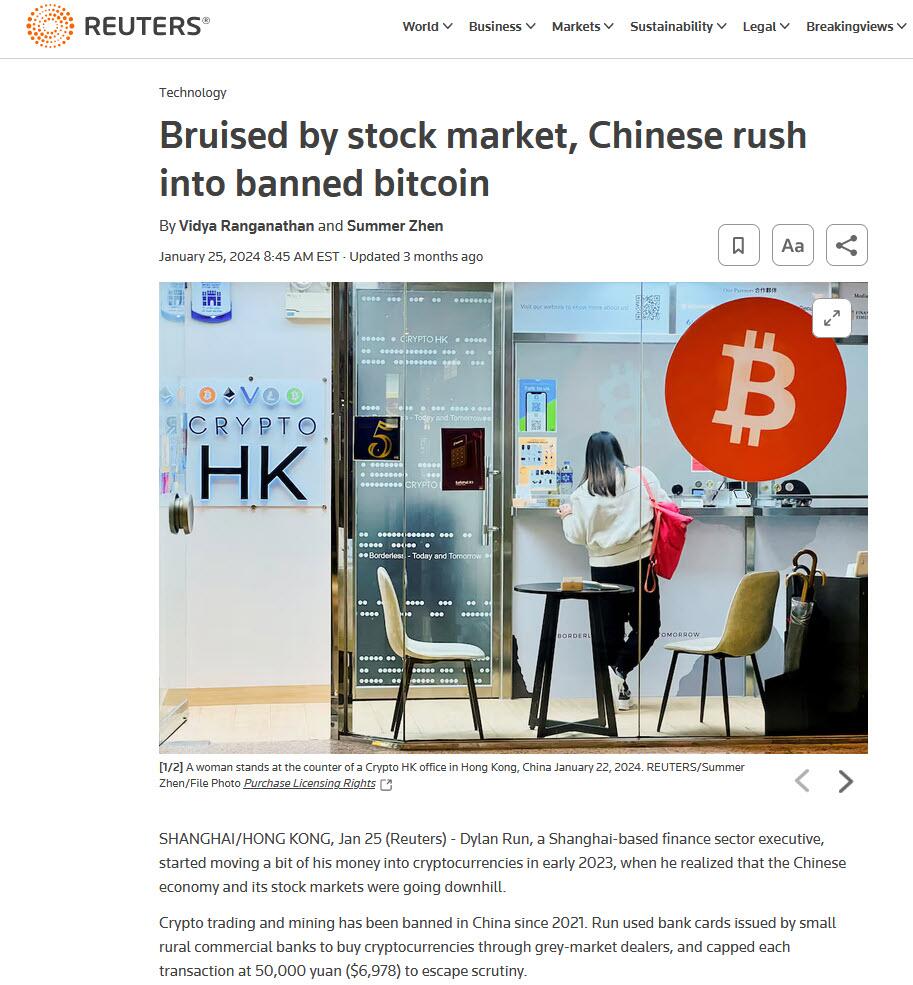
And while conventional wisdom is that this surge in the price of the digital currency was largely due to the January launch of Bitcoin ETFs, what many missed was a Reuters story in January which reiterated our original thesis from back in 2015, according to which much more than ETFs, and much more than rapidly shifting sentiment or frankly any day-to-day newsflow, it is China's massive wall of inert capital that has been the biggest driver of bitcoin moves, and never more so than during periods of FX and capital outflows which usually precede some form of capital controls.
We bring all this up because seven months after our first correct prediction that China's spike in FX outflows would send bitcoin surging, it's time to do it again.

One wouldn't know it, however, if one merely looked at the official Chinese FX reserve data published by the PBOC, here nothing sticks out. In fact, at $3.2 trillion, despite a rather notable drop for April, reported Chinese reserves are now near the highest level in past four years, and monthly flows are very much stable as shown in the chart below.

The problem, of course, is that as we have explained previously China's officially reported reserves are woefully (and purposefully) inaccurate of the bigger picture.

Instead if one uses our preferred gauge of FX flows, one which looks at i) onshore outright spot transactions; ii) freshly entered and canceled forward transactions, and iii) the SAFE dataset on “cross-border RMB flows, we find that China's net outflows were a massive $86BN in April, up from $11BN in February and $39BN in March and the fastest pace of outflows since the September spike in FX outflows which we duly noted half a year ago.

Drilling down, in April, we saw $50BN in net outflows via onshore outright spot transactions, and $1BN outflows via freshly entered and canceled forward transactions. Another SAFE dataset on "cross-border RMB flows" showed outflows of $35bn in the month, suggesting net receipt of RMB from onshore to offshore, likely on the back of Stock Connect outflows, but the "unusual flow" really could be anything including the unexplained  capital flight into gold and bitcoin. Ours - and Goldman's - preferred FX flow measure therefore suggests FX outflows were really $86BN in April, more than double the official net FX outflows of $39BN in the month.

How did we get this number? First, the portfolio investment channel showed net outflows in March after adjusting for cross-border RMB receipts. Stock Connect flows showed around US$9bn outflows, vs. US$8bn outflows in March. Foreigners kept buying RMB bonds - the bond market saw US$7bn inflows in April, vs. US$6bn in March.

Finally, the current account channel also showed faster net outflows. Despite a sizeable goods trade surplus in April, we saw a small outflow of $2bn related to goods trade in April vs. an inflow of $14bn in March. The services trade deficit widened to $22bn vs. $18bn in March. The income and transfers account showed outflows of $5bn in April, faster than the $2bn outflows in March.

At the time when FX outflows were re-acclererating, the broad USD strengthened further in April, and more importantly, the USDCNY spot drifted higher, as one would expect when there is capital flight... Oh, and Bitcoin traded at its record high above $70K.

And while Chinese policymakers are still keen on maintaining FX stability (or at least create that impression) as the countercyclical factors in the daily CNY fixing remained deeply negative and front-end CNH liquidity tightened notably in recent weeks, the reality is that with China desperate to boost its exports at a time when its great mercantilist competitor, Japan, has hammered the yen to the lowest level in 3 decades, it is only a matter of time before the currency devaluation advocates win, as they did in 2015. 

We hope that we don't have to remind readers that the first big trigger for bitcoin's unprecedented eruption higher starting in 2015 was - you guessed it - China's August 2015 FX devaluation, as we correctly noted at the time when we predicted that bitcoin would explode from $250 to the tens of thousands.
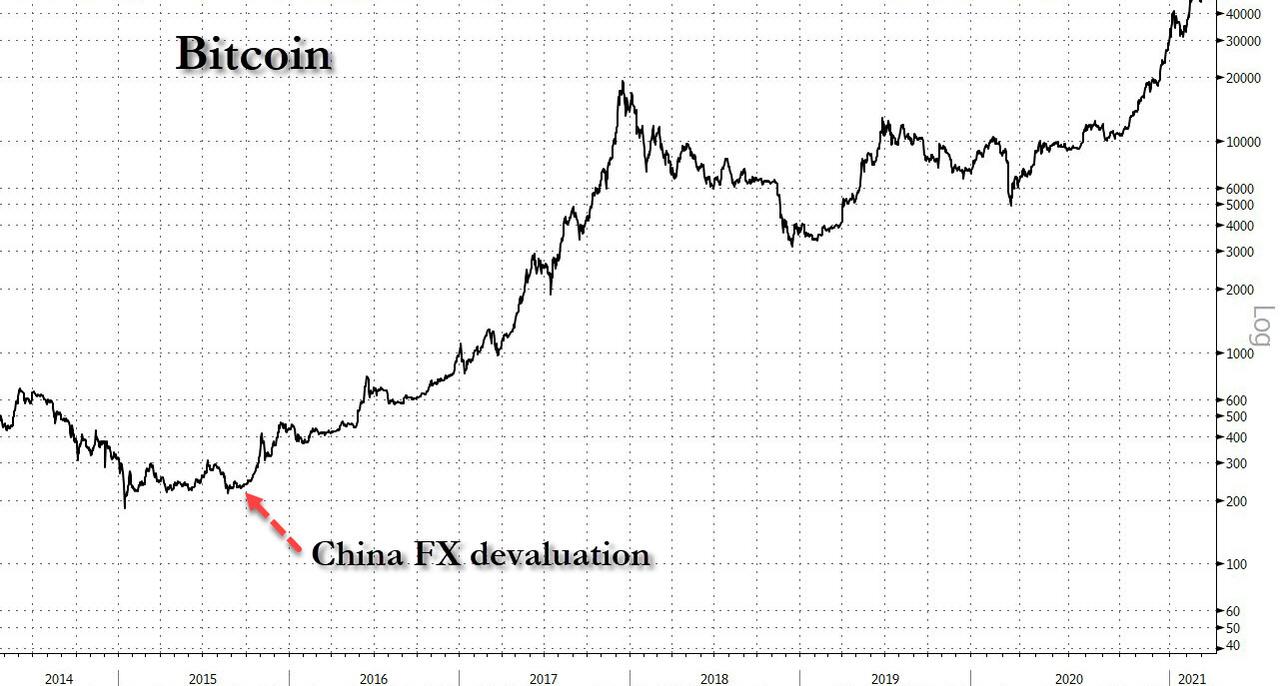
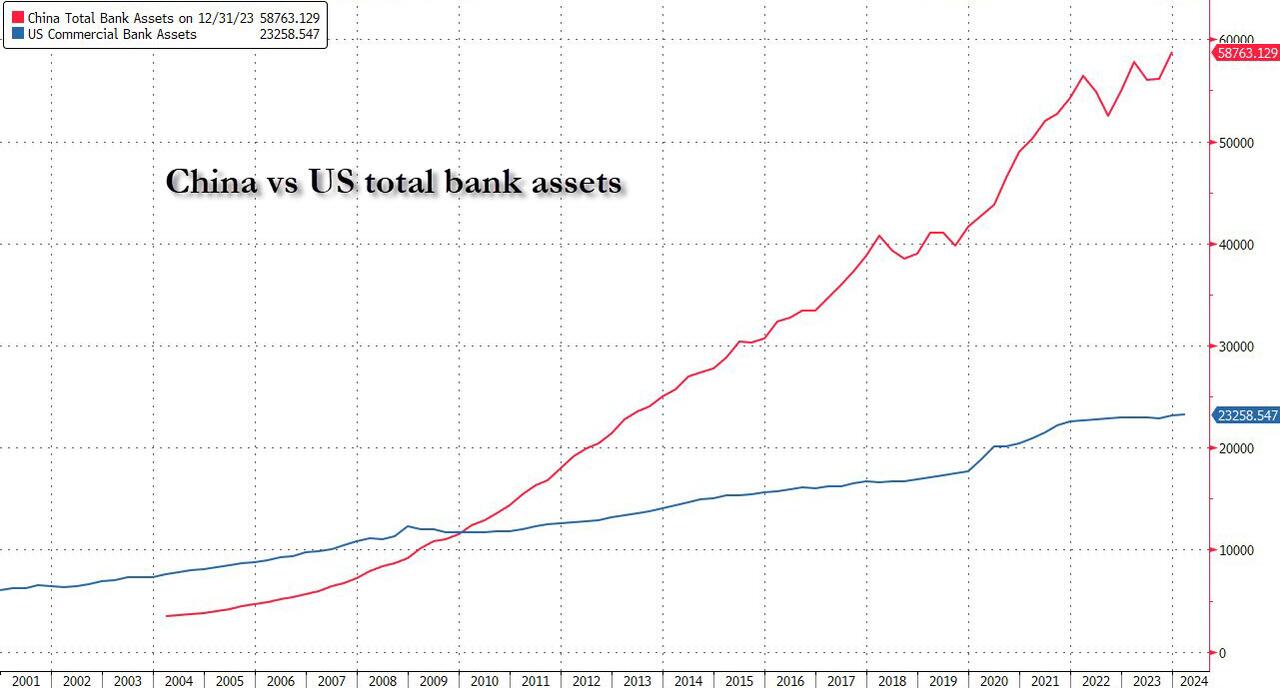
So don't be surprised if in the next 6 months Bitcoin doubles again, and the move has nothing to do with ETF inflows, the halving, or frankly anything else taking place in the US... and instead is entirely driven by China's massive wall of money which at last check was almost 3x bigger than the US.
https://www.zerohedge.com/markets/chinese-fx-outflows-soar-highest-2015-devaluation-priming-next-bitcoin-surge

Inventiva positive recommendation of 4th DMC of Phase III trial with lanifibranor in MASH/NASH


  • The Data Monitoring Committee recommended to continue the clinical trial without modification of the current protocol, based on the pre-planned review of safety data.
  • The recommendation was based on the unblinded review by the DMC of safety data from more than 900 patients randomized in the main and exploratory cohorts, including more than 360 and 80 patients that have been treated for more than 48 and 72 weeks, respectively.
  • The patient who experienced the adverse event of increased liver test results, which was reported as a SUSAR, has been without clinical symptoms throughout the period of observation and has fully recovered.
  • The DMC review confirms the good safety profile of lanifibranor.

Capricor started at Outperform by Oppenheimer

 Target $14

https://finviz.com/quote.ashx?t=CAPR&p=d

US lukewarm on G7 Russian diamond ban after industry backlash

 The United States is re-evaluating the strictest elements of a ban on Russian diamonds from the Group of Seven major democracies, after opposition from African countries, Indian gem polishers and New York jewellers, seven sources said.

The sanctions package, agreed in December and including a ban across the European Union, represents one of the industry's biggest shakeups in decades.

Two of the sources familiar with the negotiations said the Americans had disconnected from G7 working groups on the stringent controls, with one describing them as "there but not engaging".

The U.S. State Department declined to comment.

A senior Biden administration official said Washington had not changed its position and that the United States would keep working with the G7.

"We will want to make sure that we strike the right balance between hurting Russia and making sure that everything is implementable," said the official who declined to be named because they were not authorised to speak publicly on the negotiations.

The G7 sanctions aim to hit another stream of revenue for the Kremlin's war effort in Ukraine, even though at around $3.5 billion, according to Russian state-run miner Alrosa's 2023 results, diamonds represent a small fraction of the profits Moscow earns from oil and gas.

Since March, importers to G7 countries must self-certify that diamonds do not originate from Russia, the world's leading producer of rough diamonds. Sanctions were imposed on direct imports of Russian gems in January.

From September, the EU ban will require diamonds of 0.5 carats and above to pass through Antwerp, a centuries-old diamond hub in Belgium, for traceability certification using blockchain - the digital ledger used by cryptocurrencies.

Sources said G7 powers had agreed that Antwerp would be the logical first hub, with others to be added later.

But three of the sources said Washington had cooled on enforcing traceability and that discussions on implementing tracing had stalled.

The Biden administration official said the commitment to implementing a traceability mechanism by Sept. 1 applied to the European Union, not the United States, citing the language in a G7 leaders' statement in December.

"We need to do this in a way that takes into account concerns from African partners and African producers, takes into account Indian and UAE partners ... and makes sure we can also make it workable for U.S. industry," said the official.

"Is there a traceability mechanism that satisfies all of that? We haven't walked away from the idea... on the other hand, we couldn't sign up to definitely having this in place by Sept. 1st."

Indian spice trade group fears plunge in exports due to ETO pesticide scrutiny

 An Indian spice trade group said on Friday that spice exports could drop by 40% after two major brands were hit with contamination allegations over the use of a pesticide the group considers safe but others say causes cancer in the event of long-term exposure.

India is the world's biggest exporter, consumer and producer of spices, and its spice exports came to $4 billion in the year from April 2022 to March 2023.

But the Federation of Indian Spice Stakeholders (FISS) said the industry has already seen buyers put some export orders on hold amid international scrutiny of two popular Indian brands - MDH and Everest.

The exports regulator, the Spices Board, did not respond to a request for comment.

Hong Kong last month suspended sales of three MDH spice blends and one from Everest citing high levels of the pesticide ethylene oxide, or ETO - a cancer risk in the event of long exposure.

The two companies both say their products, hugely popular in India and exported globally, are safe for consumption.

"If other countries also start taking a similar stand, our spices exports could fall by 40%," said Tejus Gandhi, the secretary of FISS, which represents 600 spice makers and exporters around the country.

Already, Britain's food regulator has applied extra checks for all spice imports from India and the U.S, New Zealand and Australia are looking into the matter.

"Many countries are questioning... Lot of spices exporters have orders. They have been halted," Gandhi said at a press briefing in Ahmedabad city in western India.

ETO can be used as a pesticide to help prevent microbial contamination. While some nations allow a small presence of ETO in spices, many completely prohibit it.

The U.S. Environmental Protection Agency says regular exposure to ETO over many years raises the risk of cancers including non-Hodgkin lymphoma, myeloma and lymphocytic leukemia, as well as breast cancer in women.

India's Spices Board last month said the country has "stringent protocols and guidelines for ETO residue" and it will strictly monitor consignments going abroad.

The FISS said in a statement that ETO "is not harmful" without elaborating, while it added that: "ETO is extremely effective eliminating (pathogens in spices)".

https://sg.news.yahoo.com/indian-spice-trade-group-fears-142026977.html

Leading index for U.S. economy sinks again and points to slower growth

 Leading economic index drops 0.6% in April

The numbers: The leading indicators for the U.S. economy fell in April for the second month in a row and pointed to "serious headwinds to growth."

The index of leading economic indicators sank 0.6% last month, the privately run Conference Board said Friday.

The leading index is a gauge designed to show whether the economy is getting better or worse. Economists polled by the Wall Street Journal had forecast a 0.3% decline in April.

The leading index had risen in February to mark the first increase in two years. It was the third-longest negative stretch ever.

The other two times the index experienced such large declines, a recession ensued. But the pandemic and its aftermath has partly severed typical economic patterns and the U.S. has continued to grow at an above-average rate.

Key details: The leading index declined mainly because of weaker business orders, fewer permits to build new homes and a decline in stock prices last month. Stocks have since rebounded, however, to fresh record highs.

Big picture: The economy slowed in the first quarter after heady growth in the second half of 2023. It's unlikely speed up much until inflation tapers off and the Federal Reserve cuts interest rates.

A recession also appears unlikely, though. A strong labor market, characterized by steady hiring, low layoffs and low unemployment, means people have the means to spend to keep the economy growing.

Looking ahead: While the index "no longer signal a forthcoming recession, they still point to serious headwinds to growth ahead," said Justyna Zabinska-La Monica, senior manager of business-cycle indicators at the Conference Board.

"Indeed, elevated inflation, high interest rates, rising household debt, and depleted pandemic savings are all expected to continue weighing on the US economy in 2024."

https://www.morningstar.com/news/marketwatch/20240517272/leading-index-for-us-economy-sinks-again-and-points-to-slower-growth

G7 to back EU line on frozen Russian assets, Italian official says

 Finance ministers from the Group of Seven major democracies meeting in Italy next week will back a European Union plan to use the income from frozen Russian assets to help Ukraine's war effort, an Italian Treasury official said on Thursday.

Italy, which holds the rotating presidency of the G7, will also try to revive an international deal on how to share taxing rights on large corporations which the United States is struggling to ratify in Congress, the official, who declined to be identified by name, told a media briefing.

The G7 froze around $300 billion worth of financial assets soon after Moscow's attack on its neighbour in February 2022. Since then, the European Union and other G7 countries have debated whether and how to use the funds to help Ukraine.

The G7 comprises the United States, Japan, Germany, France, Britain, Italy and Canada.

The United States has proposed seizing the assets in their entirety, but Europe has balked, citing risks to the euro and legal repercussions.

The G7 will support the EU's line to use the extraordinary revenues from the frozen Russian assets to the benefit of Ukraine, the official said ahead of the meeting in Stresa, northern Italy, on May 24-25.

The talks are focused on using income from the assets, not the assets themselves, the official said, adding that any decision must have the backing of the EU and a "solid legal basis."

In the face of European resistance, Washington has more recently proposed using the assets as collateral to provide loans for Ukraine.

The Italian official said the finance chiefs will do the groundwork aimed at enabling G7 heads of government to reach a final decision at a summit in the southern Italian region of Puglia, in June.

Trade relations with China will also be discussed in Stresa, after the United States this week unveiled steep tariff hikes on a raft of Chinese imports, though the issue is not on the formal agenda of the meeting, the official said.

Italy has reservations about the use of tariffs because of their disruptive impact on world trade.

With a trade truce over digital services taxes between the U.S. and several European countries set to expire in June, Italy will promote last-ditch talks to prevent the failure of plans for a global minimum tax on multinationals.

The first pillar of that agreement aims to reallocate to the countries where companies do business the rights to tax about $200 billion in corporate profits.

The official said the negotiations have made no progress ahead of next week's meeting.

https://ca.news.yahoo.com/g7-back-eu-line-frozen-181552774.html