Search This Blog

Monday, November 11, 2024

Citius Positive Prelim Phase I in Recurrent Solid Tumors

 Study, in patients with solid tumors focusing on gynecological malignant tumors such as ovarian, endometrial, and cervical, nearing completion with three remaining subjects to be enrolled

27% Objective Response Rate (ORR)

33% Clinical Benefit Rate (CBR) with a median Progression Free Survival (PFS) of 57 weeks

Chemotherapy-free immunomodulatory regimen well-tolerated with no documented serious immune-related adverse events

https://www.prnewswire.com/news-releases/citius-pharmaceuticals-inc-and-citius-oncology-inc-announce-promising-preliminary-results-of-an-investigator-initiated-phase-i-clinical-trial-of-pembrolizumab-keytruda-and-lymphir-in-cancer-patients-with-recurrent-solid-tu-302300516.html

The Economic Challenges Facing The Trump Administration

 by Jeffrey Tucker via The Epoch Times,

The first great challenge to the Trump administration is controlling inflation. It is coming back already and we might face a second wave that emerges in the summer. Throughout the campaign, we’ve had almost no honest talk about the reasons for this devastation.
It cannot be stopped through “anti-gouging” legislation. No one ever believed that this would achieve anything. The message had no public resonance at all.

But just as crucially, the inflation was not kicked off by energy regulation and throttles on oil and gas production. That increased transportation costs, yes, but the oil price now is not high and inflation is still a menace.

The root of the problem is so unbearably obvious, so much so that it feels pointless to point it out. For two years, the money stock grew $6 trillion on the backs of a wild spending bonanza by Congress, all of which was paid for by Fed purchases of new debt.

Because the new money was directly distributed to the population as if by helicopter, it watered down the value of the U.S. dollar in terms of goods and services. Growth stopped with rate increases but the Fed has reversed itself again in an attempt to forestall recession.

Right now, the money stock is growing again, thanks to a great deal of U.S. Treasury releases designed to prettify the GDP leading to the election.
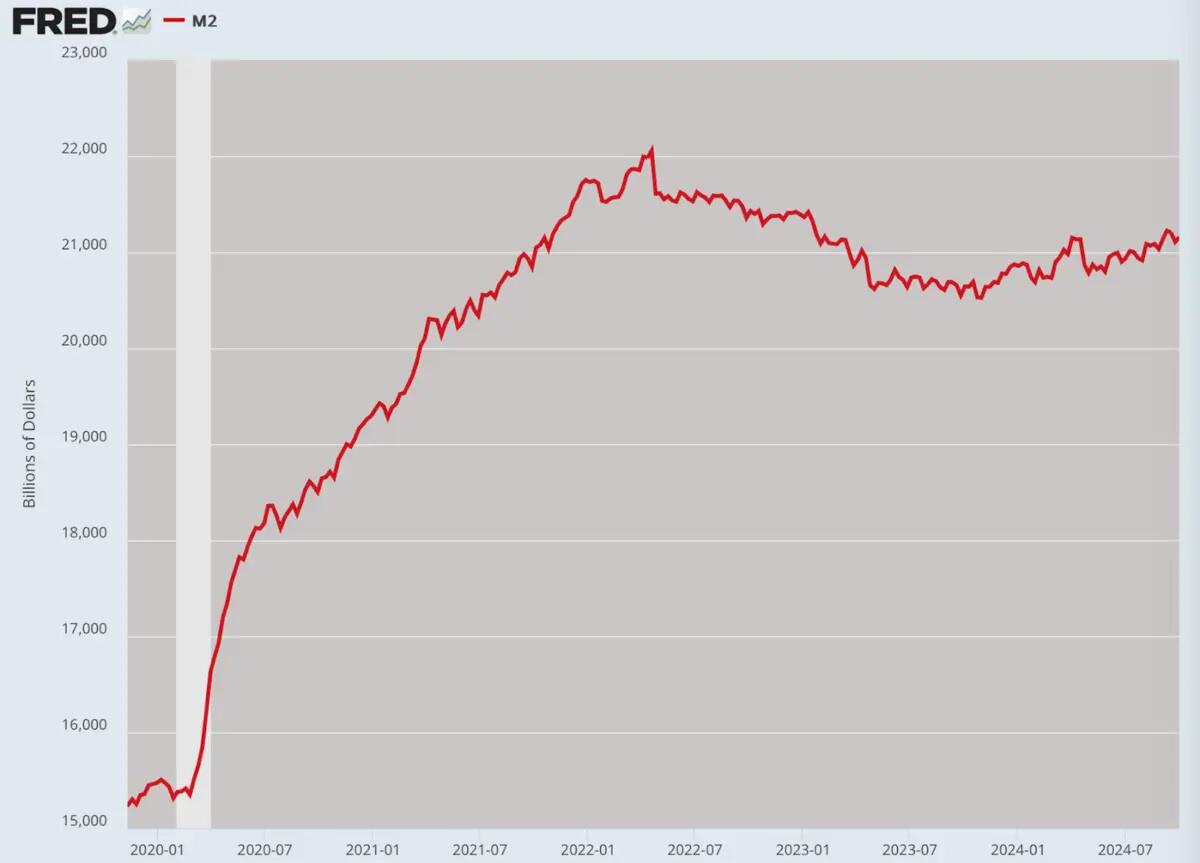
(Data: Federal Reserve Economic Data (FRED), St. Louis Fed; Chart: Jeffrey A. Tucker)

There is no easy fix to this. Lowering energy prices with more supply can help but there is a point at which lower prices actually reduce supply, simply because it no longer pays the bills to drill and refine. By all means, deregulate but this much I can promise you: it will not fix the inflation problem.

Nor should the Trump administration be overly concerned about the boogeyman called “deflation.” The people always benefit from rising purchasing power. Producers can cope just fine, as the computer and software industry have proven for the better part of 30 years. Absolutely no policy choices should be made under the motive to stop deflation. That is no way a threat right now.

Ideally, the Trump administration would seek a fix to the problem of the Fed, such as ending open-market operations and debt support, permanently. The effect of such changes long-term would be glorious but it will not stop the problem that exists right now.

Price controls are anathema under all circumstances.

The best single strategy to deal with the immediate problem is to inspire investment via dramatic tax cuts (capital and income) plus huge and far-reaching deregulation of everything that lowers the costs of start-up and the operation of small businesses. That is essential.

Keep in mind that the usual suspects will scream that higher growth only makes inflation worse. This is wrong. There’s no other way to put it. It’s just bad analytics stemming from outdated models. Higher growth does not feed inflation. It mitigates it, burying its impact amidst more opportunities and great wealth creation.

Think of it as a race. Growth needs to rise well above inflation rates. The tax cuts also put more money in the hands of producers and consumers, granting more control over wealth in the hands of the public so that the ghostly tax increases of inflation have less impact.

That of course will reduce government revenue and increase the debt, which is inflationary too, so that is a major problem. Again, there is an answer in the form of far-reaching spending cuts. There really is no choice. Cutting $2 trillion out of the budget is a good start but it is not enough. These have to be real cuts, not fake cuts in the rate of growth.

Some revenue shortfalls can be covered by tariffs but there are potential pitfalls here. There are three reasons for tariffs: revenue, protection of industry, and rebalancing settlement systems. They work at cross purposes. The revenue comes from paying the tariffs. They are only paid when trade occurs. Protection happens when trade does not take place on the scale it otherwise would have.

The more protection, the less revenue. The more revenue, the less protection.

Do you see the problem? Relying on tariffs to make up revenue losses from tax cuts absolutely requires the continued existence of imports, especially on high-dollar capital goods. Seeking ever more revenue from this source perpetuates the problem of international industrial competition. As for rebalancing trade, that likely cannot happen so long as the dollar (and petrodollar) are the final means of payment.

My point is simply that there are real limits here. One cannot always know at the outset what they are.

There is also no way to know precisely when consumers and producers will revolt against high tariffs, which absolutely increase the prices of goods and services.

Another note on the price increases associated with tariffs: they do not cause inflation. Price increases on particular products is a relative change, not a general change. You will read floods of commentary in the coming months that Trump’s tariffs drive up inflation. That is absolutely untrue. They increase discreet prices but have zero effect on general prices. This fallacy will persist however as the whole of the financial press will blame the second wave of inflation on Trump. Not a word of it will be true.

In any case, sizing it all up, the best hopes that the Trump administration has for avoiding an obvious inflationary recession: massive regulatory changes and asset sales, dramatic spending cuts in discretionary spending, and huge capital and income tax cuts to inspire optimism and put more money back into people’s pockets.

The tariffs are going to come either way given Trump’s outlook but the most we can hope from them is to do the least-possible damage. They hope will be to reverse the red ink in trade deficits but that is highly doubtful. So long as the U.S. dollar is the world reserve currency, the balance sheets of foreign central banks will continue to stockpile them.

Remember that a strong dollar drives imports. That is at cross purposes with the trade agenda. The dollar’s value in terms of other currencies is rising now and will likely continue. There is no real threat to the dollar as reserve currency in the short run. It’s not a subject about which anyone should care for a long time to come.

That aside, a newly ebullient investment environment could provide energy for a new focus on growth, which in turn will grow revenue on its own. If the shift is serious enough, it could reverse investor psychology and bring about a transformative effect on the mood of the public and confidence. This is the biggest hope we have.

Doing nothing is not an option. Fortunately, the Trump transition knows this and seems prepared to act.

https://www.zerohedge.com/economics/economic-challenges-facing-trump-administration

The View's Sunny Hostin Killed Kamala's Chances Of Topping Trump: Carville

 by Steve Watson via Modernity.news,

Veteran leftist political strategist James Carville says that the stand out moment when Kamala Harris cemented her historic loss to president elect Donald Trump was when she couldn’t think of a single thing she’d do different to Joe Biden.

Harris first made the comment while appearing on The View, something that should’ve been a walk in the park.

“There is not a thing that comes to mind. And I’ve been a part of most of the decisions that have had an impact,” she stated at the time.

But it was even worse than this sounds.

Harris was also asked “What do you think would be the biggest specific difference between your presidency and a Biden presidency?”

Harris responded, “We’re obviously two different people.”

Carville, the former lead strategist in Bill Clinton’s winning 1992 Presidential campaign, noted “When we go back and history unearths this, it’s going to be right there on the View.”

“Sunny Hostin, Houston, whatever asked the question. That’s the most devastating answer you can imagine,” he added.

It’s still astounding that she did not have an answer prepared to this completely basic softball question?

The remarkable thing is that she was repeatedly asked the same question in the weeks after this and STILL couldn’t give an answer.

Let’s not forget, the Democratic Party made a monumental error in running with cackles. 

They didn’t have much choice, however after Biden screwed them over.

The most delicious thing about this might be the total meltdown that the screeching witches on The View engaged in once the results were in.

*  *  *

https://www.zerohedge.com/political/how-views-sonny-hostin-killed-kamalas-chances-topping-trump

Evotec, after stock-tanking blows, attracts private equity buyout interest

 Evotec’s struggles have put it in the crosshairs of private equity groups. After seeing the company’s share price fall around 60% this year, Triton Partners has raised its stake in the drug discovery shop and is reportedly considering a buyout bid.

Bloomberg reported details of the M&A chatter, quoting anonymous sources familiar with the matter. A spokesperson for Triton declined to comment, but Bloomberg’s sources say the private equity firm wants to meet with top Evotec executives. As it stands, Triton is still mulling its options, according to the report, and could opt against making a formal offer to acquire Evotec.

Other details are in the public domain. Financial regulatory filings show Triton recently raised its stake in Evotec. With Triton’s holdings now nearing 10%, the company will need foreign investment approval to significantly increase its stake.

Making a move to acquire Evotec will also require the support of the company’s other major investors. Evotec listed three investors with stakes of 5% or greater in its 2023 annual report. At that time, T. Rowe Price was the bigger shareholder, with a 10.1% stake, followed by Novo Holdings—the controlling shareholder of Novo Nordisk—at 8.4% and Abu Dhabi’s sovereign fund Mubadala Investment at 6.6%. 

Investors in Evotec have seen the value of their holdings decrease this year, in which time the company’s share price has fallen from $11.40 to $4.13 on Nasdaq. The report of Triton’s interest in Evotec sent the company’s share price up almost 22% in Europe.

Evotec has been trying to turn its business around, embarking on a “priority reset” in April that has seen it exit the gene therapy space, jettison employees and sell an active pharmaceutical ingredient plant. The steps are part of the response to what Evotec has called a “weak market” that suffers from overcapacity.

The company, a service provider that has built a pipeline of partnered programs, is reviewing its strategy. Evotec CEO Christian Wojczewski outlined his thinking about the pipeline in response to a question on the company’s third-quarter results earnings call last week.

“You should not imply that we're dumping the pipeline or that we're doing anything else, reducing the pipeline, at this point in time. It's a healthy pipeline we have. We believe that there are good assets,” Wojczewski said. “Of course, it will be part of the review ... when it comes to the pockets of value creation in the future, how much effort we will put into that going forward.”

https://www.fiercebiotech.com/biotech/evotec-after-stock-tanking-blows-attracts-private-equity-buyout-interest-report

Inspire Medical $75 million Accelerated Share Repurchase Program

  Inspire Medical Systems, Inc. (NYSE: INSP) (“Inspire,” or the “Company”), a medical technology company focused on the development and commercialization of innovative, minimally invasive solutions for patients with obstructive sleep apnea, today announced that it entered into an accelerated share repurchase (“ASR”) transaction under an agreement with Goldman Sachs & Co. LLC, to repurchase an aggregate of $75.0 million of shares of the Company’s common stock, par value $0.001 per share. The ASR transaction is being completed pursuant to a previously announced $150.0 million share repurchase program authorized by the Company’s Board of Directors.

https://www.globenewswire.com/news-release/2024/11/11/2978173/0/en/Inspire-Medical-Systems-Inc-Announces-75-million-Accelerated-Share-Repurchase-Program.html

Dynavax $100 Million Accelerated Share Repurchase Program

 Dynavax Technologies Corporation (Nasdaq: DVAX), a commercial-stage biopharmaceutical company developing and commercializing innovative vaccines, today announced that it has entered into an Accelerated Share Repurchase transaction ("ASR") under an agreement with Goldman Sachs & Co. LLC to repurchase $100 million of the Company's common stock. Dynavax executed the ASR as part of the $200 million share repurchase program authorized by its Board of Directors in November 2024. Upon completion of this ASR, Dynavax will have $100 million remaining under the program.

https://www.prnewswire.com/news-releases/dynavax-announces-100-million-accelerated-share-repurchase-program-302300848.html

RAPT Therapeutics Stops Zelnecirnon Program Following Clinical Hold


Due to Single SAE of Severe Liver Injury

Continues to advance preclinical pipeline, including next generation CCR4 compounds, and pursue licensing opportunities