Search This Blog

Monday, November 11, 2024

‘Round Face’: A Viral Term’s Real Diagnostic Implications

 “Cortisol” has become a household word, popularized by social media and tagged in videos that garnered nearly 800 million views last year. This is linked to the also trending term “moon face,” which TikTok influencers and others have suggested is caused by high cortisol levels and, conversely, can be reduced through stress reduction.

Although it’s true that cortisol is a hormone associated with stress, elevated stress levels are unlikely, by themselves, to cause the rounded facial features associated with “moon face.”

photo of Anat Ben-Shlomo, MD
Anat Ben-Shlomo, MD

“When we hear the term ‘moon face,’ we’re typically referring to Cushing syndrome [CS] or treatment with prolonged high-dose glucocorticoids,” Anat Ben-Shlomo, MD, co-director of the Multidisciplinary Adrenal Program, Pituitary Center, Division of Endocrinology, Diabetes and Metabolism at Cedars-Sinai Medical Center, Los Angeles, told Medscape Medical NewsMedscape Medical News previously discussed moon face in an article detailing how to diagnose CS.

Ben-Shlomo noted that the labels “moon face” and “moon facies” should be avoided for their potentially derogatory, unprofessional-sounding connotations, and that the preferred terms are “rounded face” or “round plethoric face.”

There are several disorders that can be associated with facial roundness, not all of which relate to elevated cortisol.

“It’s important for clinicians to be able distinguish between presentations due to other pathophysiologies, identify the unique constellation of Cushing-associated signs and symptoms, engage in a differential diagnosis, and treat whatever the condition is appropriately,” Katherine Sherif, MD, professor and vice chair of academic affairs, Department of Medicine, Thomas Jefferson University, Philadelphia, told Medscape Medical News.

The Unique Presentation of CS

CS results from “prolonged elevation” in plasma cortisol levels due to either exogenous steroid use or excess endogenous steroid production.

“The shape of the face isn’t the only feature associated with CS,” Ben-Shlomo said. “There’s central obesity, particularly in the neck, supraclavicular area, chest, and abdomen. You sometimes see a posterior cervical thoracic fat pad, colloquially — but unprofessionally — called a ‘cervical hump.’ Simultaneously, the arms and legs are getting thinner.” The development of a round, plethoric face is common in long-standing significant CS, and a reddening of the skin can appear.

Additional symptoms include hirsutism and acne. “These can also be seen in other conditions, such as PCOS [polycystic ovary syndrome] but, combined with the other facial features, are more suggestive of CS,” Ben-Shlomo said.

Deep, wide purple striae appear in the trunk, breast, upper arms, and thighs, but not in the face, Ben-Shlomo advised. These appear as the fragile, thinning under-skin breaks when the patient gains weight.

Additional metabolic issues that can occur comorbidly include insulin resistance and diabetes, hypertension, osteoporosis, dyslipidemia, ecchymoses, increased susceptibility to infections, mood changes, cognitive dysfunction, low libido, infertility, weakness of muscles in the shoulders and thighs, episodes of bleeding and/or clotting, and an increased risk for heart attacks and strokes, Ben-Shlomo said.

“Not everyone presents with full-blown disease, but if you see any of these symptoms, be suspicious of CS and conduct a biochemical evaluation.” Three screening tests to use as a starting point are recommended by the Pituitary Society’s updated Consensus on Diagnosis and Management of Cushing’s Disease. The tests should be repeated to account for intra-patient variability. If two or all three tests are positive, clinicians should be suspicious of CS and move to additional testing to identify the underlying cause, Ben-Shlomo said.

‘Subclinical’ CS

Ben-Shlomo highlighted a condition called minimal autonomous cortisol secretion (formerly “subclinical CS”). “This condition is found when a person has an adrenal nodule that produces cortisol in excess, however not to levels observed in CS. An abnormal finding on the overnight 1-mg low-dose dexamethasone suppression test (LDDST) will identify this disorder, showing mildly unsuppressed morning cortisol level, while all other tests will be within normal range.”

She described minimal autonomous cortisol secretion as a form of “smoldering CS,” which has become more commonly diagnosed. “The condition needs to be treated because the patient can develop insulin resistance, metabolic syndrome, and osteoporosis over time.”

Once a cause has been determined, the optimal course of action is to take a multidisciplinary approach because CS affects multiple systems.

‘Pseudo-Cushing Syndrome’

A variety of abnormalities of the hypothalamus-pituitary adrenal (HPA) axis can be associated with hypercortisolemia and a rounder facial appearance but aren’t actually CS, Ben-Shlomo said.

Often called “pseudo-Cushing syndrome,” these conditions have recently been renamed “non-neoplastic hypercortisolism” or “physiologic non-neoplastic endogenous hypercortisolism.” They share some clinical and biochemical features of CS, but the hypercortisolemia is usually secondary to other factors. They increase the secretion of hypothalamic corticotropin-releasing hormone, which stimulates adrenocorticotropic hormone (ACTH) and adrenal cortisol secretion.
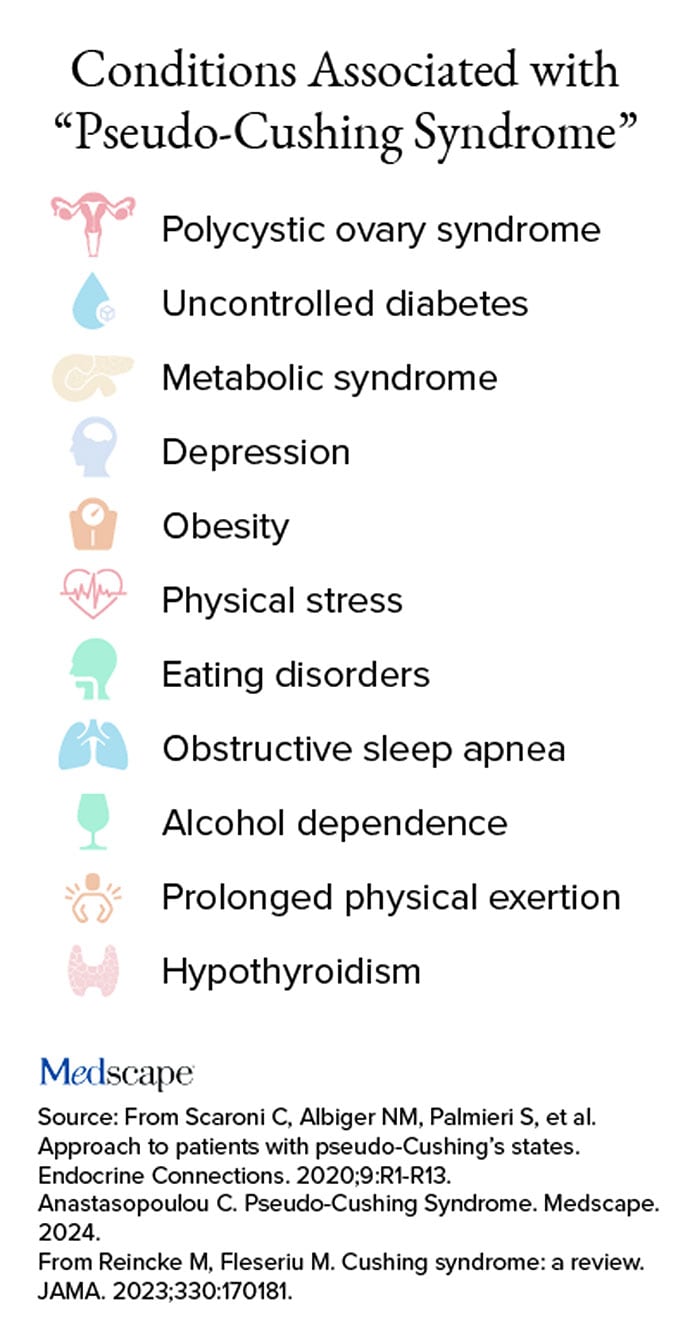
photo of an illustration

Identifying PCOS

photo of Katherine Sherif, MD
Katherine Sherif, MD

PCOS is often associated with central obesity, Sherif noted, but not all women with PCOS have overweight or a central distribution of fat.

“Ask about menstrual periods and whether they come monthly,” Sherif advised. “If women using hormonal contraception say they have a regular cycle, ask if their cycle was regular prior to starting contraception. So many women with PCOS are undiagnosed because they started contraception in their teens to ‘regulate their periods’ and never realized they had PCOS.”

Additional symptoms of PCOS and its impact are found in the figure below.
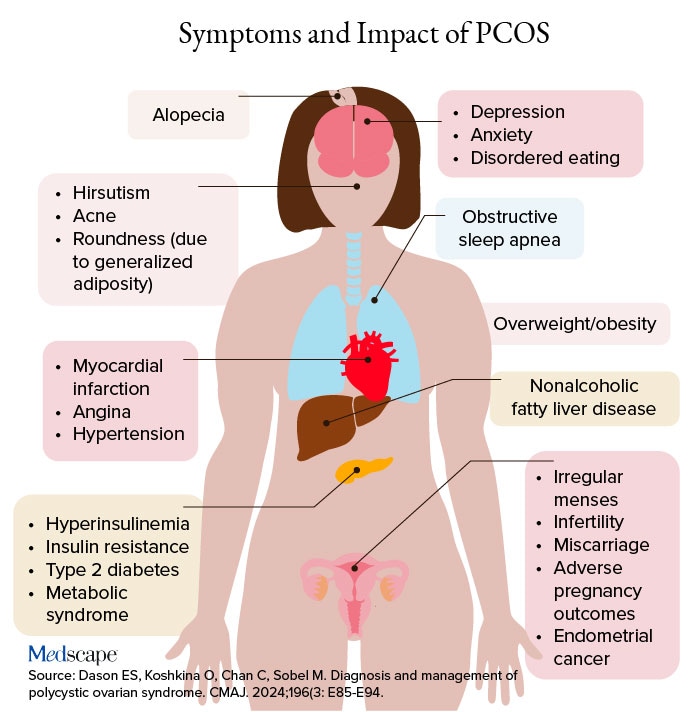
photo of an illustration

PCOS is diagnosed when two of the following three Rotterdam criteria are met, and other diagnoses are excluded: 

  1. Irregular menstrual cycles
  2. Clinical hyperandrogenism or biochemical hyperandrogenism
  3. Polycystic ovarian morphology on transvaginal ultrasonography or high anti-mullerian hormone (applicable only if patient is ≥ 8 years from menarche)

If PCOS is suspected, further tests can be conducted to confirm or rule out the diagnosis.

Alcohol Abuse

Alcohol abuse stimulates hypothalamic corticotropin-releasing hormone, leading to increased ACTH levels. It’s associated with a higher fasting cortisol level, particularly at 8:30 AM or so, and attributable to impaired cortisol clearance due to alcohol-related hepatic dysfunction. The LDDST will show abnormal cortisol suppression.

Sherif advised asking patients about alcohol use, recommending treatment for alcohol use disorder, and repeating clinical and biochemical workup after patients have discontinued alcohol consumption for ≥ 1 month.

Eating Disorders Mimicking CS

Eating disorders, particularly anorexia nervosa, are associated with endocrine abnormalities, amenorrhea, impaired body temperature regulation, and hypercortisolism, likely due to chronic fasting-related stress. Dysregulation of the HPA axis may linger, even after weight recovery.

It’s unlikely that patients with anorexia will display the “rounded face” associated with hypercortisolism, but some research suggests that anorexia can result in a disproportionate accumulation of central adiposity after recovery from the illness.

Neuropsychiatric Disorders

Major depressive disorder (MDD) is associated with HPA axis hyperactivity, with 20%-30% of patients with MDD showing hypercortisolemia. The post-awakening cortisol surge is more pronounced in those with MDD, and about half of patients with MDD also have high evening cortisol levels, suggesting disrupted diurnal cortisol rhythms.

Some patients with MDD have greater resistance to the feedback action of glucocorticoids on HPA axis activity, with weaker sensitivity often restored by effective pharmacotherapy of the depressive condition. Neuropsychiatric disorders are also associated with reduced activity of cortisol-deactivating enzymes. Posttraumatic stress disorder and anxiety are similarly associated with hypercortisolemia.

Addressing neuropsychiatric conditions with appropriate pharmacotherapy and psychotherapy can restore cortisol levels to normal proportions.

Diabetes, Obesity, Metabolic Syndrome

Diabetes, obesity, and metabolic syndrome can occur comorbidly with CS, and many patients with these conditions may display both a rounder face, some central adiposity, and hypercortisolemia. For example, obesity is often related to a hyperresponsive HPA axis, with elevated cortisol secretion but normal-to-low circulatory concentrations.

Obesity is associated with increased cortisol reactivity after acute physical and/or psychosocial stressors but preserved pituitary sensitivity to feedback inhibition by the LDDST. When these conditions are appropriately managed with pharmacotherapy and lifestyle changes, cortisol levels should normalize, according to the experts.

Hypothyroidism

Hypothyroidism— Hashimoto disease as well as the subclinical variety — can be associated with weight gain, which may take the form of central obesity. Some research suggests a bidirectional relationship between hypothyroidism and obesity.

“Years ago, we didn’t conduct thyroid tests very often but now they’re easy to do, so we usually catch people with hypothyroidism at the beginning of the condition,” Sherif said. “If the patient’s thyroid hasn’t been checked in a year or so, thyroid hormone testing should be conducted.”

Thyroid disease can easily be managed with the administration of thyroid hormones.

Obstructive Sleep Apnea (OSA)

OSA has an impact on HPA axis activation, especially when accompanied by obesity and hypertension. A meta-analysis of 22 studies, encompassing over 600 participants, found that continuous positive airway pressure treatment in patients with OSA reduced cortisol levels as well as blood pressure.

Exogenous Corticosteroids

Oral corticosteroid treatment is a cornerstone of therapy in transplant, rheumatic, and autoimmune diseases. The impact of chronic exposure to exogenous glucocorticoids is similar to that with endogenous glucocorticoids.

Sherif said corticosteroid treatment can cause facial roundness in as little as 2 weeks and is characteristic in people taking these agents for longer periods. Although the effects are most pronounced with oral agents, systemic effects can be associated with inhaled corticosteroids as well.

Finding alternative anti-inflammatory treatments is advisable, if possible. The co-administration of metformin might lead to improvements in both the metabolic profile and the clinical outcomes of patients receiving glucocorticoids for inflammatory conditions.

Educating Patients

“There’s much we still don’t know about hypercortisolemia and CS, including the reasons for its impact on metabolic derangement and for the accumulation of fat in particular adipose patterns,” Ben-Shlomo said. “But experienced endocrinologists do know relatively well how to diagnose the condition, distinguish it from other conditions presenting with central obesity or a rounder face, and treat it.”

Given the casual use of the terms “moon face” and “extra cortisol” on social media, it’s important for physicians to educate patients about what elevated cortisol does and doesn’t do, and design treatment strategies accordingly.

Neither Ben-Shlomo nor Sherif reported having any disclosures.

https://www.medscape.com/viewarticle/round-face-viral-terms-real-diagnostic-implications-2024a1000kia

Fibroids: Medical Therapy, Not Hysterectomy, Should Be First Treatment Choice

 Although hysterectomy remains the most common procedure for treating fibroids and fibroids are the leading indication for hysterectomy, its long-term sequelae make less invasive alternatives the better choice for managing most of these myometrial masses, an invited clinical practice paper in the New England Journal of Medicine (NEJM) asserts. 

The practice summary also calls for earlier identification and treatment of fibroid disease and may raise awareness among general gynecologists and primary care physicians less familiar with newer treatments.

Based on a review of evidence and existing formal guidelines, the paper urges wider use of uterus-sparing approaches such as hormone therapy, uterine-artery embolization, focused ultrasound ablation, and radiofrequency ablation. Authored by ob/gyns Elizabeth A. Stewart, MD, and Shannon K. Laughlin ‑ Tommaso, MD, MPH, o f the Mayo Clinic in Rochester, Minnesota, the document also features textbook-style diagrams illustrating procedures.

“To clarify, this is not a new guidance but an invited clinical practice paper,” Laughlin-Tommaso told Medscape Medical News. “I believe NEJM recognized the gap in knowledge among all providers, for early diagnosis of uterine fibroids, especially in young patients and those presenting with anemia.”

The l ess invasive treatments highlighted in the paper can help women recover faster and resume their normal activities more quickly, said Laughlin-Tommaso. “Additionally, many studies have now shown that there are health benefits to keeping the uterus and the ovaries.”

Despite multiple uterine-sparing options, however, a recent study in a commercially insured population found nearly 60% of fibroid patients undergoing hysterectomy had never received a prior conservative treatment.

Why hysterectomy for a benign condition? Hysterectomy, which is universally available in ob/gyn practices, makes decision-making easier for medical providers and patients, Laughlin-Tommaso explained. “It’s the only treatment that is definitive in that patients will not have bleeding or fibroids in the future and providers don't have to determine which fibroids to treat or remove.”

More common in Black women, fibroids affect up to 80% of persons with a uterus during their lifetime and up to 50% have symptoms such as heavy and prolonged menstrual bleeding, anemia-associated fatigue, pelvic pressure, and menstrual and nonmenstrual pain, the authors noted. These lesions can also compress nearby structures causing painful intercourse, constipation, and urinary frequency, urgency, or retention.

In 2021 the American College of Obstetricians and Gynecologists issued a practice bulletin on the management of symptomatic uterine leiomyomas, similarly endorsing individualized care that accounts for the desire to preserve fertility or the uterus, increase quality of life, and reduce symptoms. It, too, recommended medical management as first-line treatment for symptomatic fibroids.

“This paper will be helpful for clinicians by covering some of the newer options such as gonadotropin-releasing hormone antagonists introduced in the past 5 years and tailoring treatment to patients depending on whether they still want to conceive,” said Sandra M. Hurtado, MD, an ob/gyn and an assistant professor at UTHealth Houston Medical Center and McGovern Medical School in Houston, Texas, in an interview. “And the illustrations will be useful to doctors who are not gynecologists and will help to explain the interventional options to patients,” added Hurtado, who was not involved in the paper.

Offering another outside perspective on the paper, Charles J. Ascher-Walsh, MD, senior system vice chair for gynecology and division director of urogynecology in the Raquel and Jaime Gilinski Department of Obstetrics, Gynecology and Reproductive Science at Mount Sinai in New York City, called it a useful though not new summary. Reaching the wider audience of NEJM may raise awareness of newer fibroid therapies among general, nonspecialist ob/gyns, whose practices may concentrate largely on obstetrics, he added, “and the excellent illustrations clarify the treatment options.” In his view, broader awareness may increase much-needed funding for this neglected area of research.

Among the paper’s recommendations:

Diagnosis

Pelvic ultrasonography is the most cost-effective imaging method, providing information on size, location, and number of fibroids and ruling out adnexal masses. It is limited, however, by less-accurate resolution if the uterine volume is greater than 375 mL or if fibroids number more than four.

Medical Alternatives

Early diagnosis and first-line medical therapies are recommended.

Contraceptive hormones to control heavy menstrual bleeding are the first step in most algorithms for treating fibroid-related bleeding, despite low-quality evidence.

Nonsteroidal anti-inflammatory agents and tranexamic acid during menstruation also limit heavy menses but have more evidence of efficacy for idiopathic heavy menses.

Gonadotropin-releasing hormone (GnRH) agonists in depot form are approved for short-term preoperative therapy. While they cause amenorrhea in nearly 90% of patients and reduce uterine volume by 30%-60%, they have a high incidence of hypogonadal symptoms, including bone loss and hot flushes. They also cause a “steroidal flare” when the stored gonadotropins are released and cause subsequent heavy menstrual bleeding with the rapid decrease in estrogen levels. 

Oral GnRH antagonist combinations are a major therapeutic advance, pairing a GnRH antagonist (such as elagolix or relugolix, which rapidly inhibit ovarian steroidogenesis) with estradiol and progestin at doses equivalent to systemic levels in the early follicular phase of the menstrual cycle.

In clinical trials these combinations decreased heavy menstrual bleeding by 50%-75%, pain by 40%-50%, and bulk-related symptoms through a 10% decrease in uterine volume. Side effects are few, with hot flushes, headaches, and nausea occurring in fewer than 20% of participants.

Interventional Options

Smaller fibroids in the submucosal to intramural spaces can be treated transcervically, while larger lesions of any type or smaller subserosa fibroids are treated abdominally.

Uterine-artery embolization uses minimally invasive radiologically guided catheterization to release embolic particles directly into both uterine arteries. This process causes ischemic infarction of the fibroids and decreases bleeding, pain, and bulk-related symptoms. 

Other procedures shrink individual fibroids with energy that creates coagulative necrosis. These include focused ultrasound ablation (with MRI or ultrasound guidance) and radiofrequency ablation (with laparoscopic or transcervical ultrasound guidance).

Unlike uterine-artery embolization, which treats all fibroids concurrently, these therapies require individual targeting of fibroids. 

Radiofrequency ablation can be done concurrently with other surgical therapies, such as laparoscopic excision of endometriosis or hysteroscopic myomectomy. 

Myomectomy, or the surgical removal of fibroids, is most often used in persons actively seeking pregnancy or having very large fibroids in whom shrinkage would be inadequate. Most guidelines recommend surgical excision rather than shrinking procedures to optimize fertility. However, myomectomy often commits patients to future cesarean section, which increases pregnancy-related morbidity.

Although myomectomy is seen as superior to uterine-artery embolization for improving quality of life, both approaches provide substantial symptom relief.

Recurrence

Incidence of recurring fibroids is high, with, for example, new fibroids developing in approximately 50% of persons within 5 years of myomectomy. 

Earlier this year, a large cohort study reported that myomectomy was best for avoiding reintervention after surgical leiomyoma management.

Reintervention rates vary according to procedure, patient age, disease extent, and symptoms and can be as high as 33% up to 5 years after treatment, with lower percentages seen among persons older than 45 years of age.

Hysterectomy

Minimally invasive hysterectomy is recommended. Drawbacks to hysterectomy include perioperative risk and concomitant oophorectomy, which was common until the early 2000s when large cohort studies showed elevated risks of death, cardiovascular disease, dementia, and other illnesses compared with hysterectomy plus ovarian conservation. Oophorectomy but not hysterectomy rates have since decreased.

Still needing study, according to Laughlin-Tommaso are the underlying reasons for health disparities in fibroids, especially among Black and Latina individuals. “Some studies have found associations with vitamin D deficiency and with stress and racism,” she said.

Looking ahead, the authors stressed the need for a fibroid risk-prediction model, a staging system, and large randomized trials of treatment effectiveness. Also needed are methods for primary and secondary prevention. “Earlier screening and medical treatment in primary care settings could potentially minimize morbidity and the incidence of unnecessary hysterectomies, and primary care–based screening trials are warranted,” they wrote.

Case Study

In addition to procedural illustrations the practice document includes a vignette of a 33-year-old never-pregnant Black woman (but desiring motherhood) with heavy menstrual bleeding, abdominal bloating, and non–iron deficiency anemia. Evaluation for thalassemia and sickle cell anemia is negative, but ultrasonography reveals an enlarged uterus with multiple fibroids and normal ovaries.

In line with the clinical review, the authors prescribe oral GnRH agonist combination therapy, plus iron and multivitamin supplementation, and recommend annual reassessment — earlier if pregnancy is desired or if symptoms escalate. Since the patient prioritizes fertility, hysterectomy would be appropriate only if she had biopsy-proven cancer. 

The authors received no external funding for this practice paper, but both have funding from the National Institutes of Health for fibroid research. Laughlin-Tommaso reported royalties from UpToDate. Stewart reported research support from the Agency for Healthcare Research and Quality, and speaking, data-monitoring, and consulting fees for various private companies, including AbbVie, Anylam Pharmaceuticals, ASKA Pharma, and Movant Sciences. She holds a patent on treatment for abnormal uterine bleeding and has been involved in CME for various medical educational agencies. Hurtado and Ascher-Walsh had no relevant conflicts of interest to declare. 

https://www.medscape.com/viewarticle/fibroids-medical-therapy-not-hysterectomy-should-be-first-2024a1000kih

'Doctors Caution Over Weight Loss Drug Link to Nurse's Death'

 Doctors have urged caution in linking the weight loss drug tirzepatide to the death of a 58-year-old nurse from Scotland.

Susan McGowan, from North Lanarkshire, took two low-dose injections of tirzepatide (Mounjaro) for around 2 weeks before her death in September. 

BBC News reported that multiple organ failureseptic shock, and pancreatitis were listed on her death certificate as the immediate cause of death, with "the use of prescribed tirzepatide" recorded as a contributing factor.

McGowan worked as a nurse at University Hospital Monklands in Airdrie. A family member said that, apart from carrying a "bit of extra weight" , she had been otherwise healthy and was not taking any other medication.

It is understood that McGowan had sought medical advice before purchasing a prescription for tirzepatide through a registered UK pharmacy. However, days after administering a second injection, she went to A&E at Monklands with severe stomach pain and sickness. She died on September 4.

Commenting to the Science Media Centre (SMC), Amanda Adler, MD, PhD, professor of diabetic medicine and health policy at the University of Oxford, described the nurse's death as "sad" but said that "whether or not it was related to tirzepatide may be difficult to prove". While tirzepatide can be associated with uncommon problems such as acute pancreatitis, "one can develop acute pancreatitis for many other reasons as well", she said. 

Naveed Sattar, MD, PhD, professor of metabolic medicine at the University of Glasgow, noted that data from multiple trials of tirzepatide, involving around 10,000 people living with diabetes or obesity, "do not suggest a higher risk of pancreatitis". Furthermore, "the data seem to show acceptable safety thus far and a range of benefits including sizeable average weight loss (near 20%), strong diabetes prevention, and considerable benefits in people living with sleep apnoea", he told the SMC.

Tirzepatide, a GLP-1 receptor agonist, was approved for use as a weight loss aid in the UK in November last year by the Medicines and Healthcare products Regulatory Agency (MHRA). It lists nausea, diarrhoea, and vomiting as the most common side effects, as well as hypoglycaemia for patients with diabetes.

Available figures under the Yellow Card scheme up to 19 May 2024 show that there were 208 adverse drug reactions reported about tirzepatide this year, including 31 serious reactions and one suspected death of a man in his sixties.

In a statement, a spokesperson for the drug’s manufacturer, Eli Lilly, said, “Patient safety is Lilly’s top priority. We are committed to continually monitoring, evaluating, and reporting safety information for all Lilly medicines. 

“Mounjaro (tirzepatide) was approved based on extensive assessment of the benefits and risks of the medicine, and we provide information about the benefits and risks of all our medicines to regulators around the world to ensure the latest information is available for prescribers. If anyone is experiencing side effects when taking any Lilly medicine, they should talk to their doctor or other healthcare professional.” 

In October, the NHS submitted plans to the National Institute for Health and Care Excellence (NICE) for a phased rollout of tirzepatide in England that would initially prioritise patients with the greatest clinical need. The first phase would see the drug available to people with a body mass index of more than 40 kg/m2 who also suffer from at least three of the main weight-related health problems: hypertension, dyslipidaemia, obstructive sleep apnoea, and cardiovascular disease.

“Our sincere sympathies are with the family of individual concerned," said Dr Alison Cave, MHRA Chief Safety Officer.

“Patient safety is our top priority and no medicine would be approved unless it met our expected standards of safety, quality and effectiveness. Our role is to continually monitor the safety of medicines during their use, such as GLP-1 RAs. We have robust, safety monitoring and surveillance systems in place for all healthcare products.  

“New medicines, such as tirzepatide, are more intensively monitored to ensure that any new safety issues are identified promptly. We strongly encourage the reporting of all suspected reactions to newer medicines, which are denoted by an inverted Black Triangle symbol.

“On the basis of the current evidence the benefits of GLP-1 RAs outweigh the potential risks when used for the licensed indications. The decision to start, continue or stop treatments should be made jointly by patients and their doctor, based on full consideration of the benefits and risks." 

He encouraged patients and healthcare professionals to continue reporting suspected side effects to GLP-1 RAs, such as tirzepatide, through our Yellow Card Scheme. "When a safety issue is confirmed, we always act promptly to inform patients and healthcare professionals and take appropriate steps to mitigate any identified risk.”

The Department of Health and Social Care declined to comment. 

Adler disclosed being involved as an unpaid investigator on an Eli Lilly-funded trial for a different drug. 

Sattar, MD, PhD, has disclosed no relevant financial relationships.  

https://www.medscape.com/s/viewarticle/doctors-caution-over-weight-loss-drug-link-nurses-death-2024a1000kiu

OpenAI applies new techniques to train models as performance plateaus: report

 Microsoft-backed OpenAI is applying new techniques to improve the performance of its upcoming large language model, code-named Orion

https://seekingalpha.com/news/4275270-openai-applies-new-techniques-to-improve-upcoming-model-report

'Finland dismisses 'Finlandisation' model for Ukraine'

Forcing neutrality onto Ukraine will not bring about a peaceful solution to the crisis with Russia, Finland's foreign minister said on Monday, adding that Moscow could not be trusted to adhere to any agreement it signs.

Ruled by tsarist Russia for more than a century, Finland gained independence in 1917. It then desperately fended off a Soviet invasion in 1939 and for a time sided with Nazi Germany in a bid to win back lost territory.

As the war ended with Allied victory, Finland found itself compelled to spend decades maintaining friendly and accommodating relations with its eastern neighbour and treading a sometimes precarious path of neutrality to preserve independence - a tactic known as "Finlandisation".

With the prospect of U.S. president elect Donald Trump seeking to end the conflict as quickly possible and concerns from some allies that the terms could be imposed in Kyiv, one scenario could be to force a neutral status on Ukraine.

Russia has repeatedly demanded Ukraine remain neutral for there to be peace, which would de facto kill its aspirations for NATO membership.

RUSSIA TRUST ISSUES

Speaking in an interview with Reuters, Finland's Foreign Minister Elina Valtonen poured cold water on using the "Finlandisation" model, pointing out that firstly Helsinki had fended off Russia in World War 2 and that despite the ensuing peace had always continued to arm itself fearing a new conflict.

"I'm against it (Finlandisation), yes. Let's face it, Ukraine was neutral before they were attacked by Russia," Valtonen, whose country has a 1,300-km (810-mile) border with Russia, said on the sidelines of the Paris Peace Forum.

"It's definitely not something I would be imposing on Ukraine. Definitely not as a first alternative," adding that it would not make the problems go away.

The Ukraine invasion led both Finland and Sweden to abandon decades of military non-alignment and seek safety in the NATO camp.

Valtonen questioned whether Russia could be trusted even if it agreed a deal and said forcing Ukraine's hand to accept terms against its will would tear down the international system.

"I really want to avoid a situation where any European country, or the United States for that matter, starts negotiating over the heads of Ukraine," she said.

"A larger power can not just grab territory, but also essentially weaken the sovereignty of another nation," she said.

https://www.aol.com/news/finland-dismisses-finlandisation-model-ukraine-154513053.html

GSK Quits Trade Group BIO as Industry Faces Uncertain Political Future


GSK’s departure comes as the industry anticipates the incoming Trump administration and as it continues to grapple with the threat of the BIOSECURE Act and losses of legal challenges to the IRA’s drug price negotiation program.

GSK will not renew its membership with leading industry lobby group Biotechnology Innovation Organization, according to several media reports on Friday.

“At this time, we believe there are other areas we can focus our resources,” a GSK spokesperson in a statement to Fierce Pharma. “We remain committed to fostering a policy environment that prioritizes disease prevention, addresses health equity and access barriers, and incentivizes sustainable innovation.”

BIO has suffered several high-profile departures over the past year. In April 2024, Japanese pharma Takeda likewise revealed that it had not renewed its membership with the organization for its 2024 fiscal year, outlets reported at the time. That move followed similar ones by UCB and AbbVie.

And in December 2023, STAT also reported that pharma powerhouse Pfizer would be parting ways with BIO. In a statement at the time, the trade group’s chief public affairs and marketing officer Rich Masters said that the organization was “disappointed” by the departure, which he attributed to economic reasons. “But it in no way affects our mission of protecting patients and medical innovation in the United States.”

Perhaps most well-publicized of recent exits, however, is WuXi AppTec, which in March 2024 announced that it would cut ties with the lobby group over tensions surrounding the BIOSECURE Act.

GSK’s departure from BIO comes as the industry faces an uncertain future under the incoming Trump administration. Analysts see Trump’s election win as a modest positive for pharma, with a potentially more industry-friendly Federal Trade Commission (FTC) that is more lenient toward acquisitions and other transactions. However, this optimism is largely offset by the possibility of having Robert F. Kennedy hold a leadership role in the Department of Health and Human Services—including the FDA and CDC.

GSK’s BIO exit also coincides with the industry’s struggle to gain legal footing against the drug price negotiation program of the Inflation Reduction Act (IRA). The companies’ arguments touch on two main arguments of unconstitutionality—that the negotiations constitute the unlawful taking of their products without just compensation, thus violating the Fifth Amendment, and force them to parrot government talking points, in breach of the First Amendment.

Courts have largely been skeptical. In April 2024, New Jersey Judge Zahid Quraishi ruled against Johnson & Johnson and Bristol Myers Squibb. The judge also handed Novartis a similar defeat last month. In July 2024, Boehringer Ingelheim likewise lost its case against the IRA negotiations, as did industry group Pharmaceutical Research and Manufacturers of America (PhRMA) in February 2024.

These cases are in several stages of appeals. In September 2023, the Fifth Circuit Court of Appeals took PhRMA’s side and sent the case back to a lower Texas court, which will hear the merits of the group’s case against the IRA. Last week, the Third Circuit Court of Appeals heard arguments from AstraZeneca, J&J and BMS—though the three-judge panel did not indicate which way they leaned.

It is yet unclear how the Trump administration will affect the IRA, though analysts believe that the price negotiations could be revised or deprioritized.

BioSpace has reached out to both GSK and BIO and will update this article with new information as they become available.

https://www.biospace.com/business/gsk-quits-trade-group-bio-as-industry-faces-uncertain-political-future