Search This Blog

Wednesday, November 13, 2024

Minimally invasive neural interface allows brain access without skull opening

 A team of researchers led by Rice University's Jacob Robinson and the University of Texas Medical Branch's Peter Kan has developed a technique for diagnosing, managing and treating neurological disorders with minimal surgical risks. The team's findings were published in Nature Biomedical Engineering.

While traditional approaches for interfacing with the nervous system often require creating a hole in the skull to  with the brain, the researchers have developed an innovative method known as endocisternal interfaces (ECI), allowing for electrical recording and stimulation of neural structures, including the brain and , through  (CSF).

"Using ECI, we can access multiple brain and spinal cord structures simultaneously without ever opening up the skull, reducing the risk of complications associated with traditional surgical techniques," said Robinson, professor of electrical and computer engineering and bioengineering.

ECI uses CSF, which surrounds the nervous system, as a pathway to deliver targeted devices. By performing a simple lumbar puncture in the lower back, researchers can navigate a flexible catheter to access the brain and spinal cord.

Using miniature magnetoelectric-powered bioelectronics, the entire wireless system can be deployed through a small percutaneous procedure. The flexible catheter electrodes can be navigated freely from the spinal subarachnoid space to the brain ventricles.

"This is the first reported technique that enables a  to simultaneously access the brain and spinal cord through a simple and minimally invasive lumbar puncture," said Kan, professor and the Robert L. Moody Sr. Chair of Neurosurgery at UTMB. "It introduces new possibilities for therapies in stroke rehabilitation, epilepsy monitoring and other neurological applications."

To test the hypothesis, the research team characterized the endocisternal space and measured the width of the subarachnoid, or fluid-filled space, in human patients using magnetic resonance imaging. The researchers then conducted experiments in large animal models, specifically sheep, to validate the feasibility of the new neural interface.

Their experiments showed that the catheter electrodes could be successfully delivered and guided into the ventricular spaces and brain surface for electrical stimulation. By using the magnetoelectric implant, the researchers were able to record electrophysiologic signals such as muscle activation and spinal cord potentials.

Preliminary safety results showed that the ECI remained functional with minimal damage up to 30 days after the electronic device was implanted chronically into the .

Moreover, the study revealed that unlike endovascular neural interfaces that require antithrombotic medication and are limited by the small size and location of blood vessels, ECI offers broader access to neural targets without the medication.

"This technology creates a new paradigm for minimally invasive neural interfaces and could lower the risk of implantable neurotechnologies, enabling access to wider patient populations," said Josh Chen, Rice alumnus and lead author of the study.

More information: Joshua C. Chen et al, Endocisternal interfaces for minimally invasive neural stimulation and recording of the brain and spinal cord, Nature Biomedical Engineering (2024). DOI: 10.1038/s41551-024-01281-9


https://medicalxpress.com/news/2024-11-minimally-invasive-neural-interface-brain.html

'Indicators of an aging brain: A 20-year study'

 Johns Hopkins University-led researchers, working with the Biomarkers for Older Controls at Risk for Dementia (BIOCARD) cohort, have found that certain factors are linked to faster brain shrinkage and quicker progression from normal thinking abilities to mild cognitive impairment (MCI). People with type 2 diabetes and low levels of specific proteins in their cerebrospinal fluid showed more rapid brain changes and developed MCI sooner than others.

Long-term studies tracking  changes over many years are rare but valuable. Previous research mostly provided snapshots in time, which can't show how individual brains change over the years. By following participants for up to 27 years (20-year median), this study offers new insights into how health conditions might speed up brain aging.

In a study, "Acceleration of Brain Atrophy and Progression From Normal Cognition to Mild Cognitive Impairment," published in JAMA Network Open, researchers used the BIOCARD cohort to examine  associated with the acceleration of brain atrophy and progression from normal cognition to MCI. An Invited Commentary is also available.

BIOCARD was initiated at the National Institutes of Health in 1995 and continued at Johns Hopkins University from 2015 to 2023. A total of 185 participants, averaging 55 years old at the start and all cognitively normal, were selected. They underwent brain scans and tests of their cerebrospinal fluid over 20 years, measuring changes in brain structures and levels of proteins associated with Alzheimer's disease.

Findings showed that high rates of white matter shrinkage and enlargement of the brain's ventricles (fluid-filled spaces) were significant predictors of earlier MCI onset. Specifically, white matter atrophy was associated with an 86% higher risk and ventricular enlargement with a 71% higher risk of progressing to MCI.

Individuals with diabetes showed an average 41% higher risk of progressing from normal cognition to MCI compared to individuals without.

A low ratio of amyloid β peptides Aβ42 to Aβ40 in  was associated with a 48% higher risk of developing MCI. This ratio acts as a biomarker for Alzheimer's disease, where an imbalance between these two forms of amyloid beta proteins is linked to the formation of harmful plaques in the brain.

When participants had both  and a low Aβ42 to Aβ40 ratio, their risk of progressing to MCI increased by 55%, demonstrating that these two factors together significantly heighten the likelihood of cognitive decline.

These results support the importance of early identification of individuals exhibiting accelerated brain atrophy and certain unfavorable biomarkers. By recognizing when higher risk is present, preventive intervention strategies can be optimized to delay or hopefully even prevent the onset of MCI.

Long-term  like the current one are essential to deepen the understanding of how these factors interact and influence the aging brain.

More information: Study: Yuto Uchida et al, Acceleration of Brain Atrophy and Progression From Normal Cognition to Mild Cognitive Impairment, JAMA Network Open (2024). DOI: 10.1001/jamanetworkopen.2024.41505

Invited Commentary: Shohei Fujita, Optimizing Strategies to Prevent Cognitive Decline With 20-Year Brain Imaging, JAMA Network Open (2024). DOI: 10.1001/jamanetworkopen.2024.41466


https://medicalxpress.com/news/2024-11-indicators-aging-brain-year.html

Dear Border Czar: This Nonprofit Boasts A List Of 400 Companies That Employ Migrants

 President-elect Donald Trump made public safety and national security a central element of his campaign, ensuring the American people that illegal aliens would be deported. 

On Monday, incoming "border czar," Tom Homan, told "Fox & Friends" hosts, "Public safety threats and national security threats will be the priority...they pose the most danger to this country." 

Homan said, "Where do we find most victims of sex trafficking and forced labor trafficking? At worksites..." 

Homan's comment about the potential for large-scale worksite raids by Immigration and Customs Enforcement (ICE) agents next year reminded us of a note we shared with readers in March titled "How Shadowy Network Of NGOs Supplies Mega-Corporations With Migrants To Exploit Cheap Labor."

Earlier this year, Bloomberg paraded Turkish billionaire businessman and founder of the Chobani yogurt empire, Hamdi Ulukaya, a top Kamala Harris supporter, who, according to public records data, is one of the officers of the Tent Partnership for Refugees, an advisory nonprofit that companies use to work with resettlement agencies, staffing agencies, and other nonprofits, to source cheap migrant labor. 

In March, Ulukaya explained to Bloomberg that "employing refugees and committing to their successful onboarding is what's driving Chobani's success" and allowed it to double its earnings in the first nine months of 2023. 

A separate Bloomberg note showed that Tyson Foods partnered with Ulukaya's Tent for cheap labor. As of March, Tyson employed a whopping 42,000 immigrants among its 120,000 US workforce. 

"We would like to employ another 42,000 if we could find them," Garrett Dolan, who leads Tyson's efforts to eliminate employment barriers, said in March. 

What's very clear is that migrants did not aimlessly walk across the wide-open southern border and then find instant job placements that displaced and replaced blue-collar native-born workers. There is a massive NGO network, internationally and domestically, that channels unvetted migrants from foreign lands into US factories.

Suppose the Trump administration wants to learn more about potential worksites that have hired migrants over the years.

In that case, Tent boasts a massive network of 400 companies hiring migrants.

Here's the partial list...

Homan's team will have a field day with Tent's list. 

America can no longer afford to have ten-plus million unvetted illegal aliens running around the nation.

Mega-corporations that have displaced US workers with migrants over the years are likely to face significant labor challenges next year if worksite raids are conducted by ICE. Perhaps it's time to consider hiring American workers again.

https://www.zerohedge.com/markets/dear-border-czar-nonprofit-boasts-400-companies-employ-migrants

Revolutionary 'Morphing' Wheel Powers Mobility and Innovation


The Korea Institute of Machinery and Materials has developed a 'morphing' wheel, which can adapt its form to navigate obstacles like stairs. Intended applications include wheelchairs and unmanned vehicles, with potential use in industrial robots. The wheel's flexibility is inspired by the fluid dynamics of water droplets.

The groundbreaking 'morphing' wheel, created by researchers at the Korea Institute of Machinery and Materials (KIMM), promises to revolutionize mobility. Equipped with flexibility comparable to fluid dynamics, the wheel can overcome obstacles such as curbs and staircases.

Potentially applicable to wheelchairs and unmanned vehicles, the wheel could transform how goods are delivered and how mobility-assistive devices function. Researchers aim for these wheels to eventually enable robots to achieve speeds comparable to automobiles.

The innovative technology was a highlight in the journal Science Robotics in August, representing a leap forward in flexible wheel technology. It automatically adjusts stiffness via a sensor responsive to varied terrains.

OpenAI, Google, & Anthropic Face Hurdles In Advancing AI Models, Casting Doubt On Near-Term AGI

 Tech companies focused on chatbot development, like OpenAI, Google, and Anthropic, have faced significant near-term headwinds in advancing large language models. Despite tens of billions of dollars in investments, these tech firms are experiencing diminishing returns in advancing more sophisticated LLMs.

Sources told Bloomberg that OpenAI's new Orion LLM has experienced performance limitations. This means the new LLM would outperform the firm's existing models, but it does not mean there will be a significant leap in development, like that of GPT-3 to GPT-4. 

As of late summer, for example, Orion fell short when trying to answer coding questions that it hadn't been trained on, the people said. Overall, Orion is so far not considered to be as big a step up from OpenAI's existing models as GPT-4 was from GPT-3.5, the system that originally powered the company's flagship chatbot, the people said. -BBG

The breakneck pace of developing more sophisticated LLMs appears to have also hit a proverbial brick wall at Google, in which its Gemini software has not lived up to expectations, according to sources, adding Anthropic also faces challenges with its long-awaited Claude model called 3.5 Opus. 

Bloomberg noted one of the top obstacles these tech firms have encountered has been "finding new, untapped sources of high-quality, human-made training data that can be used to build more advanced AI systems." 

Sources said Orion's dismal coding performance was due to the lack of sufficient coding data to train the LLM. They added that even though the model has improvements compared to legacy ones, it has become increasingly challenging to justify the massive costs of building and operating new models. 

The setbacks may reveal an inconvenient truth for the tech industry plowing tens of billions of dollars into AI data centers and infrastructure, and the feasibility of reaching artificial general intelligence in the near future might be a pipedream. 

John Schulman, cofounder and research scientist at OpenAI who recently left, said AGI could be achieved within a few years. Dario Amodei, CEO of Anthropic, believes it could be achieved by 2026. 

However, Margaret Mitchell, the chief ethics scientist at AI startup Hugging Face, pointed out, "The AGI bubble is bursting a little bit," adding that "different training approaches" may be needed for progress. 

In a recent interview with Lex Fridman, Anthropic's Amodei said there are "lots of things" that could "derail" the AI progression, including the possibility that "we could run out of data." However, he was optimistic that AI researchers would overcome any hurdles.  

Scaling efforts are slowing... 

Source: Bloomberg

"It is less about quantity and more about quality and diversity of data," said Lila Tretikov, head of AI strategy at New Enterprise Associates and former deputy CTO at Microsoft.

Tretikov said, "We can generate quantity synthetically, yet we struggle to get unique, high-quality datasets without human guidance, especially when it comes to language."

Moving forward, Noah Giansiracusa, an associate professor of mathematics at Bentley University in Waltham, Massachusetts, said AI models will continue to improve, but the hypergrowth in recent years is unsustainable:

"We got very excited for a brief period of very fast progress. That just wasn't sustainable."

If tech firms are struggling to advance LLM performance, this raises serious doubts about whether large investments can continue to be made in AI infrastructure. 

"The infrastructure build for AI is the bubble. The AI 2.0 companies that can actually figure out a way to monetize it are the investments years from now. Might as well light a match to this fund. The infrastructure build like the telecom infrastructure during the dotcom boom will be oversupplied and pricing will collapse," Edward Dowd recently noted on X.

Well Nvidia has soared to new highs. 

AI companies struggling to develop more advanced LLMs is undoubtedly an ominous sign for the AI bubble

https://www.zerohedge.com/technology/openai-google-anthropic-face-hurdles-advancing-ai-models-casting-doubt-near-term-agi

Is Obama connected to the Dem panic about Hegseth as Defense Secretary?

 I am delighted with the roster of people Donald Trump will have at his side as he heads into the White House. (Some more than others, of course, but all are good.) Trump 2024 is a far cry from the naïve neophyte who entered the White House in 2017 when the Republican establishment treated him as if he had the plague and left him dependent on people who proved to be weak or damaging. I don’t even consider this “Trump 2.0.” This is MEGA MAGA TRUMP, and the administration comes in loaded for bear, ready to rip apart the entire Democrat government infrastructure that is smothering America.

What I love most of all is Trump’s decision to appoint Pete Hegseth to act as his Defense Secretary. The military is both America’s last and first line of defense against foreign enemies inside and outside of America’s borders—and for decades now, the Democrats have been chipping away at it.

Democrats have demoralized the military by snatching defeat from the jaws of victory in Vietnam (we won the Tet offensive), Iraq (we’d won until Obama pulled us out, leaving a vacuum for ISIS and Iran), and Afghanistan (we were at least maintaining until Biden gave us the most humiliating retreat in American history).
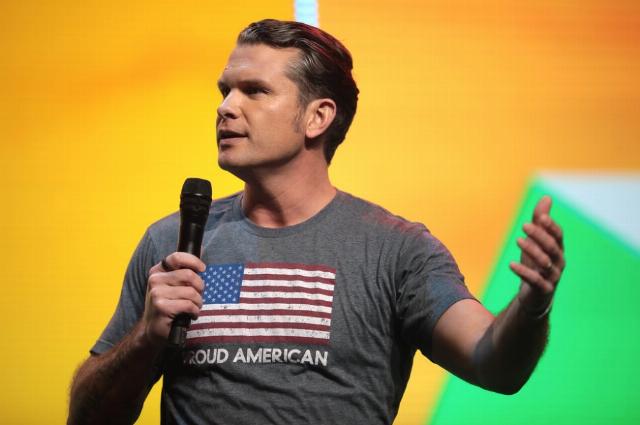
Image by Gage SkidmoreCC BY-SA 2.0.

Democrats have structurally weakened the military by focusing on climate change, not defense.

And Democrats have corrupted the military at a core level by bringing racial identity politics to what was once the best-integrated institution in America and by flooding it with people who have a deviant sexual agenda.

Pete Hegseth promises to stand against all of that. The worst thing I can say about Hegseth is that he’s Ivy League educated, which is always something to worry about in those who graduated after 1984 when those institutions became ideologically corrupted. His B.A. from Princeton and Masters in Public Policy from Harvard’s John F. Kennedy School of Government make him suspect in my eyes.

However, everything else about the man offsets those concerns. A member of the Minnesota Army National Guard (just like Tim Walz), Hegseth actually served as an infantry officer in both Iraq and Afghanistan. He eventually received two Bronze Stars and a combat infantry badge. Since leaving active duty, Hegseth has worked hard to improve life for military veterans. He’s also written multiple books with strong conservative themes, including The War on Warriors: Behind the Betrayal of the Men Who Keep Us Free, which attacks the Democrats’ relentless war on troops and the military itself.

Just to provide a contrast, remember that the left loved Obama’s Defense Secretary, Leon Panetta, who served two years in the Army (1964-1966), and then spent the rest of his life as a politician and Deep State operative.

Speaking of Panetta, Hegseth is rightly opposed to Panetta’s greenlighting women in combat roles. As I wrote when Panetta made this decision, it’s an appallingly bad idea:

Hegseth also has practical solutions to achieve good outcomes without exposing the troops, such as giving Israel free rein in fighting Iran:

You can see why leftists would hate Hegseth.

Some of the attacks are funny, as with Elizabeth Warren’s completely clueless take on his qualifications:

Joe Walsh, a NeverTrumper, sounded equally foolish:

However, there’s a frantic fury to the attacks against Hegseth that goes beyond the usual leftist animus toward anyone Trump would choose. They’re throwing everything at him—such as the fact he’ll be immune to lobbyist dollars (which Democrats clearly see as a negative):

Other attacks on Hegseth’s qualifications came from Rep. Dan Goldman (D-NY) (“I’m shocked... [B]eing a serviceman does not make you qualified to lead the Department of Defense...”); actor Wendell Pierce (“Pete Hegseth is the epitome of white privilege”); and the inimitable Joy Reid (who laughs about a Fox weekend morning show host helping to fill Trump’s “clown car”). The rank and file are even bringing up Hegseth’s obvious joke about washing his hands (and I say that as someone who is very OCD about clean hands).

 Reid may be laughing, but, as I said, there’s more than a whiff of panic here; there’s a stench. Why would that be? I think it relates to the CNN report that the Pentagon is mapping out ways to stage what is effectively a coup against President Trump by classifying his orders as “unlawful” and refusing to follow them.

Were I the only one saying this, I’d take me with a grain of salt. However, Lee Smith, one of the smartest political analysts you’ll find, thinks that a coup is on the table, and he traces this to Barack Obama’s last hurrah.

In a must-read essay entitled “Obama Isn’t Going Anywhere,” Smith examines how Obama has been running a shadow presidency since he left the White House in January 2017. It was he who seeded the Russia Hoax, got Biden into the White House when Kamala, his preferred candidate, flamed out in 2015, controlled Biden’s policy, and gave Biden the boot to give Kamala a second chance. Obama also refused to leave D.C., breaking a presidential tradition going back to George Washington.

Looking back, every one of Obama’s efforts failed to cement his legacy, as evidenced by the fact that he could not keep Trump—the new, fully-loaded Trump—out of the White House.

This is where we begin to see what will be Obama’s last hurrah: Getting our constitutional military, once the most trusted part of the American government, to undermine President Trump, effectively staging a military coup (something previously unimaginable in America). Or as Smith writes, “Now Obama is looking for another play, and it appears that it involves splitting the armed forces.”

Smith analyzes in some detail what the CNN report has to say about how Pentagon officials are gaming ways to prevent Trump from exercising his constitutional powers as president and commander-in-chief of U.S. military forces. While I urge you to read the whole essay, it’s the conclusion that may explain the panic about Pete:

Does the resistance really intend to move pieces in place to split the military or are they just bluffing to get Trump to back off on campaign promises that will topple two of its pillars? It might seem strange to threaten to destabilize the country on behalf of defense bureaucrats and illegal aliens, but the former constitute a crucial part of Obama’s network, and giving the latter the vote, as Trump’s landslide victory shows, may be the Democrats’ best chance to win national elections in the near future. It’s tempting to read the Brooks scenarios and the CNN report as resistance porn—a performance of the rituals and motions that this class has accustomed itself to over the course of the past eight years, as it now braces for the return of the president it did its best and failed to destroy.

Would Obama fracture the military to once again cripple Trump’s term in office? The former president is in a decidedly weaker position and facing a battle-hardened Trump. Still, it would be reckless to assume the best from the man who already proved his willingness to weaponize the national security apparatus against his political opponent. The president-elect shouldn’t take any chances.

Trump’s appointment of Hegseth, a battle-hardened veteran and a trustworthy outsider, shows that Trump isn’t taking any chances. I just hope that Hegseth is prepared for the Pentagon rebellion he may be facing and, if it occurs, moves swiftly and courageously to end even the whiff of sedition or a coup.

https://www.americanthinker.com/blog/2024/11/is_obama_connected_to_the_dem_panic_about_hegseth_as_defense_secretary.html

Vanguard Group increases GameStop position, surpassing CEO Ryan Cohen’s stake

 The asset-management giant has grown its stake in videogame retailer and original meme stock

The Vanguard Group Inc. has increased its position in GameStop Corp., according to a 13-F filing, with the asset-management giant's stake in the videogame retailer now surpassing that of GameStop Chief Executive Ryan Cohen's RC Ventures.

Vanguard, which was already GameStop's top institutional investor, now has 37,108,031 shares, or an 8.7% stake, in the popular meme stock, according to the filing with the Securities and Exchange Commission. Vanguard's previous position was 29,698,579 shares, or a 6.87% stake.

Cohen's RC Ventures has 36,847,842 shares, according to an SEC filing in June, representing a 8.64% stake in the company.

GameStop shares surged recently on no apparent news, before snapping a five-day winning streak on Tuesday. The stock ended Wednesday's session down 1.4% and saw trading volume of 18.38 million shares, above its 65-day average of 8.78 million shares.

The videogame retailer hasn't issued a press release since Oct. 15, when it announced a collaboration with trading-card and autograph authenticator and grading service Collectors.

Cohen, who endorsed Donald Trump in the presidential election, was named GameStop's CEO in September 2023. Last December, GameStop's board of directors approved a new investment policy permitting the company to invest in equity securities, among other investments. The board gave Cohen the authority to manage the investment portfolio.

GameStop (GME) shares are up 50.9% in 2024, outpacing the S&P 500 index's SPX gain of 25.5%.

https://www.morningstar.com/news/marketwatch/20241113734/vanguard-group-increases-gamestop-position-surpassing-ceo-ryan-cohens-stake