Search This Blog

Thursday, November 14, 2024

Hims & Hers stock falls as Amazon launches Telehealth offering

 Shares of Hims&Hers Health, Inc. (HIMS) dropped over 15% Thursday following Amazon’s announcement of new telehealth treatment options aimed at providing low-cost care for a range of health and beauty concerns, which could pose significant competition for Hims&Hers’ subscription-based health services.

Amazon (NASDAQ:AMZN) said its new telehealth services, available to Prime members, cover men’s hair loss, eyelash growth, anti-aging skincare, ED, and motion sickness, all with upfront pricing.

Amazon touts the service as offering convenience and affordability, with rates as low as $16 per month for hair loss treatments.

Bergen Penhart, general manager for Amazon One Medical (TASE:PMCN) Pay-per-visit, highlighted Amazon’s commitment to accessible, affordable health care, saying the new service allows Prime members “to get expert clinical advice and prescribed treatments for common health, beauty, and lifestyle needs, all from the comfort of home.”

Amazon’s telehealth visits are available 24/7, allowing users to consult with clinicians for $29 through messaging and $49 via video. Once diagnosed, Prime members can have prescriptions filled through Amazon Pharmacy, which offers free delivery directly to their door, often the same day in select cities.

In response to the announcement, the stock of Hims&Hers—a company specializing in telehealth and subscription-based wellness products—plunged as investors weighed the impact of Amazon’s pricing and distribution capabilities on Hims&Hers’ market share.

As Amazon aggressively moves into this space, analysts anticipate potential market disruption for existing telehealth services.


https://finance.yahoo.com/news/hims-hers-stock-falls-amazon-152229847.html

Nuvectis stock sinks on data for cancer drug

 Nuvectis Pharma (NVCT) stock falls as company posts interim data from a Phase 1b trial for its ovarian cancer drug candidate

https://seekingalpha.com/news/4290861-nuvectis-stock-sinks-data-cancer-drug

PPI Unexpectedly Prints Hotter Than Expected Across The Board

 After yesterday's in line - but really cooler than whispered - CPI which restored hope in a December rate cut, all eyes are on this morning's PPI print to boost dovish hopes that the Fed's easing cycle would remain on track. It was not meant to be, however, as the PPI came in hotter than expected across the board on both a monthly and annual basis.

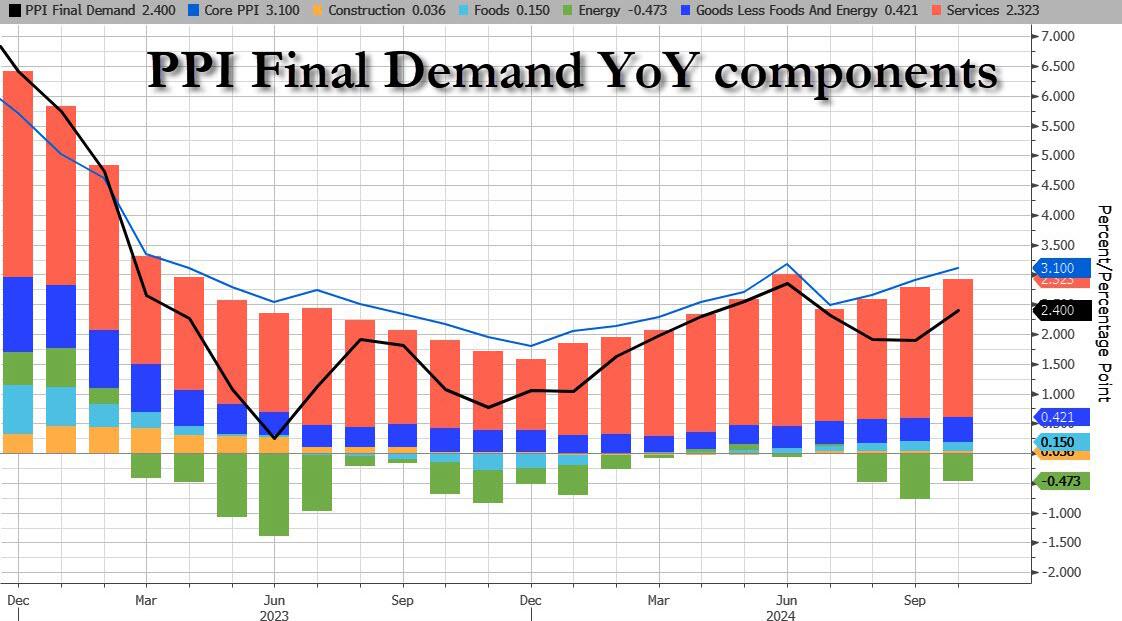
Starting at the top, headline PPI rose 0.2% MoM (in line with the +0.2% expected) but September was revised higher from 0.0% to 0.1%; meanwhile on an annual basis, headline PPI rose 2.4%, higher than the 2.3% expected, with the last month also revised higher from 1.8% to 1.9%.
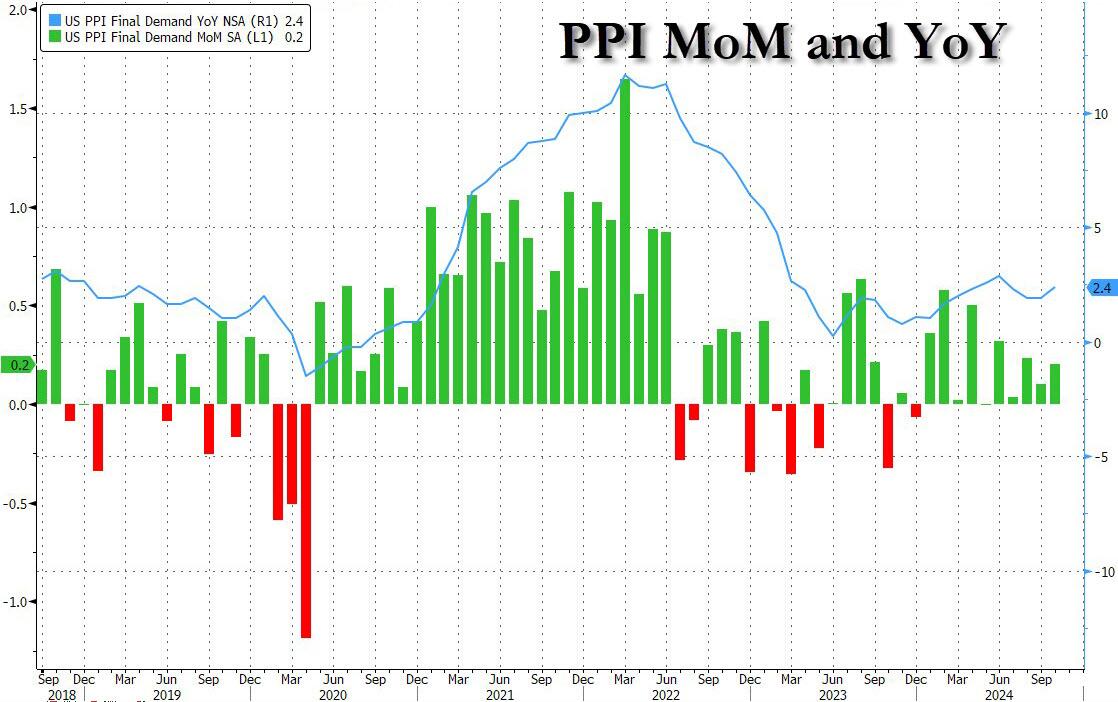
Unlike last month when a drop in energy prices weighed heavily on the headline PPI number, this month energy subtracted just 0.02% from the final print, the lowest detraction since July. Meanwhile, Services added a hefty 0.179% to the bottom line number.
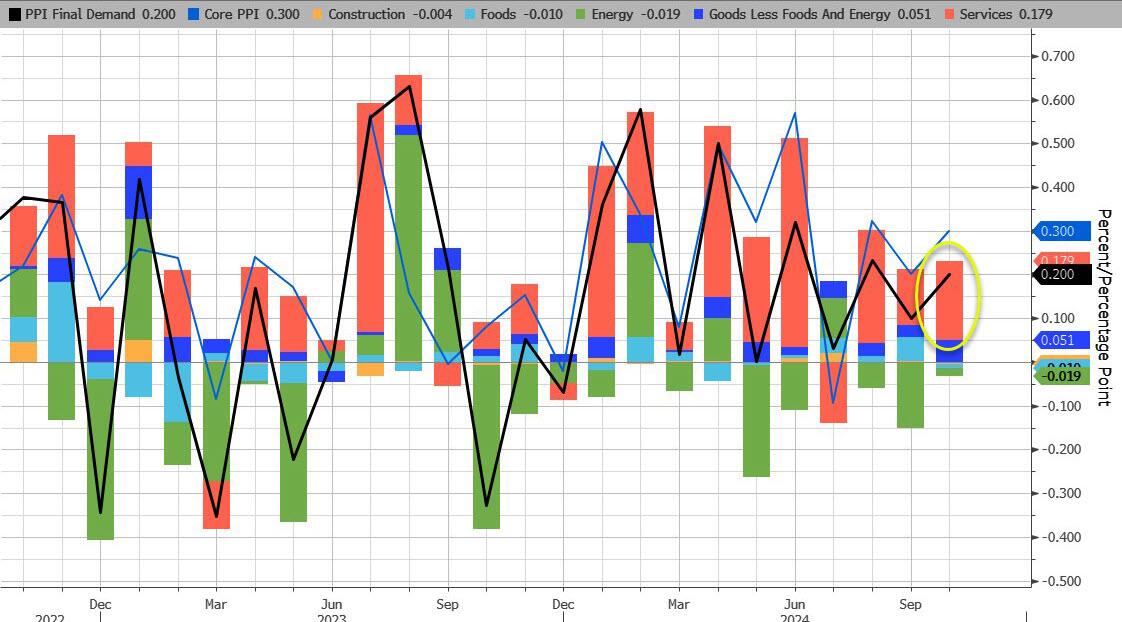
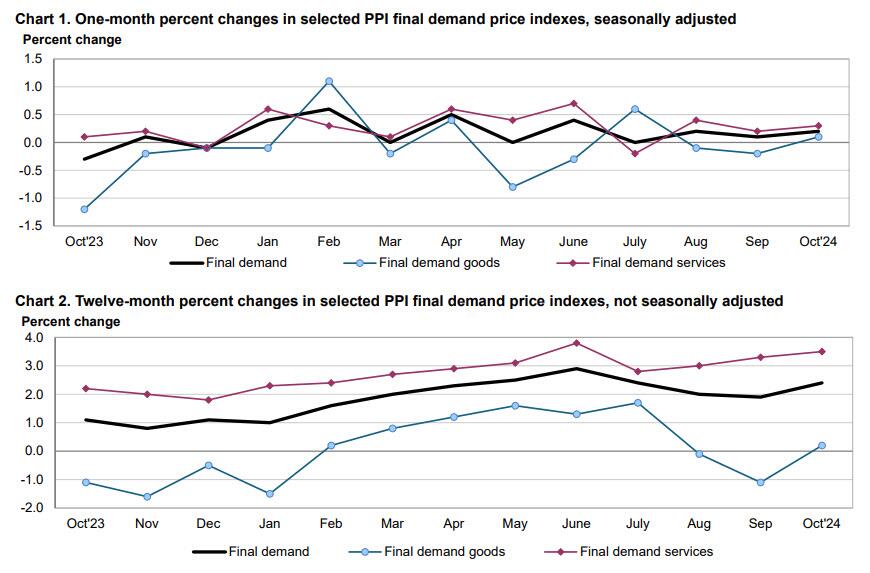
Indeed, according to the BLS, most of the rise in final demand prices can be traced to a 0.% advance in the index for final demand services. Prices for final demand goods inched up 0.1%, the first increase in the index since July.
Taking a closer look at the components:

Final demand services: The index for final demand services increased 0.3 percent in October after rising 0.2 percent in September. Over three-fourths of the broad-based advance in October is attributable to prices for final demand services less trade, transportation, and warehousing, which moved up 0.3 percent. The indexes for final demand transportation and warehousing services and for final demand trade services also increased, 0.5 percent and 0.1 percent, respectively. (Trade indexes measure changes in margins received by wholesalers and retailers.)

Product detail:

  • Over one-third of the rise in the index for final demand services can be traced to prices for portfolio management, which advanced 3.6 percent. The indexes for machinery and vehicle wholesaling; airline passenger services; computer hardware, software, and supplies retailing; outpatient care (partial); and cable and satellite subscriber services also moved higher.
  • In contrast, margins for apparel, footwear, and accessories retailing fell 3.7 percent. Prices for securities brokerage, dealing, investment advice, and related services and for truck transportation of freight also declined.

Final demand goods: The index for final demand goods inched up 0.1 percent in October following two consecutive decreases. The advance can be traced to a 0.3-percent rise in prices for final demand goods less foods and energy. Conversely, the indexes for final demand energy and for final demand foods declined 0.3 percent and 0.2 percent, respectively.

Product detail:

  • An 8.4-percent increase in the index for carbon steel scrap was a major factor in the advance in prices for final demand goods. The indexes for meats, diesel fuel, fresh and dry vegetables, and oilseeds also moved higher.
  • In contrast, prices for liquefied petroleum gas fell 18.1 percent. The indexes for chicken eggs, processed poultry, and ethanol also decreased.
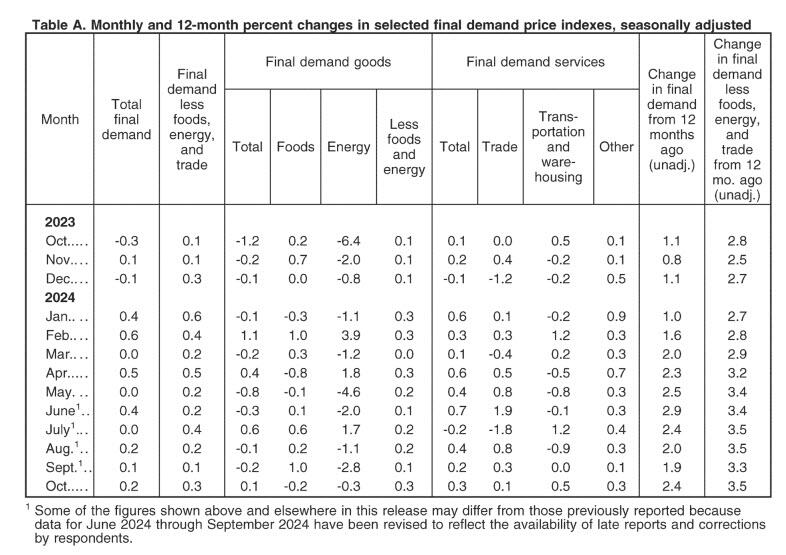
Even more problematic for the doves, however, is that core PPI jumped to +3.1% YoY (hotter than the 3.0% exp) with the prior month revised higher to 2.9% from 2.8%. This was the second hottest print going back to March 2023 with just the June outlier surge hotter than October...
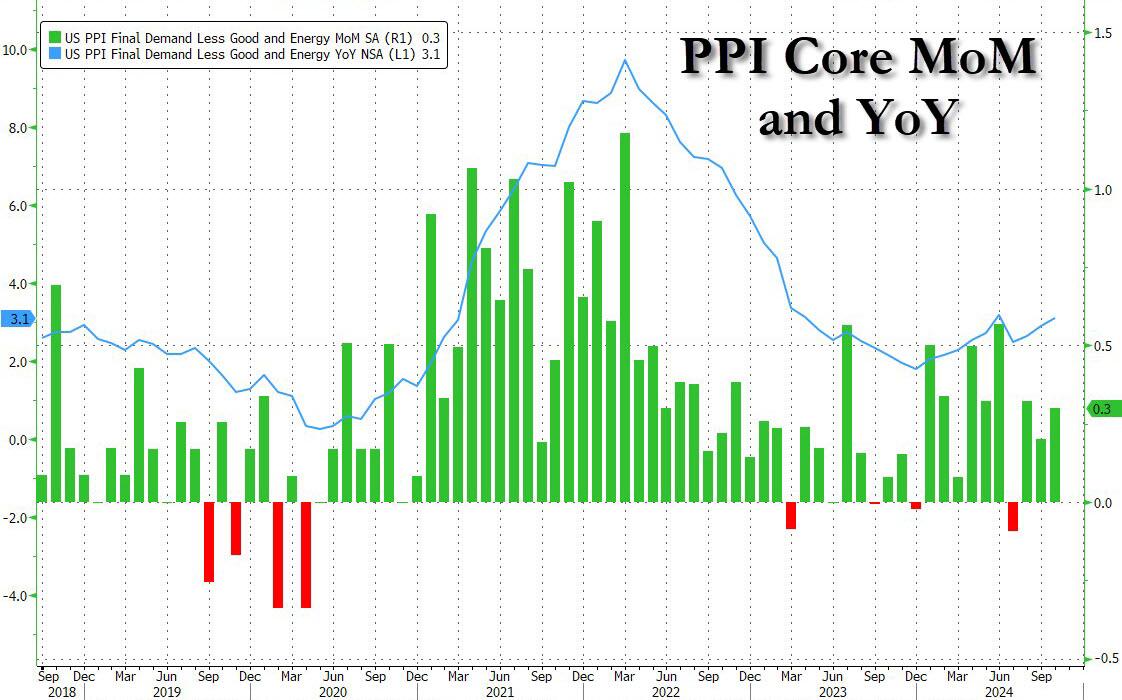
... as sticky Services costs continue to rise.
The hotter than expected PPIs have pushed yields and the dollar higher, even as the market waits to see the details of what impact today's numbers will have on the Fed's preferred core PCE metric - according to UBS key PPI components to PCE look hot - although Bloomberg noted a big jump in air passenger services (3.2%), which suggests some upside risks (i.e., 0.3% core PCE).

The most notable takeaway from the data appears to be the increase in final demand for services in October, which is similar to the factors that increased CPI yesterday -- shelter, food and energy, which are components the Fed cannot control with interest rates.

Bottom line: this is a long way from the Fed's mandated 2%, and it's moving in the wrong direction, something which has not been lost on the market, where Treasury curves are flattening after the data, which suggests traders are wavering over the prospects of a December rate cut. That has yet to be reflected in rates markets -- bets have been trimmed but marginally, not enough to really change the swaps market outlook as of now. According to BBG's Vince Cignarella, sizeable block trades are going through Treasuries, mostly in the five-year tenor and some ten-year tenors, which looks like positioning for higher yields and flatter curves.

https://www.zerohedge.com/markets/ppi-unexpectedly-prints-hotter-expected-across-board

Not Funny: The Onion Buys Infowars In Bankruptcy Auction

 The leftist-satirical rag The Onion announced on Thursday that it had won a bankruptcy auction to acquire Infowars - the website founded and operated by Alex Jones since 1999.

On Wednesday, Jones said that the auction's trustee could choose any bidder it wanted - not necessarily the high bidder. Jones announced the sale on X Thursday morning.

"I just got word 15 minutes ago that my lawyers and folks met with the U.S. trustee over our bankruptcy this morning and they said they are shutting us down even without a court order this morning," he said. "The Connecticut democrats with The Onion newspaper bought us."

The Onion told the NY Times that the bid was sanctioned by the families of the victims of the mass shooting at Sandy Hook Elementary School, who won a $1.4 billion defamation lawsuit against Jones.

The Onion did not disclose the price it paid for Infowars and its assets, including Jones' production studio and supplement business.

Ben Collins, CEO of The Onion parent company, Global Tetrahedron, says he plans to relaunch Infowars in January as a parody of itself, mocking "weird internet personalities."

In a not-funny post, The Onion wrote:

What’s next for InfoWars remains a live issue. The excess funds initially allocated for the purchase will be reinvested into our philanthropic efforts that include business school scholarships for promising cult leaders, a charity that donates elections to at-risk third world dictators, and a new pro bono program pairing orphans with stable factory jobs at no cost to the factories.

As for the vitamins and supplements, we are halting their sale immediately. Utilitarian logic dictates that if we can extend even one CEO’s life by 10 minutes, diluting these miracle elixirs for public consumption is an unethical waste. Instead, we plan to collect the entire stock of the InfoWars warehouses into a large vat and boil the contents down into a single candy bar–sized omnivitamin that one executive (I will not name names) may eat in order to increase his power and perhaps become immortal.

After Infowars is raped and rebooted, the nonprofit Everytown for Gun Safety says it plans to advertise on it. Collins declined to disclose the value of said advertising deal, but that it was a multiyear agreement that would include banner ads and sponsored articles on the site.

John Feinblatt, president of Everytown, told the NY Times, "This was an opportunity for us to give The Onion the facts, the storytelling, the data and the research that’s at our fingertips," adding "And for them to give us the creativity of how to turn all of that information into new messaging to a new audience."

Collins said that the relaunched Infowars might publish its own satirical stories focusing on gun violence.

Chris Mattei, a lawyer for the Sandy Hook families, said in a statement that taking possession of Infowars amounted to accountability for "Alex Jones and his corrupt business."

"By divesting Jones of Infowars’ assets, the families and the team at The Onion have done a public service and will meaningfully hinder Jones’s ability to do more harm," said Mattei.

According to the NYT, "The plan is to relaunch it next year with an approach reminiscent of Clickhole, The Onion’s sister site that poked fun at “listicles” from BuzzFeed and other purveyors of viral content."

https://www.zerohedge.com/political/not-funny-onion-buys-infowars-bankruptcy-auction

CFPB May Place Google Under Federal Supervision

 Washington Post reports the Consumer Financial Protection Bureau (CFPB) is moving to place Google under federal supervision, potentially subjecting the tech giant to strict monitoring similar to that imposed on financial institutions.

Two people familiar with the situation said Google resisted the move to be placed under federal supervision, setting the stage for a potential legal battle with the CFPB.

Formed after the 2008 GFC meltdown, the CFPB has broad powers to shield consumers from unfair, deceptive, or predatory financial practices. The reasons behind CFPB's potential move remain unclear, and the agency's future direction under Director Rohit Chopra faces uncertainty with President-elect Trump's return to the White House. 

WaPo said: 

The CFPB already conducts these inspections at large banks and credit unions, which have been subject to supervision — by other state and federal regulators — for many years. But Chopra has expressed recent alarm that the government does not always apply the same oversight to technology companies, even at a time when the financial tools they provide are similar to the bank accounts and payment systems long under close watch.

WaPo noted:

Google, for example, offers financial services including Google Wallet, which stores credit cards digitally and allows users to pay at registers with their mobile phones. (It previously offered another app, called Google Pay, which allowed U.S. users until this June to send each other cash.) Hundreds of customers have complained about Google's services in comments to the CFPB in recent years, alleging that they experienced trouble with unauthorized charges on their accounts.

...

To supervise Google, the agency must identify the company's activities as a risk to consumers. Simultaneously, the CFPB has also worked to finalize a broader set of rules that could allow it to impose supervision across the tech industry, covering not only the search giant but other large firms, including Amazon, Apple and PayPal-owned Venmo.

Meanwhile, big tech firms have lobbied against the oversight proposal and warned that the CFPB's legal authorities threaten mom-and-pop businesses. 

"Digital payment apps and nonbank entities differ from banking institutions in their function, characteristics, and capabilities," the Computers & Communication Industry Association, a lobbying group for big tech firms, told the CFPB earlier this year, adding, "Hence, they should not be subject to the same supervisory authority as banks and credit unions."

https://www.zerohedge.com/technology/cfpb-may-place-google-under-federal-supervision

GSK Builds Case for Blenrep with Multiple Myeloma OS Data That Bests J&J’s Darzalex


GSK is carving out a niche for Blenrep in the second-line multiple myeloma setting, for which it projects a multi-blockbuster potential for the antibody-drug conjugate.

GSK on Thursday revealed additional data from the Phase III head-to-head DREAMM-7 study, touting significantly better survival outcomes in multiple myeloma patients treated with its antibody-drug conjugate Blenrep (belantamab mafodotin) than with Johnson & Johnson’s Darzalex (daratumumab).

DREAMM-7 is one of two studies—alongside DREAMM-8—that GSK is using to plot the comeback of Blenrep after pulling the drug from the market in November 2022 when it failed a confirmatory trial. In June 2024, the pharma unveiled progression-free survival data from DREAMM-7, touting a 60% greater reduction in the risk of death or disease progression with Blenrep versus Darzalex.

In an oncology-focused virtual investor event at the time, GSK management touted the “multi-blockbuster” potential of Blenrep, which it is positioning as a second-line treatment for multiple myeloma. CCO Luke Miels during the call estimated that Blenrep could hit peak sales of over $3 billion and potentially dethrone Darzalex as the standard of care in this indication.

Follow-up data from the head-to-head study on Thursday were sparse, with GSK revealing only that patients treated with a Blenrep-based regimen saw a “statistically significant and clinically meaningful reduction in the risk of death,” versus a Darzalex-based combo. The pharma will present data from DREAMM-7 at the upcoming 2024 American Society of Hematology Annual Meeting in December 2024.

GSK is also “sharing these data with health authorities,” Hesham Abdullah, senior vice president and global head of Oncology R&D, said in a statement. In July 2024, the European Medicines Agency accepted GSK’s marketing authorization application for Blenrep, combined with either bortezomib and dexamethasone or pomalidomide and dexamethasone, for relapsed or refractory multiple myeloma.

Blenrep targets the BCMA protein, which is expressed on multiple myeloma cells. The drug carries a microtubule inhibitor payload that, when released inside cancer cells, triggers their cell cycle arrest and death.

The FDA originally approved Blenrep under its accelerated pathway in August 2020, allowing its use as a monotherapy for patients with multiple myeloma who had progressed after previous treatments with an immunomodulatory agent, an anti-CD38 antibody and a proteasome inhibitor.

To keep Blenrep on the market, GSK ran the Phase III confirmatory DREAMM-3 study. In November 2022, however, the pharma announced that DREAMM-3 fell short of its primary efficacy endpoint, unable to significantly improve progression-free survival versus pomalidomide plus dexamethasone. GSK withdrew the drug a few days later.

https://www.biospace.com/drug-development/gsk-builds-case-for-blenrep-with-multiple-myeloma-os-data-that-bests-j-js-darzalex

Omeros Corp (OMER) Q3 2024 Earnings Call Highlights


  • Net Loss: $32.2 million or 56 per share for Q3 2024, compared to $56 million or 97 per share in Q2 2024.

  • Cash and Investments: $123.2 million as of September 30, 2024, a decrease of $35.8 million from June 30, 2024.

  • Costs and Expenses: $35.4 million for Q3 2024, a decrease of $23.8 million from Q2 2024.

  • Interest Expense: $4.1 million for Q3 2024, $5.2 million lower than Q2 2024.

  • Interest and Other Income: $2.3 million for Q3 2024.

  • Income from Discontinued Operations: $4.9 million for Q3 2024.

  • Omidria Royalties: $9.3 million for Q3 2024 on net sales of $31 million, compared to $10.9 million on net sales of $36.4 million in Q2 2024.


Release Date: November 13, 2024


Positive Points

  • Omeros Corp (NASDAQ:OMER) reported a significant reduction in net loss for Q3 2024, decreasing from $56 million in Q2 to $32.2 million.

  • The company has $123.2 million in cash and investments as of September 30, 2024, providing a solid financial base.

  • Omeros Corp (NASDAQ:OMER) is making progress with the FDA on the resubmission of its Biologics License Application for narsoplimab, with expectations for commercial sales in 2025.

  • The company has initiated Phase 3 clinical programs for its MASP-3 inhibitor, Zoltan Aart, targeting rare diseases such as PNH and C3G.

  • Omeros Corp (NASDAQ:OMER) received a rare pediatric disease designation from the FDA for Zoltan Aart in treating C3G, which could lead to a valuable priority review voucher.

Negative Points

  • Omeros Corp (NASDAQ:OMER) experienced a decrease in cash and investments by $35.8 million from June 30, 2024.

  • The company is still awaiting FDA feedback on its statistical analysis plan for narsoplimab, which could delay the resubmission process.

  • Omeros Corp (NASDAQ:OMER) faces competition in the market for alternative pathway therapeutics, which could impact its market share.

  • The company's royalty income from Omidria decreased in Q3 2024 compared to the previous quarter and the same quarter last year.

  • Omeros Corp (NASDAQ:OMER) anticipates similar operating costs in Q4 2024, indicating ongoing financial pressure.

Q & A Highlights

Q: Given the brevity of the FDA's requests for narsoplimab, is it reasonable to expect commercial sales in 2025? A: Gregory Demopulos, CEO: Yes, we are targeting 2025 for commercial sales. We plan to quickly resubmit the BLA once we receive and align on the FDA's comments regarding the sensitivity analyses.


Q: Can you provide more details on the phase three trial designs for the MASP-3 inhibitor, particularly for PNH? A: Gregory Demopulos, CEO: The phase three trials will include a switch-over trial for patients not optimally responding to C5 inhibitors and a trial for patients not previously treated with complement inhibitors. Both trials have received positive feedback from FDA and European regulators.

Q: What is your strategy regarding the potential priority review voucher for pediatric C3G? A: Gregory Demopulos, CEO: It's premature to discuss our strategy. We will assess the landscape and decide whether to sell or retain the voucher based on our program's progress and market conditions.

Q: Can you provide an estimate of the size and cost of the OMS 906 phase three program, and will you need a partner to complete it? A: Gregory Demopulos, CEO: We plan to move forward independently, confident in our data and safety profile. The studies will be relatively small, with each trial involving slightly below 100 patients, making them manageable with our current resources.

Q: How will the enrollment process for the OMS 906 trials be managed to ensure timely completion? A: Gregory Demopulos, CEO: We have identified patient pockets and expect to enroll quickly. Our clinical operations team has done significant groundwork to line up patients, which should positively affect the trial's fixed monthly costs.

For the complete transcript of the earnings call, please refer to the full earnings call transcript.


https://finance.yahoo.com/news/omeros-corp-omer-q3-2024-071511949.html