Search This Blog

Thursday, November 14, 2024

Powell: No "signals that we need to be in a hurry to lower rates"

 From Fed Chair Powell: Economic Outlook. Excerpt:

The recent performance of our economy has been remarkably good, by far the best of any major economy in the world. Economic output grew by more than 3 percent last year and is expanding at a stout 2.5 percent rate so far this year. ... The labor market remains in solid condition, having cooled off from the significantly overheated conditions of a couple of years ago, and is now by many metrics back to more normal levels that are consistent with our employment mandate.
...
We are moving policy over time to a more neutral setting. But the path for getting there is not preset. In considering additional adjustments to the target range for the federal funds rate, we will carefully assess incoming data, the evolving outlook, and the balance of risks. The economy is not sending any signals that we need to be in a hurry to lower rates. The strength we are currently seeing in the economy gives us the ability to approach our decisions carefully. Ultimately, the path of the policy rate will depend on how the incoming data and the economic outlook evolve.

https://www.calculatedriskblog.com/2024/11/fed-chair-powell-no-signals-that-we.html

FEC Chairman: Biden DOJ Broke Federal Policies With Letter Targeting Musk

 by Eric Lendrum via American Greatness,

On Wednesday, the chairman of the Federal Election Commission (FEC) admitted that the outgoing Biden-Harris Department of Justice (DOJ) violated federal policies and illegally targeted “perceived political opponents” by sending a threatening letter to Elon Musk.

According to the Washington Examiner, FEC Chairman Sean Cooksey sent a letter to DOJ Inspector General Michael Horowitz, saying that the letter to Musk concerning his efforts to encourage people to support freedom of speech constituted an attempt “to intimidate and chill private citizens and organizations from campaigning on behalf of President Trump.”

Cooksey also recommended that Horowitz, along with the DOJ’s Office of Professional Responsibility (OPR), open investigations into the incident and “hold accountable any individuals responsible for any violations of federal law or department policies.”

The letter in question was sent to Musk by the DOJ just weeks before the election on November 5th.

In it, DOJ officials warned Musk’s America PAC that the pledge to give away $1 million every day to a randomly-selected voter who signed the PAC’s petition in support of freedom of speech was allegedly a violation of federal law.

The letter also accused Musk of making “a mockery of democracy.”

Musk defended his PAC’s actions, pointing out that participants at the time did “not need to register as Republicans or vote in the Nov. 5 elections.”

“The underlying motivation behind this stunt is obvious,” said Cooksey in his scathing letter to the DOJ.

“Employees of President Biden’s Department of Justice wanted to stop an independent political committee from campaigning for President Trump in crucial swing states just prior to election day.”

Cooksey further accused the DOJ’s Public Integrity Section of deliberately leaking the Musk letter to the New York Times, which was a violation of the department’s media policies.

“Writing such a letter and then leaking it also violates the department’s long-standing policy against the identification of uncharged parties and the disclosure of prejudicial information,” Cooksey continued.

Elon Musk, the founder and owner of Tesla and SpaceX, as well as the owner of the social media platform X (formerly known as Twitter), is the wealthiest man in the world. He was previously a Democrat who supported politicians such as Barack Obama, but has shifted further to the right in recent years, due primarily to the Democrats’ increasingly radical stances, including support for censorship and transgenderism. Musk gave his official endorsement of President-elect Donald Trump’s 2024 campaign following the assassination attempt against him on July 13th.

President-elect Trump has since announced that Musk, alongside businessman and former presidential candidate Vivek Ramaswamy, will lead an entirely new federal agency called the Department of Government Efficiency (DOGE), with the purpose of significantly reducing the size of the federal government over the course of the next two years. The agency plans to complete its work by July 4th, 2026, which will be the 250th anniversary of the founding of the United States.

https://www.zerohedge.com/political/fec-chairman-biden-doj-broke-federal-policies-letter-targeting-musk

A Plan To Tame Inflation

 by Jeffrey Tucker via The Epoch Times,

There is finally some chance for honesty now, after four years of gaslighting, especially when it comes to economic conditions. For all this time, we’ve heard nothing from official spokespeople, agencies, and the national media that inflation is cooling, calming, disappearing, improving, and you name the verb. It’s been anything but worsening, at least that’s what we’ve been told. 

We emerge from the miasma of these terrible years and what happens? The newest inflation data appears and it is still awful, even worse than before. All told, the U.S. dollar’s purchasing power is down in official data by 22 cents over four years. 
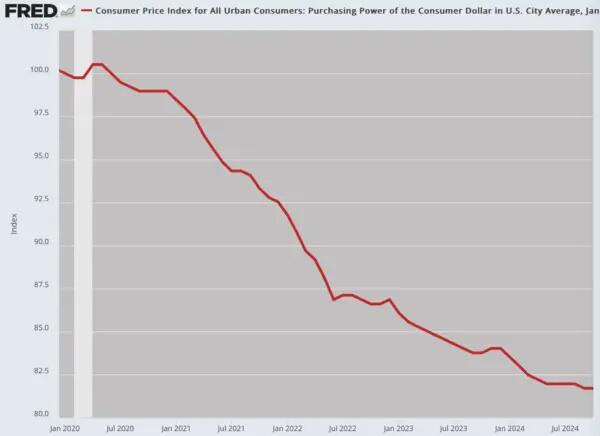
That’s what we are being told, and that’s terrible enough. The reality is likely worse once you add in interest rates, shrinkflation, new fees, and housing insurance. That gets us closer to 40 cents and more. 

Let us please let go of any doubts about the cause.

Elon Musk summarizes:

“The excess government spending is what causes inflation! ALL government spending is taxation. This is a very important concept to appreciate. It is either direct taxation, like income tax, or indirect via inflation due to increasing the money supply.”

It comes down to the machinery that prints money. Congress authorizes spending, the government mints the debt, and the Fed buys it with money that it creates out of thin air. The result is that all existing monetary units are reduced in value, same as when you mix juice with water. 

It’s not that complicated actually, especially when the new money is distributed in the form of direct stimulus payments to individuals and businesses. That’s exactly what happened. 
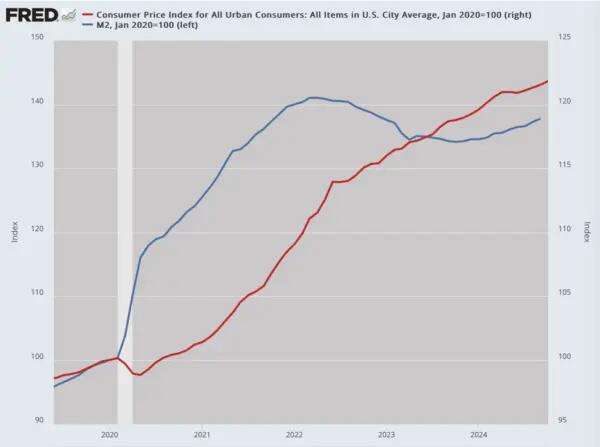
Where do we stand right now? There is some heavy risk of a second wave coming next year. On the current trajectory, that is where we are headed. The Fed has fed another $1.1 trillion in fake money into the system in the last 12 months. The Treasury has created new debt as never before, probably in hopes of ginning up the GDP prior to the election. The trick did not work but now the public is stuck with the bill of $35 trillion. 

Inflation is a wicked beast that cannot be controlled directly. On the campaign trail, Trump spoke often about how it was the throttling of the energy sector that kicked off inflation. That is only partially true in the sense that the soaring price of oil and gas grew the costs of transportation. It was also a symptom rather than a cause. Plus, the price of oil and gas is actually not high right now in real terms. 

Yes, the plan of “drill baby drill” is necessary and should happen but it cannot fix the existing problem of inflation much less do much to forestall a second wave. Nor is there a viable fix in the idea of price control, even when it is masked as “anti-gouging” legislation. 

There is nothing government can do to directly control prices, much less force them from going up given the deep structural problems. 

There are ways to mitigate against the problem, or at least minimizing them. You can have a look at how Javier Milei did it in Argentina. He took the problem of massive hyperinflation and converted it to low inflation in a year. His is a case study.

The answer is:

  1. end debt creation by dramatic spending cuts,

  2. curb the actions of the central bank,

  3. and inspire economic growth through deregulation and agency elimination. 

That’s three steps.

Let’s consider each. 

First, the end of debt creation is essential.

Every time Congress authorizes more spending than is in the bank, the Treasury has to float debt to make it happen. That is the statutory obligation. What that means is that Congress needs to pass a balanced budget, ideally right away. 

That comes down to the commission created by Elon Musk: the Department of Government Efficiency or DOGE. It is not an official department. It works as an outside advisory team. That’s excellent. They will likely push for a “Twitter-style” solution of firing 4 in 5 government workers to reduce costs directly. 

That’s a start but it is not enough. There also must be sweeping elimination of agencies, each of which can save tens of billions and possibly a trillion or more in total. That needs to happen immediately. It can happen through executive order or through legislation. One way or another, the spending in excess of revenue has to stop. 

Trump is not famous for being a budget cutter. He cared nothing for the topic in his first term. He was vulnerable after March 2020 to believing that multiple trillions could be spent without consequence to keep the economy floating during lockdowns. That was an error. He will never admit to it. 

This time, however, he has a strong reason to dramatically cut the federal budget. This much he can know for sure: every dime cut from the federal budget is likely to end the flow of money to people who are working to undermine his administration. In saying that, I’m in no way promoting the politics of revenge but rather drawing attention to political realities. Balancing the budget has the side benefit of defunding the opposition. 

Second, if the Treasury stops the T-bill tsunami, the Fed will not be called upon to sponge up the excess with money creation.

You can look at the charts over the last year and see how the Biden/Harris administration was spending and working with the Fed to promote more economic illusion going into the election. That was the whole point of the rate cuts. That really must come to an end. 

There is a danger that comes with taking away the punch bowl. It could mean a panic by the bond market and a push by the media to announce the Trump Recession. 

This is why it is imperative that the Trump team move quickly to explain that right now, the economy is in much worse shape than has been advertised. The pit is very deep and it would be good to dial back expectations of a quick recovery. 

We don’t need a falling rate of money growth. We just need stability now. That’s not going to stop the wave of price increases for the next year but it can stop it from getting worse and end it completely by 2026. There is at this point zero need to worry about “deflation,” despite what the financial press will be screaming. Quite frankly, deflation at this point would be a gift to American consumers in any case.

Third, Trump needs to fire up the wealth-creation engine of the American economy through dramatic, sweeping, historic levels of regulation torching plus the shock and awe of full agency elimination, same as in Argentina.

The Trump team needs a list of 100 agencies to eliminate immediately but that should just be a start. Another 100 should be on the chopping block. Without all the regulatory clogging that they cause, investment will soar. 

Tax cuts–income and capital–will assist here too. The crucial point is the focus on boosting supply and jobs as a way of outrunning inflationary forces. Here again, the financial press will scream about the economy “overheating” but that metaphor is worn out. The effect of economic growth on inflation is exactly the opposite. Economic growth can bury the effects of price increases. 

There is not a lot of time, and it is a bargain that the Trump administration will surely lose if it does not act decisively and quickly. The debt creation and money creation must end and the economic growth through agency elimination and deregulation must become the top priority. All of this has the added advantage of making Trump more popular with the people who elected him. 

There is no incompatibility between political success and economic rationality. In this case, the incoming Trump administration is very fortunate: they go together. 

https://www.zerohedge.com/economics/plan-tame-inflation

AC Immune Positive Interim Results from Phase 2 Trial of Immunotherapy in Early Parkinson’s


  • Active immunotherapy with ACI-7104.056 induces high anti-a-synuclein antibody levels on average 16-fold higher than placebo after 3 immunizations
  • 100% of patients receiving ACI-7104.056 responded against the target antigen
  • ACI-7104.056 is well tolerated with no clinically relevant safety issues reported to date
Based on further interim results to be reported in H1 2025 including pharmacodynamic data, AC Immune may decide to initiate Part 2 of VacSYn with up to 150 patients. Patients from Part 2 will also be evaluated for progression of motor and non-motor symptoms of the disease, as well as digital, imaging, and fluid biomarkers. The aim is to establish early proof-of-concept and identification of disease-specific biomarkers for rapid transition into a pivotal study.

Immutep Efti Excellent Survival Data in Non-Small Cell Lung Cancer Trial


  • Mature data in patients with a minimum follow-up of 22 months (N=21) shows excellent results, well above historical controls and exceeding expectations:
    • Median Overall Survival is 32.9 months, with median Progression Free Survival reaching 12.7 months, and a 24-month Overall Survival rate of 81.0%
  • Data from all evaluable patients to date (N=40) demonstrates significant improvement of Overall Response Rate compared to historical controls
  • Safety continues to be favourable with no new safety signals
  • INSIGHT-003, which is nearing completion of enrolment, evaluates efti with the most widely used immunotherapy-chemo combination today in a similar population to upcoming TACTI-004 Phase III trial

Trouble With Upcoding Extends Far Beyond Ethics

 After a long day in my primary care practice in rural southwest Virginia, I still had one more task to complete. As an employee of a healthcare corporation that provided care for Medicare patients, I was required to review and add additional "suggested" diagnoses to each Medicare Advantage encounter.

I later learned that this practice, known as "upcoding," is a means to make patients appear "sicker" and thus increase the annual capitation payment that the Medicare Advantage plan receives to insure these patients. The extra revenues were then shared with our employer in the form of "bonuses." We were told that these payments would help keep our department solvent and that our compliance with this coding practice would be reflected in our compensation.

This practice seemed harmless enough. However, I later learned that upcoding is responsible for $12-25 billion in overpaymentsopens in a new tab or window to Medicare Advantage insurers each year, enough to provide free vision and hearing care to every senior over age 65. I was involved in a practice that, at best, was billing in a way that increased our income a bit and, at worst, was defrauding taxpayers and contributing corporate profits to both insurers and healthcare companies. This was a moral dilemma that was quite different than those I studied in my medical school medical ethics class.

I now live in Charlottesville, Virginia, the headquarters of University of Virginia (UVA) Health. It recently came to light that administrators at UVA Health received a letteropens in a new tab or window about a year ago from 128 employed physicians, alleging that the leadership pressured them to engage in fraudulent billing practices and created a toxic work environment that endangered patients. Subsequent reportingopens in a new tab or window quoted physicians who were fearful of fines or even prosecution for complying with practices that they felt were unethical.

Whether or not physicians should engage in these practices in order to generate funds to provide patient care while increasing corporate profits seems to me a false choice. The question we should really ask is whether for-profit healthcare serves the best interests of patients and physicians. Is there a better way to build the system?

The rest of the world seems to think so. Most other major industrialized countries provide universal care more cheaply and effectively than the care system in the U.S., with far better outcomes. They do this with systems where administrative costs are low and opportunities for profit are limited due to a combination of strict regulation and government funding. In the U.S., an estimated 30% of excess health spendingopens in a new tab or window covers administrative costs of insurance and administrative costs borne by clinicians -- these are expenses much of the rest of the world has already decided should not be part of their system.

Other developed countries have plans that are structured in a way where doctors are not required to engage in coding and creative billing. Hospitals in Canada are paid by their provincial governments who fund their operating budgets, obviating the need to bill for services, resulting in administrative costs half of those in the U.S.opens in a new tab or window Most other major industrial countries finance their healthcare systems through tax revenues, thereby sharply limiting the impact of insurance companies and the profits their shareholders expect.

Reform of our system is not just about saving money. According to a Commonwealth Fund analysisopens in a new tab or window of 10 wealthy industrialized countries, we rank dead last in health outcomes despite spending twice as much per capita compared to the other countries in the survey. For-profit medical care is bad for our patients' health.

Wasting resources that could go to providing more and better healthcare is not the only negative consequence of our free-market system. Every day physicians face ethical conflicts with pressure to engage in "creative billing" and "upcoding," practices that increase premiums, and the tax burden for all of us, while increasing profits that benefit only those at the very top.

The extra time physicians spend on prior authorization requests and appeals of denials of care contributes to stress and burnout while taking away from time with patients. In 2021, U.S. physicians spent at least 11.1 million hoursopens in a new tab or window on prior authorization requests for Medicare Advantage alone. Furthermore, an American Medical Association physician survey indicated that 35% of physiciansopens in a new tab or window said that prior authorization criteria used by insurers rarely or never followed evidenced-based guidelines approved by medical specialty societies.

Does it really have to be this way? When I started practicing family medicine in the 1980s there was little in the way of for-profit healthcare. Services were provided by locally owned hospitals with a mission to serve their communities. In our practice, we largely used only two treatment codes for all our patient visits. A management consultant later told us we had been leaving money on the table, but the physicians in our group still managed to earn a comfortable living. I know we can't return to that era, but do we have to be part of a system that pressures physicians to cross uncomfortable ethical boundaries on a daily basis?

When asked, patients and physicians alike agree that a government-financed system that provides universal coverage is the best way to achieve reformopens in a new tab or window. The Medicare for All Actopens in a new tab or window, as proposed in House and Senate (with 127 cosponsors), could go a long way toward achieving these aims. Of course, the Donald Trump election victory and the likely party alignment in Congress is not an environment conducive to healthcare reform. Nonetheless, physicians should be clear-eyed that without changes, the current system of free-market healthcare will continue to generate harm both to physicians and their patients.

Robert Devereaux, MD, is a retired board-certified family physician who practiced in rural southwest Virginia for 35 years. He currently resides in Charlottesville, Virginia, and is a member of Physicians for a National Health Program.

https://www.medpagetoday.com/opinion/second-opinions/112848

Former BCBS of Michigan employee who refused COVID-19 vaccine awarded $13 m

 A federal jury awarded a $13 million verdict to a former Blue Cross Blue Shield of Michigan employee who says she was wrongfully terminated for refusing to get the COVID-19 vaccine due to her religion.

Lisa Domski filed a lawsuit in August 2023 through the U.S. District Court Eastern District of Michigan Southern Division, alleging that the health system fired her after she refused to get the vaccine due to religion.

Attorney John Marko says Domski is a devout Catholic and applied for a religious exemption to the vaccine. Marko says Domski, who worked for the health system for nearly 38 years, provided a written statement explaining her beliefs and the name and contact information of her priest. 

Marko alleges that Blue Cross Blue Shield failed to contact her priest and told Domski that she could use her written statement. He says the health system instead denied her accommodation and told her she would be fired if she didn't get the vaccine. Domaski refused and was terminated, he says.

Marko says Domaski was awarded $13 million — $10 million in punitive damages, $1.3 million in front pay, $1 million for pain and suffering, and $315,000 in back pay.

"Our forefathers fought and died for the freedom for each American to practice his or her own religion. Neither the government nor a corporation has a right to force an individual to choose between his or her career and conscience," Marko said in a statement. "Lisa refused to renounce her faith and beliefs and was wrongfully terminated from the only job she had ever known. The jury's verdict today tells BCBSM that religious discrimination has no place in America and affirms each person's right to religious freedom."

Statement from Blue Cross Blue Shield of Michigan

"Throughout the pandemic, Blue Cross Blue Shield of Michigan, together with its employees, worked to promote the health and safety of our colleagues, stakeholders, and communities. As part of that shared work, in October 2021, Blue Cross, and its subsidiaries, enacted a vaccine policy requiring all of its employees to be fully vaccinated for Covid-19 or obtain a religious or medical accommodation. 

"In implementing the vaccine policy, Blue Cross designed an accommodation process that complied with state and federal law and respected the sincerely held religious beliefs of its employees. While Blue Cross respects the jury process and thanks the individual jurors for their service, we are disappointed in the verdict. Blue Cross is reviewing its legal options and will determine its path forward in the coming days."


https://www.cbsnews.com/detroit/news/woman-awarded-13-million-in-blue-cross-blue-shield-of-michigan-lawsuit/