Search This Blog

Saturday, February 8, 2025

2 Decades Ago, Senator's Probe Of USAID Funding Led To Government Transparency Reform

 Revelations that USAID officials are spending hundreds of millions of U.S. tax dollars overseas for controversial projects such as advancing atheism in Nepal and funding “transgender opera” in Columbia are nothing new.

As Mark Tapscott details below for The Epoch Times, nearly 20 years ago, in October 2005, the refusal of USAID officials to admit they were funding a prostitution ring in India so angered Sen. Tom Coburn (R-Okla.) that he vowed to introduce a new law enabling every U.S. citizen with the internet to quickly and easily find out how federal officials are spending his or her tax dollars.

A year later, President George W. Bush’s signing of Coburn’s proposal into law—thus mandating the creation of today’s USASpending.gov—marked a huge step forward in making government spending easily accessible for every citizen with internet access.

Coburn described the USAID coverup in detail in his Senate floor speech in April 2006 as he introduced the promised proposal, which was known as the Federal Financial Accountability and Transparency Act (FFATA).

The FFATA proposal was a bipartisan one from the beginning, with then-Sen. Barack Obama (D-Ill.), Sen. John McCain (R-Az.), and Sen. Tom Carper (D-Del.) as co-sponsors.

Coburn, who was already well-known among his Senate colleagues as “Dr. No” for his opposition to wasteful federal spending and his annual compilation of examples, called the “Wastebook,” assembled a crack staff of congressional investigators and communicators who constantly exposed outrages such as the $329 million earmark better known as Alaska’s “Bridge to Nowhere.”

In his FFATA floor speech, Coburn described how USAID officials fought his staff investigators every step of the way in their probe of the agency’s funding of a nongovernmental organization (NGO) called “Sampada Grameen Mahila Sanstha (SANGRAM).

Coburn quoted an unclassified State Department memorandum concerning how SANGRAM opposed a U.N. agency’s effort to free 17 young Indian girls from a prostitution ring.

“The girls are now back in the brothels, being subjected to rape for profit,'' the memorandum said.

“On November 16, 2005, a USAID briefer asserted to subcommittee staff that USAID had ‘nothing to do with’ the grant to the pro-prostitution SANGRAM and that the subcommittee’s inquiries were ‘destructive,’” the Oklahoma lawmaker told his Senate colleagues.

“Nonetheless, congressional investigators continued to pursue this matter and eventually proved that USAID money financed the pro-prostitution SANGRAM through a second organization named Avert, which was established with the assistance of four USAID employees as a pass-through entity.”

Not only did USAID officials help start Avert and fund it, but one of them also served on the group’s board of directors.

Twenty years later, USASpending.gov has been used for billions of searches by journalists, congressional staffers, academic researchers, and nonprofit advocacy groups seeking information about how the federal government spends trillions of tax dollars every year.

Many of those searches produce widely read and discussed news stories about waste and fraud in government.

Roland Foster, who was one of Coburn’s staff investigators as his legislative director, is now a special adviser to Sen. Joni Ernst (R-Iowa).

Ernst makes public a monthly “Squeal Award” that highlights the latest examples of tax dollars being wasted.

She has also introduced legislation to strengthen USASpending.gov, including the Stop Secret Spending Act that penalizes agencies that hide spending from disclosure and “TRACKS,” to require prompt and accurate reporting of funds going to China.

U.S. Senator Joni Ernst (R-Iowa) questions former Office of Management and Budget (OMB) Director Russell Vought during a U.S. Senate Homeland Security and Governmental Affairs Committee hearing on his second nomination to be OMB director, on Capitol Hill in Washington on Jan. 15, 2025. Jemal Countess/ AFP

When asked about the current USAID revelations, Foster told The Epoch Times that “between USAspending and Wastebook, Senator Coburn created the blueprint empowering every taxpayer to continue carrying on his mission today as a DOGE deputy.”

John Hart, the recently appointed chief executive officer of Open the Books, the website that captures virtually all spending by every level of government in America, was Coburn’s long-time communications director, including during the years when FFATA was conceived, written, proposed, and adopted by Congress.

Hart told The Epoch Times that the latest USAID revelations were no surprise for him.

“It’s been an open secret for years that USAID was not spending effectively on vital humanitarian assistance,” Hart said.

“Decades ago, Senator Coburn was pointing out that agency’s funding of radical organizations that use the money for far-left, dangerous or even criminal activities. It’s a relief that a reckoning has come.”

https://www.zerohedge.com/political/2-decades-ago-senators-probe-usaid-funding-led-government-transparency-reform

'Children's bodies a 'battleground' in Haiti as sexual violence surges, UNICEF warns'

 Sexual violence against children in Haiti has surged in the last year and their bodies have been turned into "battlegrounds," UNICEF warned on Friday.

Describing the increase between 2023-2024 as "staggering," the spokesperson for the United Nations agency for children, James Elder, told reporters at the Palais des Nations in Geneva that armed groups have inflicted "unimaginable horrors on children" in the Caribbean country.

Powerful gangs, armed with weapons largely trafficked from the United States, have united in Haiti's capital Port-au-Prince under a common alliance. They control 85% of the city, according to the U.N.

Elder, who recently returned from a visit to Haiti, told reporters about a 16-year-old girl who was abducted by armed men and extensively beaten, drugged and raped. She was later released and found shelter in a UNICEF-supported safe house.

Amid surging violence and what the U.N. describes as "rampant sexual violence," more than 100 Kenyan police arrived in Haiti's capital on Thursday to reinforce a security mission. Its future has been in limbo since the U.S. froze $13 million in funding on Tuesday, before passing a waiver to unlock a separate batch of funds.

The security mission, approved by the U.N. Security Council but not led by the U.N., has struggled to make headway in fighting gangs as its numbers remain far under target.

More than a million people, over half of them children, are displaced within Haiti due to ongoing violence, according to U.N. data. Extreme poverty has also pushed children into gangs, with up to half of all armed groups made up of minors, "some as young as eight years old," Elder said.

https://www.msn.com/en-ie/news/world/children-s-bodies-a-battleground-in-haiti-as-sexual-violence-surges-unicef-warns/ar-AA1yCeQa

The Balance Sheet of Pandemic Mortality

 In the ongoing struggle to write the history of the pandemic years, nothing is more important than mortality – did the world’s governments save us from mass mortality or not?

The grand strategy (which as I have said before was neither grand nor strategic) was to lock down the population of whole countries as an interim measure ‘until a vaccine becomes available.’

This was a novel (and completely unproven) strategy to defeat a supposedly completely novel virus, on the grounds that no human had ever encountered anything like SARS-CoV-2 before so no one would have any pre-existing immunity to it. But the clue is in the name – SARS-CoV-2 was named after SARS to which it was closely related, sharing approximately 79% of its genome sequence according to this paper in Nature. It is situated within a cluster of coronaviruses, and another Nature paper discussed the extent of cross-reactivity with these including the common cold viruses, and even with other families of viruses altogether. It was somewhat novel, but not unique.

So, policymakers should have been skeptical about the claims made early in 2020 that SARS-CoV-2 would produce extreme levels of mortality. This has consequential implications for the claims that the grand strategy was a success because these levels of mortality did not eventuate. If they were never going to happen, then we did not need to be saved from them.

The deployment of vaccines was supposed to bring about ‘the end of the pandemic.’ The clinical trials of the vaccines purportedly showed they could reduce symptomatic infections by over 90%.

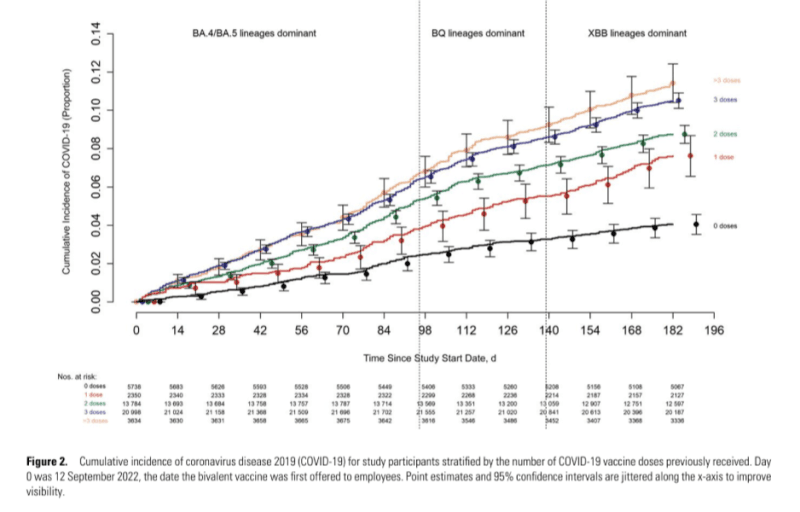
At the population level, this does not add up. If over 90% of infections were supposed to be prevented by vaccination, and 270 million people in the US population had been vaccinated by the end of May 2023 (out of a total population of around 340 million), then how come there were over 100 million confirmed cases by then, according to Our World in Data? It defies belief that nearly 100 million of the unvaccinated 170 million were the ones infected. Particularly as a study by the Cleveland Clinic showed that on average the more vaccinations people had, the more likely they were to be infected:

It was assumed there would be a consequential reduction in mortality from reducing infections (which in any case does not appear to have happened), but the clinical trials did not show any differences in mortality between the groups exposed to the vaccines and the placebo groups. The orthodox defence is that they were not powered sufficiently to detect any differences as the trial populations were not large enough. But by the same token, we are entitled to draw the following conclusion: the clinical trials did not demonstrate the vaccines’ ability to reduce mortality.

In the quality assurance business, we evaluate the success of an intervention or program by comparing the actual outcomes with the claims made.

The reality is that waves of infection and excess mortality continued after the deployment of the vaccines during 2021, continuing with two severe waves in the United States, and peaking again at the end of January the following year. There was a trend of declining peaks, but it is not evident that this trend changed as a result of the vaccination campaign, as it would be expected over the course of any pandemic.

Conventional wisdom would have us believe that the vaccines, while they may not have reduced overall levels of infection, somehow reduced levels of hospitalization and mortality from Covid-19. Again, it defies belief that vaccination could be deficient in preventing infection and still be successful in reducing illness.

These claims of success do not rest on hard evidence. 

A number of recent papers are smoking guns that show us that the grand strategy did not work. We need to look beneath the hood, however (to switch metaphors,) because the narrative usually concludes that the strategy was a success. The data however sometimes tell a different story. This shows that the authors are biased, and their data can be more reliable than their narratives.

Take, for example, a study by Bajema et al. based on patients of the US Veterans Health Administration. They concluded:

This cohort study showed that, during the 2022 to 2023 season, infection with SARS-CoV-2 was associated with more severe disease outcomes than influenza or RSV, whereas differences were less pronounced during the 2023 to 2024 season.

During both seasons, RSV remained a milder illness, whereas COVID-19 was associated with higher long-term mortality. Vaccination attenuated differences in disease severity and long-term mortality.

This seems conclusive, doesn’t it?

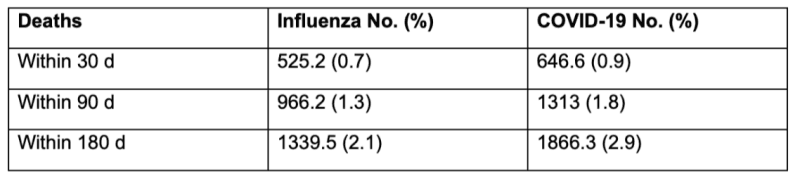
But the conclusions are based on the data summarised in Figure 2A, which includes:

On these figures, it is literally true that Covid-19 mortality was more severe over 180 days – but by less than 1 percent. This was meant to be the once-in-a-100-year pandemic that would cut a swathe through the population and was dramatically more dangerous than influenza, necessitating throwing the whole world into a state of emergency. Was this justifiable for a disease that had less than 1% higher mortality than influenza? Many media articles have derided claims that Covid-19 posed a similar burden of disease to influenza, but over time it has proved to be comparable.

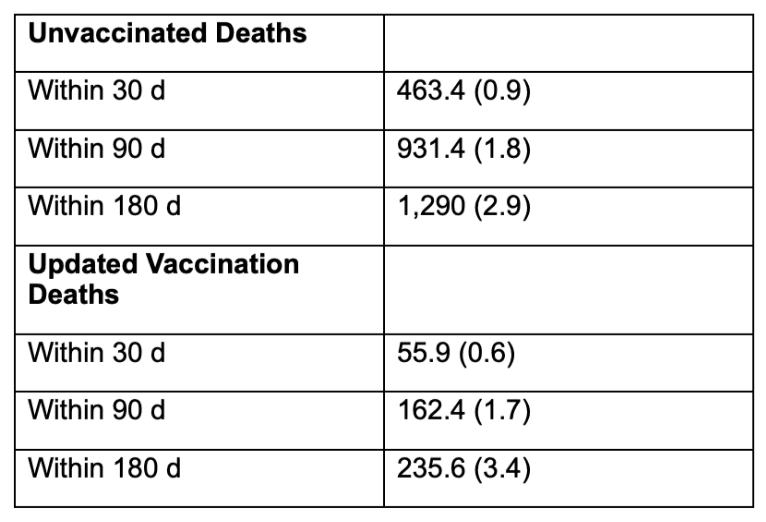
How much did vaccination help? Figure 2 gives us these comparisons for the Covid-19 patients.

So, in a paper based on a carefully selected and processed sub-population of a sub-population, the vaccinated were ahead by half of one percent over 180 days. Is this the best they can do? Is it statistically significant?

Papers based on the excess mortality in the whole population of a country can avoid the methodological issues caused by variability in the attribution of mortality to Covid-19 and the selectivity of trial populations. Of note is a recent preprint by Dahl et al: Covid-19 mRNA-vaccination and all-cause mortality in the adult population in Norway during 2021-20: a population-based cohort study. They too reach the obligatory conclusion:

Vaccinated individuals had a lower rate of all-cause death during 2021-2023 in Norway.

But again, how does the data support this conclusion?

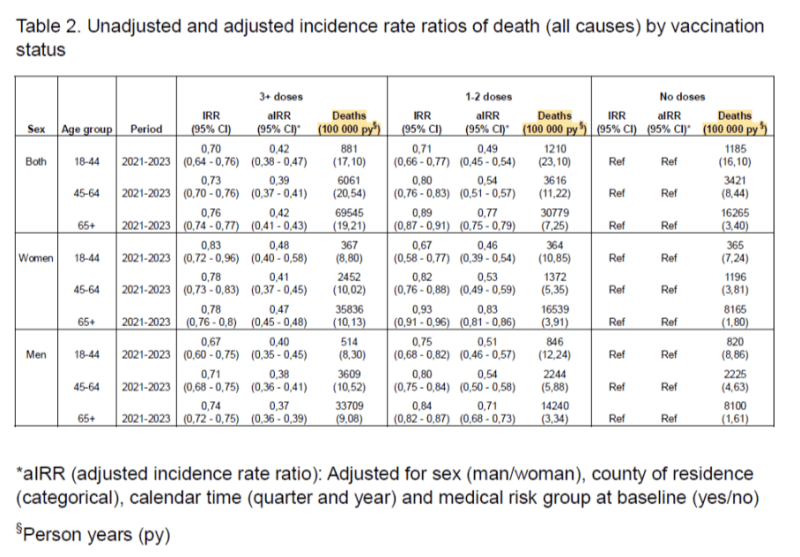
If we focus on the data for both sexes and read from right to left, deaths per 100,000 py increase steadily for each age group except for the youngest, where deaths would have been rare.

By contrast, for the oldest age group (65+), they increase from 3.40 with no doses, to 7.25 with 1-2 doses, to 19.21 with 3+ doses. What obscure statistical magic did they deploy to arrive at incident rate ratios that go in the opposite direction to deaths per person-years? And why do they not explain this in the narrative?

On a plain reading of the figures behind the text, all-cause mortality in the vaccinated was at least twice as high as in the unvaccinated during this time period in Norway. But they concluded the reverse.

So, the first thing we need to demand from our scientists is that they reach conclusions that are clearly supported by the data!

Papers on vaccination are critically weakened by confirmation bias. The strength of the authors’ belief in vaccination is such that all data is usually interpreted as supporting vaccination, even when it is contrary.

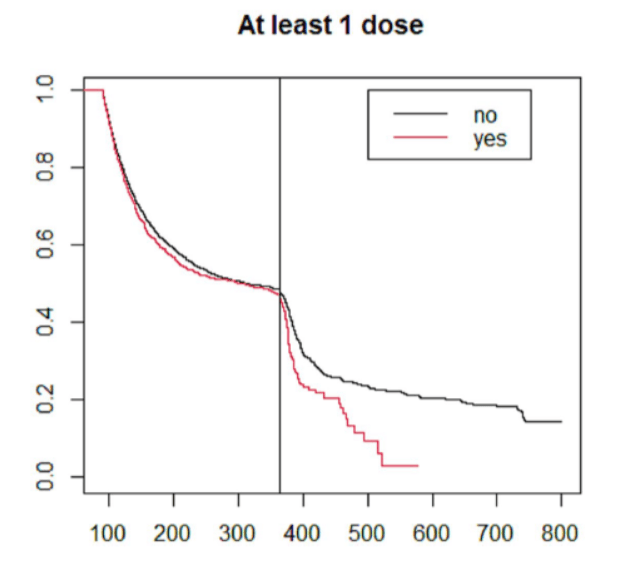
Another broad study was undertaken of all patients diagnosed with Covid-19 in Brazil over the period 2020 to 2023 by Pinheiro Rodrigues and Andrade. Their conclusion was summed up in the abstract:

The protective effect of COVID-19 immunization was observed up to one year after the first symptoms. After one year, the effect was reversed, showing an increased risk of death for those vaccinated.

This is illustrated in Figure 1, with number of days of survival along the X-axis:

We must congratulate these authors for reaching conclusions that accurately reflect their data, which is unusual in this context. This has naturally led to the paper being investigated by the journal post-publication, which never happens for papers that reach orthodox conclusions on vaccination which are normally accepted at face value. Publication bias is rife – how will the distinguished peer-reviewers handle the Dahl paper? The fate of these two papers will be a key test. On current form, you would expect the Brazil study to be retracted and the Dahl paper to be accepted.

The studies that reach positive conclusions are either based on selected periods of time (variations on what is known as case-counting window bias) or on modelling.

Take for example Christopher Ruhm’s cross-sectional study of US states which aimed to ascertain whether state Covid-19−related restrictions (nonpharmaceutical interventions or NPIs + vaccine mandates) affected the number of pandemic deaths in the US. The study was based on data from the entire US population, so it was inclusive in that sense. Ruhm concludes:

This cross-sectional study indicates that stringent COVID-19 restrictions, as a group, were associated with substantial decreases in pandemic mortality, with behavior changes plausibly serving as an important explanatory mechanism.

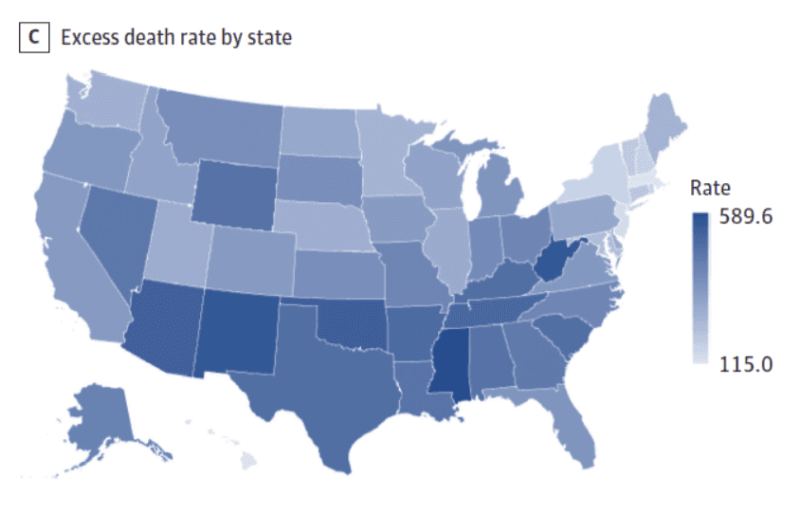
The giveaway however is the time window: ‘The primary investigation covers the 2-year period July 2020 to June 2022.’ What about the earlier months? This is important because the first wave of Covid-19 mortality hit the Northeast states heavily and is omitted from the window. Subsequent waves hit the Southern and Western states so variations in excess death rates over the period were heavily influenced by geography, which is likely to have been a confounding factor. This is evident in Figure 2C for the study period:

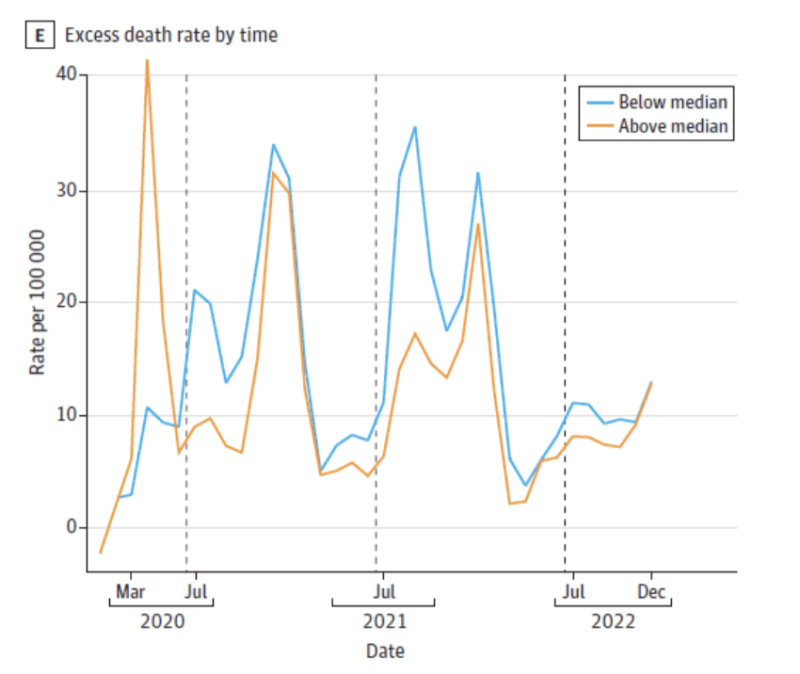
Figure 2E includes the earlier period and clearly shows a reverse pattern then, with states having more severe NPIs (‘above median’ – the orange line) having much higher mortality than those that did not.

The states with less severe interventions had higher mortality for a month or so after July 2021, which seems to account for almost the entire differential in the primary investigation window. By the end of the window, the orange line ticks up again – what happened next? 

Remember the Brazilian study which found that the protective effect of Covid-19 immunization was observed up to one year after the first symptoms, but after one year, the effect was reversed.

Consider also the Estimation of Excess Mortality in Germany During 2020-2022 by Kuhbandner and Reitzner. The authors rightly acknowledge that ‘when interpreting estimates of the increase in mortality, one has to be aware of the model and parameter choices.’ 

In the later parts of their paper, they map excess mortality since March 2020 against vaccinations in a timeline. It is evident that there are peaks of excess mortality both before and after the vaccination campaign, rising greatly towards the end of the study period:

They conclude:

In 2020, the observed number of deaths was extremely close to the expected number, but in 2021, the observed number of deaths was far above the expected number in the order of twice the empirical standard deviation, and in 2022, above the expected number even more than four times the empirical standard deviation.

This cannot be interpreted as a triumph for the vaccination campaign. It was supposed to prevent excess deaths but did not.

Alessandria et al. published A Critical Analysis of All-Cause Deaths during COVID-19 Vaccination in an Italian Province (Pescara), reanalysing an existing data set to correct for Immortal Time Bias by aligning the population on a single index date (1 January 2021).

They found that:

The all-cause death hazard ratios in univariate analysis for vaccinated people with 1, 2, and 3/4 doses versus unvaccinated people were 0.88, 1.23, and 1.21, respectively. The multivariate values were 2.40, 1.98, and 0.99.

Hazard ratios for third and fourth doses are often lower as these are the most recent ones, and as we have seen in the Brazilian study, initial improvements are reversed later on.

Alessandria et al. finish their report by examining various types of bias that can affect vaccination studies, including a particular type of case-counting window bias, in which results from the first 10-14 days post-vaccination are excluded from the vaccine group in observational studies, with no equivalent for the control group. According to Fung et al., on this basis, ‘a completely ineffective vaccine can appear substantially effective’ (48% effective in the example they calculate using data from the Pfizer Phase III randomised trial).

While putting the finishing touches on my review, the Annals of Internal Medicine released Effectiveness of the 2023-2024 XBB.1.5 Covid-19 vaccines Over Long-Term Follow-up by Ioannou et al. This study tries to emulate a controlled clinical trial by matching XBB.1.5-vaccinated individuals with matched unvaccinated participants. The conclusions are uninspiring: 

Vaccine effectiveness against SARS-CoV-2–associated death progressively declined when ascertained after 60, 90, and 120 days of follow-up (54.24%, 44.33%, and 30.26%, respectively) and was even lower (26.61%) when extended to the end of follow-up.

This is represented in Figure 3:

So, the case-counting window appears to be day 10 to day 210. What happens outside the window is not known. If poor results are recorded even with case-counting window bias, the reality must be even worse.

We have been reviewing a selection of observational studies. In the best-case example, the data in these show no material advantage for being vaccinated, and in the worst-case scenario, deaths are greater in the vaccinated group.

There have also been a number of counterfactual studies, in which mortality during the pandemic period is compared with expected mortality. 

The first of these by Watson et al. estimated that 14.4 million deaths from Covid-19 had been averted in the first year of vaccination in 185 countries, rising to nearly 20 million when using excess deaths as the measure.

These are extraordinary figures, which have had an extraordinary impact on the public imagination and are frequently referred to in the media. They have been updated in a review by Ioannidis et al. Not surprisingly, given the waning effect of Covid-19 vaccination, these authors arrive at more conservative figures, with over 2.5 million lives saved.

But both studies merely assume the vaccine effectiveness rates they feed into their calculations, with Ioannidis et al. assuming VE of 75% pre-Omicron and 50% during the Omicron period. These are presumably based on the VE found in the clinical trials for symptomatic infections, but an empirical basis for the estimates of mortality averted is not evident.

Modelling is not evidence and does not appear in hierarchical pyramids of evidence-based medicine (EBM). If you assume your treatment is effective, and then calculate its effect on a given population, you will inevitably find – your treatment is effective! The hypothesis is not falsifiable, and the reasoning is circular.

The supposedly extreme threat of the Covid-19 pandemic that panicked governments into emergency measures was created in large part by modelling, which assumed that extremely high levels of deaths would occur without novel countermeasures. Pandemania ensued and should never be repeated. Retrospectively, the orthodox now attempt to show that because these fictional levels of mortality did not eventuate, this was because of the countermeasures.

Three possible scenarios for medium-term mortality emerge from these studies:

  1. VE = 50-70%
  2. VE = 0%
  3. VE is negative

Empirical evidence for the first scenario is lacking. The other scenarios are unacceptable. Scenario 2 is unacceptable because we cannot administer treatments to people if there is no benefit and they may be exposed to adverse effects, and the adverse effects of the Covid-19 vaccines are unusually high, as Fraiman et al. have shown. 

The adverse effects of lockdowns continue to accumulate, too, especially on the mental health and educational levels of young people. According to Ferwana and Varshney:

Results show that lockdown has significantly and causally increased the usage of mental health facilities in regions with lockdowns in comparison to regions without such lockdowns. Particularly, resource usage increased by 18% in regions with a lockdown compared to 1% decline in regions without a lockdown. Also, female populations have been exposed to a larger lockdown effect on their mental health. Diagnosis of panic disorders and reaction to severe stress significantly increased by the lockdown. Mental health was more sensitive to lockdowns than to the presence of the pandemic itself.

The pandemic strategy was the greatest public health experiment in history. As chairman of a human research ethics committee, I would vote against any proposal where the net benefits were likely to be either zero or worse. Benefits must demonstrably exceed risks.

In my hometown of Melbourne, Victoria, the entire population was confined to home detention for 262 days overall. Severe vaccination mandates were then imposed on all ‘essential workers’ (and nearly all workers turned out to be essential), and the unvaccinated were locked out of public places and regarded as a health hazard. Like other island nations, Australia did quite well during the period when it shut the borders, but the grand strategy did not work – after the interim NPI period, the arrival of vaccination did not prevent excess mortality as it was supposed to:

An essential principle should be that the more serious the breaches of individual liberty brought about by public health measures, the more hard evidence of their effectiveness is needed. 

Governments should not be able to trample on individual liberties because they think that their interventions might work in theory, and then retrospectively justify them with statistical magic.

Michael Tomlinson is a Higher Education Governance and Quality Consultant. He was formerly Director of the Assurance Group at Australia’s Tertiary Education Quality and Standards Agency, where he led teams to conduct assessments of all registered providers of higher education (including all of Australia’s universities) against the Higher Education Threshold Standards. Before that, for twenty years he held senior positions in Australian universities. He has been an expert panel member for a number of offshore reviews of universities in the Asia-Pacific region. Dr Tomlinson is a Fellow of the Governance Institute of Australia and of the (international) Chartered Governance Institute.

https://brownstone.org/articles/the-balance-sheet-of-pandemic-mortality/

'What happens next to DEI at health systems?'

 Many hospitals and health systems have integrated diversity, equity and inclusion into their workforce and patient care strategies.

But now DEI is under scrutiny for both public and private organizations. President Donald Trump signed an executive order Jan. 20 to remove DEI from the federal government. Large companies are following suit; Google ended its DEI hiring goals and other DEI programs are being reviewed, according to The Wall Street Journal.

Amazon also slimmed down its diversity initiatives last year and Facebook disbanded its team overseeing diversity efforts. What will health systems do?

Many CEOs are keeping a close eye on new legislation and considering next steps. Providence, a 51-hospital system in Renton, Wash., is taking a thoughtful approach.

"As we do whenever new laws are enacted, Providence is carefully evaluating these executive orders to understand what it means for our patients, caregivers, physicians and communities. We are also well aware that legal challenges and legislative actions are common in the lawmaking process, so it's likely many of these new policies will continue to evolve," said a statement provided to Becker's.

Workforce inclusion
Providence reaffirmed its commitment to an inclusive work environment reflecting the diverse communities it serves and "ensuring every person has a chance to live their healthiest life, especially among health disparate populations."

"In addition, we will continue to be a safe, welcoming place of healing for everyone, including members of the LGBTQ+ community. We believe this is an important part of delivering high-quality patient care, with respect and compassion," the statement reads.

Providence isn't the only system leaning into a diverse workforce. USF Tampa General Physicians President Mark G. Moseley, MD, told Becker's Tampa General Hospital has a deep focus on belonging as a core cultural value.

"If you join our team, you have the right to belong and you matter to us regardless of any particulars about your own individual situation," he said. "As a team member, we will help you find connection to deep meaning and purpose in the work we do together. We prioritize our values and seek to have an intentional culture where we cultivate and encourage those values."

Leong Koh, MD, president and CEO of Northwest Permanente and co-lead of Kaiser Permanente National Health Equity Group took a similar stance.

"Across Permanente Medical Groups, we have an unwavering commitment to equity, inclusion and diversity in our workforce and in how we care for patients," he told Becker's. "Permanente Medicine was founded on the principle that healthcare should be accessible and affordable to all. Permanente Medical Groups are actively building on the principles of value-based care to advance health equity."

Northwestern Permanente also aims to build a workforce that is "as diverse or more diverse" than the patient population served to improve preventative care for all patients. Data published in the Journal for the American Medical Association Network Open showing Black residents had lower mortality rates in areas where there were more Black physicians than those in areas without Black physicians, validating the practice's strategy.

"The Permanente Medicine model was built on the premise of equitable care. That hasn't changed," he said. "As the country grows more diverse, the need for equitable, culturally responsive healthcare increases. Data consistently shows that when we focus on reducing disparities, public health improves. We are deeply committed to eliminating health disparities."

Sinai Chicago, a safety-net hospital, has built its workforce to reflect its own patient population, which is 90% Black and Latino. Sinai Chicago's workforce breakdown is 36% Black / African American, 28% Hispanic / Latino, 21% White and 12% Asian.

"Our caregivers are the heart and soul of Sinai Chicago," Ngozi Ezike, MD, President and CEO of Sinai Chicago, told Becker's. "We embrace the strength that lies in understanding diverse perspectives, encouraging the formation of Caregiver Resource Groups, and fostering a sense of cultural humility among our management. This translates into a high-performing, empathetic and culturally adept workforce."

Sinai Chicago actively recruits physicians and caregivers from the same communities as their patients, who can understand their backgrounds, speak the same language and share a common culture. The hospital also trains students, nurses, residents and others in cultural competency and fosters a passion and commitment to caring for the surrounding communities.

"With these initiatives and more, Sinai Chicago remains dedicated to celebrating the diversity that defines us and moves toward a future where prosperity and health are accessible to all and where respect, dignity and appreciation are the standard," said Dr. Ezike. "We're not changing our focus. This is part of our DNA at Sinai Chicago. A commitment to diversity, equity and inclusion has been a hallmark of our work since Mount Sinai Hospital opened its doors in 1919 to serve the Jewish immigrants who lived on Chicago's West Side. Over the years, the demographics of our population changed, but Sinai stayed focused on caring for immigrants and marginalized populations."

Albert L. Wright Jr., president and CEO of WVU Medicine West Virginia University in Charlottesville, said he'll continue to prioritize building a diverse, inclusive and skilled workforce to shape the system's culture and overcome complex issues.

"From a practical standpoint, the day-to-day reality of our workforce challenges requires us to cast a broad net in our recruitment efforts well outside our service area," he said. "Our home state cannot always meet our workforce needs in many critical areas; the homegrown numbers simply are not there to sustain our recruitment efforts."

Dr. Wright said the system has "hardwired" diversity and inclusiveness into daily routines, with the only litmus test being whether teams and caregivers do exceptional work.

"Culturally, we've built a health system that embraces diversity and recognizes it as a great asset, not a negative liability or a threat," Dr. Wright said. He later added, "We think fielding that A-Team of professionals requires having people who come from different backgrounds, experiences and beliefs. It's really that simple."

Dr. Ezike echoed this sentiment.

"Our collective goal needs to be creating healthier communities for all human beings, regardless of who they are, where they live or how much money they have," she said. "Healthcare's a fundamental human right, not a privilege."

Deborah Visconi, CEO of Bergen New Bridge Medical Center in Paramas, N.J., is taking a measured approach by recruiting diverse talent from the frontline staff to executive leadership with the goal of representing the community served, and advancing health equity.

"DEI is health equity, and these efforts must be both meaningful and measurable," she said, later noting, "I always say we are only as healthy as our least healthy community members. We use data to identify disparities in care and work with the community to close those gaps by strengthening public outreach programs and addressing the social determinants of health that impact patient outcomes."

Population-based projects
Kaiser Permanente, which includes 40 hospitals, 24,605 physicians and 12.5 million-member health plan, has a long history of population-based projects focused on health equity and value-based care.

"At The Permanente Medical Group, our dedicated physicians and clinicians strive to advance health equity and deliver culturally relevant care to all populations in our communities," said Maria Ansari, MD, FACC, CEO and executive director of The Permanente Medical Group, president and CEO of Mid-Atlantic Permanente Medical Group, and co-CEO of the Permanente Federation. "Our efforts helped Kaiser Permanente Northern California achieve five-star ratings in the category of 'Prevention and Equity' by the National Committee for Quality Assurance."

One example of The Permanente Medical Group's efforts is their colorectal cancer screening program, designed to eliminate racial disparities in screening and death rates between Black and White members. In 2009, the colorectal cancer death rate was 54.2 per 100,000 patients for Black members and 32.6 per 100,000 for White members.

"Through enhanced outreach, death rates fell by more than half among Black members by 2019," said Dr. Ansari. "This concerted effort and commitment saved lives."

Kaiser Permanente also launched the Kaiser Permanente Center for Black Health and Wellness in Portland, Ore., in 2023 to focus on reducing care disparities and improving outcomes for Black members while elevating the care experience and creating a culturally responsive environment to share across Kaiser Permanente.

Faith-based health systems also have a mission of providing care to diverse underserved populations. Cleveland, Ohio-based Sisters of Charity Health System has a 174 year history of providing care to those on the "fringes of society," according to CEO Michael Goar.

"As a Catholic organization committed to serving all God's people, we have worked closely with marginalized and vulnerable groups, fighting injustice that threatens the dignity of people, and cultivating an ethos of inclusion and belonging," he told Becker's. "The CSAs provided resources and developed ministries that served individuals of all colors, orphans, unwed mothers, alcoholics, AIDs victims and their families, those experiencing homelessness, victims of human trafficking, refugees and immigrants, struggling families, and children – all vulnerable populations."

His team is focused on healing the whole person, which includes providing opportunities for growth and fulfillment to all people.

"When systematic structures oppress marginalized groups, the CSAs and their collaborators have always spoken up to bring about just conditions for all people who may otherwise be overlooked and silenced," said Mr. Goar. "The CSAs have always embraced diversity and encourage important dialogue guided by the spirit of truth and wisdom. True to Catholic social teaching, we root our efforts and initiatives through the CSA lens of love, which is expressed in their motto, 'In all things charity' and in the core values that shape our family of ministries and programs, located in Cleveland, Canton, Ohio, and throughout the state of South Carolina."

The executive orders and move away from DEI in other sectors won't affect Sisters of Charity's approach to care, Mr. Goar said.

"We are remaining steadfast to our mission of honoring and serving all people, regardless of race, income, religion, or social and economic status. We recognize the dignity of all people and are working to especially serve the neediest among us," he said.

Victorville, Calif.-based Desert Valley Medical Group CEO Marie Langley is similarly elevating the group's mission of accessible, compassionate and effective healthcare for all community members. She pushed back on the notion that DEI efforts hinder the organization.

"Diversity, equity and inclusion are naturally embedded in this mission, not as barriers or bureaucratic hurdles, but as guiding principles helping us meet the unique news of our diverse patient population," said Ms. Langley. "Healthcare is, at its core, about treating individuals and communities. While policies and regulations evolve, our focus remains on delivering the best care to our patients."

Compliance vs. community
As federal and state regulations change, C-suites are working with their boards and legislators to ensure they're able to carry out their mission. Dr. Ezike said she and her team are watching the new administration closely to see how it defines healthcare priorities, but will remain focused on advancing health opportunities for the community and addressing long-term health disparities.

"We will continue working with local, state and federal leaders to advocate on health equity. This mission is more important than ever," she said. "Our mission of service to our community remains the same. The fact is, we look like the community we serve – we are that community. Many of our patients and our caregivers are immigrants. Many of our caregivers were born, raised and live in our community. And we believe that all should feel safe, respected and valued in our community – our employees and trainees, our patients and our neighbors."

Bergen New Bridge is moving forward with its health equity work and preparing for the possibility of lost funding. The hospital recently expanded clinical and non-clinical team training for cultural awareness, implicit bias education, and best practices for equitable treatment and outcomes to boost patient care.

"The recent executive orders have sparked conversations regarding funding, compliance, and long-term sustainability," said Ms. Visconi. "While we are mindful of potential shifts in policy, our approach remains focused on what is best for our patients, residents and our team members. We are evaluating how these policies may affect grant funding, reimbursement models and other financial considerations. However, we are also working with community partners and private organizations to ensure key programs fundamental to our mission continue, regardless of federal policy shifts."

And Bergen New Bridge will keep its commitment to inclusion, too.

"Compliance is important, but our equity efforts are about doing the right thing for our patients, residents and employees. Regardless of political changes, we remain committed to fostering a workplace where everyone feels valued and safe while ensuring every patient receives care that is respectful and responsive to their needs. At the end of the day, we remain dedicated to providing exceptional, accessible, and equitable healthcare to our community. That is simply good, responsible healthcare," said Ms. Visconi.

Ms. Langley sent a similarly strong message about Desert Valley Medical Group's DEI plans amid the executive orders: the team will continue to prioritize patient care.

"While we continuously assess and refine our practices to align with regulatory requirements, we do so with the singular goal of enhancing patient outcomes and experiences," she said. "Our commitment to compassionate, evidence-based care will always be the foundation of how we operate, regardless of external changes."

https://www.beckershospitalreview.com/health-equity/what-happens-next-to-dei-at-health-systems.html