A new asthma treatment, depemokimab, hasshownpromise in reducing exacerbations while maintaining a strong safety profile, according to findings presented at the 2025 American Academy of Allergy, Asthma & Immunology/World Allergy Organization Joint Congress and reported March 13 byHealio.
Depemokimab is an anti-interleukin-5 agent that can be administered every six months, offering a less frequent dosing alternative.
In a phase 3 study, 629 patients 12 and older participated, including 419 who had previously received depemokimab and 210 who had taken a placebo in an earlier trial.
After 52 weeks of treatment, annualized exacerbation rates were 0.46 for those who had previously used depemokimab and 0.48 for those transitioning from a placebo. Overall, 72% of patients were exacerbation free and 96% did not require hospitalization or emergency department visits.
A new travel ban could soon restrict people from several countries from entering the United States.
The Trump administration is preparing a new travel ban, according to reports by The New York Times and Reuters. A draft executive order could block citizens from certain countries from entering the U.S.\
Officials have been given two weeks to finalize the list and put the ban in place. Reports say the "red list" includes countries like Sudan, Venezuela, Iran, and North Korea, with Pakistan and Afghanistan potentially added as well.
Travelers from these nations could be barred entirely, while others may face restrictions.
The Trump administration says the ban is meant to protect national security, but it’s unclear if people with valid visas will still be allowed to enter.
For now, officials say no final decision has been made, but if the ban moves forward, it could impact travelers around the world.
California Gov. Gavin Newsom isseeking a $3.4 billion loanfrom the general fund to help a shortfall in the state's Medi-Cal healthcare program. The shortfall problem comes only a year after Newsom expanded Medi-Cal coverage to include millions of illegal immigrants. California's continuing deficits and mounting debts have some officials concerned that the additional subsidies to illegals will cause a fiscal emergency in the near future.
There are at least 2.6 million illegal immigrants in the state according to recent estimates. However, California has operated on sanctuary laws since 2013 and does not track the migrant status of its citizens. Because of this, there is no way for officials to estimate potential costs associated with welfare programs and medical programs which illegals commonly tap into. Around 60% of all illegal migrants exploit welfare programs upon arrival to the US and access is generally dependent on which state they settle in.
In 2024, California expanded the state’s Medicaid program (also known as Medi-Cal) in two major ways. First, the state opened up Medicaid coverage to illegal immigrants between the ages of 26 and 49. While the state had previously granted Medicaid eligibility to illegal immigrants in other age groups, the 26 to 49 age bracket is by far the largest in California (and nationally), comprising about 75% of individuals who are in the country illegally.
The state's general fund is, technically, separate from the ample federal funding that California receives, and federal dollars are not legally allowed to go towards migrants. But the way in which the government cycles those dollars through its programs is deceptive and California is far more dependent on federal money than it claims.
To fund Medi-Cal's growth, California has resorted to using a Medicaid money laundering scheme which forces federal taxpayers to indirectly pay for the state's mismanagement. The state's scheme tripled the taxes on Medicaid insurers, which generates revenue for CA's general fund. The state is then required to spend the same amount of money on Medi-Cal as the taxes they generated (the money goes back to the insurers).
The tax is higher on Medicaid insurance plans because the state receives federal reimbursement when they pay those plans to provide Medicaid coverage. The federal government reimburses CA for the money they spend on Medicaid programs by 60%. The payments to medical insurers are then, essentially, used to open the spigot to federal funds which the state did not necessarily need. This adds billions in extra dollars for the state's general fund which is then used for illegal aliens.
The federal government permits states to engage in these tactics within certain limits, though California's case is particularly egregious. Democrats often tout California as a "donor state" that gives more in federal income than it takes, but it is also the most indebted state in the country by half a trillion dollars. California runs an annual deficit of around $50 billion to $80 billion. Despite having the some of the richest citizens in the country and a high GDP, the state suffers the worst homeless epidemic in the US and is consistently in the red. The level of budget chicanery is off the charts.
Poor governance and a refusal to secure the state from foreign invasion is leading to medical program shortfalls, even with billions in scammed federal funds. With the Trump Administration in the midst of federal audits and program cuts, it is likely that states like California that rely on hidden federal revenues will be hit the hardest.
The Democrats are working hard to drive the narrative that Donald Trump’s administration is chaotic, is doing many things that voters don’t like, and Republican voters are experiencing “buyer’s remorse.” This theme is so ubiquitous in the news that one might reasonably wonder whether it could be true.
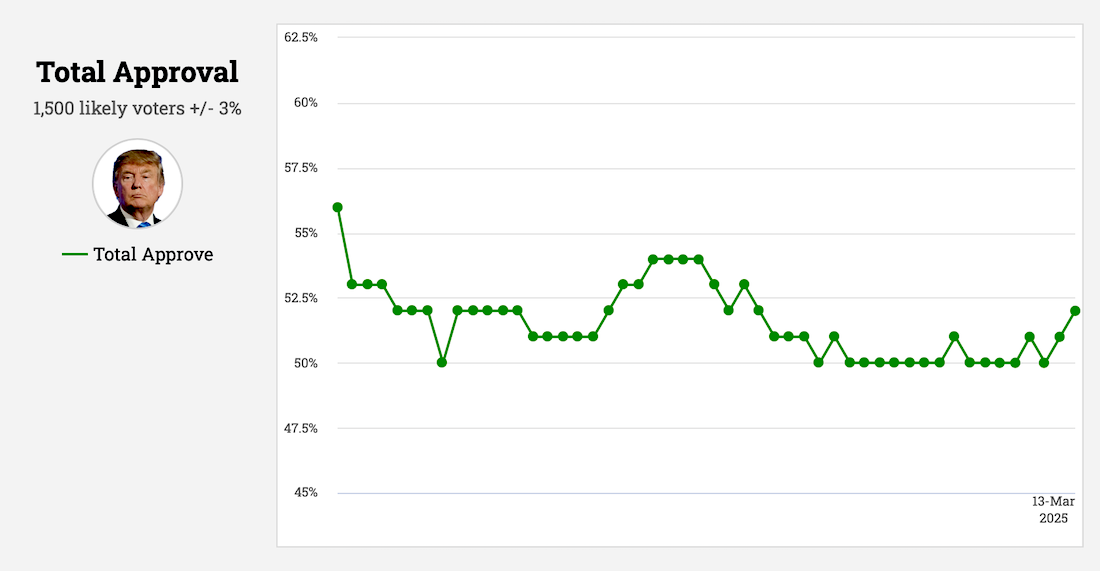
The chart below shows Rasmussen’s approval rating for Trump, from the beginning of his administration until today. Trump currently stands at a solid 52%. I think Rasmussen’s record as a pollster is as good as any, and its presidential tracking survey is especially worthwhile, since 1) unlike pretty much everyone else, Rasmussen consistently polls likely voters, and 2) they do the presidential approval poll every day, and what you see is a three-day rolling average. This means that while Rasmussen’s numbers may or may not be “right,” they are a very good barometer of trends:
So there is no sign that Trump’s voters are bailing on him. On the contrary, it is reasonable to assume that pretty much all of his voters think he is doing what he promised to do on the campaign trail.
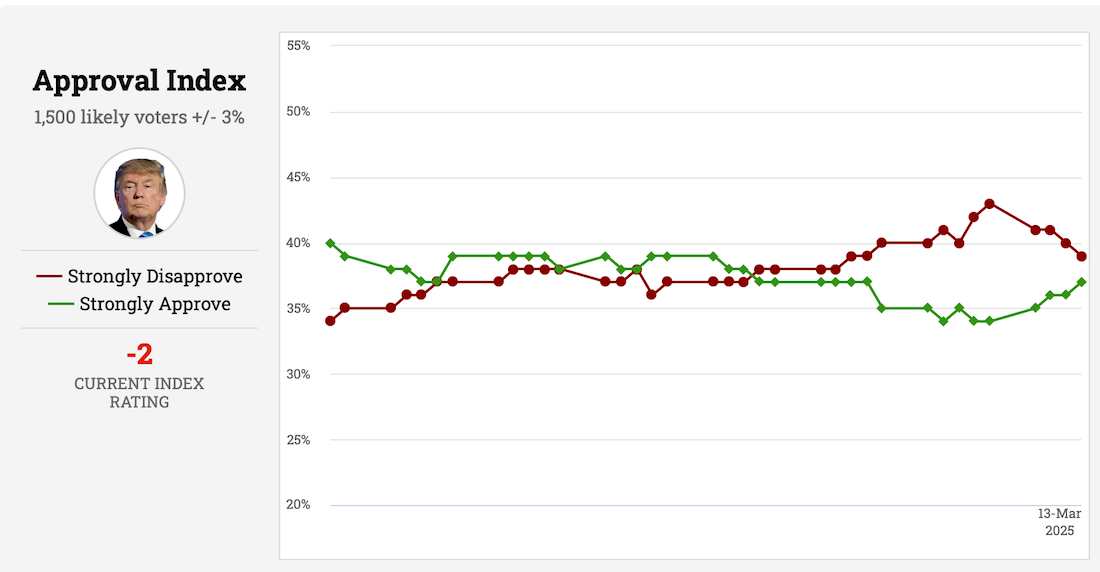
This is interesting too: Rasmussen computes an “approval index,” which is the difference between respondents who strongly approve of the president’s performance, and those who strongly disapprove. Joe Biden was in deeply negative territory throughout his administration. Trump is close to even on this measure, and gaining. The number of respondents who strongly approve of his performance has been rising, while the number who strongly disapprove is falling. Again, this would be a major surprise if you pay attention to the “news”:
It is, of course, very early to be worrying about polls. But the Democrats’ “buyer’s remorse” messaging has been so insistent that the fact that it is wholly invented is noteworthy.
U.S. Health and Human Services Secretary Robert F. Kennedy Jr. advised against providing vaccines to poultry amid a bird flu outbreak that has caused a steep increase in egg prices in recent months.
In an interview with Fox News on March 11, Kennedy said his primary concern with providing shots to egg-laying chickens is that the vaccine doesn’t provide complete protection against avian influenza.
“All of my agencies advise against vaccination of birds because if you vaccinate with a leaky vaccine—in other words, a vaccine that does not provide sterilizing immunity, that does not absolutely protect against the disease—you turn those flocks into mutation factories,” he said in the interview.
It is “much more likely” to jump to other animals at that point, Kennedy said, adding that officials with the Centers for Disease Control and Prevention, National Institutes of Health, and Food and Drug Administration advised against vaccinating birds.
“It’s dangerous for human beings to vaccinate the birds,” he said.
Since an outbreak of bird flu in the United States started in 2022, millions of egg-laying hens have been culled to prevent the spread of the virus. Egg prices have skyrocketed as a result, increasing to $4.95 per dozen on average in January 2025, according to recent data.
“We’ve killed 166 million chickens. That’s why we have an egg crisis,” Kennedy told Fox’s Sean Hannity, adding that bird flu is not transmissible via eggs or food.
“Most of our scientists are against the culling operation. They think that we should be testing therapeutics on those flocks. They should isolate. You should let the disease go with them and identify the birds that survive, which are the birds that probably have a genetic inclination for immunity.”
The price for a dozen had consistently been about $2 for decades before the disease struck. The U.S. Department of Agriculture (USDA) said recently that it expects egg prices to rise by 41 percent in 2025.
But the USDA reported last week that egg shortages are easing and wholesale prices are dropping, which might provide relief on the retail side before this year’s late Easter, which is three weeks later than last year’s. It said there had been no major bird flu outbreak for two weeks.
“Shoppers have begun to see shell egg offerings ... becoming more reliable although retail price levels have yet to adjust and remain off-putting to many,” the agency wrote in a March 7 report.
As for bird flu spreading to people, the CDC has said the risk to the public remains low.
“There is no known person-to-person spread at this time,” the CDC said in its most recent update on the virus, dated March 10.
So far, 70 people have taken ill with avian influenza, and one has died. Officials in Louisiana in December 2024 confirmed the death of a person older than 65 who had preexisting health issues.
The Trump administration has unveiled a plan to combat bird flu, including a $500 million investment to help farmers bolster biosecurity measures, $400 million in additional aid for farmers whose flocks have been affected by avian flu, and $100 million to research and potentially develop vaccines and therapeutics for U.S. chicken flocks, among other measures.
SpaceX has urged the U.S. to address trade barriers affecting its Starlink satellite communications service in foreign countries, arguing that competitors from abroad face no import costs in the country.
The Elon Musk-owned company said that it has to pay foreign governments for access to spectrum, import duties on Starlink equipment and other regulatory fees, which "artificially" inflate operating costs abroad.
Starlink operates in more than 120 markets worldwide, though in some countries, SpaceX must coordinate spectrum sharing with domestic satellite operators before activating service.
The company described the requirements as a "protectionist non-tariff trade barrier," in a letter to the U.S. Trade Representative's Office dated Tuesday.
"These anti-competitive policies have been used by foreign operators to block or slow SpaceX from providing a better quality and lower cost service to customers in those countries," Matt Dunn, SpaceX's senior director for global government affairs said in the letter.
SpaceX's concerns come amid broader tensions involving trade barriers for American companies.
U.S. automaker Tesla, which is also led by Musk, warned on Friday that it and other major American exporters are exposed to retaliatory tariffs stemming from aggressive tariffs imposed by President Donald Trump on goods from countries like Canada, China, and the EU.
Musk is a close ally of Trump and has been leading the White House effort to shrink the size of the federal government. The billionaire heads the so-called Department of Government Efficiency.
France's BNIC cognac lobby group said on Friday that the European Union (EU) should remove American whisky from its sanctions list, due to recriprocal trade wars between the United States and Europe which it said was hurting its industry.
The BNIC group said it had met French Prime Minister Francois Bayrou on Friday to address its concerns to him.
"What is currently happening to our industry and our region is catastrophic," it added in a statement.