The Trump administration is paying $6 million to El Salvador to take in around 300 soon-to-be deported members of the notorious Venezuelan gang Tren de Aragua — and throw them in its mega-prison for at least a year.
Nayib Bukele, the president of the Central American nation, reached an agreement with Secretary of State Marco Rubio to begin extraditing criminal migrants and other gangbangers who have illegally entered the US, per a memo from El Salvador’s foreign affairs ministry obtained by the Associated Press.
Hundreds of Tren de Aragua members will be kept for one year in El Salvador’s mega-prison, Terrorism Confinement Center — which houses 40,000 inmates, according to the memo.
El Salvador is going to imprison around 300 members of the Tren de Aragua gang being deported from the US.Matthew McDermott
00:00
04:26
A high-ranking leader of the MS-13 gang will also be removed, along with another member of the group convicted of double homicide in El Salvador before he illegally crossed into the US.
The arrangement is one of the first cases of the Central American country taking migrants from the US.
In February, Bukele offered up the maximum-security prison for President Trump’s mass deportations for a “relatively low” price.
President Trump had been preparing this week to speed up the process by invoking a war-time authority to deport the criminal migrants before a federal judge temporarily blocked use of that power on five Venezuelan nationals in a lawsuit filed before a DC federal court.
Washington, DC, US District Chief Judge James Boasberg barred officials from implementing the Alien Enemies Act of 1798 on Saturday.Bloomberg via Getty Images
Washington, DC, US District Chief Judge James Boasberg barred officials Saturday from implementing the Alien Enemies Act of 1798 after the American Civil Liberties Union and Democracy Forward went to bat for five Venezuelan nationals allegedly in deportation proceedings by federal immigration authorities.
Attorneys for the lefty legal groups claim that the Venezuelans, who are being held at the El Valle Detention Center in Texas, had been mistaken for members or associates of Tren de Aragua.
“Upon information and belief, the government has transferred Venezuelans who are in ongoing immigration proceedings in other states, bringing them to Texas to prepare to summarily remove them and to do so before any judicial review—including by this Court,” the attorneys wrote.
Attorneys for the lefty legal groups claim that the Venezuelans, who are being held at the El Valle Detention Center in Texas, had been mistaken for members or associates of Tren de Aragua.Houston Chronicle via Getty Images
“For that reason, Plaintiffs-Petitioners and the putative class that they represent seek this Court’s intervention to temporarily restrain these summary removals, and to determine that this use of the AEA is unlawful and must be stopped.”
The DC jurist ordered Justice Department attorneys and the groups representing the Venezuelans to appear for a 5 p.m. hearing later on Saturday, per court filings.
The 18th century law was only been acted upon after formal US declarations of war were made in the War of 1812, World War I and World War II. Former President Franklin D. Roosevelt the last commander-in-chief to make use of it.
The Post reached out to the State Department, Bukele’s office and Department of Homeland Security for comment.
Azenosertib median duration of response (mDOR) updated to 6.3 months in the ongoing DENALI Part 1b clinical trial in patients with platinum-resistant ovarian cancer (PROC) and continues to demonstrate an objective response rate (ORR) of ~35% in response-evaluable patients
On track to initiate Part 2 of the ongoing DENALI clinical trial in 1H 2025, with registration-intent topline data anticipated by year end 2026
Company also presents preclinical combination data of azenosertib with microtubule inhibitor-based antibody drug conjugates (ADCs) demonstrating synergistic antitumor effects
A review of corporate documents reveals that Brookfield—the influential $900 billion Canadian investment fund from which Liberal Prime Minister-to-be Mark Carney stepped away from in order to replace Justin Trudeau as Canada's leader—maintains over $3 billion in politically sensitive investments with Chinese state-linked real estate and energy companies, along with a substantial offshore banking presence. One of its major real estate ventures, a $750 million entry into high-end Shanghai commercial property in 2013, involved a Hong Kong tycoon affiliated with the Chinese People's Political Consultative Conference (CPPCC)—which the CIA labels a central "united front" entity of Beijing.
The investment occurred while China's real estate bubble was peaking. Last year, as China's market crashed, and vacancies soared in Shanghai, Brookfield under Carney secured hundreds of millions of dollars in loans from the Bank of China to refinance its Shanghai commercial land holdings. According to The Bureau's research, this emergency loan came a decade after Carney, serving as Governor of the Bank of England, aided Beijing by facilitating the Bank of China's expansion of its global financial footprint. In his 2013 speech, UK at the Heart of Renewed Globalisation, Carney announced that "The Bank of England [has] signed an agreement with the People's Bank of China … Helping the internationalisation of the Renminbi is a global good."
While Brookfield had already amassed well over three billion dollars in estimated investments and managed assets in China before Carney took the helm in 2020, research indicates that he played a role in expanding the firm's footprint there. This included refinancing its 2019 acquisition of Shanghai commercial real estate—initially valued at approximately CAD $2 billion at the peak of China's real estate bubble—though its actual worth was likely significantly lower when Brookfield secured nearly $300 million at four percent interest from the Bank of China last year.
Given that his history of deep investment in China—if not his holdings, reportedly now placed in a blind trust—could potentially color Carney's plans for Canada, these developments are especially notable as a trade war between the United States and Beijing escalates.
Carney and his cabinet members will be sworn in at 11 a.m. this morning at Rideau Hall, the Governor General's official residence. The timing of Carney's appointment as prime minister adds urgency to ongoing questions about potential conflicts of interest, with matters further complicated by reports that his first international meeting will be with European leaders next week—who are themselves grappling with sweeping tariffs imposed by the Trump Administration.
Brookfield's substantial investments in China—directly or indirectly involving state-linked entities—include hundreds of millions in renewable energy assets acquired through TerraForm Global in 2017, a $750 million real estate stake in China Xintiandi since 2013, a 2019 Shanghai land purchase valued at approximately $2 billion, a $100 million joint venture with GLP for solar projects launched in 2018, and reported plans to raise hundreds of millions more in both real estate and China green sector investments.
In 2013, the year Xi Jinping became president, Brookfield made its first major foray into China's real estate sector, investing up to $750 million for a 22% stake in China Xintiandi, a subsidiary of Hong Kong-listed developer Shui On Land. "The cornerstone investment in China Xintiandi gives Brookfield access to high-quality assets in Shanghai while creating opportunities for future growth through asset acquisitions and strategic partnerships," Bill Powell, Brookfield's Australasian chief executive, said in a press release. "China is a key market in Brookfield's long-term growth strategy, and partnering with Shui On Land to invest in China Xintiandi is an ideal entry point for us."
Although Shui On Land is not state-owned, it operates within China's tightly regulated urban redevelopment sector. One of Brookfield's primary real estate partners in the region is Vincent Lo, Shui On Land's principal, who previously served as a member of the Chinese People's Political Consultative Conference (CPPCC)—an advisory body that ostensibly includes diverse political parties and organizations but ultimately operates under Chinese Communist Party leadership.
Its members, especially high-profile business leaders, often support policy objectives aligned with the central government's agenda. Lo's decades of membership in the CPPCC highlights his proximity to Beijing and adds important context to any business dealings he undertakes—such as those with Brookfield.
For example, in a 2024 interview with China Daily, Lo made his position on Chinese Communist rule in Hong Kong clear: "I think a lot of people don't really understand what 'one country, two systems' is, until after a lot of disruptive demonstrations in Hong Kong that really made us realize we are under one country," he told the Communist Party–controlled news outlet.
Further illuminating sensitive questions that geopolitical analysts might consider regarding Brookfield's partnership with such investors, the China Daily interviewer asked:
"Vincent, since you mentioned that our motherland has improved and matured, understanding what the world is all about—does that diminish Hong Kong's role in any way?"
"No, [Hong Kong is] more so [important] because right now, for example, the US and its close allies are all trying to contain China's growth," Lo answered. "And so Hong Kong as a special administrative region, we have a special sort of angle to handle this situation. Because I don't believe multinational corporations can ignore the China market."
According to China Daily, Vincent Lo served as a director of Hang Seng Bank in 2010 alongside Cheng Yu-tung, a prominent Hong Kong tycoon and member of the Chinese People's Political Consultative Conference. Documents show Cheng was involved in Macau casino holdings through a consortium of Hong Kong investors, including Stanley Ho—an association that drew scrutiny from U.S. and Canadian law enforcement and intelligence. Authorities were particularly concerned about Cheng's dealings with individuals suspected by New Jersey gaming regulators of engaging in illicit activities within Macau's private VIP gaming rooms. [Cheng Yu-tung also had reported dealings with Donald Trump, before Trump ran for office in the United States.]
During his tenure as Governor of the Bank of England from 2013 to 2020, Carney deepened financial ties between the UK and China, most notably with his 'money swap deal' with China's central bank, letting each country borrow the other's cash—up to £21 billion. Carney said it could lead to a yuan-trading hub in London. This pact made it easier for businesses to use China's money worldwide, boosting Beijing's goal to rival the U.S. dollar.
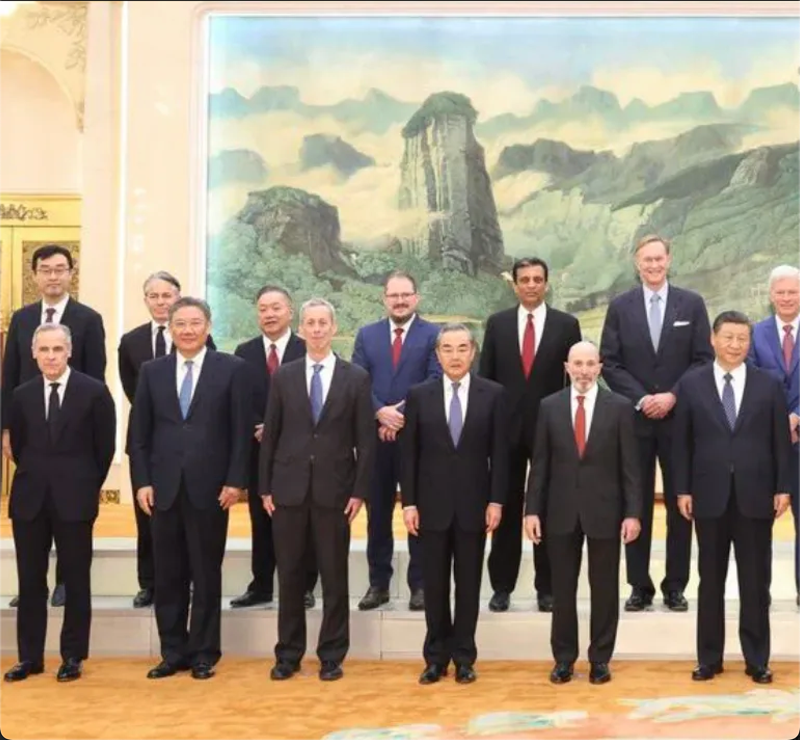
In March 2024, as Brookfield's chair, Mark Carney was among a select group of Western executives who met with President Xi Jinping in Beijing—an event The Telegram described as part of a "charm offensive" amid Beijing's efforts to stabilize its economy.
Then, 11 years after strengthening ties between London and Beijing through the Bank of China agreement, Carney returned to Beijing in October 2024—just a month after joining Liberal Prime Minister Justin Trudeau's economic task force. During this visit, he held meetings with senior Chinese officials, including a private session with Beijing Mayor Yin Yong.
The following month, as reported by Bloomberg on November 5, 2024, Brookfield secured a $276 million loan from the Bank of China—underscoring Carney and the firm's deep financial connections to the People's Republic.
According to Bloomberg's anonymous sources, the Canadian asset manager faced a looming offshore senior loan of approximately $700 million due by year-end. The loan was originally used to finance Brookfield's 2019 acquisition of a Shanghai office tower complex from Greenland Hong Kong Holdings Ltd.—a CAD 2-billion transaction that ranked among the largest commercial property purchases by a foreign firm in China. Bloomberg reported that the Bank of China loan carried an annual interest rate of around 4%.
"Talks are unfolding against the backdrop of a severe real estate slump in China, where rising supply and a slowing economy have pushed office vacancy in some prime Shanghai districts to 21.5 percent, the highest level in two decades," Bloomberg noted.
That a state-owned bank provided this financing amid China's plunging real estate market suggests the Bank of China extended a critical financial lifeline to Brookfield during a period of acute economic stress. While not classified as an investment, the loan underscores Brookfield's politically sensitive ties to Beijing's main bank—helping to sustain its multibillion-dollar real estate footprint in China under Carney's leadership.
In 2017, Brookfield invested $750 million to acquire TerraForm Global, a renewable power company originally spun out of SunEdison, an American solar power company that filed for bankruptcy in 2016. TerraForm's portfolio included 952 megawatts of solar and wind assets in emerging markets. "This transaction expands our presence in Brazil and provides a platform for further growth in India and China's attractive, high-growth renewables markets," the company said.
Notably, TerraForm's indirect ties to JIC Capital—a Chinese state-owned entity that invested in SunEdison—suggest that these power purchase agreements may have involved government-backed contracts. This acquisition positioned Brookfield as a direct investor in China's expanding clean energy market, a sector that the Chinese government has actively encouraged for foreign partnerships. It also aligns with Carney's urgent vision—promoted through multilateral entities such as the World Economic Forum—to mobilize cross-border investment in pursuit of climate change mitigation.
Brookfield has also transacted directly with a Chinese state-owned enterprise. In 2017, Brookfield Infrastructure Partners sold its 28% stake in Transelec—Chile's largest electric transmission company—to China Southern Power Grid for approximately $1.3 billion. The Transelec sale is one of the largest Chinese acquisitions in Chile's energy sector and exemplifies Brookfield's lucrative conduit role in high-level infrastructure transactions with Chinese state-owned entities.
Brookfield's presence in China extends beyond asset sales. In 2018, the company formed a 50:50 joint venture with Global Logistic Properties (GLP), a leading Asia-based logistics firm, to install 300 megawatts of distributed solar projects across China, with a pipeline that could eventually expand to 1 gigawatt. Although GLP is not a Chinese state entity, it is partially owned by Vanke Group, whose largest shareholder is Shenzhen Metro—a well-known state-owned enterprise.
In his capacity at Brookfield, Carney's interactions with Chinese leadership became even more direct. On October 20, 2024, he traveled to Beijing to attend the Financial Street Forum, an annual conference organized by the Chinese government to advance financial policy coordination with foreign investors. During this visit, Carney held a private meeting with Beijing's Mayor Yin Yong at the city's Financial Regulatory Bureau headquarters.
In language reminiscent of Chinese Communist Party framing, according to a Chinese government website statement, Beijing's mayor "encouraged Brookfield Asset Management and BlackRock to seize opportunities, tap into their strengths, and increase their investment and business presence in Beijing. He invited both companies to further deepen mutually beneficial cooperation, and share the dividends of Beijing's high-quality development and high-standard opening-up." Meanwhile, "Carney highlighted Brookfield Asset Management's keen interest in seizing development opportunities in China, further expanding its business in Beijing, and deepening cooperation with relevant partners in areas such as green finance, fund management, and infrastructure investment," the Chinese statement said.
Beyond his corporate dealings, Carney has also interacted with Chinese financial institutions at global economic forums, appearing alongside figures such as Jin Liqun, President of the Asian Infrastructure Investment Bank (AIIB). The AIIB is a China-led institution that promotes large-scale infrastructure investments backed by Chinese capital. These ties suggest that Carney has built close relationships with key figures in China's financial and political circles—connections that could shape his economic policies as he assumes leadership of Canada's government today.
Carney resigned from Brookfield in January 2025 to focus on his leadership bid for Canada's Liberal Party and secured a stunning victory this week in what CBC described as "largely a referendum on who is best to take on the U.S. president."
"Carney, who does not hold a seat in the House of Commons and has never been elected, secured more than 85 percent of the points … [and] dominated in all 343 ridings," CBC reported, noting that while he was widely seen as the front-runner, "even members of his camp were surprised by the resounding results Sunday evening."
Carney's team has stated that he placed all his assets in a blind trust to prevent conflicts of interest. However, questions remain about whether this step fully distances him from Brookfield. His opponent, Pierre Poilievre, has called for greater transparency regarding Brookfield's financial dealings, while Poilievre's party argues that Canadian media has not sufficiently scrutinized Carney's background.
Meanwhile, Centre for International Corporate Tax Accountability and Research (CICTAR) has reported that Brookfield's offshore structuring enabled it to avoid an estimated $6.5 billion in taxes in 2021 alone. "While this may be legal, it has large negative impacts on public funding for essential services," the report stated. Two years ago, with Carney at the helm, Brookfield faced criticism for using offshore tax havens and various loopholes on its properties in London and its Manhattan West holdings in New York. According to CICTAR, in the case of Brookfield's Canary Wharf properties, the management firm's £2.6 billion co-ownership deal in 2015—alongside the Qatar Investment Authority—was structured through a labyrinth of holding companies and subsidiaries, including entities in known tax havens like Jersey and Bermuda
The Paradise Papers (a 2017 leak of offshore records) further revealed numerous Brookfield-linked entities registered through the Appleby law firm. For example, Brookfield Infrastructure Partners Limited and Brookfield Property Partners Limited were incorporated in Bermuda, according to the Paradise Papers data. Records show Brookfield had many Bermuda-based vehicles dating back to the mid-2000s—such as Brookfield Asset Management Holdings Ltd. (Bermuda, incorporated 2006)—and various Brookfield Infrastructure and Property subsidiaries formed between 2007 and 2013. Brookfield Asset Management was also listed as an officer of a Cayman Islands company (Brookfield Brazil Ltd., incorporated in 1995) in the Offshore Leaks database.
As Carney takes office today, scrutiny of his financial dealings and Brookfield's deep ties to China and offshore banking is likely to intensify. With Canada's economic future becoming ever more entangled in global trade conflicts, Carney's business background offers both a wealth of expertise and a complex network of financial entanglements—factors that could potentially produce lasting consequences for Canadian citizens, whether they are fully aware or not.
Earlier this week, The Global Times, widely regarded as a vocal outlet for the Chinese Communist Party, signaled Beijing's approval of Carney's victory—at least for now.
"When asked about Mark Carney's leadership win in Canada's ruling Liberal Party and his expected rise to prime minister, Chinese Foreign Ministry spokesperson Mao Ning said Monday that China has taken note of the reports and extends its congratulations to Mr. Carney," the outlet reported.
Mao added, "We hope Canada maintains an objective and rational understanding of China and adopts a pragmatic approach, working with China to improve and develop bilateral relations."
* * *
Separately, ITM Trading's Daniela Cambone recently spoke with Sam Cooper about the real reason President Trump wants Canada.
On a quest to find loved ones who've gone missing in Mexico's years-long plague of gang-driven disappearances,a group of volunteers has discovered a ghastly, bone-strewn "extermination camp" in a rural village near Guadalajara, complete with cremation ovens. Their shock was compounded by the knowledge that police first learned about the site months ago but did little to investigate it. Some witnesses say the site was used to hold men who were abducted with the intent to force them into joining a criminal cartel -- and toteach torture techniques.
The first of an unknown quantity of human remains have yet to be identified, but the site near the village of La Estanzuela holds at least 700 personal items, including some that appear have belonged to women and children -- such as a blue summer dress, a small pink backpack and high-heel shoes, the New York Timesreports. Those and other shoes may offer one of the best indications of the potential number of people killed and/or processed at the site: There are hundreds of them.
“The number of victims that presumably could have been buried there is enormous, and it resurfaced the nightmarish reminder that Mexico is plagued with mass graves,” Mexican security analyst Eduardo Guerrero told the Times, saying what's been already uncovered is reminiscent of Nazi concentration camps.
The volunteers' discovery of all the disturbing evidence at the small, abandoned ranch outside Mexico's second-largest city came after tips about the site's existence were left on a Facebook page run by a group of citizens who are searching for missing people, the Washington Post reports. Upon traveling to the site in western Mexico, they nudged the unlocked gate open, and soon found themselves gazing into a kind of hell.
Their discoveries included three underground ovens -- presumably used for cremations. Using the crudest of methodologies -- poking metal rods into the dirt and then withdrawing them and smelling them -- they found human remains that included several hundred bone scorched bone shards. The tips left on their Facebook page had been confirmed: They'd discovered an "extermination camp," to use Mexican parlance.
Eerily, the site also held several figurines of Santa Muerte. Also called "Our Lady of Holy Death" or "the Bony Lady," Santa Muerte is typically depicted as a female skeletal figure in a cape who holds a scythe in one hand and an Earth-globe in the other. Memorably depicted in Breaking Bad, the figure is viewed as something of a protector of criminal gangs, who frequently build altars to glorify her. These altars are often adorned with offerings such as cash, alcohol, and religious items. Far worse, gang members are said to sometimes offer human sacrifices. "They stole children from other towns and sacrificed them in front of her when they wanted to land a big hit," a former gang member told AFP earlier this year.
The "Jalisco Search Warriors' fruitful citizen-led investigation has caused a scandal in Mexico, with citizens outraged to learn that police first visited the site last September. Despite arresting 10 people, freeing two hostages and finding a body shrouded in plastic at the time, the police failed to uncover the enormity of the site's significance.
It's still unclear who operated the site and for how long. Authorities suspect the notoriously violent and increasingly dominant Jalisco New Generation Cartel (CJNG) is responsible. The group is a force in illicit fentanyl, methamphetamine, extortion, logging and gasoline markets.
People have approached the Jalisco Search Warriors to give their own personal insights into what went on the sinister site. The volunteer group's leader, Indira Navarro, says the gang would use phony employment advertisements to lure men to a Guadalajara bus station. Gang members would meet them there and whisk them off to the extermination camp.
They said they arrived in the Guadalajara area expecting to meet their employers and were instead taken to the ranch and forced to undergo military-style training. Some people who failed or didn’t follow orders were killed, and their bodies cut up in pieces, according to the accounts. Others died of dehydration or beatings. The recruits were forced to dig the holes, then build makeshift ovens out of bricks and stones, they said. -- Washington Post
Others say the curriculum at the camp included torture techniques, with failing students purportedly meeting a fate straight out of a Hollywood movie:
Ms. Navarro recounted how one young man had told her that the young recruits were at times forced to burn their victims as part of their training. If they objected to the orders of their trainers, the recruits were sometimes fed to wild animals, like lions, she said.
Forcible disappearances have a history in Mexico that's even longer than many people appreciate: Data started being collected in 1962, and more than 120,000 people have vanished over that span. With countless gang members waltzing across the southern border during the Biden era -- and Trump's promised mass deportations still just another unkept campaign promise -- how long until cartel extermination camps start blossoming in America?
Thousands of Syrian Alawites continue to seek sanctuary at a Russian air base, fearing for their lives in the wake of a series of horrific sectarian massacres carried out by Syrian government-affiliated extremist armed groups.
Russian Foreign Ministry spokeswoman Maria Zakharova said on Thursday that about 9,000 people were seeking refuge at Hmeimim, an air base established by Russia as part of its 2015 intervention in the US-backed war that began in 2011 to topple the Syrian government of former president Bashar al-Assad.
Thousands of people have been sheltering at the Hmeimim Air Base near the coastal city of Jablah since March 7, when extremist militants went from house to house in predominantly Alawite towns and villages, killing residents and looting and burning their homes.
A few Alawites have left the base, seeking to return to their houses. Reutersreported on Friday that Rana Boushieh, 34, returned to her village, Al-Sanobar, on March 13. Her brother reassured her that the situation had stabilized and encouraged her to return home, arranging for her to be escorted by government security forces.
However, others were scared to leave. "Honestly, there is definitely fear, but God willing, things will get better, God willing," she said.
Boushieh headed for the base with her family as the massacres were beginning.
Watch: Jolani's men try intimidating Alawite refugees right at the outer gates of Hmeimim airbase:
After being awoken by gunfire, she and her family quickly fled to another area of the village before escaping with other residents to Hmeimim, located 11 km away.
"In the Syrian coastal region, Reuters journalists saw many homes and shops torched and looted, and villages largely deserted, during a visit to the area on Thursday, on which they were accompanied by government security personnel,"” the British news agency reported.
One man speaking with Reuters said he found the bodies of his brother and nephew upon returning to Al-Sanobar. He preferred to remain anonymous out of fear for his safety.
The name of a Sunni extremist armed group linked to the government had been written in graffiti on walls in several places.
"You brought this upon yourselves," said one slogan. The Syrian Observatory for Human Rights (SOHR) reported Friday that government-linked forces have carried out 54 massacres since 6 March, killing at least 1,476 Alawite civilians.
The SOHR accused some international human rights organizations of "misrepresenting the violence as a conflict between warring factions, rather than acknowledging the atrocities as systematic massacres."
Russia is trying to keep good relations with the new Syrian government, which is led by Hayat Tahrir al-Sham (HTS) – Al-Qaeda's offshoot in Syria that Moscow fought against during the 2015 intervention.
HTS militants ousted Syrian president Bashar al-Assad's government and took power in December last year. Russian forces did not intervene on behalf of Assad's government as they had in the past.
Late last month, Reutersreported that Israel is lobbying the United States to keep Syria weak and decentralized, including by letting Russia keep its military bases there to counter Turkey's growing influence in the country.
UK Prime Minister Keir Starmer continues leading the charge trying to put together a 'coalition of the willing' which can support Ukraine as the US takes a backseat. After a phone call with leaders of other allies, and in preparation for another meeting in London next week of defense heads focused on shoring up support for Kiev, he called on allieshelp secure Ukraine "on the land, at sea, and in the sky"in the event of a peace deal with Russia.
But the Kremlin has consistently rejected the idea of NATO troops deploying to Ukraine, even in the name of 'peacekeeping'. This announced upcoming meeting, set for Tuesday, will focus on making progress on "practical plans for how our militaries can support Ukraine’s future security," Starmer said.
He added: "We will accelerate our military support, tighten our sanctions on Russia’s revenues, and continue to explore all lawful routes to ensure that Russia pays for the damage it has done to Ukraine."
Clearly all of this is hawkish Britain trying to fill the prior role of Washington under the Biden administration, now that Trump is stepping back support and strongly leaning on Zelensky to quickly achieve peace with Russia.
Below are some of the UK prime minister’s comments following his Saturday discussions with world leaders:
We reaffirmed our commitment to Ukraine’s long-term security and agreed that Ukraine must be able to defend itself and deter future Russian aggression
We agreed military planners would convene again in the UK this week to progress practical plans for how our militaries can support Ukraine’s future security
We will build up Ukraine’s own defenses and armed forces, and be ready to deploy as a coalition of the willing in the event of a peace deal
We will accelerate our military support, tighten our sanctions on Russia’s revenues and continue to explore all lawful routes to ensure Russia pays for the damage it has done to Ukraine.
Still there's been no agreement on the US-proposed 30-day ceasefire, which is intended to lead to a more permanent peace.
President Putin has indicated openness to it, but has demanded guarantees that during the interim period Ukraine cannot train troops, resupply weapons, or ultimately use the period to regroup.
Russia has warned from the beginning that it will never sign on to a temporary truce, and has made clear it will never give up hold of the four eastern territories in the Donbass, nor will it accept anything less than recognition of its sovereignty over Crimea.
As for Starmer, he was quick to back Zelensky after last month's blow-up with Trump in the Oval Office. "You have full backing from the United Kingdom and we stand with you with Ukraine for as long as it may take," Starmer had told the Ukrainian leader.
Democrats on Capitol Hill are waging an internal war against one of their own after the GOP successfully muscled through the Senate a partisan spending bill that drew the votes of Minority LeaderChuck Schumer (N.Y.), eight other Democrats and an independent.
The clash is pitting most of the party — including virtually every House Democrat — against Schumer, who infuriated members of his party on and off of Capitol Hill by saying Thursday night he would back the measure.
The differences over strategy badly split House and Senate Democrats.
House Democrats engaged in an active pressure campaign to convince Senate Democrats to vote against the bill, before and after Schumer’s announcement. A number of prospective Democratic presidential candidates, including Govs. Gavin Newsom of California and JB Pritzker of Illinois, also urged Democrats to oppose the bill.
The fissure shattered the message of unity Democrats were hoping to convey coming out of their annual strategy retreat this week.
It also eroded confidence within the party that Schumer will hold the line to block the Republicans’ agenda in the legislative fights to come — especially after a dozen House Democrats in tough districts voted against the measure Tuesday.
“[This] is a decision about trust and cooperation, because there will be a day where the Senate will need the House to move on something. And if there is an erosion of trust, and a breach of trust, such as what is being considered right now, it will make cooperation difficult,” said Rep. Alexandria Ocasio-Cortez (D-N.Y.), who some see as a future primary opponent against Schumer.
“We cannot afford to be in an every-person-for-themselves kind of moment. We need to work together and as a team in order to usher our country through this very dark time.”
Even House Minority Leader Hakeem Jeffries (D), a fellow New Yorker, declined to say he has confidence in Schumer’s ability to lead the party heading into the coming fights against the ambitious agenda of President Trump, dealing a blow to him in the process.
“Next question,” Jeffries said Friday, a couple hours before a key Senate procedural vote on the measure, when asked about his confidence in Schumer.
One Senate Democrat likened Schumer to Tom Hagen, Robert Duvall’s character in “The Godfather,” who Michael Corleone excised from his position in the family business because he was not considered “a wartime consigliere.”
Rep. Pete Aguilar (Calif.), the chair of the House Democratic Caucus, added that Schumer’s surprise decision to pull punches in the spending fight will force House Democrats to recalibrate their strategy in the future.
“All of these experiences help shape our tactics, our responses. And those of us who lived through the D.C. crime bill and those efforts, it’s not lost on us,” Aguilar said. “And now the new members who came into Congress are having their own experiences working with the Senate shaped in real time.”
The dispute was not over the substance of the bill, which all Democrats opposed on its merits, but rather over how party leaders should have best played their cards in the face of a fast-approaching deadline to fund the federal government.
A failure of Congress to act would have led to large parts of the government closing their doors at the close of the day Friday.
The Democratic critics say the threat the bill poses is existential, granting Trump and Elon Musk new powers to dismantle the federal government and the services it provides. Schumer disagreed, arguing that the greater threat was a shutdown.
The move put him in the center of the storm.
The Senate Democratic leader lit a fuse Thursday evening when he announced that he would not support a filibuster — the most powerful tool at the disposal of the minority Democrats — to block the GOP bill, despite his opposition to its content.
A government shutdown, Schumer argued, would be worse than having the bill become law as it would have given Trump, Musk and Office of Management and Budget Director Russell Vought control over which workers should be deemed essential and nonessential. There also wouldn’t be a clear idea on how the government could be reopened.
“As bad as the CR is, allowing Donald Trump to take even much more power via a government shutdown is a far worse option. A shutdown would allow DOGE to shift into overdrive,” Schumer said. “It would give Donald Trump and DOGE the keys to the city, state and country.”
Schumer, who has led the conference since 2017, has rarely found himself in such a thorny situation, which was only exacerbated Friday morning by Jeffries’s lack of backup.
Others who sided against the bill, however, were more charitable of the unenviable spot Schumer found himself in.
“It’s a s‑‑‑ sandwich,” Sen. John Hickenlooper (D-Colo.) said of the CR, adding that he has confidence in Schumer moving forward as leader. “Everyone had to make hard decisions. … Really hard decisions. They’re making the best decision they can for the best of the country. I respect that.”
Fueling the Democratic criticisms, Trump had applauded Schumer Friday morning for helping to get the bill over the finish line. Anything Trump supports, the critics said, is probably a bad idea.
“When Donald Trump wakes up in the morning and says, ‘You’re doing the right things, Senate Democrats,’ we don’t feel that is the right place to be,” Aguilar said.