Search This Blog

Monday, April 14, 2025

Vanda Sues FDA Again, This Time Over Off-Label Use of Hetlioz for Jet Lag


Vanda is criticizing the FDA’s restrictions on information companies can provide regarding off-label use of approved medicines.

Despite suffering a series of rebuffs from the FDA, Vanda Pharmaceuticals is continuing to fight for sedative Hetlioz, suing the regulator last week to use the drug off-label for jet lag.

In the complaint, filed April 9 with the U.S. District Court for the Southern District of Texas, Vanda slammed the regulator’s “restrictive regulatory regime,” and alleged a violation of the company’s First Amendment right to provide doctors with relevant information about its drugs, as per reporting from Fierce Pharma.

Hetlioz is a sedative that was first approved in 2014 for non-24-hour sleep-wake disorder and was later granted a label expansion to cover sleep disorders for the rare disease Smith-Magenis syndrome. At issue is Vanda’s desire to promote Hetlioz in off-label uses.

Doctors can legally prescribe approved drugs off label for uses that have yet to be cleared by the FDA, but the agency limits the information that companies can share about unapproved uses. As per a recent guidance document, drug sponsors “should provide and appropriately present all information necessary” to allow healthcare providers to better assess the benefits and risks of the unapproved uses.

Companies should also be “truthful and non-misleading,” according to the FDA guidance. Their communications to doctors should emphasize that the product has not yet been approved by the FDA for the use and include details regarding known contraindications and safety risks.

Vanda took issue with these restrictions, noting in its press release that they “prevent pharmaceutical manufacturers from sharing their new discoveries with doctors” for fear of being misleading, Fierce reported. The biotech added that while they have a “credible fear” of being sanctioned for sharing Hetlioz data to doctors, it’s the patients who “ultimately suffer” from the FDA’s limitations.

Also in the court complaint, Vanda provided detailed clinical information about Hetlioz’s efficacy and safety in patients with jet lag, for which the drug is not approved. Vanda insists that the data support the drug’s use in this indication. The biotech is asking the court to declare its information about off-label Hetlioz use to be truthful.

Vanda’s latest lawsuit puts even more pressure on an already-strained relationship with the FDA. In July 2019, the regulator rejected Vanda’s bid for approval of Hetlioz in jetlag, a decision which the biotech appealed. Vanda asked for a hearing on the verdict in July 2022, but after months of not hearing back, the biotech sued the regulator for not being able to stick to its mandated timeline.

The FDA last year also rejected Vanda’s application for the NK-1R antagonist tradipitant for gastroparesis, a move that the biotech again contested. In September 2024, Vanda argued that the regulator’s verdict “generally disregarded the evidence provided.” The biotech again blasted the FDA’s timeline—the decision on tradipitant was delayed by more than 185 days, which violates the Federal Drug and Cosmetic Act’s 180-day deadline, Vanda argued.

In January, the biotech escalated the matter to then-FDA Commissioner Robert Califf. In a letter, Vanda called attention to the “culture of obfuscation and closemindedness” at the agency, which it faults for the lack of transparency regarding tradipitant’s rejection. A few days after the letter, the FDA finally provided Vanda with a justification for the rejection and gave the company the chance to request a hearing.

https://www.biospace.com/fda/vanda-sues-fda-again-this-time-over-off-label-use-of-hetlioz-for-jet-lag

Viking Rises as Pfizer’s Oral Obesity Med Falters


Viking Therapeutics enjoyed a nice share rally on the news that rival Pfizer is discontinuing obesity candidate danuglipron. But the biotech has a long way to go to recover after six straight months of decline.

The loss of Pfizer’s oral GLP-1 is Viking Therapeutics’ gain, as the small obesity biotech’s shares rose 13% on the discontinuation of the Big Pharma’s rival medicine.

“In our view, Pfizer’s setback comes as an invigorating development for Viking’s shareholders,” William Blair analysts said in a Monday morning note.

The New York pharma made the decision to halt development of danuglipron after a participant in a trial experienced signs of liver injury. The move leaves the company with just one early-stage asset. Viking could therefore be a good target for Pfizer to restock its early-stage obesity pipeline after danuglipron was discontinued, William Blair noted.

Viking’s oral obesity asset VK2735 “could offer Pfizer a rare opportunity to reestablish not only a mere presence in obesity, but also a leading position beyond the current Novo Nordisk–Eli Lilly duopoly,” the analysts wrote.

BMO Capital Markets similarly told investors that Pfizer is eager to make a deal after the discontinuation of danuglipron, with a focus on next-generation orals or injectables. Guggenheim noted that Pfizer has about $10 billion to $15 billion to deploy. Management has indicated that investors should keep an eye out for deal activity “in coming months.” The firm continued: “All programs they would move forward in the obesity space would be large opportunities and large investments.”

Viking was once the star of the obesity pipeline, William Blair said on Monday. The company is testing VK2735 as an oral and subcutaneous formulation. The Phase II VENTURE trial for the oral has already wrapped up enrollment of 280 people, Viking announced in March. With a 13-week run time, the trial could read out in the second half of this year. Meanwhile, the company is starting a Phase III test of the subcutaneous formulation in the second quarter of 2025.

Viking recently shored up its manufacturing strategy for the drug, signing a deal with CordenPharma to make “multiple metric tons” of VK2735 annually in both formulations. That long-term deal put Viking’s M&A prospects in doubt, with William Blair at the time noting a 10% share decline.

“Given the importance of procuring API [active pharmaceutical ingredient] and the associated devices and accessories, we argue it would be imprudent to delay such discussions even if Viking was theoretically in late-stage discussions with an acquirer,” the firm wrote.

Now, it seems, Viking may be back as a top take out target.

Long Way to Climb

Even with Monday’s rally, which brought Viking’s stock to $25.20 apiece, the company has a long way to go to make up an extended decline. The company’s shares are down 37% year to date and 66% over the past six months. Viking is facing competitive pressure, particularly from China, where major pharmaceutical companies have been turning for new assets. The company’s shares are also down due to the likely tariff threats and the fact that investors are losing interest in the obesity field, the analysts noted. Overall, obesity-focused stocks have lost about 40% to 80% of their value, William Blair said.

Peer company Zealand Pharma, which has four drugs in development for obesity across all stages of development, is down 37% year to date but rose over 4% Monday to $447.30. Most advanced in Zealand’s pipeline is the Boehringer Ingelheim–partnered glucagon/GLP-1 receptor dual agonist survodutide. Zealand also has the backing of Roche after the two signed a potential $5.3 billion partnership to develop a combination regimen with the biotech’s petrelintide.

Another company that could benefit from danuglipron’s fall is Structure Therapeutics, which has a differentiated asset called aleniglipron in development, according to William Blair. Meanwhile, any meds that bear similarities to Pfizer’s molecule will suffer. The Big Pharma already discontinued a similar asset called lotiglipron in June 2023.

Terns Pharmaceuticals has an asset in the same drug family as danuglipron called TERN-601, an oral glucagon-like peptide-1 receptor agonist. The drug was found to be well tolerated with no changes in liver enzymes during a Phase I trial that read out last year. Terns is working on a Phase II trial this year.

https://www.biospace.com/business/viking-rises-as-pfizers-oral-obesity-med-falters

Goldman Record Equity Trading Revenue, Misses In FICC and iBanking, Losses On Investments

 On Friday, when looking at the earnings of the largest US bank, we said that while JPMorgan reported both revenue and earnings that beat estimates, it was JPMorgan's record trading revenue that stole the show: yes, yet again the recent market turmoil meant that JPM would generate record trading revenues commissions in Q1, just as we had expected.

Today it was Goldman's turn to do the same with the bank formerly known as the giant vampire squid blowing away expectations with its Q1 numbers after its traders posted their highest quarterly revenue haul on record, riding a wave of volatility triggered by an emerging global trade war that’s roiled financial markets. Specifically, Q1 equity-trading revenue rose 27% from a year earlier to $4.19 billion - the highest on record - and above the $3.80 billion expected, even as the more important FICC group actually missed, as revenues printed $4.404 bilion, below the $4.47 billion expected and up just 2% YoY. 
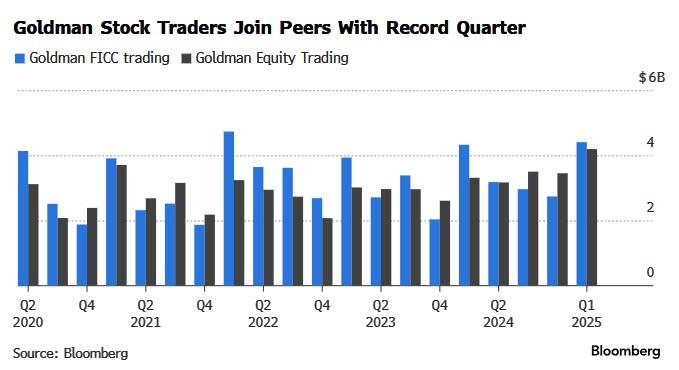

Goldman's results were a carbon copy of JPMorgan because not only did FICC miss, but investment banking was a big dud as well (with misses in advisory and equity underwriting, as only debt underwriting outperformed eBut before we dig deeper here is a snapshot of the Q1 results:

  • Net revenue $15.06 billion, +6% y/y, beating estimate $14.76 billion and the third-highest quarter on record
  • Global Banking & Markets net revenues $10.71 billion, +10% y/y, beating estimate $10.42 billion
    • Equities sales & trading revenue $4.19 billion, beating estimate $3.8 billion
    • FICC sales & trading revenue $4.40 billion, missing estimate $4.47 billion
  • Investment banking revenue $1.92 billion, -8.1% y/y, missing estimate $2.03 billion
    • Advisory revenue $792 million, -22% y/y, missing estimate $910.4 million
    • Equity underwriting rev. $370 million vs. $370 million y/y, missing estimate $394.4 million
    • Debt underwriting rev. $752 million, +7.6% y/y, beating estimate $699.5 million
  • Platform Solutions pretax earnings $25 million, beating the estimate loss $106.5 million
  • EPS $14.12 vs. $11.58 y/y, up 22% and beating estimates of $12.21, largely thanks to a plunge in the effective tax rate to 16.1%, down from 22.4% a year ago (according to the bank, the drop reflect "an increase in tax benefits on the settlement of employee share-based awards, partially offset by a decrease in other permanent tax benefits, for the first quarter of 2025 compared with the full year of 2024.")

Some more details:

  • Net interest income $2.90 billion, estimate $2.28 billion
  • Total operating expenses $9.13 billion, +5.4% y/y, estimate $9.17 billion
  • Compensation expenses $4.88 billion, +6.3% y/y, estimate $4.86 billion
  • Total deposits $471 billion, +8.8% q/q
  • Total Loans $210 billion, estimate $197.61 billion
  • Provision for credit losses $287 million, -9.7% y/y, estimate $410.4 million
  • Annualized ROE +16.9%, estimate +14.9%
  • Return on tangible equity +18%, estimate +16.1%
  • Standardized CET1 ratio 14.8%, estimate 15%
  • Book value per share $344.20 vs. $321.10 y/y
  • Efficiency ratio 60.6% vs. 60.9% y/y, estimate 61.6%
  • Assets under management $3.17 trillion, +11% y/y, estimate $3.15 trillion
  • Total AUS net inflows $24 billion vs. outflows $15 billion y/y, estimate $34.26 billion

Q1 consolidated summary:

... and by segment.
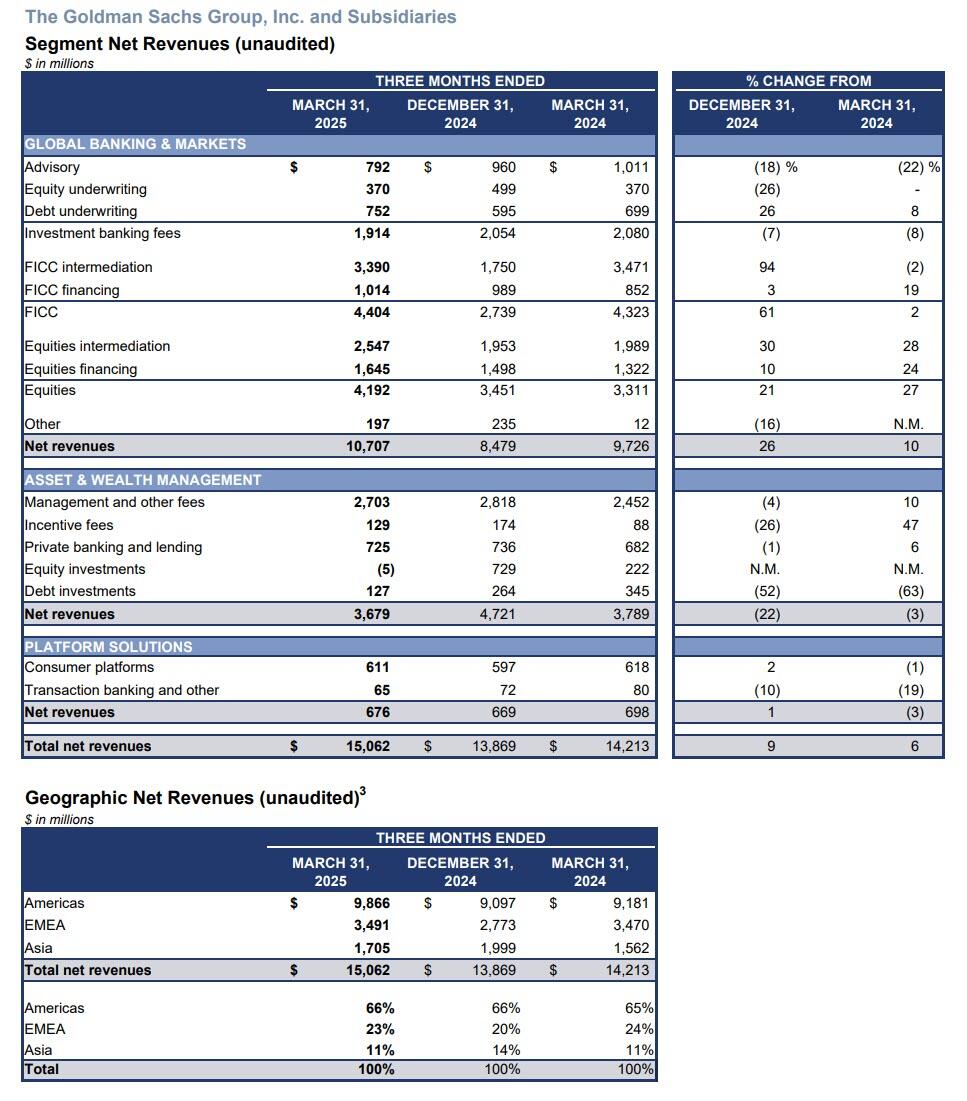
Unlike JPMorgan, whose loan loss reserves soared 3x to $1bn, Goldman's provision for credit losses was only $287 million, below estimates of $410 million, and down 10% compared with $318 million for the first quarter of 2024. Provisions for the first quarter of 2025 primarily reflected net provisions related to the credit card portfolio. Provisions for the first quarter of 2024 reflected net provisions related to both the credit card portfolio (driven by net charge-offs) and wholesale loans (driven by impairments). Then again, that is to be expected for a bank which recently took massive write down losses on its entire retail/subsprime lending effort which imploded even faster than it was launched.

Goldman's expenses were also lower than expected:

  • Operating expenses were $9.13 billion for the first quarter of 2025, below expectations of $9.17 billion, but 5% higher than the first quarter of 2024 and 10% higher than the fourth quarter of 2024. 
  • The firm’s efficiency ratio was 60.6% for the first quarter of 2025,  compared with 60.9% for the first quarter of 2024.
  • The increase in operating expenses compared with the first quarter of 2024 primarily reflected significantly higher transaction based expenses and higher compensation and benefits expenses (reflecting improved operating performance), partially offset by significantly lower consolidated investment entities expenses, including impairments (largely in depreciation and amortization) and a decrease from the FDIC special assessment fee recognized in the first quarter of 2024 (in other expenses). 
  • Net provisions for litigation and regulatory proceedings were $(11) million for the first quarter of 2025, compared with $23 million for the first quarter of 2024.

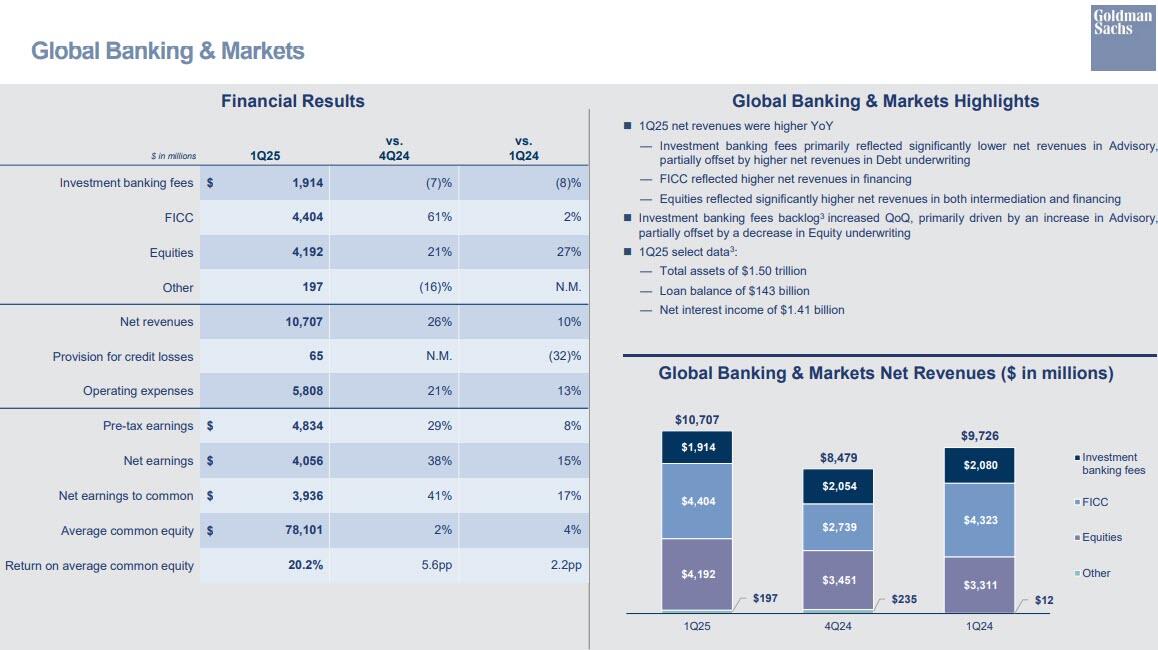
Taking a closer look at the bank's all important Global Banking and Markets division, net revenues were $10.71 billion for the first quarter of 2025, 10% higher than the first quarter of 2024 and 26% higher than the fourth quarter of 2024.  At the same time, growth in Goldman’s dealmaking machine remains challenged as the same market volatility that fuels trading hampers clients’ willingness to ink big-ticket mergers and financing agreements. The company’s investment-banking revenue was $1.91 billion, 8% lower than last year. Financial-advisory revenues and equity underwriting both missed expectations, but the bank’s debt desk came in higher than predicted. here are the deails:

  • Net revenues in Equities were $4.19 billion, beating estimates of $3.8 billion, and 27% higher than the first quarter of 2024, "due to significantly higher net revenues in Equities intermediation (primarily reflecting significantly higher net revenues in derivatives) and in Equities financing (primarily reflecting significantly higher net revenues in portfolio financing)."
  • Net revenues in Fixed Income, Currency and Commodities (FICC) were $4.40 billion, missing estimates of $4.47 billion, and 2% higher than the first quarter of 2024, "reflecting higher net revenues in FICC financing, driven by significantly higher net revenues from mortgages and structured lending. At the same time, net revenues in FICC intermediation were slightly lower, "reflecting lower net revenues in credit products, interest rate products and commodities, largely offset by higher net revenues in currencies and slightly higher net revenues in mortgages."
  • Investment banking fees were $1.91 billion, missing estimates of $2.03 billion, and 8% lower than the first quarter of 2024, "primarily due to significantly lower net revenues in Advisory compared with a strong prior year period, partially offset by higher net revenues in Debt underwriting, primarily driven by asset-backed and investment-grade activity." Net revenues in Equity underwriting were unchanged. 
  • The firm’s Investment banking fees backlog increased compared with the end of 2024. 

Even as big-ticket deals remain thin, the bank’s investment-banking fees backlog has grown quarter-over-quarter, the company said. That echoes the sentiment that Morgan Stanley CEO Ted Pick conveyed on Friday, when he said a lot of deals are paused but not abandoned. Finally, net revenues in Other were $197 million, compared with $12 million for the first quarter of 2024, primarily reflecting significantly lower net losses on hedges. Here is the breakdown visually:
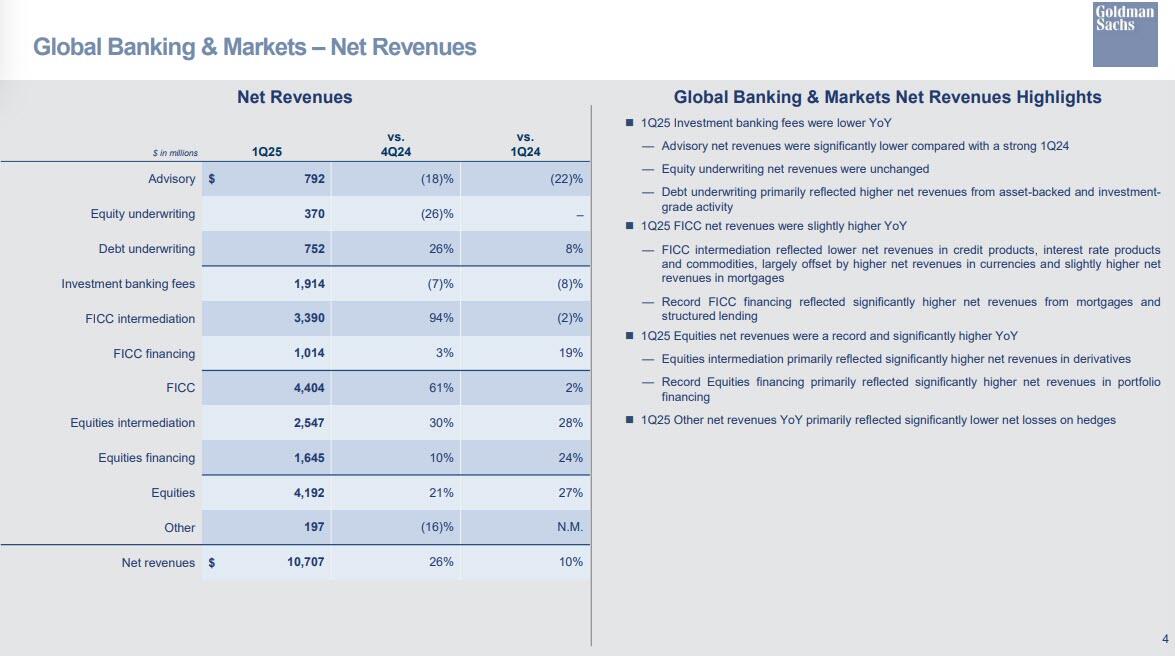
Comparing results vs a year ago:

  • Equities net revenues were a record and significantly higher YoY
  • FICC net revenues were slightly higher YoY
  • Investment banking fees were lower YoY
  • Other net revenues YoY primarily reflected significantly lower net losses on hedges
Revenue from the bank’s vast asset- and wealth-management business was $3.68 billion, lower than the $3.84 billion expected by analysts, and the reason why: investments puked and the company was busy "harvesting."

  • Equity investments reflected significantly lower net gains from investments in private equities and higher net losses from investments in public equities 
  • Debt investments reflected significantly lower net interest income due to a reduction in the debt investments balance sheet and net losses compared with net gains in 1Q24
  • Incentive fees were driven by harvesting (i.e. selling)
  • Private banking and lending primarily reflected higher net interest income from lending 
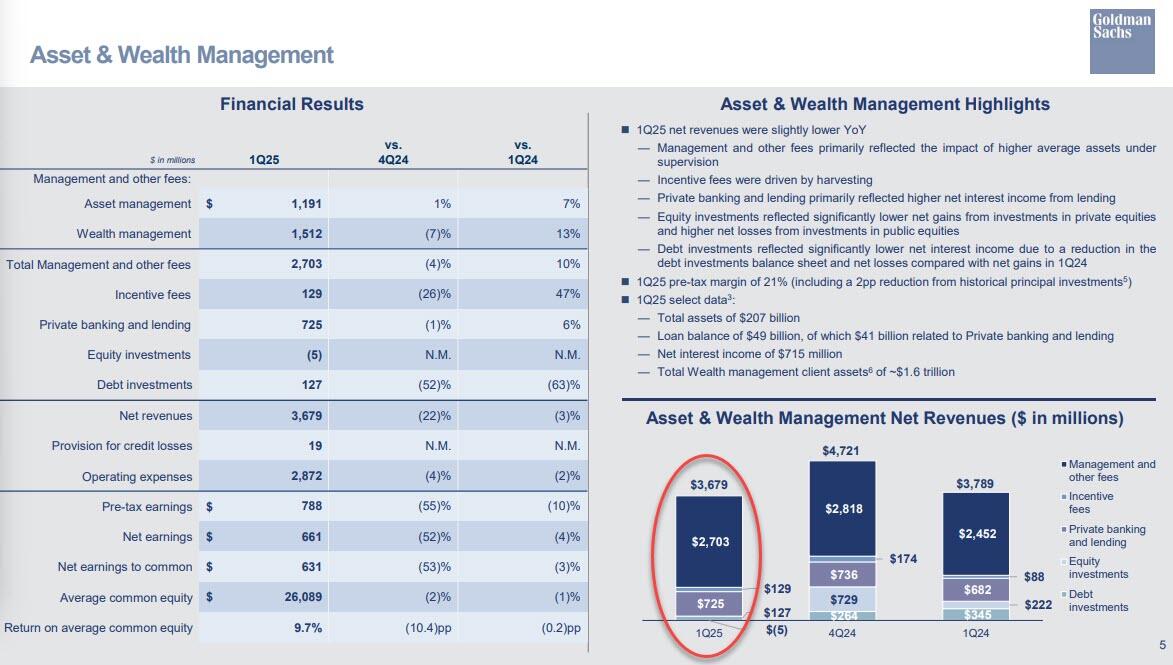
Goldman has been trying to expand its wealth management unit - which now manages $3.17 trillion - including by opening private equity funds to individual investors outside the bank. 
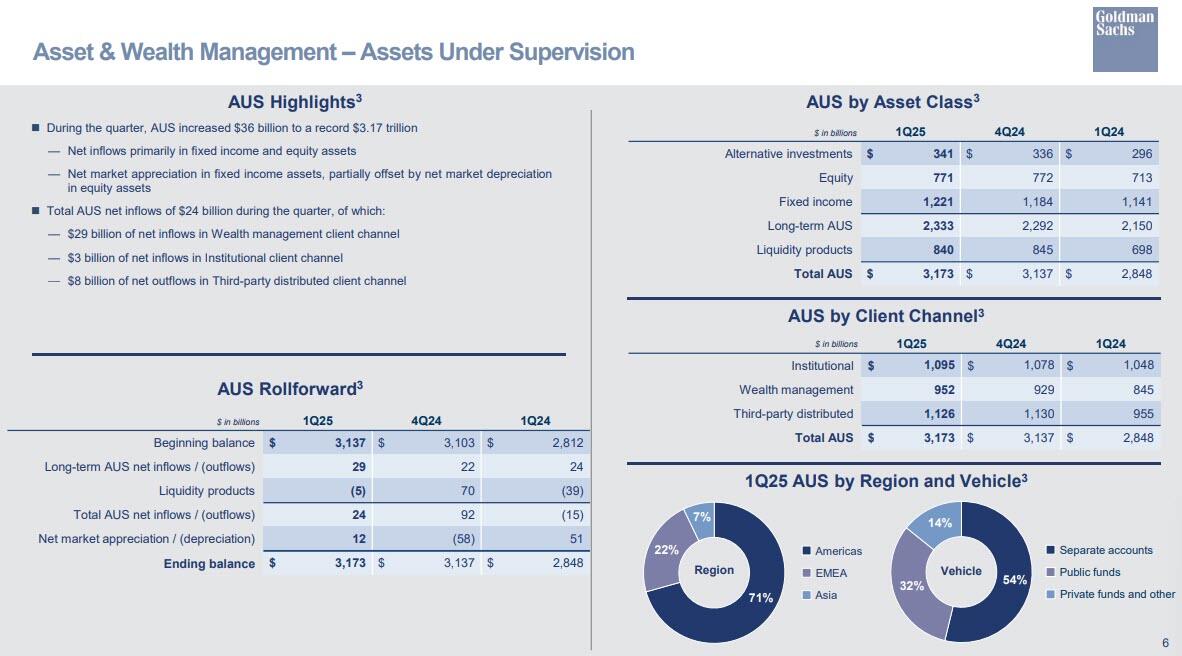
In doing so, it aims to create a more steady stream of fee-based income, tapping growing demand for private-market investments and alleviating investor concerns over its less predictable businesses.

Goldman's Q1 results build on the sector’s momentum from last week, when banking peers including JPMorgan and Morgan Stanley also notched record stock-trading hauls for the period. And they follow a record year for Goldman in 2024, when the New York-based bank lifted its revenue in the division by almost 50%.

"While we are entering the second quarter with a markedly different operating environment than earlier this year, we remain confident in our ability to continue to support our clients,” Chief Executive Officer David Solomon said in the statement.

Goldman traders stand to gain from market volatility to a point, but Solomon has also called for more clarity on Trump’s policy agenda to provide certainty to investors. The results are the first since his future at the bank’s helm was cemented with an $80 million retention bonus - criticized by investor-advisory firms - that keeps him at Goldman until at least 2030.

Stripping away the record equity trading revenue which was a given, Wall Street commentary was mixed:

RBC’s Gerard Cassidy (Sector perform, $610)

  • Goldman “posted a strong quarter driven by better-than-expected total revenues, lower-than-expected expenses and a lower-than-expected provision for credit losses,” the analyst wrote
  • Effective tax rate was lower than expected, reflects increase in tax benefits on the settlement of employee share-based awards

Evercore’s Glenn Schorr (Outperform, $594)

  • Goldman put up a strong quarter, Schorr and colleagues wrote
  • Issues include: investment-banking down 8% year-on-year and advisory down 22% year on year; but the backlog was up
  • “Second quarter will bring other challenges as banking and AWM start out the quarter in deficit, but trading remains strong and somehow Goldman’s banking pipeline is up”
  • “Goldman Sachs will likely ebb and flow with the macro backdrop, but the great start to the year, continued growth in trading, financing and management fees and the high comp accrual should provide some offsets to what could be a mid-year slowdown”

JPMorgan’s Kian Abouhossein (Overweight, $614)

  • Asset- and wealth-management revenue was “below JPM estimates, reflecting significantly lower net gains from investments in private equities and higher net losses from investments in public equities”
  • “Investment-banking fees backlog increased quarter-on-quarter, primarily driven by an increase in advisory, partially offset by a decrease in equity underwriting”

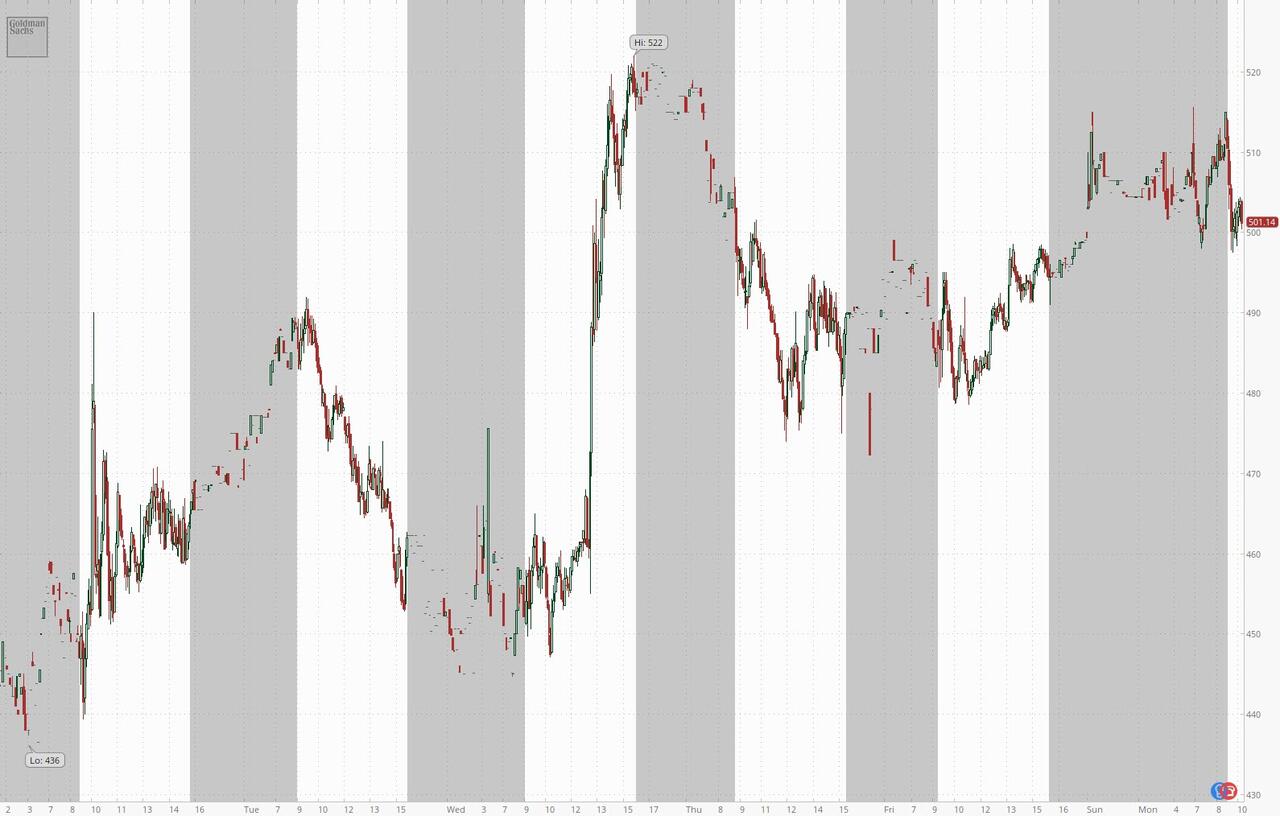
Shares of the company, which were down 14% this year through Friday, rose 1.5% in early trading. 
More in the full Q1 presentation below (pdf link)


Nvidia Announces "Engines Of World's AI Infrastructure" Will Be Built In America For First Time

 President Trump's 'America First' agenda - more specifically, the revival of domestic critical supply chains to reinforce hemispheric defense - scored a massive win this morning as Nvidia announced plans to design and build AI supercomputer factories in the United States for the first time.

Nvidia outlined new initiatives aimed at strengthening America's chip manufacturing sector:

  • Nvidia is localizing AI chip and supercomputer manufacturing in the U.S. for the first time, partnering with TSMC, Foxconn, Wistron, Amkor, and SPIL.

  • Over 1 million square feet of manufacturing space has been commissioned for Blackwell chips and AI supercomputers in Arizona and Texas.

  • Mass production of these chips is expected within 12–15 months.

  • Total AI infrastructure by Nvidia could total $500 billion over the next four years.

"Tens of 'gigawatt AI factories' are expected to be built in the coming years," Nvidia said, adding, "Manufacturing Nvidia AI chips and supercomputers for American AI factories is expected to create hundreds of thousands of jobs and drive trillions of dollars in economic security over the coming decades."

Nvidia CEO Jensen Huang commented on 'Made In America' supercomputers: 

"The engines of the world's AI infrastructure are being built in the United States for the first time" and "adding American manufacturing helps us better meet the incredible and growing demand for AI chips and supercomputers, strengthens our supply chain and boosts our resiliency." 

Nvidia's move will bolster America's chip manufacturing sector and reduce reliance on high-tech AI chips from Taiwan — a supply chain that Beijing could disrupt at any moment with an invasion of Taipei.

Rebuilding these critical domestic supply chains plays into a broader theme of hemispheric defense as the world fractures into a more profound bipolar state by the 2030s.  

The race to secure supply chains and strengthen hemispheric defense is intensifying. That's because the technological competition between the U.S. and China is set to go into hyperdrive. Control over AI chips and their applications — including EVs, clean tech, humanoid robots, drones, low Earth orbit (LEO) satellites, and large language models (LLMs) — will be critical. While these may seem like separate industries, they all share a common ecosystem of technologies and supply chains. Whoever dominates these industries will dominate the next decade. 

If America wants to win 2030 - now is the time to bolster domestic supply chains.

https://www.zerohedge.com/technology/nvidia-announces-engines-worlds-ai-infrastructure-will-be-built-america-first-time

BP makes oil discovery off US Gulf coast

  bp today announced an oil discovery at the Far South prospect in the deepwater U.S. Gulf of America.


bp drilled the exploration well in Green Canyon Block 584, located in western Green Canyon approximately 120 miles off the coast of Louisiana in 4,092 feet of water. The well was drilled to a total depth of 23,830 feet. The Far South co-owners are bp (operator, 57.5%) and Chevron U.S.A. Inc. (42.5%).


Both the initial well and a subsequent sidetrack encountered oil in high-quality Miocene reservoirs. Preliminary data supports a potentially commercial volume of hydrocarbons.


This discovery in the deepwater Gulf of America underscores how bp is in action to step up investment in exploration and strengthen its upstream portfolio under the strategy reset announced in February 2025.


Andy Krieger, Senior Vice President, Gulf of America and Canada, said: “This Far South discovery demonstrates that the Gulf of America remains an area of incredible growth and opportunity for bp. Our Gulf of America business is central to bp’s strategy. We are focused on delivering more affordable and reliable energy from this region, building our capacity to over 400,000 barrels of oil equivalent per day by the end of the decade.”


bp expects to grow its global upstream production to 2.3 – 2.5 million barrels of oil equivalent in 2030, with the capacity to increase production out to 2035. Around 1 million barrels of oil equivalent per day are expected to be delivered from the U.S. onshore and offshore regions by 2030.


https://www.bp.com/en_us/united-states/home/news/press-releases/bp-announces-oil-discovery-in-the-gulf-of-america.html

Goldman Sachs sees ounce of gold at $3700 by the end of 2025 (+15%)

 Goldman Sachs raised its end-2025 gold (GC=F) price forecast to $3,700 per ounce from $3,300, with a projected range of $3,650-$3,950, citing stronger-than-expected demand from central banks and higher exchange-traded fund inflows due to recession risks.

"If a recession occurs, ETF inflows could accelerate further and lift gold prices to $3,880 per troy ounce (toz) by year-end," the bank said in a note dated Friday.

"That said, if growth surprised to the upside on reduced policy uncertainty, ETF flows would likely revert to our rates-based predictions, with year-end prices closer to $3,550/toz."

The White House exempted smartphones and computers from "reciprocal" U.S. tariffs, however, President Donald Trump warned levies were still likely at some point.

Spot gold prices hit another record high on Monday at $3,245.42 per ounce but lacked clear direction as the market absorbed the ongoing tariff story.

The bank also nudged up its central bank demand assumption to 80 metric tons per month, from 70 tons earlier.

https://finance.yahoo.com/news/goldman-sachs-raises-end-2025-051348802.html

Pfizer discontinues development of weight loss pill

Pfizer Inc (NYSE:PFE, ETR:PFE) announced it will discontinue the development of its experimental weight-loss pill, danuglipron, due to safety concerns.

The company said on Monday that the decision comes after a clinical trial participant experienced a potential drug-induced liver injury, which resolved after stopping the medication.

“While we are disappointed to discontinue the development of danuglipron, we remain committed to evaluating and advancing promising programs in an effort to bring innovative new medicines to patients,” Pfizer chief scientific officer and president of research and development Dr Chris Boshoff said in a statement.

“Cardiovascular and metabolic diseases including obesity remain important areas of unmet medical need, and we plan to continue applying our global capabilities to advance a pipeline of investigational treatments that have the potential to fill critical gaps in patient care, including continued development of our oral GIPR antagonist candidate and other earlier obesity programs.”

Data from the danuglipron clinical development program will be presented at a scientific forum or submitted for publication in a peer review journal in the future, Pfizer said.

This is another setback for Pfizer as it seeks to compete in the lucrative obesity drug market dominated by injectable treatments from Novo Nordisk and Eli Lilly. The company abandoned a twice-daily version of danuglipron in 2023 due to tolerability issues, including nausea and vomiting.

Shares of Pfizer were unchanged on the announcement, trading hands premarket just shy of $22 each. The stock is down 17.4% in the year to date.

Rival Novo Nordisk (NYSE:NVO) saw its shares gain 2.8% premarket, while Eli Lilly and Co (NYSE:LLY) added 2.3%.

https://www.proactiveinvestors.com/companies/news/1069640/pfizer-discontinues-development-of-weight-loss-pill-1069640.html