Search This Blog

Monday, April 14, 2025

Ethical Collapse in the Peer Review of a Leading Vaccine Journal

 This article tells the story of one of the most disturbing breaches of scientific ethics we’ve encountered in our academic careers—buried in the peer-review process of one of the world’s leading vaccination journals, in the midst of a global health crisis.

Our story begins, as many things in science do, with a question. A provocative study published in Vaccine—a highly influential medical journal—asked: “Are intelligent people more likely to get vaccinated?” The study, conducted by Zur and colleagues (2023), examined soldiers in the Israeli Defense Forces (IDF) during the Covid-19 pandemic and concluded that “higher intelligence was the strongest predictor for vaccine adherence.”1

We read the study with growing unease. The conceptual leap was striking, the methodological choices questionable, and the ethical implications deeply troubling—especially given the context. These were not civilians making autonomous medical decisions in ordinary times. These were young conscripts operating within a rigid military hierarchy, subjected to intense social and institutional pressure to vaccinate during a historical moment when a strict Covid-19 vaccine passport policy was in force (i.e., the Israeli ‘green pass’).

We drafted a brief Letter to the Editor—just 500 words, in accordance with the journal’s submission guidelines. In this letter, we raised both scientific concerns and ethical red flags, questioning whether what the authors labeled “adherence” could truly be considered voluntary under the circumstances. We also argued that if the authors genuinely sought to measure medical adherence—rather than institutional compliance—they should have focused on the fourth dose of the vaccine.

By the time it was offered, the fourth dose was no longer mandated, though it remained recommended by medical professionals. Strikingly, according to the study’s own data, only about 0.5% of participants chose to take that dose—undermining the authors’ central claim. We concluded our letter with a broader ethical warning: that unfounded claims linking vaccine hesitancy to low intelligence risk evoking darker moments in history—times when marginalized groups were pathologized and ridiculed under the banner of “science.”

Confident that our critique was both scientifically sound and ethically necessary, we submitted the letter on October 22, 2023. It was concise, respectful, and carefully crafted to meet the journal’s formal requirements—including the strict word and reference limits. We believed we were entering a good-faith scientific exchange. We had no idea what was about to unfold.

Act I: Something Feels Off

What followed was a silence that grew increasingly unnerving. Days turned into weeks, and weeks into months, with no substantial response from the journal. Periodically, we received automated notifications that the “required reviews” had been completed—each time suggesting that a decision was imminent. Yet the anticipated response never came, leaving our submission in a state of perpetual limbo. Its status changed multiple times over six months, only to return repeatedly to “under review.” Something felt off.

Finally, in March 2024, we received a decision. The editor noted that “the referee(s) have raised a number of points” and that “if the paper can be substantially revised to take account of these comments,” he “would be happy to reconsider it for publication.”

What immediately stood out to us was the number of referees that were assigned to our short manuscript. Based on the way the comments were labeled, it appeared that five referees had reviewed our 500-word letter—an unusually high number for a brief communication of this kind. Yet only three sets of comments were included. Comments from Reviewers 1 and 2 were missing entirely. Reviewer 3 offered a highly positive assessment and Reviewers 4 and 5 were sharply critical. However, their reviews were completely identical, word for word, as if copy-pasted.

More troubling still, the identical reviews appeared to contain insider knowledge. In response to our concern about discrepancies in the study’s supplementary data, the reviewers wrote that they “understand [that] a corrected version has been submitted to the editor.” This was deeply puzzling. Before submitting our critique, we had reached out to Zur and colleagues—the authors of the study in question—to request clarification or correction regarding the flawed data presentation. However, they never sent us such a correction, nor was any update published on the journal’s website, to our knowledge. How, then, did these anonymous, supposedly independent reviewers know that a correction had been submitted?

At that point, we admit, our suspicion began to rise. Still, we assumed good faith and proceeded with the revision. Our revised letter was accompanied by an extensive, fully referenced response to the reviewers and editor. In fact, our response far exceeded the original submission in length. We addressed each critical point raised, corrected several mischaracterizations of our arguments (including cases where the reviewers had put words in our mouths), and reasserted our core concerns regarding the original study’s framing, methodology, and ethical implications.

We believed we were engaged in legitimate scientific discourse.

We had no idea how far that belief would be tested.

Act II: The Reviewers Behind the Curtain 

Seven more months passed. The journal remained silent.

Then, on October 29, 2024, we finally received a formal decision letter from the Editor-in-Chief of Vaccine. “Dear Dr. Yaakov Ophir,” it began, “The above-referenced paper has now been assessed by subject-matter experts serving as peer reviewers for Vaccine. After careful review, I regret to inform you of the decision to decline your manuscript without offer of revision. The reviewers’ comments (and the editor’s, if indicated) are appended below.”

The reviewer comments that followed were brief and vague: “Reviewer 4: The minor adjustments made to the phrasing within the manuscript do not align with the comprehensive revisions necessary for publication. Consequently, I advise against the publication of this manuscript (bold added).

No elaboration. No mention of the previously supportive reviews. No editorial summary. Just a quiet, opaque dismissal, seemingly based solely on the ‘objective’ advice of Reviewer 4. 

We were deeply disturbed. We emailed the Editor-in-Chief, respectfully requesting the complete feedback from all five reviewers. He never responded. So we turned to the publisher—Elsevier’s Support Center—and a kind representative promptly provided us with the full review file. We truly hope she was not punished for doing so, because each new detail we discovered in that material was more concerning than the last.

What we received from Elsevier included, for the first time, the missing reviews from Reviewer 1 and Reviewer 2. Both were strongly supportive. One even stated that our critique was “so valid and so important” that it warranted re-evaluation of the original article’s publication status. The reviewer went as far as suggesting a retraction if the original authors could not adequately respond.

And then came the revelation. Buried within the review file were comments labeled “For the Editor Only.” In that section, Reviewers 4 and 5—the ones who had submitted the identical, negative reviews—openly identified themselves: “This review is co-authored by Meital Zur and Limor Friedensohn, as co-investigators of the aforementioned work.” 

The authors of the original study—the very people we had critiqued—had been assigned to review our letter anonymously. They evaluated our critique of their own work and recommended its rejection. In their public comments, they even referred to themselves in the third person, as though they were neutral reviewers. At one point, they wrote that they “understand [that] a corrected version has been submitted to the editor”—as if they were not the ones who had submitted it themselves.

This could not have been a simple editorial oversight. Worse still, it had been hidden from us—revealed only after we demanded full transparency and received it through a secondary channel. This conduct was not merely questionable—it was a direct violation of Elsevier’s own ethical guidelines.2 

According to Elsevier’s official factsheet on competing interests, “reviewers must also disclose any competing interests that could bias their opinions of the manuscript.2 It further states that “competing interests can also exist as a result of personal relationships, academic competition, and intellectual passion”—precisely the kind of conflict that applied here.

Even more striking is the document’s guiding question for assessing integrity: “whether the relationship, when later revealed, would make a reasonable reader feel deceived or misled.” In our case, the answer is unequivocal. The authors of the original study were allowed to anonymously review and recommend rejection of a critique targeting their own work—without disclosure, without transparency, and in blatant contradiction to the standards they themselves were supposed to uphold.

Considering these blatant ethical violations, we contacted the Editor-in-Chief of Vaccine once again. We requested a formal response and asked that our letter be reconsidered for publication or, at the very least, that the conflict of interest be acknowledged. This time, we didn’t have to wait. On the very same day we informed the journal of the misconduct we had uncovered, we received a reply—not from the Editor-in-Chief, but from Vaccine’s Scientific Editor, Dr. Dior Beerens.

The email read: “The internal review and investigation by the Vaccine board of this manuscript and received letters also contributed to this final decision, in addition to the review process of external reviewers. Therefore, the decision on this letter is final.” No further explanation was offered. No accountability. No correction. And no transparency.

Act III: Breaking the Silence  

Our story, we now realize, was never just about a single letter. It was about the integrity of the scientific process. In a time of growing public mistrust, we believe science must hold itself to the highest standards of transparency, fairness, and accountability. Peer review is meant to safeguard those standards—to ensure that critique is met with openness, and that scientific claims are tested, not protected.

What happened here violated all of that. The very authors whose work we had critiqued were granted anonymous authority over our submission. They used that authority to suppress our criticism—without ever disclosing who they were. The editor allowed it. The journal stood by it. And all of it was kept from us, until we forced the process open.

We chose to publish our story not to attack individuals, but to raise an alarm. If this can happen in one of the world’s leading medical journals—on a topic as consequential and contested as Covid-19 vaccination—it can happen anywhere.

We urge the scientific community, journal editors, and publishers to ask themselves: What kind of science do we want to stand for? One that hides behind silence—or one that invites scrutiny?

Our full, step-by-step account, along with our original submission to Vaccine, is available as a preprint here.3 

The silence spoke volumes. We’ve decided to answer back.

References

1. Zur M, Shelef L, Glassberg E, Fink N, Matok I, Friedensohn L. Are intelligent people more likely to get vaccinated? The association between COVID-19 vaccine adherence and cognitive profiles. Vaccine. 2023;41(40):5848–5853. doi: 10.1016/j.vaccine.2023.08.019.

2. Elsevier. FACTSHEET: Competing Interests. https://assets.ctfassets.net/o78em1y1w4i4/5XCIR5PjsKLJMAh0ISkIzb/16f6a246e767446b75543d8d8671048c/Competing-Interests-factsheet-March-2019.pdf. Accessed April 9, 2025.

3. Ophir Y, Shir-Raz Y. Are Intelligent People More Likely to Get Vaccinated? A Critique of Zur et al. (2023) and the Conflicted Review Process that Suppressed It. https://osf.io/f394k_v1. Accessed Apr 9, 2025.


Dr. Yaakov Ophir is Head of the Mental Health Innovation and Ethics Lab at Ariel University and a member of the Steering Committee for the Centre for Human-Inspired Artificial Intelligence (CHIA) at the University of Cambridge. His research explores digital-age psychopathology, AI and VR screening and interventions, and critical psychiatry. His recent book, ADHD Is Not an Illness and Ritalin Is Not a Cure, challenges the dominant biomedical paradigm in psychiatry. As part of his broader commitment to responsible innovation and scientific integrity, Dr. Ophir critically assesses scientific studies related to mental health and medical practice, with particular attention to ethical concerns and the influence of industrial interests. He is also a licensed clinical psychologist specializing in child and family therapy.

Yaffa Shir-Raz, PhD, is a risk communication researcher and a teaching fellow at the University of Haifa and Reichman University. Her area of research focuses on health and risk communication, including Emerging Infectious Disease (EID) communication, such as the H1N1 and the COVID-19 outbreaks. She examines the practices used by the pharmaceutical industries and by health authorities and organizations to promote health issues and brand medical treatments, as well as censorship practices used by corporations and by health organizations to suppress dissenting voices in the scientific discourse. She is also a health journalist, and the editor of the Israeli Real-Time Magazine and a member of the PECC general assembly.

https://brownstone.org/articles/ethical-collapse-in-the-peer-review-of-a-leading-vaccine-journal/

Fraud In The Medicaid Program? Where To Start?

 Elon Musk, of the Department of Government Efficiency, has asserted that his goal is to cut some $1 trillion of “waste and fraud” from annual federal spending. Skeptics of the effort say that that’s just not possible, mainly because almost half of federal spending constitutes the “entitlements” — Social Security, Medicare, Medicaid, and some smaller health insurance programs — and President Trump has pledged not to cut those. Add something close to $1 trillion for defense, and another close to $1 trillion for interest on the national debt, and the remainder (less than $2 trillion) doesn’t leave nearly enough room for a trillion of cuts.

But here’s the missing piece: What if there are large amounts of fraud in the entitlement programs? Trump hasn’t pledged not to go after that. Could the amounts of such fraud be significant in the context of the huge numbers at issue? I don’t fully know the answer to that question; but today I’ll look at one example involving very big numbers where obvious fraud is hiding in plain sight.

First, a look at the big picture numbers. The Center on Budget and Policy Priorities has on its website an overview of federal spending dated January 28, 2025, providing figures for fiscal year 2024 (which ended on September 30, 2024). The big categories:

  • Federal spending for fiscal year 2024 was approximately $6.9 trillion.

  • Health insurance entitlements (Medicare, Medicare, CHIP, and Obamacare subsidies totaled $1.7 trillion, or 24% of spending.

  • Social Security totaled $1.5 trillion, or 21% of spending.

  • Defense totaled $872 billion, or 15% of spending.

  • Interest on the debt was about $892 million, or another 15% of spending.

  • The remainder added up to $1.936 trillion.

And now, here’s a good place to start looking for fraud in the entitlements. In New York we have something called the Consumer Directed Personal Assistance Program. Bloomberg had a piece about it in July 2024, which is behind paywall, but Newsweek re-wrote the story here. The idea, supposedly, was that we could use Medicaid funds to pay relatives like spouses and children to take care of their infirm relatives, and thus save the costs of professional aides, let alone nursing homes. From Newsweek:

"Oftentimes, ideas that start with the best of intentions can be taken advantage of in the wrong hands," Alex Beene, a financial literacy instructor at the University of Tennessee at Martin, told Newsweek. "With home health, some states like New York thought it would be a good idea to allow family members and friends to get paid for providing home health assistance to loved ones using Medicaid and Medicare dollars.

So what’s the problem?

[Beene]: “The problem is now you have individuals taking advantage of a pretty liberal, open-ended process for determining who qualifies."

It seems that the program to let family members become the home health aides got going in 2015.

In 2015, the eligibility rules changed, and the number of people getting care skyrocketed from 20,000 to 250,000.

And that was just the start. Here’s what Newsweek says were the relevant stats for the period 2019-2024:

[T]he money going to this program triple[d] across the span of the last five years, and home health jobs are [in 2024] considered to make up 12 percent of New York City's private sector jobs, Bloomberg reported.

The occasion for the Bloomberg and Newsweek pieces in 2024 was an interview given to Bloomberg by New York Governor Kathy Hochul in July of that year. In the interview, Hochul appeared to recognize that the home health care aide situation had gotten out of hand and needed to be reined in. From the Newsweek piece:

[Hochul said,] “The problem is now you have individuals taking advantage of a pretty liberal, open-ended process for determining who qualifies." Hochul told Bloomberg that the program was being abused so much that it now makes up the majority of New York City's job increases. . . . "I'm telling you right now, when you look on TikTok and you see ads of young people saying, 'Guess what, you can make $37 an hour by sitting home with your Grandma. You know, here's how you sign up,' it has become a racket," Hochul told Bloomberg.

So less than a year ago, Governor Hochul had recognized this as a “racket.” Surely then she did something to get it under control? Not at all. Instead, it appears that she has switched sides, and in ongoing budget negotiations this year is supporting a vast increase in Medicaid spending to continue funding this racket, among many other things. The New York Post had an editorial on April 6. Excerpt:

In a tale all too typical of Albany, Gov. Kathy Hochul a year or so ago was pushing to rein in out-of-control state Medicaid spending on home health aides, only to since switch sides with an eye on her re-election run next year. Now Medicaid outlays are set to soar at least 17% in the next budget, while the aide ranks are soaring and indeed are by far the single largest job category in all New York.

The Post collects some truly incredible statistics from a Report issued by the Empire Center think tank on April 3. The Empire Center Report is based on federal BLS data issued on April 2, although the data only go up to May 2024. From the Empire Center:

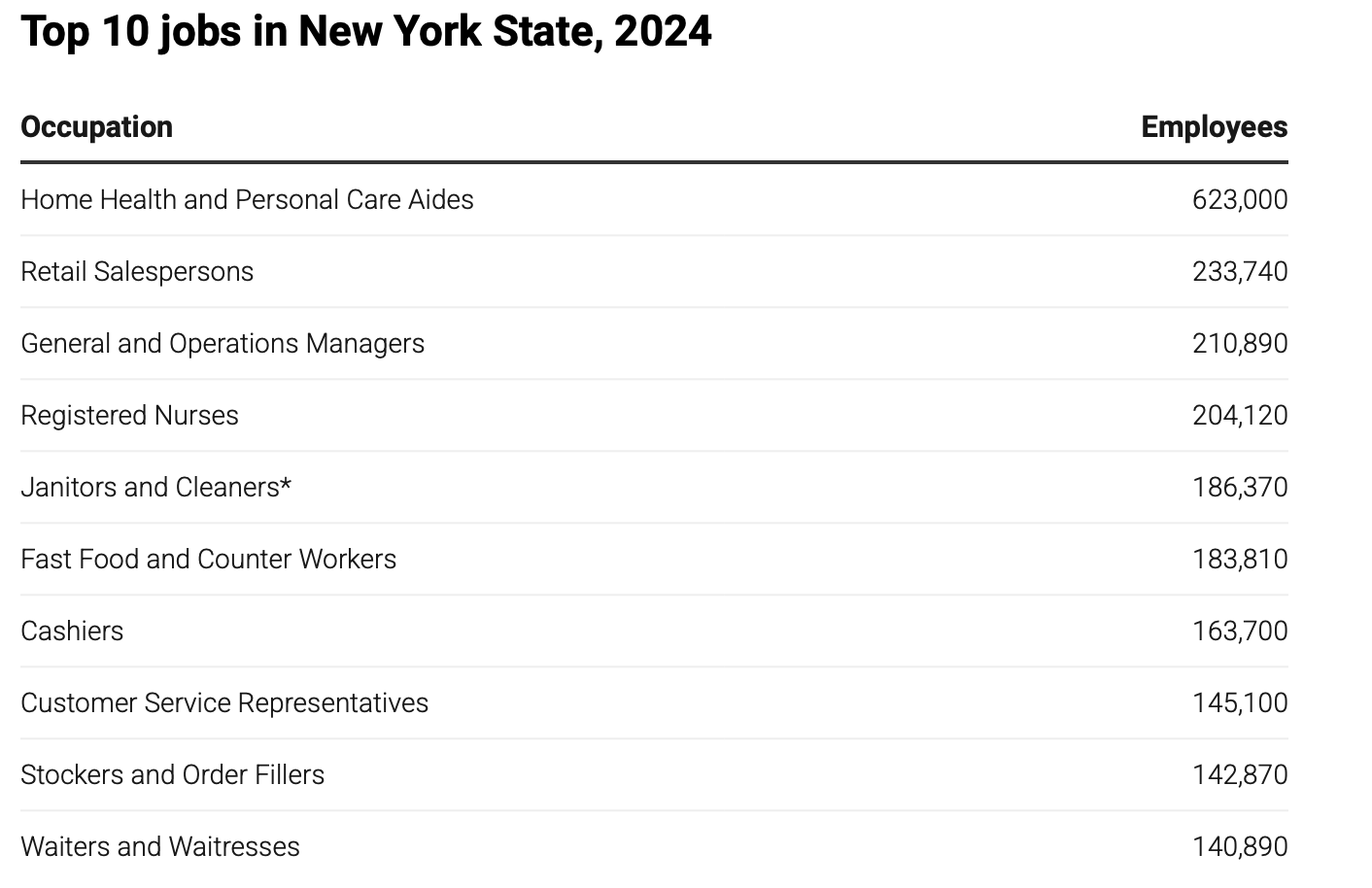
New York’s home health employment is continuing to soar, growing by 57,000 jobs or 10 percent from 2023 to 2024, according to newly released data from the U.S. Bureau of Labor Statistics. The state’s workforce of home health and personal care aides grew to an estimated 623,000 as of May 2024, according to BLS. . . .

From 20,000 in 2015 to 623,000 in 2024. Thanks, federal taxpayers, for picking up more than half of the tab. The Empire Center Report shows New York as by far the highest in the country in the number of these home health care aides per capita:

[New York has] 171 aides per 1,000 residents aged 65 or older, which was the highest rate in the U.S. – 153 percent higher than the national average and 24 percent ahead of the No. 2 state, California.

Over this period, the job category of home health aide has become far and away the largest job category in New York State. Here is a chart from the Empire Center Report, derived from BLS data, of the largest job categories in New York in 2024:

There are almost three times as many of these home health aides as all jobs in retail sales!

The Post attributes Governor Hochul’s switch of sides substantially to her buying the support of a health care union known as “Local 1199” (of the SEIU) in the run-up to her re-election campaign next year. Local 1199 hopes to unionize the home health aides to get hundreds of thousands of new dues-paying members, and then to engage in collusive wage negotiations where the bill will be paid substantially by the federal taxpayers.

I don’t know all the other examples of fraud in the entitlement programs. But if one this big and this obvious is just allowed to metastasize for years without any attempt at oversight, there are likely to be plenty of others.

https://www.manhattancontrarian.com/blog/2025-4-11-is-there-any-fraud-in-the-medicaid-program-heres-a-place-to-start-looking

End Medicaid Money Laundering

 by Sally Pipes

Earlier this month, Senator Cory Booker, D-N.J., spoke for 25 hours straight, breaking a Senate record. His goal, at least at the outset, was to "defend" Medicare and Medicaid from Republicans' proposed cuts.

"The Trump administration and Republicans in Congress are right now discussing how to cut these programs," Booker said, to fund "tax cuts for the rich."

"They're trying to gut Medicaid," he warned.

Taxpayers should be so lucky. Medicaid is rife with waste, fraud, and abuse. It's in dire need of reform.

Consider a new Paragon Health Institute study on Medicaid financing. The report exposes how state governments and healthcare providers engage in what amounts to legalized money laundering. The scheme enriches states and healthcare providers. But it does so at the expense of federal taxpayers.

Each state runs its own Medicaid program and funds it in conjunction with the federal government. The feds give each state a different amount of money, called the "federal medical assistance percentage," or FMAP.

By law, the federal government must cover at least 50% of a state's Medicaid expenditures. In most states, it covers more, up to a maximum of nearly 77% in Mississippi. Wealthy states are supposed to get less federal assistance than poorer states.

Healthcare providers have figured out how to take advantage of this system. They lobby states to impose "provider taxes." Under these schemes, states "tax" providers and then send the money right back to them as higher Medicaid reimbursement rates. The federal government counts those dollars as additional state Medicaid expenditures—and then sends more money under the terms of the FMAP.

The result, as Paragon president Brian Blase and Idaho Freedom Foundation policy analyst Niklas Kleinworth note, is that providers and states coordinate to "deliver higher payments, financed largely or entirely by the federal government, to politically powerful providers in the state."

Under the standard FMAP, $100 of financing gimmicks yields $150 in federal funds for the state.

But the states that expanded Medicaid to able-bodied adults making up to 138% of the federal poverty level under Obamacare—now 40 states and the District of Columbia—can use provider taxes to extract much more from the federal government.

The Affordable Care Act commits the feds to paying for 90% of the cost of covering this expansion population. So $100 of financing gimmicks can generate $900 in federal funds for the state.

These tactics have driven up the federal government's share of Medicaid costs from roughly 57% to 75%, according to Paragon.

In other words, states are increasingly outsourcing the cost of their Medicaid programs to taxpayers in other parts of the country.

And for what? As the Paragon authors note, this vicious cycle drives up Medicaid reimbursement rates, which encourages doctors to prioritize Medicaid beneficiaries at the expense of Medicare patients. That could reduce the ability of American seniors to access care.

Moreover, provider taxes and other financial schemes are delivering providers more than they actually need to care for Medicaid's beneficiaries. According to the Government Accountability Office, providers are using the extra funds to build new facilities and purchase non-healthcare assets.

It's no wonder then-Vice President Joe Biden called provider taxes a "scam" in 2011. Presidents Bush, Obama, and Trump all pushed to curb them. Now, the Trump administration has a chance to do so.

Blase and Kleinworth propose a number of solutions, including reducing or eliminating the "safe harbor" for provider taxes—the regulatory cover that enables states to play this game.

But the best solution is for the federal government to block-grant Medicaid funds to the states. That would allow states to tailor their Medicaid programs to meet the unique needs of their residents—and end the perverse incentives that encourage states to expand their programs.

Curtailing provider tax schemes wouldn’t just reduce waste. It would improve the integrity of Medicaid. And by reducing the incentive for states to expand their Medicaid programs, it would help preserve the program's resources for the truly needy.

https://www.forbes.com/sites/sallypipes/2025/04/14/end-medicaid-money-laundering/

Saudi Arabia plans to pay off Syria's World Bank debts, sources say

 Saudi Arabia plans to pay off Syria's debts to the World Bank, three people familiar with the matter said, paving the way for the approval of millions of dollars in grants for reconstruction and to support the country's paralysed public sector.

The plans, which have not been previously reported, would be the first known instance of Saudi Arabia providing financing for Syria since Islamist-led rebels toppled former leader Bashar al-Assad last year.

It may also be a sign that crucial Gulf Arab support for Syria is beginning to materialize after previous plans, including an initiative by Doha to fund salaries, were held up by uncertainty over U.S. sanctions.

Last month, Qatar announced a plan to provide Syria with gas via Jordan to improve the nation's meagre electricity supply, a move that sources told Reuters had Washington's nod of approval.

A spokesperson for the Saudi Ministry of Finance told Reuters, "We do not comment on speculation, but make announcements, if and when they become official."

The Saudi government's media office, a World Bank spokesperson and a Syrian government official did not immediately respond to requests for comment.

Syria has around $15 million in arrears to the World Bank which must be paid off before the international financial institution can approve grants and provide other forms of assistance.

But Damascus is short of foreign currency and a previous plan to pay off the debts using assets frozen abroad did not materialize, according to two people familiar with the matter.

World Bank officials have discussed providing financing to help reconstruct the country's power grid, heavily damaged by years of war, and also to support public sector pay, two of the sources said.

A technical delegation from the World Bank met with Syria's Finance Minister Mohammed Yosr Bernieh on Monday, according to the Syrian state news agency Sana.

The meeting, which was the first public meeting between the Syrian government and the World Bank, included discussions on strengthening financial and economic ties between the two sides.

Bernieh also highlighted the negative effects of the international sanctions imposed on Syria and policies of the former regime on the country's financial and banking sector.

Reuters reported on Saturday that Syria would send a high-level delegation to Washington for the yearly spring meetings of the World Bank and IMF later this month, marking the first visit by Syrian officials to the U.S. since Assad's ouster.

It is unclear whether the Syrian delegation will meet with any U.S. officials.

Tough U.S. sanctions imposed during Assad's rule remain in place.

In January, the U.S. issued a six-month exemption for some sanctions to encourage humanitarian aid, but this has had limited effect.

Last month the U.S. gave Syria a list of conditions to fulfil in exchange for partial sanctions relief but the administration of U.S. President Donald Trump has otherwise engaged little with the country's new rulers.

That is in part due to differing views in Washington on how to approach Syria.

Some White House officials have been keen to take a more hard line stance, pointing to the new Syrian leadership's former ties to Al-Qaeda as reason to keep engagement to a minimum, according to diplomats and U.S. sources.

https://ca.finance.yahoo.com/news/exclusive-saudi-arabia-plans-pay-124657851.html

Novo Nordisk warns consumers about counterfeit versions of Ozempic in US

 Novo Nordisk said on Monday it has become aware of several hundred units of counterfeit versions of its diabetes drug Ozempic being distributed outside its authorized supply chain in the United States.

The U.S. Food and Drug Administration was notified on April 3 about the counterfeit products and it seized them on April 9.

The FDA and Novo Nordisk (NYSE:NVO) are testing the seized products and do not yet have information about the identity, quality or safety of these drugs, the health regulator said.

https://www.investing.com/news/stock-market-news/novo-nordisk-warns-consumers-about-counterfeit-versions-of-ozempic-in-us-3983995

Approval moves Roche Columvi earlier in DLBCL treatment pathway

 A regimen based on Roche's CD20xCD3 bispecific antibody Columvi has been approved in the EU as a second-line therapy for diffuse large B-cell lymphoma (DLBCL), the first in the class that can be used at this stage in the treatment pathway.

The approval is based on the phase 3 STARGLO trial, where Columvi (glofitamab) in combination with gemcitabine and oxaliplatin (GemOx) chemotherapy achieved a 41% reduction in the risk of death compared to Roche's anti-CD20 antibody MabThera/Rituxan (rituximab) plus chemo.

The Columvi combination also met its key secondary endpoints, with a 63% reduction in the risk of disease worsening or death compared to the control treatment.

Columvi has already been given conditional approval in Europe as a third-line or later treatment option for DLBCL, and the STARGLO data should help convert that to a full approval, according to Roche. In that indication, the drug competes with AbbVie and Genmab's rival CD20xCD3 bispecific Epkinly (epcoritamab), so, moving it into the first relapse setting could hand Roche an advantage.

Specifically, the European Commission has cleared Columvi for patients whose cancer has returned after initial treatment, but who are not eligible for autologous stem cell transplant (ASCT). The US FDA is due to make a decision on the new indication by 20th July.

It also means Columvi has become an off-the-shelf alternative to CAR-T therapies for NHL like Gilead Sciences' Yescarta (axicabtagene ciloleucel), Novartis' Kymriah (tisagenlecleucel), and Bristol-Myers Squibb's Breyanzi (lisocabtagene maraleucel) in second-line DLBCL treatment, which have complex manufacturing and administration procedures and require in-clinic care.

"People with [relapsed/refractory] DLBCL not eligible for ASCT represent a challenging population, especially those with primary refractory disease or early relapse whose need for a readily accessible and effective therapy is insufficiently addressed globally," said Franck Morschhauser, a STARGLO study investigator at the University Hospital Lille.

"This new Columvi combination is immediately available if a patient's cancer returns or doesn't respond to first-line therapy, which is a welcome addition to manage DLBCL," he added.

Roche's bispecific rivals are also looking to move Epkinly further up the treatment pathway, and Epkinly is being tested as a second-line option in the phase 3 EPCORE DLBCL-1 study, comparing it as a monotherapy to investigators’ choice of chemo in patients who did not respond to or are ineligible for an ASCT, with results due next year.

Meanwhile, AbbVie and Genmab are also running the Epcore DLBCL-4 trial, which is testing Epkinly plus Bristol-Myers Squibb's Revlimid (lenalidomide) in relapsed/refractory DLBCL patients who have failed or are ineligible for autologous stem cell transplant.

Roche maintains that a key difference between Columvi and Epkinly is that its drug uses a fixed duration of treatment, while AbbVie and Genmab’s therapy needs to be administered until the disease progresses.

That may allow for time off treatment that could reduce the risk of long-term side effects, it contends. Meanwhile, AbbVie and Genmab reckon that their drug is less likely to cause side effects like cytokine release syndrome (CRS) and has an easier route of administration (subcutaneous instead of intravenous).

https://pharmaphorum.com/news/approval-moves-columvi-earlier-dlbcl-treatment-pathway

Why relying on AI outcome models may not be a good idea

 The use of artificial intelligence-based outcome prediction models (OPMs) in medicine is on the rise, but a new paper has warned widespread use could lead to unintentional patient harm.

Specifically, it suggests that OPMs – statistical models that predict a certain health outcome based on a patient's characteristics and may be used in challenging treatment cases – can be vulnerable to "harmful self-fulfilling prophecies", even if they are very effective at predicting outcomes.

At the moment, the usual practice is to keep monitoring an OPM's accuracy – its discrimination – to make sure it continues to be effective, but somewhat counter-intuitively the new analysis in the data journal Patterns (PDF) suggests that may not actually be the best approach as it is too simplistic.

For example, if they are trained on data that reflects existing disparities in treatment or demographics, the AI could perpetuate these inequalities, leading to poorer patient outcomes. To guard against that, an element of "human reasoning" must be incorporated into the process.

The team – led by Wouter AC van Amsterdam of University Medical Center Utrecht – used various mathematical models to test their hypothesis and found that, in some cases, the OPM "can lead to harm, even when the predictions exhibit good discrimination after deployment."

The study is timely, according to Professor Ewen Harrison of the University of Edinburgh, a specialist in medical informatics who was not directly involved in the study, as it highlights the risks of AI and computer algorithms unintentionally harming patients by influencing treatment decisions.

He described a new AI tool to estimate who is likely to have a poor recovery after knee replacement surgery using characteristics such as age, body weight, existing health problems, and physical fitness.

"Initially, doctors intend to use this tool to decide which patients would benefit from intensive rehabilitation therapy. However, due to limited availability and cost, it is decided instead to reserve intensive rehab primarily for patients predicted to have the best outcomes," said Prof Harrison.

"Patients labelled by the algorithm as having a 'poor predicted recovery' receive less attention, fewer physiotherapy sessions, and less encouragement overall. As a result, these patients indeed experience slower recovery, higher pain, and reduced mobility, seemingly confirming the accuracy of the prediction tool."

The authors of the paper suggest that the current approach to prediction model development, deployment, and monitoring "needs to shift its primary focus away from predictive performance and instead toward changes in treatment policy and patient outcomes."

https://pharmaphorum.com/news/why-relying-ai-outcome-models-may-not-be-good-idea