by Allen Stein via The Epoch Times,
As the snow and icy rain began to fall on that early winter morning in New York, New Jersey, and Rhode Island, something big was going down.
They didn’t know it, but Jan. 20, 2011, was the beginning of the end for the Mafia.
On that day, the largest law enforcement operation against America’s most infamous crime organization commenced. Hundreds of FBI agents, equipped with criminal warrants, began arresting mob suspects across three states.
This operation was different from the many others that had been launched in the past. Authorities were going for not just the heart of the Mafia—the crime family bosses—but also individuals further down the hierarchy.
By the end of the day, ‘made men’ like Luigi Manocchio, the former boss of the New England Mafia; Andrew Russo, the street boss of New York’s Colombo family; and his acting underboss, Benjamin Castellazzo were in custody.
More than 125 individuals were arrested and charged with felonies including murder, extortion, and loan sharking.
The FBI’s dragnet even captured several labor union officials suspected of collaborating with the Mafia.
U.S. attorney general at the time, Eric Holder, said the FBI’s largest single-day operation, sent a “strong message” in the fight against traditional organized crime. And that wasn’t the end of it.
Still reeling from the 2001 operation, the Mafia was hit again on March 12, 2015, when FBI agents arrested 10 members of the New Jersey-based DeCavalcante crime family on charges of murder and prostitution.
In 2025, the seven traditional crime families known as La Cosa Nostra—meaning “This thing of ours”—are a shadow of their former selves.
While the Mafia was mostly a homegrown threat, there is now a much larger danger facing the United States.
Kristen Setera, spokesperson for the FBI’s Boston field office, said that the organized crime landscape has changed significantly since the late 20th century.
Back then, crime was often organized around hierarchical “families” that operated within neighborhoods, cities, and states.
Now, the United States is dealing with the rise of international criminal enterprises that possess multi-billion-dollar war chests and have a global reach.
Outside of the Mexican drug cartels are the Venezuelan gang Tren de Aragua and the Salvadoran MS-13 gang.
The most insidious of their crimes is the proliferation of illicit fentanyl and other opioids into American society, a flood that was responsible for almost 70 percent of the overdose deaths in the United States in 2024, according to the Drug Enforcement Administration (DEA).
In 2020, the FBI requested more than $137 million in program enhancements to combat transnational organizations and cartels. By 2024, that request increased to $196 million.
In the first quarter of 2025, the DEA seized more than 13.5 million fentanyl pills.
On Feb. 20, the State Department designated several Mexican cartels, as well as Tren de Aragua and MS-13, as foreign terrorist organizations and specially designated global terrorists.
The Department of Justice said the order marks a significant escalation in the United States government’s fight to eradicate drug cartels and foreign crime groups operating on domestic soil.
“We must do more than try to mitigate the enormous harms these groups cause in America,” the DOJ said in a statement.
“It is not enough to stem the tide of deadly poisons, such as fentanyl, that these groups distribute in our homeland.”
In fiscal year 2024, the Department of Homeland Security (DHS) arrested more than 3,600 individuals linked to fentanyl seizures and seized 2,200 pill presses and more than 27,000 pounds of illicit fentanyl at the nation’s borders. The fentanyl alone was equivalent to more than 738 million doses.

Salvatore Sammy "The Bull" Gravano meets with an Epoch Times reporter in Arizona on April 10, 2025. Allan Stein/The Epoch Times
A Bull in the FBI’s Shop
Salvatore Sammy “The Bull” Gravano has been deeply entrenched in the inner circles of the Mafia machine and has survived.
The former underboss of New York’s Gambino family sounds almost sentimental as he says, “The Mafia is nothing like it used to be—that’s for sure. They’ve boiled down to nothing. It’s not the same.”
If his nostalgia is honest then it’s also ironic, considering he assisted the FBI in bringing down Gambino family leader, John Gotti.
In 1991, Gravano—nicknamed “The Bull” after someone remarked that he fought like a bull in street fights—agreed to testify against Gotti, who was known as “Dapper Don” for his stylish appearance and “Teflon Don” for his remarkable ability to avoid criminal charges.
For his cooperation, Gravano, now 80 years old, served one year of a five-year sentence in federal prison after admitting to his involvement in 19 murders that implicated Gotti, who died in prison on June 10, 2002, from laryngeal cancer.
Gravano also confessed to participating in the 1985 unsanctioned killing of Paul Castellano, the former head of the Gambino family, before Gotti came to power.
Gravano entered the federal Witness Protection Program in Colorado but left in 1995 and relocated to Arizona.
How It All Came Apart
Gravano believes that advancements in surveillance technology, a concerted decades-long effort by the FBI, DEA, and other law enforcement agencies, and use of the Racketeer Influenced and Corrupt Organizations (RICO) Act ultimately brought down the organization.
“I think all of them combined—in my era, in my time, [the FBI] combined everybody, all over the place—in New York, they were everywhere,” Gravano told The Epoch Times.
“When you start sticking your finger in the FBI’s face and the government’s face, they’re gonna keep coming at you. So they joined forces—the FBI and the New York Organized Crime Task Force, the DEA,” Gravano said.
“It was the enormous power of the government that came down on them in a big way, and they destroyed quite a bit of it. With the RICO law and the witness protection program, guys were flipping like pancakes. So, you add all of those things together and the Mafia—its era—has passed away.
“They had teams on every family. All five [New York] families had a special team—14 to 16 agents working on each family. And … they busted everybody,” said Gravano.
The federal RICO Act of 1970 was aimed at combating organized crime by enabling its victims to seek recovery through civil lawsuits.
RICO imposes a criminal penalty of 20 years in prison for convictions showing a pattern of racketeering by the accused.
“It allowed for prosecution of organized crime in a way that had never been done before,” said Mafia expert Geoff Schumacher, vice president of exhibits and programs at The Mob Museum in Las Vegas.
“You did not have to prove that the boss of the family had actually pulled the trigger in a murder. He was involved in it because of his association. The burden of proof is reduced significantly.”

James "Whitey" Bulger (R) is escorted from a U.S. Coast Guard helicopter to a waiting vehicle at an airport in Plymouth, Mass., on June 30, 2011. Stuart Cahill/The Boston Herald via AP
Bigger Fish to Fry
Setera would not confirm if the FBI Boston field office had gone so far as to disband its organized crime squad and reassign its agents.
She told The Epoch Times via email that the FBI Boston continues to allocate resources to combat transnational and regional organized criminal enterprises.
“As a matter of general practice, and in keeping with longstanding policy, the FBI doesn’t discuss how it allocates personnel and resources to address today’s dynamic threat environment,” Setera said.
She said disclosing such information could give criminals and foreign adversaries an advantage.
“That said, every year, every field office across the FBI takes a hard look at the threats in their respective area of responsibility and adjusts resources assigned to mitigate those threats to ensure each one is adequately being worked. FBI Boston is no exception,” Setera said.
The FBI’s Boston field office, responsible for large parts of New England, has played a central role in combating organized crime over the past 50 years.
This includes significant efforts against the Patriarca crime family and the infamous Irish mobster James “Whitey” Bulger from South Boston.
Bulger became an informant for the FBI but fled Boston in 1994 after receiving a tip that he was facing murder charges.
After 16 years on the run, authorities caught up with Bulger, then 81, who was living in Santa Monica in 2011. He was tried and convicted and died in prison at the hands of a fellow inmate in 2018.
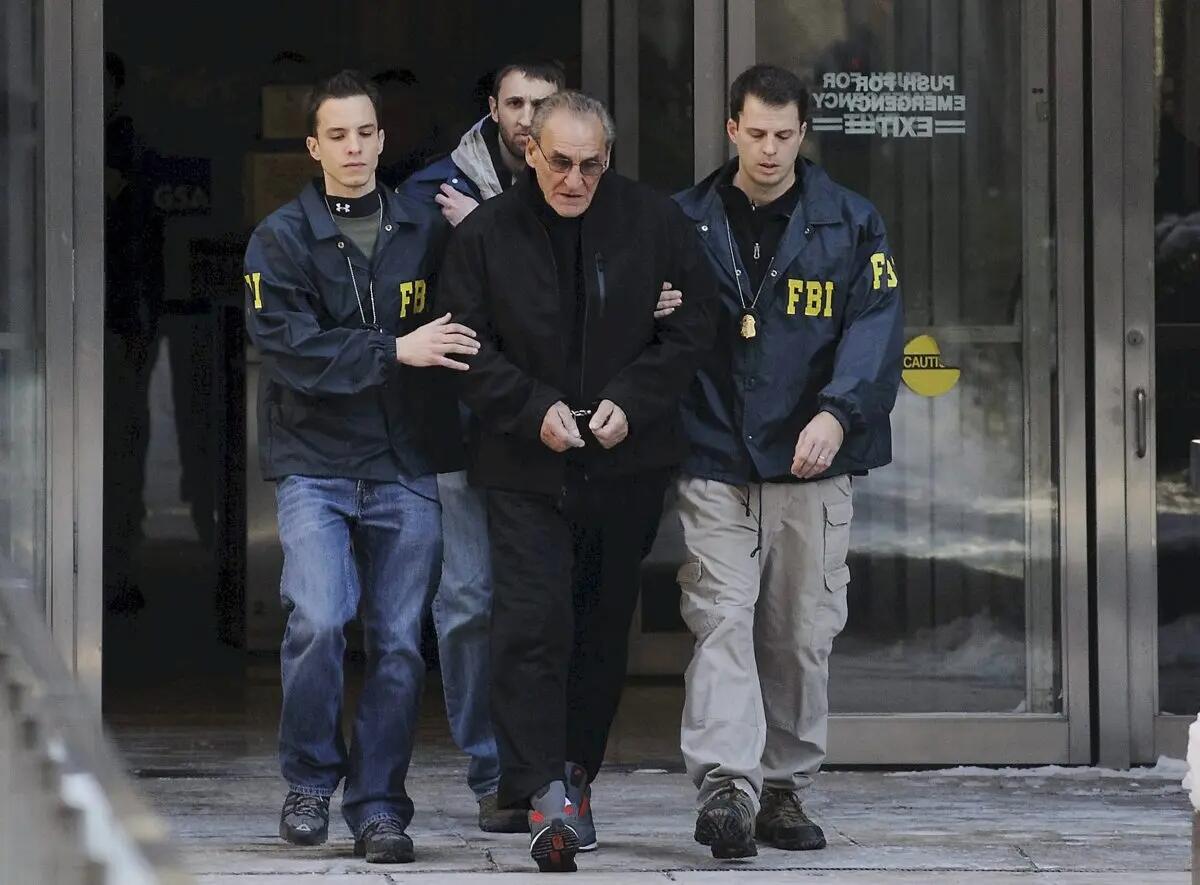
FBI agents flank Vincent Asaro as they escort the reputed mobster from FBI offices in New York on Jan. 23, 2014. Charles Eckert/Newsday via AP
Today’s Gangs
Gravano stresses that there are intrinsic differences between the Mafia and gangs such as MS-13 and Tren de Aragua–most notably, in the use of violence.
“My captain always told me, ‘We can use violence, but as a last resort. In other words, you get into an argument, you gotta chill. Otherwise, you’re an animal,’” Gravano said.
“These gangs are so [expletive] dangerous. They’ll rob a kid’s bike, kill the kid for the bike. You don’t see Mafia guys doing that,” he said.
“These people are completely different.”
Unlike modern crime syndicates, traditional organized crime families adhered to a specific code of conduct, Gravano said.
Gravano said the sanctioned killing of a Mafia member is a serious and complicated matter; it requires planning and the approval of the family boss. Breaking the code often meant a death sentence.
He sees a big difference between the Mafia and the Mexican cartels.
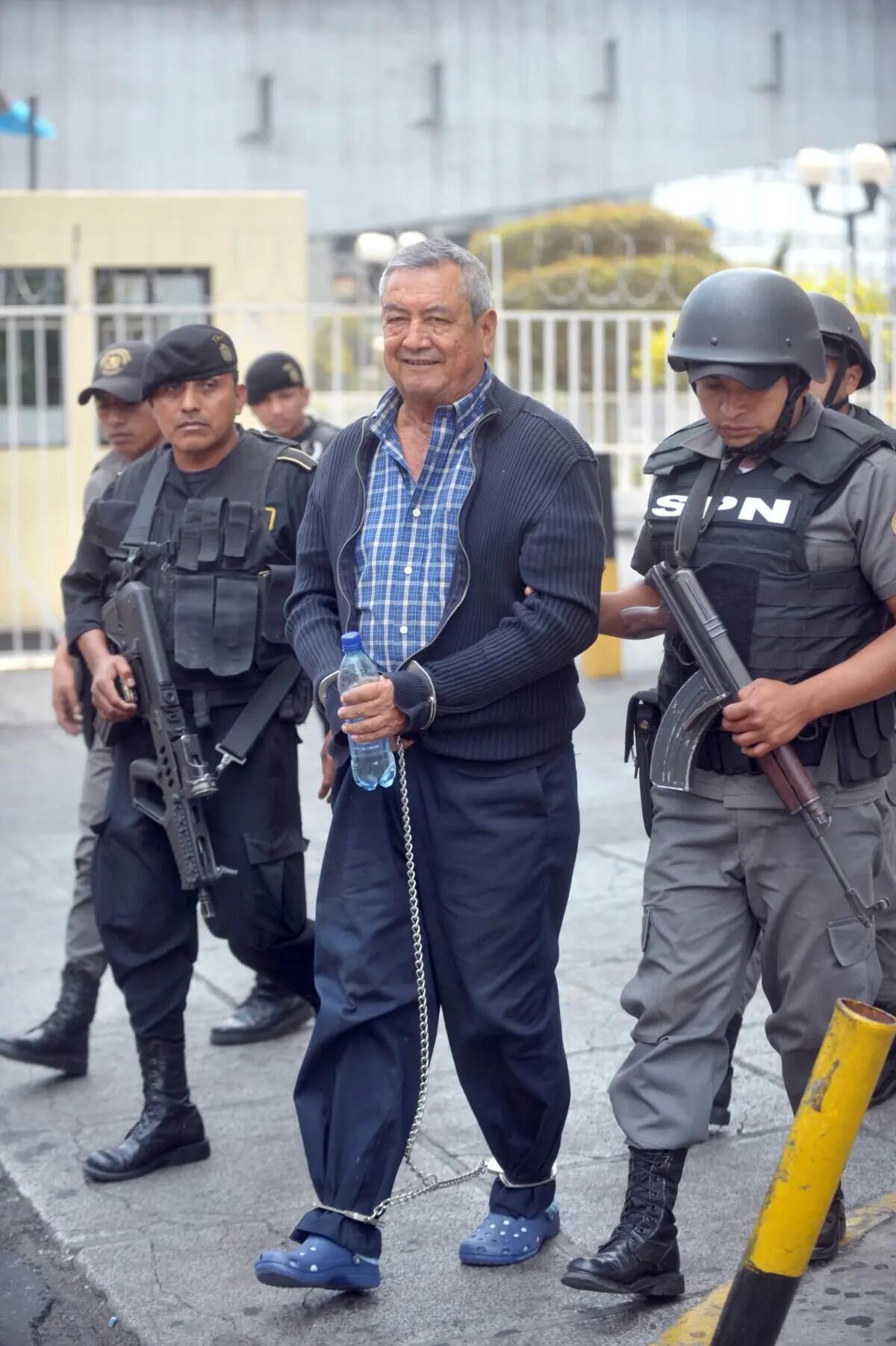
Drug trafficker Waldemar Lorenzana Lima, related to the Mexican Sinaloa drug cartel, was arrested on April 28, 2011, in Guatemala City. Johan Ordonez/AFP via Getty Images
“They don’t have a code of honor. The Mafia did have a code of honor,” he said. “There’s a lot of us who broke the code of honor a number of times—I mean, I broke it myself. I took it out on a boss—killed a boss—Paul Castellano.
Gravano said of the cartel and gang members: “These are people, like, if a guy cooperates [with law enforcement], they want to kill the wife, the kids—the rest” of their family.
“We don’t kill kids. We don’t kill women. I mean, it happens once in a blue moon, but for practical purposes, we don’t do anything like that.”
MS-13 has more than 10,000 members operating in at least 10 states and the District of Columbia, according to the Department of Justice. The department said thousands more are involved in gang activities, including theft, intimidation, and murder in Central America and Mexico.
“MS-13 is organized by subsets known as ‘cliques,’ and each clique typically has one or more leaders, commonly referred to as ’shot callers,'” the Justice Department stated.
Between 2005 and 2014, Immigration and Customs Enforcement (ICE) arrested approximately 4,000 members of MS-13, which represents about 13 percent of the 31,000 gang members arrested nationwide, according to a report by the Center for Immigration Studies, a nonpartisan research organization.
Of those arrested with MS-13 affiliations, at least 92 percent were illegal immigrants and 16 percent of the individuals had illegally entered the United States at least twice.
While MS-13 affiliates made up 13 percent of all gang-related arrests during that time period, they accounted for 35 percent of murderers arrested by ICE, the report noted.
Down but Not Out
While La Cosa Nostra may no longer have the cunning clout it once did, the FBI reports that it continues to pose a “significant threat” in the New York metropolitan area, New England, Philadelphia, Chicago, and Detroit.
Through its investigations, the FBI has created an organizational chart of La Cosa Nostra that resembles a corporate board or commission.
At the top of the hierarchy is the crime family’s “boss” or don, along with his “consigliere,” who acts as an adviser.
The “underboss” is second in command, followed by the “capo,” a ranking member in charge of a crew of “soldiers.”
All these “soldiers” are “made men” who have taken an oath of silence.
At the lowest level of the hierarchy are the “associates,” uninitiated crew members who participate in various crimes under the family’s protection and are entitled to a share of the profits.
In 1988, John Gotti promoted Gravano to the position of consigliere after the latter had served as a captain for several years.
Gravano believes that traditional organized crime is far less glamorous than it was in the last century.
“Sooner or later, you got [law enforcement] people looking at you all the time. Sooner or later, you’re going to jail. And you’re going to do heavy time,” Gravano said.
“I don’t know why a young guy would want to get into it any more—because it’s stylish, maybe. But it’s going to bring you nothing but headaches.”
Gravano has seen other internal changes in “the life” of the Mafia that have undermined its once dominant role.
The traditional code of conduct, once a matter of life and death during Prohibition, is fast losing its influence, he said.
The Mafia code of silence, known as “omerta,” was a pillar of loyalty, Gravano said.
Old-school mobsters facing jail time were less likely to “rat” on other members, Schumacher said.
“Back in the day, these guys were willing to serve their time. They would not flip. That did change during the ‘70s and ’80s,” he said.
“You started seeing pretty high-profile mobsters—including Sammy “The Bull”—becoming government witnesses. That’s devastating evidence.
“He really was a big factor in taking down John Gotti.”
That code died when mobsters testified against other mobsters during the 1990s and 2000s.
The goal was to secure the best possible deal with the prosecution to obtain lighter jail sentences and avoid getting killed for cooperating with authorities, he said.
“I see [the Mafia] disappearing more and more,” Gravano said. “And I think there’s a lot of money to be made legitimately. Why would I want to be in the Mafia today?”
Times have changed, Gravano said.
Once, the Mafia had control over the labor unions through which it gained access to lucrative construction projects in the cities.
“You can’t get control of those unions now [with] 50 million phone cameras,” Gravano said. “Everybody’s taking pictures. You can’t get near the unions anymore.”
The Sheriff and the Mobster
After Gravano spent 18 months in the government’s witness protection program in Colorado, he moved to Arizona and became involved in the illegal trafficking of recreational narcotics in the late 1990s.
In June 2001, he pleaded guilty in Maricopa County, Arizona, to state charges for the distribution of the street drug ecstasy. His sentence included 19 years in prison and a $100,000 fine. He was released in 2017 and remains on supervised parole for the rest of his life.
Joe Arpaio, 92, served as a federal narcotics agent for 32 years before becoming the head of the DEA’s Arizona field office.
In 1993, he was elected as the sheriff of Maricopa County and became known for his tough stance on crime and unconventional punishment methods.
He reinstituted chain gangs, required inmates to wear pink underwear, and had them live in a tent city and eat bologna sandwiches. These moves earned Arpaio the moniker, “America’s Toughest Sheriff.”
Gravano and Arpaio’s paths eventually crossed at a Trump support rally during the 2024 election.
They also met twice after the election to discuss the realities of organized crime and the prison conditions that Gravano experienced in Maricopa County while Arpaio was the sheriff.

Maricopa County Sheriff Joe Arpaio speaks at a news conference at the Sheriff's headquarters in Phoenix on Dec. 18, 2013. Ross D. Franklin/AP Photo
As a former narcotics agent, Arpaio believes that the Mafia’s involvement in illicit drug trafficking—cocaine, heroin, and marijuana—was their “worst mistake,” one that brought the full weight of the DEA and FBI upon them.
“That brought everybody down on them,” he said.
Over the years, Arpaio has developed a perspective about the mob compared to their violent foreign counterparts.
“The mob had their regulations, which were you didn’t kill kids. And you didn’t kill cops,” Arpaio told The Epoch Times. “The so-called Mafia [foreign gangs and cartels] today kill kids; they’re vicious, and they kill cops. So there’s a big difference.”
Mafia expert Geoff Schumacher, vice president of exhibits and programs at The Mob Museum in Las Vegas, said it’s a misconception that crime families shunned narcotics trafficking before the emergence of Mexican drug cartels.
“You go back to the Prohibition era, and the Mafia was involved in drug trafficking,” he said.
“There’s this myth that the Mafia wouldn’t touch drugs—that the bosses didn’t want anyone involved in selling drugs. While sometimes they would say that publicly, they were actively engaged in drug trafficking,” Schumacher said.
“Today, I suspect the Mexican cartels have kind of a stranglehold on that.”
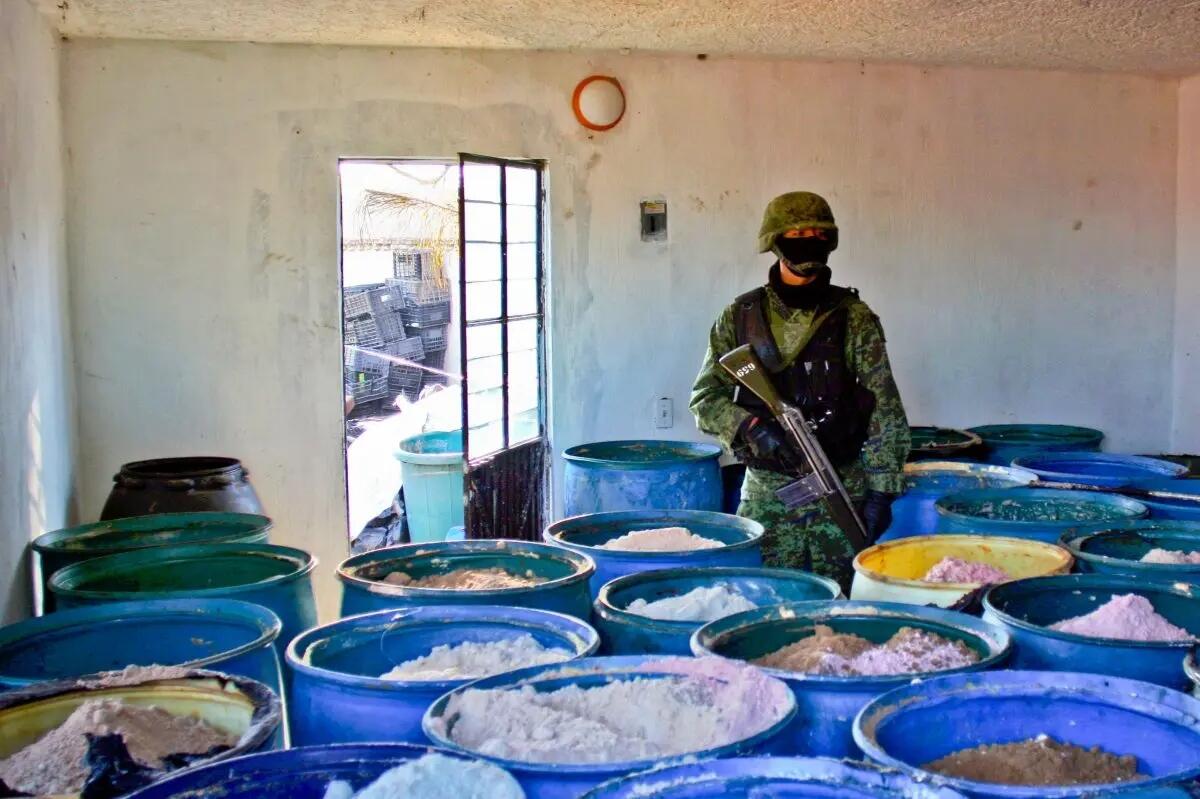
A soldier stands guard inside a clandestine chemical drug processing laboratory discovered in Mexico on Feb. 9, 2012. Hector Guerrero/AFP/Getty Images
Will the Mafia Ever Return?
Arpaio said that the term “Mafia” will endure even after the crime families have disappeared.
“The name of the Mafia isn’t disappearing,” Arpaio said. “You’ve got crime stories and all this having to do with the mob, the old mob. There’s only one Mafia.”
Schumacher said that the five New York families—Bonanno, Columbo, Gambino, Genovese, and Luchese—are still active.
They continue their involvement in illegal bookmaking, loan sharking, tax fraud, and stock market fraud, with a greater emphasis on white-collar crime.
“There’s not much killing anymore—not much of that kind of stuff,” Schumacher said. “It’s more in finding illegal ways to make money.”
“There are still remnants of the Mafia in New York, New Jersey, Philadelphia, Chicago, and Detroit. But it is fading fast.”
ICE agents apprehend fugitive criminal aliens for alleged involvement in the illegal narcotics trade in Boston on Nov. 4, 2019. ICE
‘Misplaced Fascination’
Even as traditional organized crime is waning, the public’s fascination persists, Schumacher said.
“We should never look at it as glamorous,” he cautioned. “There was almost nothing positive about it. It sold a lot of newspapers. I can say that.”
“One of the reasons for nostalgia is that some of the mob bosses had charisma, personality, fueled by tabloid journalism and Hollywood.
“We created this monster, if you will. There’s nothing wrong with studying history, learning it, being interested in it, as long as we maintain our perspective.”
Gravano now focuses on his podcast ‘Our Thing with Sammy The Bull’ and his YouTube channel called ‘Salvatore Sammy The Bull Gravano’.
He has chosen to live his life openly and share his story, and recognizes the risks that come with this decision.
“I like the road, dealing with people—legitimate people.”
In September 2024, he formally became a born-again Christian. He wears a solid gold and diamond pinky ring to signify his past life in the mob.
“I changed when I left the life,” Gravano said.
“I don’t miss the life. But when I think about it, everything I’ve done—the good, the bad, the ugly—has made me what I am today.”
https://www.zerohedge.com/personal-finance/changing-face-organized-crime-united-states


