Search This Blog

Monday, May 12, 2025

Judge Allows CIA To Fire Doctor Who Helped Enforce Military COVID Mandate

 by Tom Ozimek via The Epoch Times (emphasis ours),

A federal judge has denied an emergency bid by Dr. Terry Adirim to halt her dismissal from the CIA, rejecting her claims that political activists orchestrated her firing in retaliation for her role in enforcing the military’s COVID-19 vaccine mandate.

Dr. Terry Adirim, acting assistant defense secretary for Health Affairs, gives an update on COVID-19 at the Pentagon on June 30, 2021. Screenshot via The Epoch Times/DOD

In a ruling issued on May 9, U.S. District Judge Michael Nachmanoff found that Adirim had failed to demonstrate a likelihood of success on the merits of her claim that the CIA violated her constitutional rights. The decision clears the way for the agency to proceed with terminating Adirim’s employment under a contract provision allowing dismissal with 30 days’ notice.

Adirim, a former senior Defense Department official who served as the CIA’s director of global health services, alleged in court filings that she became the target of a politically motivated campaign led by activist Ivan Raiklin. She claimed in her lawsuit that Raiklin defamed her as a traitor and “architect” of the Pentagon’s COVID-19 vaccine mandate and that he enlisted fellow activist Laura Loomer to persuade President Donald Trump to intervene with the CIA to have her fired.

Her lawsuit named the CIA, Raiklin, CIA Director John Ratcliffe, and the conservative nonprofit America’s Future as defendants. It alleged due process violations, defamation, breach of contract, and a Privacy Act violation stemming from alleged leaks about her dismissal to Breitbart News.

In a 25-page opposition brief filed on May 6, Justice Department attorneys called Adirim’s theory “speculative and unsupported,” arguing that her theory relied on loosely drawn connections and unsubstantiated assumptions about political influence.

Plaintiff pinpoints the blame not on the CIA, but on a non-governmental actor, Ivan Raiklin, whom she accuses of orchestrating her termination through a scheme of defamation and political influence,” the attorneys wrote. “Besides being farfetched—and untrue—Plaintiff’s allegations do not actually amount to any viable claim against the Federal Defendants, let alone any claim that merits an injunction.”

The Department of Justice acknowledged Adirim’s name appeared on Raiklin’s so-called Deep State Target List but said this had no bearing on the CIA’s decision.

There is no reason other than the close timing of Ms. Loomer’s White House visit and the CIA’s communication of its termination decision to Plaintiff to suggest the two are linked,” the filing reads.

The CIA maintained that Adirim wasn’t terminated over politics but because of “multiple complaints” from CIA staff about her “inappropriate and harassing” conduct in the workplace.

According to a declaration from the agency’s deputy chief operating officer, senior leadership initiated a review of Adirim’s behavior weeks before Loomer’s reported White House visit and made the decision to terminate her independently.

The political and legal controversy surrounding the military’s COVID-19 vaccination mandate intensified just days before the court’s ruling. On May 7, the Pentagon issued sweeping new guidance acknowledging that the mandate had been “an unfair, overbroad, and completely unnecessary burden” on servicemembers. The memo directed military review boards to reinstate troops discharged over the mandate and remove related disciplinary records, declaring that the lack of due process in enforcing vaccine compliance was itself “an injustice.”

Adirim, who had signed key policy documents enabling the Pentagon’s mandate while serving as acting assistant secretary of defense for health affairs, became a focal point in that broader political reckoning—even as the CIA maintained her dismissal was unrelated.

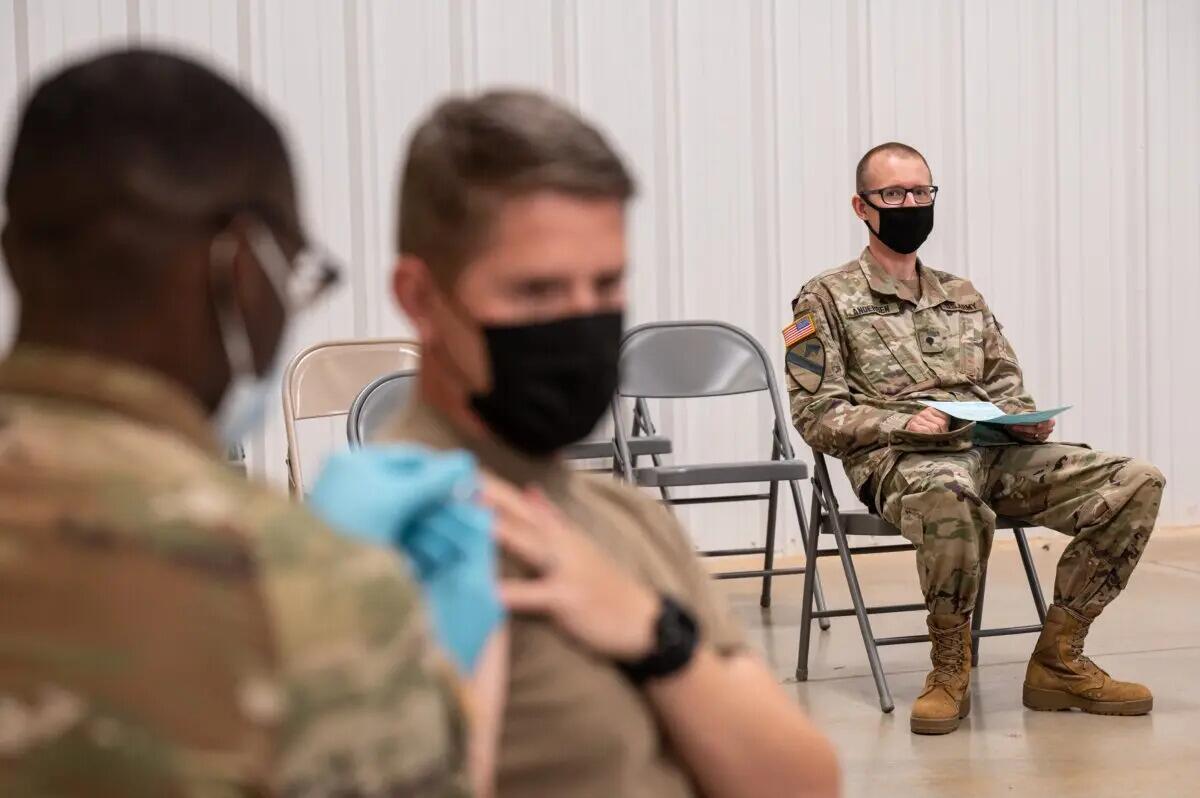
A soldier watches another soldier receive his COVID-19 vaccination from Army Preventative Medical Services in Fort Knox, Ky., on Sept. 9, 2021. Jon Cherry/Getty Images

In her complaint, Adirim contended that being fired just weeks before qualifying for federal retirement amounted to irreparable harm, that she had been defamed after decades of public service, and that her family had been endangered.

The CIA said the decision was internal, lawful, and based on employee complaints rather than political pressure.

In response to the May 9 ruling, Adirim’s attorney Kevin Carroll told The Epoch Times in an emailed statement, “We respect the court’s decision and look forward to litigating the underlying issues.”

The case remains active in federal court but, without the injunction she had sought, Adirim’s termination is now set to proceed as planned.

Raiklin, in a post on social media platform X, hailed the decision: “Terry Adirim, you’re fired!!! Your lawyer is next.”

https://www.zerohedge.com/political/judge-allows-cia-fire-doctor-who-helped-enforce-military-covid-mandate

Who Was in Charge of Covid Communications?

 Nearly a year ago, Dr. Robert Redfield, who headed the CDC (Centers for Disease Control and Prevention) during the first year of Covid, said in an interview that vaccine mandates were a bad idea and that lockdowns and school closures were government overreach. He said the virus came from a US-funded lab in Wuhan. He said Anthony Fauci made mistakes and was not transparent enough with the public.

Hopefully, Redfield’s admissions and critiques open up discussion in wider circles about these important aspects of the Covid response.

Even if that happens, however, many people who have been censored and punished for making similar claims in the past 3-4 years are asking: Why didn’t Redfield oppose what he claims are terrible policies when they were being implemented and while he was in a leading public health role?

Here’s one possible explanation:

Pandemic Communications Were Controlled by the National Security Council, not HHS/CDC

As discussed in previous articles, beginning in mid-March 2020, the HHS was removed from its leadership role in pandemic response and replaced by FEMA/DHS. The National Security Council (NSC) was in charge of pandemic policy on behalf of the White House Task Force.

Prior to Covid, all pandemic planning documents designated HHS (Health and Human Services) as the Lead Federal Agency for pandemic response. And in all those documents, CDC — a sub-agency of HHS — played a leadership role in the response. 

Communications, specifically, were supposed to be a big part of HHS/CDC’s pandemic leadership role.

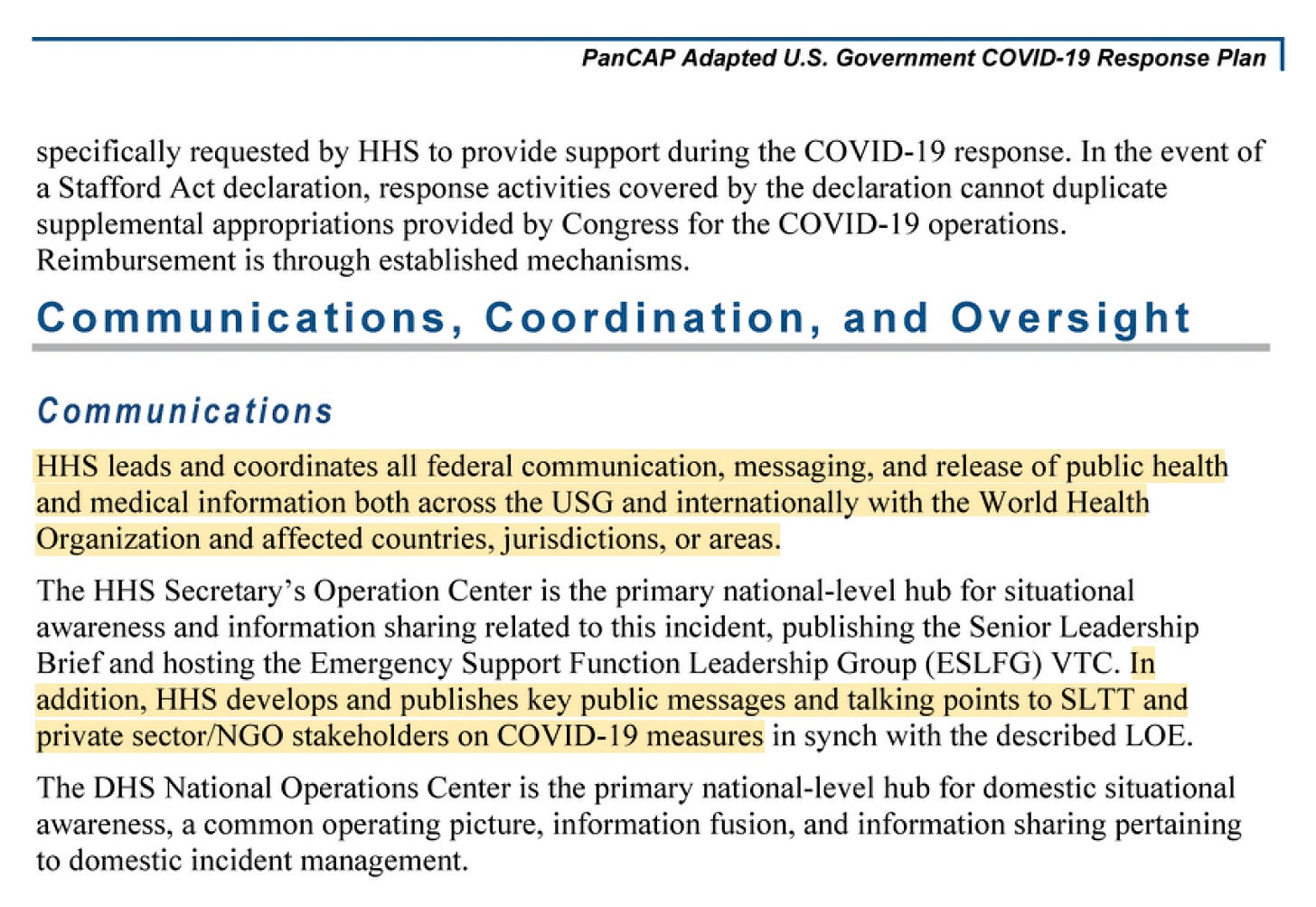
As clearly stated in the U.S. Government’s COVID-19 Response Plan (which is publicly available only because someone leaked it to the New York Times and they left it on their server): “HHS leads and coordinates all federal communication, messaging, and release of public health and medical information” and “HHS develops and publishes key public messages and talking points.”

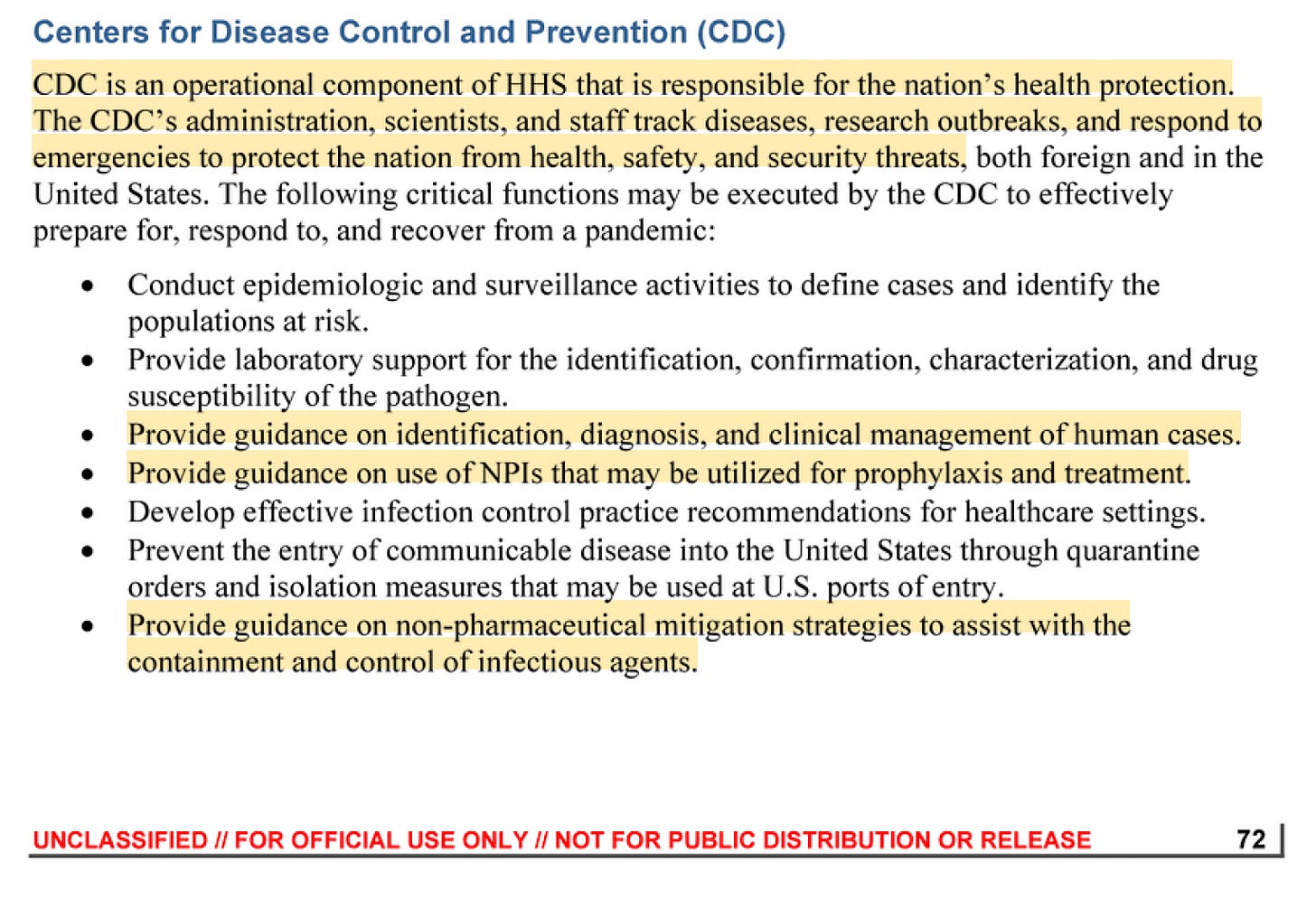
The CDC, in its key role as “an operational component of HHS that is responsible for the nation’s health protection,” provides guidance on diagnosis, clinical management of cases, use of NPIs, and non-pharmaceutical mitigation strategies as it “disseminates key public health and risk mitigation messages to the public.”

Unbeknownst to the public, however, the CDC stopped fulfilling all of these designated pandemic response functions at the end of February 2020.

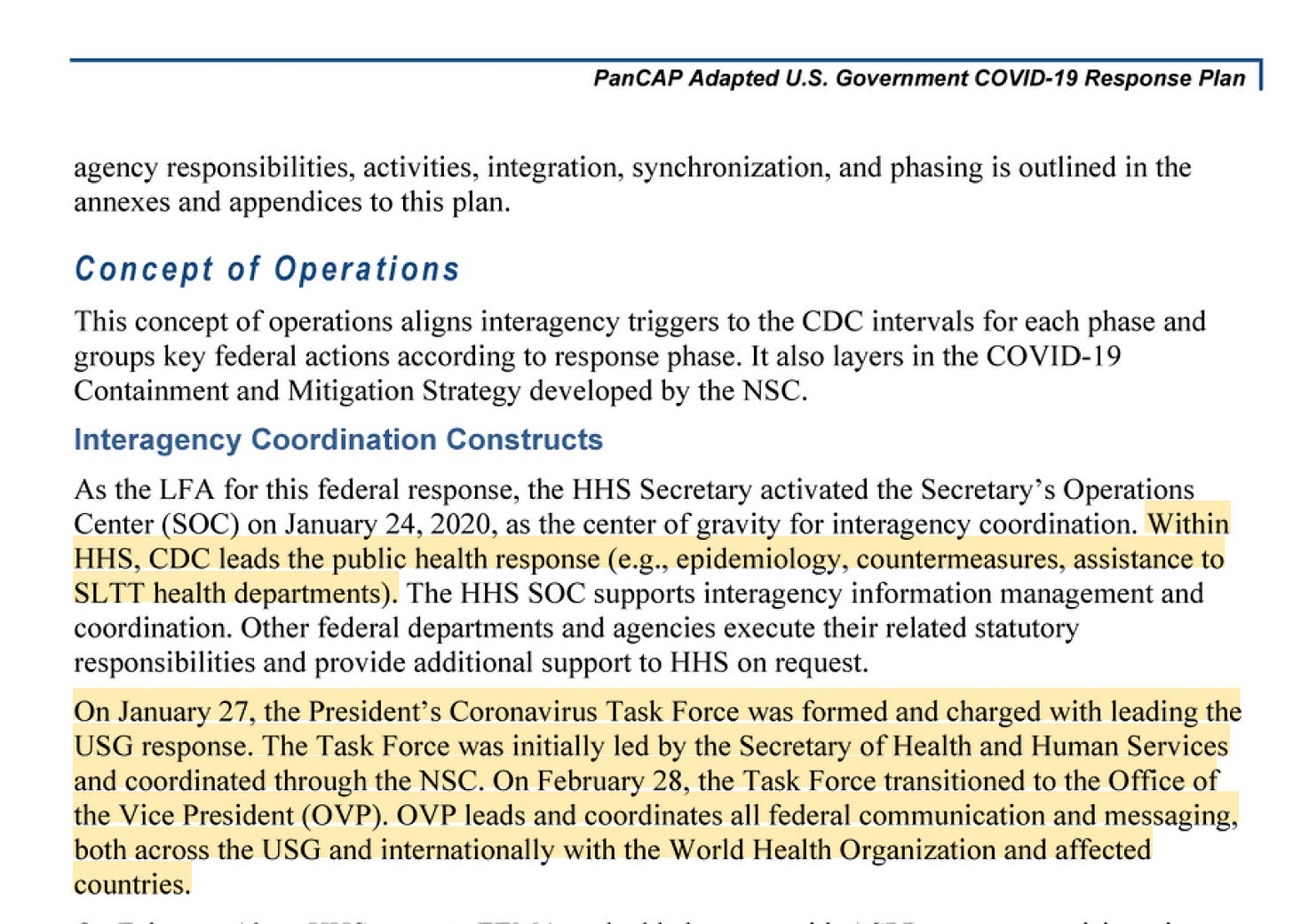
In fact, the very same government planning document that delineates the communications roles of the HHS and CDC, also directly contradicts itself, stating that as of February 28, 2020, “OVP leads and coordinates all federal communication and messaging.” 

OVP is the Office of the Vice President, where the White House Task Force was housed. The National Security Council was in charge of policy for the Task Force.

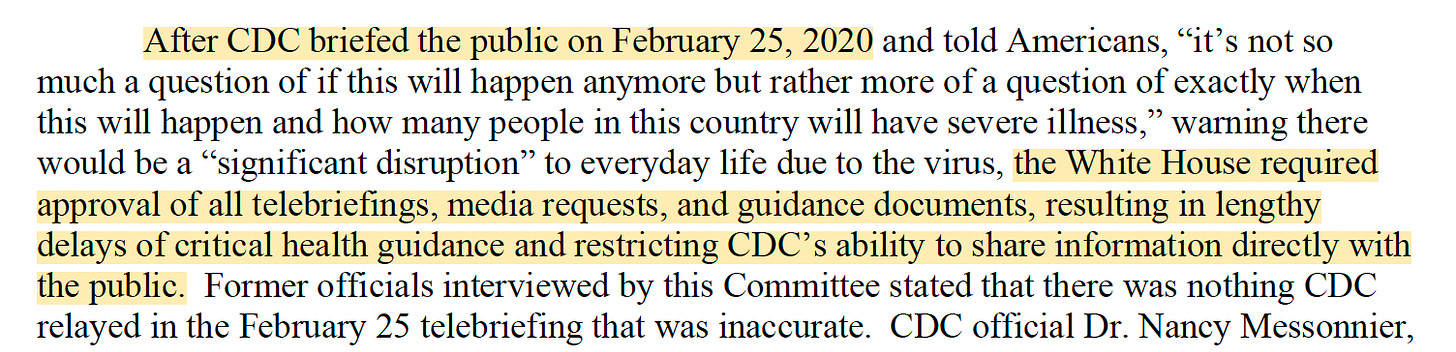
A Senate report from December 2022 confirms that “the White House,” (which, for everything Covid, does not mean the President but rather the Task Force and the National Security Council), took control of all Covid communications away from the CDC:

The CDC, presumably including Redfield, although he is not mentioned by name, was naturally frustrated: 

As these government documents clearly indicate, the CDC — and its director, Dr. Redfield — was not able to communicate directly with the public about the Covid pandemic. All messaging had to go through the White House Task Force, whose policy was determined by the National Security Council.

Furthermore, many CDC officials could not even attend the meetings where Covid policy decisions were made.

Covid Meetings Were Classified by the NSC 

On March 11, 2020, Reuters reported that “The White House has ordered federal health officials to treat top-level coronavirus meetings as classified.” Reuters sources said, “the National Security Council (NSC), which advises the president on security issues, ordered the classification.” 

This meant many public health officials who did not have high enough clearance were left out of meetings. Redfield was probably one of them.

As Reuters reported [BOLDFACE ADDED]:

Staffers without security clearances, including government experts, were excluded from the interagency meetings, which included video conference calls,” the sources said.

We had some very critical people who did not have security clearances who could not go,” one official said. “These should not be classified meetings. It was unnecessary.”

Moreover, anyone who did have clearance could not discuss what happened in those meetings:

The administration officials, who spoke to Reuters on condition of anonymity, said they could not describe the interactions in the meeting room because they were classified.

This is an astonishing state of affairs that has received almost no attention. It means that top-level discussions about the origins of the pandemic and the response strategy to the pandemic were never made public because the National Security Council classified them – and anyone who participated cannot tell us what was said.

So even if Redfield had attended those meetings, he would not be able to discuss them. Based on his testimony in a Congressional hearing in March 2023, however, I suspect he wasn’t even in those meetings.

As the New York Post reported on March 8, 2023:

Redfield, appointed by former President Donald Trump to lead the CDC in March 2018, told the House Select Subcommittee on the Coronavirus Pandemic Wednesday that in the early days of the pandemic, there was an “a priori decision that ‘there’s one point of view that we’re going to put out there, and anyone who doesn’t agree with it is going to be sidelined.’”

Redfield specifically cited a Feb. 1, 2020, conference call that he claimed was convened by Fauci and then-National Institutes of Health Director Francis Collins to discuss the origins of COVID-19.

The former CDC director said that not only was he cut out of the call, he didn’t even find out about it until June 2021. 

Redfield may or may not have been sidelined by Fauci or Collins. He and the agency he headed were most definitely sidelined by the Task Force and the National Security Council.

One more note: The date of the official switch from HHS/CDC to OVP/NSC messaging is significant. It is just one day after everything shifted — on February 27, 2020 — from traditional, science-based, and epidemiologically sound policy to the lockdown-until-vaccine biodefense plan.

Gutfeld on Trump, the Manosphere, and Hosting the “Strangest Game Show Ever”


The cohost of The Five and star of Gutfeld! talks to VF about his off-the-wall new game show, What Did I Miss?, in which contestants held in monthslong isolation are challenged to distinguish between real and fake news.

“We live in a time where we have a president that’s making news every day,” says Fox News’ Greg Gutfeld, “and some of it is just unreal, and some of it is unbelievable.”
The rapid-fire, often mind-boggling nature of the Donald Trump news cycle is an asset to Gutfeld in putting contestants through the paces on What Did I Miss?, his zany new Fox Nation game show. The streaming program, which will have a three-episode run starting on May 12, is also something of a social experiment, featuring four people who have opted to remain in complete isolation from Inauguration Day until mid-April, with no media consumption or contact with the outside world. They’re welcomed back into society by coming face-to-face with Gutfeld and a live studio audience for a showdown to see who is best at separating actual news stories from bogus ones.
I recently caught up with the busy Fox News personality as he was in a car traveling from the network’s Midtown headquarters, where he cohosts The Five and late-night show Gutfeld!, to his home in the city. I was curious if Gutfeld, beyond making the show for its pure entertainment factor, was trying to drive home a larger point about the credibility of the news media. “Not a lot of deep thinking” was involved in the making of the show, says Gutfeld, who adds: “I think you can draw conclusions that in this world, it’s hard to tell what’s real and what’s not.”

Gutfeld, a former top editor at Men’s Health, Stuff, and Maxim UK, and a TV host who mixed comedy with conservative politics on his old wee-hours Fox News show, Red Eye, arguably blazed a trail for today’s manosphere, which we discussed, along with why he considers it “incredibly healthy” to question the legitimacy of the media; how Fox News fits into that equation; and, of course, Trump. Gutfeld, a Trump supporter, says that as far as politics and entertainment go, the president didn’t just blur the line—“he erased it.”
This conversation has been edited for length and clarity.


Vanity Fair: I watched the first screener, and you called it the “strangest game show ever created.” I have to know—where did the idea come from, and how involved were you in shaping the format?
Greg Gutfeld: We had a couple of meetings on it, and I think originally we wanted to do it before the election because we thought the big question would be who becomes president. But these things take forever, so we ended up doing it in the new year. The contestants went in on Inauguration Day. Fox approached me with the idea, and I was like, I can’t believe this hasn’t been done before. It combined the reality show feel with a game show. And the idea that we get to make stuff up is fun too.


Was it meant to be purely funny, or was there an intention to say something deeper about the insanity of the news cycle or the media?
I think that’s a byproduct. It was just, Let’s do it. The concept itself didn’t need any heavy thinking. It was like, These people are going to miss the news; let’s talk about the news. And it just so happens that we live in a time where we have a president that’s making news every day, and some of it is just unreal, and some of it is unbelievable. That just added to the charm of it. Whatever you saw there was just us having fun, not a lot of deep thinking. But I think you can draw conclusions that in this world, it’s hard to tell what’s real and what’s not.

The term fake news is used a lot in the show, and Trump has used that for years to attack the mainstream media. Are you deploying the phrase in the same way here? And also, do you agree with him doing that?
I’ve been on both sides of the pen. I’ve been an editor and a writer for, I don’t know, it might have been 15 years before I got into TV, maybe even longer. I do believe it’s healthy not to trust the media. I think the concept of fake news, or calling the news fake, is incredibly healthy for people to understand that they should not be believing everything or anything they read.
And I assume that goes for Fox as well?
I think Fox is really great about presenting both sides. If you look at something like The Five, I think we’re the only show that does that. We also do something that neither CNN or MSNBC do, which is, we label our views and our commentators. When I’m talking, I’ve got an opinion. I’m not a reporter; I’m a guy with an opinion, sitting around a table like I’m at a bar. We don’t pretend to be anything else.
What do you see as your role at Fox? Are you a comedian, a political commentator? A mix of both?
I’m basically doing whatever I feel like doing. People ask my opinion, and I give it. Sometimes it’s serious, sometimes it’s funny, sometimes it’s bold. I never ever said I was a comedian, because I’ve never performed as a comedian. I was an editor and a writer for many years. I’ve always felt that I was a writer first. So basically, I’m just a guy who likes to talk and has a good time doing it.
Have you ever been told by anyone at Fox, executives or producers, to tone it down or avoid certain topics?
Never. I’ve never had anyone tell me to change an opinion at all. The only times might be about language, if I get a little too coarse. But that’s tiny, and it doesn’t affect me. I usually just do it. I think people have learned not to give me guidance, because I always end up leaning into the opposite.
Do you think your success is a signal of how audiences are changing and how they want to consume news in this era?
Well, I think it was there for the taking. All I did was comment on what I saw. A brutal honesty about the world is necessary. I’m probably the harshest critic on media and I’m in media. I think that’s healthy.
What are your thoughts about the role of comedy in politics right now? People like Elon Musk have said something to the degree of “legalize comedy.” Do you agree with that sentiment? Is comedy under threat?
I think people self-censored each other. They were worried that they would lose gigs or would lose their status. The late-night shows were very careful to stick to one side because that was the prevailing assumptions of the industry they’re in. The proof is in the explosion of people like Joe Rogan, Shane Gillis, Theo Von, and me. It’s like people needed it.
It was very sad to watch comedians have to walk back things they said in the past, which is the most absurd practice ever. It was pathetic and cowardly when comedians would do that.
You mentioned people like Joe Rogan. Do you see yourself in that world of media, which many are calling “the manosphere”?
I don’t know because I’ve never aimed for anything. I’ve always done my thing and let the world—the entertainment consumption—come to me. I think things just happen, and then the media struggles to find a way to describe it so it makes sense to them. They’ll dismiss it—“Oh, it’s the manosphere.” We were discussing Vanity Fair and their piece on how protein is part of the manosphere. Why is everything healthy now a part of MAGA? Why are you giving that up? It was like, Fitness is now conservative. No, it wasn’t. Why are you politicizing it? [Editor’s note: Thanks for reading, Greg!] You’re going to end up on the outside of that, doesn’t do anybody any favors. There should be more liberal podcasts. Why isn’t there? I don’t know. I think it’s more of an organic thing that just happened, rather than me choosing it.
Speaking to MAGA, do you personally think Trump is good for the country?
Oh, awesome. Definitely.
Did you vote for him?
Yeah, I voted for him. He’s the first nonpolitician that I’ve ever seen. He’s probably the most persuasive leader I’ve seen. He’s also, I would say, apolitical. I have conservative friends who are appalled by his trade stance. But my argument with Trump? You have to accept the total package because there’s so many good things in it that you’re bound to be upset by one thing or another.
Do you have a personal relationship with him at all?
I know him and I’ve met with him more than a few times. We talk infrequently. I guess I would say I have a relationship with him, but I wouldn’t want to overplay it. He’s done my show a couple of times and we get along. I was very critical of him for a long time, but I changed.
Where would you say you sit on the political spectrum? Do you identify with the Republican Party?
I kind of outgrew the whole party thing, and I feel like it’s a mono-party, which is why Trump is attractive—because he’s outside the mono-party.
I always felt that I was a libertarian, but I’m coming to question that. I’ve always been for the decriminalization of drugs, and maybe I still am, but I have to be honest with myself. I look at the streets of New York and LA and other cities. Was that a good idea? Can I still hold on to those beliefs, seeing what it’s done to the nature of how we live in these cities?
You said that you see Trump as apolitical in a way, but I think some would argue that there’s a blurring of the lines between politics and entertainment.
He just happens to be very entertaining and persuasive, and he likes to get shit done. That pretty much muscles out the politics. I don’t see him as a political animal at all. I’ve been around enough politicians. I can see why they have so much discomfort with him, because he’s an entertainer and a persuader and a businessman who entered their world, and he doesn’t go by their rules, and that has made them uncomfortable.
It’s not the blurring of the lines. I think he erased it.
And you see that as a positive?
Definitely. Politicians suck. They’re designed to employ language to obscure truth. He doesn’t do that. He uses the language we use. He’s the most transparent leader I’ve ever seen.
You want to know what he’s thinking? Ask him. He’s going to tell you and he’s not going to shut up. He’s the opposite of every politician. They’re all so careful about what they’re going to say. It’s funny that people are critical of him for basically having the time and generosity to tell you everything, so much you might not even like him. But he doesn’t care; he’s just going to tell you. That is a tremendous respect for people that he tells you what he thinks. I’d take that over a politician any day—left, right, you name it.
Those are pretty big shoes to fill. Who could possibly be next?
That’s the question. It could be somebody on the left because, like you said, those lines, they don’t really exist anymore. [Representative Alexandria Ocasio-Cortez] has been pushed because she does have charisma, and that matters. I honestly don’t know. He’s kind of broken the mold.
What does your media diet look like?
When I get up in the morning, I work out to podcasts. I will listen to Scott Adams. He’s the guy behind “Dilbert.” I’ll listen to the All-In podcast. I will see who was on Lex Fridman. I love Tim Dillon’s podcast, which is always great. I’ll go on YouTube and look for the people that I’m interested in, whether it’s Peter Thiel being interviewed or—I don’t listen to short-form stuff. I don’t get news that way. I deliver it in that way, but I like listening to people who are interesting talk about stuff. Could be Jordan Peterson one day. I like Bret Weinstein and his wife, Heather; it’s called the DarkHorse Podcast. They talk about biology and social issues, and I find that really interesting. I obviously always check Rogan. I listen to Red Scare because they’re really funny.
The left has been behind in this because they don’t trust themselves to go beyond a sound bite. I think that’s why Kamala [Harris], they were fighting so hard to keep her off Joe Rogan because they didn’t trust that she could do it. Whereas Trump sat down and went, like, for two and a half hours. They couldn’t trust her to go beyond what the handlers wanted her to do.I think you’re going to know who that person is. Maybe it is Stephen A. Smith. Somebody who could talk and is not afraid of taking a risk on an idea. You have to take risks for people to trust you, to be authentic. You’ve got to defend some people. And I think the left got too scared of the woke to actually defend themselves against the woke. I think there’s going to be a push away from identity politics. That’s going to be a really healthy thing for the Democratic Party to start thinking about.
Are you still living in New York City? I’m curious if you have any thoughts on the mayoral race?
Yeah, I’m still living in the city. I don’t know what to make of it. To be honest with you, I have a feeling that it’s probably going to be [Andrew] Cuomo, if he wants it. I do know that whoever is tough on crime is going to win.
Any closing thoughts on Cuomo?
He’s got some baggage, but desperate times, you know—people may overlook that baggage, whether it was the COVID rest home stuff or the sexual harassment. [Cuomo has denied all allegations against him.] People are worried about walking to work, using the subway. I think we need to get the citizens to regain confidence that they can go outside and use the subway without worrying.
I’m pulling up!
Just in time.
https://archive.is/MvDYN#selection-465.0-2643.13

Trump’s healthcare order will help fix healthcare for everyone

 Opinion by Arthur Laffer, Cynthia Fisher

One of President Donald Trump's most significant achievements during his first 100 days in office was his executive order requiring "radical" healthcare price transparency. The order doubles down on his first-term hospital and health insurance price transparency rules requiring the publication of actual prices of care and coverage, including discounted cash and negotiated insurance rates. 

This information protects patients from overcharges and empowers them to reduce inflated costs through choice and competition. The executive order requires the Department of Health and Human Services (HHS), the Department of Labor (DOL), and the Department of the Treasury to issue rules strengthening, standardizing and enforcing systemwide price transparency by the end of this month.  

Trump's healthcare price transparency effort will revolutionize healthcare and the entire economy. It's a pro-worker, pro-growth, free-market policy to boost worker paychecks and business earnings. 

When employers and unions can access actual prices throughout the healthcare system, they can spot wide price variations for the same care, expose middle players driving up costs and design affordable health plans. They can share their savings with workers in the form of lower premiums and higher wages.  

Under the status quo, healthcare is fundamentally un-American. It is the only economic sector where consumers cannot see real prices before they buy. 

No functioning market can exist under these conditions. As a result, prices for the same care can range by 10 times, even at the same hospital. 

For instance, C-sections vary from $6,000 to $60,000 and MRIs from $450 to $6,500. That isn't a marketplace — it's Russian Roulette that allows Big Health to profiteer off patients' misery.  

For decades, health insurers have hidden prices and claims information, facilitating spread pricing that robs workers and employers. Employer-sponsored family health plans now cost $25,600 annually and increase by double-digits each year. Research shows that about the same amount of compensation gains for average workers since 2000 has gone to premiums as paychecks, a major cause of wage stagnation. 

Unfortunately, hospitals and health insurers haven't complied with Trump's first-term rules. According to a recent study by PatientRightsAdvocate.org, only 21.1% of hospitals nationwide are fully complying with the hospital rule.  

The Biden administration didn't meaningfully enforce the rule, issuing only 25 financial penalties on the thousands of hospitals that didn't comply. Biden also rolled back the rule, allowing the posting of unaccountable estimates in lieu of actual prices needed to shop. And health insurers have buried their data disclosures in massive files full of meaningless "ghost codes" that crash computers and are nearly impossible to parse. 

Trump's new order increases enforcement to boost compliance, requires actual prices — not estimates — so patients can shop with financial certainty, expands transparency requirements throughout the healthcare system, and standardizes data disclosures, so consumers can make meaningful price comparisons. It gives people prices before they receive care.   

Trump's order will also enact overdue requirements for health insurers to provide Advanced Explanations of Benefits (AEOBs), required by the bipartisan No Surprises Act that passed at the end of 2020. AEOBs let patients know exactly what they'll owe — including their out-of-pocket patient responsibility — giving them financial peace of mind. 

They also empower employers and unions to audit their health plans and verify claims payments match provider bills and posted prices. Employers and unions can then eliminate spread pricing that — as the New York Times reported last year — often requires their health plans to pay far more to middle players than providers.  

Drawing on a JAMA study concluding that 25% of U.S. healthcare spending ($4.9 trillion in 2023) is waste, overcharges, and fraud, economists estimate systemwide price transparency can generate approximately $1 trillion of savings. Putting $1 trillion a year in overbilling back into the productive economy, including worker paychecks and business investment, will result in an enormous annual economic stimulus.

Healthcare price transparency is the most important microeconomic reform in American history. It creates a functional, competitive marketplace that restores choice, accountability and trust. When prices are clear, markets work. When markets work, costs fall. And when costs fall, wages rise. 

President Trump's executive order — and the ensuing federal rules issued later in May —will finally make healthcare price transparency a reality. They will solidify Trump's legacy as the president who fixed American healthcare. 

Cynthia A. Fisher is a life sciences entrepreneur, and founder and chairman of PatientRightsAdvocate.org

https://www.msn.com/en-us/health/other/trump-s-healthcare-order-will-help-fix-healthcare-for-everyone/ar-AA1EBesk

White House Unwraps Massive Drug Pricing Policy, Touching All Corners of Pharma


The package revives President Donald Trump’s much-maligned Most Favored Nations rule but goes further into the private markets and beyond, leveraging the patent system, drug importation and more.

The White House has announced a sweeping drug pricing policy package that will touch all edges of the pharmaceutical industry. The executive order to be signed by President Donald Trump Monday morning will affect drug prices from Medicare to the private markets and could impact various industry operations, including how biopharma companies source their drugs and how they protect their intellectual property.

“The president is dead serious about lowering drug prices,” White House officials said on a call Monday morning.

But government officials offered a dubious explanation of the legal authority for such a broad proposal and brushed off concerns about the collateral damage to biomedical innovation.

The package revives President Donald Trump’s Most Favored Nations rule, a much-maligned policy from his first term that ordered Medicare to price drugs in line with nations where they are cheaper. It seeks to use levers of the federal government, such as patent enforcement, to pressure drugmakers to lower their prices voluntarily.

The executive order directs Secretary of Health and Human Services Robert F. Kennedy Jr. to facilitate direct-to-consumer (DTC) sales—a growing trend in the industry—at Most Favored Nation prices. The secretary will need to “set clear targets” for achieving price reductions with MFN pricing within 30 days, according to the order.

However, an executive order does not implement a law. A president can issue these orders to direct federal agencies to conduct an action, but a presidential decree cannot override existing laws.

The White House officials insisted on Monday morning’s call that there would be no impact to biopharma innovation, which has been a talking point in the industry since the specter of MFN was raised again in recent weeks. The officials noted that the U.S. has less than 5% of the world’s population yet it accounts for about three-quarters of global pharmaceutical profits.

“We expect, obviously, the United States as the largest purchaser to be getting the best deal across the world,” one official said. “However, we do anticipate that with some of these actions that we will be taking to crack down on countries that are pursuing unfair and discriminatory practices, as well as when pharmaceutical companies realize that the United States alone is not going to pay for innovation, that they will be increasing their prices abroad and getting additional revenues there.”

The official continued: “It’s not that pharmaceutical companies are not going to continue to make money after this.”

President Trump in a post on his Truth Social network over the weekend promised immediate relief for Americans; although it’s unclear how quickly the proposed suite of actions will take force.

“We expect . . . drug manufacturers to be coming to the table immediately,” a White House official said. “We’ve already, of course, been hearing from them in the run up to this executive order, so we expect action and relief very soon.”

At a signing ceremony at the White House following the call, President Trump, flanked by HHS Secretary Robert F. Kennedy Jr., FDA commissioner Marty Makary, NIH director Jay Bhattacharya and CMS administrator Mehmet Oz, exclaimed the executive order.

“This is one of the most important orders ever signed, especially with regard to health.”

Trump said “drug prices will be reduced immediately by 50% or more. Pharma companies will abide by this voluntarily” or the administration and Congress would take some unspecified action to codify the executive order.

Kennedy, Oz, Bhattacharya and Makary then took turns speaking, each congratulating the president on his courage in signing the executive order.

Kennedy complimented Trump on his “intestinal fortitude,” and added “I have kids who are big Bernie Sanders fans, and when I told them this would happen, they had big tears in their eyes.”

A Sweeping Action

While the initial MFN rule was limited to just Medicare Part B, the public medical insurance program that covers some prescription drugs, the new package will attempt to touch all parts of the government’s insurance programs, as well as the public markets. The White House officials said this is not the same rule as the one brought forth during Trump’s first term. “This suite of actions is broader than that.”

The officials did not specifically say how the proposal would impact Medicare Part D, which covers brand-name and generic prescription drugs.

No drug or class will be off limits, according to the officials. However, the plan will focus on drugs that have the widest pricing gap between the U.S. and other nations as well as those with the largest expenditures.

When asked specifically about GLP-1 drugs, the officials issued a shot across the bow to companies like Eli Lilly and Novo Nordisk, the market leaders, and companies developing assets in the clinic.

“It would be fair to expect that GLP-1s, given that they hit both of those categories, will be a focus and there will be an expectation that those prices should come down,” the official said. “And then if they don’t, that we will be looking at our various policy levers that can be used to force those prices down.”

The White House officials said the patent system could be leveraged as a way to bring down prices, too.

“I think that we’re all familiar with some of the places where pharmaceutical companies push the limits to prevent competition that would lower their prices, whether it be through patents, whether it be through pay for delay, whether it be Orange Book manipulation, and I can just say that we will absolutely be pursuing this across all those fronts and more,” the officials stated.

A Word About Tariffs

The FDA has been ordered to work on upping drug imports from nations where drugs are cheaper, “beyond just Canada,” the White House officials said Monday morning. This would also revive a policy that Trump pushed in his first term and one that the state of Florida has tried to implement with little success. The FDA approved the state’s drug importation plan last year but Florida has yet to begin bringing in drugs from Canada.

The plan to import drugs from Canada would come as Trump also wages a trade war on the U.S.’ northern neighbor. The White House officials insisted that the drug pricing policy is separate from the plan to implement tariffs on the pharmaceutical industry and the Trump administration remains focused on lowering drug prices.

“We are opening conversations here with the pharmaceutical industry to get their prices down,” the officials said. “There is a separate strong interest to make sure that we have adequate production of essential medicines within the United States.”

The officials also offered vague details about a plan for the Department of Commerce and the U.S. Trade Representative to “take all appropriate action against unreasonable and discriminatory policies in foreign countries that suppress drug prices abroad.” When asked about the legal authority to do so, the official said the government will take actions on matters that impact national security.

https://www.biospace.com/policy/white-house-unwraps-massive-drug-pricing-policy-touching-all-corners-of-pharma

Roche makes $300M China Production Promise After Multibillion US Investment


Last month, Roche committed $50 billion in U.S. manufacturing funds, with which it will construct at least four new facilities.

Roche has pledged an RMB 2 billion infusion into its Chinese footprint, or about $300 million, boosting its domestic manufacturing capabilities and strengthening its local supply chain, the pharma announced last week in a Chinese news release.

This news comes just weeks after Roche unveiled a $50 billion package in the U.S., which will help it construct at least four new facilities: a production plant for its next-generation weight-loss medicines, a gene therapy facility in Pennsylvania, an R&D center in Massachusetts and a manufacturing site for its glucose monitoring products.

Roche’s China investment, meanwhile, will focus on biopharmaceutical manufacturing, according to a translation of the company’s news release. The pharma will use its new facility to produce the eye injection Vabysmo, indicated for diabetic macular edema and other ophthalmologic conditions. Roche expects to wrap up construction in 2029 and start production by 2031.

This latest China investment is in line with Roche’s global push to beef up its manufacturing presence. “Over the past years, it’s really been our strategy to make sure that we have strong manufacturing presence in all of the major markets,” CEO Thomas Schinecker told investors during the pharma’s Q1 earnings call last month. At the time, he revealed that the company was in “discussions” with various governments across the world—China included—with an eye to mitigate the effect of the ongoing trade war on its business.

“We’re actually investing in China to build up manufacturing there,” Schinecker said.

President Donald Trump has been hanging the threat of tariffs over the biopharmaceutical industry. Last month, after sparing the sector in his “Liberation Day” announcement of broad tariffs, Trump announced that separate “major” tariffs on pharma imports would be coming “very shortly.” A few days later, Commerce Secretary Howard Lutnick doubled down on this announcement, telling ABC News that sector-specific tariffs would come “in the next month or two.”

Lutnick’s department subsequently opened a national security probe on pharma imports, a process that could empower Trump to impose certain trade restrictions on these imports, including tariffs.

Like Roche, many other pharma companies have started bolstering their domestic manufacturing in light of Trump’s threats. Leading the pack, Eli Lilly announced a $27 billion commitment in February, followed by fellow industry powerhouses such as Johnson & Johnson and Bristol Myers Squibb. Most recently, Takeda last week made its own $30 billion promise to boost its U.S. operations over the next five years.

https://www.biospace.com/business/roche-makes-300m-china-production-promise-after-multibillion-us-investment

Fidelity website outage blocks users from trading rally

 Fidelity trading platforms experienced outages just as U.S. stock markets opened for trading on Monday morning, leaving many users of its online, mobile and Active Trader apps unable to execute buy or sell orders.

The outage occurred even as major share prices index soared on news of a breakthrough in U.S.-China trade talks over the weekend, leaving many investors frustrated that they couldn't participate in the rally.

The Standard & Poor's 500 index was up more than 2.5% by 10:30 a.m. ET.

"The volume today is the highest at this point in the day" out of any trading so far in May, said Steve Sosnick, chief market strategist at Interactive Brokers.

"We are working urgently on resolving the issues," Fidelity said in a post on Reddit, the site of many user complaints. "We apologize for the inconvenience and appreciate you being a customer."

Fidelity declined any further comment on the outages.

Thousands of users reported being unable to access their accounts as of mid-morning on Monday, according to outages tracking website Down Detector.

https://finance.yahoo.com/news/fidelity-website-outage-blocks-users-145852145.html