Search This Blog

Thursday, May 15, 2025

FAA says Denver air traffic briefly lost communications on Monday

 The Federal Aviation Administration said on Thursday that Denver air traffic control lost communications for about two minutes on Monday but was able to maintain contact through an emergency frequency.

Franklin McIntosh, the FAA's deputy head of air traffic control, said during a U.S. House of Representatives hearing that at the Denver Air Route Traffic Control Center both the main and backup frequencies failed for about two minutes but a controller was then able to transmit to the aircraft to move to a secondary frequency.

He said there was no loss of separation between airplanes during the outage.

"Anytime there are these outages, which are happening more regularly now, it is very concerning," said Representative Robert Garcia, a California Democrat, at an FAA oversight hearing.

The FAA said in a written statement it is investigating after part of the center experienced a loss of communications around 1:50 p.m. in Denver, when both transmitters that cover a segment of airspace went down.

"Controllers used another frequency to relay instructions to pilots. Aircraft remained safely separated and there were no impacts to operations," the FAA said.

FAA communications failures have gained urgent attention due to a series of telecom outages at the facility overseeing Newark air traffic after three incidents have shaken public confidence.

The FAA relocated control of the Newark airspace to Philadelphia last year to address staffing and congested New York City area traffic. But the FAA is about 3,500 air traffic controllers below targeted staffing levels.

The latest incidents highlight the air traffic control network's aging infrastructure and come after U.S. Transportation Secretary Sean Duffy last week proposed spending billions of dollars to fix it over the next three to four years.

https://www.streetinsider.com/Reuters/FAA+says+Denver+air+traffic+briefly+lost+communications+on+Monday/24805620.html

FDA Delays Decision Date on Biohaven’s Spinocerebellar Ataxia Application


The FDA also changed its tune and is now planning to convene an advisory committee to discuss Biohaven’s application.

The FDA has pushed back by three months its decision date for Biohaven’s investigational glutamate modulator troriluzole for the treatment of spinocerebellar ataxia, the biotech announced Wednesday evening. Biohaven, whose stock slumped more than 12% in premarket trading Thursday, now expects to receive the verdict in the fourth quarter.

In a note to investors early on Thursday, analysts at William Blair called the delay “surprising,” especially given the “proximity to the completed mid-cycle review.” On Monday, Biohaven also said that it had not received communication from the FDA regarding its application for troriluzole and continued to expect the regulatory decision to come in the third quarter.

In its press announcement on Wednesday, Biohaven said that the regulatory delay was to give the FDA enough time to review additional data that the company submitted in response to a request from the agency. As per William Blair based on communication with Biohaven management, the FDA’s questions “were part of the routine review process,” which the company has responded to “in a timely manner.”

The company also revealed that the FDA now intends to convene an advisory committee to discuss the application for troriluzole, though that meeting has not been scheduled yet. William Blair analysts said they are “not surprised by the AdCom expectation given troriluzole would represent the first FDA-approved therapy for the treatment of SCA [spinocerebellar ataxia].”

Troriluzole works by modulating the neurotransmitter glutamate, a key excitatory signal. The drug candidate increases the uptake of glutamate from the synapse, in turn lowering the concentration of the neurotransmitter in the synaptic space, according to Biohaven’s website. The overall effect of troriluzole is to prevent the overexcitation of neurons.

In September 2024, Biohaven unveiled topline pivotal data for troriluzole, demonstrating that the drug slowed disease progression by 50% to 70% versus untreated comparators.

The troriluzole delay comes amid delays at the FDA. Last week, for instance, the regulator failed to meet its target decision date for GSK’s Nucala, which the pharma is pushing into chronic obstructive pulmonary disease. Last month, the FDA also ran into delays for Stealth BioTherapeutics’ Barth Syndrome application and Novavax’s COVID-19 vaccine.

William Blair addressed this possibility directly in its note. “There will be investor debate over whether this is a sign of FDA delays as a result of layoffs and restructuring at the agency,” the analysts wrote, however noting that the FDA has had a history of extending reviews in the neuroscience space. In January 2023, for example, argenx’s supplemental application for Vyvgart Hytrulo in myasthenia gravis also ran into a regulatory delay, William Blair said.

Despite the delay, “we remain optimistic that the FDA will show more regulatory flexibility” toward troriluzole “given the rare-disease nature of SCA, lack of treatment options for the disease, and troriluzole’s risk/benefit,” the analysts added.

https://www.biospace.com/fda/fda-delays-decision-date-on-biohavens-spinocerebellar-ataxia-application

Veri Medtech (VRHI) Reaches $100 Million Revenue Milestone

Veri Medtech (VRHI) announced reaching a significant milestone of $100 million in cumulative revenue since its 2017 inception, with Q1 2025 revenue of $3.3 million. The healthcare technology platform has achieved several key milestones, including reaching up to 400,000 patients and 400 physicians on its network. The company has recently relaunched two key platforms: Veriheal.com and DosePop.com, as part of its telehealth diversification strategy. VRHI has also retained a PCAOB auditor in preparation for a potential uplisting. The company positions itself to compete with LifeMD, Ro, and HIMS in the $114 billion telehealth market through its Infinite Wellness Loop platform.

Zenas BioPharma May 2025 slides: key data readouts expected by year-end


Introduction & Market Context

Zenas BioPharma (NASDAQ:ZBIO) presented its corporate overview on May 15, 2025, highlighting progress on its lead candidate Obexelimab, a novel B cell inhibitor being developed for multiple autoimmune indications. The company’s stock closed at $8.68, down 4.51% on the day, with a 52-week range of $5.83-$26.25, suggesting investor caution despite the promising pipeline developments.

Executive Summary

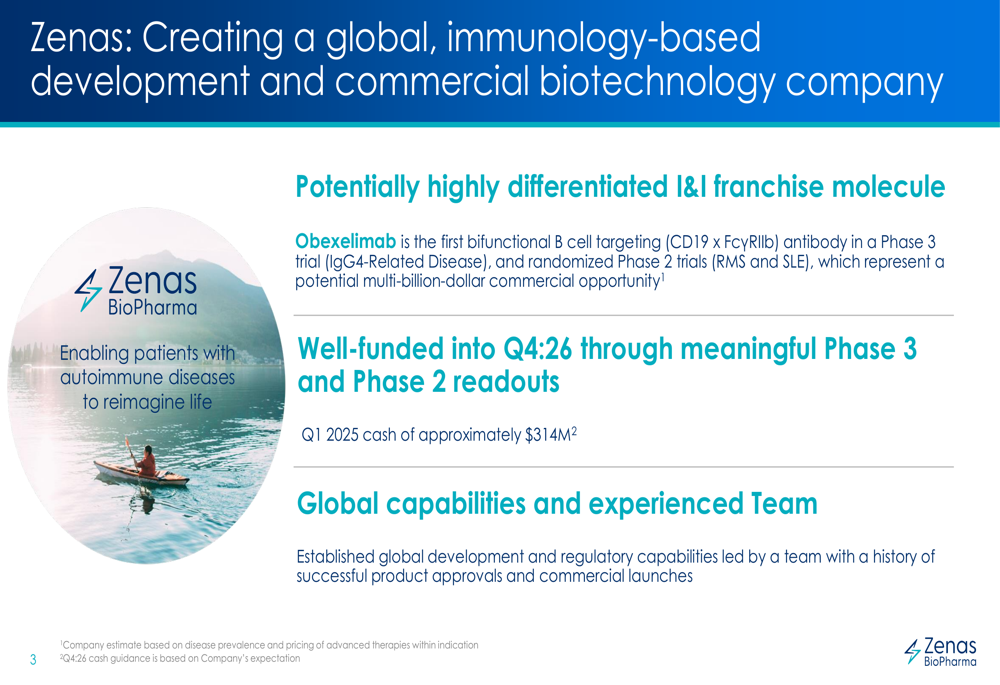
Zenas positions itself as a global, immunology-focused biotechnology company with a differentiated approach to treating autoimmune diseases. The company’s lead asset, Obexelimab, is a bifunctional antibody targeting CD19 and FcγRIIb on B cells, designed to inhibit rather than deplete these cells. With approximately $314 million in cash as of Q1 2025, Zenas reports being funded through Q4 2026, covering all planned clinical readouts.

As shown in the following company overview slide, Zenas highlights Obexelimab’s potential as a franchise molecule across multiple indications:

Strategic Initiatives: Novel B Cell Inhibition Approach

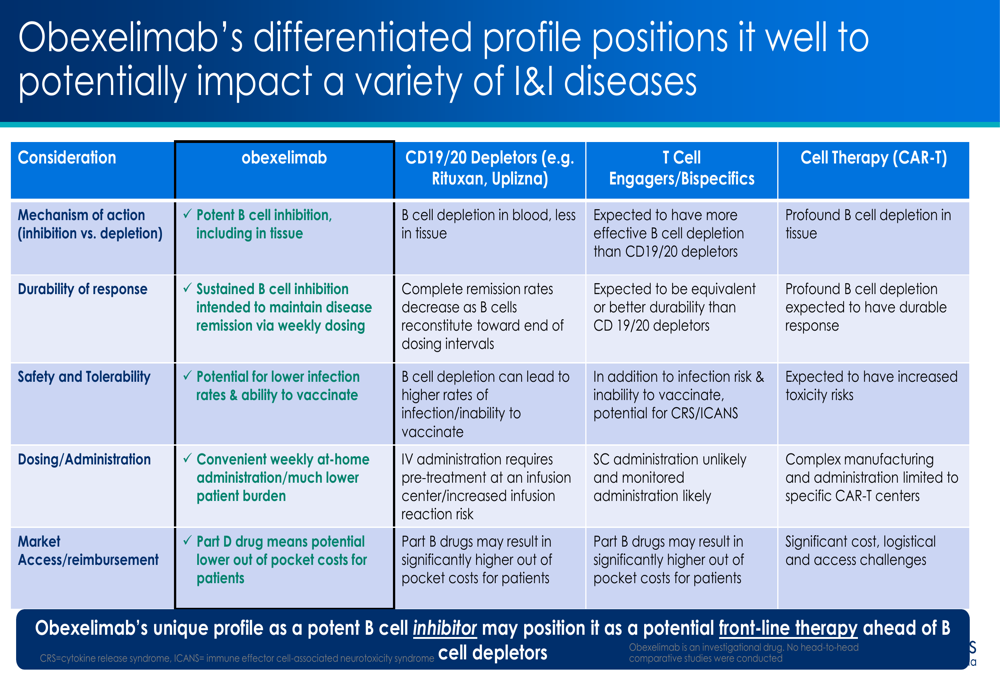
Zenas’s core strategy centers on Obexelimab’s differentiated mechanism of action. Unlike current B cell therapies that deplete cells through CD20 or CD19 targeting, Obexelimab inhibits B cell function through co-engagement of CD19 and FcγRIIb, potentially offering improved efficacy in tissues and a better safety profile.

The following comparison table illustrates Obexelimab’s potential advantages over existing therapies:

This differentiated profile could position Obexelimab as a front-line therapy ahead of B cell depletors in multiple indications. The company emphasizes that Obexelimab’s weekly subcutaneous self-administration offers convenience advantages over intravenous therapies, while potentially maintaining effective disease control with a favorable safety profile.

Detailed Pipeline Analysis

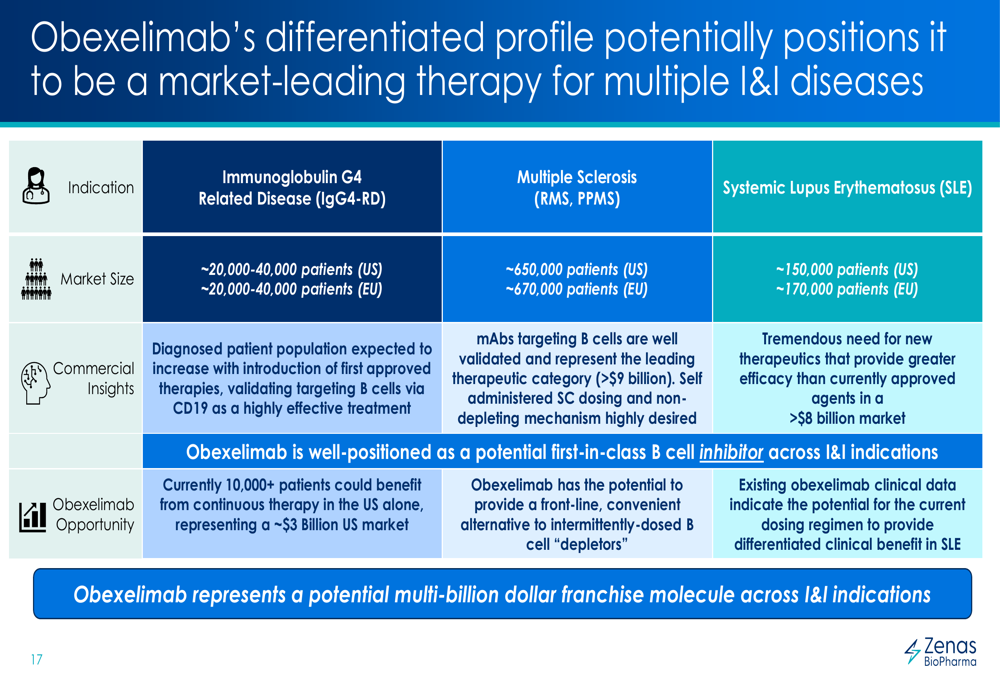
Zenas is pursuing a three-pronged development strategy for Obexelimab, targeting IgG4-Related Disease (IgG4-RD) as a fast-to-market orphan indication, while simultaneously advancing into larger markets with Multiple Sclerosis (MS) and Systemic Lupus Erythematosus (SLE).

The market potential across these indications is substantial, as illustrated in this market overview:

IgG4-Related Disease (IgG4-RD)

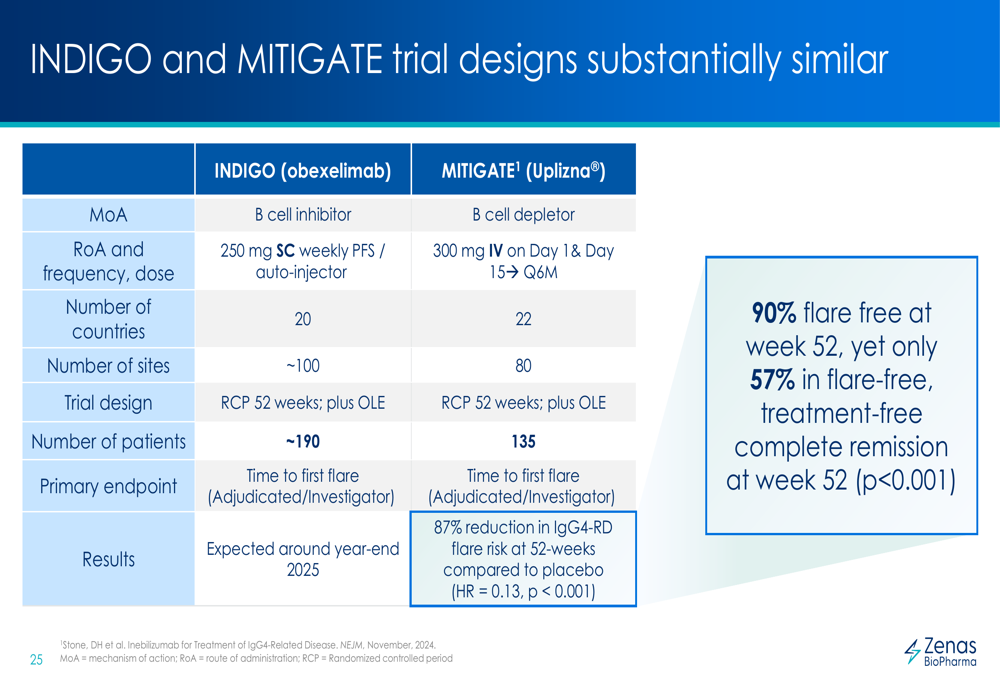
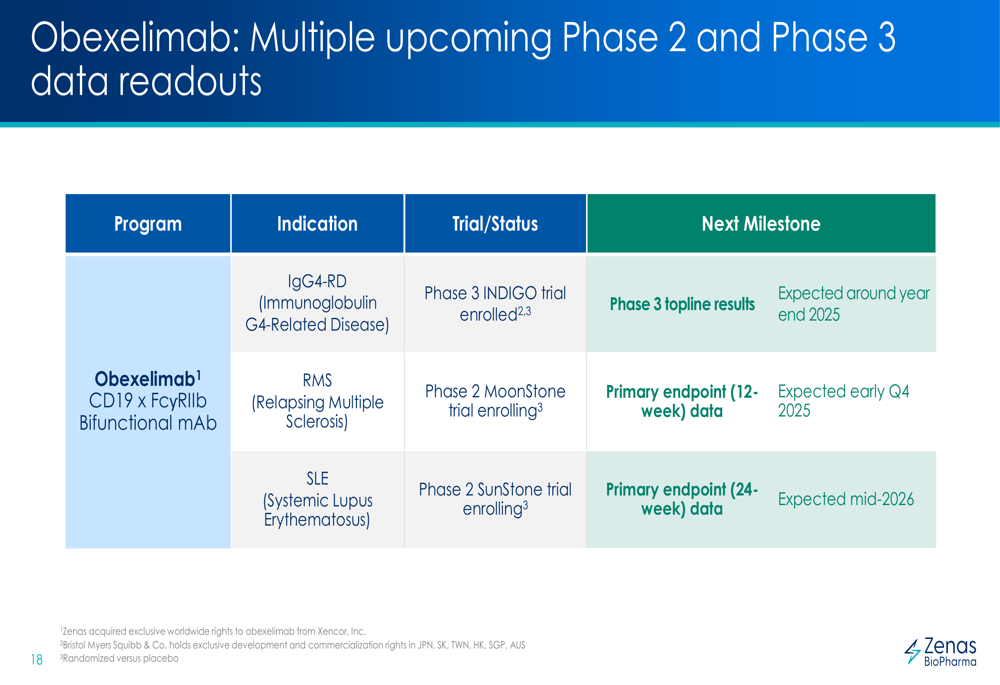
The Phase 3 INDIGO trial for IgG4-RD has completed enrollment, with topline results expected around year-end 2025. This pivotal trial follows encouraging Phase 2 results where 100% of patients who completed the trial met the primary endpoint, with 93% showing ongoing response at the end of the trial.

The INDIGO trial design is being compared to the recently completed MITIGATE trial of a competing therapy:

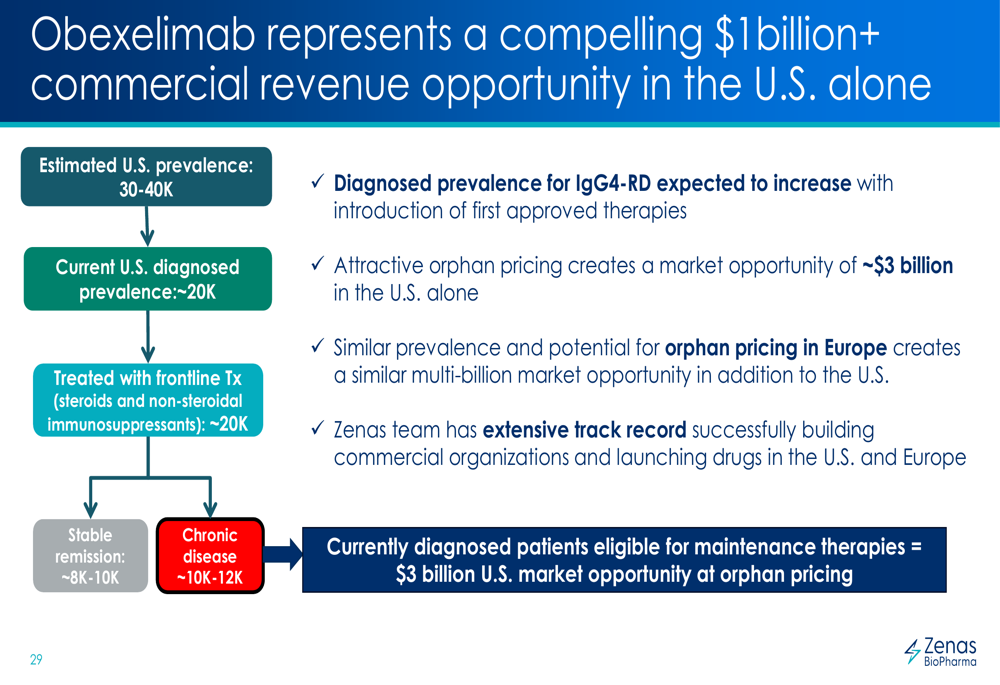
Zenas estimates the U.S. IgG4-RD market opportunity at approximately $3 billion, based on orphan pricing and a diagnosed prevalence of around 20,000 patients, with similar potential in Europe.

Multiple Sclerosis (MS)

For MS, Obexelimab is being positioned to compete in a market dominated by B cell-targeting therapies that collectively generate over $9 billion in annual sales. The Phase 2 MoonStone trial is currently enrolling patients with relapsing MS, with results expected in early Q4 2025.

Systemic Lupus Erythematosus (SLE)

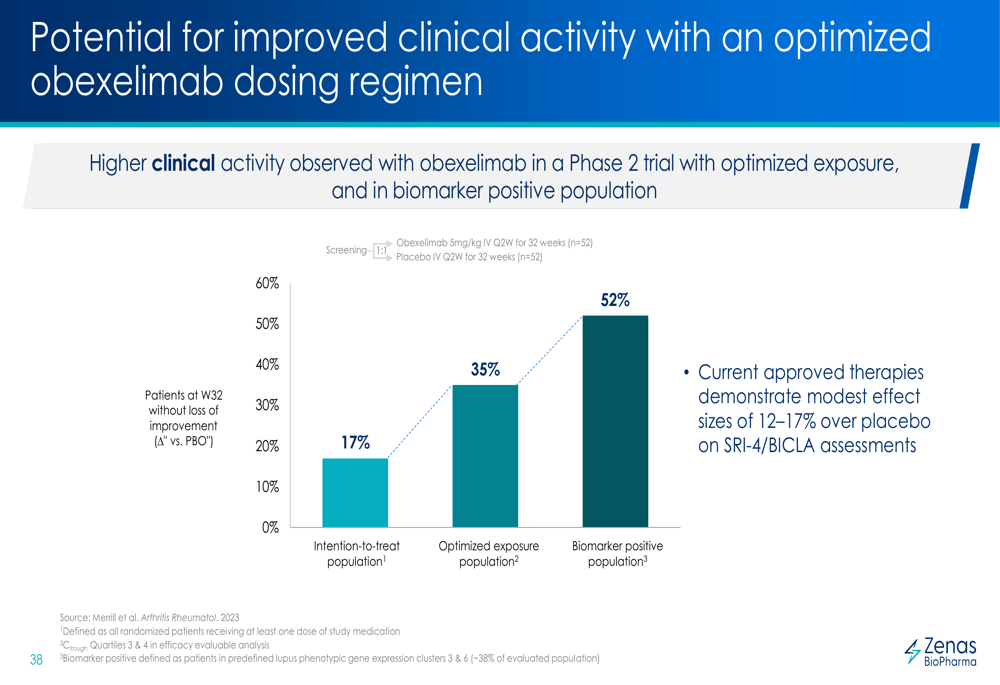
The Phase 2 SunStone trial in SLE is also enrolling, with results expected by mid-2026. Previous Phase 2 data showed promising results, particularly in biomarker-positive populations:


Forward-Looking Statements

Zenas has outlined a clear timeline for upcoming clinical readouts across its pipeline:

These data readouts represent significant potential catalysts for the company over the next 12-18 months. Additionally, Zenas has secured a strategic collaboration with Bristol Myers (NYSE:BMY) Squibb, which includes rights to develop and commercialize Obexelimab in Japan, South Korea, Taiwan, Singapore, Hong Kong, and Australia, along with $50 million upfront and a $20 million equity investment.

Competitive Industry Position

Zenas’s management team brings substantial industry experience, with collective involvement in over 70 IND filings, 30+ BLA/NDA filings, and 30+ commercial product launches.

[MORE}

https://www.investing.com/news/company-news/zenas-biopharma-may-2025-slides-key-data-readouts-expected-by-yearend-93CH-4048123

'Bayer (BAYZF) Faces Potential R&D Impact Amid Tariff Concerns'


Potential Impact of Tariffs on Bayer's R&D

Bayer (BAYZF) has recently highlighted concerns regarding the proposed tariffs on pharmaceuticals, emphasizing their potential to dramatically affect the company's research and development (R&D) budget. The pharmaceutical giant underscores that for every dollar allocated to tariffs, there is a corresponding reduction in funding available for innovation, a critical component of Bayer's growth strategy.

Looking Beyond 2026: Strategic Preparation

Although Bayer does not anticipate immediate repercussions from these tariffs, the company is not resting on its laurels. Instead, it is gearing up for possible challenges that could emerge beyond 2026. To this end, Bayer is making strategic adjustments to its supply chain, aiming to mitigate the future risks associated with these proposed tariffs.

By proactively managing their supply chain and financial strategies, Bayer is taking deliberate steps to safeguard their innovation pipeline and ensure long-term stability. Investors should watch how effectively Bayer navigates these potential hurdles, which could ultimately influence the company's market performance.

https://www.gurufocus.com/news/2867333/bayer-bayzf-faces-potential-rd-impact-amid-tariff-concerns

Walmart stock drops as it signals price hikes due to 'magnitude' of Trump tariffs

Walmart (WMT) posted a mixed quarterly print Thursday morning as it navigates President Trump's tariffs.

Its Q1 revenue jumped 2.5% to $165.6 billion, missing Wall Street expectations of $166.02 billion. Adjusted earnings per share grew 1.7% year over year to $0.61, beating estimates of $0.58. US same-store sales also beat expectations with a 4.5% increase, led by health and wellness, and groceries.


But Walmart stock dropped 5% in early trading as it signaled more pain ahead.

"We will do our best to keep our prices as low as possible, but given the magnitude of the tariffs, even at the reduced levels announced this week, we aren't able to absorb all the pressure given the reality of narrow retail margins," Walmart CEO Doug McMillon said in the release. He added on the earnings call that tariffs have already led to price increases in April and May.


McMillon said the "reset of costs" will continue throughout the year, adding for an "imported item, you pay the tariff at the time it comes through customs ... even if the tariff rate comes down later, the cost has been elevated."

Robert Ohmes of Bank of America estimates Walmart imports roughly 15% of its US sales from China. Around 60% of the US sales are groceries, which are largely tariff-exempt if they're produced domestically or in Mexico and Canada.

McMillon said that "tariffs on countries like Costa Rica, Peru, and Colombia are pressuring imported items like bananas, avocados, coffee, and roses."


He added that the company is trying to "keep food prices as low as possible," and hopes it can get help from policy changes.

In the quarter, adjusted operating income growth of 2.8% beat its guidance of 0.5% to 2%, though it had walked that range down last month. Prior to Trump's "Liberation Day" announcement, Walmart had guided to annual adjusted operating profit growth of 3.5% to 5.5% on a Feb. 20 earnings release.


The company expects net sales for the second quarter to increase 3.5% to 4.5%. It did not provide guidance for adjusted earnings or operating income, as "the dynamic nature of the backdrop" makes it "exceedingly wide and difficult to predict," Rainey said in the release.

For the full year, the company reiterated its conservative 2026 fiscal year guidance. It projects net sales to increase between 3% and 4%, in line with a target of 4% annual sales growth it laid out years ago.

Telsey Advisory Group's Joe Feldman wrote in a note to clients that the retailer is expected to "weather the pressure better than most."


Prior to earnings, Walmart stock was up 7.3% year to date and up more than 4% in the last month as investors have sought out safe havens. That's compared to the S&P 500 (^GSPC) remaining flat year to date and a 30% drop for Target (TGT).

https://finance.yahoo.com/news/walmart-stock-drops-as-it-signals-price-hikes-due-to-magnitude-of-trump-tariffs-110354897.html

"A Modest Request": The Supreme Court Hears Challenge To National Or Universal Injunctions

 by Jonathan Turley,

Today, the United States Supreme Court will hear three consolidated cases in Trump v. CASA on the growing use of national or universal injunctions. This is a matter submitted on the “shadow docket” and the underlying cases concern the controversy over “birthright citizenship.” However, the merits of those claims are not at issue. Instead, the Trump Administration has made a “modest request” for the Court to limit the scope of lower-court injunctions to their immediate districts and parties, challenging the right of such courts to bind an Administration across the nation

The case is the consolidation of three matters: Trump v. CASA out of  Maryland; Trump v. Washington out of Washington State, and Trump v. New Jersey, out of Massachusetts. These cases also present standing issues since the Administration challenges the argument that there is a cognizable “injury” to individuals who may travel to the states bringing the actions.

However, the main question is the scope of injunctions.

As I have previously written, district court judges have issued a record number of injunctions in the first 100 days of the Trump Administration. 

Under President George W. Bush, there were only six such injunctions, which increased to 12 under Obama. 

However, when Trump came to office, he faced 64 such orders in his first term.

When Biden and the Democrats returned to office, it fell back to 14

That was not due to more modest measures. 

Biden did precisely what Trump did in seeking to negate virtually all of his predecessors’ orders and then seek sweeping new legal reforms. He was repeatedly found to have violated the Constitution, but there was no torrent of preliminary injunctions at the start of his term.

Yet, when Trump returned to office, the number of national injunctions soared again in the first 100 days and surpassed the number for the entirety of Biden’s term.

This is a rare argument. 

First, it is a shadow docket filing that usually results in summary decisions without oral argument. Moreover, this matter came after what is commonly viewed as the final day for oral arguments. The Court granted a rare late oral argument, reflecting that multiple justices view this matter sufficiently serious to warrant a break from standard operating procedures.

Rather than arguing a “question presented” on birthright citizenship, the Administration is solely looking for limits on the district courts as appeals continue on the “important constitutional questions” raised by birthright citizenship.

The Administration argues that the Constitution does not give judges the power to issue universal injunctions and that courts are limited to addressing the cases before them in a given district. The Administration acknowledges that class actions can create the basis for universal injunctions, offering a moderate resolution to the Court. In such cases, if the parties can meet the standard for a national class, they can seek a national or universal injunction.

In today’s arguments (which I will be covering for Fox and on X), we can expect to hear from justices who have previously been critical of universal injunctions, including Justice Clarence Thomas, who, in his concurring opinion in Trump v. Hawaii, called them “legally and historically dubious.”

Likewise, Justices Gorsuch and Alito have criticized such injunctions. In a prior dissent to an emergency filing in Department of State v. AIDS Vaccine Advocacy Coalition, Alito was joined by Thomas, Gorsuch, and Kavanaugh in stating that the government “has a strong argument that the District Court’s order violates the principle that a federal court may not issue an equitable remedy that is ‘more burdensome than necessary to’ redress the plaintiff’s injuries.”

Many of us will be watching three members the most closely: Chief Justice John Roberts and Associate Justices Elena Kagan and Amy Coney Barrett. Roberts is the ultimate institutionalist, and we should see in his argument how he views the impact of such injunctions on the court system as a whole. He is very protective of the courts’ inherent authority but may also have misgivings about the scope of these orders.

During the Biden Administration, Justice Kagan has previously criticized universal injunctions. In an interview at Northwestern University Law School, Kagan flagged the “forum shopping” by litigants in filing cases before favorable courts:

“You look at something like that and you think, that can’t be right. In the Trump years, people used to go to the Northern District of California, and in the Biden years, they go to Texas. It just can’t be right that one district judge can stop a nationwide policy in its tracks and leave it stopped for the years that it takes to go through the normal process.”

Justice Barrett previously joined with Kavanaugh in stating that the power of district courts to enter a universal injunction “is an important question that could warrant our review in the future.”

The argument today will start at 10 am and I will be doing a running review of the arguments on X.

U.S. Solicitor General D. John Sauer will argue the government’s case.

Jeremy Feigenbaum, New Jersey’s solicitor general, will argue for the state and local governments and  Kelsi Corkran, the Supreme Court director at Georgetown’s Institute for Constitutional Advocacy and Protection, will argue for the private individuals and groups.

Jonathan Turley is the Shapiro Professor of Public Interest Law at George Washington University where he teaches a course on the Supreme Court and the Constitution.

https://www.zerohedge.com/political/modest-request-supreme-court-hears-challenge-national-or-universal-injunctions