Amazon has unveiled three groundbreaking AI innovations that create real-world value for our customers, employees, and delivery partners. The new advancements—which include Wellspring, a generative AI mapping technology; an AI-powered demand forecasting model that’s powering Amazon’s supply chain; and new agentic AI capabilities for robotics—represent Amazon's continued investment in cutting-edge, practical AI applications that solve real-world logistics challenges.
While these systems work behind the scenes, customers will certainly experience their benefits: more accurate delivery locations, faster shipping options, and improved availability of the products they want, when they want them.
Here’s a look at what we’re developing:
Generative AI mapping: Wellspring
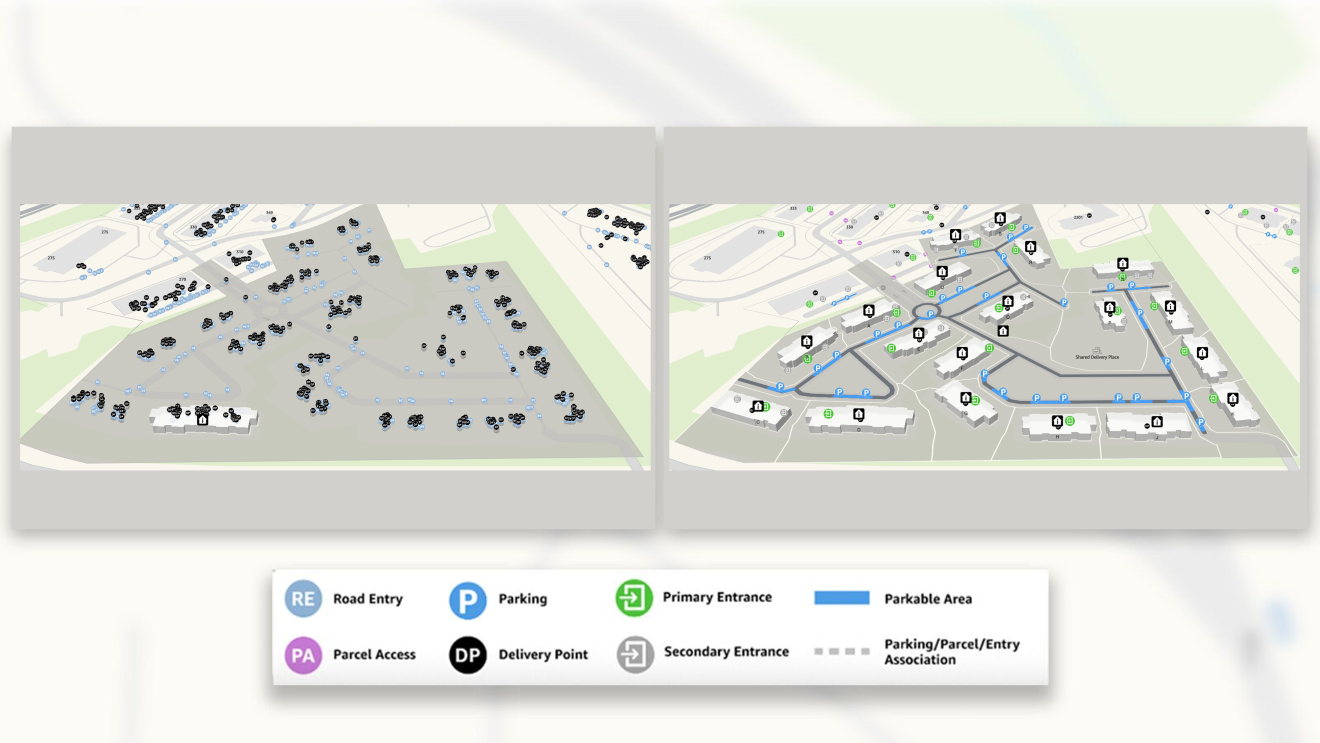 Before (left): All locations of where to deliver packages, based on delivery history and geographic coordinates. After (right): AI-powered technology that accurately identifies entrances, parking spots, and individual units within an apartment complex and displays shared delivery locations.
Wellspring is an initiative to improve delivery accuracy for customers. Powered by generative AI, this new system harnesses data from dozens of sources, including satellite imagery, road networks, building footprints, customer instructions, information from prior deliveries, and street imagery, to create a comprehensive delivery solution for millions of locations. This technology helps drivers better navigate complex and varied environments—like multi-building apartment complexes or brand-new neighborhoods that don't yet appear on navigation apps—so they're able to deliver packages to customers where they want them. With Wellspring, we're able to better identify which apartment numbers correspond to a specific building in an apartment complex, which parking spots and entrance points provide the most convenient route for package drop-off, and the location of a shared mailroom—supporting drivers in navigating diverse delivery landscapes. Before Wellspring and generative AI technology, we were not able to leverage the wide range of locational information that helps us create a better understanding and depiction of the physical world for delivery partners.
When we started testing Wellspring in the U.S. in October 2024, the results were significant—the system mapped over 2.8 million apartment addresses to their corresponding buildings across more than 14,000 complexes, while also identifying convenient parking locations at 4 million addresses. Earlier, this view of the physical world would have taken us years to understand. The technology also detects building entrances and mailroom locations by analyzing proof-of-delivery photos and location data from past deliveries. These improvements help drivers navigate unique environments with greater confidence, ensuring packages arrive where customers expect them.
Amazon’s supply chain has a new foundational AI forecasting model designed to predict what customers will want, where they’ll want it, and when—for hundreds of millions of products per day. While our previous systems used sales history to guide inventory planning decisions, this foundation model adds time-bound data like weather patterns and holiday schedules to place the right products in the right locations more accurately.
By analyzing regional differences—like sunscreen sales in Cape Cod, Massachusetts, in the summer months, or ski goggles in Boulder, Colorado, during peak ski season—we’re able to accurately and efficiently cater to the different needs of the communities we serve. These forecasts have contributed to a 10% improvement in long-term national forecasts for deal events, and a 20% improvement in regional forecasts for millions of popular items, boosting productivity and shrinking our network’s carbon footprint.
The technology’s benefits are tangible: Packages arrive faster (sometimes same-day instead of within two days), delivery partners travel fewer miles, traffic is reduced, carbon emissions decrease, and carbon emissions are avoided. Operations networks in the U.S., Canada, Mexico, and Brazil are already using this technology, with future expansion coming soon.
