Search This Blog

Friday, June 13, 2025

US FDA extends review of KalVista’s swelling disorder drug

 KalVista Pharmaceuticals’ said on Friday that the U.S. Food and Drug Administration had extended the review of its drug for a type of hereditary swelling disorder due to heavy workload and limited resources.

The FDA indicated that it now expects to deliver a decision within four weeks, KalVista said.

The original target action date for the decision on the medication, named sebetralstat, was set for June 17 by the regulator.

The extension is the latest instance of the FDA missing a deadline following mass layoffs as part of a major overhaul of federal health agencies under U.S. Secretary of Health and Human Services Robert F. Kennedy Jr.

KalVista said the FDA had not requested additional data or studies and had not raised any concerns regarding the safety, efficacy or approvability of the drug.

"We remain confident in the potential for near-term approval of sebetralstat," the company told Reuters in an email.

It also said it had addressed all prior information requests in a timely manner and believed the only remaining item under FDA review was the finalization of the packaging insert.

If approved, sebetralstat will become the first on-demand oral treatment for hereditary angioedema, offering a convenient alternative to injectable treatments.

The life-threatening condition causes sudden, dangerous swelling in the body, including the skin, digestive tract and upper respiratory system, due to deficiency in a protein known as C1 inhibitor.


https://www.investing.com/news/stock-market-news/us-fda-extends-review-of-kalvistas-swelling-disorder-drug-due-to-heavy-workload-4095767

Protected Status Terminated For 1 Million Migrants In US

 Around 1 million migrants in the U.S. on temporary protections are seeing their status terminated by the Trump administration.

In April, around 350,000 Venezuelans lost their Temporary Protected Status in the country and were told to self-deport.

As Statista's Katharina Buchholz reportsyesterday, the Department of Homeland Security notified almost 500,000 people from Cuba, Haiti, Nicaragua and Venezuela in the U.S. on the so-called CHNV program that their status had ended.

Infographic: Protected Status Terminated for 1 Million Migrants in U.S. | Statista

While the Supreme Court allowed the government to proceed as if the Temporary Protected Status of the Venezuelans in question and the CHNV program had ended, the programs are officially considered on hold as lower courts continue to litigate legal challenges to their discontinuation.

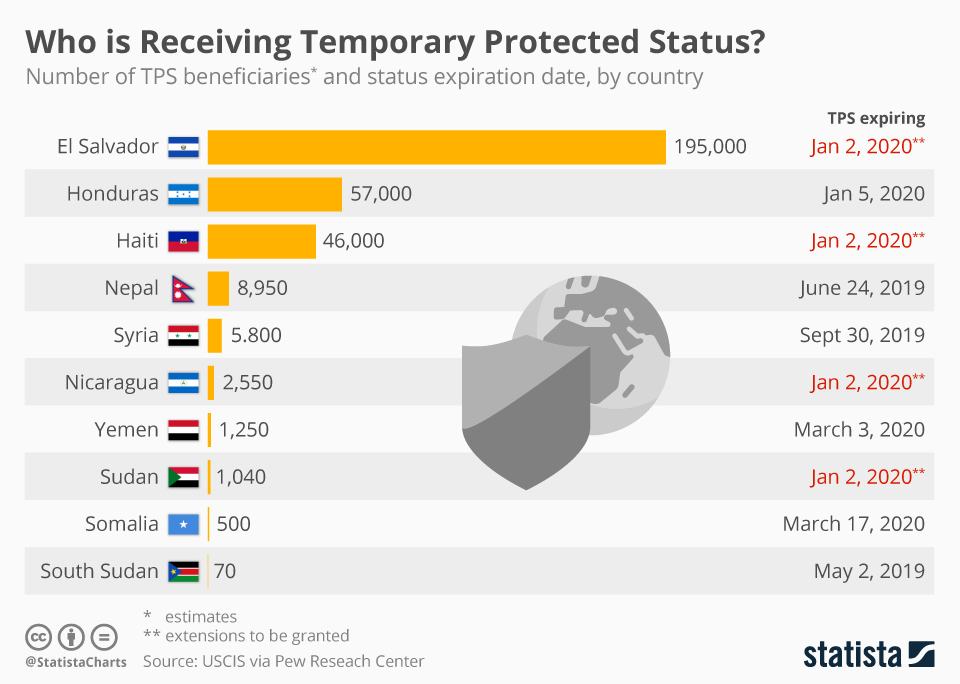
Earlier in the year, the U.S. government had already announced that is was cutting short or not extending some other Temporary Protected Status programs. This affects Haitians, Afghanis, Nepalese and Cameroonians. A total of around 220,000 people, mostly from Haiti, are set to lose their legal status in the U.S. this way in July and August.

Even more Temporary Protected Status programs are also suspected to not be extended. Protections for almost 250,000 additional Venezuelans would have to be extended before September, while more than 50,000 Hondurans are currently seeing their status expire in early July. Other programs include those for El Salvadorians (whose extension wasn't stopped by the Trump administration), Syrians, Ukrainians and Nicaraguans.

https://www.zerohedge.com/geopolitical/protected-status-terminated-1-million-migrants-us

Dark-Money Network Funneled Millions Into 'No Kings' Nationwide Color Revolution Operation

 by Peter Schweizer & Seamus Bruner of the Government Accountability Institute

New Schweizer team investigation reveals how 'No Kings' and its partners bagged $114.8 million from the Arabella dark money network and how these professional protest organizations use tax dollars as a force multiplier.

The expected worldwide mobilization of protests this weekend, from Mississippi to Malawi, will hardly be a spontaneous eruption. On the contrary, the tumult is a carefully plotted production (complete with a protest song book) financed by the progressive dark money network that has perfected the mounting of made-to-order protests.

This "grassroots" day of defiance targets Donald Trump and his "billionaire allies," according to organizers. The dark money network funding it is known as Arabella Advisors, whose benefactors are the left's own billionaire heroes, the CONTROLIGARCHS, including George Soros, Bill Gates, Hansjorg Wyss, Mark Zuckerberg, and Reid Hoffman.

Arabella provided nearly $5 million to two leftwing nonprofits involved with the "anti-I.C.E." riots in Los Angeles this past week, according to the most recent financial disclosures available. One of those groups, Community Change Action, supports the L.A. protests and has provided protest tips in Spanish. Its "brainchild," the Fair Immigration Reform Movement, has trained children how to aggressively protest.

Another group, the Coalition for Humane Immigrant Rights of Los Angeles, was accused by Senator Josh Hawley of fomenting "unlawful" unrest this week and has supplemented its Arabella cash with more than $50 million in state and federal grants since 2021. Indeed, taxpayers are unwittingly partnering with Arabella- and Soros-funded groups to back social unrest.

And the protests this weekend? Arabella has dumped more than $100 million into the coffers of the official "No Kings" protest partners.

 Map: Nationwide Mobilization Effort 

This weekend's day of demonstrations is dubbed "No Kings," a purpose-built protest brand created by an entity called The Indivisible Project (or "Indivisible"). That entity and its eponymous offshoots – "Indivisible Civics," "Indivisible Action," "Indivisible East Bay," et al – sprung up as an activist mobilization machine in response to Trump's 2016 victory.

Led by activists Ezra Levin and his spouse, Leah Greenberg, Indivisible has helped organize numerous anti-Trump protests. Among the partners and affiliates of No Kings are familiar names such as the ACLU and Sierra Club, and more controversial groups such as 350, which promoted and participated in the 2023 "Stop Cop City" direct actions in Atlanta which ultimately descended into firebombing chaos and saw more than 60 rioters arrested and charged with various crimes, including RICO.

Two of Arabella's top benefactors – the godfather of dark money, George Soros, and shadowy Swiss-billionaire Hansjorg Wyss – are anchor investors in Indivisible's operations. Soros's Open Society Network provided important financial support, ultimately upwards of $8 million, while Wyss's political action fund funneled $2.5 million to the Indivisible professional protest machine. LinkedIn founder and Big Tech oligarch Reid Hoffman funded Indivisible's Truth Brigade (a project to combat supposed right-wing disinformation), and the left-wing funding behemoth, Tides Nexus, has given more than $3 million.

Arabella's Sixteen Thirty Fund, which The Atlantic called the "indisputable heavyweight of Democratic dark money," has cut multiple checks to Indivisible for "civil rights, social action, and advocacy." In its most recently available financial disclosure (2023), Indivisible reported $14.06 million in contributions. And while Indivisible is the credited organizer of the No Kings protests, its "partners" are the real big money players behind the demonstrations.

The Government Accountability Institute obtained the most recent Arabella financial disclosures (2019 through 2023), crunched the numbers and found that, in addition to direct funding to Indivisible, the Arabella network has showered the No Kings protest partners and affiliates with at least $114.8 million.

More alarming than the staggering sums that leftwing billionaires are spending on "direct action" protest machines is the fact that taxpayers will almost certainly be funding, at least indirectly, a portion of these protests. As mentioned above, the anti-I.C.E. demonstrations in L.A. were fomented by a group that got state and federal tax dollars.

It's a force-multiplying approach that progressives have mastered, as we learned from the "Gold Bars Off the Titanic" episode, when EPA chief Lee Zeldin revealed that the Biden administration tried to disburse tens of billions of climate cash into the coffers of purpose-built progressive NGOs (Arabella's Windward Fund, for example, was a partner recipient of $2 billion from the EPA for the Rewiring America initiative that Stacey Abrams advised).

Three of the largest Arabella-run funds funneling billionaire cash to professional protest groups are the New Venture Fund, the Hopewell Fund, and the Windward Fund.

Here's the corporate structure... 

The No Kings call to action exhorts disgruntled Americans to "join millions across the country on June 14 to march against authoritarian politics and billionaire takeover."  Whether or not the protests turn violent, as in Los Angeles, remains to be seen. But whatever happens on the Day of Defiance, its organizers and media allies are certain to call it "mostly peaceful."


*   *   *

Seamus Bruner is the author of Controligarchs: Exposing the Billionaire Class, Their Secret Deals, and the Globalist Plot to Dominate Your Life and Peter Schweizer's Head of Research at the Government Accountability Institute. Follow him @SeamusBruner.

https://www.zerohedge.com/political/dark-money-network-funneled-millions-no-kings-nationwide-color-revolution-operation

RFK Jr. Plans to Pull Medical Schools' Funding if They Don't Teach Nutrition

 HHS Secretary Robert F. Kennedy Jr. said in April that he plans to tell medical schools to teach nutrition or risk losing federal funding, ABC News reported

opens in a new tab or window last week.

"Under Secretary Kennedy's leadership, HHS is committed to ensuring that nutrition is treated as core clinical knowledge -- not a wellness extra -- in building a healthcare system equipped to prevent and manage chronic disease," an HHS spokesperson told MedPage Today in an email.

Medical organizations have said that doctors do indeed receive nutrition training in medical school. The Association of American Medical Colleges (AAMC), a key oversight agency in medical education, said in an emailed statement to MedPage Today that the vast majority of medical schools already teach nutrition in some form, including topics such as obesity, food access, and food security.

But nutrition experts say there's room for improvement, as courses can be more extensive and more focused on prevention.

Nutrition Experts Supportive

Brenda Rea, MD, DrPH, RD, of Loma Linda University in California and a founding member of the American College of Lifestyle Medicine (ACLM), said current medical school education on nutrition often involves biochemistry and nutritional deficiencies.

"It's not necessarily about chronic disease management nutrition, or the ability to actually reverse and put disease into remission with nutrition," Rea told MedPage Today.

There is currently no nationwide curriculum for nutrition education in medical schools. Nor are medical school students required to demonstrate competencies in advising patients about healthy food, according to David Eisenberg, MD, an adjunct associate professor at Harvard's T.H. Chan School of Public Health.

"I share Secretary Kennedy's desire to increase the degree to which doctors and medical trainees are introduced to nutrition," Eisenberg told MedPage Today. He and colleagues last year published a consensus statement in JAMA Network Openopens in a new tab or window recommending 36 mandatory nutrition competencies in medical education.

It's crucial that medical students, residents, and doctors have hands-on training in what a healthy diet looks -- and tastes like, Eisenberg said.

"Trying to educate physicians or patients to make better food choices in the absence of some experiential learning in a kitchen with real food is like talking to people about the benefits of swimming in the absence of a swimming pool: it can't be done," he said.

Eisenberg co-founded Healthy Kitchens, Healthy Livesopens in a new tab or window, an annual conference that instructs healthcare professionals in nutrition science and healthy eating, and established the Teaching Kitchen Collaborativeopens in a new tab or window, which includes dozens of hospitals and medical schools equipped with "teaching kitchens."

One such kitchen operates at the University of South Carolina School of Medicine Greenville, which requires its students to take 106 hours of lifestyle medicine across their 4 years. The program is a front-runner in the extensiveness of its training, says its director of lifestyle medicine programs, Jennifer Trilk, PhD.

"The model that works best is a classroom, clinic, community model," Trilk told MedPage Today.

Regarding Kennedy's mandate for nutrition education, Trilk said Greenville leans more toward the carrot than the stick.

"The medical schools that want to do this, how can we help them integrate lifestyle medicine into medical education?" she said, adding that it remains to be seen whether Kennedy's proposed mandate will be effective.

Potential Challenges

Kim Williams, MD, chair of medicine at the University of Louisville in Kentucky, believes that nutrition education for doctors is necessary, as is their ability to pass that knowledge along to patients.

However, he thinks that some of Kennedy's other nutrition recommendations -- such as eliminating seed oils -- are not supported by data and should therefore be dropped.

"We need to be very evidence-based," Williams said to MedPage Today, a point that Trilk also emphasized. "Look at the randomized trials. Look at the accumulation of evidence from large observational studies, all of them pointing to the same thing, whether you're talking about heart disease, heart failure, kidney failure, stroke, all of it is reduced dramatically by going on a whole food, plant-based diet."

Rea added that there are real barriers to achieving Kennedy's mandate. "There's curricular overload, there's limited faculty expertise, there's a lot of misconceptions about accreditation and assessment," she said.

There's also the question of whether simply tacking on a few extra nutrition classes to a medical student's training is sufficient, said Colleen Sloan, RD, PA. The whole of the problem shouldn't fall on doctors, she said, noting that there's already a whole healthcare profession -- dietitians -- dedicated to nutrition that should be better integrated into patient care.

Sloan lamented that insurance will cover seeing a dietitian only when "the patient is diagnosed with diabetes or end-stage renal disease. And I find that such a shame and a disservice to our patients that we're waiting until they're sick enough that we want them to see a dietitian to help."

It would be more beneficial, Sloan said, for a doctor to "pass the baton to the dietitian" much earlier to make dietary recommendations and help patients achieve their goals.

Disclosures

Eisenberg reported receiving personal fees from Teaching Kitchen Collaborative, Northwell Health, CancerScan, Infinitus, and Nissin, and honoraria from Barilla outside the submitted work.

Williams, Rea, Trilk, and Sloan had no disclosures to report.


https://www.medpagetoday.com/publichealthpolicy/medicaleducation/116050

'AMA Opposes Estate Recovery to Recoup Medicaid $$ From Dead Beneficiaries'

 by Cheryl Clark

The American Medical Association (AMA) House of Delegatesopens in a new tab or window voted Wednesday to oppose federal or state efforts to try to recover long-term care costs from Medicaid beneficiaries' estates.

"The government taking a house from a grieving family, for pennies in return, is not healthcare. That is state-sanctioned exploitation," said Dayna Isaacs, MD, MPH, speaking for the Resident and Fellow Section. "A grave should not come with a bill."

Sarah Mae Smith, MD, PhD, who was also speaking for the Resident and Fellow Section, said states that do recover costs from estates recoup small fractions of the amounts owed.

"The highest-income patients to whom estate recoveryopens in a new tab or window would putatively apply are also best able to evade recovery efforts by leveraging legal mechanisms, leaving poorer families and families of color to bear the brunt of these misguided policies," she said.

"Medicaid and estate recovery in the same phrase is an oxymoron," said Niva Lubin-Johnson, MD, speaking for the Illinois State Medical Society.

Gregory Pinto, MD, speaking for the New York delegation, expressed an opposing view. "Our AMA should not be trying to prohibit federal estate efforts to recoup these funds. In fact, several states are able to do so successfully."

The recommendation to oppose estate recovery came in the form of an amendment to an 8-page report from the AMA's Council on Medical Service that detailed the pros and cons of estate recovery. As proposed, the report had recommended that the AMA support making Medicaid estate recovery optional, instead of mandatory, for states.

"At this time right now, Medicaid needs every dollar that it can get to help care for patients" due to looming and widespread federal cuts to Medicaid, said Patrice Burgess, MD, a member of the council that compiled the report. "It is important to allow states that option," so more patients can get covered care.

However, so many delegates were against that, an amendment was introduced to oppose estate recovery efforts outright.

The report noted that just five states -- Massachusetts, New York, Pennsylvania, Ohio, and Wisconsin -- recouped nearly half of all Medicaid Long Term Services and Supports (LTSS) collections in the U.S., and that overall, "recovered dollars represent a small slice of what Medicaid spends on LTSS." Plus, the administrative costs of going after such assets "can be substantial," the report noted.

Medicare Opt-Out Advice?

The AMA had trouble gathering consensus about whether it should develop educational guidance for physicians to opt out of Medicareopens in a new tab or window, since payment to physicians treating seniors and the disabled has fallen far short of keeping pace with inflation, even as administrative burdens have risen.

The idea was that the AMA should develop on its website a prominently featured page with a step-by-step guide on how to opt out; an overview of legal, financial, and ethical considerations; information on alternative payment models and strategies to ensure continuity of care; and an FAQ section to address concerns or special scenarios doctors might face.

The resolution, introduced by seven state delegations, noted that participating in the Medicare program imposes "increasing administrative burdens and financial strain due to payment rates that fail to keep pace with inflation and rising practice costs." Many physicians, the proponents said, "are unaware of the process and implications of opting out of Medicare" or their ability to explore alternative payment models.

But would actively helping doctors drop out be a good service for its members? Or would it perhaps subject the AMA to criticism that it was, in effect, acting to reduce the supply of doctors available to treat the nation's seniors and disabled?

Delegates tried to soften the language by deleting one paragraph that might appear to be overly promotional for doctors to opt out. Before deletion, the paragraph would have allowed the AMA to "promote awareness of this resource among its members and provide additional support for physicians exploring alternative practice models."

Gregory Fuller, MD, speaking for the Texas Medical Association, said he understands "the optics don't look good" and pointed to negative press reports about the effort.

But he insisted that it's important "to have all options available so when people go to the website and look, they can see that option to opt out, but they can also see how to not participate or maybe they need to know how to get into Medicare. We want the optics to look good."

Ultimately, the resolution was referred to the Board of Trustees to make a decision.

GLP-1 Side Effects Registry

Another item prompting vigorous discussion was a proposal for the AMA to support a registry of patients' side effectsopens in a new tab or window from GIP and GLP-1 drugsopens in a new tab or window and their impacts on pregnancyopens in a new tab or window.

The resolution notes that besides their use in people with diabetes, there are limited studies on the potential side effects, such as muscle loss and bone density loss, especially in adults ages 65 and older.

It was approved with overwhelming support from the delegates.

"These are now given to a completely different population of people, [than they were originally intended] and a lot of people are taking these recreationally ... that we would describe as otherwise healthy individuals," said Alan Klitzke, MD, a delegate of the American College of Nuclear Medicine, who spoke for himself. "Some of them have obesity and some of them don't. And they're prescribed to a whole population of people that don't understand what the side effects may be."

"We've seen the commercials: that you learn how to dance or sing or play the guitar if you take one of these medications," Klitzke said.

Nita Shumaker, MD, an alternate delegate for the Organized Medical Staff Section that proposed the resolution, said she could find nothing on the FDA's website about "the newest side effectopens in a new tab or window I've seen, which is non-arteritic anterior ischemic optic neuropathy."

As an obesity medicine specialist, she added, "when I prescribe these medications for my patients, I want to know every potential side effectopens in a new tab or window and everything that is known in the literature, which is not easily accessible at this time."

Jonathan Leffert, MD, of the American Association of Clinical Endocrinology, speaking on behalf of the Endocrine Section Council, argued strongly against the registry, noting that the side effects "are well known."

"These drugs have revolutionized the care of patients with type 2 diabetes because of their effect on both blood sugar and weight loss," he said. "Several hundred papers have been written about these medications and their side effects, including in pregnancies, with many ongoing."

Pinto, of the New York delegation, supported the move. "These medications indeed are not new, but the marketing is new. A bigger advertisement requires a bigger warning label, and that's what this registry does."

https://www.medpagetoday.com/meetingcoverage/ama/116057

Trump Admin Providing Data on Immigrant Medicaid Enrollees to Deportation Officials

 President Trump's administration this week provided deportation officials with personal data -- including the immigration status -- on millions of Medicaid enrollees, a move that could make it easier to locate people as part of his sweeping immigration crackdown.

An internal memo and emails obtained by the Associated Press show that Medicaid officials unsuccessfully sought to block the data transfer, citing legal and ethical concerns.

Nevertheless, two top advisors to HHS Secretary Robert F. Kennedy Jr. ordered the dataset handed over to the Department of Homeland Security (DHS), the emails show. Officials at the Centers for Medicare & Medicaid Services (CMS) were given just 54 minutes on Tuesday to comply with the directive.

The dataset includes the information of people living in California, Illinois, Washington state, and Washington, D.C., all of which allow non-U.S. citizens to enroll in Medicaid programs that pay for their expenses using only state taxpayer dollars. CMS transferred the information just as the Trump administration was ramping up its enforcement efforts in Southern California.

California Gov. Gavin Newsom's (D) office said in a statement that it was concerned about how deportation officials might utilize the data, especially as federal authorities conduct immigration raids with the assistance of National Guard troops and Marines in Los Angeles.

"We deeply value the privacy of all Californians," the statement said. "This potential data transfer brought to our attention by the AP is extremely concerning, and if true, potentially unlawful, particularly given numerous headlines highlighting potential improper federal use of personal information and federal actions to target the personal information of Americans."

HHS spokesman Andrew Nixon said the data sharing was legal. He declined to answer questions about why the data was shared with DHS and how it would be used.

"With respect to the recent data sharing between CMS and DHS, HHS acted entirely within its legal authority -- and in full compliance with all applicable laws -- to ensure that Medicaid benefits are reserved for individuals who are lawfully entitled to receive them," Nixon said.

DHS officials did not respond to requests for comment.

Besides helping authorities locate migrants, experts said, the government could also use the information to scuttle the hopes of migrants seeking green cards, permanent residency, or citizenship if they had ever obtained Medicaid benefits funded by the federal government.

A Targeted Review of Millions of Immigrant Medicaid Enrollees

CMS announced late last month that it was reviewing some state's Medicaid enrollees to ensure federal funds have not been used to pay for coverage for people with "unsatisfactory immigration status." In a letter sent to state Medicaid officials, CMS said that the effort was part of Trump's Feb. 19 executive order titled "Ending Taxpayer Subsidization of Open Borders."

As part of the review, California, Washington, and Illinois shared details about non-U.S. citizens who have enrolled in their state's Medicaid program, according to a June 6 memo signed by Medicaid Deputy Director Sara Vitolo that was obtained by the AP. The memo was written by several CMS officials under Vitolo's supervision, according to sources familiar with the process.

The data includes addresses, names, social security numbers, and claims data for enrollees in those states, according to the memo and two people familiar with what the states sent to CMS. Both individuals spoke on the condition of anonymity because they were not authorized to share details about the data exchange.

CMS officials attempted to fight the data sharing request from DHS, saying that to do so would violate federal laws, including the Social Security Act and the Privacy Act of 1974, according to Vitolo's memo.

"Multiple federal statutory and regulatory authorities do not permit CMS to share this information with entities outside of CMS," Vitolo wrote, further explaining that the sharing of such personal data is only allowed for directly administering the Medicaid program.

Sharing information about Medicaid applicants or enrollees with DHS officials would violate a "longstanding policy," wrote Vitolo, a career employee, to Trump appointee Kim Brandt, deputy administrator and chief operating officer of CMS.

Vitolo and Brandt could not be reached for comment.

The legal arguments outlined in the memo were not persuasive to Trump appointees at HHS, which oversees the Medicaid agency.

Four days after the memo was sent, on June 10, HHS officials directed the transfer of "the data to DHS by 5:30 ET today," according to email exchanges obtained by AP.

Former government officials said the move was unusual because CMS, which has access to personal health data for nearly half of the country, does not typically share such sensitive information with other departments.

"DHS has no role in anything related to Medicaid," said Jeffrey Grant, a former career employee at CMS.

Beyond her legal arguments, Vitolo said sharing the information with DHS could have a chilling effect on states, perhaps prompting them to withhold information. States, she added, needed to guard against the "legal risk" they were taking by giving federal officials data that could be shared with deportation officials.

A 'Concerning' Development

All states must legally provide emergency Medicaid services to non-U.S. citizens, including to those who are lawfully present but have not yet met a 5-year wait to apply for Medicaid.

Seven states, along with the District of Columbia, allow immigrants who are not living legally in the country to enroll -- with full benefits -- in their state's Medicaid program. The states launched these programs during the Biden administration and said they would not bill the federal government to cover those immigrants' healthcare costs.

The Trump administration has raised doubts about that pledge.

Nixon, the HHS spokesman, said that the state's Medicaid programs for immigrants "opened the floodgates for illegal immigrants to exploit Medicaid -- and forced hardworking Americans to foot the bill."

All of the states -- California, New York, Washington, Oregon, Illinois, Minnesota, and Colorado -- have Democratic governors. Due to his state's budget woes, Newsom announced earlier this year he would freeze enrollment into the program; Illinois will also shut down its program for roughly 30,000 non-U.S. citizens in July.

The remaining states -- New York, Oregon, Minnesota, and Colorado -- have not yet submitted the identifiable data to CMS as part of the review, according to a public health official who has reviewed CMS' requests to the states.

State health officials from the District of Columbia, Washington, and Illinois did not respond to requests for comment.

Newsom's office said in its statement that the data sharing has "implications for all Californians, but it is especially concerning for vulnerable communities."

https://www.medpagetoday.com/publichealthpolicy/medicaid/116070

Swearing Off Cold Drinks to Prevent Afib


  • People reporting cold drinks or foods as triggers for their atrial fibrillation (Afib) were invited to a survey.
  • Approximately half the cohort reported reducing their Afib episodes by avoiding cold ingestion, with methods including waiting for drinks to warm to room temperature and eliminating straw use.
  • Healthcare providers often held a dismissive attitude towards the so-called "cold drink heart" phenomenon, the study showed.

Avoiding ice water, smoothies, and ice cream seemed to work as a lifestyle change for some with atrial fibrillation (Afib or AF), according to the first cross-sectional survey of people with "cold drink heart" (CDH).

Among people who claimed to have ever had symptomatic Afib triggered by cold ingestion, 51.5% reported that their Afib episodes occurred only following cold drink or food consumption (as opposed to other triggers). In these patients, avoidance of cold ingestion reduced or eliminated their Afib episodes with 100% effectiveness (as opposed to 72.4% in people who also had a history of non-CDH Afib).

"When asked about avoidance, respondents reported several effective behavioral modifications in lieu of complete avoidance, such as reducing speed of ingestion or avoiding rapid gulping, eliminating straw use, allowing drinks to warm to room temperature, or warming liquids in their mouth before swallowing," reported David Vinson, MD, of Kaiser Permanente (KP) Northern California in Pleasanton, and colleagues in the Journal of Cardiovascular Electrophysiologyopens in a new tab or window.

With their survey, the investigators had taken the first step to study the cold drink-Afib link more systematically, beyond the initial case reports.

The survey included 101 people who self-reported cold ingestion-triggered symptomatic Afib or atrial flutter at KP Northern California emergency departments (n=39) and an additional cohort of non-KP patients who had contacted the research team, unsolicited, offering their experience with CDH (n=62).

"We did this study because for decades there have been people telling their healthcare providers that cold foods and drinks trigger their atrial fibrillation episodes -- but many providers have dismissed this possibility," said Vinson in a press release. "Yet, the more patients with atrial fibrillation are asked about -- or read about -- this trigger, the more often we hear, 'Yes, that's happening to me, too.'"

"Although the majority of the people we surveyed said their atrial fibrillation was associated with cold ingestion, it was actually rare that eating or drinking something cold always precipitated an atrial fibrillation episode," Vinson noted. "In other words, most people with cold drink heart were often able to eat cold food or drinks without developing symptoms of atrial fibrillation. This shows how unpredictable the condition can be and why it's been hard for some patients to identify these triggers."

He and his study co-authors urged greater clinician awareness of CDH in the setting of Afib, citing one estimate that 5-10% of people with paroxysmal Afib may have cold drinks or foods as a trigger.

In their present report, patients said they had gotten a range of reactions from professionals when they shared their experiences: 52.4% of respondents reported dismissive attitudes from one or more healthcare providers, while some actually said they learned about the phenomenon from a physician.

In practice and in research, alcohol is more established as a dietary trigger of Afib.

"Alcohol ingestion has been recently identified as a trigger of discrete AF events, but only after a delay of 3-12 [hours]. This hours‐long delay contrasts with the relative immediacy of cold drink triggers, which precipitate AF within seconds to minutes," wrote Vinson's group.

Vinson and colleagues recruited a study cohort that was 75% men with a median age of 56 years, a median CHA₂DS₂‐VASc score of 1, and 25.7% on anticoagulants. Patients said they had been 44.5 years old at CDH onset.

When asked which rhythm was triggered by cold ingestion, 74.3% of patients reported only Afib, 15.8% said both Afib and flutter, 3.0% flutter only, while 7.0% said they were unsure.

The KP cohort underwent chart review for ECG confirmation of their Afib. As for the outside cohort, a documented diagnosis of AF or atrial flutter was required but these patients did not have to share their medical records.

Study authors noted that 36.5% of those surveyed reported that Afib was often triggered by cold ingestion soon after physical activity, and some reported that this was always the case for their CDH episodes.

"While the underlying mechanism could not be elucidated by the current study, an exacerbation after exercise suggests a vagotonic effect. Indeed, heightened vagal tone appears to trigger AF, and esophageal stimulation such as with a cold drink, may acutely increase such an autonomic response," Vinson's group surmised.

"Alternatively, as the esophagus lies directly behind and often in contact with the posterior left atrium, direct cold mechanical irritation of the left atrium may also be responsible, which also could be exacerbated post-exercise due to the relative increase in vagal tone," the investigators continued.

Rapid gulping or swallowing was reportedly also more likely to provoke Afib, the survey found.

Vinson and colleagues acknowledged that the study was not designed to prove causality and that the survey responses may have been inaccurate. There was likely some degree of selection bias affecting the study, as well.

"Further study will be required to assess the prevalence of CDH among an unselected population of AF patients, and importantly, the generalizability of our findings around the effectiveness of cold drink avoidance and other behavioral modifications in reducing AF recurrence," they wrote.


Disclosures

The study was supported by The Permanente Medical Group Delivery Science and Applied Research program.

Vinson had no personal disclosures.

One study co-author reported funding from the NIH and PCORI and personal ties to InCarda.

Primary Source

Journal of Cardiovascular Electrophysiology

Source Reference: opens in a new tab or windowDiLena DD, et al "Characterizing patients with cold drink-triggered atrial fibrillation" J Cardiovasc Electrophysiol 2025; DOI: 10.1111/jce.16753.


https://www.medpagetoday.com/cardiology/arrhythmias/116072