Search This Blog

Sunday, August 10, 2025

Texas Redistricting Breaks The Democratic Party

 Consider what has transpired in the past few weeks and ask yourself which political party is acting like petulant children.

Earlier this year, the Justice Department found that four Texas districts drawn in 2021 are “unconstitutionally racially biased” because they violate the equal protection clause and “must be rectified immediately.”

Hans von Spakovsky, an election law expert at the Heritage Foundation, notes that not only did those Texas districts violate the Constitution, but the boundaries they drew in 2021 were based on faulty 2020 Census data, which had missed half a million Texans, and didn’t reflect the influx of 2 million people over the past five years.

So, the state redrew districts to pass constitutional muster and reflect the reality of Texas’ population, which, because it ends up creating more Republican-favored districts, sparked an unhinged national outrage.

Democratic state legislators fled Texas so they could block a vote on the new district boundaries – a flagrant attempt to thwart the democratic process that also violates Texas law.

Democratic leaders around the country lost their collective minds, beclowning themselves and the party they lead in the process.

House Minority Leader Hakeem Jeffries promised that “Democrats are going to respond from coast to coast and at all points in between to this effort to steal the midterm elections.” (In 2021, Jeffries called Trump a “pathological liar” a “sociopath” and a “malignant narcissist” for claiming that Democrats stole the 2020 election,)

Illinois Gov. JB Pritzker proudly claimed to be providing sanctuary to the runaway Texans, “’cause we know they’re doing the right thing, we know that they’re following the law.”

Pritzker claims to be fighting a valiant battle against “gerrymandering” – in which district lines are drawn purposely to favor one party or another. It’s is an unfortunate reality in politics, one hated by whichever party is on the losing end.

But Illinois is one of the most gerrymandered states in the land, with districts that bob and weave all over the place to guarantee the maximum number of seats that can be controlled by Democrats. In fact, Illinois gets “Fs” across the board from the Princeton University Gerrymandering Project. It’s so bad that even Democratic water-carrying “comedian” Stephen Colbert confronted Pritzer about it on his soon-to-be-canceled late-night show.

Massachusetts Gov. Maura Healey also welcomed Texas lawmakers, calling the redistricting plan “an attempt to grab power, to change the rules, to determine a certain outcome,” Healey, flanked by Texas lawmakers, told reporters Tuesday.

Massachusetts currently has zero Republican districts. (Democrats hold 14 of Texas’ 38 congressional seats.)

New York Gov. Kathy Hochul says she wants to redraw the state’s legislative map to “counter” Texas by creating more Democrat-controlled districts, despite the fact that doing so would require undoing a 2014 state constitutional amendment handing the job of drawing district lines to an independent commission.

Not to be outdone, Calif. Gov. Gavin Newsom announced plans to hold a special election to bypass the independent commission voters approved in 2008.

“A key difference between the proposed line redrawing in Texas and the California plan is that the former, however brazen, is legal and precedented, while the latter specifically contravenes California law and the expressed will of the state’s voters,” noted Hoover Institution fellow Lanhee Chen in the Los Angeles Times.

Newsom wasn’t finished making a fool of himself. In response to a post on X about how Democrats have already gerrymandered eight states to such an extent that they have zero Republican representatives, Newsom provided a list of his own – states that have no Democratic representatives.

Except Newsom included four states on his list – Alaska, South Dakota, North Dakota, and Wyoming – which have only one congressional district for the entire state. Montana has two, with the district line splitting the state in two.

Newsom’s clumsy attempt to score a point prompted CNN commentator Scott Jennings to say, “Trump is truly blessed by the dumbest opposition.”

The real reason Democrats are acting so petulantly isn’t because they are dumb. It’s not because Texas is doing something illegal or even out of the ordinary. (Gerrymandering got its name in 1812 from a district drawn by Massachusetts. Gov. Elbridge Gerry, who outlined a district that looked like a salamander.)

The reason they are acting this way is that – after decades of being coddled by the media, entertainers, academia, and rich benefactors – they suddenly find themselves on the losing end of political winds sweeping the nation. And, like spoiled children who’d had their toys taken away, they can’t cope.

https://issuesinsights.com/2025/08/08/texas-redistricting-breaks-the-democratic-party/

Jim Acosta’s ‘interview’ with murdered teen shows rock bottom has a basement

 by Joe Concha

Jim Acosta, former senior White House correspondent for CNN, spent President Donald Trump’s first term making himself the story. An ultimate example of this behavior was when he lectured Stephen Miller on Trump’s call for immigrants to learn English. 

“The Statue of Liberty says, ‘Give me your tired, your poor, your huddled masses yearning to breathe free. It doesn’t say anything about speaking English,” Acosta piously said in what was supposed to be a question in 2017. “This whole notion of, ‘Well, they have to learn English before they get to the United States’ — are we just going to bring in people from Great Britain and Australia?” 

Miller responded thusly: 

“I am shocked at your statement that you think only people from Great Britain and Australia would know English,” Miller retorted. “It reveals your cosmopolitan bias to a shocking degree. This is an amazing moment — that you think only people from Great Britain or Australia would speak English is so insulting to millions of hardworking immigrants who do speak English from all over the world. That is one of the most outrageous, insulting, ignorant, and foolish things you have ever said.” 

Good for Miller. And he’s right: 125 million people speak English in India alone. Acosta would later go on CNN that night to make himself the victim for asking a ridiculous question. 

Eight years later, he was basically shown the door by CNN after being offered to anchor the graveyard shift to the smallest audience possible. Acosta declined and was out at the network, but not before (again) having another look-at-me moment before signing off. 

“People often ask me if the highlight of my career at CNN was at the White House covering Donald Trump,” he said during his last broadcast. “Actually, no. That moment came when I covered President Obama’s trip to Cuba in 2016 and had the chance to question the dictator there, Raul Castro, about the island’s political prisoners. As the son of a Cuban refugee, I took home the lesson: it is never a good time to bow down to a tyrant. I have always believed it’s the job of the press to hold power to account. I’ve always tried to do that at CNN and plan to go on doing it in the future.”

The tyrant in Acosta’s mind, of course, is Trump. As for holding the powerful to account, it’s worth noting Acosta couldn’t leave his position of White House correspondent fast enough after Biden’s victory in 2020 because that would mean holding a Democrat administration accountable and that simply was not going to happen. 

Since leaving CNN, Acosta has launched a podcast that involves only interviewing Democrats. It couldn’t be any more tedious since the conversation is two people agreeing with each other the entire time. 

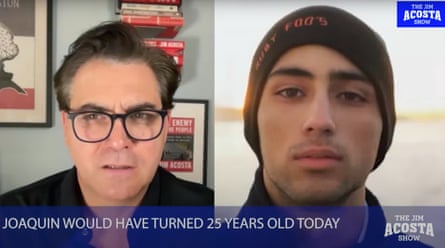
With barely anyone watching these online interviews (his last one on Thursday generated a whopping 5,700 viewers on his YouTube channel), the host decided to do the unthinkable: Interview an AI-generated avatar of a dead teenager, Joaquin Oliver, who was murdered during that horrific school shooting in Parkland, Florida, in 2018 that left 17 dead. 

“A show you don’t want to miss at 4p ET / 1p PT. I’ll be having a one of a kind interview with Joaquin Oliver. He died in the Parkland school shooting in 2018. But his parents have created an AI version of their son to deliver a powerful message on gun violence,” a shameless Acosta posted on X while turning replies off. 

It is ironic: A leading purveyor of fake news interviewing a fake person to draw attention to himself. 

“I would like to know what your solution would be for gun violence,” Acosta asked AI Joaquin at one point. 

“Great question. I believe in a mix of stronger gun control laws, mental health support, and community engagement. We need to create safe spaces for conversations and connections, making sure everyone feels seen and heard,” the avatar responded. “It’s about building a culture of kindness and understanding. What do you think about that?” 

“I think that’s a great idea, Joaquin,” Acosta responded while acting as if this were an interview with an actual person. 

It can’t be underscored enough just how sick and unethical this is. For starters, we have zero idea what Joaquin’s views were on gun control or if he had an opinion on the matter at all. In this case, the AI version was obviously pre-programmed to agree with Acosta on gun control. 

With no boss or advertisers to answer to, Acosta got away with this. But it’s hard to see how he’s not going to lose subscribers over this. And since this drew attention, thought mostly negative, Acosta will likely do something this again to satisfy his constant need for attention. 

So who’s next? AI Nicole Brown Simpson to answer questions about O.J.? 

What is so telling in 2025 is how much those who claimed to be serious, objective journalists have completely exposed themselves for who they’ve been all along: Lefty activists with a microphone. 

In the past few months alone, we’ve heard ex-ABC White House correspondent Terry Moran argue that it’s “not reporter’s job to be objective” while calling Trump’s immigration policy “a terror campaign.” 

Chuck Todd, the former moderator of NBC’s Meet The Press, said the press were mere victims of the attempted cover-up of Joe Biden’s cognitive health and bore no responsibility for taking part in the cover-up “because they were lied to.” 

Don Lemon, another ex-CNNer, argued that “no rational Black person” could support Trump (after Trump got the highest share of the Black vote in more than 50 years in 2024), while ex-MSNBCer Joy Reid has compared Trump’s immigration centers to “concentration camps” designed to round up “brown people.”

Jim Acosta interviewed a dead teenager this week. He says he has zero regrets. 


And therein lies the rub of “journalism” without the guardrails of an editor or authority. 

Because no sane person would ever greenlight such an obvious, and pathetic, publicity stunt. 

https://www.washingtonexaminer.com/in_focus/3495132/acosta-interview-murdered-teen-rock-bottom/

'Digital resurrection: fascination and fear over the rise of the deathbot'


Rod Stewart had a few surprise guests at a recent concert in Charlotte, North Carolina. His old friend Ozzy Osbourne, the lead singer of Black Sabbath who died last month, was apparently beamed in from some kind of rock heaven, where he was reunited with other departed stars including Michael Jackson, Tina Turner and Bob Marley.

The AI-generated images divided Stewart’s fans. Some denounced them as disrespectful and distasteful; others found the tribute beautiful.

At about the same time, another AI controversy erupted when Jim Acosta, a former CNN White House correspondent, interviewed a digital recreation of Joaquin Oliver, who was killed at the age of 17 in a 2018 high school shooting in Florida. The avatar of the teenager was created by his parents, who said it was a blessing to hear his voice again.

In June, Alexis Ohanian, a co-founder of Reddit, posted on X an animation of his late mother hugging him when he was a child, created from a photograph. “Damn, I wasn’t ready for how this would feel. We didn’t have a camcorder, so there’s no video of me with my mom … This is how she hugged me. I’ve rewatched it 50 times,” he wrote.
AI-generated images of Ozzy Osbourne and Tina Turner were shown at a recent Rod Stewart concert in North Carolina. Illustration: Iamsloanesteel Instagram

These are just three illustrations of a growing phenomenon of “digital resurrection” – creating images and bots of people who have died using photographs, videos, voice messages and other material. Companies offering to create “griefbots” or “deathbots” abound, and questions about exploitation, privacy and their impact on the grieving process are multiplying.
“It’s vastly more technologically possible now because of large language models such as ChatGPT being easily available to the general public and very straightforward to use,” said Elaine Kasket, a London-based cyberpsychologist.

“And these large language models enable the creation of something that feels really plausible and realistic. When someone dies, if there are enough digital remains – texts, emails, voice notes, images – it’s possible to create something that feels very recognisable.”

Only a few years ago, the idea of “virtual immortality” was futuristic, a techno-dream beyond the reach of ordinary people. Now, interactive avatars can be created relatively easily and cheaply, and demand looks set to grow.

A poll commissioned by the Christian thinktank Theos and carried out by YouGov in 2023 found that 14% of respondents agreed they would find comfort in interacting with a digital version of a loved one who had died. The younger the respondent, the more likely they were to be open to the idea of a deathbot.
Jim Acosta, a former CNN White House correspondent, ‘interviewed’ a digital recreation of Joaquin Oliver, who was killed in a 2018 high school shooting in Florida. Illustration: Youtube

The desire to preserve connections with dead loved ones is not new. In the past, bereaved people have retained precious personal items that help them feel close to the person they have lost. People pore over photos, watch videos, replay voice messages and listen to music that reminds them of the person. They often dream of the dead, or imagine they glimpse them across a room or in the street. A few even seek contact via seances.

“Human beings have been trying to relate to the dead ever since there were humans,” said Michael Cholbi, a professor of philosophy at the University of Edinburgh and the author of Grief: A Philosophical Guide. “We have created monuments and memorials, preserved locks of hair, reread letters. Now the question is: does AI have anything to add?”

Louise Richardson, of York university’s philosophy department and a co-investigator on a four-year project on grief, said bereaved people often sought to “maintain a sense of connection and closeness” with a dead loved one by visiting their grave, talking to them or touching items that belonged to them.

“Deathbots can serve the same purpose, but they can also be disruptive to the grieving process,” she said. “They can get in the way of recognising and accommodating what has been lost, because you can interact with a deathbot in an ongoing way.”

For example, people often wonder what a dead loved one might have done or said in a specific situation. “Now it feels like you are able to ask them.”

But deathbots may also provide “sanitised, rosy” representations of a person, said Cholbi. For example, someone creating a deathbot of their late granny may choose not to include her casual racism or other unappealing aspects of her personality in material fed into an AI generator.

There is also a risk of creating a dependency in the living person, said Nathan Mladin, the author of AI and the Afterlife, a Theos report published last year. “Digital necromancy is a deceptive experience. You think you’re talking to a person when you’re actually talking to a machine. Bereaved people can become dependent on a bot, rather than accepting and healing.”

The boom in digital clones of the dead began in the far east. In China, it can cost as little as 20 yuan (£2.20) to create a digital avatar of a loved one, but according to one estimate the market was worth 12bn yuan (£1.2bn) in 2022 and was expected to quadruple by 2025.

More advanced, interactive avatars that move and converse with a client can cost thousands of pounds. Fu Shou Yuan International Group, a major funeral operator, has said it is “possible for the dead to ‘come back to life’ in the virtual world”. According to the China Funeral Association, the cost is about 50,000 yuan per deceased person.

The exploitation of grief for private profit is a risk, according to Cholbi, although he pointed to a long history of mis-selling and upselling in the funeral business.

Kasket said another pitfall was privacy and rights to digital remains. “A person who’s dead has no opportunity to consent, no right of reply and no control.” The fraudulent use of digital material to create convincing avatars for financial gain was another concern, she added.

Some people have already begun stipulating in their wills that they do not want their digital material to be used after their death.

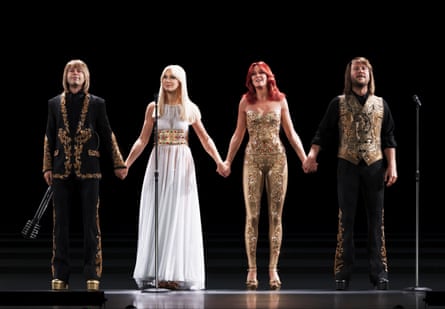
Interactive avatars are not just for the dead. Abba Voyage, a show that features digital versions of the four members of the Swedish pop group performing in their heyday, has been a runaway success, making about £1.6m each week. Audiences thrill – and sing along – to the exhilarating experience while the band’s members, now aged between 75 and 80, put their feet up at home.
Abba’s avatars, wearing Dolce & Gabbana, as seen in Abba Voyage. Illustration: Abba Voyage

More soberly, the UK’s National Holocaust Centre and Museum launched a project in 2016 to capture the voices and images of Holocaust survivors to create interactive avatars capable of answering questions about their experiences in the Nazi death camps long into the future.

According to Cholbi, there is an element of “AI hype” around deathbots. “I don’t doubt that some people are interested in this, and I think it could have some interesting therapeutic applications. It could be something that people haul out periodically – I can imagine they bring out the posthumous avatar of a deceased relative at Christmas dinner or on their birthday.

“But I doubt that people will try to sustain their relationships with the dead through this technology for very long. At some point, I think most of us reconcile ourselves with the fact of death, the fact that the person is dead.

“This isn’t to say that some people might really dive into this, but it does seem to be a case where maybe the prospects are not as promising as some of the commercial investors might hope.”

For Mladin, the deathbot industry raises profound questions for ethicists and theologians. The interest in digital resurrection may be a consequence of “traditional religious belief fading, but those deeper longings for transcendence, for life after death, for the permanence of love are redirected towards technological solutions,” he said.

“This is an expression of peak modernity, a belief that technology will conquer death and will give us life everlasting. It’s symptomatic of the kind of culture we inhabit now.”

Kasket said: “There’s no question in my mind that some people create these kinds of phenomena and utilise them in ways that they find helpful. But what I’m concerned about is the way various services selling these kinds of things are pathologising grief.

“If we lose the ability to cope with grief, or convince ourselves that we’re unable to deal with it, we are rendered truly psychologically brittle. It is not a pathology or a disease or a problem for technology to solve. Grief and loss are part of normal human experience.”

https://www.theguardian.com/news/ng-interactive/2025/aug/10/artificial-intellligence-avatar-death-grief-digital-resurrection-fascination-deathbot

'EU foreign policy big: any deal between US, Russia must include Ukraine, EU'

 European Union foreign policy chief Kaja Kallas said on Sunday that any deal between Washington and Moscow to end the war in Ukraine must include Ukraine and the EU, adding that she will convene a meeting of European foreign ministers on Monday to discuss next steps.

“The U.S. has the power to force Russia to negotiate seriously. Any deal between the U.S. and Russia must have Ukraine and the EU included, for it is a matter of Ukraine’s and the whole of Europe’s security,” Kallas said in emailed comments.

U.S. President Donald Trump plans to meet Russian President Vladimir Putin in Alaska on Friday.

Kallas said that “as we work towards a sustainable and just peace, international law is clear: all temporarily occupied territories belong to Ukraine”.

“A deal must not provide a springboard for further Russian aggression against Ukraine, the transatlantic alliance and Europe,” she added.

Kallas also said that ministers will discuss the situation in Gaza.

https://www.msn.com/en-us/news/world/kallas-says-any-deal-between-us-and-russia-must-include-ukraine-and-eu/ar-AA1KfH2C

Last Line Of Defense: USA Intervenes Against EU Digital Surveillance

 by Thomas Kolbe,

U.S. Secretary of State Marco Rubio has launched a lobbying campaign against the EU’s Digital Services Act. With this step, Americans have become the last line of defense for the free speech rights of EU citizens.

If, in the past, U.S. President Donald Trump often spoke of the European Union as “a tough nut to crack,” he couldn’t have been more accurate. Freedom-loving EU citizens know exactly what he meant. In Brussels, a bizarre mélange of control fetishism, economic dirigisme, and isolation from the outside world has developed—a combination that is no longer tolerable.

Not least, Brussels’s fight against free expression in the digital sphere has revealed the true intentions of the von der Leyen Commission: the recovery of narrative dominance and control over political dissidence—achieved by cold-bloodedly sacrificing citizens’ fundamental freedoms.

U.S. Vice President J.D. Vance already issued multiple warnings in the spring about a European censorship empire. In a speech in the U.S. Senate, he denounced European digital legislation as an attack on Western liberties. In his address at the Munich Security Conference, he went so far as to suggest cutting ties with the Europeans if they did not reverse their illiberal, dictatorial trajectory.

Criticism Bounces Off

As usual, American criticism fell on deaf ears in Brussels. Although Brussels swallowed the bitter pill of an asymmetrical trade deal with the U.S. two weeks ago, both the hidden protectionism disguised as climate regulation and harmonization standards, as well as the repressive digital laws, remain intact. This is detrimental not only to free speech among Europeans but also for American companies—undoubtedly a key target of the EU censors.

The EU’s discriminatory ambitions through the Digital Services Act (DSA) and the corresponding Digital Markets Act (DMA) primarily target U.S. communication platforms like X, Telegram, and Meta. If these platforms don’t conform to EU rules—granting access to internal communications and aiding Brussels’s surveillance efforts—they face billions in fines.

Much like Britain’s digital ID program, Brussels now masks its shamelessly invasive censorship with claims of youth protection and anti-hate measures. It’s tiresome to hear—but, as always, it’s about “their democracy,” or, to put it more accurately, a massive concrete barrier constructed to shield against the audacious citizen seeking to preserve privacy from an unbounded EU bureaucracy.

Next Round with Rubio

It seems Americans, even before EU citizens, have finally lost patience with Brussels. U.S. Secretary of State Marco Rubio is next in line to confront the EU Commission, stepping into attack mode. This week, Rubio instructed all U.S. embassies across the EU to initiate a coordinated lobbying blitz against Brussels’s censorship package surrounding the DSA.

The allegation: Under the guise of security and responsibility, the EU is deliberately suppressing free speech in digital spaces and targeting U.S.-based platforms and communication companies. Rubio has tasked his diplomats with urging governments and regulators to amend the DSA. At the same time, they are to record and report censorship incidents involving U.S. citizens and companies to ramp up pressure for reform.

This marks another daring challenge from Washington to the EU’s expansive control apparatus.
The trade war between the U.S. and the EU has now shifted fully into the digital realm. Brussels’s response to Rubio’s initiative was swift. In an official statement, the EU Commission flatly dismissed the censorship allegations: “The claims of censorship connected to the DSA are entirely baseless. Freedom of expression is a core right in the EU.” They added coldly: “Our EU regulations and standards were never up for discussion—and they will not be.” In other words, Brussels refuses to be swayed in building its digital citadel of narrative control—least of all by Washington.

Loss of Narrative Control

The U.S. attempt to protect its businesses from EU overreach draws them into a broader clash between EU citizens and Brussels’s increasingly omnipotent central authority. Brussels senses growing public pressure and feels exposed amid a deepening economic crisis.

Grand narratives—like human-caused climate change and the need for open borders to avert a demographic crisis—are eroding public consensus and exposing Brussels’s failed centralization of Europe’s economy. We are witnessing Brussels’s last desperate stand to defend its narrative monopoly against a rising opposition that is increasingly reclaiming public and media spaces.

What happens in the U.S. now matters fundamentally for EU citizens. Under President Trump’s administration, Europe-inspired climate agendas are being reversed, and funding for public media and NGOs is being rolled back.

The air is clearing—spaces open for fresh discourse and honest reckoning with recent history. Brussels’s errors in climate dirigisme and centralized planning are now apparent for all to see.
It would be unthinkable today in the U.S. for a leading figure like Ursula von der Leyen to quietly escape scandal—say, over the Pfizer-Corona controversy. That is the political maturity that Washington exemplifies and Brussels starkly lacks.

The Turning Point Is Here

This shift in public discourse owes much to initiatives like Elon Musk’s acquisition of Twitter and renewed defense of free speech on platforms like Telegram. These are spawning counter-narratives that expose Brussels’s planning failures by setting them against reality. We are emerging from Plato’s cave, seeing who cast the shadows on our walls.

Washington’s interests may be economic—but they resonate with EU citizens. Those in the EU who yearn for a return to a Brussels central authority that oversees fair competition in an open single market should feel gratitude for unexpected U.S. solidarity. It is the strongest alliance we could ask for. Brussels’s push for centralization and power armor has outrun democratic checks—and that is dangerous.

Thomas Kolbe, a German economist, has worked as a journalist and media producer for over 25 years. As a publicist, he focuses on economic processes and observes geopolitical events from the perspective of the capital markets. His publications follow a philosophy that focuses on the individual and their right to self-determination.

https://www.zerohedge.com/markets/last-line-defense-usa-intervenes-against-eu-digital-surveillance

https://www.marketscreener.com/news/chinese-state-media-says-nvidia-h20-chips-not-safe-for-china-ce7c5ed2d88cf32d