Search This Blog

Sunday, August 10, 2025

Canadians In Nova Scotia Now Banned From Using Public Forests

 Tyranny is a process of acclimation.  Governments test the public to see what they will quietly tolerate; leaders then turn "temporary" restrictions into permanent laws as people are conditioned to accept the new normal.  Sometimes the public fights back and officials are forced to retreat.  However, the tests never end and the bureaucracy continues to press year after year until it gets what it wants.

Many commentators have noticed that the Canadian government has been expediting this authoritarian process in recent years to the point that the intentions of elitist politicians can no longer be misunderstood.  The mask is fully off and the country is becoming a draconian cesspool.  From censorship laws, to gun bans, to carbon taxes and even legislation that turns Christian worship into "hate speech", Canada is almost every bit as cooked as their commonwealth cousins in Britain.  

Every few weeks it seems a new and oppressive mandate is enforced.  This month, the province of Nova Scotia has abruptly banned nearly all civilian activity in public forests.  It is illegal for Canadians to walk, hike, drive, camp (outside of official campgrounds) or fish in Nova Scotia's woods and anyone caught without a heavily regulated permit is subject to extreme fines.  Smaller parks that have woods are also restricted.  The bans will continue until October 15th unless the provincial government decides to extend.

The offices for obtaining work permits have been swamped with requests and questions and citizens have been told to stop calling.  At least one citizen, Canadian veteran Jeff Evely, has challenged the law and has been fined over $28,000 simply for walking into the forest.

Nova Scotia leaders have set up "snitch lines" that people can call to report their neighbors.  According to Premier Tim Houston, the measures address the current climate with hot and extremely dry conditions increasing the risk of starting wildfires:  

“Most wildfires are caused by human activity, so to reduce the risk, we’re keeping people out of the woods until conditions improve. I’m asking everyone to do the right thing – don’t light that campfire, stay out of the woods and protect our people and communities..."

The average high temperature in Nova Scotia in July was a mere 73°F and little has changed in August.  The province also experienced heavy rains and flash flooding last month

Keep in mind, these are public forests that the Canadian public pays exorbitant taxes to the government to maintain.  The government also enforces restrictions on forest management that cause the very wildfires they say they are trying to stop.  This includes a number of regulations against logging to thin overgrown woods and preventing the collection of fallen trees. 

As in many parts of the US, this kind of "conservation" turns public lands into tinderboxes in times of drought.  It also suggests that preventing wildfires is not the true motive behind the bans.  Critics argue that the ban is practice run for a future rollout of laws related to climate controls. 


The restrictions are reminiscent of the bans on outdoor activities during the pandemic lockdowns; bans that were enforced beyond all reason, logic or viral science.  Numerous political leaders suggested at the time that pandemic lockdowns blocking personal travel and outdoor mobility could be extended to include "climate lockdowns". 

The scenario is also similar to globalist efforts to "re-wild" western countries by removing public access from certain areas and allowing "nature to take over" without human influence.  This would, at bottom, force human beings into tighter and tighter bubbles of population that they are rarely allowed to leave. Such policies are often beta tested in smaller regions before they are expanded to include the entire nation.    

Legal challenges against the bans will be ample, but the overall intent behind the restrictions is suspicious and may be a warning sign of authoritarian laws to come in Canuckistan and across the western world.


China's unemployed young adults who are pretending to have jobs


No-one would want to work without getting a salary, or even worse – having to pay to be there.


Yet paying companies so you can pretend to work for them has become popular among young, unemployed adults in China. It has led to a growing number of such providers.

The development comes amid China's sluggish economy and jobs market. Chinese youth unemployment remains stubbornly high, at more than 14%.

With real jobs increasingly hard to come by, some young adults would rather pay to go into an office than be just stuck at home.

Shui Zhou, 30, had a food business venture that failed in 2024. In April of this year, he started to pay 30 yuan ($4.20; £3.10) per day to go into a mock-up office run by a business called Pretend To Work Company, in the city of Dongguan, 114 km (71 miles) north of Hong Kong.

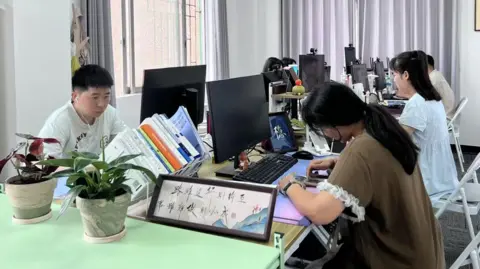
There he joins five "colleagues" who are doing the same thing.

"I feel very happy," says Mr Zhou. "It's like we're working together as a group."


Such operations are now appearing in major cities across China, including Shenzhen, Shanghai, Nanjing, Wuhan, Chengdu, and Kunming. More often they look like fully-functional offices, and are equipped with computers, internet access, meeting rooms, and tea rooms.

And rather than attendees just sitting around, they can use the computers to search for jobs, or to try to launch their own start-up businesses. Sometimes the daily fee, usually between 30 and 50 yuan, includes lunch, snacks and drinks.

Attendees can either just sit around, or use the provided computers to apply for jobs


Dr Christian Yao, a senior lecturer at Victoria University of Wellington's School of Management in New Zealand, is an expert on the Chinese economy.

"The phenomenon of pretending to work is now very common," he says. "Due to economic transformation and the mismatch between education and the job market, young people need these places to think about their next steps, or to do odd jobs as a transition.

"Pretend office companies are one of the transitional solutions."

Mr Zhou came across the Pretend To Work Company while browsing social media site Xiaohongshu. He says he felt that the office environment would improve his self-discipline. He has now been there for more than three months.

Mr Zhou sent photos of the office to his parents, and he says they feel much more at ease about his lack of employment.

While attendees can arrive and leave whenever they want, Mr Zhou usually gets to the office between 8am and 9am. Sometimes he doesn't leave until 11pm, only departing after the manager of the business has left.

He adds that the other people there are now like friends. He says that when someone is busy, such as job hunting, they work hard, but when they have free time they chat, joke about, and play games. And they often have dinner together after work.

Mr Zhou says that he likes this team building, and that he is much happier than before he joined.


In Shanghai, Xiaowen Tang rented a workstation at a pretend work company in Shanghai for a month earlier this year. The 23-year-old graduated from university last year and hasn't found a full-time job yet.

Her university has an unwritten rule that students must sign an employment contract or provide proof of internship within one year of graduation; otherwise, they won't receive a diploma.

She sent the office scene to the school as proof of her internship. In reality, she paid the daily fee, and sat in the office writing online novels to earn some pocket money.

"If you're going to fake it, just fake it to the end," says Ms Tang.


Dr Biao Xiang, director of the Max Planck Institute for Social Anthropology in Germany, says that China's pretending to work trend comes from a "sense of frustration and powerlessness" regarding a lack of job opportunities.

"Pretending to work is a shell that young people find for themselves, creating a slight distance from mainstream society and giving themselves a little space."

The owner of the Pretend To Work Company in the city of Dongguan is 30-year-old Feiyu (a pseudonym). "What I'm selling isn't a workstation, but the dignity of not being a useless person," he says.

He himself has been unemployed in the past, after a previous retail business that he owned had to close during the Covid pandemic. "I was very depressed and a bit self-destructive," he recalls. "You wanted to turn the tide, but you were powerless."

In April of this year he started to advertise Pretend To Work, and within a month all the workstations were full. Would-be new joiners have to apply.

Feiyu say that 40% of customers are recent university graduates who come to take photos to prove their internship experience to their former tutors. While a small number of them come to help deal with pressure from their parents.

The other 60% are freelancers, many of whom are digital nomads, including those working for big ecommerce firms, and cyberspace writers. The average age is around 30, with the youngest being 25.

Feiyu, the owner of Pretend to Work Company says he is selling people "dignity"


Officially, these workers are referred to as "flexible employment professionals", a grouping that also includes ride-hailing and trucker drivers.

Over the longer term Feiyu says it is questionable whether the business will remain profitable. Instead he likes to view it more as a social experiment.

"It uses lies to maintain respectability, but it allows some people to find the truth," he says. "If we only help users prolong their acting skills we are complicit in a gentle deception.

"Only by helping them transform their fake workplace into a real starting point can this social experiment truly live up to its promise."

Mr Zhou is now spending most of his time improving his AI skills. He says he's noticed that some companies are specifying proficiency in AI tools when recruiting. So he thinks gaining such AI skills "will make it easier" for him to find a full-time job.

https://www.bbc.com/news/articles/cdd3ep76g3go

'Chinese Flu Shot Maker Soars in Hong Kong Trading Debut'


Ab&B Bio-Tech soared as much as 169% in its trading debut in Hong Kong, after retail investors flocked to the Chinese vaccine maker’s initial public offering.

The stock climbed to as high as HK$34.64 ($4.41) per share on Monday morning, more than double its HK$12.90 IPO price, which was set at the low end of the marketed range.

https://www.bloomberg.com/news/articles/2025-08-11/chinese-flu-shot-maker-soars-in-hong-kong-trading-debut

Judge Blocks Beto's Shady Fundraising For 'Runaway' Dems

 by Luis Cornelio via Headline USA,

A Texas judge has temporarily blocked Beto O’Rourke’s shady fundraising campaign to bankroll “runaway Democrats”—the group of state legislators who fled Texas to stall redistricting efforts.

On Friday, Tarrant County District Judge Megan Fahey issued a temporary injunction against O’Rourke and his group, Powered by People, barring them from raising funds or covering expenses for the Democrats while a lawsuit from Texas Attorney General Ken Paxton moves forward.

The order came just hours after Paxton sued O’Rourke and Powered by People, accusing them of misleading donors by falsely advertising the campaign as a political effort rather than a slush fund for personal expenses.

In her ruling, Fahey said the court found “imminent harm” that could cause the state to be irreparably injured, meeting the threshold for such an order.

“Because this conduct is unlawful and harms Texas consumers, restraining this conduct is in the public interest,” Fahey said.

Paxton celebrated the ruling in a statement, declaring:

“The Beto Bribe buyouts that were bankrolling the runaway Democrats have been officially stopped.”

He added, “People like Robert believe Texas can be bought. Today, I stopped his deceptive financial influence scheme that attempted to deceive donors and subvert our constitutional process. They told me to ‘come and take it,’ so I did.”

The next hearing is set for Aug. 19, 2025.

https://www.zerohedge.com/political/judge-blocks-betos-shady-fundraising-runaway-dems

Orchestra BioMed scores $111M, backed by Medtronic, Ligand

 Orchestra BioMed reported that it has secured over $111 million in financing through a series of transactions and offerings—supported by deals with Medtronic and Ligand Pharmaceuticals—as it looks to complete late-stage clinical studies.

That includes $40 million from a public offering announced last week, plus about $16 million in private placements of common stock to Medtronic and Ligand. 

Medtronic also committed to deliver another $20 million by next May, in exchange for a promissory note that would convert to a prepaid revenue share—upon the FDA’s approval of Orchestra’s bioelectronic, pacemaker-like BackBeat therapy for lowering high blood pressure.

The proceeds are slated to fund the full enrollment of a global pivotal trial of BackBeat’s atrioventricular interval modulation approach, or AVIM, as well as support the study’s follow-up measures to evaluate its primary endpoints.

The BackBeat neuromodulation therapy, designed to integrate with existing cardiac rhythm implants, previously demonstrated a 10.3 mmHg reduction in 24-hour systolic blood pressure after six months, in a study of 14 patients. 

Medtronic previously picked up an exclusive license and collaboration agreement with Orchestra for the development and commercialization of BackBeat. The companies said the collaboration has now been expanded to provide a path for developing AVIM-capable leadless pacemakers as well.

Ligand, meanwhile, committed $35 million in return for a tiered revenue interest in future royalties, tied to Orchestra’s BackBeat as well as its Virtue sirolimus-equipped balloon—with the latter program aiming to finish enrolling participants in a trial for treating in-stent restenosis of the coronary arteries. 

Orchestra has been developing the Virtue angioplasty therapy—which delivers a precise dose through micropores in the balloon, as opposed to an outer drug coating—with Terumo Corporation, via a partnership launched in 2019.

“We are very proud to have secured significant long-term capital from strategic transactions with Medtronic and Ligand and the completion of our first underwritten public equity offering,” Orchestra CEO David Hochman said in a statement

“With Ligand, an established royalty investor, joining us as a strategic capital partner and Medtronic, the global market leader in cardiac rhythm management, expanding their commitment to our existing collaboration, this new capital strongly positions us to advance our core technologies, AVIM therapy and Virtue SAB, toward fundamental clinical and regulatory milestones that have the potential to create significant value for all stakeholders,” Hochman added.

https://www.fiercebiotech.com/medtech/orchestra-biomed-scores-111m-backed-medtronic-ligand

Elizabeth Holmes billboards cropping up around the country

  Elizabeth Holmes may currently be incarcerated at a Texas prison camp, but supersized images of the disgraced Theranos founder have appeared in California, Florida and New York City’s Times Square.

There’s one man behind the attention-catching billboards: Ryan “Egypt” El-Hosseiny, a Miami-based entrepreneur who claims he has recreated Holmes’ blood-testing technology.

Holmes was convicted in 2022 for defrauding investors with false claims of what her California-based startup, Theranos, could accomplish. Her technology, which she said could detect diseases and conditions from a few drops of blood, never worked.

El-Hosseiny is trying his best to brand the Holmes muse as “innocent,” one billboard at a time.

A self-described “accomplished filmmaker,” El-Hosseiny is working on “Just Blood,” a potential documentary that would reframe Holmes and her doomed startup, according to the Hollywood Reporter.

He’s also branded himself and Holmes as “the inventors” on some of the signs, and claims to have relaunched Theranos this year.

He told media in Florida that the billboards are part of his mission to “free Elizabeth Holmes ” and “take on Big Pharma.”

“I am not a sock puppet in the healthcare space,” El-Hosseiny wrote in a statement to the Miami New Times. “I am an innovator, an inventor, and put quality products before profits. No one did their homework on Theranos. I did, and I’m here today.”

In Februrary, Holmes attempted to have her fraud conviction overturned, but a federal appeals court countered she hadn’t proved there were legal missteps during her trial.

https://www.yahoo.com/news/articles/elizabeth-holmes-billboards-cropping-around-143036099.html

Canadian Steel CEO Warns: U.S. Tariffs Could Lock Us Out Completely

 Canadian steelmakers may need to overhaul their operations as steep U.S. tariffs threaten to block access to their largest export market, says Algoma Steel Inc. chief executive Michael Garcia. He made the comments to Financial Post last week. 

“We’ll have little to no business in the U.S. if the 50 per cent tariff continues,” Garcia told the Financial Post’s Larysa Harapyn. “Once the full effect of (the tariffs) plays out, it will effectively lock out Algoma and frankly other Canadian steel producers from the U.S. market.”

Algoma, based in Sault Ste. Marie, Ont., is Canada’s only plate steel producer. While it still has contractual obligations in the United States, Garcia said those will wind down within the year if the tariff remains. “There really are no practical foreign markets for Canadian steel other than the U.S. market,” he said.

The company has asked Ottawa for a $500-million enterprise tariff loan facility, not due to immediate liquidity concerns, but to safeguard operations as it adjusts to the loss of U.S. sales and navigates an uncertain Canadian market.

Financial Post writes that if U.S. access remains blocked, Garcia said producers will have to pivot to the domestic market, which in recent years has been supplied about two-thirds by foreign steel. “Much of that steel is unfairly traded and dumped into the Canadian market,” he said. “That’s accelerated now that the U.S. has 50 per cent tariffs on all foreign steel coming into the U.S.”

Algoma sees potential in infrastructure and defense projects under Prime Minister Mark Carney’s nation-building agenda, but Garcia noted that significant demand from those projects has yet to materialize. “Our challenge is to bridge the company into the future,” he said. “Make sure we’re making the right type of products, that are demanded by Canadian customers, and be there when that demand appears.”

Meeting domestic needs would require investment and time, Garcia said, with steelmakers shifting away from coil production and toward products such as plates for shipbuilding, energy, and defense. “There has to be an environment where Canadian steelmakers are making the … type of steel that is consumed in Canada and have a free-trade environment to win that business.”

Algoma has already signed agreements with shipbuilders, including B.C.-based Seaspan, and is positioning itself to supply marine plates if domestic shipbuilding expands. Garcia said the company has a history in the sector and is ready to rejoin the supply chain if projects are awarded and dormant shipyards return to activity.

https://www.zerohedge.com/markets/canadian-steel-ceo-warns-us-tariffs-could-lock-us-out-completely