I have long opposed wealth taxes based on both constitutional and practical grounds.
When Elizabeth Warren pushed her own wealth tax, I noted that the high starting income or wealth levels would likely be lowered with time if Congress were ever allowed to cross this constitutional Rubicon.
The Massachusetts Teachers Association (MTA) is now demanding an amendment to the state constitution to tax the “wealth of the richest 1%” to pay for free public college.
Previously, the state passed a constitutional amendment to place a 4 % tax on income above $1 million. This would add a new wealth tax to that earlier “Fair Share Amendment.”
In a press release, the teachers union president Max Page declared:
“if we are serious about social and economic justice and nurturing a culturally rich and welcoming state of involved citizens, we will provide all residents with the best vehicle for a prosperous future – public education.”
New York City socialist mayoral candidate Zohran Mamdani has made a similar proposal that, in addition to taxing corporations, he will “tax the wealthiest 1% of New Yorkers—those earning above $1 million annually—a flat 2% tax.”
Not surprisingly, Warren recently declared Mamdani the future of the Democratic Party.
During President Donald Trump's wide-raning news conference held at the White House on Monday, he was asked about the much anticipated Alaska summit with Russian President Vladimir Putin, which is of course stirring much controversy given European fears that he'll do a deal which sidelines Ukraine's interests.
"This is a war that should never have happened," Trump began in this section of the presser. "This is a war that wouldn't have happened if I were president, it would never have happened." These statements are nothing new, but what followed is a first.
Trump then interestingly for the first time used language about the Friday planned summit which appears aimed at greatly tempering expectations. This is after several rounds of US-backed Russia-Ukraine peace talks in Istanbul failed to produce any breakthroughs.
Trump described the talks with Putin as merely a "feel-out meeting" and said that Putin "wants to get involved". He then voiced his belief that Putin wants to get the war "over with".
"I've said that a few times and I've been disappointed because I'd have a great call with him and then missiles would be lobbed into Kyiv or some other place," Trump stated.
He futher pledged that he'll tell Putin "you've got to end this war, you've got to end it". And he sought to once again reassure European leaders -"who I get along with very well" - saying they will be the first phone call after the talks are over.
As for whether a final deal could be achieved in Alaska, Trump emphasized that "it's not up to me". Again choosing language which seeks to manage expectations, Trump casually said: "I got a call to say they'd like to meet, and I'm going to see what they want to meet about."
"I'd like to see a ceasefire, I'd like to see the best deal that could be made for both parties, it takes two to tango," he added, which could be interpreted as a jab toward Ukraine.
Trump at one point in his comments mistakenly said: "We're going to Russia. That's going to be a big deal." He perhaps has a future trip to Russia in mind, as a return gesture for Putin coming to American soil to talk.
But then near the end of the remarks he offered a corrective, saying "I thought it was very respectful that the president of Russia is coming to our country, as opposed to us going to his country, or even a third, third party place."
Such warm words said of Putin will likely make Zelensky nervous, hearkening back to the opening months of Trump taking office, when Trump's relations with Zelensky hit a low-point, and criticisms aimed at Kiev came weekly. Some analysts have already pointed out that these Monday statements from Trump don't bode well for Ukraine and a favorable settlement on its terms.
Meanwhile, Zelensky in fresh statements has highlighted Russia has only stepped-up aerial attacks on Ukraine of late. He talled that in just the past week, Russia sent more than 1,000 air bombs, nearly 1,400 drones and several missile strikes on Ukraine. But Ukraine has also been hitting Russian oil refineries on a weekly basis at this point, as both sides continue to target energy infrastructure.
Ukraine's position has been to accuse Russia of simply trying to buy time, and that it's not actually interested in negotiating peace. The fact that Trump is even meeting with Putin is being felt as a huge slap in the face in Kiev.
The last decade has seen a 578 percent rise in deaths due to nitrous oxide poisoning, a new research letter shows, revealing a sharp rise in U.S. fatalities linked to the gas—often called “laughing gas”—over the past 13 years.
The colorless, odorless gas is used recreationally as a euphoric and hallucinogenic drug.
The same drug used as anesthesia in dentists’ offices is now easily purchased by teenagers at corner stores and inhaled for a quick high—and it’s proving increasingly deadly.
“On the streets, the slang term for nitrous oxide is ‘whippits,’” Brian Townsend, a retired supervisory special agent with the U.S. Drug Enforcement Administration and not involved in the study, told The Epoch Times. “The gas comes from canisters, typically released into balloons before the user inhales it. This gives them a brief euphoric feeling or ‘high.’”
Fatalities have climbed from 23 in 2010 to 156 in 2023, with researchers linking the increase to the spread of whippits among American youth.
A Steep Increase
In the letter, recently published in JAMA, researchers examined death records from 2010 to 2023 using data from the Centers for Disease Control and Prevention’s Wide-Ranging Online Data for Epidemiologic Research database. The study focused on fatalities among Americans ages 15 to 74, where nitrous oxide poisoning was identified as the cause of death.
They found a mortality rate of 0.01 per 100,000 population in 2010, which climbed to 0.0622 per 100,000 by 2023.
While deaths showed a consistent upward trend, researchers noted a particularly sharp increase after 2016, when fatalities jumped from 120 to 149.
“At that continued rate, we could be looking at a much larger problem,” Andrew Yockey, University of Mississippi assistant professor of public health and author of the research letter, stated in a press release.
“We have evidence that nitrous oxide poisoning is a very real danger, but this is very often ignored or trivialized,” said letter co-author Rachel Hoopsick, assistant professor of health and kinesiology at the University of Illinois. “Sellers of nitrous oxide rarely, if ever, provide health warnings. I think the public sees it as a party drug.”
The findings also highlight a growing public health concern related to the misuse of nitrous oxide, with researchers emphasizing the importance of increased awareness and prevention strategies to reduce these preventable deaths—especially as recreational use appears to be rising.
Researchers also noted that young people were the most common users of nitrous oxide, with eighth graders making up a large portion of those misusing inhalants.
Earlier this year, the U.S. Food and Drug Administration issued an advisory warning consumers not to inhale nitrous oxide products, which are not federally controlled, due to the potential for severe adverse health events if used recreationally.
Flying Under the Radar
Nitrous oxide is readily sold in canisters from smoke shops.
Researchers and addiction specialists point to concerning marketing practices that may target young people. Nitrous oxide products come in flavored varieties with names like bubblegum and mango. “There is no age limit, and this is available online and in gas stations across the country,” Yockey stated in another press release.
Townsend said homeless people with substance use disorders often use nitrous oxide because it’s inexpensive and easy to get.
Nitrous oxide is one of those substances that “flies under the radar” because it seems harmless, said Dr. Raj Dasgupta, quadruple-board certified in pulmonary, sleep, internal, and critical care medicine and chief medical advisor for Sleepopolis.
“This study highlights a problem that’s quietly gotten worse over the years,” Dasgupta said.
Serious Health Risks
Recreational use can deprive the brain of oxygen, leading to short-term effects like dizziness or unconsciousness and long-term issues like nerve damage or even paralysis. “There’s also a serious risk of addiction and mental health decline when use becomes habitual,” said Sarah Grado, chief programs officer at notMYkid, a nonprofit dedicated to helping youth overcome addiction challenges.
It is unclear how nitrous oxide causes side effects, but inhaling large amounts of it can cause asphyxiation, and heavy use can cause vitamin B12 deficiency over time, which can cause nervous system issues like lasting nerve damage or difficulty walking.
Inhaling large amounts of the gas in a short period can cause nitrous oxide poisoning, Grado said.
Symptoms of nitrous oxide overdose include seizures, psychosis, rapid heartbeat, and tightness in the chest.
Prolonged inhalation of nitrous oxide recreationally can also lead to weakness in the limbs, problems with bowel and bladder control, and psychiatric problems such as dissociation, delusions, hallucinations, paranoia, and depression.
Recreational nitrous oxide is unregulated and used without medical supervision, said Jessica Tate, chief clinical officer at Milton Recovery Center. In medical settings, the drug is mixed with oxygen, but recreational users often inhale it in its pure form, making it far more potent and dangerous.
Social media exposure showing people using nitrous oxide is also driving increased use, according to Michele Bowers, clinical director and therapist at Sophros Recovery.
“Think back to big tobacco; they deliberately targeted young people with cartoons, fun flavors, and flashy colors,” Hoopsick said. “That is a parallel we’re seeing now with nitrous oxide.”
Bowers noted that many health care providers lack sufficient training to recognize nitrous oxide abuse and often do not screen for it.
Kindly MD (NASDAQ:NAKA) reported its Q2 2025 financial results while preparing for a transformative merger with Nakamoto Holdings. The company received $9.2 million from warrant exercises and made its first Bitcoin purchase of 21 BTC valued at $2.25 million.
The merger, expected to close around August 11, 2025, has secured approximately $761.5 million in financing through PIPE investments ($561.5M) and convertible notes ($200M). However, Q2 revenues decreased by 36.1% to $408,527, while net loss widened to $2.41 million. Insurance reimbursements showed strong growth of 153.1% to $231,726.
The company ended Q2 with $6.02 million in cash, representing a 165% increase from December 2024.
Shares of Owens & Minor (NYSE:OMI) fell on Monday after the company's 2025 outlook failed to meet analysts' expectation, while also missing Q2 earnings estimates.
The company said it expects its full year adjusted profit in the range between $1.02 per share and $1.07 per share, below the consensus of $1.64 per share. It also sees revenue in the range between $2.76B and $2.82B.
The shares of the company have tanked 27% so far. YTD, the stock is down about 58%.
Owens & Minor also reported second quarter adjusted earnings of $0.26 per share, missing street estimate by $0.02 per share. Its quarterly revenue rose 3.3% to $681.9M.
"We are in the final stages of our robust process for the divestiture of the Products & Healthcare Services segment, and, as a result, have classified this segment as discontinued operations," CEO Ed Pesicka mentioned.
Puma Biotechnology Inc (NASDAQ:PBYI) presented its Q2 2025 earnings call on August 7, highlighting the commercial performance of its flagship product NERLYNX, which targets the HER2 positive early-stage breast cancer market. The company has established a comprehensive distribution network in the United States while continuing to expand globally through strategic partnerships.
The presentation comes as Puma (OTC:PMMAF) reported better-than-expected quarterly results, with earnings per share of $0.15 significantly outperforming the forecasted $0.09. Following the announcement, Puma’s stock rose 1.23% in after-hours trading to $3.29, reflecting positive investor sentiment despite the stock trading well below its 52-week high of $4.06.
Quarterly Performance Highlights
Puma Biotechnology reported substantial growth in NERLYNX revenue for Q2 2025, demonstrating strong momentum in both year-over-year and sequential performance. The company’s distribution network, which includes major specialty pharmacies and distributors, has effectively facilitated product delivery to various sites of care.
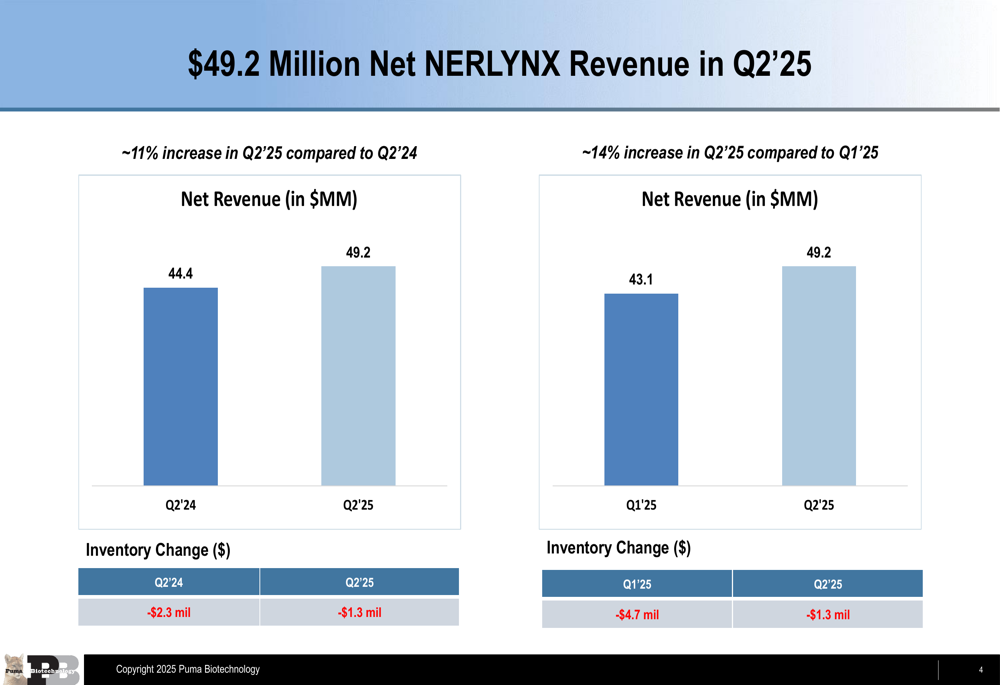
As shown in the following chart of quarterly revenue performance:
Net NERLYNX revenue reached $49.2 million in Q2 2025, representing an 11% increase compared to $44.4 million in Q2 2024 and a more substantial 14% increase from $43.1 million in Q1 2025. The company noted inventory changes of -$1.3 million in Q2 2025, an improvement from the -$4.7 million reported in the previous quarter.
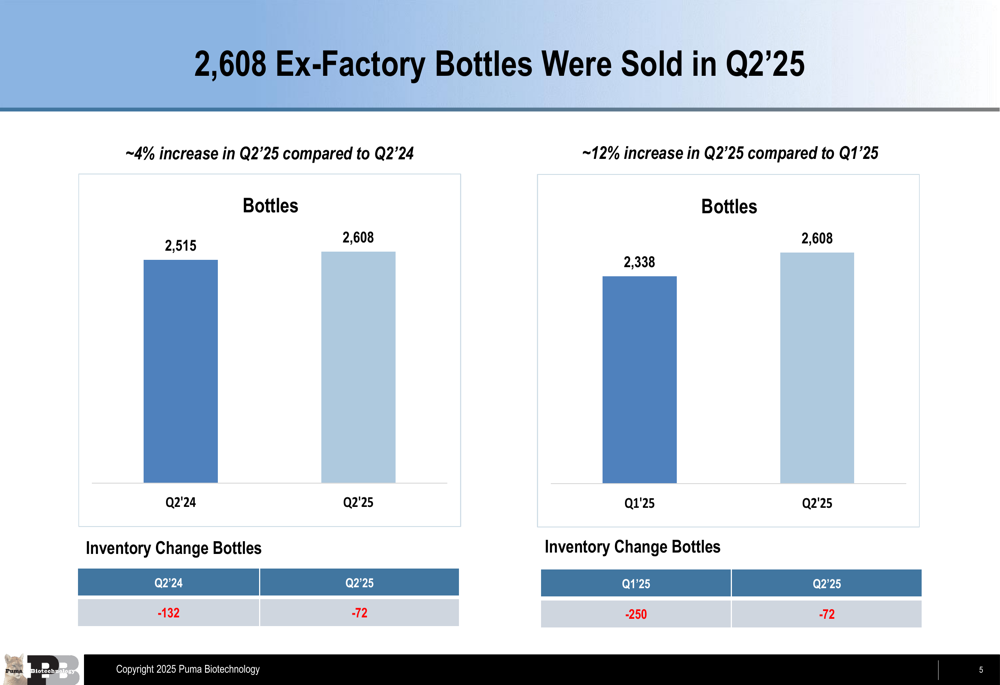
This revenue growth was supported by increased product volume, as illustrated in the bottle sales data:
The company sold 2,608 ex-factory bottles in Q2 2025, showing a 4% year-over-year increase from 2,515 bottles in Q2 2024 and a more significant 12% sequential increase from 2,338 bottles in Q1 2025. The inventory change in bottles was -72 in Q2 2025, considerably better than the -250 reported in Q1 2025.
Detailed Financial Analysis
While the presentation focused primarily on NERLYNX product revenue of $49.2 million, Puma’s total revenue for the quarter reached $52.4 million, exceeding analyst expectations of $50.75 million. This additional revenue likely came from royalties and licensing agreements related to the company’s global partnerships.
The company reported GAAP net income of $5.9 million ($0.12 per share) and non-GAAP net income of $7.5 million ($0.15 per share) for the quarter. Puma maintains a strong cash position of $96 million as of June 30, 2025, providing financial flexibility for ongoing operations and potential strategic initiatives.
According to available data, Puma continues to demonstrate strong profitability with a 72.4% gross margin, reflecting efficient operations in the competitive biotech sector. The company’s P/E ratio of 4.21 suggests the stock may be undervalued relative to earnings potential.
Strategic Initiatives
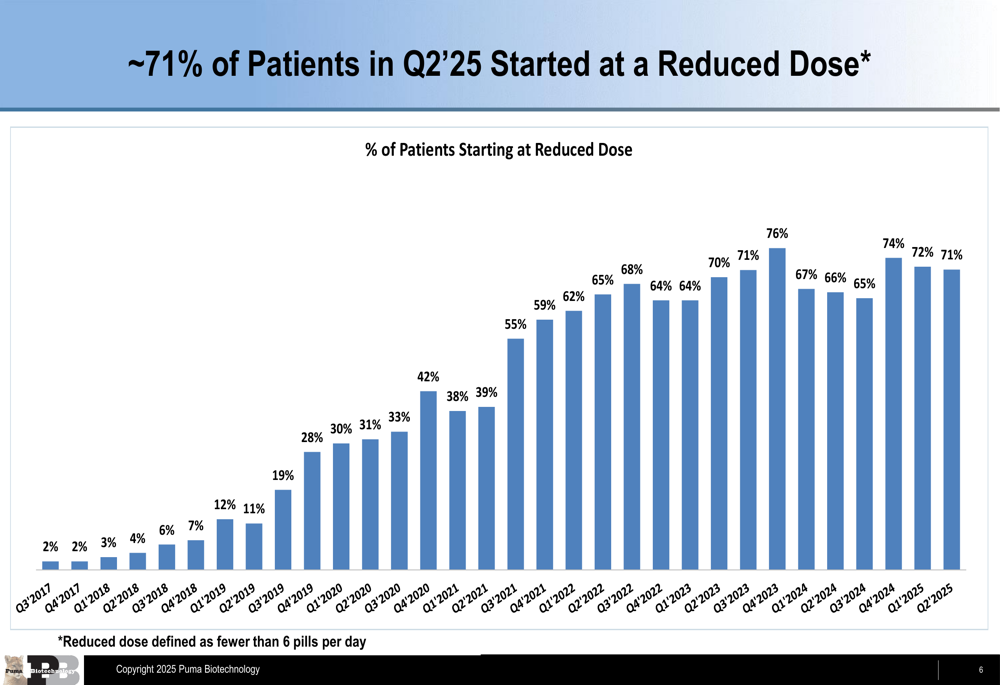
A key element of Puma’s strategy involves optimizing the dosing regimen for NERLYNX to improve patient tolerability. The presentation highlighted the company’s approach to reduced dosing:
Approximately 71% of patients in Q2 2025 started NERLYNX at a reduced dose (defined as fewer than 6 pills per day), compared to 72% in Q1 2025. This represents a significant shift from earlier periods, as the graph shows a substantial increase in reduced-dose starts since 2017, when only a small percentage of patients began treatment at lower doses. This strategy likely aims to improve treatment adherence by managing side effects.
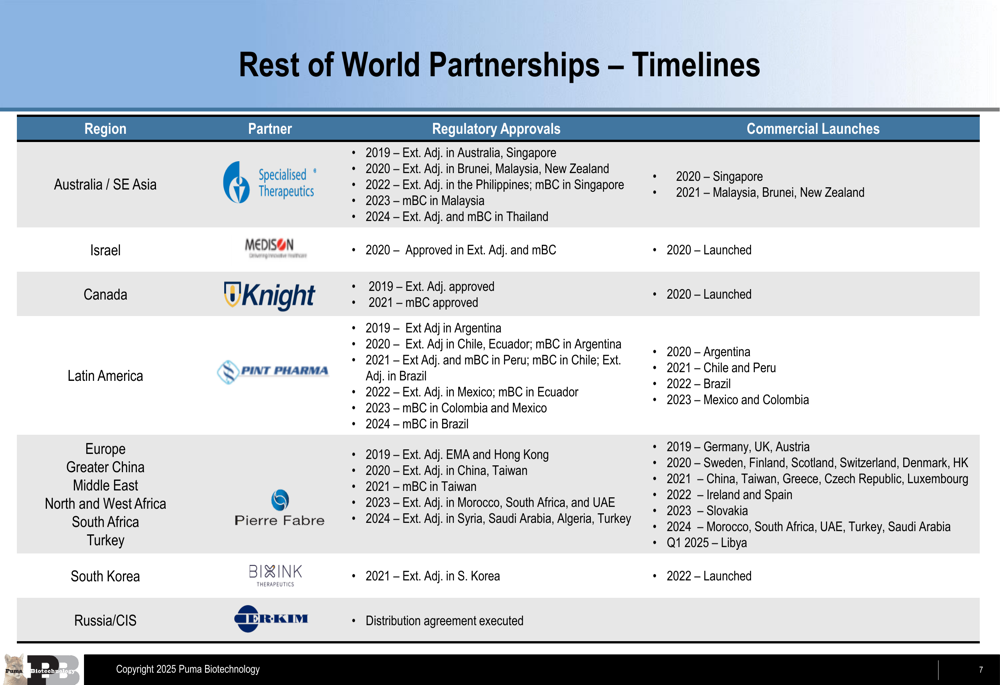
Puma’s global expansion efforts were also prominently featured in the presentation, detailing the company’s partnerships across multiple regions:
The company has established partnerships covering Australia/Southeast Asia, Israel, Canada, Latin America, Europe, Greater China, Middle East, North and West Africa, South Africa, Turkey, South Korea, and Russia/CIS. These relationships have resulted in regulatory approvals and commercial launches in numerous markets, creating additional revenue streams through royalties and licensing agreements.
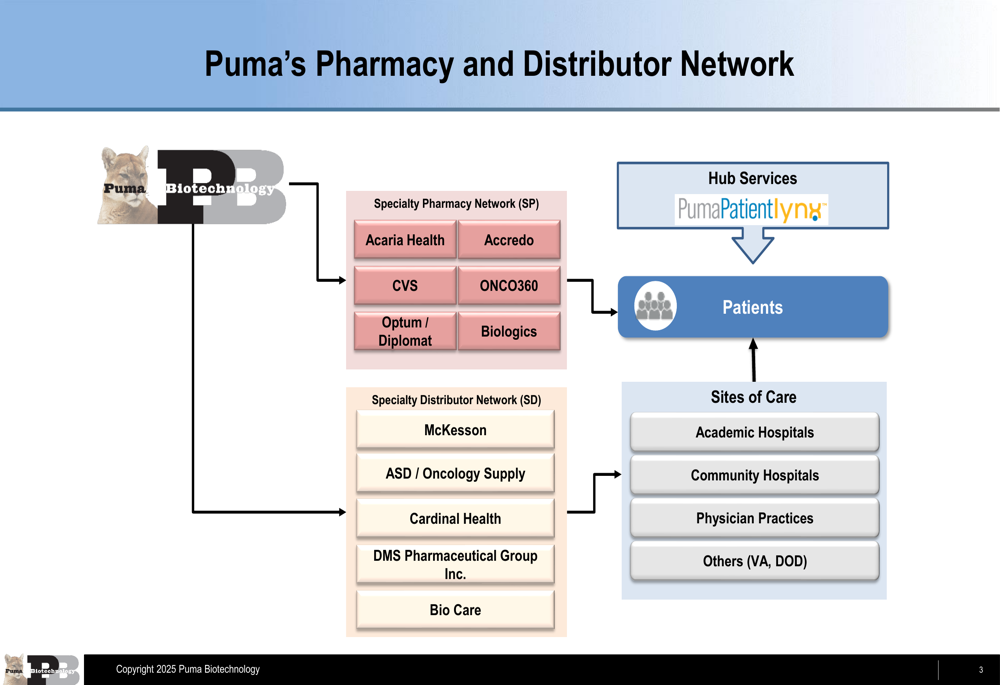
Puma’s distribution network in the United States provides a solid foundation for domestic sales:
The network includes major specialty pharmacies such as Acaria Health, Accredo, CVS, ONCO360, Optum/Diplomat, and Biologics, as well as specialty distributors including McKesson (NYSE:MCK), ASD/Oncology Supply, Cardinal Health (NYSE:CAH), DMS Pharmaceutical Group Inc., and Bio Care. This comprehensive network ensures NERLYNX reaches patients across various sites of care, including academic hospitals, community hospitals, and physician practices.
Forward-Looking Statements
Puma Biotechnology maintains its full-year 2025 NERLYNX product revenue guidance at $192-$198 million, suggesting continued confidence in the product’s performance. For Q3 2025, the company anticipates NERLYNX product revenue between $46 million and $48 million and royalty revenues of $2 million to $3 million.
CEO Ellen Auerbach expressed satisfaction with the quarter’s results, noting "demand-driven growth in NERLYNX sales in 2025" while emphasizing the company’s "fiscal responsibility to the shareholders." She also highlighted the "significant unmet medical need for patients battling breast cancer," positioning NERLYNX as an important treatment option.
Despite the positive outlook, Puma faces potential challenges including competition in the HER2 positive breast cancer market, regulatory hurdles, economic pressures affecting healthcare spending, and potential supply chain disruptions. The company’s ability to navigate these challenges while continuing to expand globally will be crucial for sustaining growth momentum in coming quarters.
U.S. President Donald Trump has signed an executive order extending the China tariff deadline for another 90 days, CNBC reported on Monday, citing a White House official.