Belite Bio (NASDAQ:BLTE) reported increased expenses and widening losses in its Q2 2025 financial results presentation on August 11, while highlighting progress in its late-stage clinical trials for retinal diseases. The ophthalmology-focused biotech maintains a strong cash position despite accelerating spending on research and development.
Quarterly Performance Highlights
Belite Bio’s financial results for the second quarter of 2025 showed significant increases in both research and development (R&D) and general and administrative (G&A) expenses. Total operating expenses jumped to $17.6 million, up from $10.5 million in the same period last year, representing a 68% increase.
R&D expenses rose to $11 million from $9.1 million in Q2 2024, reflecting the company’s continued investment in its clinical programs. More notably, G&A expenses surged to $6.5 million, compared to just $1.4 million in the prior year period, marking a substantial 370% increase.
As shown in the following financial results table:
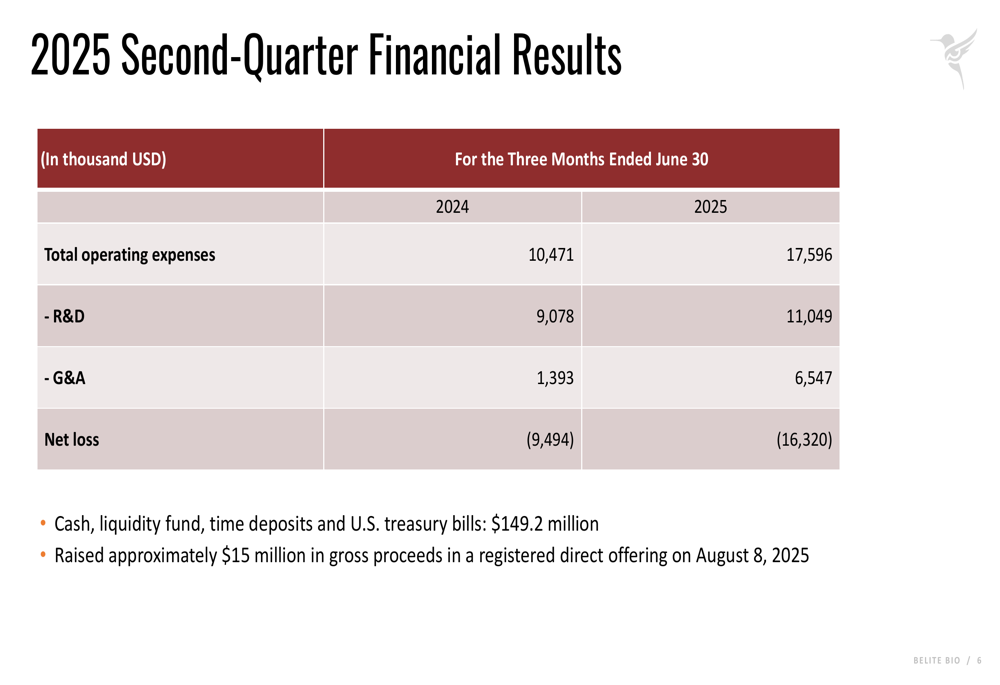
The company reported a net loss of $16.3 million for Q2 2025, compared to $9.5 million in the same quarter of 2024, representing a 72% increase in losses. Despite beating analyst expectations with an earnings per share of -$0.31 versus the forecasted -$0.39, the stock closed slightly lower at $69.88, down 0.54%.
Pipeline Progress and Strategic Initiatives
Belite Bio’s presentation highlighted its clinical development programs targeting Stargardt Disease (STGD1) and Geographic Atrophy (GA), both representing significant unmet medical needs in ophthalmology.
The company’s lead product candidate, Tinlarebant, is a novel once-daily oral tablet designed to reduce retinol delivery and slow or halt the formation of toxic retinol-derived by-products in both STGD1 and GA. Belite emphasized that there are currently no FDA-approved treatments for STGD1 or orally administered treatments for GA, positioning the company to potentially capture these untapped markets.
The pipeline overview demonstrates the company’s progress across multiple clinical trials:
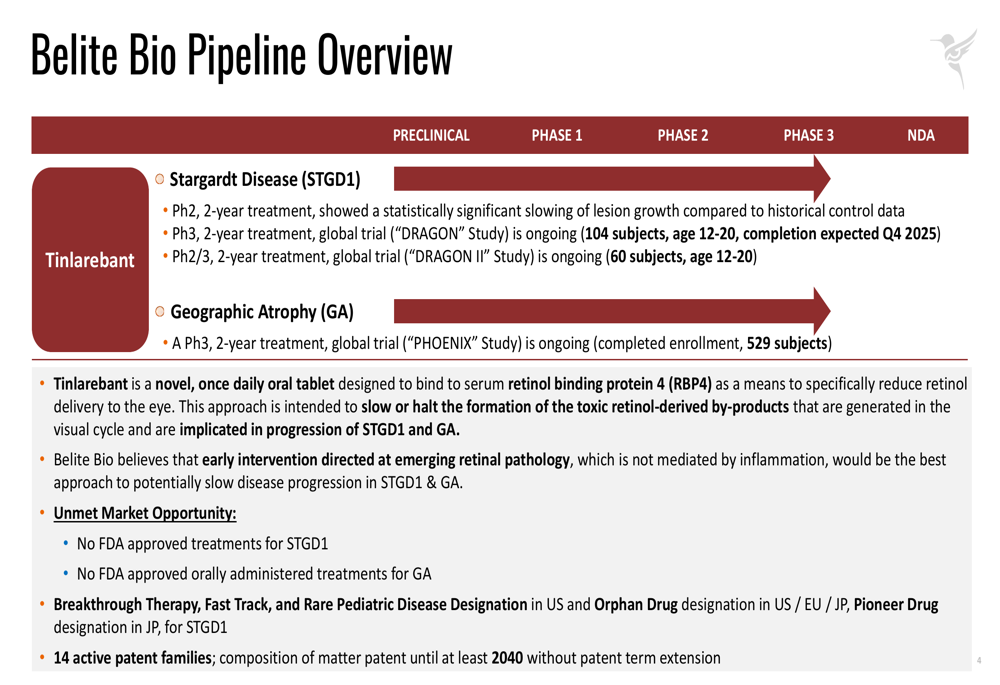
For Stargardt Disease, the company’s Phase 3 "DRAGON" study is ongoing with 104 subjects aged 12-20, with completion expected in Q4 2025. A parallel Phase 2/3 "DRAGON II" study is also underway with 60 subjects in the same age range.
In Geographic Atrophy, Belite has completed enrollment for its Phase 3 "PHOENIX" study with 529 subjects, representing a significant milestone in advancing this program.
Financial Position and Outlook
Despite increased spending, Belite Bio maintains a strong financial position with $149.2 million in cash, liquidity funds, time deposits, and U.S. treasury bills as of June 30, 2025. The company further strengthened its balance sheet with approximately $15 million raised in a registered direct offering on August 8, 2025.
According to the earnings call transcript, CFO Hao Yun Chuang emphasized the company’s financial stability, noting they have "four years of cash runway." The company forecasts a cash burn of $40-45 million over the next two years, suggesting careful management of resources while advancing its clinical programs.
Belite Bio is preparing for a New Drug Application (NDA) submission in the first half of 2026, with potential commercialization following regulatory approval.
Executive Commentary
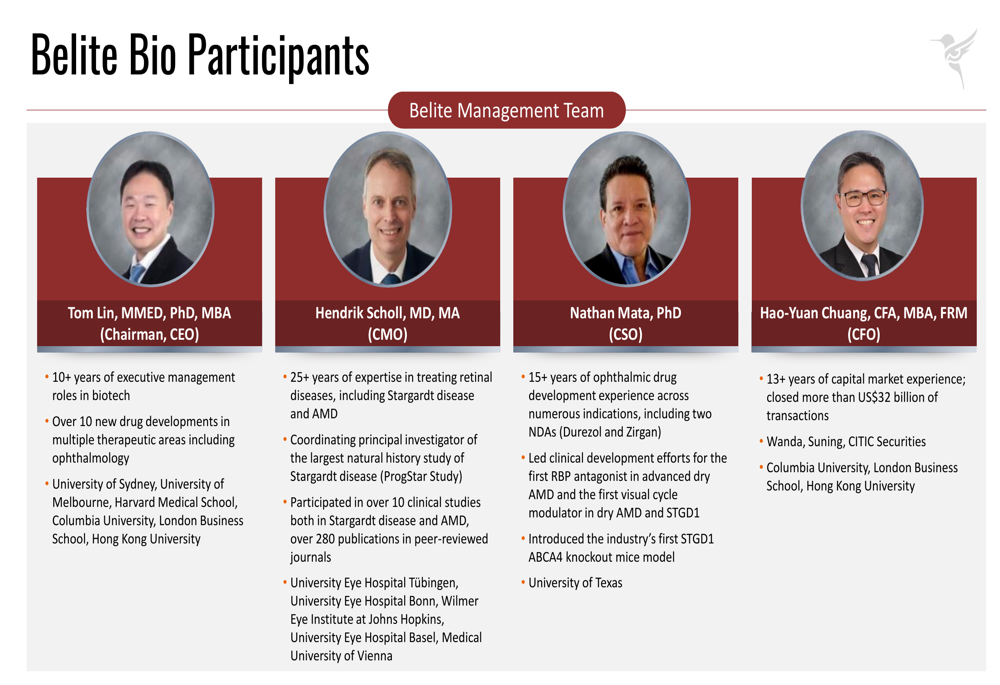
The presentation featured Belite Bio’s management team, which brings extensive experience in ophthalmology drug development and commercialization:
During the earnings call, CEO Dr. Tom Lin highlighted the company’s strategic positioning, stating, "We are uniquely positioned to address these unmet needs," referring to the lack of approved treatments for Stargardt Disease and orally administered therapies for Geographic Atrophy.
The company’s scientific leadership is particularly notable, with Chief Scientific Officer Dr. Nathan Mata bringing 15+ years of ophthalmic drug development experience, including introducing the industry’s first STGD1 ABCA4 knockout mice model, which has been instrumental in the company’s research efforts.
Chief Medical Officer Dr. Hendrik Scholl contributes over 25 years of expertise in treating retinal diseases, having participated in over 10 clinical studies with more than 280 publications to his name.