Search This Blog

Tuesday, August 12, 2025

Adam Schiff OKd intel leaks to smear Trump, thought he’d be CIA chief if Hillary won: whistleblower

 Sen. Adam Schiff (D-Calif.), then the top Democrat on the House Intelligence Committee, authorized leaks of classified information to tarnish President Trump’s image during the Russiagate probe — having assumed he would lead the CIA in a Hillary Clinton administration, according to newly released whistleblower statements.

The unidentified male source, who worked as a Democratic staffer on the House Intelligence Committee for 12 years after more than two decades in the intelligence community, told FBI agents in December 2017 that the mood among the panel became “indescribable” after Trump’s upset win the year before.

“Ranking member [Schiff] was particularly upset, as he had believed he would have been appointed as the director of the CIA had candidate [Hillary Clinton] won the election,” according to a summary of the interview obtained by The Post.

In September 2017, the same whistleblower told investigators that he had heard from congressional staff colleagues around October 2016 that Schiff would be offered the CIA job if Clinton had won.

After Trump was sworn in as the 45th president, the September 2017 interview summary reads: “Schiff believed Russia hijacked the election and the United States was in the middle of a constitutional crisis. Classified information began leaking to the media. The Democratic minority leadership of [the Intelligence Committee] was aware of the leaks but was under the impression that leaking the information was one way to topple the administration and fix the constitutional crisis.”

Sen. Adam Schiff had drawn suspicions of leaking during the first Trump administration.AP
During an FBI interview in June 2023, the whistleblower recalled being part of an all-staff meeting called by now-Sen. Schiff (D-Calif.), at which the Democrat “stated the group would leak classified information which was derogatory to President of the United States Donald J. [Trump]. [Schiff] stated the information would be used to Indict President [Trump].”

The whistleblower said he objected to Schiff’s idea, a summary of that interview reveals, only to be told by other participants that “they would not be caught leaking classified information.”

Sometime later, the whistleblower said he was approached again about leaking against Trump and responded that he “believed this activity to be unethical and treasonous.”

The whistleblower later reached out to the FBI and was even invited to attend a mock grand jury hearing, only to later be told that the Justice Department would not investigate further.

Investigators believed Schiff, now 65, was protected by the Constitution’s Speech or Debate Clause, which bars the apprehension of legislators for their professional activities except in the event of “Felony, Treason and Breach of the Peace.”

The whistleblower claimed during his June 2023 interview that he “did not believe” Schiff’s actions were covered by the Speech or Debate Clause.

President Trump has seethed at Schiff, who had been one of his top House Democratic adversaries during his first term.AP

The whistleblower’s claims were first reported by Just the News, with FBI Director Kash Patel confirming on X Monday night: “We found it. We declassified it. Now Congress can see how classified info was leaked to shape political narratives – and decide if our institutions were weaponized against the American people.”

Patel previously worked as a top aide to former House Intelligence Committee Chairman Devin Nunes (R-Calif.) and authored a memo accusing FBI officials of abusing their power during the Trump-Russia investigation, which proceeded under the code name Crossfire Hurricane.

The whistleblower was described as “friends with both Schiff and Nunes” and someone who “worked with senior political leaders from both major political parties.”

However, an October 2017 FBI memo claimed that word was spreading among committee staff that the whistleblower had been fired for a “perceived lack of party loyalty.” When a Republican staffer went to offer condolences, the memo relates, the whistleblower told them they had lost their job because “there was an expectation of leaking and he refused to participate.”

Russiagate loomed large over the first Trump administration.REUTERS

Over drinks that evening, the whistleblower claimed that Democrats on the Intelligence Committee had established a “system” for leaking in which sensitive information would be given to Schiff, “after which a decision was made as to who would leak the information.”

One prominent oversharer, according to the whistleblower, was Rep. Eric Swalwell (D-Calif.), another committee member.

In the December 2017 FBI interview, the whistleblower recounted how a “particularly sensitive document” was seen by a small group of lawmakers and staff, including Schiff and Swalwell, but leaked out “almost verbatim” within a day. The whistleblower allegedly claimed to have “been warned to be careful because he [Swalwell] had a reputation for leaking classified information.”

Schiff, who spearheaded the first impeachment of Trump in 2019, had long been suspected by Republicans of leaking classified information during the Russiagate saga. He also infamously read key portions of the since-debunked Steele dossier into the Congressional Record in 2017.

In 2023, House Republicans voted to censure Schiff for his role in Russiagate, only for him to be elected to the Senate the following year.

FBI Director Kash Patel turned over the bureau’s findings on the whistleblower’s accusations to Congress.REUTERS

Last week, The Post reported that a grand jury has been convened in Maryland to investigate whether Schiff “falsified bank documents and property records to acquire more favorable loan terms.”

The California senator is accused of mortgage fraud, mail fraud, bank fraud and false statements to financial institutions for certifying a Maryland property as his primary residence while also claiming a California condominium as his main home for tax and mortgage purposes.

The FBI earlier this month initiated an investigation into former CIA Director John Brennan and ex-FBI Director James Comey for any potential criminal actions taken as part of the Trump-Russia probe.

The Justice Department also launched a “strike force” last month after Director of National Intelligence Tulsi Gabbard released a long-anticipated, 44-page report from the House Intelligence Committee that found “egregious” errors committed by Brennan in the compiling of an assessment that claimed Moscow preferred Trump to defeat Clinton.

Representatives for Schiff and Swalwell did not immediately respond to requests for comment.

https://nypost.com/2025/08/12/us-news/adam-schiff-authorized-classified-intel-leaks-to-smear-trump-during-russiagate-whistleblower-claims/

Lilly pledges vigorous defense as Texas sues over alleged drug kickbacks

 If at first you don’t succeed, try, try again.

That seems to be the strategy behind a new lawsuit from Texas Attorney General Ken Paxton and Health Choice Alliance accusing Eli Lilly of “incentivizing” providers in the state to prescribe its drugs, including the popular diabetes and obesity medications Mounjaro and Zepbound.

Co-plaintiff Health Choice Alliance has lodged similar complaints against Lilly in the past, but those allegations were subsequently dismissed across multiple courts and by the federal government.

Paxton and Health Choice Alliance are now accusing Lilly of plying Texan medical providers with “illegal incentives” to induce prescriptions of the company’s drugs. Many of those medications were covered by Medicaid, allegedly causing millions of dollars in claims to the state program to be “tainted by Eli Lilly’s illegal marketing and quid pro quo arrangements,” according to a press release from Paxton’s office.

“Big Pharma compromised medical decision-making by engaging in an illegal kickback scheme,” Paxton said in a statement. “I will not stand by while corporations unlawfully manipulate our healthcare system to line their own pockets.”

Eli Lilly, for its part, will “vigorously defend against these allegations,” a company spokesperson said over email.

“Multiple courts and the federal government have rejected claims by this same corporate relator against Lilly as meritless,” the spokesperson continued, alluding to Health Choice Alliance.

The new lawsuit specifically accuses Lilly of orchestrating two kickback schemes referred to in the filing as the “Free Nurse Program” and the “Support Services Program.”

In the first, Lilly allegedly provided—either directly or through third parties—“in-kind remuneration to providers” through the provision of free patient-care services, the lawsuit claims.

Through the second purported scheme, Lilly allegedly provided kickbacks to providers in the form of reimbursement support services.

Aside from Mounjaro and Zepbound, Lilly’s actions were used to encourage prescriptions of drugs like the Type 1 diabetes treatment Basaglar, the eczema med Ebglyss, Emgality for migraine, several insulin presentations, the inflammatory drug Taltz and multiple other approved products, the lawsuit contends.

The lawsuit marks a continuation of Texas’ legal pursuit of Lilly and other large drugmakers.

Last October, the state accused several major pharmacy benefit managers, as well as drugmakers Lilly, Novo Nordisk and Sanofi, of raising the prices of their insulin products and then paying an undisclosed sum back to PBMs in a quid pro quo agreement. In turn, those pharma middlemen allegedly gave preferred status on their standard formularies to drugs with the highest list prices.

“Big pharma insulin manufacturers and PBMs worked together to take advantage of diabetes patients and drive prices as high as they could,” Paxton said at the time.

Meanwhile, Lilly has faced similar kickback claims from Health Choice Alliance before. The research organization originally sued Lilly in 2017, alleging that the Indianapolis drugmaker and other companies ran a “multi-tiered kickback scheme” by offering free nursing services in exchange for prescriptions of Humalog and Humulin as well as the osteoporosis drug Forteo.

In August 2018, a federal judge in Texas dismissed the case on the grounds that the facts stated in Health Choice Alliance’s lawsuit weren’t specific enough to support the allegations. Still, the plaintiff was given an opportunity to restate its claims in an amended suit. And in 2021, the Fifth Circuit Court of Appeals upheld the prior decision to scrap the case.

Regarding Health Choice Alliance’s past claims, “the United States government determined that ‘the relators’ allegations lack sufficient factual and legal support’ in a prior case.” Lilly’s spokesperson said Tuesday.

In its justification, the government explained that “‘federal healthcare programs have a strong interest in ensuring that, after a physician has appropriately prescribed a medication, patients have access to basic product support relating to their medication,” the spokesperson said. 

https://www.fiercepharma.com/pharma/eli-lilly-pledges-vigorous-defense-texas-ag-and-return-relator-sue-over-alleged-kickback

Theravance: Revenue jumps 22%, cash position triples

 Theravance Biopharma (NASDAQ:TBPH) presented its second quarter 2025 financial results on August 12, showing significant improvement from its first quarter performance. The company’s stock closed at $11.40, up 4.56% for the day, with a slight increase of 0.88% in after-hours trading, reflecting positive investor sentiment toward the quarterly results.

The biopharmaceutical company, focused on respiratory diseases and neurological disorders, reported substantial growth in its YUPELRI franchise and a dramatically improved cash position following the sale of its TRELEGY royalty interest. This marks a significant turnaround from Q1 2025, when the company missed earnings expectations with an EPS of -$0.27 against a forecast of -$0.22.

Quarterly Performance Highlights

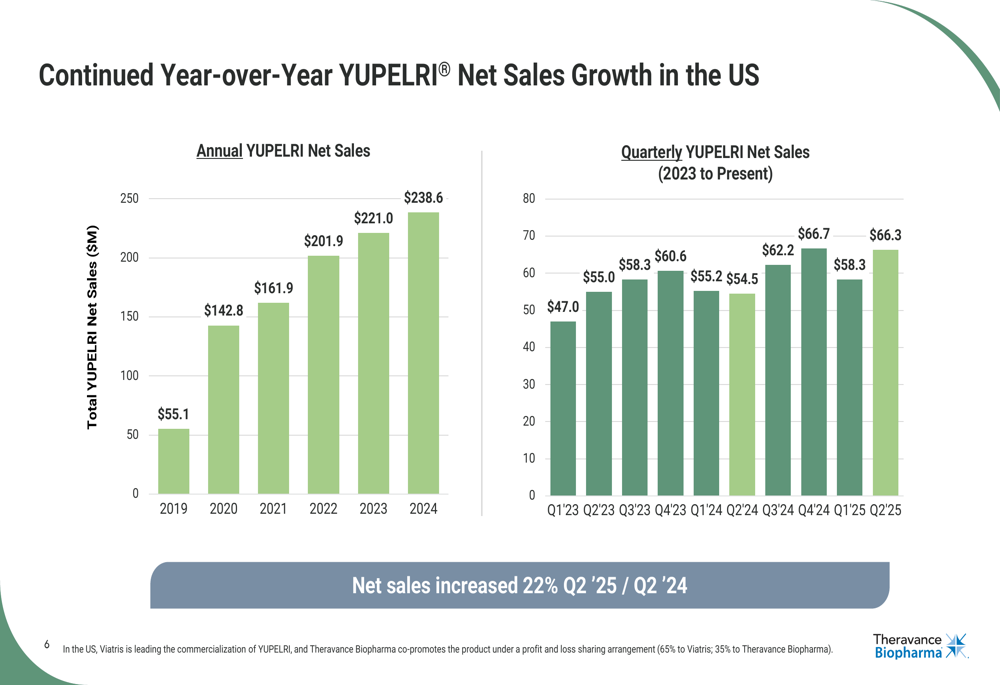
Theravance reported total revenue of $26.2 million for Q2 2025, driven primarily by strong YUPELRI sales and a milestone payment from China. YUPELRI (revefenacin), the company’s once-daily nebulized maintenance treatment for COPD, achieved net sales of $66.3 million, representing 22% year-over-year growth.

As shown in the following chart of YUPELRI’s historical sales performance, the product has demonstrated consistent growth since its launch:

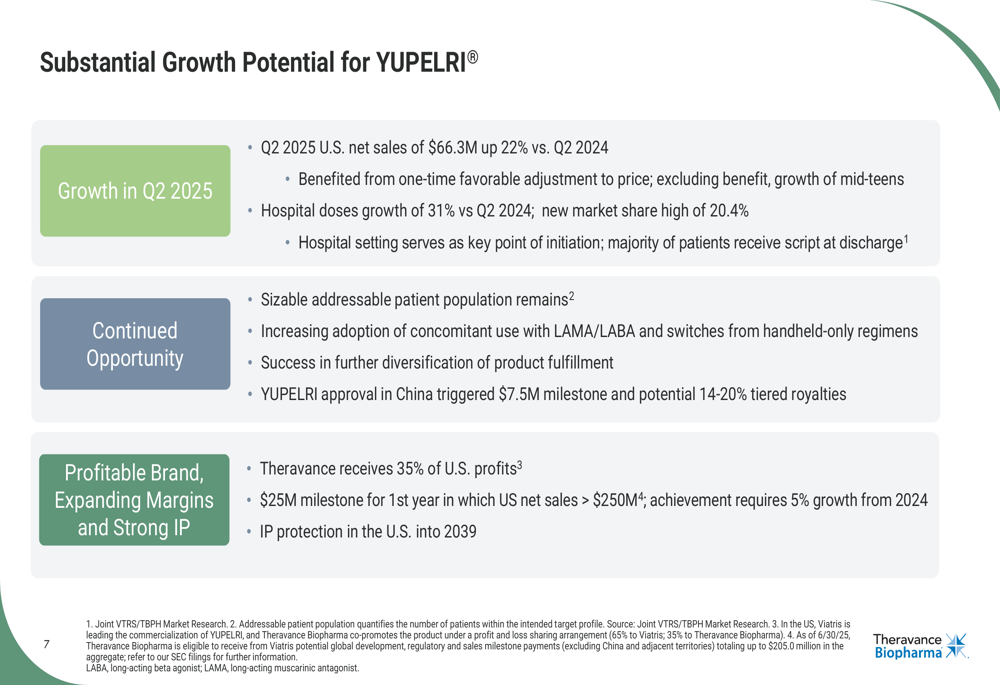
The company highlighted particularly strong growth in the hospital setting, with doses increasing 31% year-over-year and reaching a new market share high of 20.4%. This performance benefited from a one-time favorable price adjustment, though even without this adjustment, growth would have been in the mid-teens.

Detailed Financial Analysis

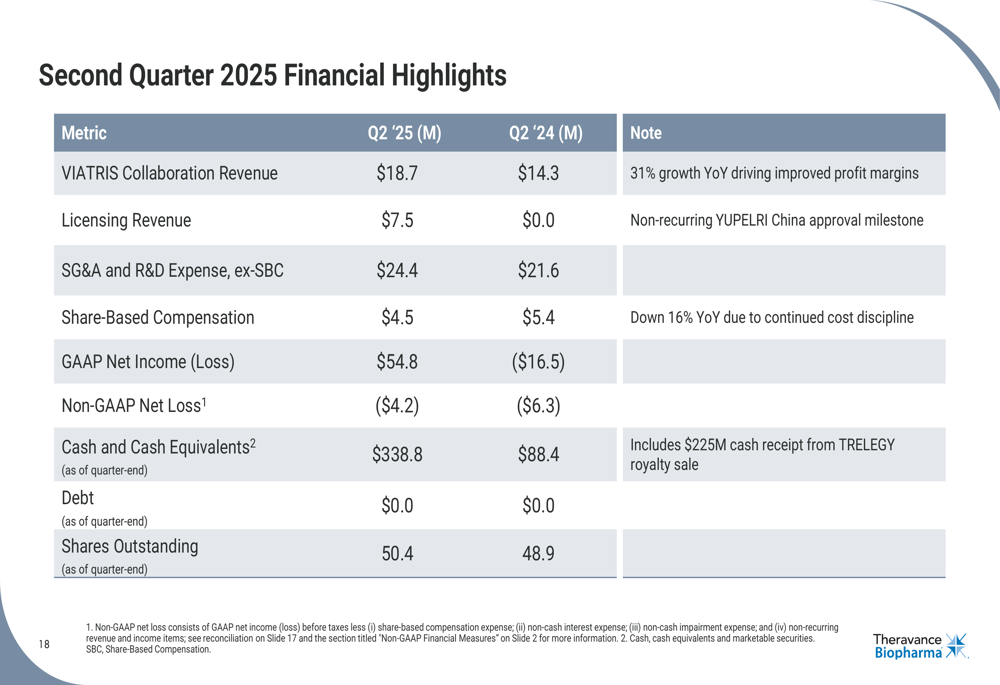
Theravance’s financial position improved dramatically in Q2 2025, with cash and cash equivalents reaching $338.8 million, compared to $88.4 million in Q2 2024 and $131 million at the end of Q1 2025. This substantial increase was primarily due to the $225 million received from the sale of the company’s TRELEGY royalty interest.

The company’s second quarter financial highlights show significant improvement across several metrics:

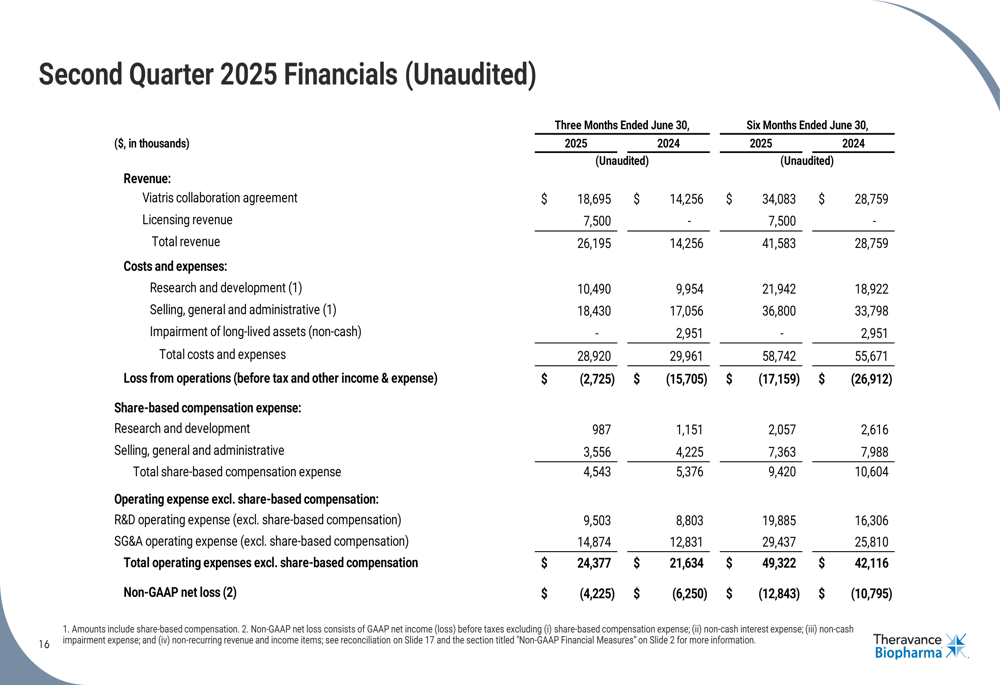
For the quarter, Theravance reported GAAP net income of $54.8 million, compared to a loss of $16.5 million in Q2 2024. On a non-GAAP basis, the company reported a net loss of $4.2 million, improved from a $6.3 million loss in the same period last year. The VIATRIS collaboration revenue increased 31% year-over-year to $18.7 million, driving improved profit margins.

The detailed quarterly financial breakdown shows:

Strategic Initiatives

Theravance’s strategic focus remains on two key assets: YUPELRI and Ampreloxetine. For YUPELRI, the company outlined substantial growth potential beyond the current performance:

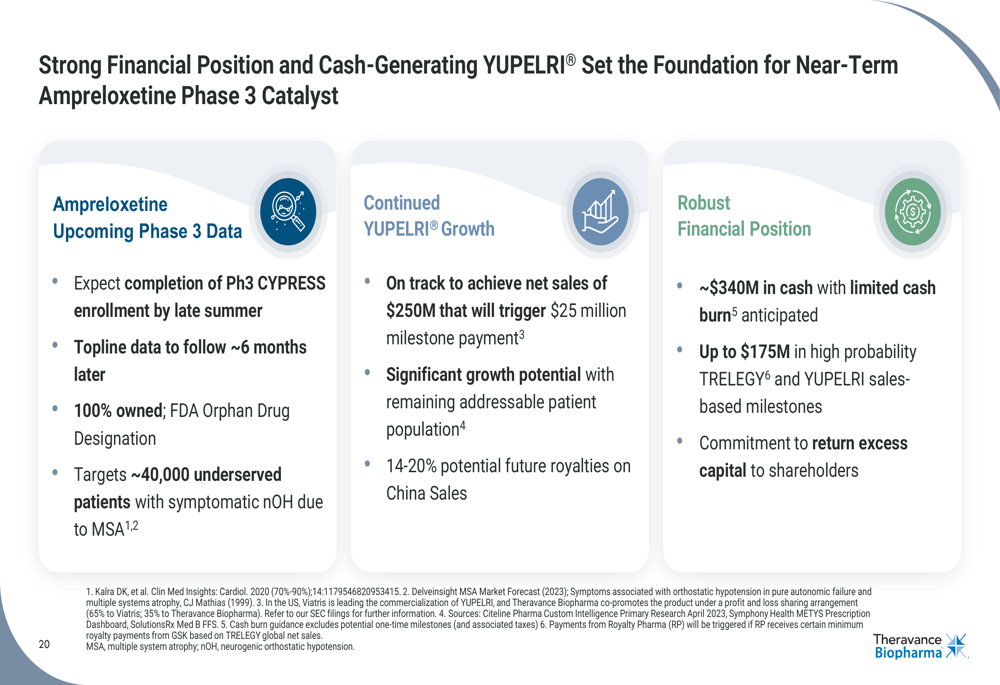
The company received a $7.5 million milestone payment triggered by YUPELRI’s approval in China, with potential for future royalties of 14-20% on Chinese sales. Theravance expects to reach the $250 million U.S. net sales threshold for YUPELRI in the near future, which would trigger an additional $25 million milestone payment.

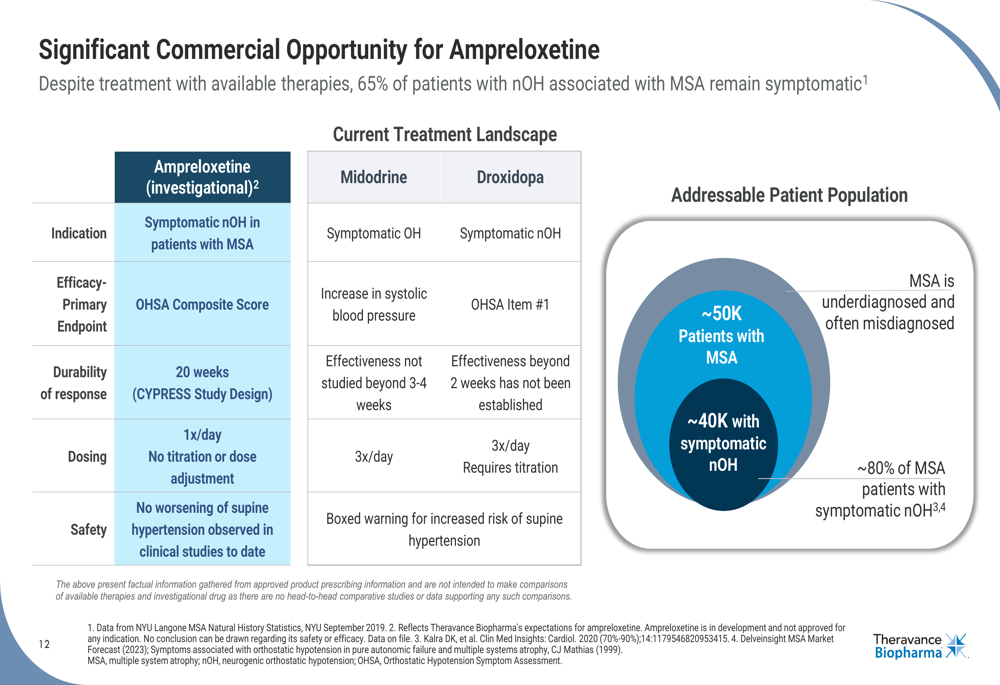
For Ampreloxetine, Theravance’s investigational treatment for symptomatic neurogenic orthostatic hypotension (nOH) in patients with multiple system atrophy (MSA), the company expects to complete enrollment in the Phase 3 CYPRESS study by late summer, with topline data anticipated approximately six months later.

The commercial opportunity for Ampreloxetine appears promising, as the company positions it against existing treatments:

Forward-Looking Statements

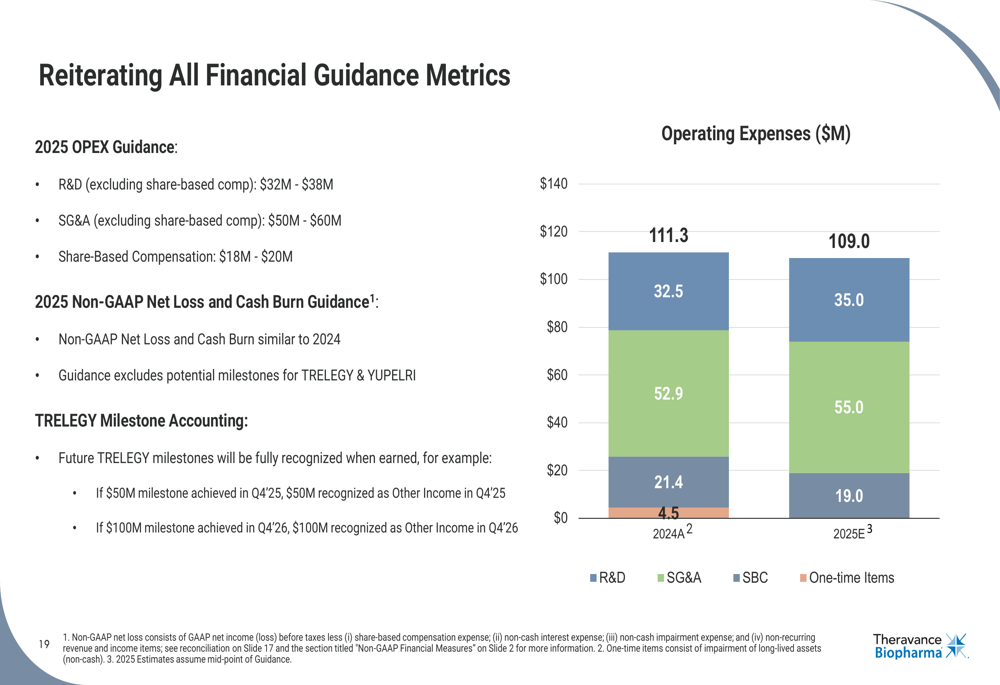
Theravance reiterated its financial guidance for 2025, maintaining its outlook for operating expenses and projecting that non-GAAP net loss and cash burn will be similar to 2024 levels:


The company also highlighted potential near-term catalysts that could drive future growth:

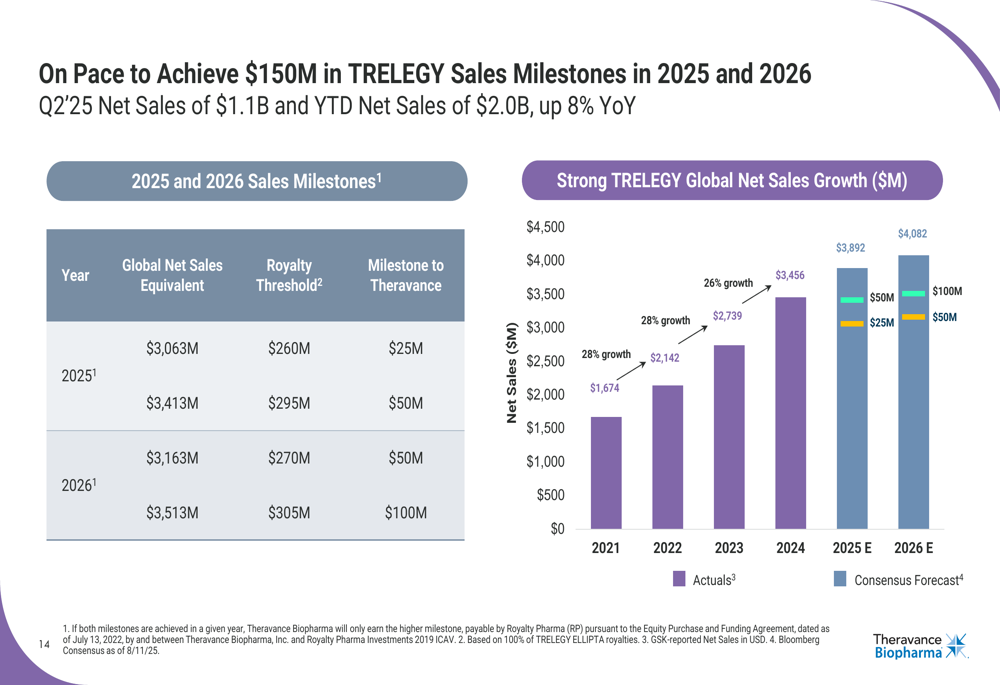
TRELEGY, GSK’s once-daily triple therapy for COPD and asthma which generates milestone payments for Theravance, continues to show strong sales growth. With Q2 2025 net sales of $1.1 billion and year-to-date sales of $2.0 billion (up 8% year-over-year), TRELEGY is on track to trigger a $50 million milestone payment to Theravance in 2025:

Conclusion

Theravance Biopharma’s Q2 2025 presentation reveals a company with strengthening financials and promising growth prospects. The combination of robust YUPELRI sales growth, a substantially improved cash position, and potential near-term catalysts from both Ampreloxetine and TRELEGY positions the company well for future success.

With no debt and approximately $340 million in cash, Theravance has significant financial flexibility to support its development programs while potentially returning excess capital to shareholders. The upcoming Ampreloxetine Phase 3 data readout represents a particularly important inflection point that could further transform the company’s outlook in the coming year.

Full presentation:

https://www.investing.com/news/company-news/theravance-biopharma-q2-2025-slides-revenue-jumps-22-cash-position-triples-93CH-4186617

Obesity Leaders Dig Manufacturing Moats To Defend Injectable GLP-1 Empires


Leaders at Eli Lilly believe heavy investment in the company’s manufacturing footprint “sets a high standard that newcomers may find challenging to match.” At least one of those newcomers disagrees.

For years, Eli Lilly and Novo Nordisk have invested heavily in the production of GLP-1 weight-loss drugs to try to keep up with soaring demand. Now, with a wave of challengers on the horizon, their manufacturing footprints are a potential advantage for the incumbents in a market that is poised to become increasingly competitive.

Capital spending at Lilly increased almost 50% last year compared to 2023, rising to over $5 billion as the company invested in global facilities to make existing and future products. The company paid $924.7 million to acquire an injectable manufacturing facility in Wisconsin in December 2024 and committed to a $3 billion expansion program at the site to support the production of drugs, including its diabetes and obesity products.

Lilly views investments in manufacturing as a way to both ensure product supply and strengthen its hand in the upcoming fight for market share with new entrants to the obesity market, a company spokesperson told BioSpace in an email.

“Our state-of-the-art facilities, combined with our years of expertise, allow us to produce high-quality products efficiently and at scale,” the spokesperson said. “This capability not only supports our ability to meet the demands of our customers, but also sets a high standard that newcomers may find challenging to match.”

Opinions are split on Lilly’s argument. Matt Phipps, a partner at William Blair, said earlier this year that the complexity of peptide manufacturing presents a barrier to new entrants. Phipps asked: “Are fast-followers going to want to spend $10 billion to have a facility that will be ready in four years that may produce an injectable only similar to Novo Nordisk and Lilly’s treatments?”

Yet executives at aspiring obesity companies such as Amgen and Metsera have made the case that manufacturing science expertise can reduce the investment needed to break into the space, arguing that work to improve yield or lower the effective dose will make them competitive despite Lilly and Novo’s head starts.

“Potency actually doesn’t matter in terms of efficacy—you can just use more drug to get to the same level of weight loss with a less potent drug—but it matters a lot in terms of dose,” Metsera CEO Whit Bernard told BioSpace. “If you’re doing the same amount of work at one-tenth to one-fifteenth the dose, you’re just manufacturing one-tenth to one-fifteenth the peptide, you’re reducing the cost of goods but, more importantly, you’re doing 10 times more work with every factory you build.”

Latecomers can, and are, accessing capacity at third parties to compete with the incumbents but the scale of the obesity opportunity is forcing them to go beyond transactional outsourcing. Metsera has partnered with the generics company Amneal to build two manufacturing facilities in India. Viking Therapeutics entered into a long-term supply agreement with CordenPharma.

Accessing capacity is only part of the challenge. New entrants must also be able to make products for a low enough cost to compete in a sector where prices are falling. Lilly believes it has an advantage in that regard, as CFO Lucas Montarce said at an investor event in May. Bank of America analyst Tim Anderson asked Montarce how the “flood of new entrants coming into the [weight loss] category” from 2028 onward will affect price erosion, given that “they’ll all be desperate to gain share [and] the only lever they’ll likely be able to pull is the price lever.”

Montarce predicted that price erosion will be a continuation of the downward trend Lilly has seen in recent years. A range of variables affect price erosion, the Lilly CFO said, and competition will be a bigger factor in the future. As new products launch, Montarce argued that Lilly’s investments will put the company in a strong position to compete on price and that new entrants will face challenges because manufacturing scale will affect their margins and, by extension, the price they can profitably charge.

“They will need to also think about how they manage their gross margin, how they manage their levels, and they will start with a small piece of share,” Montarce said. “From the gross margin perspective, they will have less flexibility to adjust their prices significantly down to where the prices will be at that time.”

Novo’s Struggles

For now, Lilly is competing chiefly against Novo Nordisk in the obesity space. Novo was first to market, winning FDA approvals for its GLP-1 agonist semaglutide in diabetes in 2017 and in obesity in 2021, but has since lost ground to Lilly as its competing products were approved. The Danish drugmaker has lowered its forecast growth for 2025 from 13%–21% to 8%–14% amid pressures on its GLP-1 drugs. Lilly, meanwhile, expects full-year sales to grow 32% at the midpoint of its range, driven by demand for its obesity and diabetes drugs.

Manufacturing capacity is one potential contributor to Novo’s problems. Novo’s first-to-market advantage was dampened by the more than 1,000 days that semaglutide was on the FDA’s drug shortage list. Lilly’s tirzepatide faced supply problems, too, but spent around 300 fewer days on the shortage list. Novo declined to answer questions about its manufacturing capabilities for this article.

Novo has strengthened its manufacturing footprint, notably through the $11.7 billion acquisition of three fill-finish sites in conjunction with its parent company’s takeover of Catalent. The Danish drugmaker said the acquisition is expected to enable an expansion of manufacturing capacity, “provide future optionality and flexibility” for its existing supply network and gradually increase fill-finish capacity.

Despite the investment, Novo’s outlook for 2025 reflects the expectation of continued periodic supply constraints and related drug shortage notifications across a number of products and geographies. The company lowered its projected sales and operating profit for 2025 in July.

On a conference call to discuss the revised outlook, Danske Bank analyst Carsten Lønborg Madsen asked about the implications of Novo’s “huge” capital spending program and slowing sales growth. Madsen asked whether Novo will write down the value of its assets if it has excess semaglutide production capacity. Novo CFO Karsten Munk Knudsen made the case that the company can fill the facilities.

“We believe that we will have a good use of the factories that we’re putting in place,” Knudsen said. “The factories we are building are, of course, for the in-line products that are on the market today but . . . they are based on technologies that we expect to be able to apply for our pipeline products. So, at this point, there are no indications of any potential write-downs.”

The Next Wave

Novo’s future pipeline products such as CagriSema and amycretin could compete against medicines from late entrants to the obesity sector. Companies ranging from larger pharmas like Roche to three-year-old startups such as Metsera are lining up to challenge the incumbents. Bernard is bullish on the potential for smaller companies to overcome the manufacturing moats, citing factors such as the ability to access scale through partnerships and reduce capacity demands through peptide engineering.

“The big guys are leading the way, which is phenomenal and laudable. Those of us coming in their wake should not be intimidated to take this on in any way,” Bernard told BioSpace. “It’s just an exciting innovation opportunity.”

https://www.biospace.com/business/obesity-leaders-dig-manufacturing-moats-to-defend-injectable-glp-1-empires

'Medical Journal Refuses to Retract Vaccine Study Despite RFK Jr.’s Criticism'


The Annals of Internal Medicine ran a large-scale study in July, pointing to the lack of an association between childhood aluminum exposure through vaccination and chronic conditions. The Health Secretary, in an opinion piece earlier this month, called the paper a “ballyhooed study.”

A leading medical journal refused to retract a large vaccine study despite public criticism from Health Secretary Robert F. Kennedy Jr., who alleged in an opinion piece earlier this month that the study was inappropriately designed.

“I see no reason for retraction,” Christine Laine, editor in chief of the Annals of Internal Medicine, told Reuters in an interview. Laine added that while some of the issues Kennedy raised could indeed be considered as “acceptable limitations” of the study, “they do not invalidate what they found, and there’s no evidence of scientific misconduct.”

On Aug. 2, Kennedy wrote an opinion piece for TrialSiteNews calling the Annals paper a “ballyhooed study,” one that is “so deeply flawed it functions not as science but as a deceitful propaganda stunt by the pharmaceutical industry.”

The study, published in mid-July, was funded by the Danish government and looked at health registry data of more than 1.2 million children from 1997 to 2018, seeking to determine whether aluminum exposure from early childhood vaccination was linked to the risk of chronic conditions, such as autoimmune or neurodevelopmental disorders. This is a claim that Kennedy has long backed. The Children’s Health Defense, a non-profit he founded, continues to identify aluminum as a “neurotoxic” adjuvant in vaccines.

Results of the Annals study, however, showed that over two decades of follow-up, cumulative exposure to aluminum through vaccination in early childhood is not associated with a heightened risk of autoimmune or neurodevelopmental disorders. Aluminum was also not linked to atopic or allergic diseases.

In his opinion piece, Kennedy claimed without providing evidence that the authors “meticulously designed” the study “not to find harm.” The researchers, he alleged, left out children who were at the highest risk of harm from aluminum exposure, such as those who died before 2 years of age and those with early respiratory conditions.

Among the many other so-called “deceptive devices” that Kennedy took issue with were the study’s reliance on hospital diagnoses from inpatient registers, the reliability of Denmark’s national health registry as a data source and the failure to consider populations that might be more susceptible due to their genetic makeup.

Kennedy in his opinion called on the Annals to “immediately retract this badly flawed study.”

This is not the first time that Kennedy has targeted high-profile academic journals. In May, he trained his sights on the New England Journal of MedicineJournal of the American Medical Association and The Lancet, three of the biggest medical publications, calling them “corrupt” and considered barring government scientists from publishing their studies in them.

Weeks later, however, FDA Commissioner Marty Makary and Center for Biologics Evaluation and Research Director Vinay Prasad published an article in JAMA outlining the agency’s priorities.

https://www.biospace.com/policy/medical-journal-refuses-to-retract-vaccine-study-despite-rfk-jr-s-criticism

HHS Freezes Vaxart’s Oral COVID-19 Vaccine, Again


The stop order came on Aug. 5, the same day Health Secretary Robert F. Kennedy Jr. terminated 22 mRNA vaccine projects under the Biomedical Advanced Research and Development Authority, though Vaxart’s candidate is protein-based.

The Department of Health and Human Services has slapped vaccine manufacturer Vaxart with another stop order for its next-generation oral COVID-19 vaccine, which the California-based company was developing with support from the federal government.

According to an SEC document on Aug. 5, Vaxart was told to stop screening and enrolling patients into a Phase IIb trial for VXA-CoV2-3.3, an investigational pill designed to elicit broad protection against variants of the SARS-CoV-2 virus. Vaxart can “continue efforts associated with the per protocol follow-up for the 10,000-person cohort, to the extent already dosed,” as per the regulatory filing. The biotech has so far enrolled around half of its target participants.

HHS did not give Vaxart a reason for the order, only indicating that it will release a “follow-up notice with further details,” according to the SEC document. Vaxart is working on the mid-stage trial with funding from the Biomedical Advanced Research and Development Authority (BARDA), which gave the biotech an award of up to $460 million.

VXA-CoV2-3.3 is an orally available S-protein COVID-19 vaccine that, according to the biotech’s website, is designed to elicit durable immunity against the virus. Preclinical data additionally showed that the immunizing pill can also lower airborne transmission by minimizing viral shedding.

In its mid-stage study, Vaxart aims to compare VXA-CoV2-3.3 with Pfizer and BioNTech’s mRNA-based vaccine Comirnaty across more than 10,000 patients. The company started dosing in May and expects the trial to wrap up in November 2026. The program has had a rough couple of months, however, with HHS in February issuing a similar stop order to review its initial findings. The freeze was lifted in April.

Beyond Vaxart, Health Secretary Robert F. Kennedy Jr. has enacted many other policy changes that are in line with his well-documented history of vaccine criticism. Most recently, Kennedy canceled some $500 million—corresponding to 22 projects—in BARDA contracts for mRNA vaccines. Incidentally, this move came on Aug. 5, the same day the new stop work order for Vaxart’s protein-based vaccine was handed out.

Kennedy in late July also said that he would “fix” the U.S. Vaccine Injury Compensation Program, claiming that the system has “devolved into a morass of inefficiency, favoritism, and outright corruption.” It is unclear what exact changes he is considering. In May, Kennedy also removed routine COVID-19 vaccination from the CDC’s guidelines for healthy children and healthy pregnant women—a move that a coalition of medical societies blasted in July as a “baseless and uninformed policy decision.”

https://www.biospace.com/policy/hhs-freezes-vaxarts-oral-covid-19-vaccine-again