Search This Blog

Wednesday, August 27, 2025

Detecting and Intervening Against Elder Abuse

 Elder abuse is any action — or lack of appropriate action — occurring in a relationship where there is an expectation of trust that causes harm or distress to an older person, according to the World Health Organization. 

photo of Ecler Jaqua
Ecler Jaqua, MD, MBA

One sixth of community-dwelling older adults are affected by elder abuse, with rates climbing in the United States and globally. The ramifications are alarming, says Ecler Jaqua, MD, MBA, associate professor, family and geriatric medicine and medical director, San Antonio Regional Hospital Center of Aging, Rancho Cucamonga, California. 

Equally disturbing is that it’s frequently unrecognized, with only 1 in 24 cases reported to authorities and <2% reported by physicians. “This is unfortunate because we’re the main ‘point people,’ often the first or only professionals, in a position to detect and maybe intervene,” Jaqua told Medscape Medical News

photo of Tony Rosen
Tony Rosen, MD, MPH

The consequences are devastating, said Tony Rosen, MD, MPH, emergency medicine physician, Weill Cornell Medicine and NewYork-Presbyterian Hospital, New York. “Elder abuse may lead to increased mortality, increased depression, and exacerbations of chronic illness.” 

Be Aware of Risk Factors

Cognitive and functional impairment are among the strongest risk factors for experiencing elder abuse, with prevalence among individuals 

with dementia significantly higher than in those without dementia. Other risk factors include difficult family dynamics, diminished community support, challenging behaviors (resisting care, aggression, or agitation), mental illness, substance abuse, lower income, frailty, trauma, or past abuse. Older women, minorities, and lesbian, gay, bisexual, or transgender individuals are also at higher risk.

Factors found in perpetrators include mental illness, inexperience, reluctance to assume a caregiver role, substance abuse, financial difficulties, and a conflictual relationship. Among community-dwelling older adults, the most common perpetrators of elder abuse are family members.

Detecting Elder Abuse in the Clinical Setting

Elder abuse is typically divided into five categories:

  1. Neglect/abandonment: Failure to meet or allow others to provide the elder’s basic needs (food, clothing, shelter, medical care, hygiene, social interactions)
  2. Physical: Infliction of physical pain, injury
  3. Psychological/emotional: Infliction of emotional pain (e.g., threatening violence or institutionalization, verbal aggression, humiliating statements)
  4. Sexual: Nonconsensual sexual talk, contact, activity
  5. Financial: Illegal/improper use of elder’s funds/resources

photo of Amy Shaw
Amy Shaw, MD

“Having a high index of suspicion is very helpful,” Amy Shaw, MD, a geriatrician at Weill Cornell Medicine and NewYork-Presbyterian Hospital, New York, told Medscape Medical News.

Begin with observing potential red flags in the patient-caregiver interaction, Shaw and Rosen advised. 

  • Patient seeming uneasy around caregiver
  • Caregiver seeming angry/resentful
  • Hostility between patient and caregiver
  • Caregiver not allowing patient to speak
  • Caregiver not understanding patient’s medical issues or type of care required
  • Missed appointments
  • Differing caregiver and patient reports
  • Caregiver has taken patient to multiple doctors/hospitals (there may be an innocuous explanation, or it may suggest elder abuse)
  • Delayed presentation for care — e.g., after injury

Clues in the Physical Examination

Rosen recommended looking for unexplained bruises not found over bony prominences, burns, fractures, infected areas of open wounds, soiled diapers, long fingernails or toenails with dirt underneath, poor hygiene, and signs of malnutrition.

Uncontrolled chronic medical conditions can suggest the caregiver isn’t attending to the patient’s needs, Shaw noted — for example, if the patient isn’t taking prescribed medications or is taking them incorrectly.

Concerning findings suggesting sexual abuse include difficulty walking/sitting, genital pain/itching, vaginal/anal bleeding, and damaged/bloody underclothing. Dehydration, failure to thrive, unexplained weight loss, and repeated falls may signal neglect. But remember, certain conditions can mimic neglect or abuse in elders. For example, poor wound healing can be associated with diabetes.

Screening for Elder Abuse

The US Preventive Services Task Force doesn’t recommend routine screening of all older adults for elder abuse. Nevertheless, Jaqua screens her older patients because elder abuse is so common. It’s certainly important to screen if you suspect elder abuse.

“Never screen with the caregiver present,” Jaqua warned. “You have to ask the caregiver to step out in a nice way, but it’s a clue if the caregiver won’t allow the patient to be alone with you.” 

Jaqua starts with open-ended questions such as, “Has anyone ever hurt or threatened you? Do you feel safe at home? Where do you live? Are you afraid of anyone in your life?”

Screening tools can be incorporated into the visit. Although several tools are available, Jaqua uses the Elder Abuse Suspicion Index (EASI), validated for family physicians in an ambulatory setting in older adults with a Mini-Mental State Examination score of ≥23. 

“Explain to patients why you’re asking these questions,” Shaw advised. “You can say, ‘Some older adults are mistreated, so we ask these questions routinely.’” A positive screen doesn’t definitively confirm elder abuse but suggests follow-up is indicated.

Some patients may not want to disclose elder abuse, Jaqua noted. “They may fear caregiver retaliation or being forced to go to a nursing home. They may not want to get their caregiver in trouble — especially a family member like a spouse, child, or grandchild.” Reassure the patient you’re interested in their safety and want them to be able to live with dignity, “and there are people (such as social workers) who can help make that happen.” 

Reporting Elder Abuse

Concerns should be thoroughly documented, including the history, complete physical exam, and results of any screening tests. Include statements made by the patient, documentation of marks of physical abuse (potentially including photographs), the caregiver’s name, and the patient’s living situation. 

“No absolute proof is needed to make a report to APS [Adult Protective Services] or law enforcement, only reasonable suspicion,” Jaqua said. “As unpleasant as it is, and of course the caregiver won’t like it — the patient may not like it either — it’s better to be safe than sorry and err on the side of caution.”

Laws regarding reporting suspected elder abuse are “less uniform and clear than those regarding child abuse,” Shaw noted. “Laws vary from state to state, so it’s important to be familiar with the reporting laws of the state in which you practice. In some cases, it may be necessary to call not only APS but also law enforcement.”

Rosen elaborated. “While CPS [Child Protective Services] must step in immediately after a report, APS typically has 72 hours to initiate an investigation. Cooperating with APS is considered ‘voluntary,’ so if the patient or caregiver don’t answer the door or refuse services, APS may close the case. That’s why law enforcement might need to be involved, especially in life-threatening situations.” 

Ideally, decisions shouldn’t be made in a vacuum but should include social workers and case managers. Physicians treating older patients outside a hospital or health system should develop a relationship with geriatric social workers and case managers in the community. Rosen recommended findhelp.org, which offers a guide to community-based resources. “Even rural communities may have more resources than you realize.”

For patients with decision-making capacity, the physician’s role is to assist with safety planning. “This is no different from working with any adult who is experiencing domestic abuse,” Rosen commented. “That person has the right to decide whether or not to stay in the relationship.” But reporting is necessary if the patient is frail, disabled, or lacks decision-making capacity.

Information about reporting elder abuse can be found at these websites:.

Detecting Financial Abuse

Physicians can play an important role in detecting financial abuse. Elders may be exploited not only by caregivers but also by scammers. According to the FBI, older individuals seem “disproportionately” affected by fraud, including cryptocurrency and tech support scams.

Questions to ask patients include: 

  • Has money/property been taken from you without your consent?
  • Have your credit/debit cards been used without your consent?
  • Has anyone called/emailed you asking you to send or wire money to them?
  • At the end of the month, do you have enough money for food, rent, utilities, or other necessities?

Victims may be unwilling to disclose exploitation because of embarrassment, so use a nonjudgmental tone, Jaqua advised.

Considerations regarding a physician’s role in detecting and intervening in financial abuse can be found in a paper by Lachs and Pillemer in The New England Journal of Medicine.

Caregivers Also Have Needs

Caregivers often neglect themselves because of caregiving demands. They need “resources, respite, and time to attend to their own needs, such as medical appointments or financial commitments,” Jaqua said.

Rosen advised recommending organizations that provide information and support for caregivers.

  • Alzheimer’s Association
  • National Alliance for Caregiving
  • National Institute on Aging
  • CaringBridge
  • Family Caregiver Alliance
  • Aging Life Care Association
  • Eldercare Locator

Complex Cases

Patients with dementia may lack the capacity to describe what’s happening to them, Jaqua said. “You’ll need to rely more heavily on your own observations, physical exam, interactions with the caregiver, and other clues not provided verbally by the patient.”

It’s challenging when a patient with dementia describes being abused by a caregiver but no evidence corroborates that abuse and you don’t see concerning behaviors on the caregiver’s part, Jaqua noted. “It’s helpful to have a longstanding relationship with the patient and caregiver, which provides a baseline of their ‘usual’ interactions. It’s more challenging with a new patient.” Make sure you have the right diagnosis, and ask the patient to return for additional appointments to assess the situation over time. 

Optimal care can be provided by involving a multidisciplinary team of social workers and other healthcare and sometimes non-healthcare professionals (e.g., forensic accountants). 

The time available during a primary care appointment is compressed, with many other issues to address. Multidisciplinary collaboration can extend the umbrella of care, ensuring the myriad needs of these patients are being met, Shaw said. 

For example, members of the team might help the patient qualify for Medicaid, involve non-abusive family members, and increase homecare hours, which might help with neglect. And forensic accountants might assist with financial abuse, in collaboration with financial institutions and law enforcement.

Rosen receives funding from the National Institutes of Health. Shaw and Jaqua disclose no relevant financial relationships. 

https://www.medscape.com/viewarticle/detecting-and-intervening-against-elder-abuse-tips-primary-2025a1000mnc

Could OTC Remedies Really Work for Depression?

 A recent scoping review in the UK reported that some over-the-counter (OTC) supplements showed “limited but promising” evidence for treating depression. Researchers identified folic acid, lavender, zinc, tryptophan, rhodiola, and lemon balm as ingredients deserving investigation. 

Further evaluation of herbal supplements as adjuncts to antidepressants and psychological therapies is needed, the researchers concluded.

“This is an interesting review but the evidence to support the effectiveness of herbal remedies or dietary supplements is still poor,” said Glyn Lewis, professor of epidemiological psychiatry at University College London, who was not involved in the study.

He told Medscape News UK: “Many of the trials are very small and therefore providing unreliable results, even in aggregate. At present I would not recommend that patients rely upon these OTC products to help with depression. It would be better to seek medical advice that would include non-pharmacological advice and treatment, as well as the possibility of pharmacological treatment.” 

Quality vs Quantity

Study investigator Rachael Frost, senior lecturer in health and social care at Liverpool John Moores University, told Medscape News UK: “The most important limitation is that we didn’t look at the quality of the trials we included, only the volume of clinical trials available.”

Frost added that the study’s aim was to scope the literature and map available evidence rather than make definitive conclusions on each product. 

The review, published in Frontiers in Pharmacology, included 209 randomised controlled trials, with a median of 70 participants each. Of these, 78 were conducted in Iran, 28 in Germany, 27 in the US, 13 in Australia, and nine in the UK. 

Stella Chan, professor of evidence-based psychological treatment at the University of Reading, said the study was useful but noted that narrative reviews cannot replace meta-analyses.

Vulnerable Population 

Chan also warned that patients with depression may misinterpret the findings and delay seeking evidence-based treatment.

“Promising results may not be good enough in this day and age when alternative treatments have been around for more than 50 years,” said Dr Cosmo Hallström, a London-based general adult psychiatrist. “The real big danger is that depressed people will choose to go down the alternative treatment route when effective treatments and skilled practitioners are available,” he told Medscape News UK

Joseph Firth, professor of psychology and mental health at the University of Manchester, noted that while biological risks of supplements are generally low, patients risk wasting time and money or delaying evidence-based care.

Personalised Approach

Firth suggested that future studies should examine personalised nutritional interventions rather than searching for a single “best” supplement. “This is because research is increasingly showing us how the nutritional status, absorption of certain nutrients, and impact of supplementation vary substantially across the population,” he told Medscape News UK. “Likewise, the causes, severity and symptoms of depression can be entirely different between two individuals with the same diagnosis.” 

Different ages, severities, and genders may respond differently to different supplements, Chan noted.

Research Barriers

Hallström said that a lack of funding and incentives limits research on supplements. “Good studies cost a lot of money to run, and those marketing health supplements tend not to have the money to spend. Their treatments are also not patented so there is little financial incentive,” he said. 

He added that sellers of herbal products are not required to demonstrate efficacy and can “say almost what they like.”

Last month, the Advertising Standards Authority upheld a complaint against TRIP drinks over claims that its products were “science-backed.” The regulator found that statements suggesting the drinks could reduce stress and anxiety through ingredients such as lion’s mane, lemon balm, and chamomile breached advertising rules.

Despite concerns, experts acknowledged potential benefits of OTC supplements if robust evidence emerges, such as finding previously undiscovered molecules that, if harnessed and modulated, could be beneficial. “That is the hope, but I think it is unlikely as none have emerged so far,” Hallström noted. 

“Mental health is stigmatised, and some have negative feelings about taking medications,” said Chan. “If OTC products could actually work, they could provide a more accessible and less stigmatised treatment option. The question is just whether they work.”

Chan, Frost, and Hallström reported no relevant disclosures.

https://www.medscape.com/viewarticle/could-otc-remedies-really-work-depression-2025a1000mlo

FDA accepts lenient MASH trial requirement

 MASH drug developers spike as FDA accept a proposal for a non-invasive surrogate endpoint for clincal trials targeting the liver disease.

https://seekingalpha.com/news/4489702-fda-accepts-lenient-mash-trial-requirement

Veeva Systems Q2 2026: revenue up 17%, operating margins expand

 Veeva Systems Inc. (NYSE:VEEV) presented its Q2 2026 financial results on August 27, 2025, showcasing continued strong performance with total revenue reaching $789 million, up 17% year-over-year. The company’s stock closed at $286.54, rising 2.61% on the day, and continued to climb 1.19% in after-hours trading, reflecting positive market reception to the results.

The quarterly performance builds on Veeva’s strong momentum from Q1, when the company surpassed analyst expectations and saw its stock surge by over 15%. The life sciences cloud software provider continues to demonstrate resilience and growth despite macroeconomic uncertainties in the healthcare sector.

Quarterly Performance Highlights

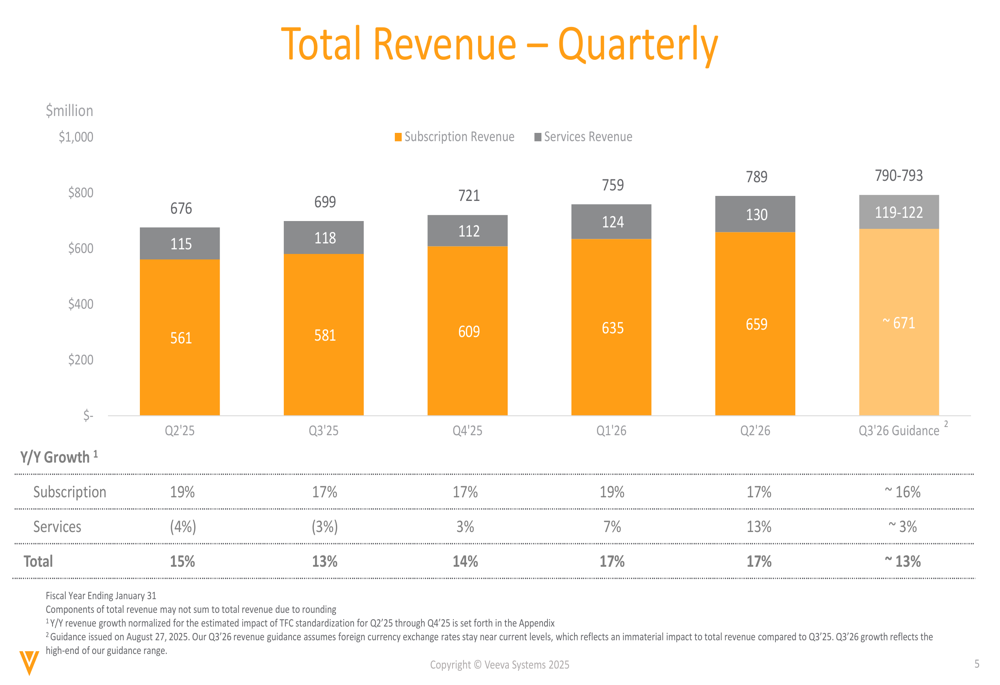
Veeva’s Q2 2026 results revealed robust growth across key financial metrics. Total revenue reached $789 million, representing a 17% increase from the $676 million reported in Q2 2025. This growth was primarily driven by subscription revenue, which grew 18% year-over-year to $659 million, while services revenue increased by 13% to $130 million.

As shown in the following chart of quarterly revenue:

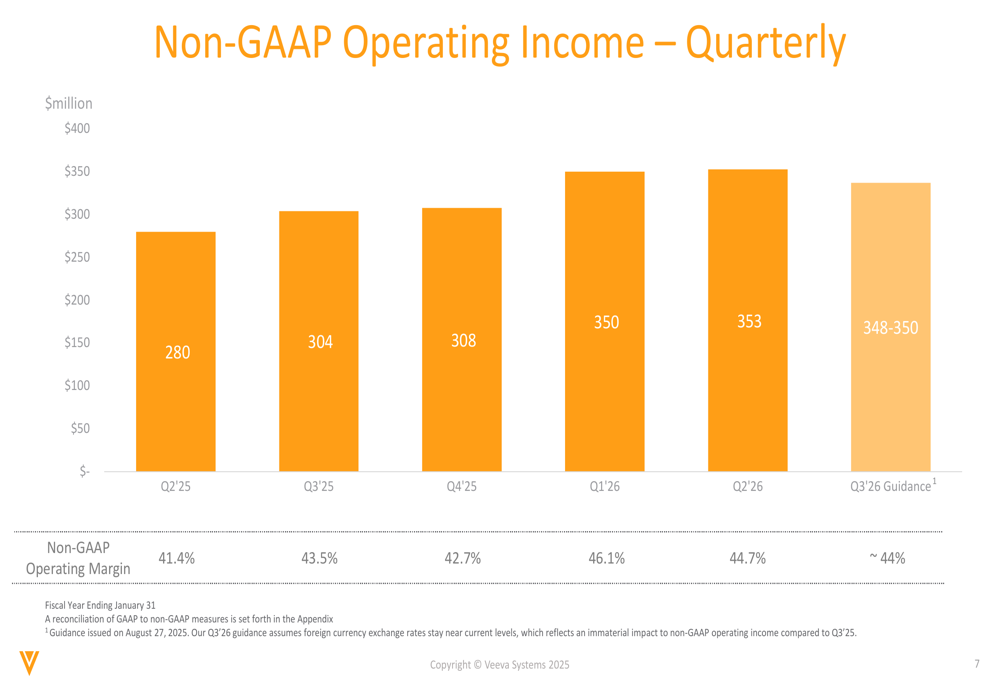
The company’s profitability metrics showed significant improvement as well. Non-GAAP operating income for Q2 2026 reached $353 million, up 26% from $280 million in the same period last year. This resulted in a non-GAAP operating margin of 44.7%, an impressive expansion from 41.4% in Q2 2025.

The quarterly operating income trend demonstrates Veeva’s ability to scale efficiently:

Detailed Financial Analysis

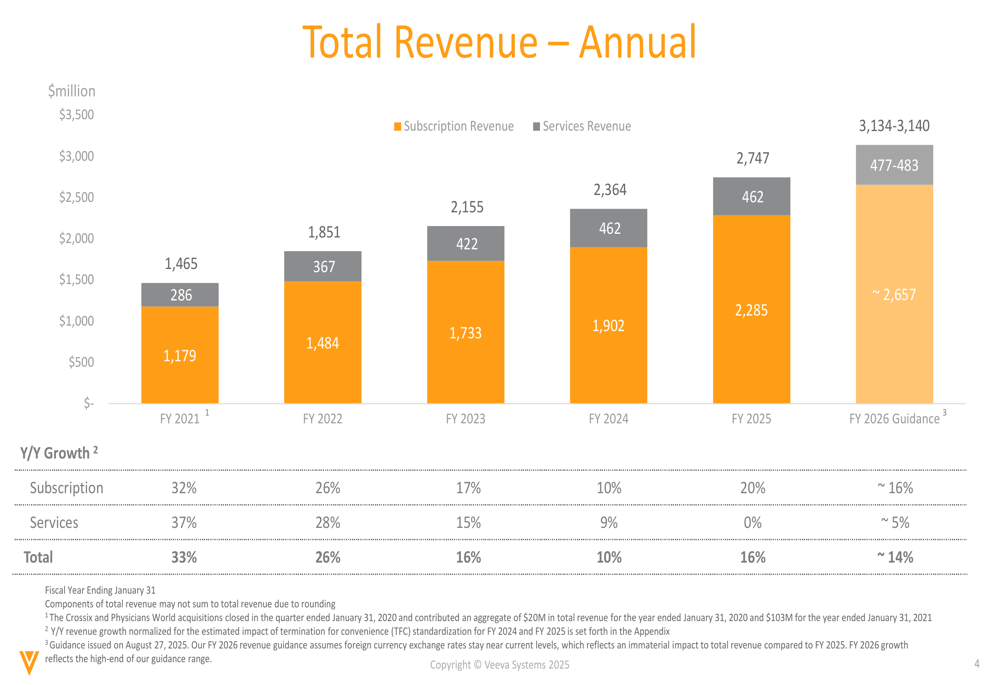
Looking at Veeva’s longer-term performance, the company has maintained consistent growth in annual revenue over the past several years. From FY 2021 to the FY 2026 guidance, total revenue is projected to grow from $1.47 billion to approximately $3.14 billion, representing a compound annual growth rate of over 16%.

The following chart illustrates this sustained revenue growth trajectory:

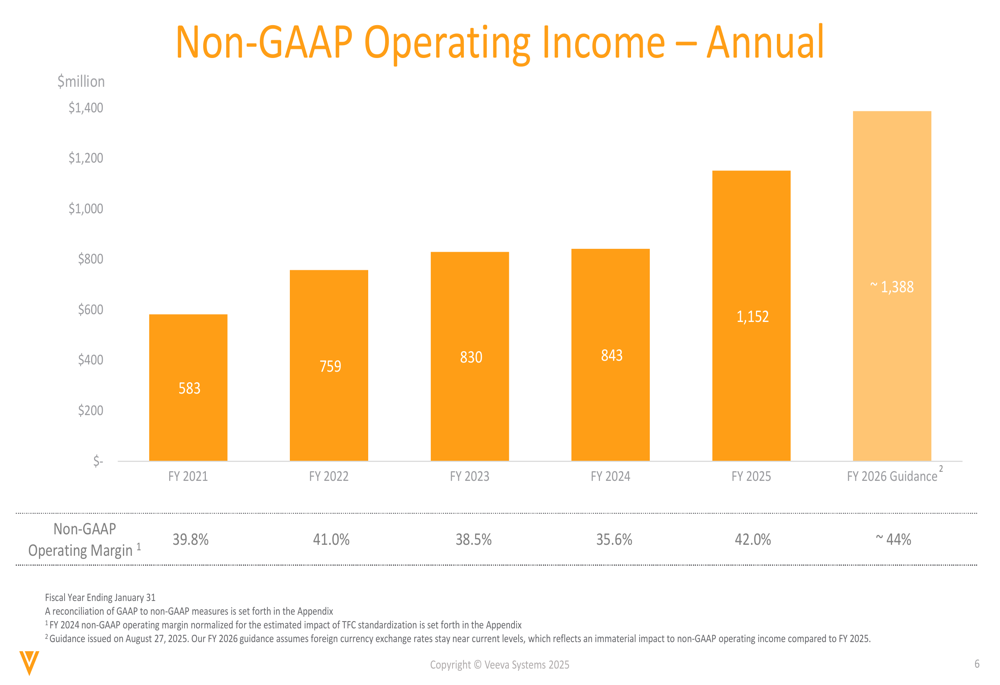
Similarly, Veeva’s non-GAAP operating income has shown strong growth, expected to reach approximately $1.39 billion in FY 2026, up from $583 million in FY 2021. This represents an improvement in operating margin from 39.8% to around 44% over this period.

The annual operating income trend demonstrates the company’s increasing profitability:

Cash flow generation has also been impressive. Non-GAAP operating cash flow is projected to reach approximately $1.33 billion in FY 2026, representing a margin of about 42%, up from 32% in FY 2021. This improvement reflects Veeva’s efficient business model and strong customer relationships.

The following chart shows the company’s cash flow performance:

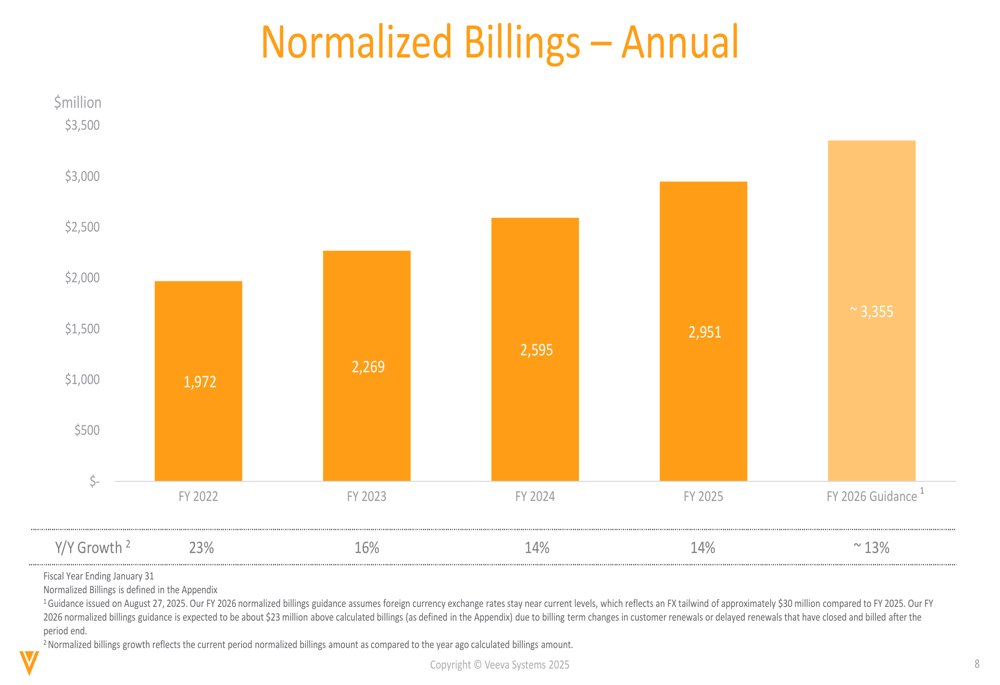
Normalized billings, an important forward-looking indicator of business momentum, are expected to reach approximately $3.36 billion in FY 2026, representing about 13% year-over-year growth.


Veeva provided comprehensive guidance for both the upcoming quarter (Q3 2026) and the full fiscal year 2026. For Q3, the company expects total revenue between $790-793 million, with subscription revenue of approximately $671 million and services revenue between $119-122 million. Non-GAAP operating income is projected to be between $348-350 million, maintaining the strong 44% operating margin.

The detailed Q3 2026 guidance is presented below:

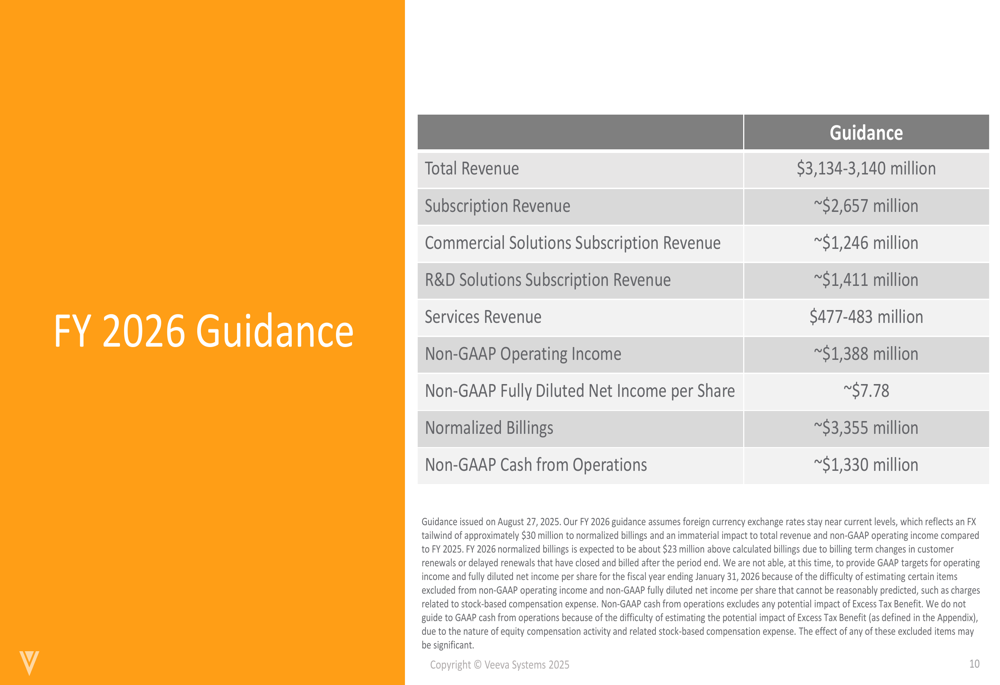
For the full fiscal year 2026, Veeva expects total revenue between $3,134-3,140 million, representing approximately 14% year-over-year growth. This includes subscription revenue of about $2,657 million, split between Commercial Solutions ($1,246 million) and R&D Solutions ($1,411 million). Non-GAAP operating income is projected to be approximately $1,388 million, with non-GAAP earnings per share of around $7.78.

The comprehensive FY 2026 guidance is shown in the following table:

Strategic Initiatives

An important strategic change highlighted in the presentation is Veeva’s standardization of Termination for Convenience (TFC) rights for customers with multi-year ramping deals. This change, implemented as of February 1, 2023, reflects the company’s shift toward longer contract durations.

While this accounting change affects the timing of revenue recognition, Veeva emphasized that it does not impact cash flows, billings, or the expected total revenue from multi-year deals. The company provided normalized growth rates to help investors understand the underlying business momentum without the effects of this accounting change.

This strategic evolution in contract structure demonstrates Veeva’s confidence in its product offerings and customer relationships, as it increasingly secures longer-term commitments from clients. The standardization also provides more consistency in how customer contracts are structured and recognized, potentially reducing complexity for both Veeva and its customers.

Conclusion

Veeva Systems’ Q2 2026 results demonstrate continued strong execution and financial discipline. With 17% revenue growth, expanding margins, and robust cash flow generation, the company appears well-positioned to maintain its leadership in providing cloud software solutions to the life sciences industry.

The positive market reaction to these results, coming after the strong performance in Q1 2026, suggests investors are confident in Veeva’s ability to deliver on its growth targets and financial projections for the remainder of fiscal year 2026 and beyond.

Full presentation:

https://www.investing.com/news/company-news/veeva-systems-q2-2026-slides-revenue-up-17-operating-margins-expand-93CH-4213306

NY Times Slammed For Predictable RFK Health Hit-Pieces

 by Luis Cornelio via Headline USA,

The New York Times came under fire on Monday for running a hit piece against Health Secretary Robert F. Kennedy Jr. and Defense Secretary Pete Hegseth’s pro-exercise campaign.

The leftist newspaper, as legacy media often does, leaned on so-called experts cautioning “against jumping into a difficult routine suggested by Robert F. Kennedy Jr. and Pete Hegseth.”

Its headline—100 Push-Ups and 50 Pull-Ups in Under 10 Minutes. What Could Go Wrong?—was predictably snarky.

The piece targeted the “Pete and Bobby Challenge,” a social media campaign aimed at raising awareness about fitness and weight loss.

However, according to The Times and their quoted experts, the exercise “may not be for everyone.”

“For the average person, I would definitely recommend building volume in these movements over three to four weeks before giving it a go,” said Utah athlete Dallin Pepper.

The leftist rag then cited Toronto-based personal trainer Chris Smits to say that the regimen proposed by Hegseth and Kennedy is not feasible for most Americans.

Citing experts is a common tactic in legacy media attacks on conservatives.

Self-described journalists pick a topic, guide the experts toward the conclusions they desire and then publish the story.

This cycle allows them to wash their hands by claiming they are simply reporting.

On X, critics piled on The Times, describing the hit piece as predictable as it was laughable.

“The New York Times really hates working out,” wrote Republican communicator Nathan Brand.

Media personality Collin Rugg added: “The @TheBabylonBee couldn’t even come up with something as insane as this.”

Fitness expert Oliver Anwar quipped, “This is confirmation that The New York Times is run by low-T softies.”

https://www.zerohedge.com/political/ny-times-slammed-predictable-rfk-health-hit-pieces

FDA Revokes Emergency Authorization For COVID-19 Vaccines

 The Department of Health and Human Services under Health Secretary Robert F. Kennedy Jr. revoked emergency authorization for COVID-19 vaccines.

"The emergency use authorizations for Covid vaccines, once used to justify broad mandates on the general public during the Biden administration, are now rescinded," Kennedy posted to X on Wednesday.

The news comes as the FDA, which is part of HHS, announced the approval of the Pfizer-BioNTech COVID-19 vaccine for older adults and children as young as 5-years-old who have at least one condition that puts them at higher risk of severe COVID-19 outcomes, Pfizer said in a Wednesday statement.  

Regulators have issued similar approvals for COVID-19 jabs from Novavax and Moderna. 

HHS revoking emergency approval means that FDA clearance is no longer in place for some 240 million Americans, however "These vaccines are available for all patients who choose them after consulting with their doctors," Kennedy sai. 

As the Epoch Times notes further, per federal law, the FDA approves products it determines are “safe, pure, and potent.” Emergency authorizations, in contrast, can only be offered under certain circumstances, such as during a public health emergency, and are for products that officials believe “may be effective” in treating or preventing a life-threatening disease or condition.

Updated Approvals

Dr. Marty Makary, the FDA’s commissioner, and Dr. Vinay Prasad, its top vaccine official at the time, signaled the change in May, when they said that the FDA would stop approving COVID-19 vaccines for many Americans absent clinical trial data.

The FDA can only approve products if it concludes, based on scientific evidence, that the benefit-to-harm balance is favorable. And we simply need more data to have that confidence for younger individuals at low-risk of severe disease,” Prasad said at the time.

In the United States, regulators in recent years have been authorizing updated COVID-19 vaccines annually in a bid to counter waning effectiveness and better match circulating variants. The model is based on the historical approach to influenza vaccines.

Regulators in 2024 cleared updated shots from Moderna, Pfizer, and Novavax without human data, citing animal tests and data from trials for previous versions.

Most Americans have not taken one of those COVID-19 vaccines. Just 13 percent of children and 23 percent of adults had received one of them as of April 26, according to the latest statistics available from the CDC.

Makary and Prasad also said they would continue approving updated versions of the COVID-19 vaccines for all individuals 65 and older, as well as younger people with one or more of the risk factors that increase the likelihood of severe COVID-19 outcomes. These approvals would be based solely on immunobridging data, or testing that shows vaccines trigger an antibody response against the disease.

Around that time, the FDA approved Novavax’s vaccine, previously under emergency use authorization, for people 65 and older, and for individuals ages 12 to 64 with at least one risk factor. More recently, the agency approved a new Moderna vaccine for the same populations, and Moderna’s existing vaccine for the elderly and for individuals aged 6 months to 64 years who have at least one risk factor.

The new approval of Pfizer’s vaccine is for the elderly and people aged 5 to 64 who have one or more risk factors, Pfizer said.

That means Moderna’s vaccine is the only one available for infants and toddlers, as had been expected.

Also recently, the CDC stopped recommending COVID-19 vaccination for healthy children and pregnant women while keeping in place recommendations to receive a shot for all other individuals.

The American Academy of Pediatrics recently recommended that all children aged 6 months to 23 months receive a COVID-19 vaccine, while the American College of Obstetricians and Gynecologists advised all pregnant women to get one.

Regulators cited the public health emergency over COVID-19 in their most recent emergency authorizations for the COVID-19 vaccines in 2024. Then-Health Secretary Xavier Becerra on Jan. 1 extended the COVID-19 health emergency to Dec. 31, 2029.

Kennedy said on Wednesday that he promised to end COVID-19 vaccine mandates, to keep vaccines available to people who want them, to require placebo-controlled trials, and to “end the emergency.” The FDA actions “accomplished all four goals,” he said.

 This is a developing story that will be updated.

https://www.zerohedge.com/covid-19/fda-revokes-emergency-authorization-covid-19-vaccines

'Susan Monarez Removed As CDC Chief: What Went Wrong'

 Susan Monarez has been removed as director of the CDC less than a month after her Senate confirmation, the White House announced Wednesday. Her ouster, citing “irreconcilable differences,” comes amid reported clashes with Health Secretary Robert F. Kennedy Jr. over vaccine programmes and disease policy. The abrupt dismissal has raised alarm among public health advocates.

In a shake-up at the nation’s top public health agency, Susan Monarez has been ousted as director of the Centers for Disease Control and Prevention (CDC), less than four weeks after her Senate confirmation. The White House announced her removal on 27 August, citing “irreconcilable differences” but providing no further details, a Washington Post report revealed.

Monarez, a microbiologist with decades of experience in biosecurity and public health innovation, was confirmed by a narrow 51–47 Senate vote on 31 July, backed strongly by Health Secretary Robert F. Kennedy Jr. She became the first CDC director to undergo Senate confirmation under a new law aimed at strengthening accountability in public health leadership.

Clashes Over Public Health Priorities

According to the Washington Post report, officials familiar with the matter said Monarez’s ouster stemmed from disagreements with Kennedy over sweeping reforms he has sought at the Department of Health and Human Services (HHS). These included proposed cuts to vaccine programmes, a shift away from chronic disease management, and reduced emphasis on equity initiatives — moves Monarez was reportedly reluctant to endorse.
During her confirmation hearing, Monarez had spoken firmly in favour of science-based communication and vaccination. According to sources, she resisted efforts to dismantle longstanding CDC programmes, particularly those ensuring equitable access to healthcare, which she had supported during her previous role at ARPA-H (Advanced Research Projects Agency for Health).
Political Pressures and Reactions
Her abrupt removal has fuelled speculation of a deeper power struggle within the Trump administration, with Kennedy’s policy preferences outweighing Senate-approved leadership. Critics argue the ouster undermines scientific independence and threatens to politicise the CDC further at a time when the agency faces staffing cuts, morale challenges, and a surge in Covid-19 infections.
Public health advocates, including several former CDC officials, voiced alarm over the decision. “This is destabilising the nation’s frontline health institution at a critical time,” one former official told The Washington Post. Meanwhile, some conservative voices welcomed Monarez’s removal, framing it as a correction of what they view as entrenched “bureaucratic orthodoxy” in public health.

Next Steps for the CDC

The CDC’s deputy director, Debra Houry, has been named acting director until a permanent replacement is appointed. The White House has not outlined a timeline for the appointment, leaving the agency’s direction uncertain.
The controversy also follows reports that Monarez, in her brief tenure, had overseen the removal of certain web content on health topics — fuelling questions about the extent of political pressure on the CDC’s communications.