Search This Blog

Wednesday, October 1, 2025

OPEC secretariat receives updated compensation plans from countries including Russia, Iraq

 OPEC+ will likely lift its quotas by another 137,000 barrels per day for November when they meet on October 5, Skandinaviska Enskilda Banken AB (SEB) Chief Commodities Analyst Bjarne Schieldrop said in a report sent to Rigzone on Monday morning by the SEB team.

“OPEC+ will decide on 5 October on what to do with production quotas for November,” Schieldrop highlighted in the report.

“Market consensus seems to be that the group will lift its overall quota by 137,000 barrels per day yet again - we fully share that view,” he added.

“When it lifted the quotas for October by 137,000 barrels per day at the start to September the Brent crude oil price was trading at $65.5 per barrel. Now it is close to $70 per barrel,” he continued.

“It seems highly likely that they will lift the quota yet again. The group naturally loves a good price, but right now the group is in a process of recapturing market share,” Schieldrop went on to state.

In the report, Schieldrop outlined that the price of Brent crude was down one percent to $69.4 per barrel on Monday morning “in part due to this”.

In a separate report sent to Rigzone by the Standard Chartered team last week, Standard Chartered Bank Energy Research Head Emily Ashford highlighted that “OPEC has accelerated its return of barrels, with one eye on adherence to compensation cuts and the other on the perception of tightening spare capacity”.

Rigzone has contacted OPEC for comment on the SEB and Standard Chartered reports. At the time of writing, OPEC has not responded to Rigzone.

A statement posted on OPEC’s website on September 7 revealed that Saudi Arabia, Russia, Iraq, the UAE, Kuwait, Kazakhstan, Algeria, and Oman “decided to implement a production adjustment of 137,000 barrels per day” at a virtual meeting that day.

“The eight OPEC+ countries, which previously announced additional voluntary adjustments in April and November 2023 … met virtually on 7 September 2025 to review global market conditions and outlook,” the statement noted.

“In view of a steady global economic outlook and current healthy market fundamentals, as reflected in the low oil inventories, the eight participating countries decided to implement a production adjustment of 137,000 barrels per day from the 1.65 million barrels per day additional voluntary adjustments announced in April 2023,” the statement added.

This adjustment will be implemented in October 2025, the statement said. A table accompanying the statement posted on OPEC’s site outlined that Saudi Arabia and Russia’s adjustment amounts to 42,000 barrels per day, each. Iraq’s comes to 17,000 barrels per day, the UAE’s is 12,000 barrels per day, Kuwait’s is 11,000 barrels per day, Kazakhstan’s is 6,000 barrels per day, Algeria’s is 4,000 barrels per day, and Oman’s is 3,000 barrels per day, the table outlined.

The table highlighted that October 2025 “required production” is 10.020 million barrels per day for Saudi Arabia, 9.491 million barrels per day for Russia, 4.237 million barrels per day for Iraq, 3.387 million barrels per day for the UAE, 2.559 million barrels per day for Kuwait, 1.556 million barrels per day for Kazakhstan, 963,000 barrels per day for Algeria, and 804,000 barrels per day for Oman.

“The 1.65 million barrels per day may be returned in part or in full subject to evolving market conditions and in a gradual manner,” the statement posted on OPEC’s site noted.

“The countries will continue to closely monitor and assess market conditions, and in their continuous efforts to support market stability, they reaffirmed the importance of adopting a cautious approach and retaining full flexibility to pause or reverse the additional voluntary production adjustments, including the previously implemented voluntary adjustments of the 2.2 million barrels per day announced in November 2023,” it added.

“The eight OPEC+ countries also noted that this measure will provide an opportunity for the participating countries to accelerate their compensation,” it continued.

“The eight countries reiterated their collective commitment to achieve full conformity with the Declaration of Cooperation, including the additional voluntary production adjustments that will be monitored by the Joint Ministerial Monitoring Committee (JMMC),” the statement went on to note.

The countries also “confirmed their intention to fully compensate for any overproduced volume since January 2024”, according to the statement on OPEC’s site, which said the eight OPEC+ countries will hold monthly meetings to review market conditions, conformity, and compensation. The statement revealed that the eight countries will meet again on October 5.

In a separate statement posted on OPEC’s site on September 8, the OPEC Secretariat said it had received updated compensation plans from Russia, Iraq, the United Arab Emirates, Kuwait, Kazakhstan, and Oman.

A table accompanying this statement revealed that these plans amount to a total of 235,000 barrels per day in October, 248,000 barrels per day in November, and 190,000 barrels per day in December. The plans amount to a total of 4.779 million barrels per day from August 2025 to June 2026, according to the table.

https://www.rigzone.com/news/opec_will_likely_lift_quotas_at_next_meeting-30-sep-2025-181956-article/

Intel in early talks to add AMD as foundry customer, Semafor reports

 Intel is in early-stage talks to add AMD as a customer at Intel’s factories, in what would be another vote of confidence in the struggling chipmaker, according to people familiar with the matter.

In the past seven weeks, Intel has gained investment dollars and public support from the White HouseNvidia, and SoftBank, and is in talks for backing from Apple, Semafor and others have reported. AMD designs chips that are currently produced mostly by Taiwan’s TSMC, and Intel currently lacks the technology to produce AMD’s most advanced, profitable chips.

It’s unclear how much of their manufacturing would shift to Intel if the two companies reach a deal, or whether it would come with a direct investment by AMD, similar to the deals cut by other companies. It is possible that no agreement will be reached, the people said.

Spokespeople for Intel and AMD declined to comment. Intel shares rose around 3.5% on the news and are up around 77% for the year.

AMD has reason to stay in the White House’s good graces. Its significant business selling chips in China was hit by export restrictions earlier this year, which Trump recently loosened.

Intel’s chip factories are considered inferior to TSMCs. But big American companies, following the Trump administration’s preference for having a US chip-manufacturing champion, have diverted at least some of their production, mostly for less-advanced chips, towards Intel’s domestic foundries.

Intel for months has been speaking with prospective customers and investors about similar deals, people familiar with the company have previously said.

Intel once dominated, and still has a large market share, in more prosaic chips that power laptops. But the rapid advancement and adoption of AI chips, pioneered by Nvidia, has left it flat-footed.

https://finance.yahoo.com/news/intel-early-talks-add-amd-175823156.html

KKR explores $7 billion sale of stake in Canada's Pembina Gas Infrastructure, sources say

 KKR is exploring a potential sale of its 40% stake in Pembina Gas Infrastructure, with its holding in the Canadian midstream operator expected to be valued at around $7 billion, four people familiar with the matter said on Wednesday.

Pembina Gas Infrastructure was formed in 2022 as a joint venture between the investment firm and Pembina Pipeline Corp, and owns natural gas and natural gas liquids transportation, processing and storage infrastructure in western Canada.

KKR has been working with investment bankers at Scotiabank in recent weeks to solicit potential buyer interest in the stake, said the sources, who cautioned that no sale was guaranteed and spoke on condition of anonymity to discuss confidential information.

KKR and Scotiabank declined comment. Pembina Pipeline did not respond to comment requests.

The KKR stake in Pembina Gas Infrastructure is expected to attract interest from other alternative asset managers and infrastructure funds, the sources said. Such buyers are drawn to minority stakes in such assets because they can pocket steady returns from the revenues earned without needing operational knowledge.

Opportunities to own substantial stakes in large-scale Canadian pipeline assets are rare, which gives the Pembina Gas stake additional scarcity value, the sources added.

Deal activity has remained strong for the Canadian energy sector this year, gaining attention from investors as companies seek to consolidate and build scale on growing demand for infrastructure and energy projects to meet rising energy needs.

When Pembina Gas was formed, the parties said the venture was worth around C$11.4 billion ($8.17 billion) in total, meaning an exit for KKR at the mooted price would be significantly profitable for the investment firm. Since formation, Pembina Gas has grown through bringing built projects online and acquiring further assets.

Pembina Gas has capacity to process around 5 billion cubic feet per day of natural gas, with assets within both the Montney and Duvernay shale formations, according to its website.

https://ca.finance.yahoo.com/news/exclusive-kkr-explores-7-billion-190447852.html

MercadoLibre Slumps as Rival Amazon Boosts Presence in Brazil


Shares of MercadoLibre Inc. are heading for their biggest two-day slump since November on concern that Amazon.com Inc.’s latest move in Brazil will ramp up competition in the e-commerce segment.

The stock extended Tuesday’s selloff, dropping as much as 5.8% on Wednesday to as low as $2222.52, its weakest intra-day level since May 7. That followed a 6.6% decline the prior session.

https://www.bloomberg.com/news/articles/2025-10-01/mercadolibre-slumps-as-rival-amazon-boosts-presence-in-brazil

'Amazon Launches Cheap Grocery Brand As Value War With Walmart Heats Up '

 Value wars between Amazon and Walmart to attract cash-strapped consumers are heating up late in the year. Amazon announced on Wednesday morning the launch of a new private-label line called "Amazon Grocery," which spans more than 1,000 products and is largely priced under $5. The timing couldn't be better, as our attention has shifted to a storm brewing in the low-income consumer world.

Amazon Grocery will be a direct competitor to Walmart, Aldi, and other value grocery chains, offering affordable private-label goods amid ongoing value wars (read report). The new line will feature dairy, fresh produce, meat, snacks, and pantry staples priced under $5, an easy hook for low-income consumers. Another selling point: more than 1,000 items can be delivered straight to consumers' doors, saving them the time and hassle of driving to the supermarket and pushing a cart down the aisles. 

"The extensive selection includes everything from milk and olive oil to fresh produce, meat and seafood, with most products priced under $5, offering exceptional value to customers," Amazon wrote in a press release. 

"With Amazon Grocery, we're simplifying how customers discover and shop our extensive private label food selection while maintaining the quality and value our customers expect and deserve," Jason Buechel, Vice President of Amazon Worldwide Grocery Stores and Chief Executive Officer at Whole Foods Market, wrote in a press release

Buechel noted, "During a time when consumers are particularly price-conscious, Amazon Grocery delivers more than 1,000 quality grocery items across all categories that don't compromise on quality or taste – from fresh food items to crave-worthy snacks and pantry essentials – all at low, competitive prices that help customers stretch their grocery budgets further."

Amazon has long operated a large online grocery business, selling household basics, paper products, and cleaning supplies. In recent years, it has doubled down on physical retail through Whole Foods Market, Amazon Fresh supermarkets, and convenience stores. 

The timing of Amazon Grocery comes at a critical moment, following the sudden collapse of subprime auto lender Tricolor Holdings and CarMax's earnings miss, which has shifted our focus onto the financial health of low-income consumers as cracks begin to appear.

This week, Goldman's consumer sector specialist, Scott Feiler, and financials sector specialist, Christian DeGrasse, both noted that low-income trades are under pressure, pointing to Tricolor and CarMax as potential drivers that have set off alarm bells among investors.

https://www.zerohedge.com/markets/amazon-launches-cheap-grocery-brand-value-war-walmart-heats

SNAP Aims to Shift Shelves from Snacks to Staples

 America’s largest anti-hunger program, SNAP, is preparing for a significant update. USDA’s updated SNAP stocking rules aim to replace the “one rice, one bean, one chicken” baseline with a seven-variety standard that reads like a nutrient-density checklist, promising richer choices for the 42 million Americans who rely on the benefit. Yet the question lingers: will the science of dietary diversity survive the politics of convenience-store economics?

SNAP, the Supplemental Nutritional Assistance Program, serves approximately 42 million people in 22 million households, accounting for about 12.5% of our total population. New policy is being directed at the SNAP work requirement [1] and the products available for purchase by SNAP recipients. The USDA has just released updated rules for retailer SNAP eligibility, outlining the required items and their minimum quantities. While ambitious on paper, questions remain about whether these changes will be implemented, let alone how effectively they will be enforced. 

The thrust of the rulemaking is to both increase the breadth of nutritional foods available and make it easier to enforce these stocking requirements. There are approximately 250,000 establishments that accept SNAP benefits. The majority, 80% of food stamp redemptions, come from supermarkets and “superstores,” such as Walmart and Target. While convenience stores represent the largest number of outlets, accounting for 44% of the quarter million, they make up only 5% of redemptions. So, the impact of these new rules will be muted at best. Still, how a store qualifies for SNAP participation reveals why variety standards matter.

The Road Paved With Good Intentions

To qualify as a SNAP retailer, a food store must either demonstrate that at least 50% of its sales come from staple foods or show that it carries a required breadth of staple items. Specialty shops, such as butchers or bakeries, usually qualify under the first rule, while most supermarkets and general food stores qualify under the second.

SNAP divides staple foods into four core categories—the building blocks of balanced meals:

  • Protein: meat, poultry, or fish, whether fresh, frozen, or canned.
  • Dairy: milk, yogurt, cheese, and related products.
  • Grains: bread, rice, pasta, cereals, and flours.
  • Fruits and vegetables: fresh, frozen, or canned produce.

SNAP stocking standards aim to ensure that families can purchase the basic building blocks needed to prepare real meals at home. They emphasize raw staples, grains, flours, beans, peas, and lentils, rather than relying on processed, multi-ingredient products. Under the current regulations, those choices are fairly limited

  • Only “3 × 4” is required: Stores need only three varieties in each of four staple groups, with perishables required in just two groups. That adds up to as few as 12 items in total.
  • “Ingredient loophole: USDA’s current “variety” test is ingredient, not product-based, so anything that shares the same main ingredient—no matter the cut, color, flavor, or brand—gets lumped into the same variety bucket. Three cans of pinto beans can satisfy the entire “bean” requirement, or several packs of chicken nuggets can meet the protein quota—leaving little diversity.
  • Accessory-food loophole: Snack items, such as jerky sticks or protein bars, count toward the quota even though they’re not staples or ingredients, encouraging small stores to stock easy, high-margin snacks instead of fresh or minimally processed staples, thereby squeezing out healthier choices.
  • Few Perishables: Fresh items are only required in two categories, so retailers often stock shelf-stable produce and dairy but avoid fresh proteins or whole-grain breads. Shoppers often see a limited selection of fresh meats, yogurts, and whole-grain breads—foods that spoil more quickly but are essential for a well-rounded, healthy diet.

In practice, this system often leaves SNAP shoppers in low-income areas, who are primarily served by convenience stores, with a bare-bones pantry instead of genuine choice.

The proposed rules significantly raise the bar—expanding the minimum from 12 items to 28 and tightening definitions to ensure true variety 

  • “3 × 4” becomes “7 × 4”: every SNAP retailer would have to stock seven distinct varieties in each staple group—protein, dairy, grains, and produce. The shelf of white bread, corn flakes, and oatmeal would give way to a variety of options, including rice, quinoa, oats, corn tortillas, pasta, and more.
  • Removes the ingredient loophole by splitting big buckets into sub-groups. Beans are now categorized by type (dry, canned, or mixed), so a bag of black beans and a can of chickpeas represent different varieties. Protein options expand beyond just chicken.
  • Closes the accessory-food loophole: Snack bars, most jerky sticks, and cheese/fruit spreads are formally re-labeled “accessory foods,”things we tend to snack on, sweeten with, or use to complement a meal rather than form its foundation, so they no longer count toward staple quotas. A store that previously met its protein target with beef, turkey, and pork jerky must replace them with more traditional staples, such as canned tuna, eggs, or raw nuts, thereby broadening the healthy protein options on the shelf.
  • More fresh items: Perishables must appear in at least three categories, not just two—so stores must add fresh proteins or grains alongside produce and dairy.

In USDA’s own survey of small retailers, only 52 % stocked enough dairy and 63 % enough protein to meet the future seven-variety standard—evidence that many stores are already thin on these categories today.

SNAP rules are being refined to strike a balance between nutrition and choice. The USDA is proposing updates to SNAP’s variety framework to expand the definition of distinct staple foods in the protein, dairy, and grain categories. The goal is to provide households using SNAP with greater access to diverse, nutritious building blocks for home cooking, while reducing unnecessary complexity for retailers. 

  • Protein has long been the trickiest category for small-format stores to meet. The proposed framework categorizes proteins into seven groupings, now including nuts, legumes, and plant-based proteins—broadening affordable, fiber-rich options.
  • Dairy’s new categories reflect what most families actually buy, rather than by the mammal (cow, goat, or sheep) producing the dairy product. The focus is on everyday choices, such as milk, yogurt, and cheese, with room for plant-based substitutes.
  • Grains now focus on raw grains and flour as core staples, recognizing their role as versatile ingredients for cooking and baking. All forms of bread (bagels, tortillas, loaves) count as one variety, as do breakfast cereals and foods.
  • Fruits and Vegetables are already diverse, but pre-cut produce now counts as staples, while deli-prepared salads do not.

A Nutritional Aside

Nothing is being taken away—people can still buy snack bars, jerky, or fruit spreads with SNAP benefits. The change simply tightens how stores qualify as SNAP retailers. These changes aim to make SNAP stores look less like “just enough” pantries and more like real sources of variety for home cooking.

The proposal doesn’t ban ultra-processed foods (UPFs). What it does is tighten the criteria for which items “count” when retailers prove they stock enough staple foods. Because many UPFs are now classified as accessory foods (so they no longer help a store pass the test), while the quota for minimally processed staples jumps from 12 to 28, shelf space is nudged away from UPFs and toward beans, raw grains, fresh meat, milk, and produce. Shoppers can still buy soda or candy with SNAP, but stores get no regulatory credit for carrying them.

Paving the Road

The idea of stricter retailer requirements is not new. What is little mentioned is that these expanded retailer requirements were part of the 2014 Agricultural Act, or Farm Bill. The USDA spent two years developing regulations to clarify what constitutes a variety. Moments before they were to take effect, now three years since the 2014 enabling legislation, Congress did a “do-over,” barring the USDA from enforcing the new provision and requiring a rewrite to the variety definitions. In 2019, USDA tried again, but its compromise drew criticism from both nutrition advocates and industry. The rules were never finalized, and today’s proposal—nearly a decade later—represents another attempt to balance competing pressures from Congress, advocates, and food retailers.

The long stall comes down to a mix of politics, practicality, and pushback. Congress, worried about the burden on small stores, repeatedly blocked enforcement through budget riders. USDA’s 2019 attempt at compromise alienated advocates by weakening nutrition standards while failing to provide clear regulatory text. At the same time, industry groups pushed for flexibility to avoid stocking requirements they saw as costly or unrealistic. The result has been nearly a decade of gridlock—caught between the Farm Bill’s intent to improve access to healthy staples and the political and logistical realities of regulating diverse food retailers.

If history is any guide, regulation alone won’t turn a corner bodega into a bastion of fresh produce. Without enforcement muscle, incentives for small retailers, and parallel investments in nutrition education, Congress’s decade-old mandate risks another loop through the policy grinder. The new rule is a necessary nudge toward healthier plates. Still, its real power will depend on whether lawmakers fund compliance, watchdogs demand transparency, and communities insist that access to good food is more than a line item. MAHA warriors will once again face the question of whether the words used to woo their votes will become acts and deeds or remain smoke and mirrors.

[1] As Pew Charities reports, “most Americans ages 16 to 59 who aren’t disabled must register with their state SNAP agency or employment office; meet any work, job search, or job training requirements set by their state; accept a suitable job if one is offered to them; and work at least 30 hours a week. Failure to comply with those rules can disqualify people from getting SNAP benefits.”


Source: Proposed Rule - Updated Staple Food Stocking Standards for Retailers in SNAP USDA Food and Nutrition Service

Dr. Charles Dinerstein, M.D., MBA, FACS is Director of Medicine at the American Council on Science and Health. He has over 25 years of experience as a vascular surgeon.

https://www.acsh.org/news/2025/10/01/snap-aims-shift-shelves-snacks-staples-49747

Doing Insurers’ Bidding and Shutting Down the Government


Last night, Congress failed to pass a seven-week continuing resolution, triggering a federal government shutdown. Senate Democrats refused to support the “clean” CR, insisting on $1.5 trillion in additional spending, including massive subsidies to health insurers, as a condition for keeping the government open.
 
As I discussed last week, the Democrats’ plan would repeal all the health policy provisions in the One Big Beautiful Bill, including policies that (1) restrict subsidies to U.S. citizens and certain legal immigrants, (2) require work for able-bodied adults on Medicaid, and (3) reduce Medicaid’s money-laundering schemes that result in corporate welfare. Their core demand is to continue a Biden COVID-era policy of $40 billion in additional annual federal payments directly to health insurers selling Obamacare plans above and beyond the original Obamacare subsidies that flow straight to insurers. This is despite overwhelming evidence that much of this spending is lost to fraud and does not translate into any health care received by more than one-third of enrollees.
 
In today’s newsletter, I discuss two prominent op-eds on why Biden’s COVID credits should expire. I then highlight a new Paragon policy brief that shows there are far more enrollees who do not use any health care compared to the number of people who would supposedly lose coverage when the COVID credits expire. I conclude with an editorial in The Wall Street Journal showing significant attrition in employer-based health coverage over the past few years—attrition driven by the COVID credits.

Ge Bai: Let Covid Credits Expire

In a new Wall Street Journal op-ed, Johns Hopkins professor and Paragon advisor Ge Bai argues that Biden’s COVID credits must expire:

Letting the subsidies go away merely restores the original ObamaCare premium-support structure. That preserves access to subsidies for low-income populations, who already comprise 93% of the 24 million who get health insurance through the ObamaCare exchanges.

As I have written in a recent policy brief, the government would subsidize more than 80 percent of the premium for the average enrollee after the COVID credits expire.
 
In her op-ed, Ge explains that “since 2021, Congress has been bribing higher-income Americans to purchase expensive ObamaCare plans by hiding the plans’ true price tags using taxpayer dollars.” This is because the COVID credits raised the cap on subsidies that existed at four times the federal poverty level.
 
Ge documents Obamacare’s problems: soaring premiums, deductibles over $5,000, and one in five medical claims denied. In essence, these plans are so unappealing that massive subsidies are needed to get people to enroll. Those subsidies now exceed $130 billion annually. Policymakers should avoid wasting additional funds by propping up this inefficient structure with ever-larger subsidies. Instead, as Ge suggests, they should begin by asking the more fundamental question: why are Obamacare plans so unaffordable in the first place? Here’s Ge’s answer:

The inflationary provisions of the Affordable Care Act—such as the medical loss ratio, mandated “essential” benefits, community rating and premium subsidies—have inhibited insurers from offering affordable and flexible options. The law’s regulatory burdens on providers have also fueled consolidation and driven up service prices.

More from Ge, including a mention of fraud, which I discuss below:

By luring people to these expensive plans and making them dependent on subsidies, lawmakers not only wasted taxpayer dollars and invited fraud but also effectively killed the market for affordable alternatives. Continuing this scheme would be fiscally reckless and irresponsible to consumers. Covid-era subsidies should be allowed to die a natural death.

Ge then discusses how the COVID credits make health coverage worse for Americans:

By masking the true price of ObamaCare plans, Covid-era premium subsidies have distorted insurance markets and trapped people in plans they don’t want. As Americans start to understand how expensive these plans really are, they will begin demanding genuine insurance that covers only major events at affordable premiums. Innovative options—such as direct primary and specialty care, association plans, health-share ministries, and crowd-sharing arrangements—will emerge organically.

Burlison: Let Covid Credits Expire

Congressman Eric Burlison of Missouri had a Washington Examiner op-ed on why the COVID credits should expire. According to Rep. Burlison:

42% of Obamacare enrollees are on fully subsidized plans as of 2024. Another 28% pay a premium of $50 or less. When Biden’s subsidies expire, the average enrollee (someone earning 200 percent of the federal poverty level) will only have to pay $32 a week for a plan — about the cost of a median DoorDash order. Someone earning 100% of the poverty level would only have to pay $3.45 — the cost for a cup of coffee.
Even without Biden’s COVID subsidies, taxpayers will still cover 80% of the typical enrollee’s premium —up from 68% in 2014. That’s because Obamacare subsidies cap what enrollees pay, fully insulating them from rising healthcare costs and shifting costs directly onto taxpayers.
If Republicans cave to the Left’s demands, it will be entirely clear that generous taxpayer-funded pandemic healthcare subsidies will be here to stay; almost four million Americans will lose their employer coverage, crowded out by artificially low government-backed premiums.

Zero-Claim Obamacare Enrollees by State

As a result of Biden’s COVID credits, there was a surge in enrollees with coverage who received no care. In fact, two in five enrollees in fully subsidized Obamacare plans did not use their coverage at all in 2024—not for a single doctor visit, test, or prescription.
 
In a new policy brief from Paragon, Niklas Kleinworth, John R. Graham, and Liam Sigaud uncover how these zero-claim enrollees cannot be explained by a surge of young, healthy enrollees without health care needs. The increase in zero-claim enrollees between 2021 and 2024 is more than double the increase in enrollees under 35 years of age. Rather, many of these enrollees are phantoms—people unaware of their coverage or enrolled in other plans.
 
Paragon estimates that more than 6.4 million individuals were fraudulently enrolled in exchange plans during 2025. These are people who claimed incomes between 100 and 150 percent of the federal poverty level to qualify for a fully subsidized 94% actuarial value plan, even though they did not earn that income. They found a very strong positive correlation between zero-claim and fraudulent enrollees by state (a correlation coefficient of 0.67). Of the top 20 states with zero-claim enrollees, 15 of them also ranked in the top 20 for fraudulent enrollment.
 
The large number of zero-claim enrollees severely undercuts the argument that permitting the COVID credits to expire will harm Americans’ health. Prior work from Paragon highlighted how health coverage does not translate to improved health, but those who are unaware of even having this coverage in the first place certainly would not face any negative health effect from losing coverage.
 
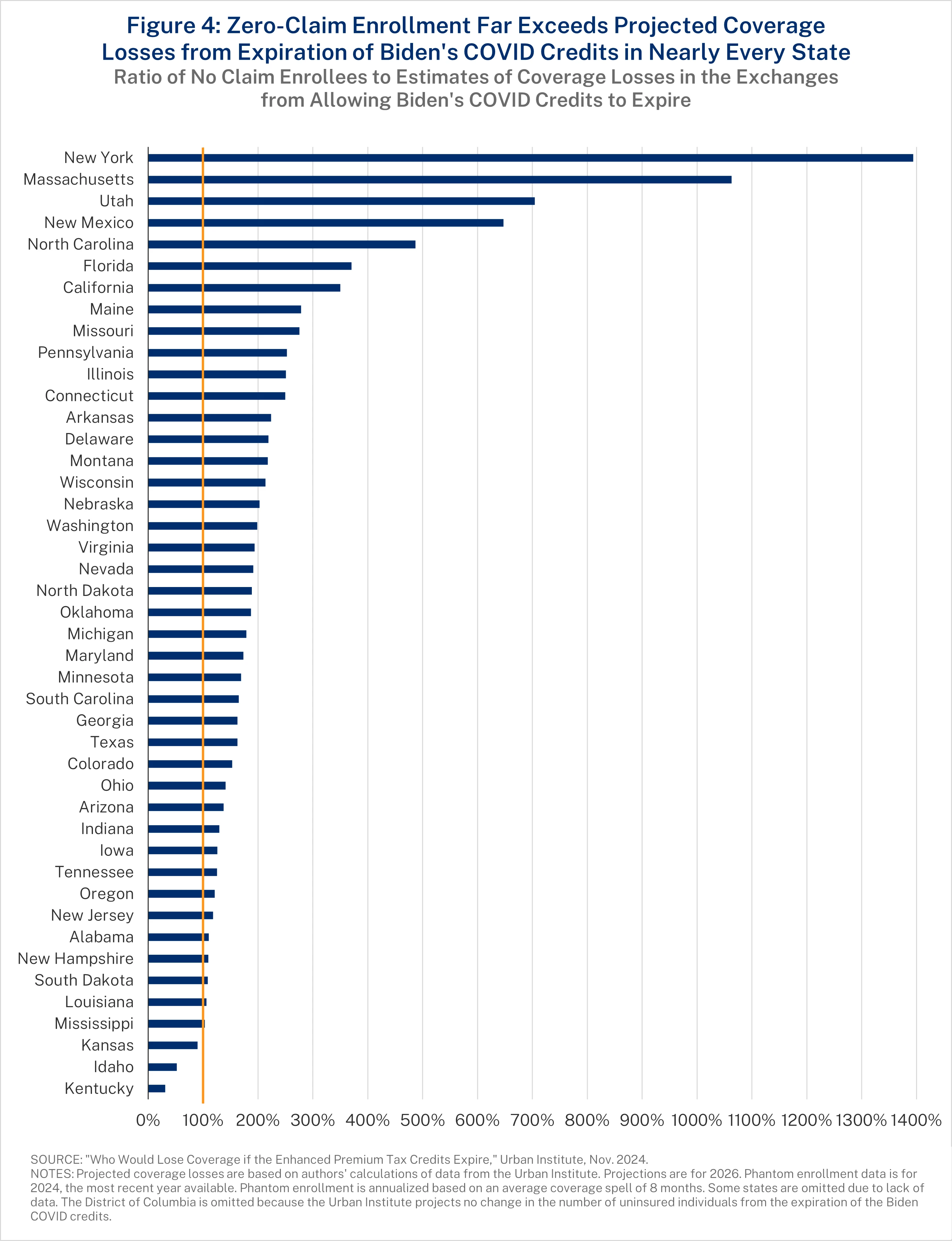
The new brief compares state projections of the increase in the uninsured if the COVID credits expire with zero claim enrollees. In all but three states, there are more zero claim enrollees (on an annualized basis) than enrollees who would lose coverage. As the figure below shows, zero-claim enrollees outnumber projected coverage losses by more than two-to-one in 17 states.
 

Zero-Claim Enrollment Far Exceeds Projected Coverage Losses from Expiration of Biden's COVID Credits in Nearly Every State

Though not all disenrollments will involve phantom enrollees, most coverage losses will likely come from people who valued coverage so little they enrolled only because it was free, or from individuals who were unknowingly enrolled by fraudsters, unaware they had ACA coverage entirely.

Covid Credits Hit Employer Coverage

In a September 29 editorialThe Wall Street Journal reviews data from the Bureau of Labor Statistics (BLS) and highlights a massive drop in the percentage of employees covered by their employers’ health insurance plan. According to The Journal’s analysis, “the share of workers with access to medical benefits increased to 74% this year from 71% in 2019.”
 
At the same time, “the share of workers who participate in employer medical plans…has fallen to 65% from 73%.” The drop is steepest among lower-income workers: “part-time workers (to 44% from 56%) and employees whose wages are in the bottom 25% (49% from 61%) and 10% (34% from 57%).”
 
The editorial asks why—and reaches the right conclusion. “Perhaps because they can now get ObamaCare plans at no cost.”
 
The COVID credits were massive new subsidies—but only for people who do not have employer-based health coverage. As a result, there is less incentive for workers to enroll in employer coverage or seek employers who offer coverage. The editorial concludes: “The BLS report shows that many workers could get employer coverage if the enhanced subsidies lapse… Don’t believe the Democrats’ ObamaCare scare.”

Brian Blase, Ph.D., is the President of Paragon Health Institute. 

https://www.realclearhealth.com/blog/2025/10/01/doing_insurers_bidding_and_shutting_down_the_government_1138306.html