America’s public-sector unions have a problem they can’t explain away: Workers are leaving.
Ask a public employee when they joined their union and most couldn’t tell you. Because they didn’t join. The dues just started coming out of their check.
That’s not a membership, and for decades nobody told workers they could opt out.
That changed in 2018, when the U.S. Supreme Court affirmed in Janus v. AFSCME that no government employee can be forced to join or pay dues to a labor union.
Hundreds of thousands opted out the moment they found out— the Freedom Foundation alone has helped more than 265,000 workers exercise their First Amendment rights since the ruling was issued.
Union leaders don’t talk about that number.
For decades, public-sector unions ran on automatic - automatic dues collection, automatic membership, automatic political spending - whether the worker wanted it or not.
The National Education Association confiscated $390 million in dues revenue during the most recent fiscal year from nearly 2.9 million members - most of it seized directly from taxpayer-funded paychecks before the workers could even see it.
In California alone, public education unions are estimated to collect more than $800 million per year. That money doesn’t come from convincing workers the union is worth it. It comes from a system designed so workers never had to be asked.
When the Supreme Court exposed their scheme in Janus, unions had to find other ways to keep the cash spigot open — including literally criminalizing their opposition.
Oregon, for example, effectively passed a law last year making it illegal to send public employees a mailer explaining their right to opt out. In theory, the law only bans marketing materials whose sender attempts to deceive the recipient into believing it was sent by their union. But in practice, the legislation is written so broadly that a left-leaning judge could easily construe nearly any outreach to union members as such an impersonation, subjecting the sender to potentially hundreds of thousands of dollars in fines.
To be clear, the law is specifically intended to thwart the Freedom Foundation, which has helped thousands of public-sector union members in Oregon opt out of their union. And other blue states are following suit.
New York lawmakers are currently considering an identical bill. In Hawaii, a similar measure has already cleared its second legislative committee.
The bills use the same language because the same people are writing them. Union-backed legislators, coordinating across state lines, are abusing their power to impose laws designed to prevent workers from understanding their First Amendment rights.
If you have to pass a law to stop people from finding out they can leave, you've already lost the argument.
This is Big Labor’s playbook. Unions are forging worker signatures on membership applications, signing people up without asking them, then taking dues from their paychecks. When workers try to resign, the union hands them documents they'd never seen, let alone signed.
Chaquan May, a California caregiver and mother, described what happened when she first encountered SEIU 2015 representatives at an orientation for newly hired in-home healthcare providers. “They locked us in a room,” she said. “One of the head union workers hovered over me at the table and stood there and told me, ‘What are you waiting for? Just sign it.’ I honestly felt scared and just went ahead and signed it out of fear.”
The Freedom Foundation has filed a class-action lawsuit against SEIU 2015 on behalf of May and a dozen other workers like her.
Meanwhile, the NEA’s president pulled in more than $514,000 in salary last year — a pay raise of $80,000 since she took office.
The union reported more than $51 million in disbursements for political activities and lobbying in the same period. The NEA and the American Federation of Teachers have together put $43.5 million into political organizations since 2022.
This is what the dues are for. Not the worker, the machine.
The reforms are commonsense:
make re-enrollment annual and affirmative — if a worker wants to belong, they sign up every year
end automatic payroll deductions so dues are a visible, conscious transaction
require unions to disclose political spending the same way corporations have to
These are exactly the kinds of reforms Oregon, New York and Hawaii are working to prevent — not by defeating them in debate, but by making it illegal to tell workers such options exist.
Unions that fight every one of those reforms are telling you the membership numbers don't hold up if workers get a real vote. The hundreds of thousands of workers who left after Janus proved it.
The fight now is making sure that choice stays real, and that the people trying to take it away don’t succeed one forged signature, one locked room and one state legislature at a time.
Aaron Withe is the CEO of the Freedom Foundation, a nonprofit organization dedicated to protecting workers' rights and advancing employee freedom across America.
Senate investigators spent months reviewing roughly 2,000 pages of federal records. What they found is damning.FDA and CDC officials under the Biden administration identified a significant stroke risk tied to Pfizer's COVID-19 bivalent booster in seniors- and never breathed a word to the public.
Sen. Ron Johnson (R-WI), chairman of the Senate's Permanent Subcommittee on Investigations,sent a formal letter to HHS Secretary Robert F. Kennedy Jr. laying out the evidence. He wasn't speculating. He was citing the government's own files.
"HHS records show that as early as October 2022, federal health officials identified a potential connection between the Pfizer-BioNTech COVID-19 bivalent booster and ischemic stroke for individuals over the age of 65," Johnson wrote.
An ischemic stroke means a blockage of blood to the brain. Between November 2022 and March 2023, seven separate analyses of incoming data flagged the same stroke signal — specifically in adults over 65. CDC data cited by Johnson shows 226 stroke cases reported between August 2022 and February 2023, with additional cases surfacing throughout 2023 and 2024.
Despite the risk, the Biden administration issued no formal warnings. No Health Alert Network message. No changes to booster recommendations for seniors. Nothing.
Instead, in February 2023, HHS quietly hired a private contractor, Lukos LLC, to conduct a deeper internal investigation, dubbed "The Stroke Project." Publicly, officials kept insisting the vaccines were safe.
"From the initial detection of the safety signal in late 2022 … health officials continued to say the vaccine was safe while simultaneously searching for evidence to support that assertion,” Johnson said.
It gets worse. Federal officials drafted a communications plan about the stroke risk that included a "Tough Questions and Answers" section prepared for President-ish Biden and his White House team. During final edits, the description of the stroke signal was quietly changed from "moderately elevated" to "slightly elevated." Who made that change? Nobody knows. The language softened, the edit went unattributed, and the public remained in the dark.
The pattern is consistent. Senate investigators previously established that Biden officials also downplayed the risk of vaccine-induced myocarditis and kept that from the public. This wasn't a one-time failure. It was a system.
Here's what makes this cover-up even more infuriating. The Biden administration showed it was more than willing to pull the plug on a vaccine when it wanted to.
In April 2021, officialspaused the Johnson & Johnson (Janssen) vaccine due to blood clot concerns. The controversial move was pitched as proof of the administration’s commitment to safety. At the time of the pause, six cases of severe blood clots had been reported out of nearly 7 million doses administered. So when 226 stroke cases surfaced tied to Pfizer's bivalent booster in the most vulnerable seniors, the same administration did nothing. That double standard wasn't accidental; it was deliberate.
The fallout from that kind of institutional betrayal is hard to overstate. According to the Kaiser Family Foundation,fewer than half of all Americans now trust the CDC and FDA to operate free from political or special-interest influence.
US Vice President JD Vance said that Washington made a lot of progress in talks with Iran, according to an interview on Fox News' Special Report with Bret Baier on Monday.
Vance, asked whether more talks were coming, said the ball was in Iran's court.
He added that the US expects Iran will make progress on opening the Strait of Hormuz, warning that the negotiation would change if Tehran does not.
Google, the owners of YouTube, has removed a channel on the platform belonging to a pro-Iran group producing Lego-themed videos mocking Donald Trump.
"Upon review, we’ve terminated the channel for violating our Spam, deceptive practices and scams policies," a YouTube spokesperson told Middle East Eye. "YouTube doesn’t allow spam, scams, or other deceptive practices that take advantage of the YouTube community."
Explosive Media's content largely consists of animations ridiculing the US war effort against Iran and poking fun at the US president.
YouTube did not specify how the channel had violated its policies, but the company has previously been described as being "aligned with the Islamic Revolutionary Guard Corps".
One of the group's videos depicts Trump hurling a chair at US military figures, while Iranian generals press a red button with the label "Back to the Stone Age," referencing a threat made by Secretary of War Pete Hegseth. Another depicts Trump with a flaming bottom, holding a sign that reads: "VICTORY! I am a loser."
A number of videos reference Shia Islamic mythology, including depictions of Hussein ibn Ali, the grandson of the Prophet Muhammad, who is a key symbol of resistance and spiritual leadership for Shia Muslims.
Writing on X, Explosive Media hit out at Google for suspending its channel, saying it had been done because its content was "violent". It wrote: "Seriously! Are our LEGO-style animations actually violent?"
Explosive Media, known in Persian as Akhbar Enfejari, has denied it is backed by the Iranian government and its videos have reached millions of viewers across a range of social media platforms.
Its most recent video prior to being suspended appeared to show Trump carrying out the war in Iran to distract from the Epstein files and at Israel's behest.
It also implied that Epstein and his associates had engaged in cannibalism, for which there is no evidence. An earlier video referenced other victims of US violence through history, including Native Americans, the Vietnamese and the children of Gaza, Hiroshima and Nagasaki. It also quoted Malcolm X.
Content war
Social media has increasingly become a major platform for the war of words between the US, Israel, Iran and their various supporters and opponents.
Trump's White House has also put out largely AI-generated imagery and videos that aggrandize the president and project American power. Earlier on Monday, Trump posted an image on his Truth Social network that appeared to present him as Jesus Christ.
Much of it will be lost on Iranians, however, as they are currently under the longest internet blackout in history, according to monitoring group NetBlocks.
The Islamic Republic regularly blocks internet access in Iran during periods of unrest. The government says the move is aimed at countering misinformation, but critics say it provides cover for violent state crackdowns. Some have been able to circumvent the block using alternative methods such as the Starlink satellite, while government allies have been granted exceptions.
Speaking to the BBC, the head of Explosive Media, who referred to himself as "Mr Explosive", said his team consisted of fewer than 10 people and that the Iranian government was a "customer" of his company.
California Democratic Rep. Eric Swalwell announced via a statement on X that he will be resigning from the House, a day after he suspended his gubernatorial campaign in the wake of sexual misconduct allegations.
"I am deeply sorry to my family, staff, and constituents for mistakes in judgment I’ve made in my past. I will fight the serious, false allegation made against me. However, I must take responsibility and ownership for the mistakes I did make."
Swalwell has strongly denied the allegations of rape. In a social-media message late Sunday, in which Swalwell announced that he was suspending his campaign in the California governor’s race, the lawmaker said he “will fight the serious, false allegations that have been made.” And yet, in his resignation tweet he admits "mistakes" but is still going to fight the allegations.
Well, better to quit than get fired:
"I am aware of efforts to bring an immediate expulsion vote against me and other members. Expelling anyone in Congress without due process, within days of an allegation being made, is wrong. But it’s also wrong for my constituents to have me distracted from my duties. Therefore, I plan to resign my seat in Congress.
It was not immediately clear when the lawmaker would formally leave his role, but Swalwell said he would work with his staff to ensure they are able to still help constituents in his absence.
Ahead of Swalwell’s announcement, the WSJ reported that lawmakers had coalesced around the idea of an even trade - one Democrat for one Republican - to spread the ignominy across both parties and preserve the fragile balance of power in the House, where Republicans have a tiny majority. Expelling a member requires a two-thirds vote, needing overwhelming support from both parties.
Rep. Anna Paulina Luna (R., Fla.) said she would file a motion to expel Swalwell, while exploring whether she can pair that with a motion to expel Gonzales. Rep. Byron Donalds (R., Fla.) is among the Republicans who said they would vote to expel both Swalwell and Gonzales, while Reps. Jared Huffman (D., Calif.) and Pramila Jayapal (D., Wash.) are advocating for the move on the Democratic side.
Swalwell Suspends Gubernatorial Campaign
Update: Swalwell suspended his California gubernatorial campaign on Sunday as furor over his sex assault allegations reached a fever pitch.
"To my family, staff, friends, and supporters, I am deeply sorry for mistakes in judgment I’ve made in my past," he wrote on X. "I will fight the serious, false allegations that have been made — but that’s my fight, not a campaign’s."
I am suspending my campaign for Governor.
To my family, staff, friends, and supporters, I am deeply sorry for mistakes in judgment I’ve made in my past.
I will fight the serious, false allegations that have been made — but that’s my fight, not a campaign’s.
Since the San Francisco Chronicle story and initial fallout (including Hakeem Jeffries’ call for Swalwell to step down), Swalwell released a video across social media strongly denying the allegations as “flat false” and confirming he is not dropping out of the governor’s race. In the video Swalwell specifically referred to the accusations as coming from “anonymous” people, even though at least one woman (the primary accuser) has come forward publicly and given an on-camera interview to CNN.
Hear it directly from me. These allegations are flat false. And I will fight them. pic.twitter.com/bQSlCquD1U
CNN’s follow-up confirmed four women total have now alleged misconduct - including the named Chronicle/CNN accuser (former staffer) plus three others citing unwanted touching, intoxicated encounters, and unsolicited explicit messages or nude photos. Additional prominent Democrats (Sen. Adam Schiff, campaign co-chairs Reps. Jimmy Gomez and Adam Gray) withdrew endorsements and joined calls for Swalwell to exit the race and resign from Congress. More unions and rival candidates echoed those demands.
The campaign saw continued staff departures, quietly removed its endorsements page (now a 404 error), and faces legal threats against accusers. Prediction markets price his win odds at roughly 4-5% and show ~86%+ odds he drops out before the June primary. Republicans (including Rep. Anna Paulina Luna) have filed motions to expel him from the House. No formal investigations or lawsuits have been publicly filed yet, but the political damage appears severe and possibly irreversible.
Eric Swalwell's chances of becoming California's next corrupt governor cratered on Friday after detailed sexual assault allegations from a former district-office staffer were published in the San Francisco Chronicle.
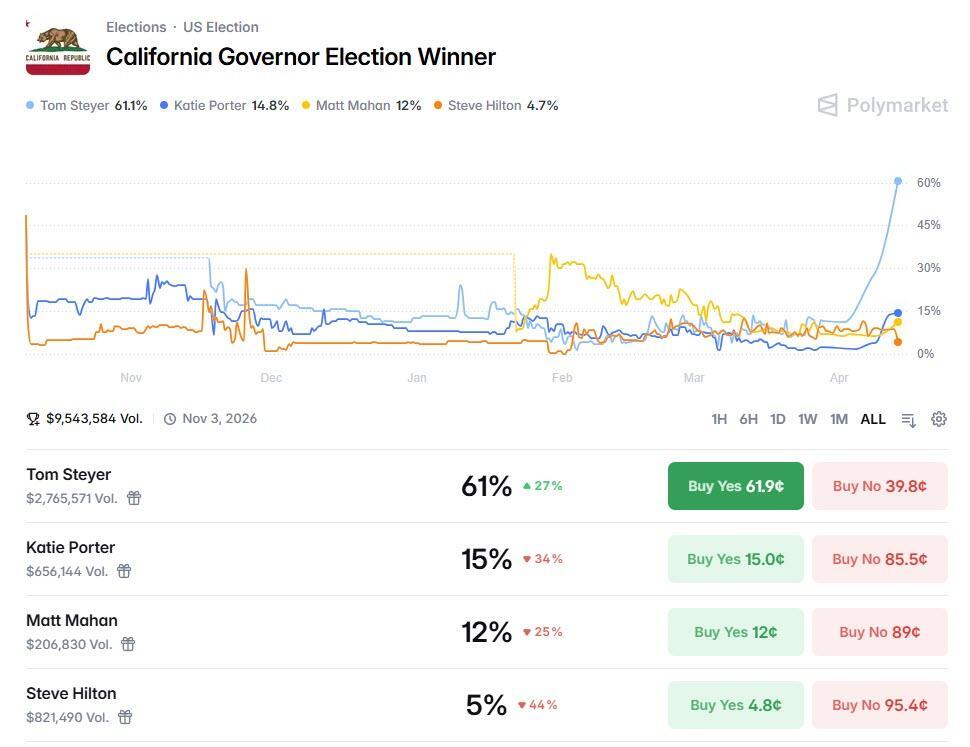
Polymarket odds of becoming California's next governor are at 4% as of this writing...
The stunning drop - visible in real time on platforms such as Polymarket, where “Yes” contracts on Swalwell's victory traded as high as $1,100 earlier in the day before cratering to pennies - reflects a campaign that appears to be in free fall just weeks before ballots drop in the June primary. Traders piled into the “No” side at 96 cents, effectively pricing in the congressman’s political demise in the nation’s largest state.
The Allegations
A woman who worked in Swalwell's Castro Valley district office for nearly two years, beginning around 2019 when she was 21, alleged that Swalwell sexually harassed her as soon as she started, that they had some consensual encounters while she was on staff, and that he twice sexually assaulted her when she was too intoxicated to consent - once in a 2019 hotel room and again in 2024 after she had left his office. The woman, who is not named in the story, told the Chronicle she felt pressured by his position of power and has lived in fear of coming forward.
"She said Swalwell, who is married and 17 years her senior, tried to kiss her in her car when she drove him home from a donor meeting one night. Driving him to another event weeks later, she said Swalwell pulled out his penis in the car and asked her to perform oral sex on him. She said she did so in a parking lot.
In September 2019, the woman said, Swalwell invited her out for drinks and she became so severely intoxicated that she does not remember the rest of the night. She said she woke up naked in Swalwell’s hotel bed and could feel the effect of vaginal intercourse. She said Swalwell distanced himself from her afterward and the relationship faded." -The Chronicle
Swalwell immediately rejected the claims as “false” ...hang on...
...and politically motivated, calling them a last-ditch effort to kneecap the Democratic primary leader. “For nearly 20 years, I have served the public — as a prosecutor and a congressman - and have always protected women,” he said in a statement. “I will defend myself with the facts and where necessary bring legal action.” His attorney sent a cease-and-desist letter to the accuser’s counsel threatening defamation litigation.
The allegations landed as the campaign was already reeling from weeks of unverified social-media rumors about inappropriate conduct with female staffers. By Friday, the fallout was swift and brutal.
At least four senior aides had resigned in anticipation of the story, according to multiple Democratic sources familiar with the situation. Unions that had endorsed Swalwell, including the powerful UFCW Western States Council, withdrew their support and called on him to suspend his campaign. “The allegations … are extremely detailed, troubling, and gut-wrenching,” the union said in a statement.
Even longtime ally Rep. Ted Lieu (D-Calif.) publicly withdrew his endorsement. House Speaker Emerita Nancy Pelosi, who had been neutral in the race, issued a carefully worded statement Friday night: “This extremely sensitive matter must be appropriately investigated with full transparency and accountability. As I discussed with Congressman Swalwell, it is clear that is best done outside of a gubernatorial campaign.”
* * * Update: House Speaker Hakeem Jeffries has called for Swalwell to step down, as well as for an investigation.
Swalwell’s campaign manager, Yardena Wolf - his longtime chief of staff who moved over to run the gubernatorial operation - had personally briefed a small group of online influencers earlier in the week on the initial rumors, sticking to the campaign’s line that the claims were “false, outrageous” and that no NDAs or ethics complaints existed. Wolf has not issued a new public statement since the Chronicle story dropped, and a campaign spokesperson was unreachable Friday night amid the staff exodus.
JUST IN: The 'Endorsements' section on Eric Swalwell's campaign site has been removed and returns a 404 error. pic.twitter.com/sMndosxwWl
The political math in California has shifted overnight. Just weeks ago, Emerson College polling showed Swalwell leading a fragmented Democratic field with 17 percent support and 25 percent undecided. Prediction markets briefly pegged his chances above 60 percent. He had positioned himself as the Democrat best equipped to counter the Trump administration from Sacramento, leveraging his national profile and prosecutorial background.
Now the race is wide open. Rivals who once struggled for attention are suddenly the story, while progressive voices that once gave Swalwell the benefit of the doubt are demanding full investigations - or his immediate exit from the race and even Congress.
The timing has fueled intense partisan finger-pointing. Swalwell allies describe the allegations as a coordinated hit job engineered by flailing opponents and amplified by conservative voices. Supporters of the accuser counter that the details are credible, long-suppressed and too serious to ignore for a candidate seeking the state’s highest office.
Whatever the ultimate legal or electoral verdict, the market verdict is already in. The blue line on the betting charts has turned into a cliff - and Eric Swalwell’s path to the governor’s mansion has all but vanished.
Needless to say, not even Chinese spies will be interested in Eric after this.
New York City-based NewYork-Presbyterian has beenorderedto pay $500,000 and make “sweeping” reforms as part of a settlement over its treatment of patients experiencing behavioral health emergencies.
Six things to know:
1. Following a yearslong investigation, the Office of the New York State Attorney General found NewYork-Presbyterian “engaged in a repeated pattern of failures that put vulnerable patients at risk,” according to an April 13 news release from the office. The investigation included testimony from providers and affected families and reviews of emergency department visit data, patient records, incident reporting systems and psychiatric bed capacity data.
2. A NewYork-Presbyterian spokesperson said providing safe, high-quality care for patients with complex behavioral health needs is a priority, according to an April 13 statement shared with Becker’s.
“Since 2022 we have continued to strengthen policies and workflows, expand mental health capacity with inpatient beds and outpatient services, and improve safety — improvements that the Attorney General’s findings acknowledge,” the spokesperson said. “We are proud to have one of the largest behavioral health footprints of any multi-campus hospital in New York and remain committed to continuous improvement for our patients and the communities we serve.”
3. Specific concerns the attorney general’s office cited include failing to properly evaluate and stabilize patients in emergency departments and diverting ambulances from bringing behavioral health patients to the emergency department. In multiple instances, patients experiencing serious psychiatric symptoms, such as suicidal ideation and violent behavior, left the hospital without being properly discharged or transferred because of inadequate supervision and safety protocols, the release said.
4. The attorney general’s office also found that despite directions from state regulators and growing patient demand, the system did not bring all of its licensed inpatient psychiatric beds back online after the pandemic. More than 100 psychiatric beds were out of operation across the system as of May 2023, according to the release.
5. NewYork-Presbyterian has been ordered by the state to make changes to better serve patients and strengthen oversight, including:
Major emergency department reforms, such as strengthening screening policies to identify risks including suicide and violence and improving patient safety and monitoring by establishing mandatory observation protocols.
Elopement prevention measures, including requirements for staff to immediately escalate situations, notify leadership and fully document when a high-need patient goes missing.
Health record upgrades to ensure providers have real-time access to full patient information and can follow care protocols.
Care coordination improvements, including requirements for staff to review prior records, consult relevant databases and make efforts to contact a patient’s family members and document all outreach.
Stronger discharge and admission planning, such as ensuring patients with complex needs leave the hospital with necessary follow-up care, including scheduled appointments.
6. In addition to the $500,000 settlement, NewYork-Presbyterian will face a $10,000 penalty per violation for any future violations of the settlement terms, the release said.