Search This Blog

Friday, May 15, 2026

Iran warns backers of US Hormuz resolution


Iran’s mission to the United Nations accused Washington on Friday of attempting to manufacture the appearance of broad international backing for its actions through a US-backed draft resolution on the Strait of Hormuz.

In a sharply worded statement, the mission said the United States was exploiting the number of co-sponsors attached to the resolution to create a “false image” of international support for what it described as unlawful actions against Iran.

“Should the U.S. trigger any new escalation, all co-sponsoring States will share international responsibility alongside Washington for the consequences,” it said.

“No political excuse or diplomatic cover can absolve them of responsibility for facilitating, enabling, and legitimizing U.S. aggression.”

https://www.iranintl.com/en/liveblog/202605153417

Iranian hackers suspected over US fuel tank system breaches - CNN


US officials suspect Iranian hackers were behind a series of breaches targeting systems used to monitor fuel levels in storage tanks at gas stations across several states, CNN reported on Friday.

According to the report, the breaches involved automatic tank gauge systems, which help track fuel levels and detect leaks or other issues.

Officials told CNN there is no indication of physical damage so far, but warned that compromising such systems could create broader safety risks if problems go unnoticed.

US investigators reportedly suspect Iranian involvement partly because Iranian-linked cyber actors have previously targeted vulnerable infrastructure systems tied to energy and utilities.

https://www.iranintl.com/en/liveblog/202605153417

Waltz says China ‘backed away’ from Iran after Trump-Xi summit


US Ambassador to the United Nations Mike Waltz said China has “backed away” from Iran following President Donald Trump’s meetings with Chinese President Xi Jinping in Beijing this week.

Appearing on Fox News program The Story, Waltz described Beijing’s shift in posture as one of the major outcomes of Trump’s three-day visit to China.

Asked to explain what he meant, Waltz said Beijing had agreed on two key principles: “no nuclear weapons and no militarization of the Strait of Hormuz.”

https://www.iranintl.com/en/liveblog/202605153417

'AP: Largest U.S. Children's Hospital to Set Up a 'Detransition Clinic' for Trans Youth'

 The nation's largest children's hospital has agreed to a legal settlement with Texas and the Trump administration over gender-affirming care for transgender youth that includes a $10 million payment to the state and the requirement to set up a "detransition clinic," the administration and Texas Attorney General Ken Paxton announced Friday.

Texas Children's Hospital, based in Houston, said in a statement that it had agreed to the settlement "to protect our resources from endless and costly litigation." The hospital, which serves more than 1 million patients annually, said Paxton's office and the U.S. Department of Justice (DOJ) has investigated its care for 3 years, forcing it to "navigate an unconscionable campaign of mistruths and mischaracterizations."

The hospital announced in 2022 that it would stop gender-affirming hormone treatments for minors after Paxton issued a legal opinion calling such care "child abuse" and Gov. Greg Abbott (R) directed the state's child welfare agency to investigate reports of care as abuse. In 2023, Texas became the most populous state to ban gender-affirming care for minors -- at least 27 ban or restrict it -- and the U.S. Supreme Court ruled in June 2025 that states can do so.

Paxton said the settlement will require Texas Children's to set up a "detransition clinic" to provide free care to transgender patients for 5 years to "reverse the damage" from gender-affirming care. He described it as the first "detransition clinic" of its kind in the nation, although that could not immediately be confirmed.

"This historic settlement reflects an institutional and fundamental shift away from radical 'gender' ideology," Paxton said in announcing the settlement.

Paxton's office did not release a copy of the agreement, and the statement from Texas Children's did not discuss its specific terms.

The leader of the LGBTQ rights group Equality Texas said Texas Children's "has lost its integrity and put politics over patients" and called the settlement "embarrassing."

"Paxton is blackmailing a hospital system into creating a resource that no one is asking for," CEO Brad Pritchett said in a statement. "It ignores the actual science and years of data about the overwhelming benefits of gender-affirming care."

Under Trump, HHS has moved to use its regulatory power to block gender-affirming care for minors, and the DOJ has demanded access to providers' records. Acting U.S. Attorney General Todd Blanche said in a statement Friday that the DOJ would "use every weapon at its disposal" to stop gender-affirming care for children.

Paxton is running for the U.S. Senate, and he announced the settlement less than 2 weeks before a May 26 runoff with him locked in a tight race to unseat GOP incumbent Sen. John Cornyn. President Donald Trump -- who has aggressively sought to roll back transgender rights -- has not publicly endorsed a candidate in the race.

Most major medical groups see access to gender-affirming care as important for people with gender dysphoria. Transgender youth, parents, and providers have described it as life-saving for youth who are depressed or suicidal because their gender identities do not match the sex assigned to them at birth.

Gender-affirming care may include counseling, medications that block puberty, hormone therapy to produce physical changes, or surgeries to transform chests and genitals, although those are rare for minors.

The hospital said it fully cooperated with Paxton's office and the DOJ, produced more than 5 million documents, and did its own internal investigations. All of them showed that it never violated the law, the hospital said.

"These efforts have required significant staff time and financial resources to defend ourselves," its statement said. "This settlement will allow us to redirect those precious resources to focus on the life-saving care and groundbreaking discoveries of our exceptional clinicians and scientists."

Paxton said the agreement also requires Texas Children's to fire -- "and never again hire" -- five doctors who provided gender-affirming care, agree never to provide such care, and to change its bylaws so that any doctor violating the state law automatically loses any privileges at the hospital.

The $10 million payment will go to the state's Medicaid program. Paxton had accused the hospital of submitting false billings, an allegation it rejected.

https://www.medpagetoday.com/washington-watch/washington-watch/121297

"Gold is no longer playing its role as a refuge for investors" (Norman K)


During a press lunch held earlier this week, the international consulting firm shared its market analysis with the media.

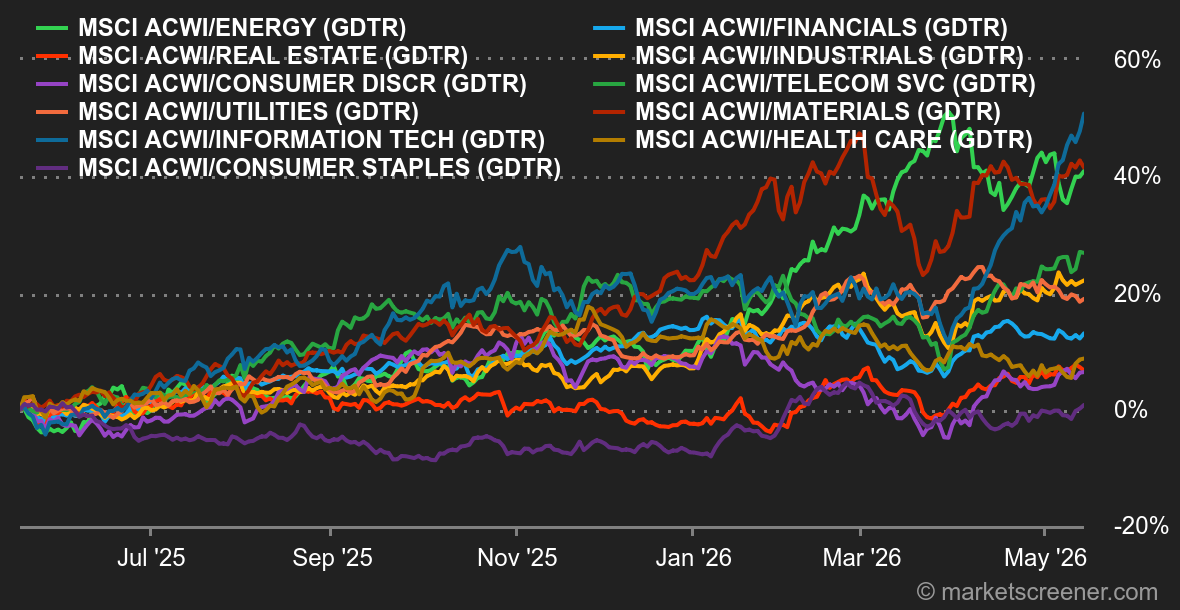
Between the Iran-US war, soaring oil prices, and the relentless surge of artificial intelligence, financial markets have navigated a high-tension Q1 of 2026.


For Grégoire Kounowski, investment strategy advisor at Norman K, the resilience shown by indices masks deep divergences between asset classes and global regions.

"The outbreak of the conflict led to a marked market correction, but the truce in early April, combined with Donald Trump's statements, fostered a rapid rebound in risk assets," the manager explained.

Long considered the ultimate safe haven, gold prices have nearly tripled since 2021. However, this momentum has stalled since the Iran conflict began. Consequently, during the first month of the war in March, gold lost nearly 18%, even hitting -20% mid-session. The yellow metal thus fell alongside equities.

"Gold is no longer a safe-haven asset; it has become a momentum asset," analyzes Grégoire Kounowski.

Even so, YTD, gold is still up 9%, although its price action now mirrors that of risk assets.

Defense retreats while AI flexes its muscles

Another paradox highlighted by Norman K is that defense stocks are retreating despite the opening of a new front. Furthermore, the healthcare sector, typically defensive, is also down. "It is, in fact, the only European sub-sector that has been negative since the start of the year," the specialist points out.

The only true winners of this period have been oil, AI, and semiconductors, which have soared within a few weeks.

While the rest of the world absorbed the shock, American tech continued its ascent. The Nasdaq-100 quickly erased its March correction, and stocks linked to artificial intelligence have posted spectacular performances since the beginning of the year: Intel at +217%, SK Hynix at +148%, Samsung at +114%, STMicroelectronics at +110%, and AMD at +104%.

"AI operates as a separate engine, unaffected by geopolitical crises," summarizes Grégoire Kounowski. This conviction largely explains the resilience of the US market compared to the rest of the world.

China-US: What if Iran was just a pretext?

For Grégoire Kounowski, the true fault line in the markets remains the Sino-American rivalry. "Since Trump's return, there has been a growing rivalry between China and the United States for global superpower status," the advisor notes.

And the Iranian conflict could well be a new disguised episode of this struggle. With Beijing being the primary buyer of Iranian oil, a hypothesis is circulating: "Could it be that, fundamentally, they attacked Iran to target China? It is possible," the manager muses.

In the meantime, the market's verdict is final: the MSCI China remains far from its peaks, weighed on by a persistent real estate crisis. Beijing's only ace in the hole is its strategic reserves, which are cushioning the shock better than elsewhere in Asia.

https://www.marketscreener.com/news/gold-is-no-longer-playing-its-role-as-a-refuge-for-investors-norman-k-ce7f5bd3d989f72c

Ackman, Loeb take different routes on tech bets in early 2026


 Two of Wall Street's most closely watched billionaire stock pickers, both once voluble activist investors, took opposite tacks this year when Bill Ackman bet on Microsoft and exited Google parent Alphabet and Daniel Loeb did the opposite.

Ackman said on X his firm Pershing Square began building a new position in software giant Microsoft in February after shares dropped, saying investors weren't giving it enough credit for its Microsoft 365 office suite and artificial intelligence investments.

Loeb's hedge fund Third Point, on the other hand, sold 925,000 shares of Microsoft during the first quarter, liquidating a position the firm had held since late 2022, according to a new regulatory filing. 

Ackman and Loeb once ranked among Wall Street's loudest activist investors, pushing companies to perform better with suggestions ranging from selling off divisions to firing CEOs.

In recent years, both have adopted a quieter tone, sidestepping public fights that generated headlines, and instead making stock picks and riding along. Picks by the two are closely followed by investors parsing their quarterly filings.

Loeb's Third Point reported it bought 175,000 shares in Google parent Alphabet in the first quarter, while Ackman sold down most of his position in the company, according to a regulatory filing. A source said Ackman exited the rest of his Alphabet holding in the second quarter.

Also during the first quarter, both Pershing Square and Third Point established new positions in Meta Platforms, their filings show. Reuters first reported the position in February when Ackman told clients the technology and social media heavyweight will benefit from artificial intelligence. 

The regulatory filings showed Loeb and Ackman and other big investors who filed their quarterly 13F holding data with the Securities and Exchange Commission are being more selective in investing in the "Magnificent Seven" AI giants, a group that includes Meta, Microsoft and Alphabet.

https://www.marketscreener.com/news/ackman-loeb-take-different-routes-on-tech-bets-in-early-2026-ce7f5bd3dd8aff22

Inflation worries while waiting for Nvidia


Despite investors' still-insatiable appetite for AI-related stocks, which pushed Wall Street to new highs this week, sentiment deteriorated sharply on Friday as inflation fears resurfaced. Stronger-than-expected U.S. economic data put renewed upward pressure on bond yields, as investors worried that central banks could soon adopt a tougher tone, or even raise rates. Profit-taking spread to Europe and Asia, although U.S. markets remain close to flat for the week.
Weekly variations*
DOW JONES INDUST...
49,526.17  -0.17%
Chart DOW JONES INDUST...
NASDAQ 100
29,125.2  -0.38%
Chart NASDAQ 100
FTSE 100
10,195.37  -0.37%
Chart FTSE 100
GOLD
$4,538.32  -3.26%
Chart GOLD
WTI
$101.09  +2.26%
Chart WTI
EURO / US DOLLAR
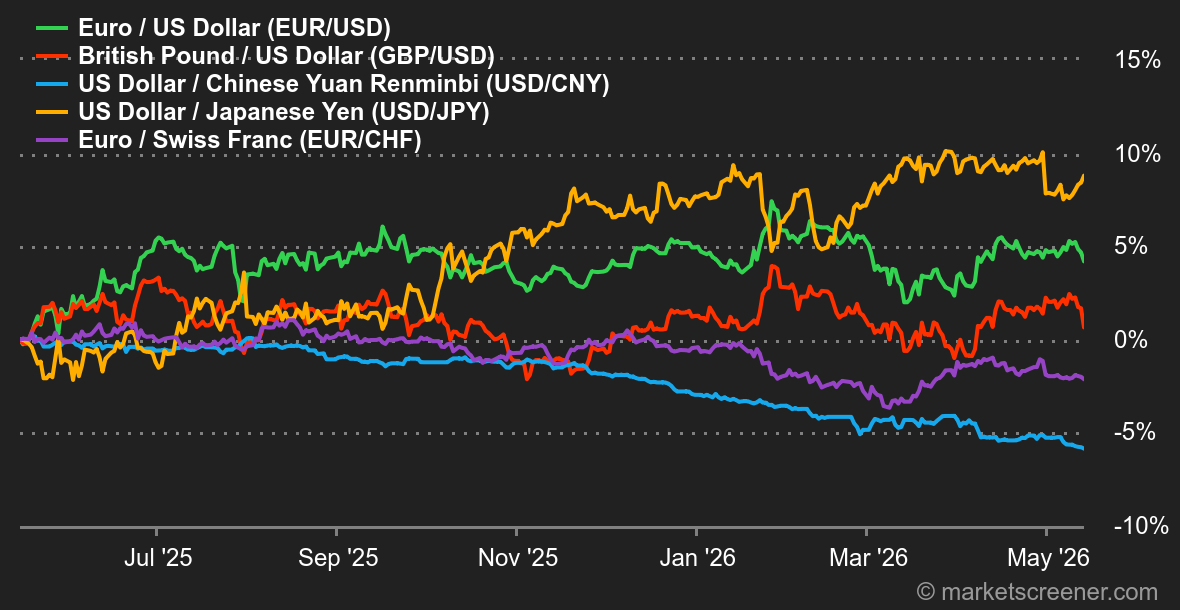
$1.16  -1.22%
Chart EURO / US DOLLAR
This week's gainers and losers
Up:

Tower Semiconductor +29.84% : Investor appetite for semiconductor stocks shows no sign of fading, especially when companies deliver strong results. The U.S. company also announced contract wins totaling €1.3 million.

Rocket Lab Corporation +18.3% : After reporting results last week, the company benefited from positive recommendations from Deutsche Bank and New Street. A recent insider share sale was not enough to derail the rally.

Nebius Group +24.22% : A notable rebound. When it reported results, the U.S. group announced diluted earnings per share of $2.11, compared with a loss of $0.48 a year earlier.

Lumen technologies +18.51% : Northline is the name the fiber specialist has given to its new low-latency optical route linking Seattle and Minneapolis. Another positive: Lumen and Qwest Corporation announced an extension of the early participation and withdrawal deadlines for their offers.

Ford +8.77% : The U.S. automaker rallied after the official launch of Ford Energy, a subsidiary focused on battery storage systems for data centers and large industrial customers. The stock was also helped by a Morgan Stanley note valuing the new business at up to $10 billion, based on a target operating profit of about $588 million at full capacity, or 20 GWh a year.

Philip Morris +10.89% : The U.S. tobacco company saw a clear rebound in investor interest after the FDA issued new guidance saying it would not prioritize enforcement action against nicotine pouches and vaping products whose premarket authorization applications have been accepted and are under review. The move removes much of the regulatory uncertainty that had weighed on ZYN Ultra and IQOS in the United States.

Tate & Lyle +44.55% : The British food ingredients specialist surged after U.S.-based Ingredion made a cash takeover offer valuing the shares at 615 pence each, a 64% premium to the last closing price, against a backdrop of sustained weakness in the stock over the past year.

Intertek +14.36% : The British testing, inspection and certification specialist jumped after its board said it was prepared to recommend EQT’s final offer of GBX 6,000 per share. This is the Swedish fund’s fourth sweetened bid, valuing the group at £9.4 billion.

British American Tobacco +13.99% : The British tobacco giant benefited from a major regulatory reprieve in the United States. The FDA said it would deprioritize enforcement action against smoke-free products with accepted PMTA applications, significantly reducing the risk hanging over the Vuse and Velo brands. Morgan Stanley upgraded the stock to overweight, while Citi raised its price target to GBX 5,200.

Down:

JBS -16.33% : The Brazilian meat processor listed in New York was hit by a double blow: weaker results and earnings per share that were more than halved. JP Morgan then downgraded the stock from buy to neutral. Morgan Stanley remains positive on the name but cut its price target to $19 from $20.50.

Intel -12.93% : South Korea raised the prospect of a tax on AI-related stocks, sending the sector lower. After the Korean giants, Intel and SanDisk also came under pressure, with SanDisk further hurt by a $3.5 million insider share sale.

Oklo -14.15% : A widening net loss is rarely a good sign. Oklo’s net loss again landed in negative territory, at $33.1 million, compared with analysts’ expectations for a $32.1 million loss.

3i Group -14.67% : The British private equity firm fell sharply after reporting annual results. The main concern is the trajectory of Action, its flagship holding, which represents 65.4% of a £31.8 billion portfolio, as growth slows and margins narrow.

Burberry -12.27% : The British fashion house came under pressure after annual results showed revenue down 2%, despite an improvement in earnings driven by Joshua Schulman’s restructuring plan. The entire sector remains out of favor, with analysts at AlphaValue noting that “the highly uncertain geopolitical backdrop and persistently weak tourism-related demand continue to limit visibility.” Salvatore Ferragamo also fell sharply after lackluster figures.

Chart Commodities
Commodities

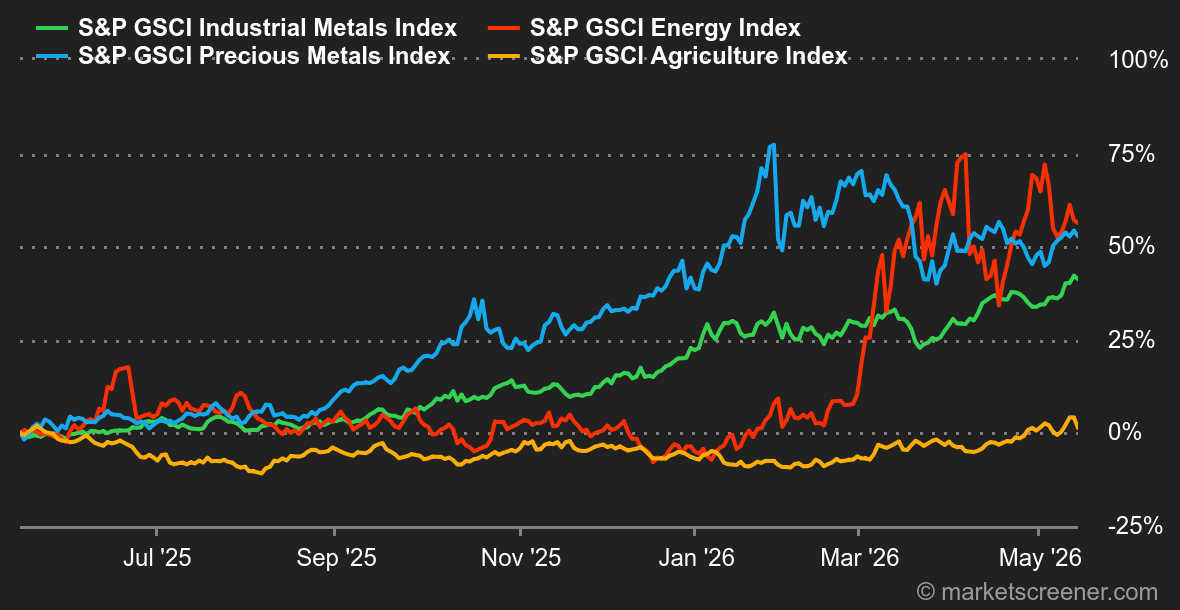
Energy: Oil prices ended the week sharply higher. Brent rose nearly 4% to around $108 a barrel. U.S. WTI also advanced, moving above $100. The market reacted to ongoing disruptions in the Strait of Hormuz and a persistent global supply deficit. The meeting between Donald Trump and Xi Jinping in Beijing failed to break the deadlock over Iran. Both presidents agreed on the need to prevent Tehran from obtaining nuclear weapons and to reopen the Strait of Hormuz. The market hopes China will use its influence over Iran to help secure a peace deal, but no concrete progress emerged from the summit. On the ground, geopolitical risks remain high. Tight supply remains the main driver of higher prices. The International Energy Agency (IEA) estimates that global production fell by 1.8 million barrels per day (mb/d) in April. The latest OPEC report confirms the trend. The cartel’s production fell by 1.73 mb/d in April. The decline stems from export difficulties in the Persian Gulf and still includes volumes from the United Arab Emirates, which officially left OPEC on May 1. On 2026 demand, agencies are offering different scenarios. The IEA cut its forecast and now expects global demand to fall by 420,000 barrels per day, weighed down by aviation and petrochemicals. OPEC, by contrast, maintains a positive outlook and expects demand to grow by 1.17 mb/d.

Metals: In London, copper topped $14,000 a metric ton this week before pulling back to around $13,938. As with oil, the rally was driven by supply-side concerns. Peru, the world’s third-largest producer, is facing production issues, raising the risk of a copper shortage given low global inventories. Demand, meanwhile, remains strong. The development of artificial intelligence requires the construction of many data centers, which use large amounts of copper. In precious metals, gold fell this week to $4,550. The U.S. economy continues to face persistent inflation. U.S. producer and consumer prices rose sharply in April, wiping out hopes for an interest-rate cut this year. High interest rates weigh on gold, as investors prefer assets that generate income.

Agricultural products: Wheat posted the strongest weekly gain. The July 2026 contract rose 6% over the week to 650 cents a bushel. The increase was driven directly by the $A’s latest forecasts, which point to a weak wheat harvest. Soybeans reacted to U.S.-China trade talks and ended the week slightly lower, at 1,188 cents. Donald Trump expects China to make large soybean purchases, but price action suggests the market is tempering those expectations.

Chart Commodities
Macroeconomics

Macro: The odds of a Fed rate hike appear to be rising by the day. According to the CME FedWatch tool, markets now see roughly a one-in-two chance that the Fed raises rates at least once by year-end. This week's inflation data, with both CPI and PPI above expectations, increased pressure on the Fed. The U.S. 10-year yield crossed 4.5% this week. The 2-year yield, generally seen as a proxy for expectations about the Fed's rate path, is at its highest level since last June. Back then, the Fed funds rate was 75 basis points higher. Finally, Jerome Powell's term as Fed chair ends this Friday. Kevin Warsh, confirmed by the Senate this week, will take over.

Crypto: Bitcoin fell 2.2% this week and is once again flirting with $80,000. More broadly, alongside equity indexes, BTC has gained 17% since late March. But that still trails the Nasdaq 100, which is up 28% over the same period. The leading cryptocurrency had previously accustomed investors to magnifying moves in equity indexes, both up and down. This time, however, enthusiasm for the AI-semiconductor theme has largely overshadowed crypto. As a result, while investors once diversified by adding a bitcoin position to their portfolios, the trend now is to pile into anything that sounds like “semiconductor.” It is reminiscent of the period when simply adding the word “blockchain” to a press release was enough to send a stock soaring. This time, though, the use cases for AI are much more tangible than they were for blockchain. It may take tomorrow's AI agents adopting crypto use cases at scale before major inflows return to the cryptosphere. For now, other cryptocurrencies have followed bitcoin lower since Monday: ether (ETH) is down 4.8%, around $2,250; Solana (SOL) has fallen 5.5%, to $91; and XRP is flat at around $ 1.46.

Historical Chart
It was a strange week for markets, caught more than ever between AI enthusiasm and inflation fears. As of this writing, the much-anticipated summit between Donald Trump and Xi Jinping has delivered little. The United States and China probably made progress in some areas, but there were almost no major announcements. Worse, the situation in Hormuz does not appear to be easing, even though markets had placed considerable hope in the meeting between the world's two most powerful leaders.

There are still a few earnings releases left, and some major ones at that. Nvidia reports on Wednesday, with Home Depot on Tuesday and Walmart also on Wednesday. On the macro calendar, investors will take the pulse of major economies on Thursday with May flash PMI readings.

https://www.marketscreener.com/news/inflation-worries-while-waiting-for-nvidia-ce7f5bd3da8bf322