Search This Blog

Thursday, July 9, 2026

Fed Appoints Walmart Ex-CEO to Task Force on Real-Time Economic Data

The Federal Reserve has appointed Doug McMillon, ex-Walmart CEO, to co-lead a task force on real-time economic data. The group includes Raj Chetty and Kevin Murphy, and was announced July 9 by Fed Chair Kevin Warsh. The project aims to improve data on spending, inflation, and growth to support monetary policy. McMillon is serving in a personal capacity. Marc Andreessen was also named to lead a separate task force. The move could affect risk-on assets amid broader CFT efforts.

The Federal Reserve has long made trillion-dollar decisions based on economic data that arrives weeks or months after the fact.


On July 9, 2026, Fed Chair Kevin Warsh announced the creation of multiple external task forces to reassess the central bank’s monetary policy toolkit. Among the most notable appointments: Doug McMillon, former CEO of Walmart, who will co-lead a task force dedicated to improving the quality and timeliness of economic data alongside economists Raj Chetty and Kevin Murphy.

Why a retail executive is now advising the Fed

McMillon stepped down as Walmart CEO in February 2026 after an 11-year run atop the world’s largest retailer. During that time, he oversaw a company that processes hundreds of millions of transactions per week across thousands of stores.

The task force’s mandate is to improve real economic signals around spending, inflation, and growth, the three pillars that drive virtually every interest rate decision the central bank makes.


The Bureau of Labor Statistics releases its Consumer Price Index once a month, with a lag. GDP figures come quarterly. Retail sales data arrives weeks after the transactions happen.

No direct data-sharing partnership between Walmart and the Fed has been substantiated. McMillon is there in a personal advisory capacity, not as a Walmart representative.

Venture capitalist Marc Andreessen was also named as a leader of a separate task force on the same day.

What this could mean for monetary policy

The Fed was famously late to recognize inflation in 2021 and 2022, insisting it was “transitory” while grocery bills and rent were already screaming otherwise.

https://www.kucoin.com/news/flash/fed-appoints-walmart-ex-ceo-to-task-force-on-real-time-economic-data

Israel Hands US Curiously-Timed Intelligence Saying Iran Plotting To Assassinate Trump

 Update(21:00ET): Here's what President Trump said from Ankara on Wednesday which left many wondering just what he was referring to: "They want to take out the U.S. leader—me," he said in reference to the Iranians. "I’m on every list. I saw this morning, I’m on every single one of their lists. And so far, I guess I’ve been a little bit lucky, but that maybe doesn’t last very long."

The Wall Street Journal in a Thursday evening report says that Israel has provided fresh intelligence to the White House indicating just such a Tehran-linked plot. The timing is quite curious and interesting given it comes just as the warring sides standing on the brink of returning once again to full-scale war:

Israel shared new intelligence with the U.S. that it said indicated a fresh Iranian plan to kill President Trump, people familiar with the matter said, a finding that would mark an escalation in the war between Washington and Iran.

Iran for years has vowed openly to retaliate against Trump for the assassination of Qassem Soleimani, who was a top general in the Islamic Revolutionary Guard Corps, in the president’s first term. 

The Israeli embassy in Washington declined to comment. Iran’s Mission to the United Nations didn’t immediately respond to a request for comment. The White House referred The Wall Street Journal to comments the president made on Wednesday. 

The Israelis have remained deeply dissatisfied with terms laid out in the previously agreed-to MoU, and so have every incentive to goad Washington further into the conflict. Certainly many within the US administration know this, and so might be taking this new 'intelligence warning' - which was leaked rather quickly to major media - with the appropriate degree of skepticism. 

Meanwhile the US says it is still engaged in 'technical talks' with Iran, despite the past days of tit-for-tat bombings. "Technical talks between the US and Iran are continuing, according to a US official, following two days of clashes that threatened to shatter an already fragile ceasefire between the two nations," reports Bloomberg, also late in the day Thursday. "The US is still committed to finding a solution with Iran, the official said Thursday, speaking on condition of anonymity to discuss the matter."

So it appears there's still hope that things might not spiral further. As for the alleged assassination plot, this isn't the first time Iran has faced such accusations, and each time Tehran officials have vehemently denied them.

*  *  *

Just as the US nighttime strikes were significantly bigger than prior rounds in June, so has Iran's 'retaliation' been bigger - chiefly on Gulf states and American bases there.

In the overnight and Thursday daytime hours, Iranian ballistic missiles and drones have targeted Kuwait, Qatar, Bahrain, and even faraway Jordan. The country is reporting that it has intercepted several missiles, which targeted Muwaffaq Salti Air Base - jointly operated by US and Jordanian forces. Oil prices have persisted above prewar levels on Thursday.

Social Media/UGC/Reuters

"Jordan has intercepted eight Iranian missiles in its airspace after sirens sounded across the country, according to the armed forces," reports Al Jazeera. "Falling shrapnel did not cause any casualties or material damage, it added."

Following the US bombing of the Islamic Republic for a second consecutive night, which came after Iranian forces sought to enforce its own shipping route and protocol on the Strait of Hormuz (which saw several international vessels attacked), Tehran has newly confirmed it in turn struck "US bases and strategic centers” in Bahrain, Kuwait, and Qatar.

In particular the IRGC has claimed that two US bases in Kuwait and two base in Bahrain were attacked - and the Iranian elite force is threatening more to come. US Central Command (CENTCOM) says the rate of its strikes have grown to about 14 times the number of targets hit in the last late June flare-up in fighting.

According to the figures cites in the NY Times:

U.S. forces have struck more than 170 Iranian military targets in the past two days, including air defense systems, drone and missile storage sites, military speed boats, and logistics infrastructure along the coast near the Strait of Hormuz, according to the U.S. Central Command. 

CENTCOM released footage of some of the fresh strikes:

In some instances civilian infrastructure like rail lines and bridges have reportedly been hit, which marks a return to the opening months of Operation Epic Fury, when targets all across the country were damaged or obliterated.

Little that's confirmable in the way of damage has come out of the Gulf states at this point

Kuwait said that it had intercepted three ballistic missiles, a cruise missile and 10 drones early Thursday morning and that falling debris had injured one person and caused material damage. Bahrain’s military said it had intercepted and destroyed several drones and missiles after Iran launched attacks on Thursday.

Iran also said that it had launched an attack in Qatar, a key mediator in Iran’s talks with the United States. The Qatari authorities did not confirm any strikes but did issue a public security alert early this morning that it later lifted.

Iranian state sources have said the two days of renewed American attacks have killed 14 people and wounded 78. The casualty count could be much higher given that strikes and counterstrikes could be extended as an offramp becomes more elusive. Explosions have been observed along the Iranian coast, including Bushehr, Chabahar, Bandar Abbas, and Sirik.

As for potential offramp, President Trump is still claiming that Tehran wants to make a deal "badly" - and even specified to reporters aboard Air Force One that Iran "called a while ago" make just such a request. Most pundits and reporters, after hearing the same line literally dozens of times over the past months, are skeptical to say the least. 

While this remains Trump's public-facing rhetoric, a fresh Thursday report in The Wall Street Journal offers a contrasting account. "Angered by the strikes, Trump pressed them on whether they believed Iran was serious about reaching a final deal," WSJ writes. "In the end, after discussing it with his senior aides, the president decided they weren't."

Trump had later (on Wednesday) said from Ankara at the NATO summit, "To me, I think it’s over." He then emphasized: "I don't want to deal with them…They’re liars, they’re cheats, they’re sick people."

As for Tehran's position, "An Iranian diplomat said Wednesday that the US had violated the peace deal by setting up a shipping lane that wasn’t coordinated with Tehran, contending that it justified the Islamic Republic’s decision to fire at traffic," according to the same report.

From there, Secretary of War Pete Hegseth warned alongside Trump that the United States would hit Iran "even more, and even deeper" - after that the Pentagon announced it would "further degrade their ability to threaten freedom of navigation in the Strait of Hormuz."

A US official was also quoted in the WSJ as saying Iran had chosen "the path of violence" and so will face the consequences.

*  *  *

More overnight developments

via Newsquawk...

Overnight strikes:

  • At the direction of the Commander in Chief, US Central Command forces have started conducting additional strikes against Iran to further degrade their ability to threaten freedom of navigation in the Strait of Hormuz. The United States is holding Iran accountable for recent unjustified aggression against commercial shipping and civilian crews freely navigating a vital international waterway.
  • US military base in Kuwait was hit in an Iranian retaliatory attack, while explosions heard at the US Fifth fleet HQ in Bahrain.
  • Iranian missiles targeted the Azraq base in eastern Jordan, Fars reported.
  • Iranian opposition sources report that maritime industries, shipyards, and the Revolutionary Guards' naval base in Bandar Abbas were attacked, report Kan News.

US Commentary:

  • US President Trump said Iran called a while ago, they want to make a deal.
  • US President Trump's frustration with Iran was due in part to his anger over the Strait not being fully open yet and that Iran hit ships transiting the Strait, CNN reported citing a US official. The official added that Trump is losing patience with the pace of negotiations, specifically Iran's appearing to slow walk Washington on the nuclear talks.
  • US President Trump posted "This is in retribution for yesterday’s bombing of ships by Iran. If it happens again, it will get much worse!".
  • US President Trump said Iran was just hit very hard, we have many ways to win; do not know if Iran will honour a deal but Iran wants to make a deal badly. Europe wants to help on Iran.
  • A US official said the ceasefire with Iran has been halted, at least temporarily, CNN reported.
  • "Everything depends on Iran's response - if they continue to shoot, the night's events could become a daily, weekly event. We are prepared," i24News reported citing a US source.
  • The length and severity of the new campaign depends entirely on Tehran's next moves, Axios reported citing a US official; The White House is preparing for a multi-day or multi-week exchange of fire with Iran over the Strait of Hormuz.
  • Israel has no connection to the US strikes on Iran, Al Arabiya reported citing an Israeli military source. Any attempt to target Israel will be met with a swift, decisive and strong response.

Iran Commentary:

Iran's Bushehr Governor said that US attacks on a nuclear plant in the region are not true.
Iran's advisor to the Supreme Leader Rezaei said "martyr Khamenei taught us not to fear American and showed that falsehood will perish. Await the hard slap from the Iranians".
Iran's IRGC said they will respond to the targeting of a bridge in Aqqala, Al Arabiya reported.
Iran's IRGC said two US bases in Kuwait and two base in Bahrain were attacked, response will be extended to other US bases in the region if the US repeats its attacks.
Iranian Parliament Speaker Ghalibaf said America has not yet learned that bullying and breach of promise are no longer free, adds the Strait of Hormuz will only open with Iranian arrangements, not American threats.
The US attack on Bushehr did not cause any damage to the nuclear power plant, Nour news reported citing a source.

Lebanon:

  • "The US ambassador in Beirut: Negotiations between Lebanon and Israel have moved to Rome for technical reasons", via Al Arabiya. Preparations are underway regarding the start of work in the pilot areas.
  • Israeli Defence Minister Katz said they will remain within the Lebanon security zone and will operate within it until Hezbollah is disarmed.

https://breakingthenews.net/Article/US-said-to-maintain-Iran-talks-despite-alleged-ceasefire-breach/66670467

Hormuz tanker traffic ‘grinds to a halt’ - Lloyd’s List


Shipping through the Strait of Hormuz has fallen sharply following the latest escalation between the United States and Iran, Lloyd’s List Intelligence, a maritime data and analytics provider, said Thursday in a post on X.


The firm said traceable vessels transiting through the US-coordinated Omani path had effectively ground to a halt in response to the latest confrontation.

https://www.iranintl.com/en/liveblog/202607049017

Shooting during Khamenei burial leaves two Basij members killed - reports


Two Basij members, state-run paramilitary volunteer militia within the Islamic Revolutionary Guard Corps, were killed in a shooting in Mashhad after two unidentified men in military clothing opened fire on them with handguns, according to IRGC-affiliated Sabereen News.

The shooting reportedly took place on Fakouri Boulevard, while gunfire was also heard near the Imam Reza shrine.

One of the Basij members was killed at the scene and another died later in hospital, the reports said. The attackers fled, and security forces are searching for those behind the attack.

https://www.iranintl.com/en/liveblog/202607049017

Immigration Enforcement Benefitted American Workers

 By Steven A. Camarota and Karen Zeigler on July 9, 2026

Expanded immigration enforcement has triggered several claims that the effort is having a “chilling effect” and imposing a “devastating toll” on the U.S. economy. In fact, data through June of 2026 shows evidence that since President Trump took office the native-born have made significant job gains. This analysis looks at native employment gains in the Bureau of Labor Statistics’ household survey, formally known as the Current Population Survey (CPS), and discusses the reweighting of the government data at the start of 2026, its impact on estimates of native employment, and limitations associated with using CPS data to measure employment trends by nativity.

Among the findings:

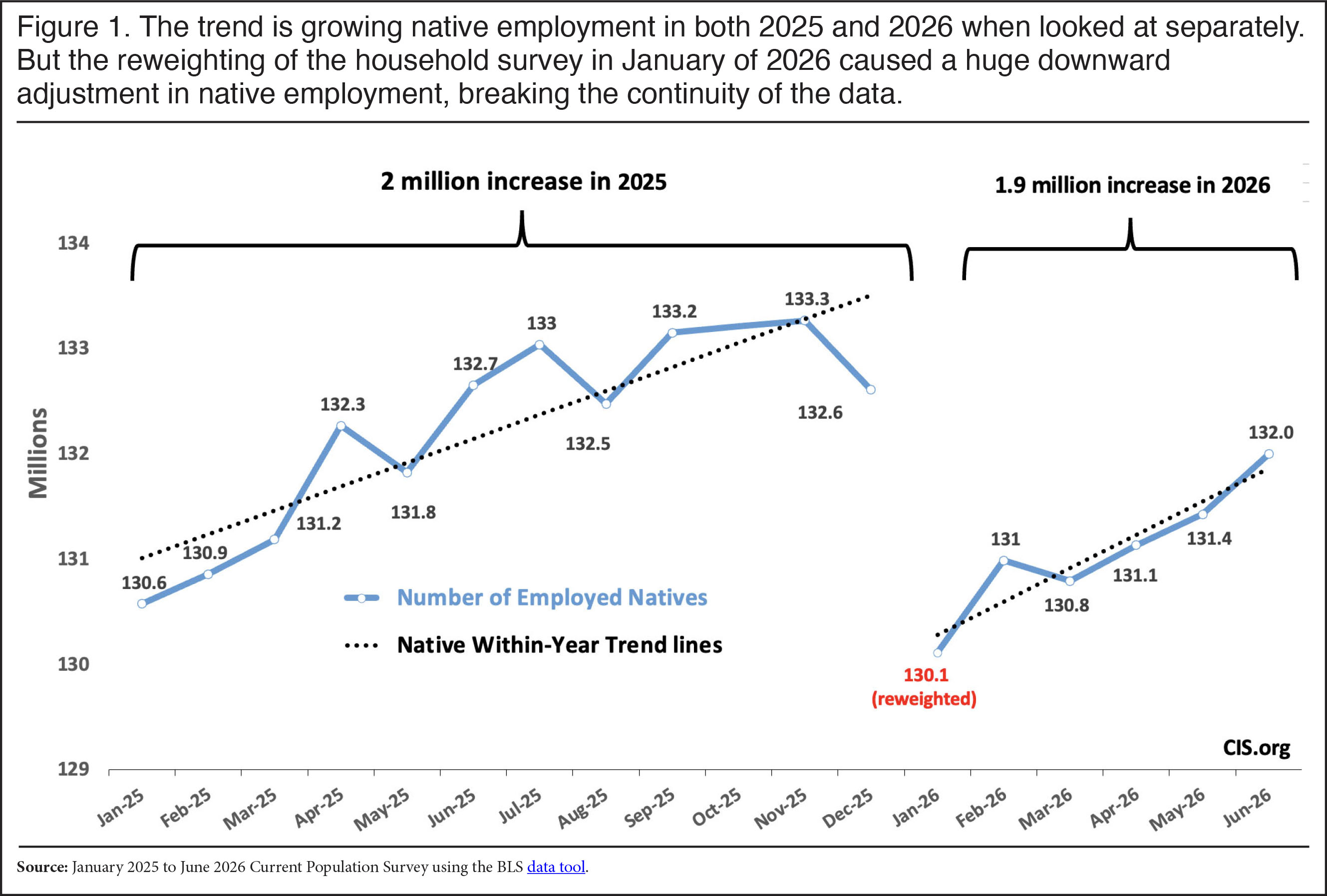
  • When 2025 and 2026 are looked at separately using within-year consistent survey weights, they show two million and 1.9 million increases, respectively, in the number of natives employed.
  • The within-year native employment gains in 2025 and 2026 are substantially larger than the within-year increase of 758,000 from January to December of 2024, or the 367,000 increase in 2023.
  • The reweighting of the data by the government in January of 2026 caused a huge 2.5 million decline in the estimated number of natives employed ─ the largest decline in native employment associated with the annual reweighting of the data since 1996.
  • Even with the January adjustment, there were still 1.4 million more natives employed in June 2026 than in January 2025, when increased enforcement began.
  • In addition to the large native employment gains, the general stability in the unemployment and labor force participation rates of natives indicate that the administration’s stepped-up immigration enforcement efforts have not harmed their labor market prospects.
  • Estimates of employment by nativity have to be interpreted with caution due to the lack of seasonal adjustment in the available data, normal sampling variability, and the weighting scheme used in the survey, which causes a decline in the estimated immigrant population to mechanically create an estimated increase in the native population, and vice versa.

Discussion

Within-Year Growth in Native Employment. In the technical supplement below we discuss the complexities of the survey’s weighting scheme, which is revised each January, and other limitations of the survey. That said, the CPS is the only data available that directly measures native and immigrant (also called foreign-born) employment.1 Figure 1 shows that using consistent within-year sample weights, from January to December 2025, native employment increased by two million. From January to June 2026, native employment increased by slightly under 1.9 million.

These changes are substantially larger than the within-year increase of 758,000 in the number of employed natives from January to December 2024, or the 367,000 increase in 2023. In fact, the 2025 and 2026 within-year increases in native employment are roughly on par with the 2.1 million within-year native employment increase from January to December 2022, when the U.S. economy was rapidly recovering in the immediate aftermath of Covid.

The Impact of Survey Reweighting. The CPS is reweighted each January to reflect updated estimates of the size and composition of the U.S. population. The January 2026 readjustment resulted in a large downward shift in the number of natives employed. The total increase in natives employed when January 2025 is compared to June 2026 is “only” 1.4 million, even with the January 2026 downward adjustment. This increase is substantial, but not as large as the increase implied by the within-year comparisons when consistent sample weights are used. As the figure shows, the number of employed natives was reduced by an implausibly large 2.5 million in the January 2026 CPS. January of 1996 was the last time there was as large a downward adjustment in native employment associated with the annual re-adjustment of the survey weights.

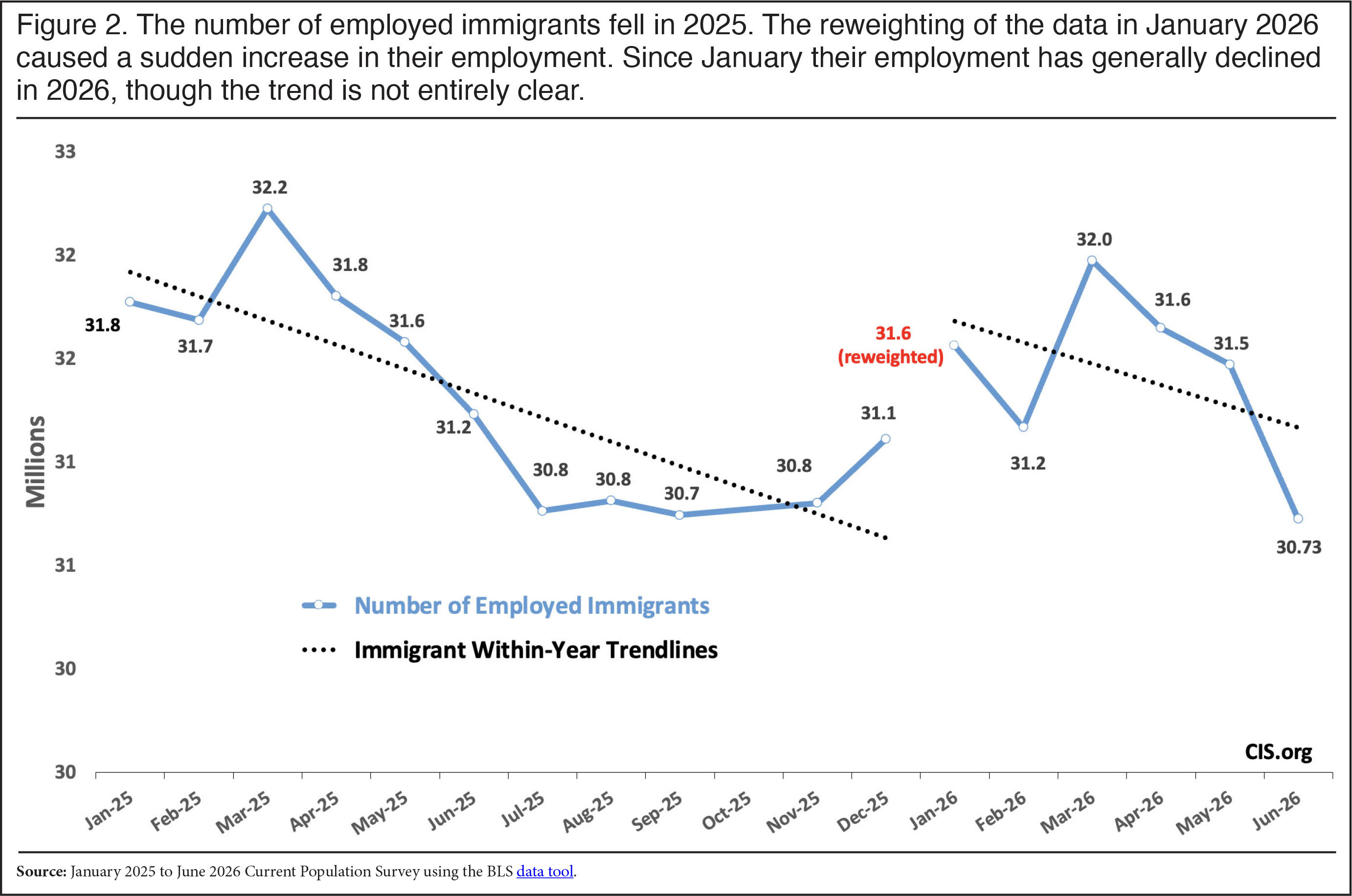
The number of employed immigrants actually went up from December 2025 to January 2026 by 450,000 (see Figure 2). This means the total decline in the number of people employed (immigrant and native together) was 2.1 million. Although there was an increase in immigrants working associated with the January adjustment in 2026, the number of working immigrants in June 2026 was about one million less than what it was in January 2025 at the start of the Trump administration. The public-use microdata, which are only available through May, show that all of the decline in employment among immigrants was due to a falloff in the number of non-citizens working. This is certainly consistent with the possibility that increased immigration enforcement caused non-citizens to leave the country, or at least leave the job market.

The Implausible Decline in Native Employment from 2025 to 2026. A one-month decline in native employment of 2.5 million is not really possible unless there was a severe recession, which is certainly not the case in 2026. As we will discuss below, there is no question that this falloff was due primarily to the adjustments to the CPS sample weights made by the Census Bureau in January 2026. That said, Figure 1 shows that the slope of the within-year trend lines in the number of employed natives for 2025 and 2026 are large and positive. The labor force participation of working-age (18 to 64) natives and their unemployment rate remained largely unchanged since the current administration took office in January 2025.2 The large increase in native employment and the stability of their unemployment and labor force participation rates indicates that increased immigration enforcement in the last year and a half are not associated with a significant deterioration in the employment situation of the U. S.-born.

Conclusion

Keeping in mind the limitations of the CPS, it is still the case that it is the best data available to examine monthly trends in native employment. The survey indicates that immigration enforcement has not harmed the employment prospects of natives as some have argued. In fact, when we look at the number of employed natives, we find very large employment gains in both 2025 and 2026 when consistent within-year survey weights are used.


Technical Supplement

CPS Data. We can look at overall job numbers from the establishment survey, officially the Current Employment Statistics Survey, which surveys employers monthly. It is also possible to use the Job Openings and Labor Turnover Survey (JOLTS) to examine trends in hiring and in those leaving their jobs each month. But the Current Population Survey (CPS), informally known as the household survey, is really the only government survey that measures monthly employment and asks respondents if they are immigrants. The CPS is conducted by the Census Bureau for the Bureau of Labor Statistics (BLS) and reflects the nation’s non-institutionalized population.

The data tool provided by the BLS makes it easy to look at employment figures by nativity. It is also possible to run much more detailed breakdowns of the CPS by downloading the public-use microdata, which the Center has done in many reports over the years. This blog post is based almost entirely on the table-generating tool from the BLS, unless otherwise indicated.

CPS Data Weights. Like virtually every modern survey, the CPS is weighted to reflect the estimated size of the entire non-institutionalized U.S. population. This means that each individual is “weighted up” so that the total population in the survey looks like the total U.S. population, or the best estimate of what the government thinks the population looks like. Based on administrative data such as birth and death records, legal immigration arrivals, and estimates of irregular migration, the complex methodology in the CPS weights the survey respondents by key “control” variables such as age, gender, and race to reflect the nation’s population size and composition. However, foreign-born status, while correlated with some of the control variables like race, is itself not a control variable and is allowed to vary based on respondent answers, just like unemployment or educational attainment.

The Annual Readjustment of the Survey. Normally, the data is updated every January with new weights based on the latest estimate of the population so that the totals match what the Census Bureau believes is the size and composition of the U.S. population.3 After being readjusted each January, the survey weights are carried forward each month based on short-term projections of births, deaths, and net international migration (NIM) during the year. Estimating net migration is by far the most difficult part of creating the survey weights, especially because illegal immigration is so difficult to measure. As we have written before, the Census Bureau, which creates the weights for the CPS, has struggled to estimate how many people are coming and going, which has caused them to significantly revise prior estimates of NIM over the years. Whether the Census Bureau properly reweighed the data in January 2026 is outside the scope of this post.

Impact of Reweighting on Employment. The BLS acknowledges that the annual January reweighting of the CPS breaks the continuity of the survey. For example, they stated at the beginning of 2026 that “household survey data for January 2026 and later months will not be strictly comparable with data for December 2025 or earlier periods” due to the annual readjustment of the weights. For January 2026, BLS reports that reweighting decreased the population level for men (primarily those 25 to 54), while it increased the population of women, particularly among those age 65 and over. As a result, it reduced the overall number of people working because men ages 25 to 54 have high labor force participation rates, while women 65 and older have low rates; the unemployment rate (share looking for work) was unaffected.

In addition to the changes made in the data by gender and age, the BLS also reports that reweighting resulted in a “substantial increase in the Asian population”, while the white and black populations were reduced. In the January 2026 CPS, non-Hispanic blacks (84.4 percent) and non-Hispanic whites (95.1 percent) ages 16 and older are disproportionately native-born, and a very large share of 16 and older Asians (68.2 percent) are foreign-born. As a result, the reweighting helps explain why the number of immigrants employed increased even as native employment fell very sharply in January 2026 relative to the preceding December.4

The January 2026 CPS with Different Weights. Partly because of the government shutdown, the January data was initially issued with the 2025-based weights carried forward from December. The new 2026-based weights were not applied until the release of the February data in March 2026. This makes it possible to see the direct impact of reweighting on the data by comparing the January 2026 CPS with the 2025-based weights to the same survey with 2026-based weights. The January 2026 CPS shows 161.7 million people employed when the 2026-based weights are used; this is 1.4 million fewer than the 163.1 million in the same data when the 2025-based weights are used.

If we compare the number of people employed in the January 2026 CPS using the 2025-based weights to the prior month of December, then the number of people (immigrant and native) employed declined by only 630,000. But if we compare December 2025 to the January data using the 2026-based weights then the decline in total employment was an enormous 2.1 million. While a decline of 630,000 may not be too surprising given the normal falloff in employment after the Christmas season, a 2.1 million month-to-month decline in the total number of employed people outside of a recession is extremely unusual.

In addition to changing the gender, race, and age of the U.S. population in the survey, the new weights resulted in a downward revision in the size of the overall U.S. population, not just in the number employed. Based on our analysis of the CPS public-use microdata, the nation’s total non-institutionalized population of all ages in the CPS is 812,000 smaller in January 2026 when the 2026-based weights are used than when the 2025-based weights are used. If we compare the December 2025 total population in the CPS to the January 2026 total population (with 2026-based weights) the decline was 675,000. Typically, the reweighting is associated with an increase in the size of the total population. In fact, there have only been three times in the last 30 years when a reduction in the size of the overall U.S. population associated with the January reweighting, relative to December, was this large.

Other Factors That Affect the Data. Finally, in addition to reweighting, several factors could have contributed to the decline in native employment. First, there is natural variability in the data. Using a 90 percent confidence level, the margin of error in the number of employed native-born Americans is 690,000 in January 2026.5 The margin is similar in size in prior months. Second, the data tool for the CPS used here does not report seasonally adjusted data; for most months this should not make a large difference.6 Employment almost always declines in January after the Christmas season is over. Third, it is possible that a decline in native employment might be due at least in part to an increase in immigrants’ willingness to identify as foreign-born, thereby indirectly reducing the reported number of natives in the survey. As Figure 2 shows, immigrant employment increased from December 2025 to January 2026.

Linked Nature of Nativity Data. As we have pointed out in the past, because the survey is controlled to a predetermined size each month, “If the overall foreign-born population declines in the survey, it must be accompanied by an increase in the overall U.S.-born because individuals can only be U.S.- or foreign-born.” This is also true in the other direction — an increase in the foreign-born must result in a corresponding decline in the native-born. This, of course, does not necessarily have to be the case when looking at employment figures, as people can remain in the country but leave or join the labor force. But in general, a change in the number of employed immigrants will typically be offset by a corresponding inverse change in the number of employed natives.

https://cis.org/Camarota/Has-Immigration-Enforcement-Benefitted-American-Workers

How California Effectively Legalized an Open-Air Sex Market

 It’s midafternoon outside KIPP Academy of Opportunity, a charter school serving children in fifth through eighth grade on South Figueroa Street in residential Los Angeles. As children inside prepare for their futures, a young female struts by in high heels, wearing nothing but a bikini and a jacket. 

“We’ll see some police officers roll by and some young women out here just prostituting. They’re walking right by, and the police drive right by them,” the school’s gun-toting security guard said. “It’s normal.”

This is Figueroa Corridor, one of California’s most notorious sex markets. Here, prostitutes gather, night after night, selling sex acts that, according to one former cop, cost as little as $25. Last year, members and associates of a gang were indicted after allegedly trafficking adults and minors—including foster children—along the corridor and branding them with tattoos.

This was all the predictable result of public policy. In 2022, Governor Gavin Newsom signed a law decriminalizing loitering with intent to commit prostitution. When he signed the bill, Newsom suggested it would help would reduce the harassment of women.

Far from it: prostitution activity began spiking up. In her groundbreaking 2023 report on Figueroa and California’s sex trade, Abigail Shrier spoke to several anti-trafficking groups, who told her that S.B. 357 changed the reality on the ground “the moment it became law.”

Now, three years later, we went to Figueroa to see if anything has changed. As we walked the corridor, saw the sex market, and rode along with a former LAPD vice cop, one thing became clear: on Figueroa, human flesh is big business—something state leaders appear to have no desire to change.

The scene stretches across almost four miles of hot, dusty cement. Nearly nude women cluster at the start of side streets just off the main road. Lines of cars slowly cruise along, apparently hoping to buy. Pimps either oversee the prostitutes themselves, on a nearby phone, or through hired low-level watchers. Sirens blare constantly, but officers often just roll on by. When asked about activity on the corridor, one prostitute said, “money and p*ssy,” before twerking and walking away.

Stephany Powell, a former sergeant in an LAPD Vice unit and former executive director at Journey Out, a Los Angeles–based nonprofit serving human trafficking victims, rode with us along the corridor.

“Statistically, the average age of entry for human sex trafficking is between the ages of 12 and 14 years old,” she said. “We’d see 14-, 15-year-olds that were out on the prostitution tracks. We also would see 25-to-30-year-olds . . . some of them had been out on the streets on the prostitution tracks since age 13. And in those cases, nine times out of ten, they had a trafficker.”

Figueroa has been a sex-trafficking den for decades. But recent policy changes have made the corridor harder to police. In California, it had been a crime to loiter with the intent of committing prostitution since at least 1995. Patrol officers could use this law to curtail the street market—and stop, identify, and rescue trafficked minors.

That began to change in 2016. That year, then-Governor Jerry Brown signed S.B. 1322, prohibiting minors from being charged with solicitation of and loitering with intent to commit prostitution. The law was arguably well-intentioned, reflecting a belief that trafficked children shouldn’t be treated as criminals.

But that wasn’t enough for the state’s progressives. In 2021, State Senator Scott Wiener authored S.B. 357, a bill that would fully decriminalize loitering with intent to commit prostitution. A trio of the state’s most powerful progressive institutions—the Anti-Defamation League, the ACLU’s California chapter, and Equality California—rallied behind the bill, which passed in 2022.

Governor Gavin Newsom signed the bill in July of that year, suggesting that it would reduce the “harassment of women.” He also referenced “transgender adults,” seemingly endorsing LGBT activists’ view that the loitering statute had criminalized “walking while trans.”

“Black adults accounted for 56.1% of the loitering charges in Los Angeles between 2017-2019, despite making up less than 10% of the city’s population,” Newsom wrote. “To be clear, this bill does not legalize prostitution. It simply revokes provisions of the law that have led to disproportionate harassment of women and transgender adults.”

Since the law’s passage, however, Figueroa has more prostitutes than it did before. Before S.B. 357, Powell says she delivered around 30 makeup kits along the entire corridor each night that she engaged in outreach efforts. When we drove past a particularly active handful of blocks, Powell said that after “S.B. 357 passed, we counted about 60 girls just from this track [alone].”

More minors are apparently being trafficked, too. The Times reported that LAPD Sergeant Al Navarro’s officers, who work at the nearby 77th Street station, rescued 123 children in 2024—a nearly eightfold increase from 2022, the year before S.B. 357 took effect.

The law itself is driving these trends. Before S.B. 357, police officers could use a woman’s attire and behavior to determine that she was loitering to commit prostitution. Once that behavior was decriminalized, prostitutes began wearing hardly any clothes—and law enforcement found itself helpless to control the sex trade.

“A lot of the girls hardly have anything on, they’re practically naked. In many cases you can see right through whatever they’re wearing,” Powell said. “Before S.B. 357 . . . what would happen if we were working vice and we’d see somebody out there like that, we could arrest them for solicitation of prostitution. Now, in order for you to arrest them for solicitation of prostitution, there has to be an act involved.”

S.B. 357 has also enabled traffickers. In the past, a patrol officer could arrest a loitering prostitute to get her off the streets and encourage her to testify against a trafficker. Today, law enforcement has to use resource-strapped undercover units to target traffickers one-by-one.

“SB 357 removed a key enforcement tool that kept communities free from red light blight,” former Los Angeles County sheriff Alex Villanueva told us. “This ill-advised bill condemned the marginalized to be sex trafficked, and human trafficking has exploded.”

The situation is so dire that the federal government intervened. In August 2025, First Assistant U.S. Attorney Bill Essayli spearheaded the region’s first-ever RICO human trafficking case against the vicious Hoover Criminal Gang. Essayli’s office charged six members and associates of the Hoovers with various crimes, including sex trafficking of minors, money laundering, and sexual exploitation of a child.

The indictment spells out the depraved allegations. The Hoovers and their associates allegedly targeted adults and children as young as 14; branded their victims with tattoos; and, in some cases, required their victims to secure $1,000 per night. In one instance, a Hoover associate and two unindicted co-conspirators allegedly tried to kidnap prostitutes from San Bernardino, a plot that failed only when the two targets broke free and escaped.

On July 1, 2026, a federal follow-up operation took down another ten suspects, including the operator of a seedy motel, who was charged with “financially benefiting from the Hoover gang’s sex trafficking operation.”

City Journal’s four-day visit to the corridor took place just before the second operation against the Hoovers and revealed the challenges faced by the ongoing federal efforts. Figueroa still pulsed with activity, with the entire apparatus of apparent prostitutes, pimps, watchers, and Johns out in the open for all to see. Police drove on by. Women walk the corridor, risking disease, beatings, and death with each step.

When he signed S.B. 357, Gavin Newsom suggested that the new law would help reduce harassment against women. What it enabled instead is a wave of crime, suffering, and abuse.