Search This Blog

Monday, July 6, 2026

Obamacare Fraud Is Worse Than You Think


Following the expiration of the Covid-era enhanced Obamacare subsidies at the end of last year, the corporate media have remained focused on how much Exchange enrollment might decline this year. But a new report issued by the Department of Health and Human Services (HHS) provides another perspective on the issue.

Official reports by the Congressional Budget Office and Government Accountability Office have previously examined how applicants misstate their income to qualify for subsidies and how Exchanges permitted enrollment of fictitious applicants. But the data HHS analyzed gives additional context and granular details surrounding improper enrollments into Exchange coverage. It provides yet another reminder that “success” should not merely consist of the number of people (real or otherwise) enrolled in government programs — and that Congress and the administration should take additional action to guard against fraud.

Individuals Removed

The report shows two facets of the same story: groups of individuals who have been disenrolled over the past year and additional groups still enrolled who show signs of questionable activity. The report reveals how the Centers for Medicare and Medicaid Services (CMS) removed enrollees over the second half of last year due to various program integrity efforts.

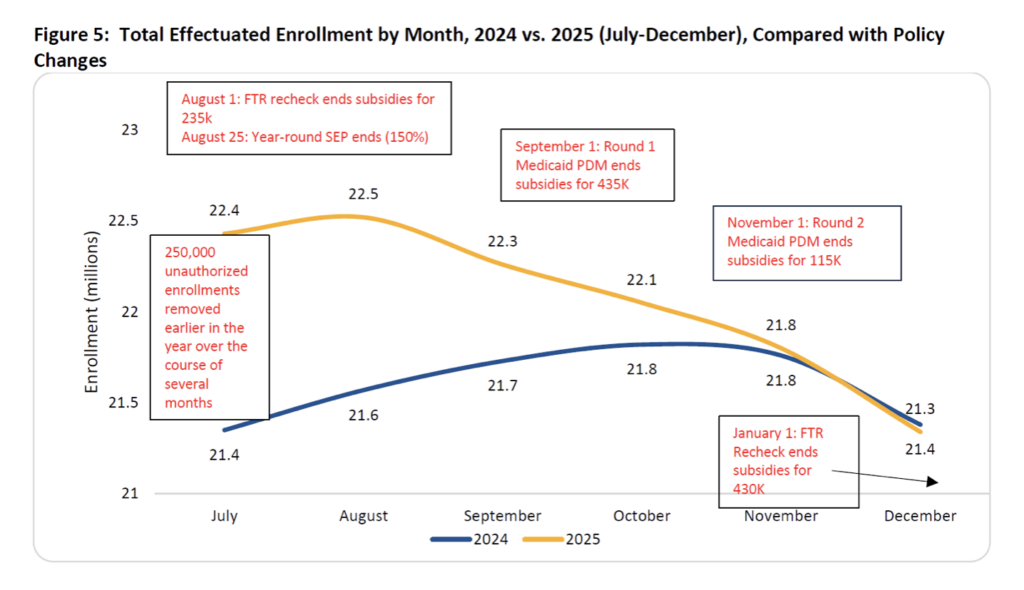
As the graphic below shows, two rounds of Medicaid periodic data matching (PDM in the chart) — i.e., removing people enrolled simultaneously in Medicaid and Exchange subsidies — culled the rolls by about 550,000. Likewise, CMS also removed approximately 665,000 enrollees who did not file federal taxes to reconcile the subsidies they received in prior years (which are based on projected income) with the subsidy amounts they should have received based on actual income (i.e., failure to reconcile, or FTR in the chart).
Additionally, the report notes that “27.8 percent of individuals in a plan where they pay no premiums whatsoever have canceled their plans through May 2026.” It would ordinarily make no sense for someone receiving “free” health coverage to disenroll from it — unless of course they were enrolled without their consent or are concerned about having to repay subsidies they do not qualify for.

The corporate media have focused on the 4 million decline in enrollment — i.e., the difference between the 23.1 million people who selected a plan during open enrollment (which ended in January) and the 19.2 million that the report says are paying premiums and currently enrolled. But if large percentages of people are canceling “free” coverage, that is a separate story in and of itself.

Continued Questionable Conduct

The report notes other potential flags that may indicate questionable enrollments of individuals who remain covered in Exchange plans. For instance, “CMS recently identified 1 million highly suspicious agent and broker assisted enrollments through Healthcare.gov with no social security number on their application who are also paying no premium.”

CMS would also like to remove an additional 300,000 people from subsidies for failing to file tax returns and therefore not reconciling their subsidy amounts for prior years. However, a federal judge has prohibited the administration from enforcing a rule issued last year that would require subsidy recipients to file taxes and reconcile past subsidies every year (as opposed to every two years under a Biden-era policy).

Questionable Value of Coverage

Finally, the report notes that more than half (55 percent) of enrollees who were in a zero-premium plan last year, but were enrolled in a plan that required a premium in 2026, had their enrollment canceled for failure to pay that premium. By contrast, from 2017-2022, only an average of 18 percent of enrollees had their plan canceled for not paying a premium after being enrolled in a zero-premium plan the prior year. 

The growth in the rate of individuals getting coverage canceled when faced with a premium could reflect improper enrollment. However, it could also mean that some enrollees just don’t value their coverage. They will stay signed up when the coverage is “free” (i.e., totally paid for by the federal government) but will drop their plan if required to pay even a nominal premium. 

Recall that a Brookings Institution study last year found that charging enrollees a de minimis premium of even $1 per month would cause nearly 1 million individuals to drop coverage. As I noted at the time, most Democrats would view this as a bug because people might become uninsured. But some conservatives might consider requiring everyone to pay something for their health coverage a feature, while asking a related question: If almost a million Americans won’t even pay $1 monthly to enroll in an Exchange plan, what does that say about how they perceive the value (or lack thereof) of Obamacare?

Affordability Debate

I won’t attempt to argue that the enhanced subsidies’ expiration had no effect. Near-retirees and households just above 400 percent of the poverty level (who became ineligible for subsidies) may face a substantial change in their out-of-pocket monthly costs for insurance. 

But the numerous signs of improper enrollment outlined in last week’s report — to say nothing of the myriad ones that preceded it — coupled with the federal government’s $39 trillion in debt, argue against spending another $350 billion (plus interest) to extend the enhanced subsidies. With fraud rampant and government spending stoking the rise in health care costs, such a measure would have only made both problems worse.

Chris Jacobs is founder and CEO of Juniper Research Group and author of the book "The Case Against Single Payer." 

https://thefederalist.com/2026/07/06/report-shows-obamacare-fraud-is-worse-than-you-think/

Trump Administration Is Right to Target Abusive Hospital Contracts

 by James Capretta

Last month, the White House Council of Economic Advisors (CEA) published an analysis of the cost reductions which would occur if policymakers banned three abusive and common contracting terms used by hospitals to inflate their revenue. For elected leaders who profess to want to make healthcare more affordable, taking up this cause would be a good place to start.

Large hospital systems have strong incentives to prevent insurers, and the employers sponsoring most private-sector coverage, from directing plan enrollees to lower-priced care settings. Legacy facilities are typically capital-intensive and expensive to maintain and run. As ambulatory care options proliferate, hospitals have bought up some of their potential competitors. They then use the availability of their hospital-owned outpatient options to require insurers and employers to buy care from their entire service delivery networks or else risk losing access to the inpatient services all plans must include in their terms.

The strategy works because many of these systems have long existed in their communities and have loyal followings. Hospital leaders know that companies are reluctant to exclude these systems altogether from their preferred networks because doing so might displease some employees. Thus, those hospitals that can claim to offer a full range of inpatient and outpatient services can try to use the goodwill they enjoy in their markets to block a more a la carte approach to purchasing services. The result is needlessly high prices for many services that could be purchased less expensively from non-system providers, such as independent physician groups and free-standing surgical centers.

The most common contracting terms used by hospitals to block competition are:

  • Anti-steering provisions. These contractual requirements restrict the use of financial incentives to direct patients toward lower-priced care options. For instance, insurers cannot offer lower cost-sharing to patients who opt to receive services from less expensive care providers. Creative insurance design strategies, such as reference-based pricing, are blocked by anti-steering terms.
  • Anti-tiering provisions. Dominant hospital systems frequently insist that insurers designate them as preferred for all of the services they provide. These stipulations amplify the effects of anti-steering strategies and prevent insurers from favoring independent clinics and physician groups over hospital-owned options.
  • All-or-nothing terms. These provisions prevent insurers and employers from contracting with dominant hospitals for inpatient services and independent entities for other services. Instead, insurers are forced to buy services from the full delivery networks owned by hospitals even when less expensive options are available.

CEA’s research complements the efforts of the Department of Justice (DOJ) to curtail healthcare contracting abuses through anti-trust litigation. OhioHealth, a large not-for-profit hospital system, recently settled a case with the DOJ by agreeing to remove provisions designed to suffocate its competitors from all current and future insurer contracts. DOJ is pursuing a similar case against New York-Presbyterian., which owns the largest not-for-profit hospital system in New York City. A second successful case would send a strong signal to other hospital systems that continuing with these practices is no longer risk-free.

The CEA study provides a range for the potential cost savings from applying the remedy imposed on OhioHealth in every jurisdiction.

  • The estimates assume, based on hospital consolidation data in major market areas, that about 40 percent of enrollees in employer-sponsored insurance (ESI) live in areas which should allow plan design to achieve lower total costs, and that about 60 percent of the contracts in those markets restrict the ability of plan sponsors from gaining access to those providers charging lower prices. Thus, about one-quarter of the ESI market would be expected to see substantial cost reductions from a ban on abusive hospital contracting practices.
  • Hospital prices are estimated to fall in the relevant markets by an average of 11 to 26 percent. The related premium savings for ESI would be about 6.5 percent annually. Lower ESI premiums would produce an increase in federal tax revenue as firms moved compensation out of tax-exempt health coverage and into taxable wages and salaries.

The provision of many services which used to require an inpatient stay, such as certain cancer treatments and common surgeries, are offered increasingly in less costly outpatient settings. Aggregate national health expenditure (NHE) data reflect the trend away from hospital-based care, with 31 percent of the total bill going to hospitals in 2024 compared to 40 percent in 1980. The downward trend in the reliance on hospitals is expected to continue in the coming years.

With less need for inpatient care, it should be possible to build insurance around service delivery in lightly-capitalized settings. That high-cost hospital systems are still dominant in many cities reflects the effectiveness of the strategies they developed to protect their positions. It is long past time to set patients free and relieve them of the burden of financing legacy institutions that were built for a different era.

https://www.aei.org/health-care/the-trump-administration-is-right-to-target-abusive-hospital-contracting-practices/

Sports related deals rising: Blair


Acquisitions in the sports industry are set to increase as investors leverage a slew of different approaches to the fast-growing sector, according to William Blair & Co.’s head of investment banking.

That’s in part as minority stakeholders in many professional teams look to exit, college athletic associations leverage so-called name, image and likeness agreements and parents spend more on their kids in youth sports, Matthew Zimmer said in a Bloomberg TV interview Monday.

Israel-Lebanon talks to be held next week in Rome

 Israel's ambassador to the United States, Yechiel Leiter, announced during a meeting with the Council on Foreign Relations in Washington on Monday that the next round of negotiations between Israel and Lebanon will take place next week, on July 15 and 16, in Rome.

Leiter went on to state that Lebanese President Joseph Aoun will meet with US President Donald Trump on July 21 and that the meeting will take place at the ambassadorial level.

Furthermore, the official responded that his country opposes the sale of F-35 stealth fighter jets to Turkey "but will respect any American decision" when questioned about the US' potential sales of F-35 fighter jets to the country.

https://breakingthenews.net/Article/Israel-Lebanon-talks-to-be-held-next-week-in-Rome/66640886

Big Tech softens its AI jobs warning: Health system CIOs were already there

 For much of the past year, the loudest voices in tech warned that AI was coming for the workforce, The Wall Street Journal reported July 5. 

Anthropic CEO Dario Amodei said in May 2025 that AI could wipe out half of entry-level jobs. Ford CEO Jim Farley predicted AI would replace half of white-collar workers in the U.S. That tone has shifted.

According to the publication, OpenAI CEO Sam Altman recently told CNBC that the industry had underestimated how much it would be able to “keep people at the center of everything.” Mr. Amodei has since pointed to more optimistic scenarios for companies that adopt AI well, while Meta CEO Mark Zuckerberg and Amazon CEO Andy Jassy have both talked up AI’s job creating potential, even as their companies cut thousands of positions.

A May survey by EY-Parthenon found the share of CEOs who expect AI to cause significant headcount reductions fell from about 46% in January 2025 to 20% this May, per the Journal.

Health system CIOs speaking to Becker’s have told a more consistent story throughout, and it looks a lot like where Big Tech has landed: augmentation over replacement, with real caveats about which roles are exposed.

Lisa Stump, executive vice president and chief digital information officer of New York City-based Mount Sinai Health System, told Becker’s in June that her health system is using AI to expand IT capacity “without expanding headcount at the same rate,” pairing that with a larger hiring pool created by big tech layoffs.

Mouneer Odeh, chief data and artificial intelligence officer of Los Angeles-based Cedars-Sinai, told Becker’s in June that healthcare AI’s “second wave” is less about productivity gains and more about restructuring how work gets done.

“It’s changing the way we work and as a result, changing the jobs that we have,” he said.

Will Landry, senior vice president and CIO of Baton Rouge, La.-based FMOL Health, said in March that he doesn’t “think mass job replacement in healthcare is likely,” though he expects duties to shift from “back end” to “front end,” with more focus on patient experience and human connection. Reid Stephan, senior vice president and CIO of Boise, Idaho-based St. Luke’s Health System, pushed back on the popular idea that “AI won’t take your job, someone using AI will,” calling it the wrong mental model. Rather than simply making existing workers more productive, he said, AI is reshaping the systems those jobs sit inside, shifting where humans add the most value toward “care, judgment, and patient relationships.”

So far, healthcare has largely been spared the AI-linked layoffs hitting other sectors. Challenger, Gray & Christmas attributed 40% of the roughly 97,000 U.S. job cuts announced in May to AI, concentrated in tech. Healthcare job cuts were up 17% year over year through May, but hospitals and health systems have mostly pointed to state and federal funding reductions, not AI, as the driver.

Separate research covered by The Washington Post in March found healthcare has largely avoided AI driven job cuts to date, based on an analysis of task level AI exposure across more than 350 occupations.

Where Big Tech’s messaging has swung from doomsday predictions to reassurance in the space of about a year, healthcare’s IT leadership has held a steadier position: AI is already touching coding, documentation, scheduling and parts of diagnostics, hiring is shifting toward AI literate and cloud skilled staff, and most CIOs describe the goal as doing more with the same headcount rather than doing the same with less.

https://www.beckershospitalreview.com/healthcare-information-technology/ai/big-tech-softens-its-ai-jobs-warning-health-system-cios-were-already-there/

Vivos Inc. (OTCQB: RDGL) FDA OK for RadioGel® Precision Radionuclide Therapy


Vivos (OTCQB: RDGL) received U.S. FDA approval for a Feasibility Investigational Device Exemption (IDE), allowing a first-in-human U.S. clinical feasibility study of RadioGel® Precision Radionuclide Therapy for non-resectable papillary thyroid carcinoma.

The Mayo Clinic study in Jacksonville will initially enroll five patients and assess safety and feasibility of yttrium-90-based RadioGel®. Vivos also continues commercial IsoPet® expansion and international PrecisionGel™ licensing efforts.

AtaiBeckley (ATAI) Faces Takeover Speculation Amid Stock Fluctuations


AtaiBeckley Inc ATAI is reportedly attracting interest from a major U.S. pharmaceutical firm, as traders reference a Betaville alert. Despite this speculation, the company's shares dropped by 6.4% on Monday. However, ATAI has seen a year-to-date increase of 21%, indicating overall positive momentum in 2023.