China Locks Down 3 Cities at Epicenter of Virus Outbreak
China put on lockdown on Jan. 23 three cities at the epicenter of a new coronavirus outbreak that has killed 17 people and infected nearly 600, as health authorities around the world scramble to prevent a global pandemic.
Health officials fear the transmission rate will accelerate as
hundreds of millions of Chinese travel at home and abroad during
week-long holidays for the Lunar New Year, which begins on Saturday.
The previously unknown virus strain is believed to have emerged late
last year from illegally traded wildlife at an animal market in the
central Chinese city of Wuhan.
Most transport in Wuhan, a city of 11 million people, was suspended
on Thursday morning and people were told not to leave. Hours later,
state media in neighboring Huanggang and Ezhou are reported to be
imposing a similar lockdown.
Chinese authorities gave no new details on the numbers of virus
infections but it has been reported in Beijing, Shanghai and Hong Kong,
and several other countries including the United States, stoking fears
it is already spreading worldwide.
Wuhan’s city government said it would shut down all urban transport
networks and suspend outgoing flights from 10 a.m. Domestic media said
some airlines were operating after the deadline, however.
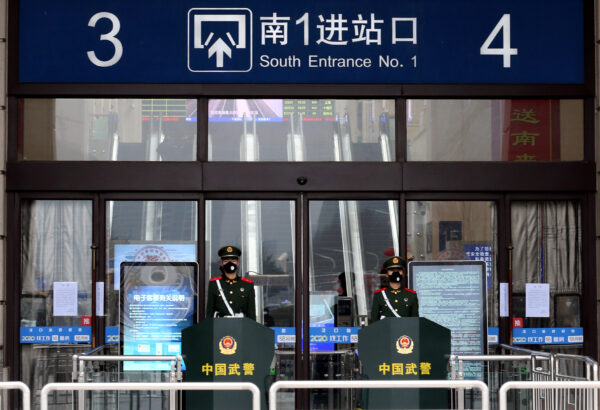
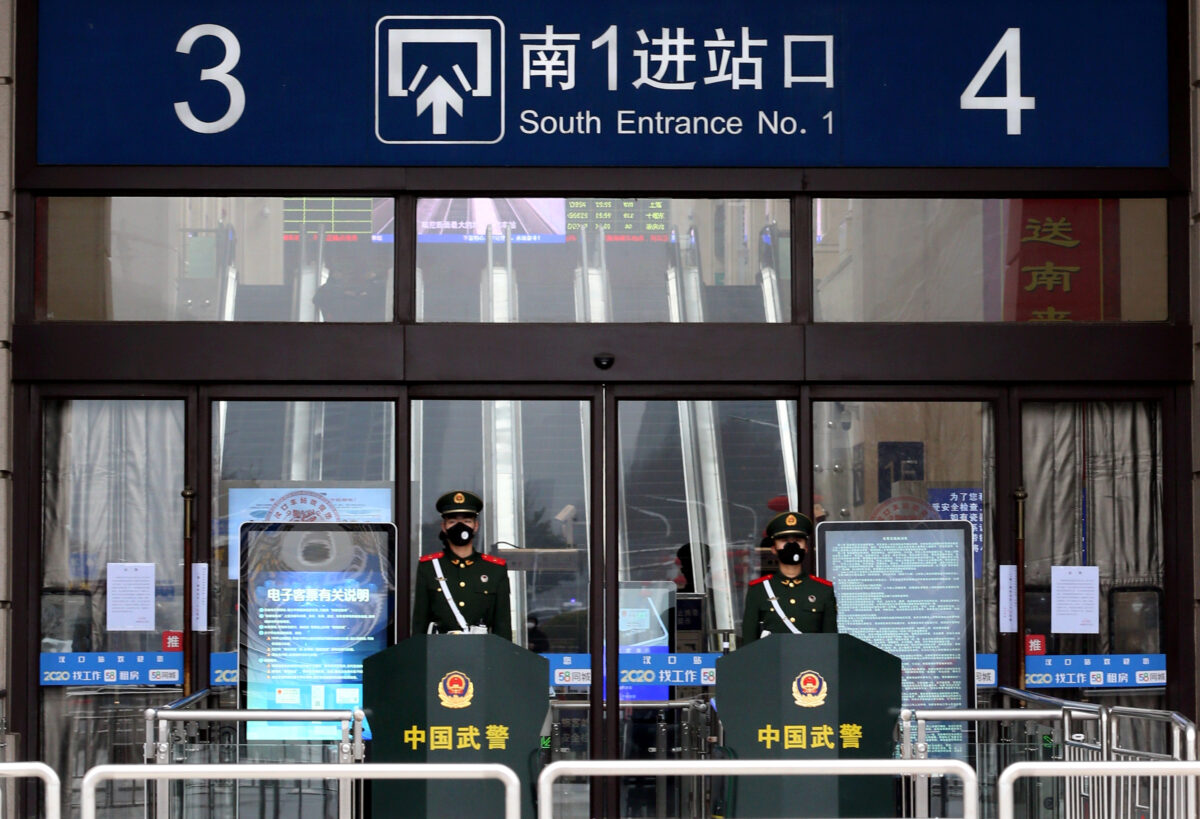
State media broadcast images of one of Wuhan’s transport hubs, the
Hankou rail station, nearly deserted, with gates blocked or barred. The
government is urging citizens not to leave the city. Chinese
paramilitary officers wearing masks stand guard at an entrance of the
closed Hankou Railway Station after the city was locked down following
the outbreak of a new coronavirus in Wuhan, Hubei province, China, on
Jan. 23, 2020. (China Daily via Reuters)
State media reported highway toll booths around Wuhan were closing
down, which would effectively cut off road exits. Guards were patrolling
major highways, one resident told Reuters.
As the city slipped into isolation, residents thronged into hospitals
for checks and scrambled for supplies, clearing out supermarket shelves
and queuing for petrol.
Authorities in Huanggang ordered indoor entertainment venues
including cinemas and internet cafes to close and were asking citizens
not to leave other than under special circumstances, state media said.
Authorities had confirmed 571 cases and 17 deaths by the end of
Wednesday, China’s National Health Commission said. Earlier, it said
another 393 suspected cases had been reported.
Of eight known cases worldwide, Thailand has confirmed four, while
Japan, South Korea, Taiwan and the United States have reported one each.
In a report on Wednesday, Imperial College London said it estimated a
total of 4,000 cases of the coronavirus in Wuhan alone as of Jan. 18,
an infection rate based on the number of cases reported in China and
elsewhere.
Virus Spreading
In contrast with its secrecy over the 2002-03 Severe Acute
Respiratory Syndrome (SARS) that killed nearly 800 people, China’s
communist government has provided regular updates to avoid panic ahead
of the holidays.
During a visit to Wuhan, Vice Premier Sun Chunlan said authorities
needed to be open about the virus and efforts to contain it, the
official Xinhua news agency said.
The World Health Organization (WHO) has said it will decide on
Thursday whether to declare the outbreak a global health emergency,
which would step up the international response.
If it does so, it will be the sixth international public health emergency to be declared in the last decade.
Some experts believe the new virus is not as dangerous as previous
coronaviruses such as SARS and Middle East Respiratory Syndrome (MERS),
which has killed more than 700 people since 2012.
“The early evidence at this stage would suggest it’s not as severe,”
Australia’s Chief Medical Officer Brendan Murphy told reporters.
WHO Director-General Tedros Adhanom Ghebreyesus told reporters in
Geneva that China’s actions were “very strong” but called on it to take
“more and significant measures to limit or minimize the international
spread”.
“We stressed to them that by having a strong action not only they
will control the outbreak in their country but they will also minimize
the chances of this outbreak spreading internationally. So they
recognize that,” he said.
Despite China’s response, stock markets across Asia were on the back
foot on Thursday, led by drops of roughly 1.5 percent in Hong Kong and
Shanghai while China’s yuan fell to a two-week low.
Flights, Rail Suspended
There is no vaccine for the virus, which can spread through
respiratory transmission. Symptoms include fever, difficulty in
breathing and cough, similar to many other respiratory illnesses.
Preliminary research suggested the virus was passed on to humans from
snakes, but government medical adviser Zhong Nanshan has also
identified badgers and rats as possible sources. Confirmed sufferers
include 15 medical workers.
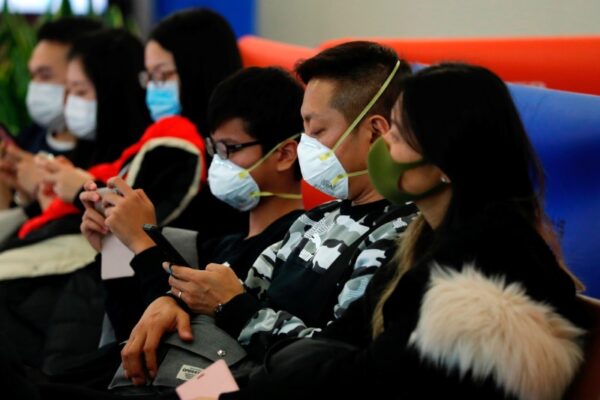
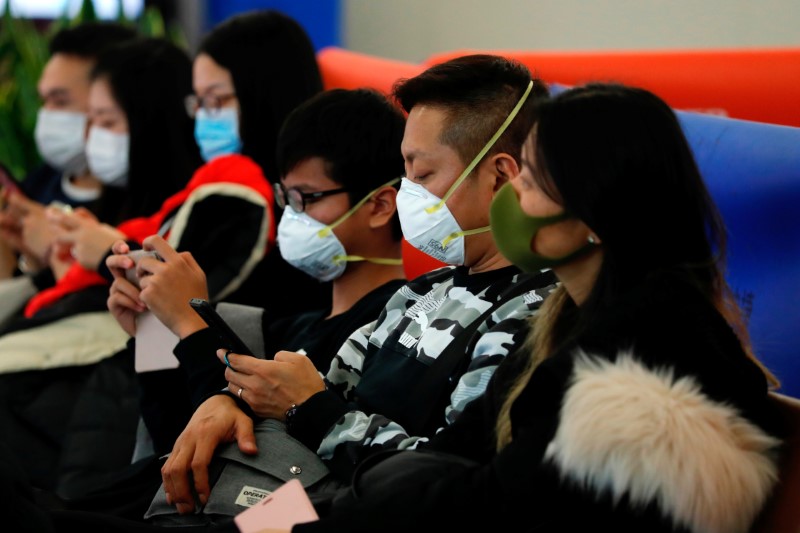
Many Chinese were cancelling trips, buying face masks and avoiding
cinemas and shopping centers, and even turning to an online plague
simulation game as a way to cope. Passengers
wear masks to prevent an outbreak of a new coronavirus at the Hong Kong
West Kowloon High Speed Train Station, in Hong Kong, China, on Jan. 23,
2020. Tyrone Siu/Reuters)
The release of seven movies over the Lunar New Year has been
postponed. The holiday is the high season for distributors and cinemas
attract huge crowds.

No comments:
Post a Comment
Note: Only a member of this blog may post a comment.