Search This Blog

Monday, December 10, 2018

Increased risk for breast cancer after childbirth may last more than 20 years


The increased risk for breast cancer that occurs after childbirth can last more than 20 years. The risk may be enhanced when a woman is older at first birth or has a family history of breast cancer, and is not mitigated by breastfeeding. Findings from pooled analysis of 15 prospective studies are published in Annals of Internal Medicine.
Childbirth is widely recognized as protective against breast cancer, but breast cancer risk has been shown to be increased shortly after childbirth. Just how long this heightened risk lasts and factors that contribute to the risk have rarely been assessed.
Researchers from the University of North Carolina Gillings School of Global Public Health (with co-authors from the Institute of Cancer Research in London and the National Institute of Environmental Health Sciences in North Carolina) analyzed individual-level data from 15 prospective cohort studies to characterize breast cancer risk in relation to recent childbirth. The data showed that compared with women of the same age who had never given birth, women who had given birth had an increased risk for breast cancer that peaked about 5 years after birth and continued for about 24 years after birth. The increased risk was seen for both estrogen receptor (ER) positive and ER negative breast cancer, and breastfeeding did not modify risk patterns.
According to the researchers, these findings show that risk factors for breast cancer can differ between older and younger women, and should be considered in combination with other characteristics than may influence risk, such as a family history of breast cancer. Combined with evidence from other studies, this research may help to develop better breast cancer risk prediction models to inform decision-making around breast cancer screening and prevention strategies.
Story Source:
Materials provided by American College of PhysiciansNote: Content may be edited for style and length.

Journal Reference:
  1. Hazel B. Nichols et al. Breast Cancer Risk After Recent Childbirth: A Pooled Analysis of 15 Prospective StudiesAnnals of Internal Medicine, 2018 DOI: 10.7326/M18-1323

BioTime initiated at Oppenheimer


BioTime initiated with an Outperform at Oppenheimer. Oppenheimer analyst Kevin DeGeeter started BioTime with an Outperform rating and $3.50 price target. New management is transforming BioTime from a holding company of multiple technology platforms to a product development company “committed to allocating necessary resources to the most promising drug,” OpRegen for the treatment of dry age-related macular degeneration, DeGeeter tells investors in a research note. He expects OpRegen to have peak end-market revenue of $1.3B.

Molecular Templates initiated at Oppenheimer


Molecular Templates initiated with an Outperform at Oppenheimer. Oppenheimer analyst Kevin DeGeeter started Molecular Templates with an Outperform rating and $15 price target. The analyst believes Molecular’s Engineered Toxin Bodies platform offers a differentiated mechanism of action that will be attractive to pharma and drive partnerships in 2019 and 2020.
https://thefly.com/landingPageNews.php?id=2834959

Pharma companies warned over ‘no deal’ Brexit disruption


The government is asking pharma companies to introduce additional measures, over and above the stockpiles already in place, in the event of a ‘no-deal’ Brexit.
Health secretary Matt Hancock said that after Brexit, the government will find ways to ensure goods can continue to flow into the country and won’t be delayed by additional controls and checks.
Some pharma companies revealed earlier this year that they had stockpiled medicines as part of their contingency planning around Brexit.
But in a letter to the industry Hancock said that the UK will not be able to control the checks that member states impose at the EU border and that extra measures other than the stockpiles will be necessary.
The European Commission has made it clear that in the event of “no deal”, it will impose full third-country controls on people and goods entering the EU from the UK, Hancock said.
“Whether this happens or not is in their hands, not ours,” Hancock said in the letter.
This could mean delays at borders for around six months after Brexit in March next year in the short straits between Dover and Folkestone, affecting both imports and exports.
Medicines and medical products will be prioritised at the borders, where there will be extra roll-on, roll-off capacity and there will be alternative routes to ensure flow of these products will continue “unimpeded” after 29 March next year, Hancock said.
Hancock said that the government last month invited vendors of pharma warehouse space to bid for government funding to secure extra storage space for stockpiled medicines.
However there was little other detail about the specific measures the industry should be putting in place in case of Brexit.
Steve Bates, chief executive of the BioIndustry Association praised the government’s hard work so far in contingency planning in the event of ‘no deal’.
But he added: “A ‘no deal’ Brexit would mean the biggest dis-integration of the complex regulated medicines market across Europe in terms of regulation, cross border movement of goods, comparative pricing and intellectual property.
“On behalf of patients we encourage all participants to be as prepared as possible for a scenario industry really does not want.
“We should be under no illusions that this will be easy or smooth and today the challenge of ensuring UK medicine supply through 2019 in a No Deal Brexit scenario got harder not easier.”
Niall Dickson, co-chair of the Brexit Health Alliance, a group of organisations including NHS bodies campaigning to safeguard interests of patients, healthcare and research during Brexit, said members are “deeply concerned about the prospect of ‘no deal’”.
“This guidance does, however, provide some assurances that the government is seeking to minimise the impact of these delays and ensure patients can get the medicines and devices they need.
“Given the mutual reliance on the supply of medical products between the UK and the EU, we must now see what contingencies the EU is putting in place to protect the health of citizens across the UK and Europe.”

Mixed feelings about naloxone


The opioid epidemic needs no introduction—the data speak for themselves. In New York, the death rate was 15.1 per 100,000 persons in 2016.[1] The rate in Pennsylvania was 18.5; in Ohio, it was 32.9; and in West Virginia, it was the highest, at 43.4.[2] Nationally, the average death rate was 13.3 per 100,000 persons in 2016. In New York, between 2012 and 2016, deaths due to synthetic opioids increased 10-fold. During the same years, deaths due to heroin doubled. Deaths due to prescription opioids doubled between 2009 and 2016.
Emergency department opioid-related visits increased 73% from 2010 to 2014. Naloxone administration by emergency medical services (EMS) more than doubled between 2013 and 2014.[1] Nationally, in 2016, there were over 42,000 deaths due to opioid overdose. More people died from opioid overdoses than in motor vehicle collisions.[3,4]

Naloxone Administration by EMTs and First Responders

Traditionally, in the out-of-hospital setting, suspected opioid overdoses havebeen managed through bag-valve-mask (BVM) assisted ventilation by emergency medical technicians (EMTs) and firefighter first responders.[5] If paramedics were available, they have had the ability to administer intramuscular (IM) or intravenous (IV) naloxone, an opioid antagonist.[6,7,8]
Naloxone can be administered through IV injections, IM injections, or IM autoinjectors, or intranasally (IN) through a generic nasal medication atomizer or a brand-name IN device.[8] IV naloxone has the most rapid onset of action, but is the most invasive route and requires the highest level of training for administration. IM injections require a moderate level of training, and IM autoinjectors require minimal training, because they are preloaded with a standard dose.
IN naloxone delivered through a nasal medication atomizer requires moderate training because, as with IV and IM injections, the medication must be drawn up from a vial in an accurate dose. However, the administration itself is much easier than with IM injections. There is also a brand-name IN naloxone device that eliminates the need to draw up medication, because it is preloaded with a standard dose and is very easy to administer.
Intranasal naloxone may be the safest administration method for providers because it is a needleless delivery method.[9] The least expensive form of naloxone is the generic IV/IM/IN atomizer naloxone, at about $35 per dose. The brand-name IN naloxone costs about $125 per two doses.[10] The autoinjector costs about $4500 per two doses (an increase from $575 in 2014).[11]
In response to the opioid overdose epidemic, EMS systems have expanded education, training, and protocols to allow basic EMTs,[12] fire department first responders,[13,14] and even law enforcement officers (LEOs)[15] to administer naloxone. EMTs, fire department first responders, and LEOs are more numerous than paramedics and can usually respond to a scene more rapidly. In some EMS systems, paramedics may not be available for every call.[16]
Some overdose victims would never have the chance to get treatment with naloxone in the field. Expanding naloxone access to nonparamedic providers increases the chances that more overdose victims receive this treatment and also ensures that they receive this treatment as rapidly as possible.[17,18,19]
Expanding naloxone administration to EMTs and fire department first responders is not without controversy. The expansion of naloxone administration to EMTs began in the mid-2010s.[12,20,21] Soon after EMTs had access to naloxone, fire departments began equipping and training firefighter first responders to use naloxone.[13,14] Although getting naloxone to overdose victims as rapidly as possible may seem to be beneficial, administering this medication can distract providers from delivering rapid and high-quality BVM artificial ventilation for patients with respiratory arrest.

Overdose or Cardiac Arrest? Start With Ventilation and Chest Compressions, not Naloxone

The initial and most important treatment for all patients with respiratory arrest, whether from overdose or not, is BVM artificial ventilation. Not all patients with respiratory arrest are overdose victims. If ventilation isn’t started first, important time is wasted in administering naloxone.
Administering naloxone can also distract from providing high-quality chest compressions in the setting of cardiac arrest.[22] For patients in cardiac arrest, even if initially caused by hypoxemia from opioid overdose, the treatment is high-quality chest compressions, not naloxone.
According to the 2015 American Heart Association Guidelines for CPR and Emergency Cardiovascular Care, “Standard resuscitative measures should take priority over naloxone administration, with a focus on high-quality CPR (compressions plus ventilation).”[23] In the same guidelines, for respiratory arrest, the American Heart Association recommends that “for patients with known or suspected opioid overdose who have a definite pulse but no normal breathing or only gasping (ie, a respiratory arrest), in addition to providing standard BLS [basic life support] care, it is reasonable for appropriately trained BLS healthcare providers to administer IM or IN naloxone.”
It is imperative that nonparamedics who administer naloxone do so with adequate training and education to ensure that practice adheres to these guidelines. Systems that allow nonparamedics to administer naloxone must have a continuous quality improvement program in place. Medical directors must ensure protocols are adequately written to address the importance of standard BLS care and high-quality chest compressions first and foremost.
The 2017 Pennsylvania statewide basic life support protocol for poisoning (protocol 831)[7] provides a good example of a naloxone protocol for nonparamedics:
Give Naloxone (if available) if decreased respiratory rate and suspected narcotic overdose
Goal = adequate respiration and oxygenation (not awakened patient)
a. Ventilation with BVM takes priority over naloxone administration.
SAFETY NOTE: If cyanotic, decreased respirations, or hypoxia (SpO2 < 95%), ventilate with BVM and oxygen to adequate color/SpO2 while preparing for administration of naloxone 
b. In pulseless patients, naloxone is not indicated and CPR should be initiated immediately.

Law Enforcement Agencies Supplying Naloxone, but Not Without Opposition

In 2004, over 220 law enforcement agencies in 24 states carried naloxone.[24]Today, over 2400 law enforcement agencies carry naloxone.[15] Because LEOs are 10 times more numerous than EMTs and are typically dispatched to overdose calls, the time to naloxone administration can be made quicker by providing LEOs with naloxone.[24]
Some police department officials are opposed to carrying naloxone.[25,26]They cite public opinion concerning “people who overdose repeatedly” being encouraged to abuse opioids because of the better chances of being saved. They believe that naloxone administration diverts resources away from their primary mission of “crime fighting.” The officials are also are concerned about the time and money needed for training, supply tracking, and storing the medication and cost of stocking the medication as barriers.
Yet other police officials report that the logistical barriers are easy to overcome and that the cost of the medication isn’t usually an issue. In many cases, naloxone is provided by health departments or community organizations.[25,26]The Virginia state police received a $154,800 grant from the Virginia Department of Behavioral Health and Developmental Services.[27] In Pittsburgh, Pennsylvania, state police and fire stations received $5 million in funding for naloxone from the Pennsylvania Commission on Crime and Delinquency.[28]
Police officials are also concerned about the personal danger to their LEOs. Opioid users can behave violently after naloxone is used. If alone, a police officer may be placed in harm’s way.[25,26]
Legal liability for LEOs and law enforcement agencies was also cited as a barrier to administering naloxone. However, this is unfounded. LEOs are at very low legal liability for using naloxone to treat an overdose victim. At the same time, LEOs are also not liable for failing to use naloxone, even if equipped with it. Some states have general or specific civil or administrative liability immunity for LEOs who use naloxone.[24]
In general, LEOs have a positive experience about receiving opioid overdose and naloxone administration training.[29,30] In New York State, the Harm Reduction Coalition provided “train-the-trainer” sessions for 55 LEOs. These sessions were well received, although a common concern regarded liability for using naloxone.[31]
The North Carolina Harm Reduction Coalition website provides FAQs, sample policies, and forms to help law enforcement agencies interested in carrying naloxone.[15] The American College of Emergency Physicians (ACEP), National Association of EMS Physicians (NAEMSP), and American College of Medical Toxicologists (ACMT) support naloxone administration by all levels of EMS providers, firefighters, and LEOs.[32]

‘Take-Home’ Naloxone Kits and Public Training Sessions

Most recently, access to naloxone has been expanded to the lay population in many states to broaden its availability in the community and allow the most rapid administration possible. Laypeople are also less likely to have the skills and equipment to provide artificial ventilation if they come across an overdose victim. Besides calling 911, naloxone may be the only way a layperson can save the life of an overdose victim.
There are also many ways that laypeople can get naloxone. Syringe exchange and opiate drop-in centers offer naloxone kits or prescriptions for naloxone.[33]They also provide education about causes, recognition, and prevention of overdoses and training in naloxone use.
In British Columbia, Canada, naloxone training and overdose education is available online. Once completed, using an electronic certification of training, naloxone can be obtained from hospitals or other approved sites.[34]
The Substance Abuse and Mental Health Services Administration, an agency within the US Department of Health and Human Services, offers free education and training at least once a month and provides information about where to obtain naloxone.[35] They also have a free online toolkit available to local governments and communities to develop policies and practices to help prevent opioid-related overdoses and deaths.
Twelve New York State Office of Alcoholism and Substance Abuse Services Addiction Treatment Centers offer free education, training, and naloxone kits.[36] New York State’s Department of Health also has an online calendar of opioid overdose trainings located in communities throughout the state.[37]
Online training and education and referrals to naloxone suppliers are available at getnaloxonenow.org.[38] Information and resources for groups to run their own naloxone programs are available at naloxoneinfo.org.[39]

Pharmacy Distribution of Naloxone

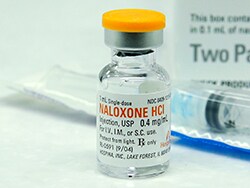
A vial of naloxone, which can be used to block the potentially fatal effects of an opioid overdose, is shown on Friday, October 7, 2016, at an outpatient pharmacy at the University of Washington. Washington governor Jay Inslee announced an executive order to fight the rising abuse of opioids in Washington State that included measures to reduce the cost and increase the availability of naloxone for the treatment of overdoses. Photo courtesy of AP/Ted S. Warren
Pharmacies have been key to distributing naloxone to the lay public. In the past, naloxone distribution by a pharmacist required a prescription from a healthcare provider. In some states, naloxone is now available without a specific prescription from a physician. The legislative and regulatory means to allow this to occur differ state by state, but the end result is that naloxone is available “behind the counter” from pharmacies.
In Pennsylvania, the physician general has written a standing prescription order that serves as the prescription for any layperson in Pennsylvania to purchase naloxone from pharmacies that carry it.[40,41] In Maryland, the Deputy Secretary for Public Health Services has also issued a standing order.[42] In this order, naloxone can be distributed to those who have been trained and certified under the Maryland Overdose Response Program. The order also provides liability protection for pharmacists.
Naloxone is now available from CVS pharmacies without a prescription in 48 states,[43] and the CVS website provides educational information about naloxone.[44]
Whereas most states now permit naloxone through standing order prescription, five states allow pharmacists to distribute naloxone under their own authority without any prescription at all. In addition, civil and criminal legal protections for pharmacists and pharmacies have been implemented in over 35 states.[45] As of 2015, 43 states and the District of Columbia have passed specific laws to increase layperson access to naloxone.[46]
Laws providing for naloxone distribution with provisions for immunity have been shown to facilitate the distribution of naloxone.[47] ACEP, NAEMSP, and ACMT support over-the-counter pharmacist distribution of naloxone.[32]However, many pharmacies do not stock naloxone.[48] New York City maintains a list of pharmacies that participate in the naloxone standing order initiative.[49]An investigation by the New York Times found that of the 720 pharmacies listed, only one third actually stock naloxone and would dispense it without a prescription.[48]
Free online training directed to pharmacists interested in dispensing naloxonevia non–patient-specific prescription is available through a course developed by the University at Buffalo and the New York State Department of Health.[50]This training is available to non-New York State pharmacists as well.

Naloxone Distribution Programs Raises Controversy Among Emergency Physicians

Because emergency department-based take-home naloxone programs are a new development, research on the outcomes of such programs is lacking. One pilot study showed no mortality benefit between patients who received a naloxone take-home kit in the emergency department after a heroin overdose.[51] However, the study is limited owing to its scale.
ACEP, NAEMSP, and ACMT support emergency physician naloxone prescriptions for at-risk patients, but do not provide an opinion on the take-home programs.[32] And some emergency physicians are conflicted about the effects of naloxone take-home programs, fearing that it increases opioid use and addiction.[52]
Another recent development are the EMS “leave-behind” programs, where naloxone is made available to at-risk opioid users. Through a statewide standing order, the Pennsylvania physician general has authorized EMS providers and EMS agencies to leave naloxone kits behind after responding to calls for opioid overdoses.[53]
Standing Order DOH-001-2018 states[53]:
This standing order authorizes Department-certified EMS providers or Department-licensed EMS Agencies who have responded to an individual experiencing an opioid-related overdose (At-Risk Person), and who are therefore in a position to assist that At-Risk Person, to leave behind naloxone with the At-Risk Person or with family members, friends, or other persons who are in a position to assist the At-Risk Person, along with instructions to follow the naloxone package insert directions and the guidance provided in Standing Order DOH-002-2017, available on the Department’s website.
EMS leave-behind programs have been implemented in Pittsburgh [54] and New York City.[55] Maryland has a similar pilot program in place.[56]

PCPs Are Encouraged to Coprescribe Naloxone to At-Risk Patients

Laypeople can access naloxone through a primary care provider. Primary care providers may coprescribe naloxone when prescribing prescription opioids to at-risk patients. Coprescribing is considered acceptable among primary care physicians, and many use this practice for their patients on long-term opioids.[57] Barriers to this practice are mostly administrative, relating to time involved and pharmacy or payer logistics.
The American Medical Association Task Force to Reduce Opioid Abuserecommends coprescribing naloxone to patients and family members or close friends of patients when it is clinically appropriate.[58] Coprescribing naloxone does not increase the prescribers’ risk for liability.[59]
Patients on long-term opioids for chronic noncancer pain generally are accepting of naloxone coprescribing, but they report receiving little education on opioid medication risks and have limited knowledge about naloxone. Providing this education and doing so in empowering, nonjudgmental language facilitates patient acceptance of naloxone prescribing.[60]

Naloxone Price Gouging and Copayment Assistance

One of the major barriers to layperson naloxone use is the cost of naloxone to consumers and possible price gouging by pharmaceutical companies.[61,62,63]To address this barrier, the New York State Department of Health AIDS Institute has implemented the Naloxone Co-payment Assistance Program (N-CAP), in which “copayments for naloxone in an amount up to $40 for each prescription dispensed will be billed to N-CAP, not to the individual getting naloxone.”[64]Most other states have not provided similar assistance to consumers.
Another barrier is a concern that providing naloxone to laypeople might increase opioid use among at-risk individuals. Small studies have found no increased heroin use in those who have participated in overdose education and naloxone distribution programs.[65] In addition, laws that increase naloxone access to laypersons and laws that provide overdose-specific liability protection have been found to reduce opioid overdose mortality with no increase in nonmedical opioid use.[66] Further research definitely is needed in this area.

BMI Inadequate for Identifying Postmenopausal Breast Cancer Risk


Target Audience and Goal Statement:
Internists, general medicine practitioners, endocrinologists, gynecologists, mammographers
To understand that body-mass index (BMI) may not be a sufficient measure of body fat for determining breast cancer risk in postmenopausal women. Women in this new study who had normal BMIs but other other elevated measures of fat, such as trunk fat mass and whole-body fat, had a significantly increased risk for invasive breast cancer.
Questions Addressed by this Story:
Is there a more precise way to identify which postmenopausal women may be at higher risk of invasive breast cancer than measures of body fat using the BMI system? Why might other biomarkers provide a more comprehensive measure of breast cancer risk in this population? Have other recent studies confirmed or contradicted these findings?
Study Synopsis and Perspective:
Currently, post-menopausal women with normal BMIs are not considered to have an increased risk of breast cancer unless they have a familial link or other genetic syndrome.
This study challenges that premise.
In this ad hoc secondary analysis of the Women’s Health Initiative (WHI) randomized clinical trial and observational study cohorts, researchers used dual-energy x-ray absorptiometry (DXA) to assess body fat in greater detail than BMI. Led by Neil Iyengar, MD, of Memorial Sloan Kettering Cancer Center in New York, they found elevated breast cancer risk in postmenopausal women with normal BMIs but who had high measurements of whole-body fat, percentage of whole-body fat, and trunk fat mass.
More specifically, their cohort study in JAMA Oncology of 3,460 women found a significantly increased risk for invasive breast cancer in those with the highest levels of whole-body fat (hazard ratio [HR] 1.89, 95% CI 1.21-2.95, P<0.01), percentage of whole-body fat (HR 1.79, 95% CI 1.14-2.83, P=0.03), and trunk fat mass (HR 1.88, 95% CI 1.18-2.98, P<0.01) compared with those with the lowest levels.
Women in this study ranged in age from 50 to 79, and had BMIs ranging from 18.5 to 24.9. The researchers used DXA in the study to obtain more detailed body fat measurements for the women. At a median follow-up of 16 years, there were 182 incident cases of breast cancer, 146 of which were ER positive.
The association between these measures and breast cancer risk was even stronger for the risk of estrogen receptor (ER)-positive breast cancer in women who had the highest levels of whole-body fat (HR 2.21, 95% CI 1.23-3.67, P=0.002), percentage of whole-body fat (HR 2.17, 95% CI 1.29-3.66, P=0.01), and trunk fat mass (HR 1.98, 95% CI 1.18-3.31, P=0.003), the study found.
In addition, the researchers found higher circulating levels of insulin, C-reactive protein, interleukin-6, leptin, and triglycerides, and lower levels of high-density lipoprotein cholesterol and sex hormone–binding globulin in women with the highest trunk fat mass. Insulin resistance, breast adipose inflammation, and elevated leptin levels are all considered to play a role in the pathogenesis of obesity-related breast cancer, the researchers explained.
“To our knowledge, this is the first study of body fat and risk of invasive breast cancer in a cohort of women with exclusively normal BMI,” the researchers said. “Normal BMI categorization may be an inadequate proxy for the risk of breast cancer in postmenopausal women. Postmenopausal women with higher body fat levels are at elevated risk for breast cancer despite having a normal BMI,” they commented.
Other recent research has also shown that a subset of women with normal BMI and excess body fat may have an increased risk for breast cancer, Iyengar and colleagues noted in their study. “Specifically, excess body fat is associated with adipocyte hypertrophy. In women with normal BMIs, breast adipocyte hypertrophy correlates with white adipose tissue inflammation, elevated levels of aromatase (the rate-limiting enzyme for estrogen biosynthesis), and increased circulating levels of leptin,” they wrote.
Insulin resistance is also understood to be a result of excess body fat. In addition, other evidence demonstrated an association between postmenopausal women with elevated insulin levels and normal BMIs have an increased risk of breast cancer. Taken together, these and other previous studies raised the possibility that excess body fat may be associated with an increased risk of postmenopausal breast cancer in women who have normal BMIs, Iyengar and colleagues wrote.
Source Reference:
JAMA Oncology online December 6, 2018. doi: 10.001/jamaoncol.2018.5327
Study Highlights: Explanation of Findings
This study examined the hypothesis that body fat might contribute to post-menopausal breast cancer risk in women with normal BMIs, who are currently thought to have normal risk.
They used DXA, which is, unlike a BMI measurement, a “direct measurement” of body fat, the authors wrote. They looked at associations between body fat levels as measured by DXA and circulating metabolic and inflammatory factors that have themselves been linked to cancer pathogenesis.
To more closely focus on body fat, Iyengar and colleagues measured whole-body fat in kilograms, percentage of whole-body fat, trunk fat (defined by the fat contained in the torso apart from head and limbs), and fat mass of the legs. They calculated the ratio of trunk to leg fat mass because a relatively high ratio is associated with a higher risk of diabetes and death.
They discovered that an increased risk for invasive breast cancer was associated with every continuous five-unit increase in whole-body fat (HR 1.35, 95% CI 1.14-1.60), percentage of whole-body fat (HR 1.27, 95% CI 1.08-1.48), and trunk fat mass (HR 1.56, 95% CI 1.18-2.06). The association was similar but slightly stronger for ER-positive breast cancer risk. They observed “moderately strong positive correlations” between BMI and DXA measures, i.e. the correlation coefficient between BMI and whole-body fat mass was 0.67. However, almost 50% of the participants in the highest quartile of trunk fat were distributed among the lowest 3 quartiles of BMI (420 of 870 [48.3%]).
In multivariate analyses, a 5-unit increase in whole-body fat mass was associated with a statistically significant 28% increase in the risk of invasive breast cancer; a 5-unit increase in percentage of whole-body fat, a 19% increase in the risk of invasive breast cancer; and a 5-unit increase in trunk fat, a 46% increased risk of invasive breast cancer.
After adjusting for potential confounders, a 5-unit increase in whole-body fat mass was associated with a statistically significant increased risk of 35%; a 5-unit increase in whole-body fat, 27%; a 5-unit increase in fat-mass of the trunk, 56%; a 5-unit increase in fat mass of the right leg, 152%; and a 5-unit increase in fat mass of the left leg, 149%.
Finally, after adjusting for race/ethnicity and age, Iyengar and colleagues found positive associations between baseline levels of insulin, homeostatic model assessment of insulin resistance, C-reactive protein, white blood cells, IL-6, leptin, triglycerides, and trunk fat mass. Inverse associations were found between levels of HDL, adiponectin, and sex hormone-binding globulin, and remained after adjustment for BMI.
“When considering an individual’s health, physicians generally assess BMI by absolute categorical levels (i.e., normal, overweight, or obese). As such, increased adiposity in an individual categorized as having normal BMI is likely to remain clinically unrecognized. Indeed, nearly half of individuals in this study who had the highest amounts of trunk fat had BMIs within the lower quartiles,” Iyengar and co-authors wrote.
In an accompanying editorial, Isabel Pimentel, MD, of the University of Toronto, and colleagues, agreed with the study authors’ conclusions: “Moving forward, more detailed elucidation of the contributions of body composition and metabolic factors to breast cancer risk will be important to help identify women most at risk and to inform preventive strategies,” the editorialists said.
“Ideally, such studies will simultaneously investigate BMI, body composition (adiposity, including location and muscle mass), clinical definitions of metabolic health, and circulating metabolic markers to determine whether BMI, fat mass (including location of fat), and metabolic markers all contribute to breast cancer risk, or whether risk is present only in those with specific fat distributions and/or metabolic profiles,” Pimentel and co-authors wrote.
Limitations of the study, the authors noted, included the relatively small numbers of incident breast cancer cases, and that the results might not be generalizable to other groups of women.

  • Reviewed by Robert Jasmer, MD Associate Clinical Professor of Medicine, University of California, San Francisco and Dorothy Caputo, MA, BSN, RN, Nurse Planner

Quidel downgraded to Hold from Buy at Craig-Hallum


Craig-Hallum analyst Alexander Nowak downgraded Quidel to Hold from Buy and lowered his price target to $51 from $80 following a “surprising” court ruling that the “Beckman BNP non-compete agreement is void”. The analyst states that since BNP is about half of the company’s EBITDA, the development represents a “material blow to the company”. Nowak further notes that Quidel’s “multiple expansion was its diversification away from flu”, and the latest news makes its model “once-again, levered to the flu season”.
https://thefly.com/landingPageNews.php?id=2834891